Human verified. Last updated by our editorial team on .
Central America · Conquest and the Spanish colonial era
Empire of Haiti
1804/1805–1806
On 1 January 1804, at Gonaïves, the generals of the indigenous army declared the western third of Hispaniola a free and sovereign state and swore never again to submit to France. The act they signed did not call the new country a republic. It struck out the colonial name Saint-Domingue, revived the Taíno word Ayiti, and left the form of government unstated. Nine months later the army filled that gap with a throne. In September 1804 the general staff proclaimed Jean-Jacques Dessalines emperor; on 8 October he was crowned Jacques I at Cap-Haïtien; and on 20 May 1805 a constitution gave the state its formal name, the empire of Hayti, and its emperor the right to make war, treaty and law.
- Existed
- 1804/1805–1806
- Shown on the map
- 1805–1915
- Peak area
- 84k km²
- Region
- Central America
The empire lasted barely two years. It covered the same ground as modern Haiti, some 27,750 square kilometres of mountains, plains and coast, with the Atlantic to the north and the Caribbean to the south, and it shared the island with a French garrison in the old Spanish east. Its population had fallen by perhaps a fifth to a third during fourteen years of war, and its plantations, the most valuable export economy in the Atlantic world in the 1780s, were burned, abandoned or worked by soldiers. What Dessalines governed was a war state with monarchical decoration, and the decoration has obscured the state.
It matters for three reasons. Haiti was the first independent state in the Americas after the United States, the first Black-led sovereign state of the modern era, and the only one founded by people who had been enslaved. Its first constitution was also the first to make blackness the legal definition of citizenship, a clause with a long and contested afterlife. And the empire's short life set the terms of Haitian politics for a century: the plantation regime it tried to preserve and the smallholding it accidentally created, the army as the arbiter of power, and the split between a northern monarchy and a southern republic that lasted until 1820.
The evidence is thinner than the subject deserves. The best narrative is Thomas Madiou's Histoire d'Haïti, published in 1847–48 by a Haitian who was born in 1815, interviewed survivors and used government papers that have since disappeared. Madiou's rival Beaubrun Ardouin, a mulatto liberal, wrote a counter-history in which the empire is an aberration. British and American consular letters, Haitian imprints and the acts of the imperial government fill in the rest. Where these sources disagree — on dates, on the scale of the killings, on Dessalines's intentions — this entry says so rather than choosing the tidiest version.
At a glance
| Name | Empire of Haiti (French Empire d'Haïti), proclaimed by the army and formalised by the imperial constitution of 20 May 1805 |
| Dates | Independence 1 January 1804; empire proclaimed September 1804; constitution 20 May 1805; emperor killed 17 October 1806. Drawn on this map 1805–1915, a range that belongs to the territory, not to the empire — see the last section |
| Where | The western third of Hispaniola, about 27,750 km²; the eastern two-thirds (Spanish Santo Domingo) stayed under French then Spanish rule |
| Capital | Dessalines (formerly Marchand), in the Artibonite, where the imperial palace stood and the constitution was signed; Port-au-Prince became the capital only after 1806 |
| Government | Military monarchy. Emperor as sole executive, a Council of State of generals, six military divisions each under a general answering to him alone, no legislature |
| Population | No census. Contemporaries and modern estimates put it below 400,000, against roughly half a million in 1789 |
| Economy | State-owned plantations worked by coerced cultivators, coffee and sugar exported through licensed foreign merchants, customs as the main revenue |
| Language | French, the language of government and the constitution; Haitian Creole spoken by nearly the whole population |
| End | Dessalines assassinated at Pont-Rouge on 17 October 1806; the empire dissolved into Christophe's northern State of Haiti (a kingdom from 1811) and Pétion's southern republic |
How did the empire come into being?
The war ended in November 1803, when the French garrison at Cap-Haïtien capitulated to an army of former slaves that had beaten Napoleon's expedition with disease, terrain and numbers. On 1 January 1804 the commanders met at Gonaïves and published an act of independence drafted, according to Madiou, by Dessalines's secretary Louis Boisrond-Tonnerre, who is said to have demanded "the skin of a white man for parchment, his skull for an inkwell, his blood for ink, and a bayonet for a pen". Deborah Jenson has shown that the text we now read as the declaration is probably a composite of several documents issued over the first weeks of 1804 and afterwards backdated to 1 January, and that the famous drafting scene rests on Madiou alone. The date is nonetheless the one Haiti has kept.
The army that won the war was the only institution the country had. It had perhaps 20,000 men under arms, organised in demi-brigades, commanded by generals who had risen under Toussaint Louverture, gone over to the French in 1802, and then deserted the French when the restoration of slavery became plain. These men made Dessalines governor-general for life and gave him the powers of a head of state: to make war and peace, to appoint officials, to name his successor. What they did not give him was a title that placed him above them. The governorship implied a delegate, a servant of some higher authority — in the republican vocabulary of the 1790s, the nation. Madiou's explanation, quoted by Haitian popular historians, is that the title "does not fulfil the general wish, since it supposes a secondary power dependent on a foreign authority".
There was also the question of how the new state would be seen abroad. A republic of former slaves was a contradiction the Atlantic world was not ready to admit; an empire at least spoke a language European chanceries understood. In 1804 an American newspaper counted four new emperors that year, among them Napoleon in France, Francis in Austria and Jacques in Haiti, and called 1804 the "imperial year". Jenson's reading of the imperial proclamations is that Dessalines's nomination and acceptance, dated February 1804 in the printed texts, were in fact composed in August, after news arrived of Napoleon's empire, and that the Haitian empire was therefore a reply to the French one rather than a copy of it.
Why did Dessalines order the killing of the French?
Between February and 22 April 1804, soldiers of the indigenous army killed most of the French people who remained in Haiti. The order is usually dated 22 February 1804, and a document printed in Philadelphia that spring as the "Extract from the Secret Deliberations of the government of the Island of Hayti", dated 29 February, sets out the government's decision. The killings were to be done quietly, with knives and bayonets rather than musket fire, so that the noise would not warn the next town. They moved with Dessalines's progress through the south and west, reached Cap-Haïtien on 18 April, and stopped at the end of the month, when he announced that "the implacable enemies of the rights of man have finally met a punishment worthy of their crimes".
The motives were stacked. Revenge was openly one of them, after two years of French atrocity in which Leclerc and Rochambeau had drowned prisoners in the harbour at Cap-Haïtien and imported man-hunting dogs from Cuba. Security was another. Some 2,000 French troops under General Ferrand still held Santo Domingo, slavery had been restored there, and French privateers used the eastern coast. Property was a third. Every Frenchman killed was a claimant removed from an estate the new state intended to keep, and the killings were followed immediately by confiscation.
The numbers are disputed and probably unknowable. Philippe Girard puts the dead at 3,000 to 5,000 and calls the episode a genocide, arguing that the killing was planned, ideologically justified and aimed at a whole category of people. Julia Gaffield's work in the surviving records suggests a figure nearer 1,000, and points out that the killings were selective: Polish legionnaires who had deserted the French army, German settlers naturalised before the revolution, white women married to Haitians and their children, priests, doctors and some American merchants were spared, and Article 13 of the 1805 constitution gave the Poles and Germans citizenship. Laurent Dubois notes that American traders were dining in Port-au-Prince while the killing went on. The two positions are not as far apart as they look: this was a campaign aimed at the French as a group, carried out with exemptions that followed calculations of utility.
What is not in doubt is the consequence. Haiti became the only state in the Americas with no white propertied class and no colonial lobby, and the constitution made that permanent by forbidding whites to own land. It also became a state that had, in the eyes of Europe, committed an unforgivable act, and the massacre was cited against it in every recognition debate for the next thirty years.
What did the 1805 constitution establish?
The imperial constitution was signed at the palace at Dessalines on 20 May 1805 by the generals and officers of the army, and sanctioned by Dessalines himself as "Emperor I of Haiti and supreme chief of the army, by the grace of God and the constitutional law of the State". It is a short document with a long reach: 1 preliminary declaration, 14 articles of rights and duties, and a set of general dispositions on the court, the succession and the army. Older accounts often date it to 8 May, following a missionary journal published in 1825; the text itself is dated 20 May, in the second year of independence and the first of the reign.
Article 1 sets the frame: the inhabitants of the island "form themselves into a free state sovereign and independent of any other power in the universe, under the name of empire of Hayti". Article 2 abolishes slavery for ever. Articles 3 and 4 promise equality before the law and declare the law the same for all. Article 6 makes property sacred. Article 9 is the one that reveals the state's mind: "No person is worthy of being a Haitian who is not a good father, good son, a good husband, and especially a good soldier." Article 11 requires every citizen to possess a mechanical art. Article 30 gives the emperor the making, sealing and promulgation of laws, the appointment and dismissal of officials, the coinage, war and peace, treaties and the disposition of the army.
Articles 12 to 14 are the ones the world remembers. Article 12 bars any white person, of any nation, from setting foot in the territory as a master or proprietor, or from acquiring property there. Article 13 exempts white women naturalised by the government and their children, and the naturalised Germans and Poles. Article 14 then performs the move that has made this constitution the most discussed document in Haitian history: "All acception of colour among the children of one and the same family, of whom the chief magistrate is the father, being necessarily to cease, the Haytians shall hence forward be known only by the generic appellation of Blacks."
Read alone, that looks like a racial slogan. Read in sequence, it is a legal technique. The colony had ranked people by skin, and the revolution had split the free population into anciens libres, the formerly free people of colour who had owned land and slaves, and nouveaux libres, the newly freed. Article 14 abolished the vocabulary of that distinction for citizens while keeping the category of the excluded, the white proprietor, outside the family altogether. Anne Gulick has argued that this was not colour-blindness but a way of making a political community out of a racial category, taking the name the slave system had used as an insult and making it the name of the citizen. Whether that succeeded is another question: the social gradations of colour survived the clause by two centuries.
The constitution's silence is as telling as its text. There is no legislature, no separation of powers, no bill of rights enforceable against the emperor, and no provision for taxation or for the budget. The Council of State was composed of generals. The empire was divided into six military divisions, each commanded by a general who corresponded directly with the emperor. Government was the army, and the army was the state.
How was the emperor crowned?
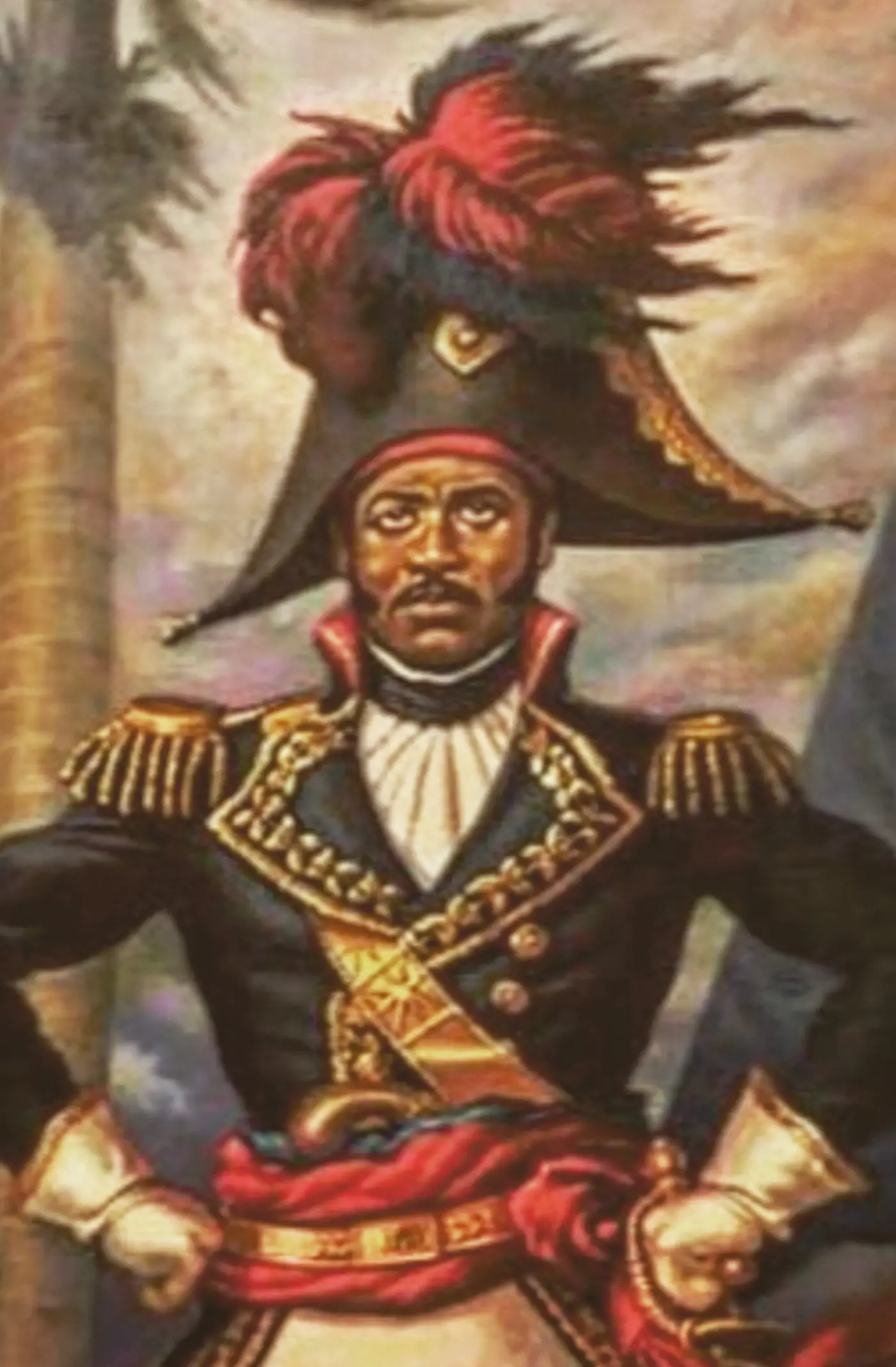
The proclamation came first and the coronation second, which is why the sources disagree about the date of the empire. Madiou, followed by most Haitian accounts, has Dessalines proclaimed emperor by the general staff and the fourth demi-brigade on 2 September 1804; many English-language works give 22 September, apparently by a slip that has been copied for decades. The coronation itself is firmly dated to 8 October 1804, at Cap-Haïtien, two months before Napoleon crowned himself in Notre-Dame.
The ceremony mixed republican ritual with imperial pageantry. The cortege went first to the altar of the fatherland, where the new sovereign was acclaimed by the army and the crowd and saluted by the guns of every battery in the town; it then moved to the church on the Champ de Mars, where Father Corneille Brelle, who would later crown Christophe as king, sang mass and the Te Deum. The regalia had been bought abroad: the crown came from merchants in Philadelphia on the American ship Connecticut, the ceremonial coat from Jamaica on a British frigate, and the carriage drawn by six horses was a gift from the British agent. The empress, Marie-Claire Heureuse Félicité, was crowned with him. The day ended with popular rejoicing.
The court that followed was small and military. Dessalines's sons were styled princes; the generals who had made him emperor kept their commands and their plantations; the titles that mattered were the six divisional commands. There was no hereditary principle. The constitution made the imperial dignity elective in form, with the emperor nominating his successor from among the principal general officers commanding the provinces, and the Council of State able to set aside a successor who tried to overturn the law. That provision was a deliberate refusal of Napoleon's hereditary empire, and it was also a refusal to solve the succession problem. Dessalines died without an heir apparent and without a named successor, and the state he had built had no mechanism for choosing one.
What happened to the land?
In February 1804 the government annulled every sale and gift of land made by the French during the war, and then confiscated more than 500 properties in the west. The reasoning was set out by Dessalines himself, in a passage quoted by the Bibliothèque nationale's exhibition on the revolution: "Ever since we have thrown out the colonists, their sons are claiming their properties; the Blacks, whose fathers are in Africa, will have nothing." The state, not the nation's individuals, would inherit the colony. Plantation leases were terminated, and the whole former French domain became the national domain, administered by the government and worked under licence.
That decision had a losers' list, and it was not the French. During the last years of the war, free people of colour and officers of the southern army had bought or simply occupied plantations abandoned by their owners, and had begun to farm them with the labour of the newly freed. The February decrees cancelled those purchases and threatened the new owners with expropriation. In the south and west, where the purchasers were concentrated and where Pétion commanded, the decrees were read as a confiscation aimed at the mulatto elite. Enforcement of the land laws in the south was the trigger for the rising that ended with Dessalines's death.
For those who had been enslaved, the settlement was ambiguous. The state kept the estates intact, which meant no general partition of land, but the officers and soldiers who had won the war received grants, and the cultivators received a share of the produce and a right to stay on the land they had worked. The result was neither the free peasantry the cultivators wanted nor the colonial plantation the planters had lost, but a militarised estate system in which the commanding officer replaced the colonial manager and the state replaced the proprietor. Only after 1807, when Pétion began distributing state land to soldiers and then to cultivators in the south, did smallholding become the dominant form of rural life — the change that Gonzalez calls the most radical measure of the whole revolution.
Why did the labour decrees fail?
Independence left the export economy in ruins. Saint-Domingue had supplied about 40 per cent of the sugar and 60 per cent of the coffee consumed in Europe in the 1780s; by 1804 the irrigation works were broken, the mills burned, the mules dead or eaten, and the merchant houses of Bordeaux and Nantes gone. Sugar requires coordinated labour, capital and a working port, and Haiti had none of the three. Coffee, which grows semi-wild on mountain slopes and needs only picking and drying, survived, and became the country's export staple.
Dessalines's answer was forced labour. Every citizen was to be a soldier or a cultivator; cultivators were attached to the plantations they had worked, forbidden to move, and required to meet production targets under the supervision of military commanders. The regulations were, in the judgement of contemporaries and historians alike, harsher than Toussaint Louverture's rural code of 1801, with corporal punishment, prison and the loss of a share of the crop as penalties. Imperial decrees restated the regime as late as May 1806. The officers who enforced it were also its beneficiaries: they held the leases, took a share of the crop and paid the state.
The system produced very little and cost a great deal of legitimacy. Cultivators fled to the mountains, squatted on abandoned land, grew food for themselves and sold surplus in the informal markets that became a permanent feature of Haitian life. The soldiers sent to round them up came from the same villages, and the army's loyalty to the emperor depended on pay and plunder rather than on ideology. Johnhenry Gonzalez has argued that the peasantry effectively won this struggle: the plantation economy could not be restored because the people who would have worked it had other plans, and the Haitian state adjusted by taxing imports and exports at the customs house rather than by collecting rent from estates.
The failure had a political consequence that outlasted the empire. Because the state could not extract a surplus from the countryside, it lived on customs duties, foreign loans and the printing press, and because it could not pay its soldiers reliably, it remained an army with a government attached. Every ruler from Dessalines to the Duvaliers faced the same arithmetic, and most solved it the same way.
Why did Dessalines invade the east in 1805?
The eastern two-thirds of Hispaniola had been Spanish until 1795 and French afterwards, and in 1804 it was held by a French garrison of about 2,000 men under General Ferrand, who had restored slavery and was using the colony as a base for raids. In January 1805 Ferrand authorised frontier commanders to raid Haitian territory for captives to sell as slaves and ordered the killing of any Haitian man over 14 found in Santo Domingo. Dessalines invaded in February with an army usually given as 20,000 to 30,000 men, took Santiago at the end of the month, and laid siege to Santo Domingo in early March.
The siege failed on sea power. The city held out for three weeks, and on 21 March a French squadron under Admiral Missiessy appeared off the harbour. Dessalines, who had no navy, assumed a new expedition was landing and lifted the siege on 28 March, retreating west with his army. The retreat was conducted with a scorched-earth policy that has never been forgotten on the other side of the border. Christophe's columns burned Santiago, Moca, La Vega, Cotuí, Monte Plata and San Francisco de Macorís; at Moca some 500 people who had come out of hiding on the promise of safety were killed in the church, and at Santiago perhaps 400 more. About 1,000 civilians, most of them women and children, were marched back to Haiti as captives and held for years.
The invasion is remembered in the Dominican Republic as the origin of a national enmity, and in Haiti as a failure of logistics. Both are true. Dessalines's strategic aim was sound: the island could not be defended while a hostile European garrison held the east, and the French would in fact hold it until the Spanish inhabitants defeated them at Palo Hincado in 1808 and the last French troops surrendered in July 1809. But the campaign also showed the limits of the empire's power. It could take a city and hold a line; it could not project force across water, and it could not afford a long war.
How did the empire end?
The end came from the south, and it came quickly. On 8 October 1806 a rising began at Port-Salut, on the southern peninsula, and moved towards Port-au-Prince. Its grievances were the labour regime, the land decrees and the concentration of command in the hands of the emperor's favourites; its leaders were the western and southern generals, Pétion foremost among them. Dessalines rode south with a small escort to crush it, and on 17 October 1806 he was ambushed at Pont Larnage, the bridge over the Rivière Rouge north of Port-au-Prince. He was shot, and his body was mutilated and dragged through the streets of the capital.
No trial, no manifesto and no successor followed. The generals met at Port-au-Prince, abolished the empire, and wrote a constitution on 27 December 1806 that restored the republic, a senate and a presidency. Christophe, the senior general and commander of the north, was offered the presidency and refused the terms; he withdrew to Cap-Haïtien, and in January 1807 the north seceded as the State of Haiti, with Christophe as president for life. Pétion was elected president of the Republic of Haiti in the south. The country was two states, and the empire had no heir.
The assassination has been read ever since as the founding act of Haitian politics: a general who concentrates power, a coalition of provincial commanders who kill him, a constitution that distributes power among them, and a new strongman within a decade. The pattern repeated in 1843, 1849, 1859, 1915 and after. What made it possible in 1806 was structural. The constitution had made the imperial dignity non-hereditary, the emperor had named no successor, and the army was the only body capable of choosing one. In the absence of an heir, the army chose itself.
Why did Haiti split in two?
The split was not simply a colour line, though colour was never absent from it. Christophe's north was the old plantation heartland, black, militarised, and committed to sugar and to the discipline that sugar required. Pétion's south was the old free-coloured and provincial country, where land was already being distributed and where the political language was republican and legalistic. Both regimes were led by men who had been generals of the revolution; both were authoritarian; both claimed to be the legitimate government of Haiti.
Christophe's state became a kingdom on 28 March 1811, when he was proclaimed Henri I, and he was crowned on 2 June 1811 by Jean-Baptiste-Joseph Brelle, the same priest who had crowned Dessalines. He built a court, a nobility of dukes, counts and barons with titles taken from the estates their holders had once worked, a college of arms, the palace of Sans-Souci and the fortress of La Ferrière. His Code Henry of 1812 regulated labour and land in more detail than any Haitian law before it, fixing the planter's and the cultivator's shares and duties. He shot himself on 8 October 1820, as his generals deserted him.
Pétion's republic moved the other way. The constitution of 1806 gave power to a senate of landowners; the revision of 1816 made the presidency a life office and gave Pétion the right to name his successor. He distributed state land to soldiers and cultivators, a policy that won him the name Papa Bon-Cœur, destroyed the plantation economy of the south and created the peasant smallholding that would define the country. He died of yellow fever in 1818 and was succeeded by Jean-Pierre Boyer, who in 1820 marched north after Christophe's suicide, reunited Haiti, and in 1822 annexed the eastern two-thirds of the island, holding it until 1844.
For Haitian political thought the two regimes posed a question the empire had already raised: whether the republic could survive without a monarch, and whether a monarch could be legitimate without an heir. Christophe answered with a hereditary kingdom; Pétion with a life presidency. Neither answer lasted. The empire's failure was the first and clearest demonstration that sovereignty in Haiti would rest on the army, and that the constitution would be a record of which general had won.
What did the empire leave behind?
The empire's most durable legacy was legal. Article 14 of the 1805 constitution made blackness the name of citizenship, and Article 12 made whiteness incompatible with property. Together they defined Haiti as a state that belonged to the descendants of Africa and to nobody else, a definition that outlived the empire in the republican constitutions, in the 1825 recognition bargain with France and in the national ideology of the twentieth century. When François Duvalier built his noiriste dictatorship in 1957, he drew on a tradition that begins in that clause, though the clause itself was about legal equality among citizens, not about the rule of a black elite.
The economic legacy was the plantation's failure. Dessalines kept the estates and lost the labour; Pétion gave away the land and lost the export crop. By 1840 Haiti had ceased to export sugar altogether, though it continued to grow cane for local rum, and coffee from smallholdings carried the trade. The country that had been the most profitable colony in the world became a nation of peasant farmers and a state that taxed them at the port. Gonzalez calls the result a "maroon nation", outside the wage-labour economy of the nineteenth century, and he is careful to say that this was a victory for the formerly enslaved as well as a disaster for the state.
The fiscal legacy was the debt. In April 1825 Charles X sent a fleet to Port-au-Prince and demanded 150 million francs in compensation for the property the former colonists had lost, in exchange for recognising Haitian independence. Haiti borrowed from a French bank to pay the first instalment, and the loan, rescheduled and refinanced, was still being serviced in the twentieth century. France reduced the indemnity in 1838; the instalments on the indemnity were completed in 1883, and the associated loans were not finally cleared until 1947. The United States withheld recognition until 1862, when the Civil War made free-labour diplomacy useful; Britain and France had recognised the country in the 1820s and 1830s, on terms that included commercial advantage.
The political legacy was the army. Every institution the empire built was military: the six divisions, the Council of State, the plantation commands. Every institution the republics built was a variant on them. The American occupation of 1915 dismantled the army and then rebuilt it, and the pattern held. When Haitians debate their constitution today, they are arguing about a document that descends, by a long and broken line, from the generals who signed the imperial constitution at Dessalines in May 1805.
Was Dessalines a mimic emperor?
The charge is old: that Dessalines took a crown because Napoleon had taken one, surrounded himself with a court, and turned a revolution against monarchy into a parody of monarchy. It was made by Haitian liberals in the nineteenth century, by foreign observers who found a Black court ridiculous, and by historians who read the empire as a lapse from republican virtue. The evidence supports a more interesting reading.
The imperial documents are not imitations. The empire was declared before Napoleon's, in September rather than December 1804. The constitution made the dignity elective and non-hereditary, which was the opposite of the French model. The title Dessalines took — emperor, but also "supreme chief of the army" and, in the constitution's family metaphor, the father of the citizens — described a military arbiter rather than a dynast. Jenson calls him a "critic emperor": a ruler who used the forms of empire to make a claim about race and sovereignty that the republics of the Atlantic could not answer.
The critique has limits. A court costs money, and the money came from coerced labour. The empire had no bureaucracy, no legal code, no fiscal system that could survive its founder, and its constitutional refusal of heredity left the succession to the sword. The comparison that matters is not with Napoleon but with Toussaint Louverture's 1801 constitution, which had also combined abolition with forced labour and autocratic power. Dessalines inherited that contradiction and added a crown. He did not create it.
Why does the map show Haiti in 1860?
The map's border data draws a polity called "Empire of Haiti" from 1805 to 1915. The empire existed from 1804 to 1806. The gap is not a small dating slip: 1860, the year this entry's map is drawn, is fifty-four years after Dessalines's death, and the state it shows is the republic of Fabre Geffrard, who had taken power at the start of 1859 after the abdication of the emperor Faustin Soulouque. The label is an artefact of a dataset that assigns one name to one territory across a century of regime change, and it is wrong for most of the period it covers.
Two further details are worth stating. The shape drawn at 1860 is the western third of Hispaniola — a coarse outline the dataset measures at about 31,000 square kilometres against Haiti's actual 27,750 — and that is the correct territory of the republic in that year; the eastern two-thirds appears separately as the Dominican Republic, independent since 1844. But the "peak area" of 84,000 square kilometres given in the site's fact box belongs to the 1822–45 period, when Boyer's Haiti ruled the whole island, and not to the empire, which never held the east for more than a few weeks in 1805. The drawn range also begins in 1805, a year after the proclamation of independence and a few months after the proclamation of the empire.
So the map is reliable about where Haiti is and unreliable about what it was called. Read it as a territorial outline that persists across regimes, and use the dates in this entry for the politics. The 1805 start, the 1915 end and the 1860 view are all boundary-data conventions, not historical claims.
Common myths about the Empire of Haiti
| Myth | What the evidence says |
|---|---|
| Dessalines crowned himself emperor in imitation of Napoleon | He was proclaimed by the army's general staff in September 1804, before Napoleon's coronation in December, and the 1805 constitution made the dignity elective and non-hereditary — the opposite of Bonaparte's hereditary empire |
| The 1804 killings exterminated the white population | Most of the remaining French were killed, but Poles, Germans, naturalised white women and their children, priests, doctors and some American merchants were spared, and Article 13 of the 1805 constitution naturalised the Poles and Germans |
| Some 5,000 whites died in 1804 | Girard estimates 3,000–5,000; Gaffield's work in the surviving records suggests nearer 1,000; the figure of 3,000 dead at Cap-Haïtien alone exceeds the town's white population at the time |
| Independence abolished the plantation system | Dessalines kept the estates and made the state the landlord, leasing them to officers and binding cultivators to them; smallholding spread only after 1807, through Pétion's land grants in the south |
| Article 14 ended racial hierarchy in Haiti | It made "Black" the legal name of every citizen and ended legal distinctions among Haitians, while barring whites from property; social gradations of colour and the rivalry of anciens and nouveaux libres continued |
| The empire fell to a French invasion | It fell to a conspiracy of its own generals and southern garrisons, triggered by the land decrees and the labour regime; no foreign army was involved in 1806 |
| Christophe's kingdom was the empire continued | Christophe ruled a separate northern state from 1807 and took a crown only in 1811; the south was a republic under Pétion, and the two states fought intermittently until 1820 |
| Haiti was a republic from 1804 | The state was an empire from 1804 to 1806; the republic was proclaimed in the south at the end of 1806, and the north was a kingdom until 1820 |
Timeline of the Empire of Haiti
| Year | Event |
|---|---|
| 1802 | Napoleon's expedition under Leclerc lands to restore French rule and slavery; Dessalines and Christophe initially submit, then defect |
| 1803 | Yellow fever and the war of the indigenous army destroy the expedition; Rochambeau capitulates at Cap-Haïtien on 18 November |
| 1804 | Independence declared at Gonaïves on 1 January; killings of the remaining French from February to 22 April; Dessalines proclaimed emperor in September and crowned Jacques I on 8 October |
| 1805 | Imperial constitution signed at Dessalines on 20 May; invasion of the east in February–March; siege of Santo Domingo lifted on 28 March; retreat with the sack of Moca and Santiago |
| 1806 | Rising in the south from 8 October; Dessalines killed at Pont-Rouge on 17 October; republican constitution of 27 December |
| 1807 | Christophe withdraws north and founds the State of Haiti; Pétion becomes president of the Republic in the south |
| 1811 | Christophe proclaimed King Henri I on 28 March and crowned on 2 June |
| 1812 | Code Henry regulates labour and land in the northern kingdom |
| 1816 | Pétion revises the southern constitution, making the presidency a life office, and accelerates land grants |
| 1818 | Pétion dies of yellow fever; Jean-Pierre Boyer succeeds him |
| 1820 | Christophe commits suicide on 8 October; Boyer reunites Haiti |
| 1822 | Boyer's army annexes the eastern two-thirds of Hispaniola |
| 1825 | Charles X's ordonnance demands 150 million francs for recognition of independence |
| 1838 | France reduces and reschedules the indemnity; payments continue for decades |
| 1844 | The Dominican Republic declares independence from Haiti |
| 1849 | Faustin Soulouque proclaims the Second Empire of Haiti |
| 1859 | Soulouque abdicates in January; the republic is restored under Fabre Geffrard |
| 1862 | The United States recognises Haiti |
What the map shows next
At 1811 on the map the island is two states: Christophe's north, proclaimed a kingdom that March, and Pétion's southern republic, where the plantation system was already being dissolved into peasant smallholdings. The contrast between the two is the best surviving evidence of what the empire's land and labour settlement had been arguing about.
At 1822 on the map the whole of Hispaniola is one country again, under Boyer, who had reunited north and south after Christophe's suicide and then annexed the Spanish east. At 1915 on the map the same territory is under American occupation, its army disbanded and its customs under foreign control — the end point of the fiscal and military inheritance that began with the imperial constitution of 1805.
Common questions
- Was the Empire of Haiti a monarchy?
- Yes: it was a military monarchy with an emperor as sole executive, a Council of State of generals and no legislature.
- When did Haiti become an empire?
- The army proclaimed Dessalines emperor in September 1804 and he was crowned on 8 October 1804, though the constitution that formally named the state an empire followed only on 20 May 1805.
- Who was the first emperor of Haiti?
- Jean-Jacques Dessalines, who reigned as Jacques I from 1804 until his assassination in 1806.
- Did Dessalines crown himself?
- No: he was proclaimed by the general staff of the army and crowned by the clergy at Cap-Haïtien, and the constitution was submitted to him for sanction rather than drafted by him.
- How long did the Empire of Haiti last?
- Barely two years, from the proclamation of September 1804 to Dessalines's death on 17 October 1806.
- What did the 1805 constitution do?
- It abolished slavery, made all Haitians legally "Black", barred whites from owning land, and concentrated all executive power in the emperor.
- Why were whites banned from owning land in Haiti?
- To prevent the former colonists or their descendants from reclaiming the plantations, and to keep the property of the country in the hands of those who had won it.
- How many French people were killed in 1804?
- Estimates range from about 1,000 to 5,000, and no reliable count exists; Girard gives 3,000–5,000, while Gaffield's archival work suggests a much lower figure.
- Why was Dessalines assassinated?
- His land decrees and forced-labour regime threatened the southern officers who had bought plantations during the war, and they organised the rising that ended in his death at Pont-Rouge.
- What happened to Haiti after Dessalines died?
- The empire was abolished, the country split into Christophe's northern state and Pétion's southern republic, and it was reunited only in 1820 under Jean-Pierre Boyer.
Sources
Every source below was consulted while writing this entry.
- Constitution impériale du 20 mai 1805, French text, Digithèque de matériaux juridiques et politiques, Université de Perpignan.
- Constitution of Hayti (1805), English translation, The Louverture Project.
- Jean-Jacques Dessalines, Acte d'indépendance, 1 January 1804, CO 137/111, The National Archives, Kew.
- Jean-Jacques Dessalines, "Extract from the Secret Deliberations of the government of the Island of Hayti", 29 February 1804, printed in Relf's Philadelphia Gazette, 30 April 1804.
- Jean-Jacques Dessalines, proclamation to the inhabitants of Haiti, 28 April 1804 ("I have avenged America"), CO 137/111, The National Archives, Kew.
- Jean-Jacques Dessalines, imperial decree of 2 May 1806, in Lois et actes sous le règne de Jean-Jacques Dessalines (Port-au-Prince, 2006).
- Thomas Madiou, Histoire d'Haïti, 3 vols (Port-au-Prince, 1847–48).
- Beaubrun Ardouin, Études sur l'histoire d'Haïti, 11 vols (Paris, 1853–60).
- Laurent Dubois, Avengers of the New World: The Story of the Haitian Revolution (Cambridge, Mass., 2004).
- Laurent Dubois, Haiti: The Aftershocks of History (New York, 2012).
- Philippe R. Girard, "Caribbean Genocide: Racial War in Haiti, 1802–4", Patterns of Prejudice 39:2 (2005), 138–61.
- Philippe R. Girard, The Slaves Who Defeated Napoleon: Toussaint Louverture and the Haitian War of Independence (Tuscaloosa, 2011).
- Julia Gaffield, Haitian Connections in the Atlantic World: Recognition after Revolution (Chapel Hill, 2015).
- Julia Gaffield, "Race and the Haitian Constitution of 1805", Unique at Penn (2015).
- Johnhenry Gonzalez, Maroon Nation: A History of Revolutionary Haiti (New Haven, 2019).
- Deborah Jenson, "Dessalines's American Proclamations of the Haitian Independence" (2009).
- Michel-Rolph Trouillot, Haiti: State against Nation: The Origins and Legacy of Duvalierism (New York, 1990).
- Martino Sacchi and Lorenzo Ravano, "The Rise and Fall of Caporalisme Agraire in Haiti (1789–1806)", in Global Plantations in the Modern World (Cham, 2023).
- Bibliothèque nationale de France, Patrimoines Partagés: Jean-Jacques Dessalines and the Independence of Haiti (online exhibition).
- UN News, "How Haiti paid for its freedom – twice over" (April 2025).
Data sources for the map
- Cliopatria v0.12 (Seshat Global History Databank, CC BY 4.0).
- Historical Basemaps (GPL-3.0).
This entry was written from the sources above and last updated .
Text available under CC BY-SA 4.0: reuse it with a credit to The World Through Time and a link to this page.
Border geometry for the map itself comes from Cliopatria v0.12 (Seshat Global History Databank, CC-BY-4.0).
See the Empire of Haiti in its world
Open the atlas at 1860 and every neighbour, rival and successor is on screen with it — then drag the slider and watch what happens next.
Open the map at 1860 →