Human verified. Last updated by our editorial team on .
Oceania · The Islamic sultanates
Sultanate of Banjar
1526–1860
The Sultanate of Banjar was the pepper and diamond state of South Kalimantan: a Muslim kingdom at Banjarmasin, founded in 1526, which traded with China, Java, the Dutch and the English, and which ended not in a battle but in a colonial proclamation after a war of resistance that lasted longer than the war itself.
- Existed
- 1526–1860
- Shown on the map
- 1526–1859
- Peak area
- 39k km²
- Region
- Oceania
Its history matters because it is the clearest case in Borneo of a trading sultanate being converted into a colonial district — and because the war that did it, the Banjar War, is one of the best-documented resistance wars in Indonesian history.
At a glance
| Name | Sultanate of Banjar; Kesultanan Banjar |
| Dates | 1526–1860 (the site draws 1526–1859) |
| Where | South Kalimantan, around Banjarmasin and the Barito and Martapura rivers |
| Capital | Banjarmasin, later Martapura |
| Founder | Sultan Suriansyah |
| Religion | Islam, adopted by the court in the sixteenth century |
| Economy | Pepper, diamonds, rattan, gold and river trade |
| End | Abolished by the Dutch proclamation of 11 June 1860 |
What was Banjar?
A sultanate on the south coast of Borneo, at the mouth of the Barito, which controlled the pepper-growing interior and the diamond fields of the Meratus mountains. Its rivers were its roads: the Barito and Martapura carried pepper, rattan, gold and diamonds down to Banjarmasin, where Chinese, Javanese, Malay and later Dutch and English merchants bought them.
It was a Malay-style port kingdom — a sultan, a court, a nobility of pangeran, and a population of Malays, Dayaks, Chinese and Bugis — whose wealth depended on the forest products of the interior and on its ability to keep the river trade open.
Who founded it?
Sultan Suriansyah, according to the Banjar chronicles, a prince who converted to Islam and made Banjarmasin the seat of a Muslim sultanate in 1526. The date is traditional rather than documentary, but the sixteenth-century origin of the state is not in doubt: by the early seventeenth century Banjar was a recognised sultanate trading with the wider archipelago.
What was the economy?
Pepper first, diamonds second. Banjar's pepper was grown by Dayak and Malay farmers in the interior and shipped through Banjarmasin; the diamonds came from the Meratus range, and the sultan's monopoly on them was one of his principal revenues. Rattan, gold, birds' nests and forest resins completed the export list, and rice and cloth came in.
The Dutch and English competed for the trade in the early seventeenth century, and the sultanate played them against each other. As the Company consolidated its position in the archipelago, Banjar's independence of action narrowed, and by the nineteenth century the Dutch were demanding treaties that made the sultan a vassal.
What was the Banjar War?
The war that ended the sultanate, 1859–63 and beyond. On 18 April 1859 Prince Antasari and Prince Djalil issued proclamations of resistance; on 28 April the rebels attacked the Dutch coal mine at Pengaron and killed several Europeans; and the war spread across the Barito and Martapura districts. The Dutch, who had abolished the sultanate by proclamation on 11 June 1860, spent years fighting a guerrilla resistance that outlasted the state.
Antasari was captured in 1862 and died on 11 October 1862; the resistance continued under other leaders, and the last of them, Seman, was killed on 1 January 1905 — forty-five years after the sultanate had ceased to exist. That gap is the measure of how little the colonial proclamation settled.
How do we know about Banjar?
From a chronicle and a colonial archive. The Hikayat Banjar is the court's own history, written in Malay and covering the dynasty from its origins to the seventeenth century; it is one of the finest Malay chronicles, and it gives the founding, the conversion, the genealogy and the court's view of its neighbours. The Dutch and English records — contracts, residency reports, the papers of the Banjar War — give the other side.
The two do not always agree, and where they differ the entry follows the documents. The war's dates, for instance, are fixed by the Dutch reports: the proclamations of 18 April 1859, the Pengaron attack of 28 April, the abolition of 11 June 1860, and the last killing in 1905.
What was Banjar's relationship with the Dutch?
Transactional, then unequal. The Company's first contract with Banjar dates from the seventeenth century, and for two centuries the sultanate granted trading rights, monopolies and toll exemptions in exchange for protection against its own rivals. The pepper trade made Banjarmasin valuable, and the Dutch, the English and the Chinese all competed for it.
In the nineteenth century the balance shifted. The Dutch, having consolidated Java, began to demand sovereignty rather than trade: the right to appoint the sultan, control of the mines, and the abolition of the sultanate's independent foreign relations. The crisis of 1859 was the result — a court that would not surrender its remaining authority, and a colonial government that had decided to take it.
What was Banjar society like?
A riverine society of Malays, Dayaks, Chinese and Bugis.
 The sultan and the pangeran — princes of the blood — governed through a hierarchy of officials, with the Dayak communities of the interior supplying forest products and labour, the Chinese running the pepper trade and the mines, and Bugis and Malay sailors carrying the cargoes. Slavery and debt bondage were part of the economy.
The Hikayat Banjar describes this world in detail: the founding of the dynasty, the conversion to Islam, the court's ceremonies, and the wars of the seventeenth century. It is one of the great Malay chronicles, and it is the main reason Banjar's history is better known than that of most Bornean states.
What is the legacy?
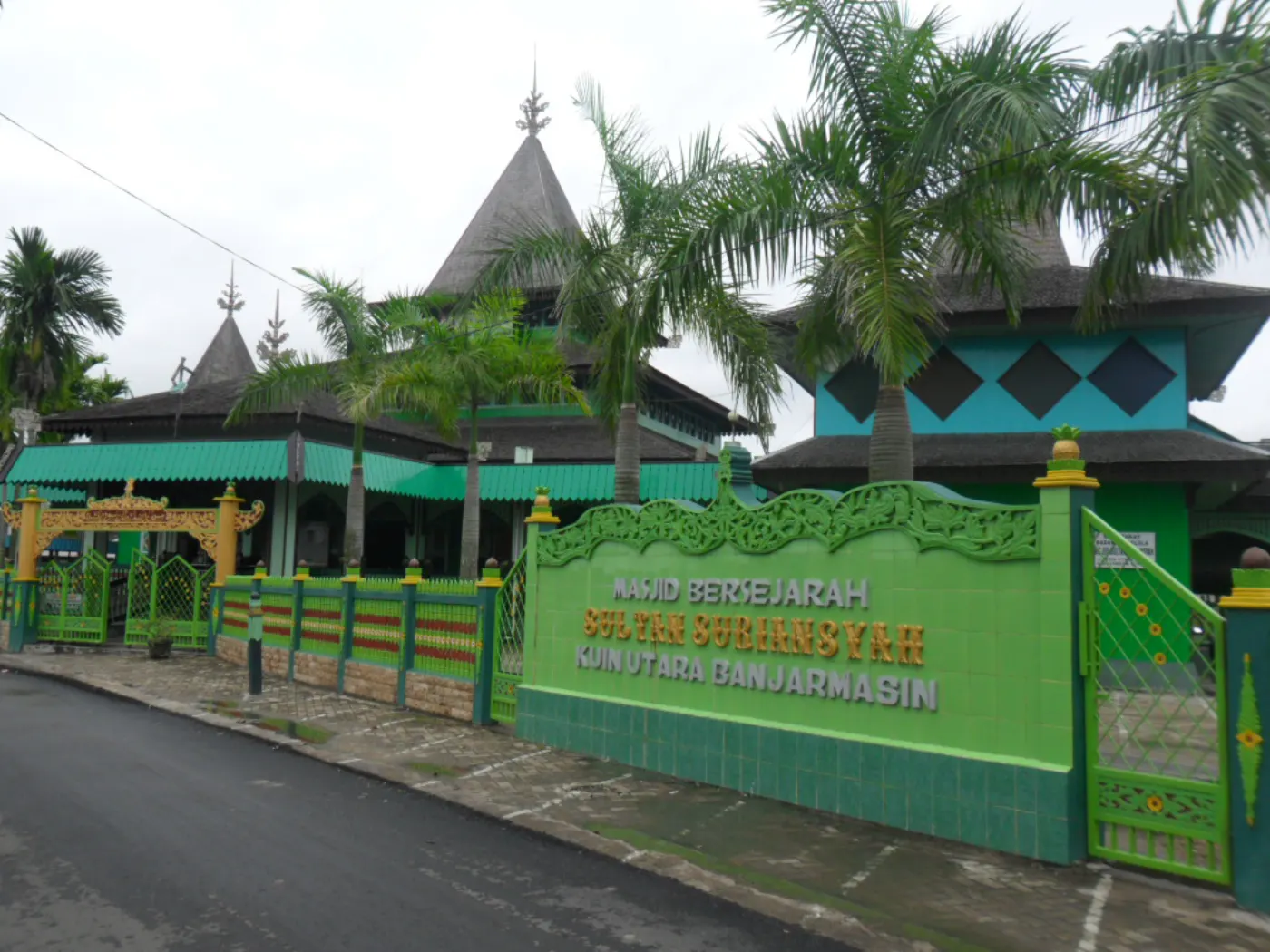
A province, a war memory and a manuscript tradition. Banjar is now a province of Indonesia with a rich literary tradition — the Hikayat Banjar, chronicles of the sultanate — and the Banjar War is remembered as a national resistance. The sultanate's descendants live in the region, and the court's mosque and tombs survive at Banjarmasin and Martapura.
Common myths about Banjar
| Myth | What the evidence says |
|---|---|
| The sultanate ended when the Dutch abolished it | It was abolished on 11 June 1860, but resistance continued until 1905. |
| The Banjar War began as a single uprising | The proclamations were 18 April 1859 and the Pengaron attack 28 April. |
| Banjar was a Dayak state | It was a Malay-Muslim port sultanate ruling over Dayak and Malay populations. |
| Diamonds were a minor trade | The sultan's diamond monopoly was a principal revenue. |
| The Dutch conquered Banjar quickly | The war lasted years and the last resistance was crushed only in 1905. |
| The sultanate was founded in the eighteenth century | It dates from 1526, and was a recognised sultanate by the early seventeenth century. |
| Banjar had no written culture | The Hikayat Banjar is one of the major Malay chronicles. |
| The 1859 war was a religious war | It was a dynastic and anti-colonial war with religious language. |
Timeline of Banjar
| Year | Event |
|---|---|
| 1526 | Sultan Suriansyah founds the sultanate |
| 1600s | Dutch and English trade at Banjarmasin |
| 18 April 1859 | Proclamations of Antasari and Djalil |
| 28 April 1859 | Attack on Pengaron |
| 11 June 1860 | Sultanate abolished by Dutch proclamation |
| 11 October 1862 | Antasari dies |
| 1 January 1905 | Seman killed; resistance ends |
What the map shows next
At 1693 on the map Banjar is an independent pepper port, and Mataram dominates Java.
At 1859 on the map the Banjar War has begun, and the Dutch East Indies is closing on Borneo.
Common questions
- What was the Sultanate of Banjar?
- A Muslim trading sultanate in South Kalimantan, founded in 1526, which exported pepper and diamonds until the Dutch abolished it in 1860.
- Where was its capital?
- Banjarmasin, later Martapura.
- Who founded it?
- Sultan Suriansyah, according to the Banjar chronicles.
- What was the Banjar War?
- The resistance war of 1859 onwards, led by Prince Antasari, against Dutch rule.
- When was the sultanate abolished?
- By proclamation on 11 June 1860.
- How long did resistance continue?
- Until 1905, when the last leader, Seman, was killed.
- What did Banjar export?
- Pepper, diamonds, rattan, gold and forest products.
- Was Banjar a Malay or Dayak state?
- A Malay-Muslim sultanate ruling over Malay and Dayak populations.
- What is the Hikayat Banjar?
- The chronicle of the sultanate, one of the major Malay historical texts.
- What is Banjar today?
- A province of Indonesia, with the sultanate's descendants and monuments preserved.
Sources
Every source below was consulted while writing this entry.
- The Hikayat Banjar.
- Dutch reports on the Banjar War, including van Rees's account of the Pengaron attack.
- Regional and provincial histories of South Kalimantan.
- Ricklefs, A History of Modern Indonesia.
Data sources for the map
- Cliopatria v0.12 (Seshat Global History Databank, CC BY 4.0).
- Historical Basemaps (GPL-3.0).
This entry was written from the sources above and last updated .
Text available under CC BY-SA 4.0: reuse it with a credit to The World Through Time and a link to this page.
Border geometry for the map itself comes from Cliopatria v0.12 (Seshat Global History Databank, CC-BY-4.0).
See the Sultanate of Banjar in its world
Open the atlas at 1693 and every neighbour, rival and successor is on screen with it — then drag the slider and watch what happens next.
Open the map at 1693 →