Human verified. Last updated by our editorial team on .
South America · Successor states and civil wars
Ecuador
1830–present
Ecuador is the only South American state named for a line of latitude. The name was chosen in 1830 by a congress at Riobamba that had just detached the former Distrito del Sur from Gran Colombia, and it was chosen because the equator crosses the country a few kilometres north of Quito. Everything else about the republic is less tidy. It is a small country — about 256,000 square kilometres — with four sharply different regions: the Pacific lowlands, the two chains of the Andes with their intermontane basins, the Amazonian Oriente, and the Galápagos, 1,000 kilometres out in the ocean. It has two rival urban cores, Quito in the highlands and Guayaquil at the mouth of the Guayas, whose merchant houses have financed one government after another and have never quite accepted the primacy of the capital. And it has an export economy rebuilt three times on three staples — cacao, bananas, petroleum — with shrimp, cut flowers and minerals now rivalling the oil.
- Existed
- 1830–present
- Shown on the map
- 1834–present
- Peak area
- 265k km²
- Region
- South America
Its political history is a record of unusual institutional instability inside unusual social continuity. Ecuador has had twenty constitutions since 1830, a fact that sounds like revolutionary ferment and is better read as the opposite: each new charter was a fresh bargain among the same landowning, commercial and banking families, written when the previous bargain stopped paying. The country abolished slavery in 1851 and the indigenous head tax in 1857, separated church and state in 1906, enfranchised women in 1929 and gave constitutional rights to nature in 2008 — a sequence of firsts that coexisted, for most of that time, with a franchise restricted by literacy and property, a hacienda system that held highland Indians in debt peonage into the 1960s, and a state whose writ ran thinly outside the provincial capitals.
What makes Ecuador worth reading closely is that its founding moment points the wrong way. The national holiday is not the declaration of independence but the revolution of 10 August 1809, when a junta in Quito seized power in the name of the imprisoned Ferdinand VII. Independence from Spain was achieved in 1822 by an army from the south, and the country then spent eight years as a province of Simón Bolívar's Gran Colombia before a group of notables in Quito dissolved the union in 1830. Ecuadorian nationality therefore begins as a secession — from a republic that Bolívar had built and that Ecuadorians had helped to win. That double movement, anti-colonial and anti-Bolivarian at once, explains a good deal about how the country has understood itself since.
At a glance
| Name | República del Ecuador / Republic of Ecuador; officially the Estado del Ecuador from 1830 to 1835 |
| Dates | Separation from Gran Colombia 13 May 1830; constitution sworn at Riobamba 23 September 1830; republic to the present (border data drawn only from 1834, four years after the founding) |
| Where | North-west South America on the equator; Colombia to the north, Peru to the east and south, the Pacific to the west, plus the Galápagos archipelago |
| Capital | Quito; Guayaquil the largest city, chief port and rival centre of power |
| Government | Presidential republic; twenty constitutions since 1830; clerical-conservative hegemony 1860–95, Liberal oligarchy 1895–1925, military governments 1963–66 and 1972–79 |
| Population | Under a million in 1830; 16,938,986 at the 2022 census |
| Economy | Cacao (the world's largest exporter c. 1860–1910), then bananas from the late 1940s, then oil from 1972; dollarised since 2000 |
| Language and religion | Spanish, with Kichwa and Shuar as official languages of intercultural relation; Catholicism disestablished in 1906 |
| Status | Independent republic; OPEC member 1973–92 and 2007–20; host of the UNASUR headquarters until 2019 |
What did the Inca leave, and what did the Spanish build?
Ecuador's territory was densely settled long before it had a name. The Valdivia culture of the Santa Elena peninsula produced fired pottery from about 3500 BC, among the earliest in the Americas; the La Tolita workshops of the northern coast worked gold and platinum into masks and figurines; the Manteño of Manabí sailed balsa rafts north to Mexico and south to Chile. None of these peoples formed a single state, and the Spanish chroniclers took little interest in them, which is why the archaeology of the Ecuadorian lowlands remained so poorly known for so long.
The Inca arrived late. Pachacuti's armies began pushing north in the 1460s, his son Túpac Yupanqui carried the frontier through the highlands, and only under Huayna Cápac, by about 1500, was the country as far as the Gulf of Guayaquil incorporated into Tawantinsuyu. The resistance was severe — the Cañari around Cuenca and the Cara north of Quito fought the Inca for decades — and Inca rule lasted less than two generations in most of the region. What it did leave was administrative: the road system, the mitimae colonies that carried Quechua north, and Quito itself as a secondary capital where Huayna Cápac spent his last years and died, probably in 1527.
His death opened the war between Huáscar and Atahualpa that the Spaniards reached in its final phase. Atahualpa's northern armies won the decisive battles on Ecuadorian soil, around Riobamba and Ambato, and then the victor was garrotted at Cajamarca in 1533. Sebastián de Belalcázar entered the highlands the following year; the Inca commander Rumiñahui burned Quito rather than surrender it, and the Spanish founded San Francisco de Quito on the ruins in December 1534. Guayaquil, founded and refounded between 1534 and 1537, became the shipyard and the port.
The colony's shape was set in 1563, when Philip II created the Real Audiencia de Quito. It was a court and a governorate rather than a viceroyalty, subordinate first to Lima and, from 1739, to the new viceroyalty of New Granada in Bogotá; its jurisdiction ran far beyond modern Ecuador, south to Paita and north to Buenaventura. The Sierra organised itself around the obraje, the textile workshop that clothed Potosí and Lima with cheap woollens, and around the hacienda worked by Indians held through the mita and debt. The coast organised itself around cacao and shipping. Both were fragile. Textile output fell by between half and three-quarters during the eighteenth century as cheaper European cloth arrived, the great Quito families slid into debt, and the expulsion of the Jesuits in 1767 removed the most efficient estate managers and schoolmasters in the country.
That economic decline is the background to the politics of 1809, and it also explains a persistent national myth: the belief that Quito had once been the capital of a pre-Inca "Kingdom of Quito", destroyed by the Inca and rediscovered by the Jesuits. The idea comes from Juan de Velasco's Historia del Reino de Quito, written in exile in 1789, and it was adopted with enthusiasm by nineteenth-century historians because it gave the new republic a pre-Columbian pedigree to set against Cusco. Archaeology has found no such kingdom.
Why did Quito revolt in 1809 and Guayaquil in 1820?
Napoleon's occupation of Spain in 1808 created the same legitimacy crisis in Quito as in Caracas or Buenos Aires, and Quito answered it earlier than most of the Spanish empire. On 10 August 1809 a group of creole notables, led by Juan Pío Montúfar, deposed the president of the Audiencia and formed a junta that governed in Ferdinand VII's name. It was, as the participants insisted, an act of loyalty; it was also one of the first seizures of sovereignty in Spanish America, and the authorities in Lima and Bogotá treated it as rebellion. Royalist troops advanced on the city, the junta dissolved itself on assurances of safety, and the assurances were not kept. When the population rose again in August 1810 the authorities disarmed it by promising a junta and then had the prisoners of the first revolt killed in their cells — an episode, remembered as the matanza del 2 de agosto, that did more than any pamphlet to make independence popular.
The second attempt was more serious. A congress met in December 1811, declared the Audiencia independent of any government in Spain, and in February 1812 adopted a constitution for the "Estado de Quito" that kept a place for Ferdinand should he return. The state lasted ten months. Its improvised army was destroyed by the royalists of Toribio Montes in December 1812, and Quito's leaders were executed or exiled.
Independence came in the end from the coast, and from outside. On 9 October 1820 the port of Guayaquil rose, deposed its garrison and proclaimed a free province under a junta headed by the poet José Joaquín de Olmedo — the episode now commemorated as the Guayaquil junta. Unlike Quito in 1809, Guayaquil could call on help: Antonio José de Sucre arrived from Colombia in May 1821 with a small army, and after a reverse in the highlands near Ambato he was reinforced from Peru. On 24 May 1822 Sucre's men climbed the slopes of the Pichincha volcano above Quito and defeated the last royalist field army in the north. The city fell the next day.
The political settlement was another matter. Guayaquil wanted to be a republic of its own, or to join Peru; Quito's notables wanted union with Colombia; Bolívar wanted both, and got them. When the Guayaquil junta resisted, Bolívar entered the city in July 1822 and incorporated it by decree; the celebrated conference with San Martín followed a fortnight later in the same city. The former Audiencia became the Distrito del Sur of Gran Colombia, with three departments — Ecuador (Quito), Azuay (Cuenca) and Guayaquil — and a constitution that made it a province of a state governed from Bogotá. Ecuadorians had won independence and lost their country in the same season.
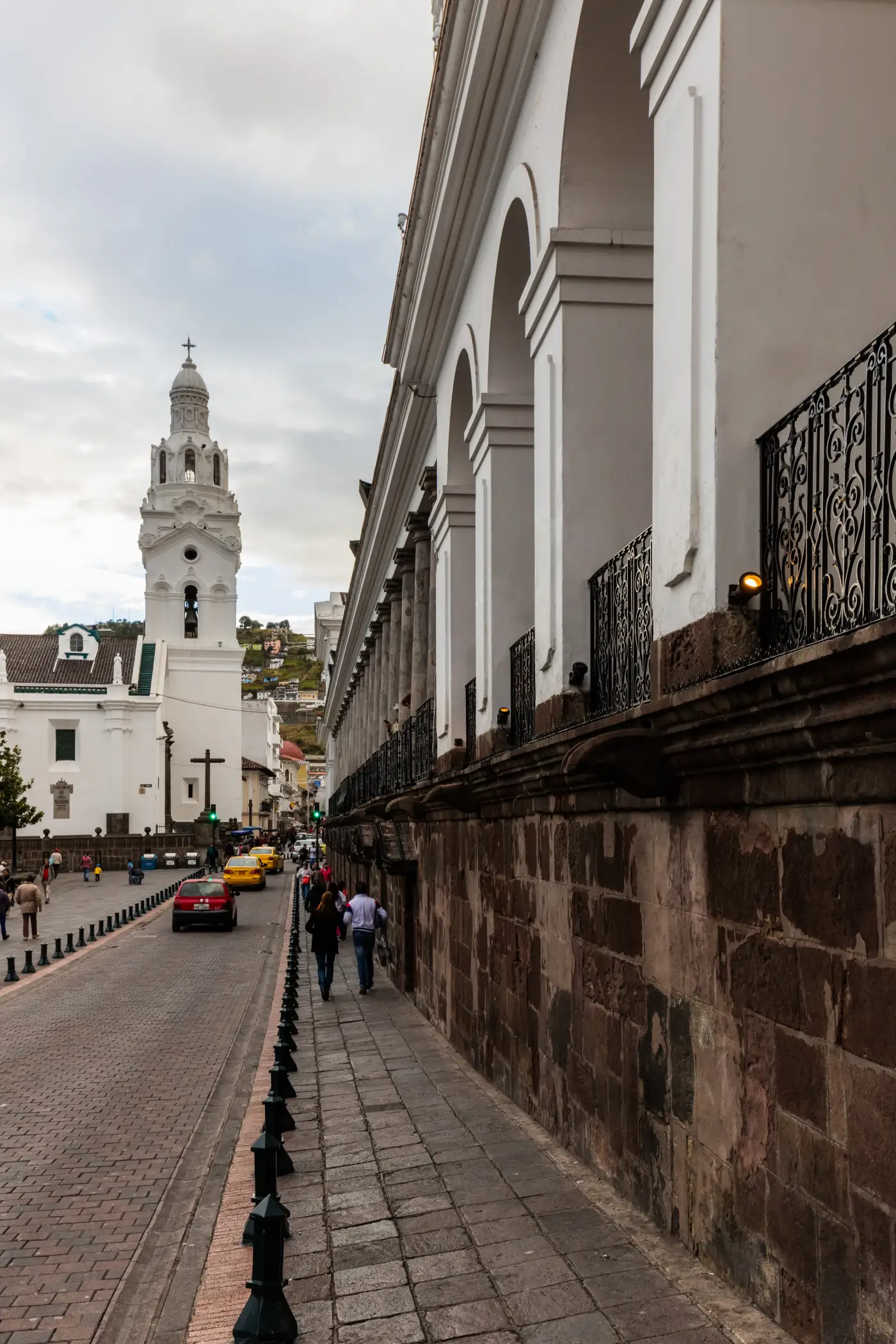
How did the southern district become a separate republic?
Eight years of Gran Colombian rule gave the southern district three things: a war, a debt and a garrison. The war was with Peru in 1828–29, fought over the border in the Amazon and over the unpaid costs of the liberation campaign; Sucre's outnumbered force won at Tarqui on 27 February 1829, and the Treaty of Guayaquil that September declared the boundary to be the old colonial one, without saying where it ran — the treaty on which Ecuador would later rest its entire Amazonian claim. The debt was Colombian, contracted in London, and Ecuador inherited its share. The garrison was the army that had won at Tarqui, commanded by a Venezuelan general, Juan José Flores, who had been Bolívar's governor of the district and who had no intention of giving up the position.
Venezuela seceded in 1829; Quito followed. On 13 May 1830 a gathering of notables in Quito declared the district separated from Gran Colombia and vested executive power in Flores. A constituent congress met at Riobamba on 14 August and, after six weeks, produced the constitution of the Estado del Ecuador, sworn on 23 September 1830. Two details are usually lost in the celebration. The first is that the constitution of 1830 left open the possibility of reunion with Colombia and Venezuela, and even provided that any Gran Colombian treaty would override it; the country did not commit itself to permanent separation until the constitution of 1835, drafted at Ambato, which renamed the state the República del Ecuador and made Vicente Rocafuerte president. The second is that the new state had no agreed frontier with either neighbour, no civil service, and an army larger than its revenues could carry. A war with Colombia over the Cauca province in 1832 was lost, and the treasury never recovered.
Flores dominated the next fifteen years, serving as president in 1830–34, 1839–43 and 1843–45. He annexed the Galápagos in 1832, importing convicts and cattle; he imported Venezuelan officers to command his regiments; and he financed himself by farming the customs houses. His opponents called his regime floreanismo and complained that the country was being governed by foreigners — the historian Alfredo Pareja Diezcanseco later made "foreign militarism" the first of the four stages of Ecuadorian republican history. In 1833 four young intellectuals who had founded the newspaper El Quiteño Libre to denounce the plunder of the treasury were murdered by soldiers; Flores was out of the capital at the time and probably did not order it, which did not help him. In 1834 a revolt in Guayaquil tried to make Rocafuerte president. Flores defeated it, then made Rocafuerte his candidate, governed through him for four years as commander of the army, and returned to the presidency in 1839.
The constitution of 1843, which extended the presidential term to eight years and allowed immediate re-election, broke the coalition. Its enemies called it the Carta de la Esclavitud, the charter of slavery, and in March 1845 a rising in Guayaquil — the marcista revolution, named for the month — forced Flores into exile. What followed was not a new order but a fifteen-year scramble. The marcistas were liberals, conservatives and Guayaquil merchants who agreed on nothing except the general's departure, and Flores spent the rest of his life trying to return, twice with foreign backing. Real power passed to José María Urbina, who took the presidency by coup in 1851, freed the slaves, expelled the Jesuits, and aligned the Liberal Party with the coastal export interest and with the country's black and Indian population against the highland landowners.
What did García Moreno's Catholic state build?
By 1859 the state had come apart. Four governments claimed authority — one in Quito, one in Guayaquil, one in Cuenca, one in Loja — and the Peruvian president Ramón Castilla took advantage of the chaos to occupy Guayaquil, where the local caudillo Guillermo Franco signed the Treaty of Mapasingue ceding the southern provinces and accepting Peruvian claims in the Amazon. It was the low point of the republic: a foreign army in the main port and a foreign claim on the southern provinces and the Amazon.
The man who reversed it was Gabriel García Moreno, a Quito lawyer and former rector of the university who had once tried to assassinate Flores. He raised an army in the highlands, joined forces with his old enemy Flores, defeated Franco's Peruvian-backed troops at Guayaquil on 24 September 1860, repudiated Mapasingue, and had himself confirmed by a constituent assembly in 1861. For the next fifteen years — as president in 1861–65 and again from 1869, and as the power behind two weaker presidents in between — he built the state that Ecuador still inhabits.
His programme was modernisation on Catholic terms. He centralised the customs revenue and the collection of the treasury, encouraged the new banks, reorganised the army, and built roads, telegraphs, schools and the great public buildings of Quito. He founded the Escuela Politécnica in 1870 to train engineers and the Astronomical Observatory in 1873 to train surveyors and astronomers, and he brought German and French scientists to staff them. In exchange he gave the Church what no Ecuadorian government had given it before: the Concordato of 1862 handed it the schools, the censorship of the press and the parish registers of births, marriages and deaths, and the constitution of 1869 — the Carta Negra — required the Catholic religion as a condition of citizenship and gave the president a six-year term with immediate re-election.
The cost was borne by his opponents, and the methods were savage: floggings, executions, exile and the return of the Jesuits. In March 1874 he had the republic consecrated to the Sacred Heart of Jesus, and the country was officially described as the "Republic of the Sacred Heart". On 6 August 1875, walking into the presidential palace in Quito, he was attacked with a machete and shot by a Colombian named Faustino Lemos Rayo; the story that he said "Dios no muere" — God does not die — as he died is reported by admirers and cannot be checked.
Historians have argued about him ever since, and the argument is really about whether the state he built was worth its price. The older Catholic biography made him a saint and a martyr; the Liberal tradition made him a fanatic; the modern scholarly reading, best represented by Peter Henderson, treats him as a conservative state-builder whose centralising reforms were a precondition for everything the Liberals later did — including the secular state that undid his church settlement.
How did cacao and the Liberal revolution change Ecuador?
After García Moreno's death the centre of gravity moved steadily to the coast. Cacao had been Ecuador's export since the eighteenth century; from about 1860 the country was the world's largest exporter of cacao beans, a position it held until about 1910, when Brazilian and then West African production overtook it. The Guayaquil merchant houses that handled the crop — and lent the government the money to run itself — became the most powerful interest in the country, and the railway that connected the port to Quito, begun in the 1870s and completed in 1908, tied the highlands to the coast economically as the colonial road had never done.
Political power followed the money with a lag of a generation. Between 1875 and 1895 the country was governed by a succession of highland notables and military men — Antonio Borrero, the dictator Ignacio de Veintemilla, and after the restoration of 1883 the progresistas — who presided over a growing export economy while refusing to share its proceeds. On 5 June 1895 the Liberals of Guayaquil rose, called Eloy Alfaro back from exile in Panama, and within months had won a short civil war. Alfaro governed as supreme chief, then as president from 1897, and again from 1907 to 1911.
The Liberal revolution's lasting work was laicism. The constitution of 1906, the twelfth in seventy-six years, separated church and state, abolished the state religion, guaranteed freedom of worship, removed the clergy from education and from the registry of births, marriages and deaths, and legalised civil marriage and divorce. Primary schooling was made free, lay and compulsory. The state took over church property and, in the process, created a system of public education that reached the mestizo middle class and produced the liberal professions that would govern the country in the twentieth century. A. Kim Clark's study of the Guayaquil–Quito railway makes the larger point: the Liberals understood the railway as a redemptive national project, a machine for turning Indians into citizens, and the project's failure to do any such thing is part of the story.
Alfaro was overthrown by his own party's moderate wing in August 1911 and murdered in Quito on 28 January 1912, his body dragged through the streets and burned. The twenty years that followed — the age of the argolla, the ring of Guayaquil bankers and Liberal politicians — were the most stable stretch of the republic's first century and among the most corrupt. The banks issued the currency, the government borrowed from them, and the cacao revenues paid for both.
Why did the cacao republic collapse, and why did it lose the war of 1941?
The cacao economy began to fail before the world economy did. Monilia rot was recorded in Ecuador in 1917 and witch-broom disease, which had appeared in Surinam in 1895, reached the country about 1922; production fell by roughly half within a decade, just as West African plantations were coming into full bearing. Then came the Wall Street crash. The value of Ecuador's exports fell from about $15 million in 1928 to $7 million in 1931 and $5 million in 1932. The Liberal order had no answer, and the army had one.
On 9 July 1925 a group of young officers — the League of Young Officers, mostly from the middle class — deposed the government in a bloodless coup known as the Revolución Juliana. It was the first intervention in Ecuadorian politics made in the name of a programme rather than a caudillo. The officers installed Isidro Ayora as provisional president in 1926; he governed with dictatorial powers while a Princeton mission headed by Edwin Kemmerer reorganised the fiscal system, and in 1927 created the Banco Central del Ecuador, which took the currency out of the hands of the private banks. The constitution of 1929, the thirteenth, wrote social rights into the charter, gave congress the power to censure ministers, and enfranchised women, among the first constitutions in Latin America to do so, five years after Matilde Hidalgo had argued her way onto the electoral register at Loja.
It did not produce stable government. Ayora was the first of fourteen chief executives in the 1930s, by the count in the Library of Congress's country study. The decade's politics were a competition between personalist caudillos — above all José María Velasco Ibarra, elected for the first time in 1934 — the socialist and communist left, and a Liberal plutocracy that kept control of the coast. In 1932 a disputed election produced a four-day civil war in Quito. The one lasting reform of the period was the Labour Code of 1938, issued by the military reformer Alberto Enríquez Gallo, which survived every subsequent government.
Then came the war with Peru. Its causes ran back a century, to the failure of the two states to agree a boundary in the Amazon; its immediate occasion was a dispute over the Zarumilla river on the southern coast. Fighting began on 5 July 1941. Ecuadorian accounts say the country was invaded; Peruvian accounts say Ecuadorian troops attacked the Peruvian posts at Aguas Verdes that morning; both agree on the date and on very little else. What is not disputed is the outcome. Peru's army was larger, better equipped, and supported by air and sea; it cleared the Ecuadorian posts along the Zarumilla, occupied the province of El Oro, and pushed as much as 200 kilometres beyond the line both sides had accepted as a status quo in 1936. Ecuador's army was a constabulary of a few thousand men, much of it sick with malaria.
A truce in October left Peruvian troops on Ecuadorian soil, and the settlement was signed under that pressure. The Protocol of Peace, Friendship and Boundaries was concluded at Rio de Janeiro on 29 January 1942, with Argentina, Brazil, Chile and the United States as guarantors. It gave Peru the disputed Amazonian territory and, with it, the river frontage Ecuador had claimed. The area in question was the zone Ecuador had claimed, rather more than 200,000 square kilometres; measured from the 1936 status-quo line, the land that actually changed hands was a small fraction of that figure. The protocol has been observed in practice ever since, though Ecuador declared it void in 1960 and a gap of some 78 kilometres in the demarcation at the Cordillera del Cóndor was not closed until 1998.
The political consequence inside Ecuador was the fall of the government. In May 1944 a popular rising in Guayaquil — the Gloriosa, as it is still called — brought down Carlos Alberto Arroyo del Río and returned Velasco Ibarra from exile. A constituent assembly dominated by the left wrote a constitution in 1945 that Velasco promptly repudiated; a second assembly produced the conservative charter of 1946, and in 1947 a military coup removed him anyway.
What did the Velasco years and the banana boom deliver?
The twelve years after 1948 were the closest thing to constitutional normality the country had known since the Liberal plutocracy. Galo Plaza Lasso, elected in 1948, was the first president in twenty-eight years to finish his term; he was followed by Velasco, who completed his third term in 1956, and by Camilo Ponce Enríquez, a Conservative, the first of his party to hold the office since the nineteenth century. The basis of the stability was a new export. Banana planting began in earnest in the late 1940s, the United States market was open, and by the mid-1950s Ecuador was the world's largest banana exporter — a position it still holds. The 1949 earthquake that destroyed Ambato and killed thousands showed how thin the state's capacity remained, but the treasury was solvent and the army was out of politics.
It did not last. Velasco's fourth term, from 1960, ended with his resignation in 1961; his successor Carlos Julio Arosemena was overthrown by the army on 11 July 1963, in a coup that the former CIA officer Philip Agee later described as promoted by the United States because Arosemena refused to break with Cuba. The military junta of 1963–66 promised reform, delivered little, and handed power back to a constituent assembly in 1966. Otto Arosemena Gómez governed from 1966, Velasco won a fifth term in 1968 at the age of seventy-five, dismissed congress and ruled as a dictator from 1970, and was removed by the army in February 1972 — the last of the great personalist caudillos, deposed by officers who had a different kind of state in mind.
What did oil do to Ecuador?
The officers moved when they did because of what had been found in the Oriente. A Texaco–Gulf consortium drilling at Lago Agrio had struck commercial oil in 1967, and by 1972 the pipeline from the Amazon to the port of Esmeraldas — the Sistema de Oleoducto Transecuatoriano — was ready. Exports began in August 1972, and the timing was extraordinary: the world price of crude was about to quadruple. Ecuador joined OPEC in 1973.
Between 1972 and 1981 oil supplied more than half of all exports, exports rose to nearly a quarter of output, and the economy grew at an average of 8.8 per cent a year — 25 per cent in 1973 alone. Government revenue, which had been a small fraction of national income, more than doubled and oil came to provide about a third of it. General Guillermo Rodríguez Lara's "nationalist and revolutionary" government used the money to build the Esmeraldas refinery, the state oil company CEPE, highways, hydroelectric plants and schools, and to renegotiate the foreign concessions on terms far more favourable to the state than the 1960s contracts had been.
It also spent more than it earned. The central government ran a deficit in every year of the boom except 1974, financed by borrowing on the easy international markets of the 1970s; the public foreign debt rose from $248 million in 1971 to $4.4 billion at the end of 1981, an increase of nearly eighteen times. The agrarian reform decreed in 1973, the regime's other great promise, transferred less than 1 per cent of cultivable land before it was abandoned. Inflation, unknown in the cacao republic, averaged 13 per cent a year.
The boom's politics were as unstable as its economics. An attempted coup in 1975 cost 22 lives; a second, in January 1976, succeeded, and a three-man military council took over with the single purpose of returning to barracks. Its timetable slipped repeatedly. A referendum in January 1978 offered voters a new constitution against a revised version of the 1945 charter: 44 per cent chose the new text, 31 per cent the old one, and 23 per cent deliberately spoiled their ballots on the instructions of the right. The constitution of 1979, which lowered the voting age, abolished the literacy requirement that had excluded most indigenous voters, and strengthened the legislature, took effect in March; Jaime Roldós Aguilera won the presidency in April and was inaugurated on 10 August 1979.
How did democracy return, and what did the indigenous movement change?
Roldós was thirty-eight, a lawyer from Guayaquil, and he governed as a social democrat against the opposition of the parties that had elected him. He was also the first president to confront the consequences of the borrowing of the 1970s. When Ecuador went to war with Peru again over the undemarcated border in January 1981 — the Paquisha incident, a skirmish over a handful of outposts in the Cordillera del Cóndor — his government handled it without escalation. On 24 May 1981 his aircraft flew into a mountain in Loja province and he was killed with his wife and the minister of defence. Conspiracy theories flourished; no evidence has ever supported them.
His vice-president, Osvaldo Hurtado, inherited a collapse. The oil price fell, the debt service consumed the budget, El Niño flooded the coast in 1982–83, and growth turned negative. From 1984 León Febres Cordero imposed a free-market adjustment, survived a brief kidnapping by his own officers, and was succeeded in 1988 by Rodrigo Borja of the Democratic Left. The earthquake of March 1987 ruptured the oil pipeline and shut exports for months. Through all of it the parties alternated, the congress asserted itself, and the press was free — a record that looks better in retrospect than it did at the time.
The most important change of the decade was social. The Confederation of Indigenous Nationalities of Ecuador (CONAIE) was founded in November 1986, uniting the highland federation Ecuarunari with the Amazonian organisations; it was the first body to speak for the country's indigenous peoples as a whole, and it was built on a decade of literacy campaigns, land invasions and parish organising that the church and the left had helped to start. In June 1990 it called a national uprising. Roadblocks went up in seven highland provinces on 4 June, spread to the Amazon and the south, and paralysed the country for four days until the government agreed to negotiate. The demands were land, bilingual education and recognition of the indigenous nationalities. Nothing was conceded immediately except the negotiation itself, but the political landscape changed for good: the indigenous movement had shown that it could stop the country, and no government afterwards could ignore it.
How did the country survive the lost decade and dollarisation?
The 1990s were among the worst decades of the republic's peacetime history. Sixto Durán Ballén (1992–96) stabilised the macroeconomy and modernised the state, but his vice-president fled the country under a corruption charge, and in January 1995 Ecuador and Peru fought again in the Cenepa valley, a two-month war in which both sides used aircraft and missiles before the guarantors imposed a ceasefire. The peace was completed at Brasilia on 26 October 1998, when Ecuador accepted the 1942 line and Peru granted it navigation rights on the Amazon.
Politics meanwhile disintegrated. Abdalá Bucaram, elected in 1996 on a populist platform, was declared mentally incapable by congress in February 1997 and replaced by Fabián Alarcón; a constituent assembly produced a new constitution in 1998. That year Jamil Mahuad took office in the middle of a banking collapse. The banks had lent heavily to their own owners, the state guaranteed the deposits, and the central bank printed money to pay for the rescue. In March 1999 the government closed the banks for a week and froze deposits over a threshold; by the end of the year the sucre had lost two-thirds of its value, output had fallen by 7 to 8 per cent, unemployment had doubled to 17 per cent, and about 70 per cent of the country's financial institutions had closed. On 9 January 2000 Mahuad announced that Ecuador would adopt the United States dollar.
Twelve days later he was gone. On 21 January a coalition of CONAIE, student organisations and mid-ranking officers occupied the National Assembly and the Supreme Court and proclaimed a "Government of National Salvation" with a colonel, Lucio Gutiérrez, as one of its three members. It lasted a few hours: the high command refused to back it, the United States threatened sanctions, and the vice-president, Gustavo Noboa, was confirmed by congress the next day. Dollarisation was completed under Noboa and, whatever its costs in sovereignty and in the losses imposed on savers, it worked as a monetary rule. Inflation fell to single digits and has stayed there.
The political system did not recover so quickly. Gutiérrez was elected in 2002, dissolved the Supreme Court in 2004 in what looked like a payoff to Bucaram, and was driven out in April 2005 by the middle classes of Quito; his vice-president, Alfredo Palacio, finished the term. By the 2006 election the parties that had governed since 1979 were discredited, and a young economist who had never held elected office won on a promise to rewrite the constitution.
What did Correa's Citizens' Revolution build?
Rafael Correa took office in January 2007 and governed for ten years. His method was a constituent assembly, elected in September 2007, which sat at Montecristi and produced the constitution approved by 63.9 per cent of voters on 28 September 2008. The text is the most interesting thing his government produced. It redefined Ecuador as a "constitutional state of rights and justice", added two new branches of government to the classic three (electoral, and transparency and social control), gave Kichwa and Shuar official status, guaranteed the rights of nature — ecosystems have the right to exist, persist and regenerate — and made sumak kawsay, "good living", the organising principle of development policy. It was the first constitution in the world to recognise the rights of nature, and it has been cited ever since.
The economic policy was less original. Correa renegotiated the oil contracts, expelled the Brazilian contractor Odebrecht, defaulted on $3.2 billion of global bonds in 2008 after an audit pronounced them illegitimate, and spent the commodity boom on roads, hospitals, schools, hydroelectric dams and cash transfers. Poverty fell from about 37 per cent in 2006 to about 22 per cent in 2016; the Gini coefficient fell from 0.55 to 0.47; real wages rose. He also concentrated power. A constitutional amendment in 2015 removed presidential term limits; the government sued newspapers and broadcasters for large sums; the tax authority, the electoral council and the courts were staffed with loyalists; and in September 2010, when police officers protesting against a pay law held him in a hospital for a few hours, his supporters called it an attempted coup and his critics called it the reckoning for a heavy-handed presidency.
Correa's environmental record is the clearest case of promise and retreat. In 2007 he announced the Yasuní–ITT initiative: Ecuador would leave nearly a billion barrels of oil under the Ishpingo–Tambococha–Tiputini block permanently in the ground if the world paid it half of the forgone revenue, about $3.6 billion. Six years later, with pledges amounting to a small fraction of that, he cancelled the scheme and authorised drilling. It was the most ambitious attempt anywhere to price the preservation of a rainforest, and it failed for want of buyers.
Why did the state lose control of its streets and its prisons?
Correa's chosen successor, Lenín Moreno, turned against him within months of taking office in 2017, moved economic policy to the right, and in a referendum in February 2018 restored term limits — which barred Correa from standing again. The correction was popular and the economics were not. Having borrowed heavily during the boom, the state now faced a falling oil price and a dollar it could not devalue. In October 2019 Moreno carried out the fuel-subsidy cut demanded by an IMF programme; CONAIE called a national strike, the government fled Quito for Guayaquil, and the country was paralysed for eleven days until the decree was withdrawn.
Guillermo Lasso, a banker elected in 2021, inherited a fiscal gap and a security emergency. A strike in June 2022, again led by CONAIE, shut down roads and oil installations for eighteen days and nearly ended his presidency. In May 2023, facing impeachment over a corruption case involving state oil contracts, he invoked the constitution's "mutual death" clause, dissolved the National Assembly and called snap elections. The campaign was overshadowed by the murder, on 9 August 2023, of the anti-corruption candidate Fernando Villavicencio, shot dead in Quito after a rally. Daniel Noboa, the son of a banana magnate, won the runoff in October with 52.3 per cent and took office on 23 November.
His inheritance was a security disaster. Ecuador had been for decades one of the safest countries in the region, with a homicide rate near 5 per 100,000; as Mexican and European buyers reorganised the cocaine trade through Guayaquil's container port, the rate rose to 25.5 in 2022 and 44.5 in 2023, the highest in South America. The prisons, built for about 30,000 and holding far more, became the gangs' headquarters and the sites of massacres that killed hundreds of inmates from 2020 onwards. On 7 January 2024 the leader of Los Choneros escaped from a Guayaquil prison; two days later armed men stormed a television studio live on air. Noboa declared an "internal armed conflict" and designated 22 criminal groups as belligerents, turning the police and army onto the streets and into the prisons. Homicides fell in 2024, while Human Rights Watch documented extrajudicial killings, mass arrests and torture in custody, and the Constitutional Court found that the government had not produced evidence of an armed conflict at all.
Noboa was re-elected in April 2025 with 55.6 per cent of the runoff vote, against Correa's candidate, Luisa González. He governs with a fragmented assembly, a constitutional court he has publicly threatened to reform, and an economy still tied to oil. Ecuador in the 2020s is a country that has done the hard monetary adjustment, kept its democracy more or less intact, and discovered that neither has made it safe.
Common myths about Ecuador
| Myth | What the evidence says |
|---|---|
| Ecuador became independent at the battle of Pichincha in 1822. | Pichincha ended Spanish rule, but the territory then joined Gran Colombia as the Distrito del Sur. The separate state dates from 13 May 1830, and it was called the Estado del Ecuador until the constitution of 1835 renamed it a republic. |
| A pre-Inca "Kingdom of Quito" ruled the northern Andes. | The kingdom comes from Juan de Velasco's Historia del Reino de Quito (1789), a literary construction that gave the colony a classical past. Archaeology shows no unified state in the Ecuadorian highlands before the Inca. |
| Ecuador lost 200,000 square kilometres of territory to Peru in 1942. | 200,000 km² is roughly the size of the zone in dispute, not of the territory Ecuador actually administered. Measured from the status-quo line both sides accepted in 1936, the land that changed hands was a small fraction of it. |
| García Moreno was simply a religious fanatic who held the country back. | He was a repressive ruler, but he also centralised the customs, founded the Escuela Politécnica and the Observatory, built roads and telegraphs and reorganised the army. The Church got control of education in exchange for supporting that programme. |
| The Liberal revolution of 1895 created a secular democracy. | It created a secular state and civil equality, but the franchise remained restricted by literacy and property, and Alfaro was overthrown and murdered by moderate Liberals in 1911–12. |
| Oil made Ecuador rich. | Oil more than doubled government revenue and produced a decade of 8.8 per cent growth, but the public foreign debt rose nearly eighteenfold between 1971 and 1981, and the 1980s were spent paying for it. |
| The coup of January 2000 was an indigenous seizure of power. | It was a coalition of CONAIE, students and mid-ranking officers; its junta lasted hours, the armed forces command refused to support it, and the constitutional successor, Gustavo Noboa, took office the next day. |
| The 2008 constitution stopped oil drilling in Yasuní. | It gave nature enforceable rights, but the Yasuní–ITT scheme was cancelled in 2013 and drilling went ahead. A referendum in 2023 ordered the block closed, and the government is still phasing the operations out. |
Timeline of Ecuador
| Year | Event |
|---|---|
| 1563 | Philip II creates the Real Audiencia de Quito |
| 1809 | Junta of 10 August in Quito governs in Ferdinand VII's name |
| 1820 | Guayaquil declares independence on 9 October |
| 1822 | Sucre wins at Pichincha; the territory joins Gran Colombia |
| 1830 | Separation declared on 13 May; constitution of the Estado del Ecuador at Riobamba |
| 1860 | García Moreno defeats Franco at Guayaquil; the 1861 constitution follows |
| 1875 | García Moreno assassinated on 6 August |
| 1895 | Liberal revolution begins at Guayaquil on 5 June |
| 1906 | Laicist constitution separates church and state |
| 1925 | Revolución Juliana; the Kemmerer mission and the Banco Central follow |
| 1929 | Constitution grants women the vote; cacao exports collapse |
| 1941 | War with Peru from 5 July; Peruvian troops occupy El Oro |
| 1942 | Protocol of Rio de Janeiro signed on 29 January |
| 1967 | Oil discovered at Lago Agrio |
| 1972 | Exports begin; Rodríguez Lara takes power |
| 1979 | New constitution; Roldós inaugurated on 10 August |
| 1990 | First national indigenous uprising in June |
| 2000 | Dollarisation announced; Mahuad overthrown on 21 January |
| 2008 | New constitution approved with 63.9 per cent of the vote |
| 2024 | "Internal armed conflict" declared against criminal gangs |
What the map shows next
At 1942 on the map the map shows a country that has just lost the Amazon war and signed the Rio Protocol, two years before the Gloriosa would bring down the government that signed it. The border drawn that year is the one Ecuador would contest for another fifty-six years.
By 1979 on the map the oil pipeline from the Oriente has been running for seven years, the military have gone back to barracks, and a new constitution has just been sworn. At 2000 on the map the sucre is being replaced by the dollar and the country is a little poorer than it had been a decade earlier, with the peace treaty with Peru two years old.
Common questions
- When did Ecuador become independent?
- Independence from Spain was won at Pichincha on 24 May 1822, but the separate Ecuadorian state dates from the declaration of 13 May 1830, when the country left Gran Colombia.
- Was Ecuador ever part of Gran Colombia?
- Yes: from 1822 to 1830 the territory was the Distrito del Sur of Gran Colombia, with three departments based on Quito, Cuenca and Guayaquil.
- Why is the country called Ecuador?
- The name refers to the equator, which crosses the country just north of Quito; it was adopted by the constituent congress of 1830 and the state was formally renamed a republic in 1835.
- Who was Gabriel García Moreno?
- A Quito lawyer who seized power in 1860, governed for most of the next fifteen years, built the modern Ecuadorian state on a Catholic and authoritarian basis, and was assassinated on 6 August 1875.
- What did the Liberal revolution of 1895 change?
- It ended clerical control of education and public records, separated church and state in the constitution of 1906, legalised civil marriage and divorce, and gave the coastal export economy political power.
- What happened in the war of 1941?
- Peru defeated Ecuador in a short war over the Amazonian border, occupied the province of El Oro, and imposed the Protocol of Rio de Janeiro in January 1942, which gave it the disputed territory.
- When did Ecuador adopt the US dollar?
- President Jamil Mahuad announced dollarisation on 9 January 2000, and the change was completed under his successor, Gustavo Noboa, during the same year.
- What is CONAIE?
- The Confederation of Indigenous Nationalities of Ecuador, founded in 1986, is the country's largest indigenous organisation and the body behind the uprisings of 1990, 2000, 2019 and 2022.
- What is the 2008 constitution known for?
- It is the first constitution in the world to grant enforceable rights to nature, and it also made Ecuador a plurinational state and adopted sumak kawsay, or good living, as a principle of policy.
- Why has violence risen so sharply since 2021?
- Competition among gangs linked to Mexican and European cocaine buyers, combined with a prison system the state does not control, pushed the homicide rate from about 5 per 100,000 in 2016 to 44.5 in 2023.
Sources
Every source below was consulted while writing this entry.
- Ministerio de Relaciones Exteriores y Movilidad Humana, Cronología de la historia de la República del Ecuador, 1830–1900 (Archivo Histórico "Alfredo Pareja Diezcanseco", Quito, 2021).
- Enrique Ayala Mora, Resumen de historia del Ecuador (Corporación Editora Nacional, Quito).
- Library of Congress, Federal Research Division, Ecuador: A Country Study, ed. Dennis M. Hanratty (1989), chapters on the colonial era and the republic.
- Law Library of Congress, 1942 Protocol of Rio de Janeiro, LL File No. 1995-1020 (1994).
- Simón Cueva and Julián P. Díaz, "The Monetary and Fiscal History of Ecuador, 1960–2017", Becker Friedman Institute Working Paper (2019).
- Maurice F. Perkins, Cacao: Production, Consumption and Trade (International Bank for Reconstruction and Development, 1948).
- Constitución de la República del Ecuador (Registro Oficial 449, 20 October 2008), articles 1, 71–74 and 275.
- Human Rights Watch, World Report 2025: Ecuador (2025).
- Congressional Research Service, Ecuador: Country Overview and U.S. Relations, IF11218 (2025).
- U.S. Department of State, "Ecuador–Peru Peace Process", fact sheet (March 1998).
- Instituto Nacional de Estadística y Censos, VIII Censo de Población y VII de Vivienda (2022).
- Encyclopaedia Britannica, "Ecuador" (country article).
Data sources for the map
- Cliopatria v0.12 (Seshat Global History Databank, CC BY 4.0).
- Historical Basemaps (GPL-3.0).
This entry was written from the sources above and last updated .
Text available under CC BY-SA 4.0: reuse it with a credit to The World Through Time and a link to this page.
Border geometry for the map itself comes from Cliopatria v0.12 (Seshat Global History Databank, CC-BY-4.0).
See Ecuador in its world
Open the atlas at 1929 and every neighbour, rival and successor is on screen with it — then drag the slider and watch what happens next.
Open the map at 1929 →