Human verified. Last updated by our editorial team on .
Central America · Independence and the federations
El Salvador
1821/1841–present
El Salvador is the smallest republic in Central America and the most densely settled country on the American mainland: 21,041 square kilometres of volcanic slope, river valley and narrow Pacific plain carrying roughly 300 people per square kilometre. It has no Caribbean coast, no navigable route to the Atlantic and, until the twentieth century, no mineral export worth digging for. What it had was soil that would grow almost anything, and a great many people to work it. That combination made land the central question of Salvadoran politics, and made the answer to it, for a century and a half, a very small owning class.
- Existed
- 1821/1841–present
- Shown on the map
- 1840–1978, 1992–present (2 periods)
- Peak area
- 22k km²
- Region
- Central America
The country became independent of Spain in 1821 as part of the captaincy general of Guatemala rather than as a nation. It separated from the Central American federation in 1841, under a constitution that described itself as erecting a republic only until the union could be restored. Through the later nineteenth century an oligarchy of coffee planters, merchant houses and their lawyers took over the state, abolished the communal lands of the villages by statute, and built railways, ports and a rural police around a single export crop. By the 1920s coffee supplied about 90 per cent of export earnings.
The costs were paid twice. In 1932 the army and the landowner militias crushed a peasant and indigenous rising in the western departments and then killed between 10,000 and 40,000 people in the reprisals — la matanza, the slaughter. In 1980 accumulated inequality, closed elections and state violence produced a civil war that lasted twelve years, killed some 75,000 people and displaced a quarter of the population. The settlement of 1992 ended the fighting, left the economic order largely intact, and became the model for United Nations peacemaking in civil wars. Since 2019, and especially since 2022, the country has run the largest peacetime mass incarceration in the Americas, and has become the hemisphere's most watched experiment in punitive government.
A note on the map. It draws El Salvador from 1840 to 1978 and again from 1992 to the present, so the polygon vanishes for the thirteen years of the civil war. That is an artefact of the border data rather than a judgement about the state, but it does mean the atlas cannot show the war it is describing, and the gap falls across the worst of it.
At a glance
| Name | República de El Salvador; the state was the State of Salvador (Estado del Salvador) until the 1841 constitution erected it into a republic |
| Dates | 15 September 1821 (independence from Spain, with the captaincy general); 1 July 1823 (United Provinces of Central America); 18 February 1841 (republican constitution). Drawn on the map 1840–1978 and 1992–present, with the civil war missing |
| Where | The Pacific slope of Central America, between Guatemala to the west and Honduras to the north and east; 21,041 km², the smallest state in the isthmus, with the Lempa river as its central artery |
| Capital | San Salvador, founded in 1525 and fixed on its present site in the Valle de las Hamacas soon after; federal capital of Central America 1834–39 |
| Government | Presidential republic with a unicameral Legislative Assembly after 1841, in practice governed by soldiers and planters; military rule 1931–79; civil war 1980–92; ARENA and FMLN alternation 1994–2019; one movement controls the presidency, assembly and courts since 2021 |
| Population | About 250,000 in the early nineteenth century; 1.5 million in 1932; 5.4 million in 1992; 6,029,976 at the 2024 census, with perhaps a quarter of all Salvadorans living abroad |
| Economy and language | Indigo until the 1870s, then coffee, which supplied about 90 per cent of exports by the late 1920s; since the 1990s remittances, textile assembly and services, with remittances worth about 24 per cent of GDP. Spanish official; Nawat (Pipil) survived in the west until the 1930s |
| Religion | Roman Catholic, with the church divided after 1968 between a socially engaged wing and a hierarchy allied to the state; Protestant churches have grown sharply since the 1980s |
| End | Not ended. The constitution of 1983, amended in 1992 and repeatedly since, remains in force; the currency has been the US dollar since 2001 |
How did indigo make a colony?
The Spanish conquest of the territory began badly and ended slowly. Pedro de Alvarado's expedition of 1524 was driven off the Pacific plain by Pipil warriors under Atlácatl and Atonal; he came back the following year with more men and better luck. San Salvador was founded in 1525 and resettled on the broad, earthquake-prone valley floor where it still stands. The region was administered from Guatemala City as part of the captaincy general, itself subordinate to the viceroyalty of New Spain, and its indigenous population — Pipil and Lenca in the centre and east, Ch'orti' Maya along the northern Lempa — was partitioned through encomienda grants and repartimiento labour drafts.
What made the colony worth governing was not gold but dye. Indigo, añil, grew on land too dry or too steep for maize and produced a cake of blue pigment that Europe's cloth industry wanted in quantity. It spread through the central and eastern valleys from the late sixteenth century, and by the eighteenth it had made the province of San Salvador the commercial engine of the captaincy: the dye went out through Guatemalan ports, the credit came in from Guatemalan merchant houses, and the profits were shared between Salvadoran growers and the merchants who financed them. Cacao, balsam and cattle filled in the rest, especially in the west around Izalco and Sonsonate, where indigenous communities survived in greater numbers and kept their language and their common lands longer than anywhere else in the country.
Indigo was labour-hungry and unhealthy, and it consumed the indigenous population. The obrajes — the indigo works — took drafts of village labour, and the combination of epidemic disease, flight from the drafts and the slow loss of communal land hollowed out the old communities of the centre and east; their people became ladinos, Spanish-speaking peasants with no corporate claim on land. In the west, where cacao and balsam needed fewer hands and the communities were denser, the Pipil survived as communities into the twentieth century. That east–west difference mattered later: the coffee frontier and the massacre of 1932 both fell hardest on the west.
The first open challenge to the Spanish crown came from the provincial elite rather than the peasantry. In November 1811 the priest José Matías Delgado and the Arce family led a rising in San Salvador, triggered in part by the arrest of conspirators in Guatemala; it spread to Sensuntepeque, Metapán and Usulután before it was suppressed. A second rising in January 1814 was crushed more thoroughly. Both were autonomist rather than separatist: they were led by creoles who wanted free trade, local office and a bishop of their own instead of the archbishop of Guatemala. But they established San Salvador as the most truculent province of the captaincy, and when news of Mexican independence reached Central America in 1821 the province had a leadership ready to act on it.
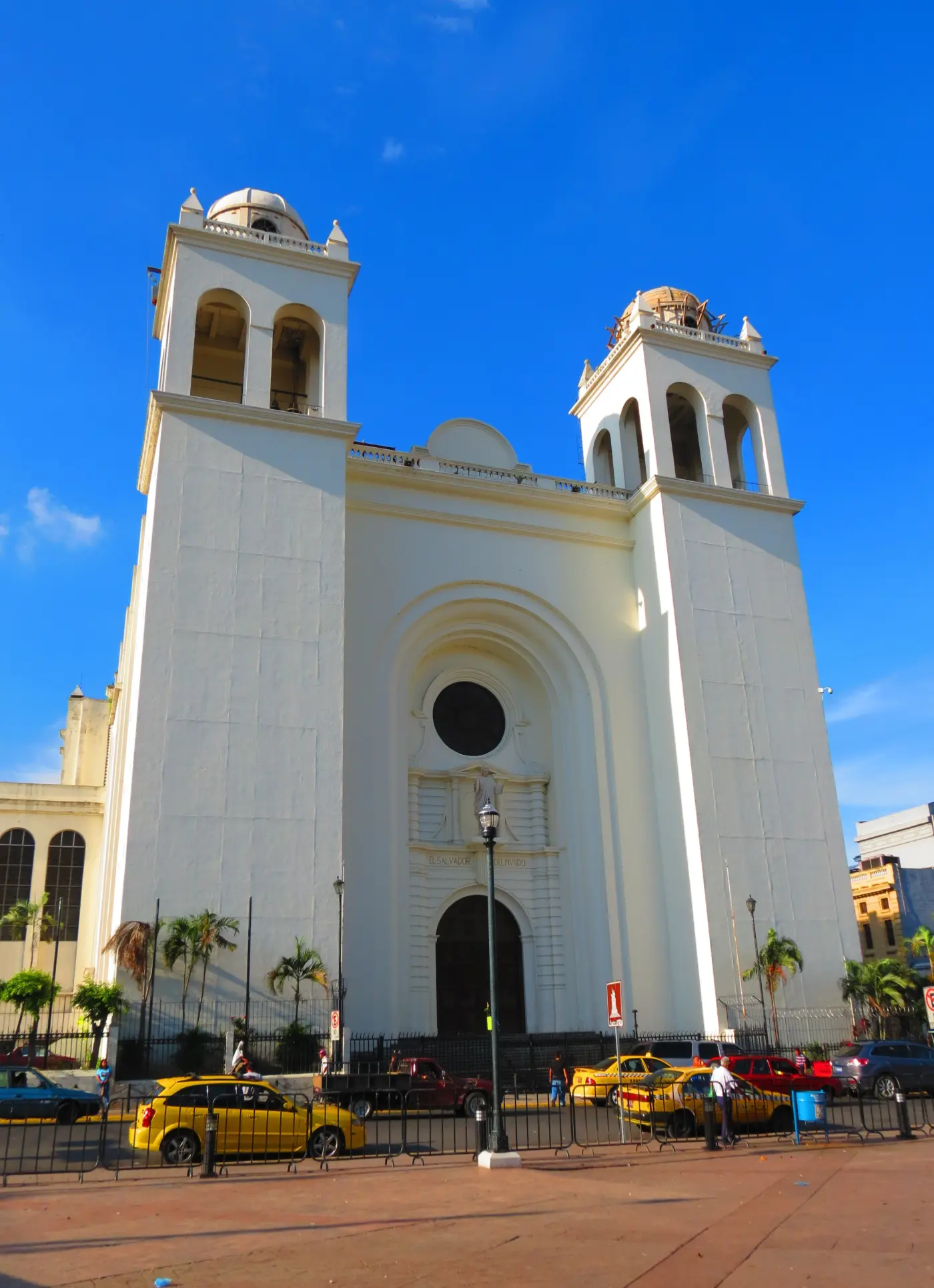
Why did independence have to be declared twice?
The act signed in Guatemala City on 15 September 1821 was a conservative document. It was drafted by the captain general's officials, it invited the king of Spain to rule as a constitutional monarch if he would come, and its purpose was to keep Central America out of the hands of Mexican insurgents and Spanish liberals alike. San Salvador accepted it and then spent eighteen months fighting its consequences. When Agustín de Iturbide had himself crowned emperor in Mexico City in 1822 and the Guatemalan junta declared the annexation of Central America to his Mexican Empire, San Salvador and San Vicente refused. The provincial council, with Delgado at its head, declared separation from Guatemala in January 1822 and prepared for war.
It was a real war. Manuel José Arce raised a small army and fought a campaign in the south-east; Guatemalan and Mexican troops under Vicente Filísola took San Salvador in February 1823, by which time the province's forces had been ground down. The victory was empty. Iturbide abdicated in March, and on 1 July 1823 the Central American assembly, with Delgado as its president, proclaimed independence from Spain, from Mexico and from "any other nation", creating the United Provinces of Central America. San Salvador and Sonsonate were merged into a single state in 1824, and Arce became the federation's first president the following year.
The federation never worked. Its capital was in Guatemala City, its revenue was controlled by Guatemalan merchants, its politics were a running fight between liberals and conservatives, and its states went to war with each other almost continuously from 1826. El Salvador was among the most active. In 1833 the Nonualco leader Anastasio Aquino raised an indigenous army in La Paz, occupied Santiago Nonualco and Zacatecoluca, and issued decrees restoring land to the communities and forbidding their members to work for ladinos; he called himself Rey de los Nonualcos, and he was defeated, captured and executed within months. The revolt is usually treated as a footnote to the federal wars. It is better read as a preview: the demand that land taken by private claimants be returned to the people who farmed it reappears in 1932 and again in the 1970s.
The federation dissolved in 1838–39, leaving El Salvador for a while the only state still nominally inside it. In February 1841 a constituent assembly in San Salvador declared the state separate, and on 18 February signed a constitution that the chief of state, Juan Lindo, promulgated on the 22nd. Its ninety-five articles are worth reading for what they concede. The vote went to men over twenty-one who were heads of household, literate or propertied; the presidency was reserved for a Central American with five years' residence and property worth 8,000 pesos; clergymen were excluded from every elective office; and Article 95 committed the state to "the reorganisation of the Republic of Central America", providing that if that effort failed El Salvador would continue "in the full exercise of its absolute independence and external sovereignty, erecting itself into a republic until the national reunion is achieved". The republic, in its own founding text, was a fallback.
Who ruled the new republic?
Soldiers and planters, in rapid rotation. Between 1841 and 1863 only one chief of state served two consecutive full years. The republic fought wars with Guatemala, Honduras and Nicaragua that were usually about who would install whom in a neighbouring presidency, and it usually lost the argument with Rafael Carrera, the Guatemalan dictator who was the final arbiter of Salvadoran politics until his death in 1865. Salvadoran troops also marched north in the campaign against William Walker in 1856, the one foreign adventure on which the whole isthmus agreed.
The liberal project that eventually took hold began with Gerardo Barrios, who governed in the early 1860s, promoted coffee, secular schooling and a professional army, and was shot in 1865 after his enemies caught him. It was consolidated by the revolution of 1871, when Santiago González overthrew Francisco Dueñas and installed the liberal regime that governed, with one interruption, until 1931. Under Rafael Zaldívar (1876–85) the state secularised education, built roads and ports, borrowed abroad, and rewrote the land law. The constitutions of 1871, 1880, 1883 and 1886 dismantled the corporate privileges of the church, and the men who wrote them were the men who were planting coffee.
Elections existed and mattered less than they seemed. The constitution of 1841 had given the vote to a wide but qualified male electorate; later constitutions narrowed it with property qualifications and indirect elections, and rearranged the machinery to suit whoever held power. Real authority lay with a small set of families around San Salvador and Santa Ana, the officers they promoted and the foreign creditors they paid. It was not a totalitarian system but a competitive oligarchy, in which factions fought through elections, coups and newspapers while the peasant majority remained a tax base and a labour supply rather than a constituency. The one thing the oligarchy would not tolerate was a government that threatened land.
How did coffee rebuild the state?
Coffee had been grown in El Salvador as a garden crop since early in the nineteenth century and became an export industry in the 1860s. It suited the country unusually well: the volcanic soils of the cordillera, the altitude bands between 500 and 1,500 metres and the rainfall of the Pacific slope were close to ideal. It also demanded more than indigo had. A coffee bush takes three to five years to bear, so planting tied up land and capital for years; it needed shade trees, nurseries, pulping stations and, above all, secure title to the ground it stood on. Unlike Guatemala and Costa Rica, Salvadoran coffee grew with almost no foreign capital, financed and processed by Salvadorans — one reason the planter class became so politically confident so quickly.
The liberal state gave coffee what it needed. Railways ran from Acajutla to Sonsonate and Santa Ana, banks were founded, and the colón became the national currency in 1892. Export earnings paid for it, and import duties on the goods those earnings bought supplied most of the government's revenue. The state also gave coffee the one thing railways could not: land with a clear title, held by whoever could pay for the paper.
The legal change is the part that mattered most, and it is often compressed into a single year. On 15 February 1881 the legislature passed the Law for the Extinction of Communities, published in the Diario Oficial on 26 February, which ordered that "the lands called communal shall be divided among the co-owners" in proportion to their contributions, and that those in possession be considered legitimate owners of their portions. Its preamble is an almost perfect statement of liberal political economy: undivided communal property "impedes the development of agriculture, obstructs the circulation of wealth and weakens the bonds of family and the independence of the individual".
A second statute, on 2 March 1882, went further. The Law for the Extinction of Ejidos declared that "the institution of ejidos is extinguished in El Salvador", converted every current occupant of municipal common land into its exclusive owner on payment of six years' rent to the municipality, and gave occupants six months to obtain title. Land neither claimed nor sold within a year reverted to the nation. Together the two laws dissolved the corporate landholding of the villages, which had been the material basis of indigenous community life since the conquest, and they did it by a procedure — survey, stamped paper, a fee, a deadline — that sorted the population by literacy and cash.
Who lost the land?
In the short run, fewer people than the legend suggests; in the long run, almost everyone who had none to begin with. The 1882 law did not confiscate the smallholder's plot. It gave him a title to it, at a price, within a deadline. Those with money, credit, literacy and friends in the municipality came out of the operation holding clear title to the best ground. Those without — and the landless labourers who had never held ejidal rights at all — came out with nothing, and land they had farmed as a right became land they worked for wages.
The consequences were visible within a decade. Coffee required nurseries, shade, picking and processing, and the labour was seasonal and heavy; the state supplied it by policing. Vagrancy laws, passed from the 1880s onwards and tightened later, allowed the authorities to define a man without visible employment as a vagrant and conscript him onto a plantation. In 1912, after a mission from Spain's Civil Guard, the government created the Guardia Nacional, a rural gendarmerie whose posts were often paid for by the estates themselves; it became the spine of rural government for the next seventy years. Where villages kept land, they kept it on the margins — steep ground, volcanic ash, the slopes nobody wanted.
Historians have qualified the picture without overturning it. Aldo Lauria-Santiago has argued that the coffee economy of the 1880s and 1890s was built by a much wider group of small and middling growers than the word "oligarchy" implies, and that peasant communities were commercially active and often successful in defending communal land — by petition and litigation as well as by revolt, and with very different outcomes from region to region. The last substantial indigenous rising of the century, at Izalco in 1898, came out of factional politics inside the Indian community of Dolores Izalco as much as out of the advance of the coffee estates. What is not in dispute is the concentration of the finished product. By the 1970s some 35,000 to 40,000 farms grew coffee, but 10 per cent of producers controlled 80 per cent of output, and a small number of millers and exporters — who financed the harvest and owned the processing plant — took a share of every sack that passed through their hands. The men who ran the country were drawn from that group, and the phrase "the fourteen families", which became a staple of 1980s journalism, was a rough political shorthand for it rather than a census.
Why did the western villages rise in 1932?
Because the state had spent fifty years teaching them that land and local office were worth fighting for, and then took both in a single season. The trigger was economic. The crash of 1929 cut the coffee price by more than half; national income fell by around 50 per cent between 1929 and 1931; plantation wages dropped from 40 or 50 centavos a day to 20. Rural unemployment in the coffee departments of the west was severe and relief was negligible.
The politics were local before they were ideological. In the towns of Sonsonate department — Nahuizalco, Juayúa, Izalco — the 1920s had been consumed by a running quarrel between Indian communities and ladino families over municipal office, over the rents from communal land, and over whether an illiterate Indian mayor could legally hold his seat. Pío Romero Bosque's reforms after 1927 opened the electoral system, and the Indians of Nahuizalco won the municipal election of December 1927, only to have the result annulled because the winner could not read. The presidential election of 1931, the first genuinely competitive contest in Salvadoran history, brought Arturo Araujo to office with a reformist programme; on 2 December the army deposed him and installed his vice-president, General Maximiliano Hernández Martínez.
What followed was a cancelled election and a wave of arrests that convinced the left the ballot was closed. Municipal elections in January 1932 were won by the Communist Party in several western towns and then annulled; its leaders, including Agustín Farabundo Martí, were arrested on 18 January. The rising that broke out on 22 January — Erik Ching's archival work puts the first attacks on the evening of 20 January — was not a communist insurrection in any operational sense. It was a conglomeration of village risings, led in Izalco by the Pipil leader Feliciano Ama and in Juayúa by Francisco "Chico" Sánchez, which took more than a dozen towns, held some for several days, and killed perhaps a hundred people, soldiers and officials among them. The Communist Party's central committee had voted to join only ten days earlier, against the judgement of some of its own members, and could not control what it had joined.
The repression was out of all proportion and it was ethnic as well as political. Troops under General José Tomás Calderón retook the towns by 25 January and then, for about a fortnight, killed villagers across the coffee districts — in Izalco, Nahuizalco, Juayúa, Tacuba and the surrounding cantons. Men were taken from their houses and shot in groups; in several towns the male population was assembled in the square and machine-gunned. Estimates of the dead run from 10,000 to 40,000 in a country of 1.5 million; scholarly work since the 1970s clusters at the lower end, but no register was kept and the figure has never been settled. Martí, Alfonso Luna and Mario Zapata were shot on 1 February; Ama was lynched in the plaza of Izalco on 28 January.
The aftermath shaped everything that followed. The Legislative Assembly passed Decree 121 on 11 July 1932, granting an unconditional amnesty to everyone, rebel or soldier, who had committed crimes during the repression — the first of the country's amnesties and the model for those of 1987 and 1993. Soldiers identified suspects by dress, language and appearance, and after 1932 the Pipil stopped wearing traditional clothes and stopped speaking the language in public; it effectively died in the west within a generation. The lesson the elite drew was that the state could kill its way out of a crisis cheaply, and that Washington would reconcile itself to a government that did. The United States, which had withheld recognition after the December 1931 coup, extended it in 1934.
How did the military hold power for forty-eight years?
By combining repression with reform, and by making the army the arbiter of both. Martínez governed from 1931 to 1944 — the Martinato — with public works, a Central Reserve Bank founded in 1934, a welfare programme for poor peasants, and rigged elections in which he was the only candidate. He survived a coup attempt on Palm Sunday 1944 and then fell, in May, to a general strike of students and office workers, the huelga de brazos caídos, after police shot a demonstrator. He resigned on 9 May and went into exile in Guatemala.
The settlement that followed was the work of junior officers. A coup in December 1948 — the golpe de los mayores — forced every officer above the rank of lieutenant-colonel into retirement and produced the constitution of 1950, which lasted, in form, until 1983. It created a central bank, social security, a labour code and a state that presented itself as modernising and anti-communist. Under Óscar Osorio and Julio Adalberto Rivera, El Salvador joined the Alliance for Progress, entered the Central American Common Market, built roads and hydroelectric dams, and kept the electorate inside a single official party, the National Conciliation Party, founded in 1961.
The reform was real but bounded. Land reform was discussed in every administration from 1950 onwards and implemented in none, because the coalition that sustained the army included the landowners who would have paid for it. The security apparatus grew instead: the National Security Agency, ANSESAL, was created in the mid-1960s, and with it ORDEN, a paramilitary network of rural informers and enforcers that intimidated voters, broke strikes and killed organisers. The church, meanwhile, had begun to change. The Second Vatican Council and the Medellín conference of 1968 pushed a generation of Salvadoran priests towards the poor, and the Jesuits at the Central American University became, in effect, the opposition's research department.
The war with Honduras in July 1969 — the hundred hours' war, remembered as the Football War — exposed the fragility underneath. Some 300,000 Salvadorans lived in Honduras, many without papers, and Honduran land reform and nationalism had turned them into a target; after the third World Cup qualifying match in June 1969, thousands were expelled or fled. El Salvador invaded on 14 July, the Organization of American States imposed a ceasefire on 18 July, and around 2,000 people, most of them civilians, were dead. The refugees who came back to a country with no land for them became the recruitment pool for the guerrilla movements and the Christian Democrats alike.
The political closure that followed turned discontent into insurgency. In 1972 the opposition united behind José Napoleón Duarte; the count gave him a narrow lead, a recount gave the presidency to Colonel Arturo Armando Molina, and a coup attempt by reformist officers was crushed within two days, with Duarte tortured and exiled. In 1977 General Carlos Humberto Romero won an election that observers thought he had lost, and on 28 February troops fired on a protest in San Salvador, killing somewhere between 200 and 1,500 people. By then the Fuerzas Populares de Liberación had been fighting since 1970, the People's Revolutionary Army since 1972, and both had built mass organisations of unions, peasants and Christian base communities.
Why did reform turn into civil war?
Because the reformers could not deliver land, and the men who opposed it owned the guns. The coup of 15 October 1979 installed a joint civilian-military junta that promised agrarian reform, nationalised the banks and the coffee and sugar export trade, and abolished ORDEN. Its first land phase, applied to estates over 500 hectares, eventually expropriated 469 properties — about 20 per cent of farmland, including 14 per cent of the coffee land — and turned them into cooperatives. That was enough to enrage the landowners and not enough to satisfy the peasants, and it was accompanied by a rising tide of killing. Landowners slaughtered their own cattle and moved machinery across the Guatemalan border; cooperative leaders were assassinated as they became visible. The three civilian members of the junta resigned in January 1980, and the Christian Democrat José Napoleón Duarte joined it in March.
On 24 March 1980 Archbishop Óscar Romero was shot while celebrating Mass in the chapel of the Divina Providencia hospital, the day after he had called on soldiers to disobey orders to kill civilians. In a letter to President Carter in February he had written that political power in El Salvador lay "in the hands of the armed forces", who "know only how to repress the people and defend the interests of the Salvadoran oligarchy". His funeral a week later ended in sniper fire that killed dozens. In December the National Guard raped and murdered four American churchwomen. By then the death squads, run out of the intelligence services and financed by the oligarchy, were killing hundreds a month, and the five guerrilla organisations had united in the Farabundo Martí National Liberation Front.
The war was fought by an army of 40,000 to 60,000, trained and equipped by the United States, against an insurgency of perhaps 10,000 to 15,000 supplied through Nicaragua and Cuba. Its logic was demographic. The army's counter-insurgency doctrine, adapted from Vietnam, aimed to "drain the sea" by emptying the villages that sheltered the guerrillas: to move or kill the rural population, bombard and burn settlements, and arm civilians into civil-defence patrols. The results were the Rio Sumpul in May 1980, where some 600 civilians were killed while Honduran troops blocked their escape; the Cabañas sweeps of 1981; and El Mozote.
On 11 and 12 December 1981 soldiers of the Atlácatl battalion, created that year with American money and trained by American advisers, murdered the population of El Mozote and the neighbouring hamlets in Morazán. The Inter-American Court of Human Rights put the dead at more than 811, including 146 children; the Argentine Forensic Anthropology Team, which exhumed one site in 1992, recovered the remains of 143 people, 131 of them children under twelve. Survivors gave journalists lists of names that grew from a few hundred to nearly a thousand, and the United Nations truth commission counted more than 500 identified victims while noting that many could not be identified. The battalion's commander, Colonel Domingo Monterrosa, was later reported to have said the village was to be made an example. The Reagan administration dismissed the first press reports as guerrilla propaganda and the reporters who filed them were attacked in Congress and in their own newspapers.
Politically the war was fought to a stalemate and then to a negotiation. Elections to a constituent assembly in 1982 produced the constitution of 1983, still in force, and a provisional president, Álvaro Magaña, chosen by the assembly. Duarte won the presidency in 1984 with 54 per cent of the vote and American money, and governed without the ability to control the army. The FMLN's November 1989 offensive took the fighting into the suburbs of San Salvador and convinced the high command that it could not win; five days later soldiers of the same Atlácatl battalion murdered six Jesuit priests, their housekeeper and her daughter at the Central American University. The murders, and the collapse of the Soviet bloc, made a negotiated settlement the only option left to both sides.
What did the Chapultepec accords settle?
Almost everything except impunity. The Peace Agreement signed at Chapultepec Castle in Mexico City on 16 January 1992 ran to nine chapters and rested on four bargains. The army would be brought under civilian doctrine, purged through an ad hoc commission and reduced; the old security forces — the National Guard, the Treasury Police and the National Police — would be dissolved and replaced by a new National Civil Police under a single command; the FMLN would become a political party; and land would be transferred to former combatants and landless peasants, with holdings above 245 hectares liable to expropriation. A Truth Commission was established to investigate the worst abuses of the war.
Implementation was supervised by the United Nations Observer Mission, ONUSAL, which began as a human rights mission in 1991 and ended as a peacekeeping and electoral operation. The Ad Hoc Commission recommended the removal of more than a hundred officers, including the defence minister and most of the high command; President Alfredo Cristiani retired about a hundred of them in 1993 and posted others abroad. The army fell from around 60,000 to fewer than 30,000, its rapid-reaction battalions were dissolved, and the National Civil Police was built from scratch with Spanish, Chilean and Swedish instructors. The land transfer, administered through a Land Bank, eventually moved land to tens of thousands of former combatants and peasants.
The truth commission reported on 15 March 1993. It had testimony concerning some 7,000 victims, registered more than 22,000 complaints for 1980–91, and attributed about 85 per cent of the violence it examined to the armed forces, the security forces and the death squads, and about 5 per cent to the FMLN. It named names, including Roberto D'Aubuisson for Romero's murder and the high command for the Jesuits. Five days later the Legislative Assembly passed a general amnesty granting "broad, absolute and unconditional" pardon. The bargain — peace for accountability — held for twenty-three years, until the constitutional chamber of the Supreme Court struck the amnesty down in 2016; prosecutors then began reopening cases, El Mozote among them.
What did peace change?
The political system more than the economy. ARENA governed from 1989 to 2009 — Cristiani, then Armando Calderón Sol, Francisco Flores and Antonio Saca — and used its four consecutive terms to privatise the banks, the pension system, the telephone company and the coffee and sugar export trade, to introduce a value-added tax, and in 2001 to abandon the colón for the United States dollar. The FMLN became a party, took a quarter of the assembly in 1994, won the mayoralty of San Salvador in 1997, and in 2009 elected Mauricio Funes, a television journalist, as the first president of the left; Salvador Sánchez Cerén, a former guerrilla commander, followed in 2014.
The social settlement was thinner. The accords transferred land to ex-combatants but did not touch the concentration of the coffee estates, and the countryside the war had emptied filled up again with families who had no title. Two earthquakes in January and February 2001 killed about 1,260 people and destroyed the homes of hundreds of thousands, and the reconstruction programme became a case study in clientelism. Remittances from Salvadorans in the United States became the country's largest source of foreign exchange — around $6 billion, a fifth of GDP, by 2019, when some 2.35 million Salvadorans lived in the United States — and migration became both the most important export and the most reliable social policy.
The gangs grew in the space the state left. MS-13 and Barrio 18 were formed in Los Angeles by Salvadoran and Mexican migrants and arrived with the deportations of the 1990s; by 2016 they had a presence in 247 of the country's 262 municipalities and lived off extortion, charged on buses, shops and market stalls. The state's answer was mano dura, mass arrests of young men on suspicion of gang membership from 2003 onwards, which filled the prisons without reducing the killings. A truce negotiated in 2012 between the two gangs and the government cut the murder rate for two years and then collapsed; in 2015 the country recorded 6,650 homicides, a rate of about 103 per 100,000, the highest in the hemisphere.
That failure is the background to everything that followed. By 2019 the rate had fallen to about 36 per 100,000 from its 2015 peak, partly through a new security policy and partly through informal arrangements with the gangs that later became a scandal. But extortion remained general, the prisons were full, and the two parties that had run the country since 1992 were widely seen as corrupt and exhausted.
How did Bukele break the old political order?
Nayib Bukele, a former mayor of San Salvador from a family of Palestinian merchants, won the presidency in February 2019 with 53 per cent of the vote, standing for a small party allied to his own new movement, Nuevas Ideas. He was 37, campaigned on social media and against corruption, and had no support in the assembly. In February 2020, after a dispute over a loan for the police, he entered the Legislative Assembly with soldiers and sat in the speaker's chair; the episode was condemned as an attempted self-coup and cost him nothing politically. In the elections of February 2021 his party and its allies won a supermajority, and on 1 May 2021 the new assembly removed the five judges of the Constitutional Chamber and the attorney general and replaced them the same day.
The consequences came quickly. On 3 September 2021 the new chamber ruled that the president could serve two consecutive terms, reversing a 2014 ruling; the constitution says no such thing, and that decision was the legal foundation of everything that followed. In June 2021 the assembly had made bitcoin legal tender, the first country in the world to do so; the currency never worked as money, and in January 2025, under an IMF programme worth $1.4 billion, the law was amended to strip bitcoin of its status as tender.
The crackdown began on 27 March 2022, in response to 87 homicides in three days, 62 of them on a single Saturday. The assembly declared a state of exception, suspending the rights to assembly, association, privacy of communication and legal counsel, and extending detention without charge from three days to fifteen. Police and soldiers arrested people on suspicion, in sweeps and blockades; the assembly raised penalties for gang membership, lowered the age of criminal responsibility to twelve and made it an offence to reproduce gang messages. The Terrorism Confinement Center, a prison for 40,000 at Tecoluca, opened on 31 January 2023. By late 2026 the state of exception had been extended 55 times, more than 90,000 people had been arrested, some 8,000 had been released, and El Salvador had the highest incarceration rate in the world — roughly 1.7 per cent of its people in prison.
The results, on the government's figures, have been extraordinary. Homicides fell from 1,147 in 2021 to 496 in 2022, 154 in 2023 and about 114 in 2024, a rate of 1.9 per 100,000; the government reported a lower rate again in 2026. Extortion has fallen sharply and approval ratings have stayed in the 80s. The costs are documented by the human rights organisations that remain: arbitrary detention, torture, deaths in custody, mass trials of hundreds of defendants at a time, and the prosecution of journalists and activists. The Congressional Research Service noted in 2025 that if police killings, deaths in prison and the discovery of remains were counted as homicides, the 2023 rate would be up to 47 per cent higher than the published figure.
The political consolidation followed the security one. In February 2024 Bukele was re-elected with 84.65 per cent of the vote, the first Salvadoran president to win a second consecutive term since Martínez in 1944. In June 2023 the country's 262 municipalities had been reduced to 44. In July 2025 the assembly amended the constitution to abolish presidential term limits, extend the presidential term from five years to six, replace the two-round election with a single round and move the next election from 2029 to 2027; in March 2026 it approved life imprisonment for murder, rape and terrorism. The opposition is reduced to a handful of deputies and a press working under threat.
The economy grew 2.6 per cent in 2024 and 3.5 per cent in 2023, against an average of 2.1 per cent a year since 2000. It rests on remittances, on the textile factories of the free-trade zones and on a construction boom financed partly by debt. Public debt reached 88.9 per cent of GDP in 2024, and poverty, having fallen for two decades, rose from 26.8 per cent in 2019 to 30.3 per cent in 2023. In December 2024 the assembly repealed the 2017 ban on metal mining, which had made El Salvador the first country to prohibit it; the church and the environmental movement opposed the repeal and the first licences are being issued. Emigration continues and has changed character, with middle-class families leaving; in 2025 the government also agreed to hold third-country deportees for the United States, and 238 Venezuelans were flown to CECOT that March.
The historical pattern is hard to miss. El Salvador has twice built a state on a single export and a single governing coalition — coffee and the planter oligarchy after 1880, and now security and the Bukele movement — and twice produced a system that delivered order at the cost of excluding most of the population from any legal claim on it. The difference is that the second system is popular in a way the first never was, because the violence it ended was real and general. Whether a state built on emergency powers, mass detention and one man can outlast him is the question the country now faces, and it is the same question the coffee republic faced after 1932.
Common myths about El Salvador
| Myth | What the evidence says |
|---|---|
| El Salvador declared independence on 15 September 1821 | The act of that date was Guatemala's, issued for the whole captaincy general; San Salvador endorsed it and then fought annexation by Mexico. The separate republic dates from the constitution of 18 February 1841 |
| 1841 was a clean declaration of independence | Article 95 of the 1841 constitution commits the state to restoring the Central American union and says it will remain a republic only "until the national reunion is achieved". Sovereignty was a fallback, not a doctrine |
| The 1881 law abolished the ejidos | The ejido law is dated 2 March 1882. The law of 15 February 1881 abolished communal (comunal) land; the 1882 law dissolved the municipal ejidos and gave occupants title |
| The land laws were a reform on behalf of the poor | They turned occupants into owners on payment, within a six-month deadline, through a procedure that required cash and literacy. Landless labourers, who held no ejidal rights, gained nothing and became the workforce of the new plantations |
| La Matanza was a communist revolution that the state crushed | The Communist Party's role was marginal: it voted to join a rising already under way and could not control it. The revolt grew out of Pipil community politics in the Sonsonate towns, with the party carried along |
| Thirty thousand people died in 1932 | No register was kept. Serious estimates run from 10,000 to 40,000 in a population of 1.5 million; the higher figures come from contemporary rumour and later political use, the lower ones from archival work on particular municipalities |
| Fourteen families owned El Salvador | The phrase is journalistic shorthand. There were 35,000 to 40,000 coffee farms, and 10 per cent of producers accounted for 80 per cent of output; the decisive concentration was in milling and exporting rather than in land alone |
| Archbishop Romero was shot at the altar of the cathedral | He was killed at the altar of the chapel of the Divina Providencia hospital, where he lived, while saying Mass for a dying woman. The setting matters: he was murdered in the compound he had chosen over the archbishop's palace |
| The Football War was caused by a football match | The matches were the occasion. The causes were Honduran land reform, the expulsion of some 300,000 Salvadorans and the collapse of a common market; the fighting lasted about 100 hours and killed around 2,000 people |
| Bukele's crackdown explains the whole fall in homicides | The rate had already fallen from about 103 per 100,000 in 2015 to 36 in 2019. The fall after 2022 is steep and real on official data, but the series leaves out categories that would raise the 2023 rate by up to 47 per cent |
Timeline of El Salvador
| Year | Event |
|---|---|
| 1821 | 15 September: Central America declares independence from Spain; San Salvador adheres |
| 1822–23 | San Salvador and San Vicente refuse annexation to Iturbide's Mexican Empire; war follows, and Mexican troops occupy the capital in February 1823 |
| 1823 | 1 July: the United Provinces of Central America are proclaimed, with Delgado presiding |
| 1833 | Anastasio Aquino's Nonualco rising is crushed and he is executed |
| 1841 | February: the constituent assembly declares the state separate; the constitution is signed on 18 February and promulgated on the 22nd |
| 1871 | Santiago González overthrows Francisco Dueñas and the liberal regime begins |
| 1881–82 | Two land laws: the Law for the Extinction of Communities (15 February 1881) and the Law for the Extinction of Ejidos (2 March 1882) |
| 1931 | 2 December: the army overthrows Arturo Araujo; Hernández Martínez takes power |
| 1932 | 22 January: the peasant rising in the west; the matanza follows, with 10,000–40,000 dead |
| 1944 | May: the general strike forces Martínez to resign |
| 1948 | December: the golpe de los mayores begins the reformist military era |
| 1969 | 14 July: the hundred hours' war with Honduras |
| 1979 | 15 October: junior officers install the Revolutionary Government Junta |
| 1980 | 24 March: Archbishop Romero is assassinated; the FMLN is formed in October |
| 1981 | 10 January: the FMLN's first great offensive; 11–12 December: El Mozote |
| 1989 | 11 November: the FMLN offensive in the capital; 16 November: the Jesuit murders |
| 1992 | 16 January: the Chapultepec peace accords are signed in Mexico City |
| 2019 | 1 June: Nayib Bukele takes office |
| 2022 | 27 March: the state of exception begins after 87 killings in a weekend |
| 2024 | February: Bukele is re-elected with 84.65 per cent of the vote |
What the map shows next
At 1841 on the map the map draws El Salvador in the year of its separation from the federation: a small state between Guatemala and Honduras, its economy still built on indigo, its borders already those it would keep. Set it beside its neighbours and the pattern of the century becomes visible — a country with no room to expand, whose politics were conducted largely by interfering in theirs.
At 1882 on the map the outline is the same and the country is not: the communal lands have just been extinguished, the railway from Acajutla is open, and the coffee frontier is moving up the volcanic slopes. At 1932 on the map the republic is drawn in the year of the matanza, with the coffee estates of the west at the centre of the economy and the army that would rule for half a century already in charge. The data then skips the war entirely and resumes at 1992; at 2024 on the map the borders are unchanged, the population is smaller relative to its neighbours than at any time since independence, and the prisons have become the government's principal claim to legitimacy.
Common questions
- When did El Salvador become independent?
- It declared independence from Spain with the rest of Central America on 15 September 1821, joined the Central American union in 1823, and became a separate republic under the constitution of 18 February 1841.
- Was El Salvador part of Mexico?
- Briefly and against its will: the province was annexed to Agustín de Iturbide's Mexican Empire in 1822, resisted with arms, and passed to the United Provinces of Central America after the empire collapsed in 1823.
- Why is El Salvador so densely populated?
- Because the volcanic soils of the Pacific slope supported a large peasant population from the colonial period and the country is small — 21,041 square kilometres holding 6,029,976 people at the 2024 census.
- What was La Matanza?
- The killing of between 10,000 and 40,000 people, mostly Pipil peasants, by the army and landowner militias in western El Salvador in January and February 1932, after a peasant rising against the government of Maximiliano Hernández Martínez.
- Who was Farabundo Martí?
- A Salvadoran revolutionary who helped found the Communist Party of El Salvador in 1930, was arrested days before the 1932 rising, and was shot on 1 February 1932; the FMLN took his name when it was formed in 1980.
- What happened at El Mozote?
- Soldiers of the American-trained Atlácatl battalion killed most of the population of a village in Morazán on 11–12 December 1981 — more than 811 people according to the Inter-American Court of Human Rights, many of them children.
- Why did El Salvador fight a war with Honduras in 1969?
- Because 300,000 Salvadoran migrants were being expelled from Honduras under pressure from land reform and nationalism, and a four-day war in July 1969 was the result; the football matches were the occasion, not the cause.
- How many people died in the civil war?
- Around 75,000, according to the United Nations truth commission, with some 8,000 disappeared and about a million people displaced out of a population of 5.4 million.
- What did the 1992 peace accords do?
- They dissolved the old security forces, created a National Civil Police, purged and shrank the army, turned the FMLN into a political party and provided for land transfers, but they left the amnesty that shielded the perpetrators.
- Is El Salvador still a democracy?
- It holds elections and its government is popular, but since 2021 the presidency has controlled the assembly, the courts and the prosecutor's office, and the 2025 amendment permitting indefinite re-election is treated by most observers as a break with constitutional rule rather than a continuation of it.
Sources
Every source below was consulted while writing this entry.
- Constitución de la República de El Salvador (San Salvador, 18 February 1841), with the bases of 24 July 1840; text published by the Corte Suprema de Justicia de El Salvador
- Ley de Extinción de Comunidades, legislative decree of 15 February 1881, Diario Oficial no. 49, tomo 10, 26 February 1881
- Ley de Extinción de Ejidos, legislative decree of 2 March 1882, Diario Oficial no. 62, tomo 12, 14 March 1882
- Peace Agreement (Chapultepec), 16 January 1992, United Nations document A/46/664–S/23501, 30 January 1992
- Comisión de la Verdad, De la locura a la esperanza: la guerra de doce años en El Salvador (United Nations, S/25500, 1993), summary text
- Corte Interamericana de Derechos Humanos, Masacres de El Mozote y lugares aledaños v. El Salvador, judgment of 25 October 2012
- Human Rights Watch, The Massacre at El Mozote: The Need to Remember (1992)
- Argentine Forensic Anthropology Team, reports on the El Mozote exhumations (1992–93)
- Jeffery M. Paige, "Coffee and Power in El Salvador", Latin American Research Review 32:3 (1997), 7–40
- Erik Ching, "In Search of the Party: The Communist Party, the Comintern, and the Peasant Rebellion of 1932 in El Salvador", The Americas 55:2 (1998), 204–239
- Aldo Lauria-Santiago, An Agrarian Republic: Commercial Agriculture and the Politics of Peasant Communities in El Salvador, 1823–1914 (University of Pittsburgh Press, 1999), and "Land, Community, and Revolt in Late-Nineteenth-Century Indian Izalco, El Salvador", Hispanic American Historical Review 79:3 (1999), 495–534
- Congressional Research Service, El Salvador's State of Exception and U.S. Interests, IN12510 (2025)
- Encyclopaedia Britannica, "History of El Salvador" and "El Salvador"
- World Bank, "El Salvador Overview", October 2025
- Wikipedia entries on La Matanza, the Salvadoran Civil War, the military dictatorship in El Salvador and the 2022 gang crackdown, used for chronology and checked against the sources above
Data sources for the map
- Cliopatria v0.12 (Seshat Global History Databank, CC BY 4.0).
- Historical Basemaps (GPL-3.0).
This entry was written from the sources above and last updated .
Text available under CC BY-SA 4.0: reuse it with a credit to The World Through Time and a link to this page.
Border geometry for the map itself comes from Cliopatria v0.12 (Seshat Global History Databank, CC-BY-4.0).
See El Salvador in its world
Open the atlas at 1909 and every neighbour, rival and successor is on screen with it — then drag the slider and watch what happens next.
Open the map at 1909 →