Human verified. Last updated by our editorial team on .
North America · Independence and the new republics
First Mexican Empire
1821–1823
The First Mexican Empire lasted seventeen months. It began on 27 September 1821, when the Army of the Three Guarantees marched into Mexico City and a new country declared itself independent, and it ended on 19 March 1823, when Agustín de Iturbide abdicated and went into exile. In between, Mexico tried to be a monarchy and discovered that it had no monarch, no money and no agreement about what kind of country it was.
- Existed
- 1821–1823
- Shown on the map
- 1822–1823
- Peak area
- 3.6M km²
- Region
- North America
It mattered none the less. The empire was the first sovereign Mexican state, the largest country in the Americas at its fullest extent, and the laboratory in which Mexican politics acquired its permanent vocabulary: the three guarantees, the imperial presidency, the pronunciamiento, the provincial revolt against the centre.
At a glance
| Name | First Mexican Empire; Primer Imperio Mexicano |
| Dates | 1821–1823 (the map draws 1822–1823) |
| Where | The former Viceroyalty of New Spain: Mexico, Central America, Texas, New Mexico, the Californias, Yucatán |
| Capital | Mexico City |
| Head of state | Agustín I (Iturbide), crowned 21 July 1822 |
| Government | Regency, then constitutional monarchy with a Constituent Congress |
| Population | About 5.8–6.5 million (Humboldt, Navarro y Noriega, Poinsett) |
| Economy | Silver mining, agriculture, a war-wrecked treasury and a paper currency at a 75 per cent discount |
| Army | A paper establishment of some 60,000 regulars, cut to 20,000 in April 1822 |
| End | Abdication, 19 March 1823; republic proclaimed 1824 |
What was the First Mexican Empire?
The state that emerged from the collapse of Spanish rule in 1821, when the royalist officer Agustín de Iturbide changed sides and the viceroyalty dissolved without a battle. It was a constitutional monarchy in form and a military improvisation in fact: a Congress wrote a constitution while a general made himself emperor, and the contradiction destroyed both of them.
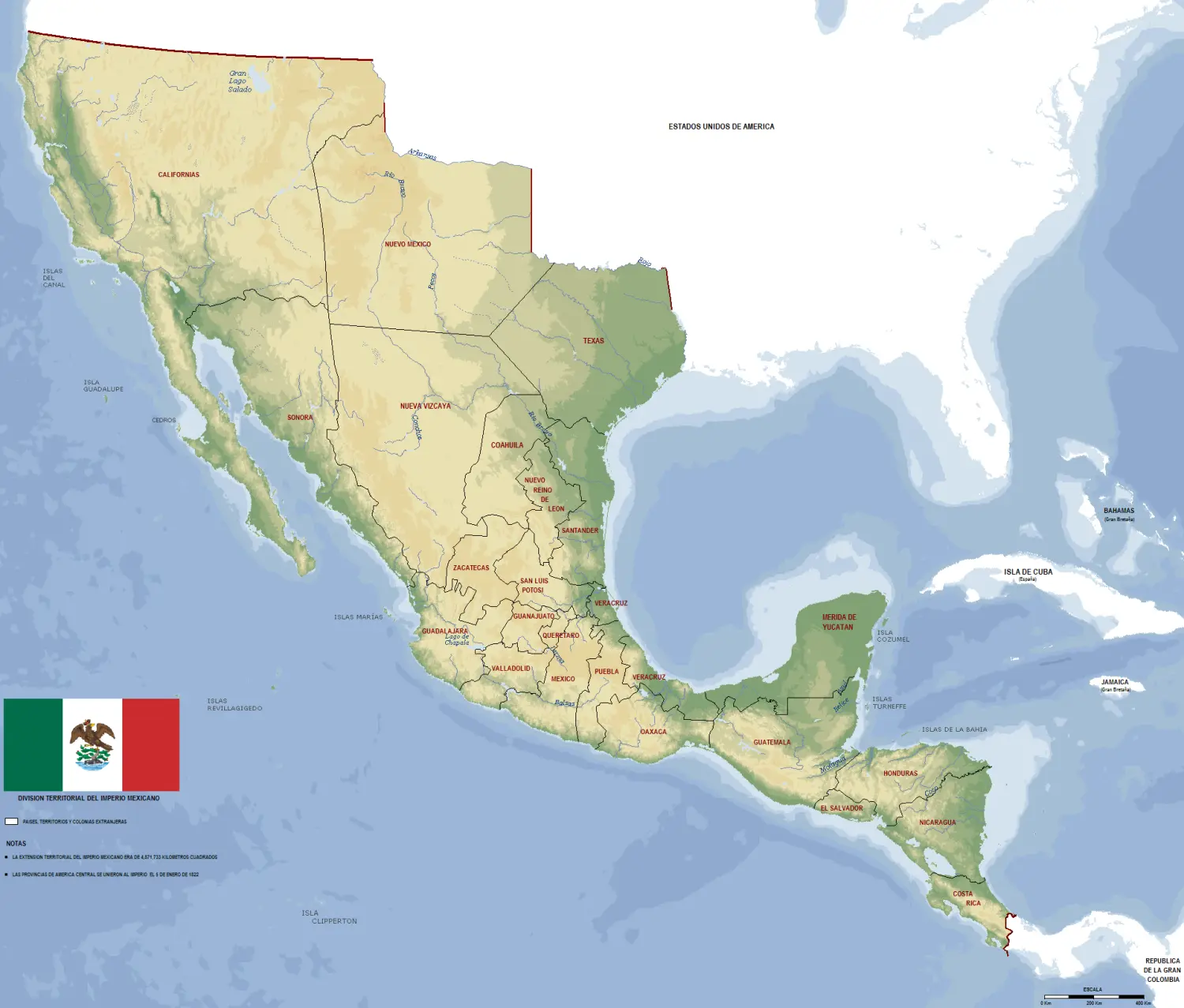
Its extent was enormous. It claimed the whole of New Spain, from the Californias and New Mexico to Chiapas and Guatemala, and for eighteen months it included most of Central America. On the map it covers some 3.6 million square kilometres; Humboldt calculated 4.4 million for the viceroyalty without Guatemala, and both figures measure a claim rather than an administration.
How did Mexico become independent?
The war itself was long and bitter. Hidalgo's army was enormous and untrained, and its march on Mexico City in 1810 was called off; his execution at Chihuahua in 1811 was followed by Morelos's campaigns in the south, the Congress of Chilpancingo in 1813, the constitution of Apatzingán in 1814 and Morelos's execution in 1815. By 1816 the insurgency was reduced to Guerrero's band in the mountains of the south and a few others, and the viceregal government — backed by a large, largely Creole royalist army — was winning.
What changed was Spain. The pronunciamiento of Riego in January 1820 restored the liberal Constitution of Cádiz, which abolished the Inquisition, limited the Church and threatened the privileges of the Mexican elite. The Creole officers who had been fighting the insurgents for a decade now faced a Spanish government they regarded as godless and centralising. Iturbide, a royalist brigadier with a reputation for ruthlessness, was the man they chose — and he chose to change sides.
Not in one moment, and not by the people everyone remembers. Miguel Hidalgo's rising of 16 September 1810 was a social revolution in the Bajío that terrified the Creole elite as much as it frightened the Spaniards; he was captured and executed in 1811. José María Morelos kept the insurgency alive, and the Congress of Apatzingán produced a republican constitution in 1814, before he too was captured and shot in 1815.
By 1820 the rebellion was reduced to a few guerrilla bands under Vicente Guerrero, and the royalist army was winning. Then the liberal revolution in Spain — the restoration of the Constitution of Cádiz in March 1820 — frightened the Mexican elite more than the insurgents did. Iturbide, a royalist officer who had fought the insurgents for a decade, was given command of a force to finish them and instead negotiated with Guerrero. The result was the Plan of Iguala of 24 February 1821, and its three guarantees: religion, independence, union — Catholicism as the only faith, independence from Spain, and an end to racial distinctions, with a monarchy and a Bourbon prince invited to rule.
It was a conservative settlement designed to prevent revolution — the same fear that had made the English colonies loyal to the crown a generation earlier — and it worked: the army changed sides, the provinces declared for the plan, and on 24 August 1821 the new Spanish viceroy, Juan O'Donojú, signed the Treaty of Córdoba accepting independence. O'Donojú died on 8 October 1821, four days after arriving in Mexico City, and the Cortes in Madrid repudiated both treaty and independence.
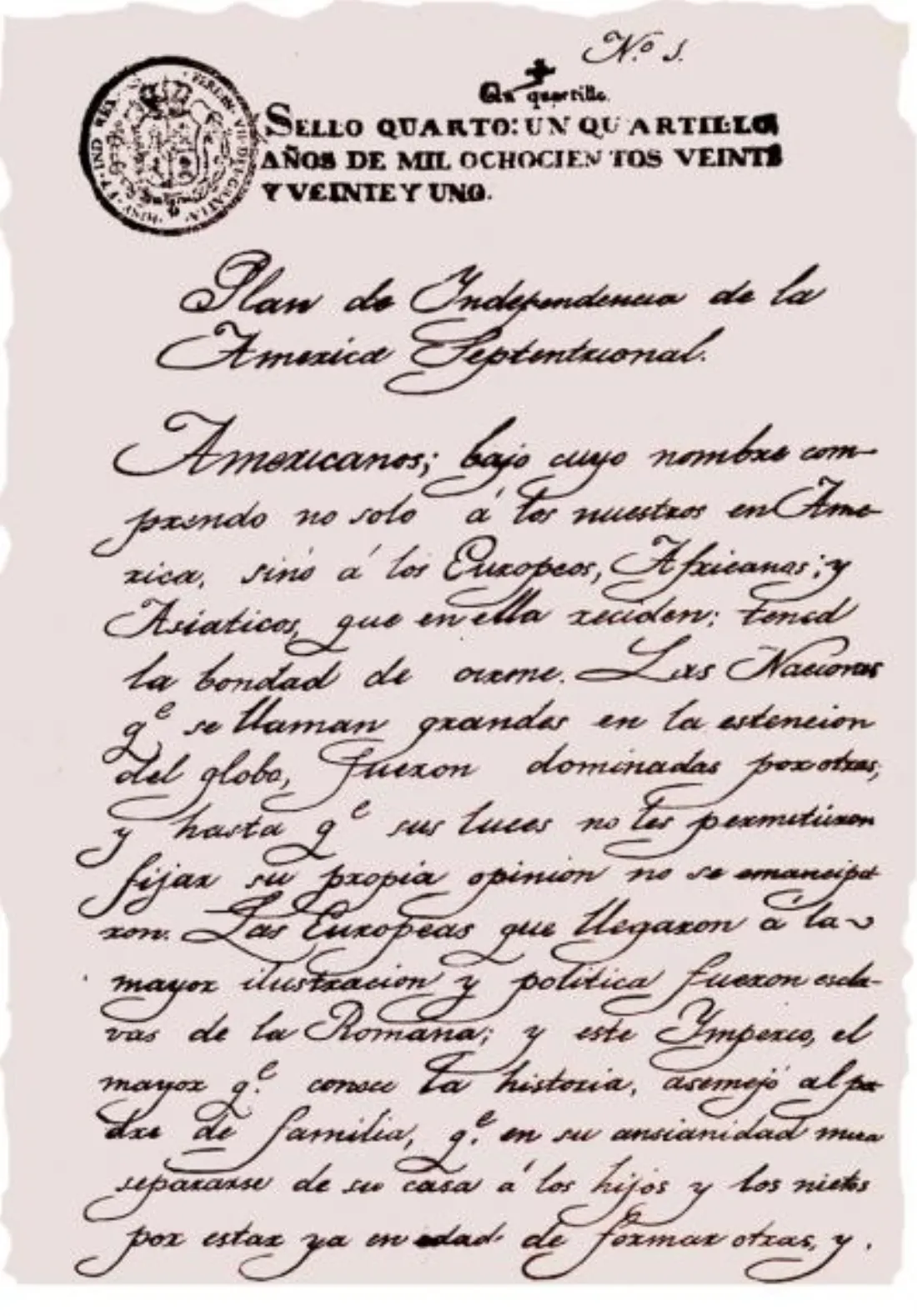
What did the Plan of Iguala actually say?
Twenty-three articles, and almost none of them about monarchy. The plan declared independence, established Catholicism as the only tolerated religion, and proclaimed the union of "European and American" Mexicans — the third guarantee — with an end to the legal distinctions between castes. It provided for a constitutional monarchy, offered the crown first to Ferdinand VII and then to a Bourbon prince, and created a governing junta and a regency to hold power until a king arrived.
What it did not do was abolish slavery, redistribute land or change the social order. It was written by a royalist general and a guerrilla chief for an elite that wanted independence without revolution — the same elite that had been terrified by Hidalgo's followers in 1810. Its genius was that it gave every faction something: the Church its monopoly, the Creoles equality with Spaniards, the army its honours, and the provinces a country.
Who ruled before the emperor?
A regency and a Congress, both improvised. The Junta Provisional Gubernativa met on 28 September 1821 and named a regency of five with Iturbide at its head. A Constituent Congress was elected by a restricted franchise and installed in February 1822, with the task of choosing the form of government and writing a constitution — while the regency governed, taxed and spent.
The arrangement was designed to fail. The Plan of Iguala and the Treaty of Córdoba had promised a monarchy with a European prince, and no European prince was coming: the Bourbons refused, and Madrid would not recognise independence at all. Congress and the regency quarrelled from the start about sovereignty, about the army, and above all about money.
What did the Treaty of Córdoba do?
It converted a rebel plan into a treaty between two governments. Signed on 24 August 1821 by O'Donojú, the last Spanish political chief, it accepted Mexican independence, endorsed a constitutional monarchy, and provided for a junta, a regency and a congress. It was not authorised by Madrid — O'Donojú had no instructions to recognise independence — and the Spanish Cortes repudiated it in 1822, which made the treaty the foundation of Mexican sovereignty and a dead letter in international law at the same time.
That contradiction never resolved. Mexico's independence rests on a treaty Spain never ratified, and the monarchy that the treaty created had no legitimate monarch to install. When Iturbide took the throne, he was filling a vacancy the treaty had left open, and his enemies could argue with some force that he had usurped a crown that belonged to someone else.
How did Iturbide become emperor?
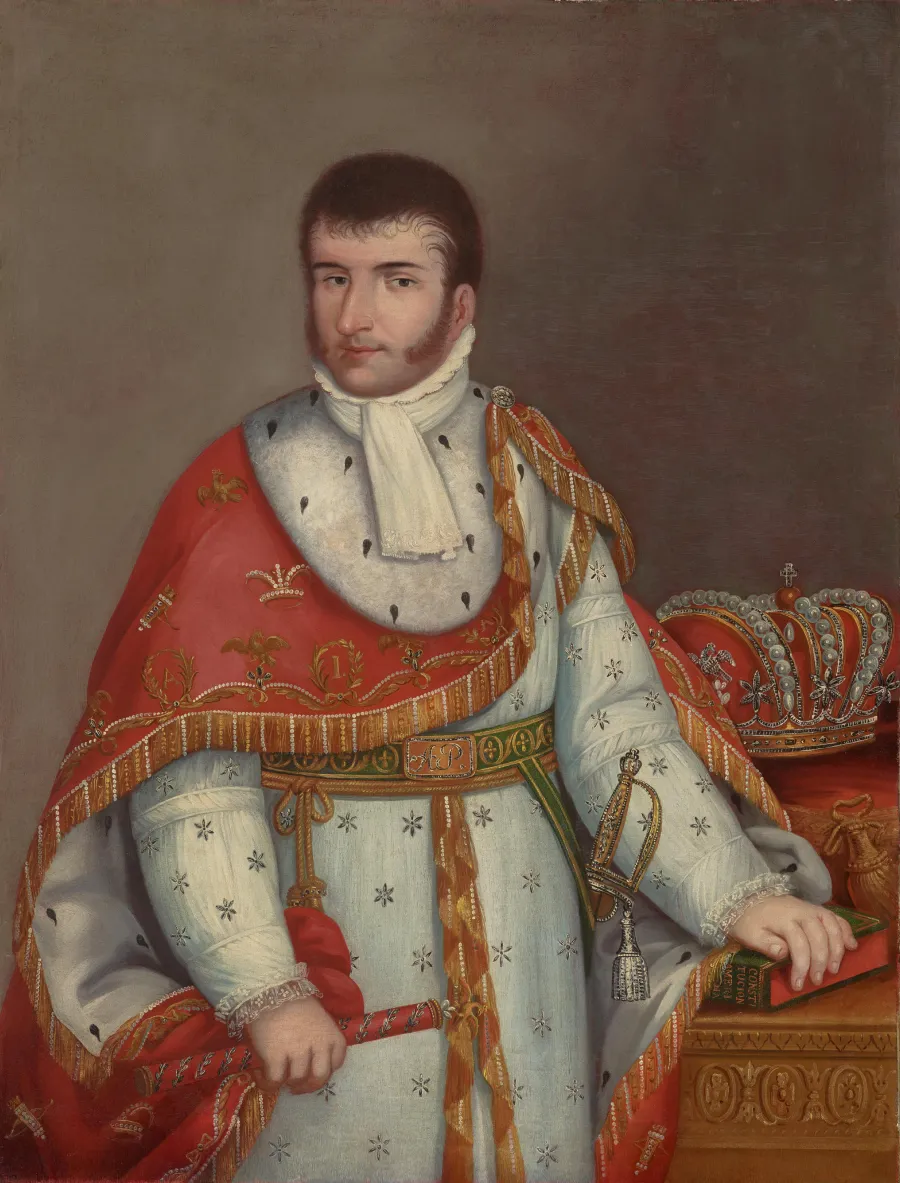
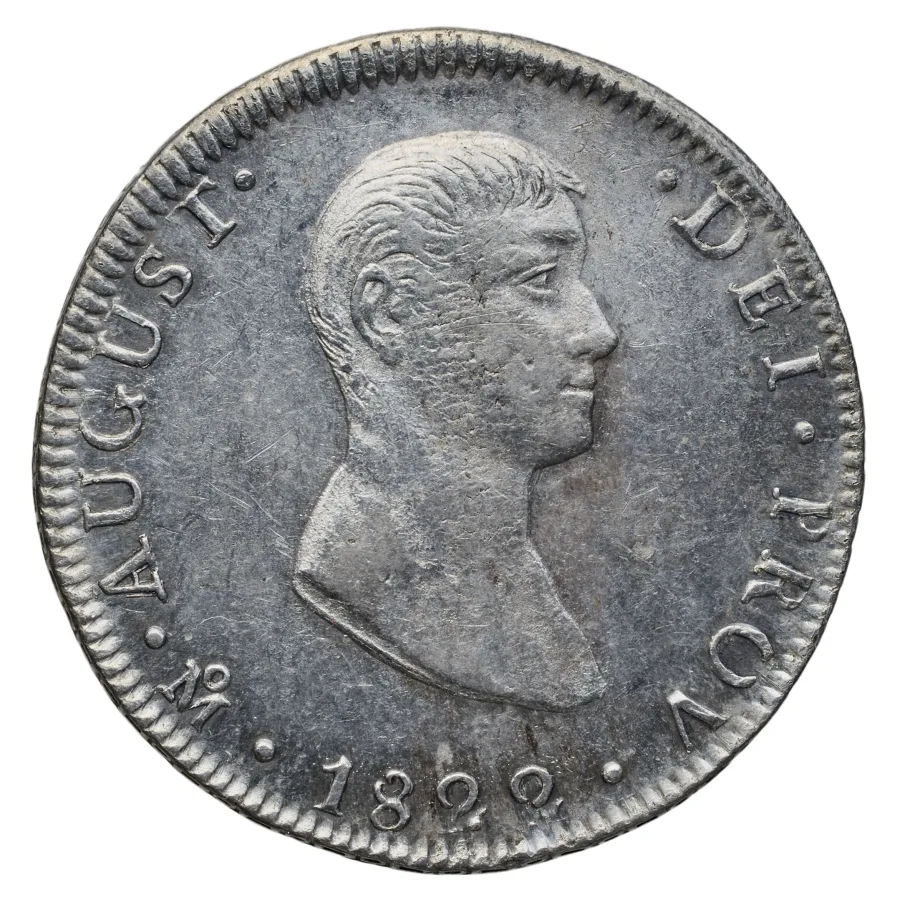
By a vote in Congress, and then by acclamation in the street. On 19 May 1822 Congress elected him emperor by 60 votes to 15 — the count is his own, transmitted through Lorenzo de Zavala. A crowd outside the chamber proclaimed him Agustín I, and the title was confirmed on 19 or 21 May depending on the account. He was crowned in the cathedral on 21 July 1822, with a diadem and a mantle modelled on Napoleon's, and the ceremony was paid for with money the treasury did not have.
The coronation was the empire's high point and its political death. Congress had intended a constitutional monarch bound by a constitution it had not yet written; Iturbide intended to rule. When Congress refused to fund the court and questioned the election, he dissolved it by decree on 31 October 1822 — a decree issued with a speech defending the act. In April 1823, after his fall, Congress would call the coronation "a work of violence and force".
Who were the political factions?
Four, and none of them a party in the modern sense. The Bourbonists wanted the monarchy the plan had promised and a European prince to make it legitimate; they were strong in the provinces and among the old royalist administration. The iturbidistas wanted the empire with Iturbide on the throne, and were strongest in the army and in the capital. The republicans — Zavala, Santa Anna, Guadalupe Victoria, the old insurgents — wanted a federal republic and treated the empire as a delay. And the provincial elites wanted autonomy, lower taxes and control of their own affairs, whichever government was in Mexico City.
The coalition that made independence possible could not govern together. The Bourbonists withdrew once Iturbide crowned himself; the republicans never accepted the crown; and the provincial elites turned against the centre as soon as the taxes arrived. Casa Mata was the provincial elites' instrument, and the republic that followed was their achievement.
Why did the empire fail?
Money, legitimacy, the army and the provinces — in that order.
Money. The treasury was empty on day one. Silver production had collapsed in the wars: the mints struck about 22.8 million pesos a year before 1810 and about 3.5 million in 1823–24. The imperial government inherited a debt that the finance minister, Arrillaga, put at 5,936,560 pesos in his 1823 memoir, borrowed from the cathedral, seized funds at Perote and Jalapa, and issued paper money in December 1822 that circulated at a 75 per cent discount. It also lost the customs revenue of Veracruz, the country's main port, when the commander there, Dávila, seized it for himself in October 1821.
Legitimacy. The empire rested on a treaty Spain had rejected and a plan that promised a Bourbon king. Every month that no prince arrived made the monarchy look like a pretext, and every act of royal pomp made the republicans' case.
The army. The imperial army was the royalist army with a new flag: some 60,000 regulars on paper, cut to 20,000 by Congress in April 1822, with an officer corps whose half-pay alone came to 1,005,795 pesos against 1,760,541 for all the line infantry. It was loyal to Iturbide personally and to its own privileges, and it could not be paid.
The provinces. The empire was governed from Mexico City and financed from the provinces, and the provinces resented both. The first revolt, at Veracruz in December 1822, was led by Antonio López de Santa Anna; the decisive one was the Plan of Casa Mata of 1 February 1823, which called for a new Congress and — in its tenth article — explicitly disclaimed any intention of moving against the emperor. It was a demand for provincial and congressional power, not a republican coup, and it worked because the army and the provinces joined it.
What happened to the army after 1823?
It became the arbiter of the republic. The imperial army was not disbanded: Congress cut the establishment from some 60,000 to 20,000 in April 1822, and the officer corps survived on half-pay and on its capacity to overthrow governments. Between 1821 and 1855 Mexico had dozens of presidents, most of them generals, and the pronunciamiento — a military declaration endorsed by a plan — became the standard mechanism of political change. Santa Anna, who had begun the revolt against Iturbide, dominated the next thirty years.
The empire's military legacy is therefore double: it created a national army out of the royalist forces, and it created the habit of resolving political disputes by barracks revolt. The republic inherited both.
How did it end?
With an abdication nobody wanted to discuss. Congress, reinstated in March 1823 (on the 7th or the 10th depending on the account), refused to debate the abdication at all; Iturbide abdicated on 19 March — some accounts say the end of March — and left for Italy, then England. In April 1823 Congress declared his government null and void from the beginning, and decreed the coronation, the dissolution of Congress and the imperial acts to have been acts of violence.
He came back in July 1824, apparently unaware that Congress had declared him an outlaw and sentenced him to death if he returned. He landed on 14 or 15 July, was arrested, and was shot at Padilla on 19 July 1824. The empire was already gone: Central America had separated on 1 July 1823, and the republic was proclaimed that autumn.
What was the Church's role?
Decisive, and ambivalent. The lower clergy had been with Hidalgo and Morelos; the hierarchy had been with Spain, and the bishops excommunicated the insurgents. The Plan of Iguala's guarantee of Catholicism as the only religion was the price of the hierarchy's acquiescence, and the Church's wealth — mortgages, land, capital — was what the empire borrowed against when the treasury was empty.
The Church was also the only institution with national reach: parishes, missions, hospitals and schools, and a clergy that spoke the country's languages. The empire's finances, its legitimacy and its administration all ran through it, which is why the reform laws of the 1850s, when they came, were so explosive.
How large was it?
Larger than independent Mexico would ever be again. The 1824 Constitution defined the nation as the old viceroyalty plus the captaincy general of Yucatán, the Internal Provinces and both Californias — which is to say Texas, New Mexico, Arizona, Alta California, Nevada, Utah and parts of Colorado, as well as the Mexico of today. The northern provinces were held by adhesion rather than administration: in 1822 the imperial government signed a treaty with the Comanche at Béjar, which is not the act of a state that governs its frontier.
Central America was the empire's one real acquisition. The provinces of the former Captaincy General of Guatemala declared their adhesion on 5 January 1822, in a vote of the ayuntamientos that the act itself records as a hundred and four in favour out of a hundred and forty-nine answering; Chiapas had detached itself on 16 January 1822 and stayed Mexican when the rest left. On 1 July 1823 the provinces separated to form the United Provinces of Central America, and the empire lost half its territory without a shot.
The Philippines and Guam were never part of it. They had been governed from Mexico under Spain, but the imperial constitution spoke of "adjacent islands", Spain banned the trade in 1822, and they were ceded to the United States in 1898 — not to Mexico in 1821.
How was it governed locally?
Through the old viceregal machinery with new names. The provinces became provincias with jefes políticos appointed from Mexico City, the subdelegations survived as districts, and the town councils — the ayuntamientos — remained the only genuinely representative bodies, which is why they became the unit of political mobilisation. The empire's Central American annexation was decided by ayuntamiento votes, not by plebiscite; the Casa Mata revolt was organised through provincial elites and their councils.
The empire also inherited the colonial fiscal system: the alcabala (sales tax), the tobacco monopoly, the tithe, the mint. It inherited the colonial legal system too, including the fuero — the separate jurisdictions of Church and army — which the republic spent fifty years trying to abolish.
Who lived in it?
About six million people, in a society built on racial classification and now legally without it. Humboldt estimated 5,837,100; Navarro y Noriega counted 6,122,354; the American minister Poinsett thought 6.5 million. The wars had been catastrophic in places — Guanajuato lost two-thirds of its population between 1810 and 1821 — and the mining districts never fully recovered.
The empire's most radical act was a decree of 17 September 1822 suppressing the legal classification of the population by caste, which ended the sistema de castas on paper. It was contradicted almost immediately: the regency's own Reglamento preserved the "classes" in article 16, and the equality of the Plan of Iguala was honoured more in rhetoric than in law. Iturbide abolished nothing else. Slavery survived the empire; the 1824 constitution banned the slave trade but not slavery, and it took Vicente Guerrero's decree of 1829 to abolish it.The casta system the decree abolished had classified people as español, indio, mestizo, mulato, castizo and dozens of other categories, with different legal rights and obligations. Its abolition in September 1822 made everyone legally a citizen, which was a real change and also a way of avoiding the harder question: whether the indigenous communities would keep their land, their communal property and their separate legal status.
They largely did, for a generation. The liberal reforms of the 1850s — the Ley Lerdo of 1856 and the constitution of 1857 — would attack communal property directly, and the Porfiriato would complete the dispossession. In 1822, the empire's equality was formal, and the country's actual inequalities were untouched.
What was the economy like?
A silver economy in ruins, with an agricultural base that had never been modernised. Humboldt put the annual product of agriculture at 29 million pesos against 24 million for the mines, but it was silver that paid for the state, and the mines were flooded, the mercury supply was disrupted, and the capital had fled. The empire tried to restart mining with foreign loans and concessions, and it failed.
Its finances were a catalogue of expedients: forced loans, seizure of merchant funds, a paper currency at a 75 per cent discount, and the sale of offices. The first foreign loan, from Goldschmidt and Company in February 1824, came after the empire had fallen and financed the republic. The army consumed most of what revenue there was; the imperial court consumed the rest; and the provinces, asked to pay for both, began to ask why they belonged to Mexico at all.
Why "first"? Was there a second?
Yes, and it was a deliberate echo. The Second Mexican Empire (1864–67) put Maximilian of Habsburg on the same throne, with French bayonets, a conservative-Catholic coalition and the same promise of order after decades of liberal-conservative war. Maximilian revived the Order of Guadalupe that Iturbide had founded, adopted the imperial tricolour, and governed from the same palace.
The comparison is instructive. Both empires were monarchies imposed on a republican political culture by a coalition that could not win an election but could win a war — and both ended with the emperor dead and the republic restored. The first lasted seventeen months; the second, three years; and between them Mexico built the federal republic that outlasted both.
What did the empire leave behind?
A flag, a debt, a constitution and a warning. The tricolour — green, white and red — comes from the Army of the Three Guarantees and became the national flag. The 1824 Constitution, written after the empire, created the federal republic that has governed Mexico ever since, with a presidency so strong that it inherited the emperor's role. The Order of Guadalupe, founded in 1822, was revived by Maximilian in 1864 when he tried to be the second emperor, and the Second Empire consciously echoed the first: a European prince, a conservative coalition, a Catholic state.
Historians have changed their minds about it. The older nationalist tradition treated Iturbide as a traitor and the empire as an aberration; the revisionist work of the last thirty years — Frasquet, Viñuela, Ávila — treats 1821 as the moment when a Spanish American nation invented a constitutional monarchy for itself, and the empire as the first experiment in Mexican sovereignty rather than a detour from the republic. The nullity decree of 8 April 1823, which erased the whole imperial government from the record, is itself part of the evidence: the republic needed the empire to have been illegal.
Common myths about the First Mexican Empire
| Myth | What the evidence says |
|---|---|
| Iturbide was a lifelong royalist | He was a royalist officer who changed sides in 1821 because the liberal Spanish constitution threatened the Mexican elite's position. |
| The empire was a vast, functioning state | It claimed 3.6–4.4 million km² and administered a fraction of it; the northern provinces were held by adhesion. |
| The Philippines were part of the empire | No: they were governed from Mexico under Spain, but the empire's constitution spoke of "adjacent islands" and Spain banned the trade in 1822. |
| Iturbide abolished slavery | No. A decree of 17 September 1822 ended caste classification, not slavery; slavery was abolished in 1829. |
| Congress elected him unanimously | The vote was 60 to 15, by Iturbide's own count. |
| The empire fell to a republican revolution | It fell to a provincial revolt, the Plan of Casa Mata, whose tenth article disclaimed any move against the emperor. |
| Iturbide was executed for treason in 1824 as a rebel | He returned unaware that Congress had outlawed him; he was arrested and shot at Padilla on 19 July 1824. |
| The empire left no trace | It left the flag, the 1824 Constitution, the debt and the presidential system. |
Timeline of the First Mexican Empire
| Year | Event |
|---|---|
| 1810 | Hidalgo's rising, 16 September |
| 1814 | Constitution of Apatzingán |
| 1820 | Liberal revolution in Spain; Iturbide given command |
| 24 February 1821 | Plan of Iguala |
| 24 August 1821 | Treaty of Córdoba |
| 27 September 1821 | Army of the Three Guarantees enters Mexico City |
| 28 September 1821 | Junta and regency installed |
| October 1821 | Dávila seizes the Veracruz customs |
| 1822 | Constituent Congress installed, February |
| 19 May 1822 | Congress elects Iturbide emperor, 60–15 |
| 21 July 1822 | Coronation of Agustín I |
| 17 September 1822 | Decree ending caste classification |
| 31 October 1822 | Congress dissolved |
| December 1822 | Santa Anna revolts at Veracruz; paper money issued |
| 1 February 1823 | Plan of Casa Mata |
| 19 March 1823 | Abdication |
| 8 April 1823 | Congress declares the imperial government null |
| 1 July 1823 | Central America separates |
| 1824 | Republic proclaimed; Iturbide shot, 19 July |
What the map shows next
At 1822 on the map the empire is at its fullest extent, and French Louisiana is already American territory.
At 1823 on the map Central America has gone, and the Federal Republic of Mexico is being written.
Common questions
- What was the First Mexican Empire?
- The monarchy that followed Mexican independence in 1821, with Agustín de Iturbide as emperor, lasting until his abdication in March 1823.
- How long did it last?
- Seventeen months, from September 1821 to March 1823.
- Who was the first emperor of Mexico?
- Agustín de Iturbide, a former royalist general, crowned Agustín I on 21 July 1822.
- Why did the monarchy fail?
- An empty treasury, a rejected treaty, a costly army and provincial resentment — and a Congress that never accepted the emperor's authority.
- How large was the First Mexican Empire?
- It claimed the former Viceroyalty of New Spain, about 3.6 million km² on this map and 4.4 million by Humboldt's calculation, including Central America for eighteen months.
- Did it include Central America?
- Yes, from January 1822 to July 1823, when the United Provinces of Central America separated.
- Did it include the Philippines?
- No. They were governed from Mexico under Spain but were never part of the Mexican empire.
- Did Iturbide abolish slavery?
- No. He ended the caste classification in September 1822; slavery was abolished by Guerrero in 1829.
- How did Iturbide die?
- He returned from exile in July 1824, was arrested under a decree outlawing him, and was shot at Padilla on 19 July 1824.
- What did the empire leave behind?
- The tricolour, the 1824 federal constitution, the presidential system and a large public debt.
Sources
Every source below was consulted while writing this entry.
Every source below was consulted while writing this entry.
Primary and official sources
- The Plan of Iguala (24 February 1821), 23 articles.
- The Treaty of Córdoba (24 August 1821), 17 articles.
- The Acta de Independencia (28 September 1821).
- The Reglamento of the Junta and the decree dissolving Congress (31 October 1822).
- The Plan of Casa Mata (1 February 1823), 11 articles.
- Congress's nullity dictamen and decree (5 and 8 April 1823).
- The 1824 Federal Constitution, article 2.
- Arrillaga, Memoria de Hacienda (1823).
- Humboldt, Essai politique sur le royaume de la Nouvelle-Espagne, and Navarro y Noriega's census.
- The Guatemalan act of union (5 January 1822).
- Gaceta Imperial, 11 October 1821 (O'Donojú's death).
Scholarship and reference works
- Espinosa, Rubrica Contemporánea (2023), on the imperial election.
- Frasquet, Estudios de Historia Moderna (2021) and Las caras del águila (2007).
- Carbajal, Signos Históricos (2011), on the Casa Mata.
- Escrig Rosa, Hispania Sacra (2020).
- Jáuregui, Estudios de Historia Moderna (2020).
- Ávila, Para la libertad (UNAM).
- Timmons, Morelos.
- Olveda, Signos Históricos, on the 1829 abolition.
- Ward, Mexico in 1827, on the army establishment.
Data sources for the map
- Cliopatria v0.12 (Seshat Global History Databank, CC BY 4.0).
- Historical Basemaps (GPL-3.0).
This entry was written from the sources above and last updated .
Text available under CC BY-SA 4.0: reuse it with a credit to The World Through Time and a link to this page.
Border geometry for the map itself comes from Cliopatria v0.12 (Seshat Global History Databank, CC-BY-4.0).
See the First Mexican Empire in its world
Open the atlas at 1822 and every neighbour, rival and successor is on screen with it — then drag the slider and watch what happens next.
Open the map at 1822 →