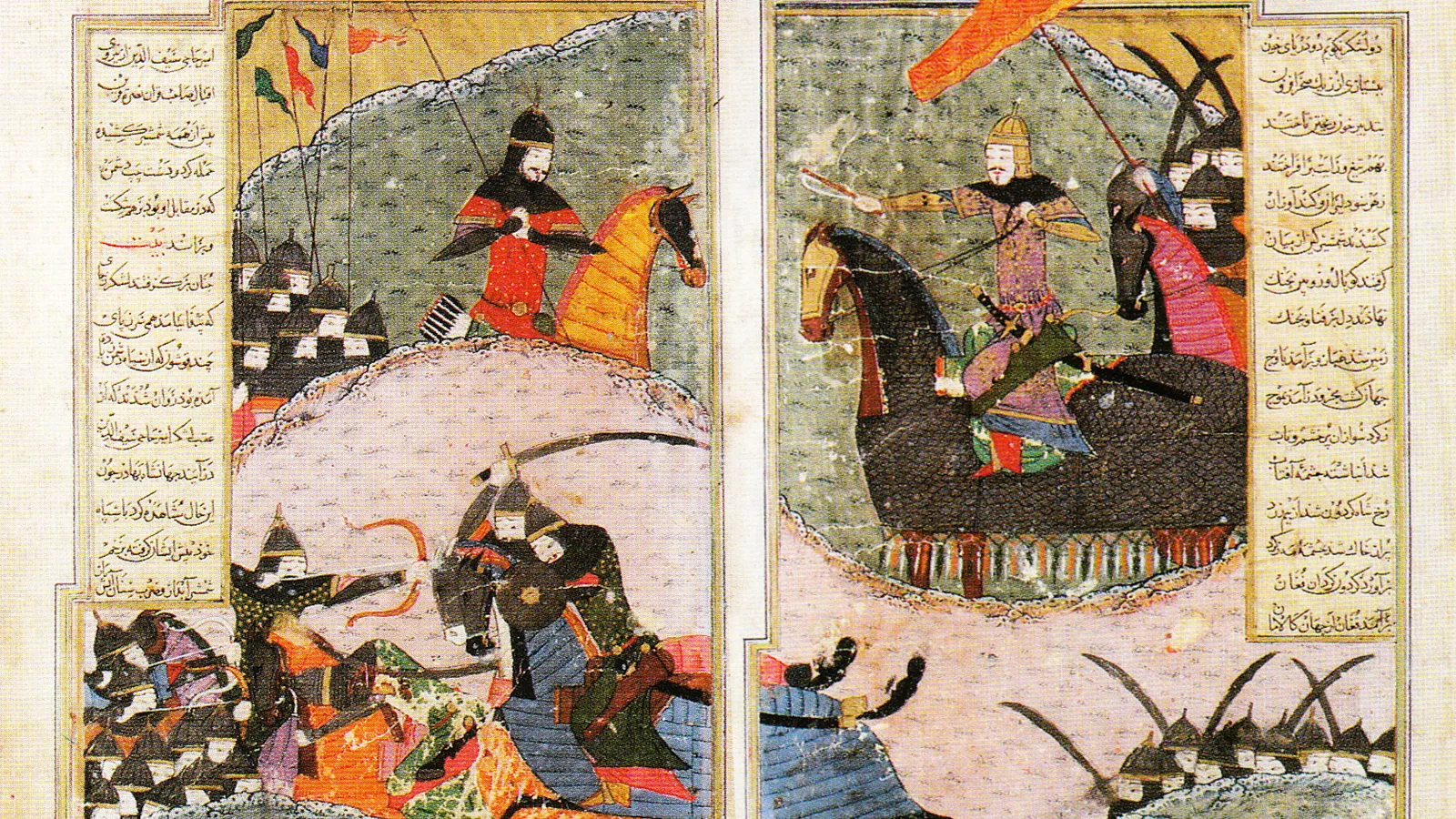
Tokhtamysh (died 1406 or 1407) was a khan of the Golden Horde, the Mongol realm on the steppes of today's southern Russia, Ukraine and Kazakhstan. A descendant of Genghis Khan's eldest son Jochi, he rose from exile with the help of the Central Asian conqueror Timur (Tamerlane), reunited the Horde in 1380 after years of civil war, and two years later took and burned Moscow. He then turned against his own patron. Timur defeated him twice, in 1391 and 1395, and destroyed the Horde's capital, Sarai. Tokhtamysh spent his last years as a refugee and was killed in western Siberia.
For Russian history he is the khan who showed that the victory at Kulikovo in 1380 had not ended Horde rule. For the history of Central Asia he is the man who almost broke Timur's rise and instead brought ruin on his own realm. The Russian historian R. Yu. Pochekaev notes that some historians praise Tokhtamysh as a "new Genghis Khan or Batu", while others think him unworthy of the title of khan.
Tokhtamysh at a glance
| Name | Tokhtamysh (Toqtamish); throne name Nasir al-Din Mahmud Toqtamish |
| Born | Probably around 1340–1350 (Pochekaev's estimate) |
| Family | Son of Tui-Khoja, a prince of the line of Tuqay-Timur, 13th son of Jochi |
| Khan of the eastern Horde | From 1378 or 1379, at Sighnaq |
| Khan of the whole Golden Horde | 1380–1395 (with attempts to return until 1397–1398) |
| Main events | Overthrow of Mamai (1380); burning of Moscow (1382); wars with Timur (1386–1395) |
| Defeats | Kondurcha (1391), Terek (1395), Vorskla (1399) |
| Died | Winter 1406/07, in western Siberia |
Exile and Timur's protection
Tokhtamysh grew up in the eastern half of the Jochid realm, which Russian sources call the Blue Horde and Persian sources usually the White Horde. In the 1370s it was ruled by Urus Khan, a distant cousin. According to Pochekaev, Urus executed Tokhtamysh's father for refusing to send troops, and in 1376 Tokhtamysh fled to Timur, who was building his own empire in Samarkand.
Timur welcomed him and gave him the towns of Otrar and Sabran on the Syr Darya. When Urus sent envoys to demand his surrender, Timur's court historian Sharaf al-Din Ali Yazdi has Urus say:
"Tocatmich has kill'd my son, and is fled for refuge to you: you ought to deliver up this prince, who is my enemy; if you refuse to do it, I declare war against you." (Yazdi, trans. 1723)
Timur replied: "Tocatmich has put himself under my protection, and I will defend him." Tokhtamysh lost several battles against Urus and his sons. After Urus died during Timur's campaign of 1377 and his successors quarrelled, Tokhtamysh took the eastern capital Sighnaq in 1378 or 1379.
Reuniting the Horde, 1380
The western half of the Golden Horde had been torn by civil war since 1359, a period known in Russian as the "Great Troubles". Its strongest man was the general Mamai, who was not a descendant of Genghis Khan and so could not be khan himself. Tokhtamysh moved west, took Sarai, and gathered the Volga lands.
On 8 September 1380 Mamai was defeated by Grand Prince Dmitry of Moscow at Kulikovo. Weeks later, Tokhtamysh met what was left of Mamai's army on the Kalka. The Simeon Chronicle describes how Mamai's princes "dismounted from their horses and bowed down to Khan Tokhtamysh". Mamai fled to the Crimea and was killed, and Tokhtamysh "took Mamai's horde, and his wives, and his treasury". Tokhtamysh now ruled a reunited Golden Horde, and the Rus' princes sent envoys with gifts to the new khan.
The burning of Moscow, 1382
Why did Tokhtamysh attack Moscow?
Kulikovo had been a victory over Mamai, a rival of Tokhtamysh, not over the khan himself. But Moscow had stopped paying regular tribute in the 1370s. According to Pochekaev, an envoy Tokhtamysh sent to summon the Russian princes, with an escort of 700 men, turned back at the border of the Nizhny Novgorod principality, fearing for his safety.
In the summer of 1382 Tokhtamysh struck by surprise. The Nikon Chronicle says he had Russian merchants in the Volga city of Bulgar robbed and their ships seized to carry his army across the river. Prince Oleg of Ryazan, according to the chronicles, showed him the fords of the Oka; Pochekaev adds that Oleg swore allegiance and supplied guides. Two sons of the prince of Suzdal and Nizhny Novgorod, Vasily and Semyon, joined his army. Grand Prince Dmitry left Moscow for Kostroma to gather troops.
The siege
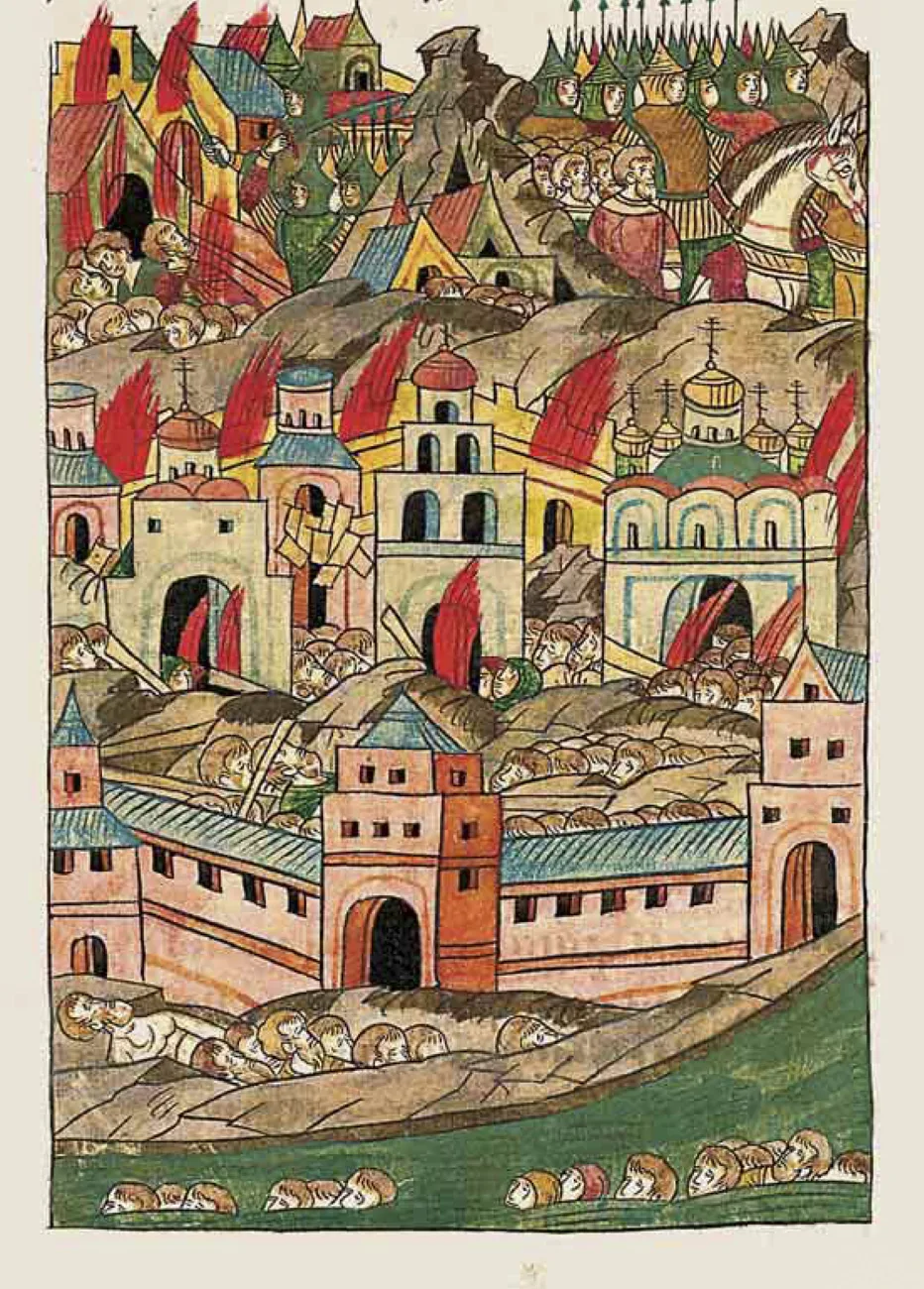
Moscow was in uproar. Then, the Tale of the Invasion of Tokhtamysh says, "a certain Lithuanian prince named Ostei, a grandson of Olgerd" arrived, calmed the riot and organised the defence. The Tatar army appeared before the city on 23 August. For three days the defenders held out. The Tale lists their weapons: arrows, stones, crossbows, catapults and tiufiaki, and adds that some "even fired the cannons themselves". This is one of the earliest mentions of firearms in Rus'.
The Horde could not take the stone walls by force. So the two Nizhny Novgorod princes swore to the townspeople that the khan wanted only gifts and would spare the city. Prince Ostei led a procession out of the gates with clergy carrying crosses. The Nikon Chronicle, in the translation of S. A. and B. J. Zenkovsky, continues:
"Thereupon, unexpectedly, the Tatars started slaying them: Prince Ostei was the first to be killed near the fortress walls; and then they started slaying the archimandrites, abbots and priests even in their vestments with crosses." (Nikon Chronicle, trans. Zenkovsky)
The Tatars broke in, killed and plundered, and set the city on fire. The Tale dates the fall to 26 August. Tokhtamysh's troops then raided Vladimir, Zvenigorod, Mozhaisk, Dmitrov, Pereyaslavl and other towns.
How many died?
The chronicles give no total. They record instead what Dmitry paid for burying the dead after his return: half a rouble for every forty bodies, a rouble for every eighty, "and they counted that in all three hundred roubles had been given for the burial of the dead" (Tale). The Zenkovskys calculated from this that "at least twenty-four thousand people had been killed in Moscow", probably most of its population. That figure is a modern calculation, not a chronicle number.
A date that does not add up
The Tale says that the Horde arrived on Monday 23 August and took Moscow on Thursday 26 August 1382. In 1382, however, 23 August fell on a Saturday and 26 August on a Tuesday. The historian A. V. Zhuravel' (2021) notes that 26 August was a Thursday only in 1378 and 1389, and lists other dates in different chronicles, from 8 to 26 August. The year 1382 is not in doubt; the exact days are.
After the sack
Later that autumn, the Tale says, an envoy named Karach came from Tokhtamysh to Moscow "about peace". Dmitry had to accept the khan's authority again. Tribute was resumed, with arrears from the 1370s that the Orthodox Encyclopedia gives as 8,000 roubles, and Tokhtamysh confirmed Dmitry as grand prince. Dmitry's son Vasily was sent to the Horde as a hostage.
The war with Timur
The protégé turns against his patron
Once in control of the Horde, Tokhtamysh pursued its old claims to Azerbaijan and Khwarazm, lands that Timur also wanted. In the winter of 1385/86 his army invaded the Caucasus and took Tabriz. According to Pochekaev, he used the same trick as at Moscow: he promised to leave in return for a ransom, and when the townspeople sent envoys, his troops burst into the city. In 1387 and 1388 Tokhtamysh raided Timur's heartland in Transoxiana, while Timur was campaigning in Iran.
Timur answered with two of the largest campaigns of his life.
Kondurcha, 1391
At the start of 1391 Timur set out from Tashkent into the steppe with a great army. Yazdi says the campaign lasted eleven months. Tokhtamysh retreated north and the two armies met on the Kondurcha, a river in today's Samara region on the middle Volga; where exactly on it is debated. The court historian Nizam al-Din Shami dates the battle to 15 Rajab 793, which corresponds to 18 June 1391. Yazdi writes that Timur divided his army into seven bodies and that the battle was hard fought. Afterwards:
"the army of Tocatmich Can was compar'd to a lamp which is going out, and which, as its last effort, casts a light greater than ordinary … from this time the power of Tocatmich continually diminish'd." (Yazdi, trans. 1723)
The Terek and the destruction of Sarai, 1395
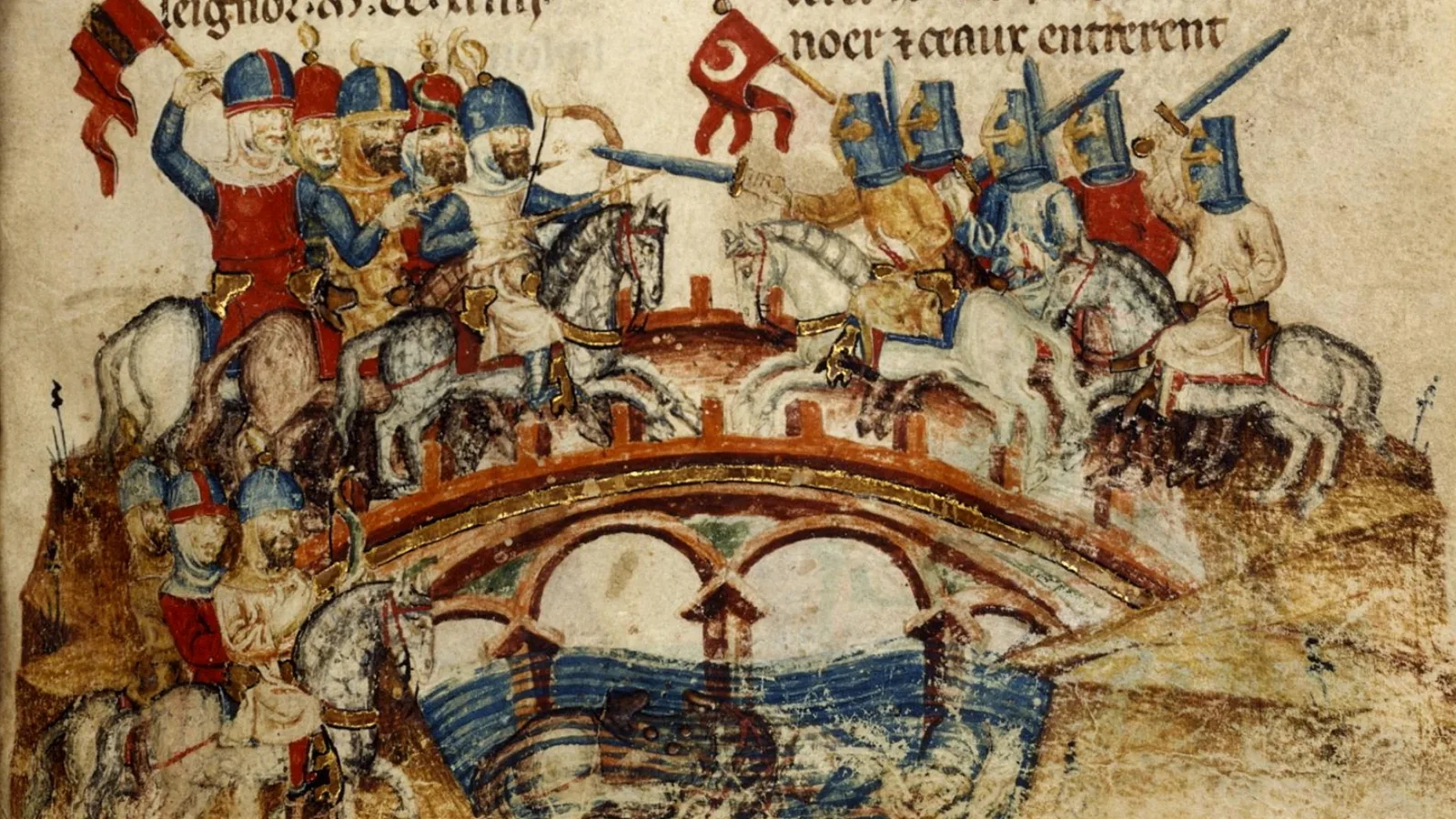
Tokhtamysh recovered, and in 1394 he raided the Caucasus again. Timur marched north through Derbent. On 15 April 1395 the two armies met on the Terek in the North Caucasus. According to Pochekaev the battle lasted two days, and Tokhtamysh held the initiative for much of it, but in the end his army broke and he fled.
This time Timur was determined to destroy the Horde's power. He set up a rival khan, a son of Urus, and his armies sacked the Horde's cities. Yazdi describes the end of Sarai, the capital on the lower Volga:
"Afterwards they went to Serai, capital of Capchac, which they set on fire, and reduc'd to ashes, after having made the inhabitants go out." (Yazdi, trans. 1723)
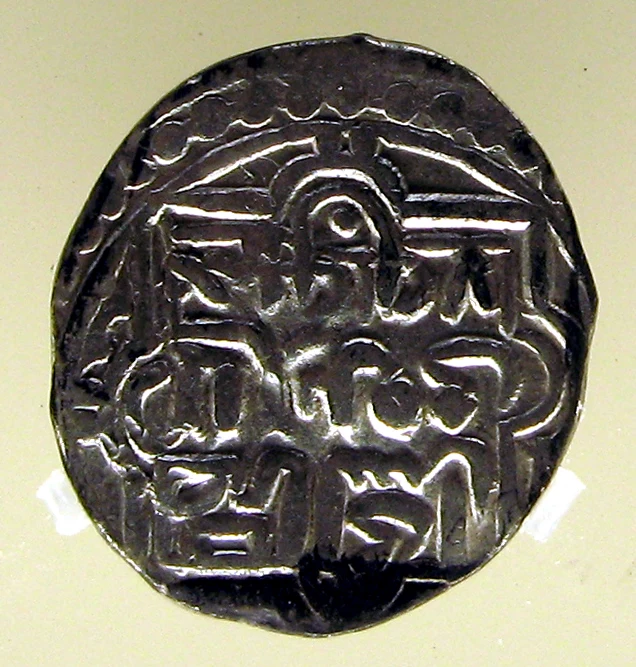
The commercial towns of the Horde, including Hajji-Tarkhan (Astrakhan), were plundered. The Golden Horde never recovered its former wealth.
Exile in Lithuania and the Battle of the Vorskla
Driven out of the Horde by the new khan Temir-Qutlugh and the powerful emir Edigu, Tokhtamysh took refuge around 1397 with Grand Duke Vytautas of Lithuania. When Temir-Qutlugh demanded his surrender, Vytautas replied, in the Nikon Chronicle's account: "I will not extradite Khan Tokhtamysh". The same chronicle claims that Vytautas planned to put Tokhtamysh back on the throne of the Horde as his own puppet, "and we will command this khan".
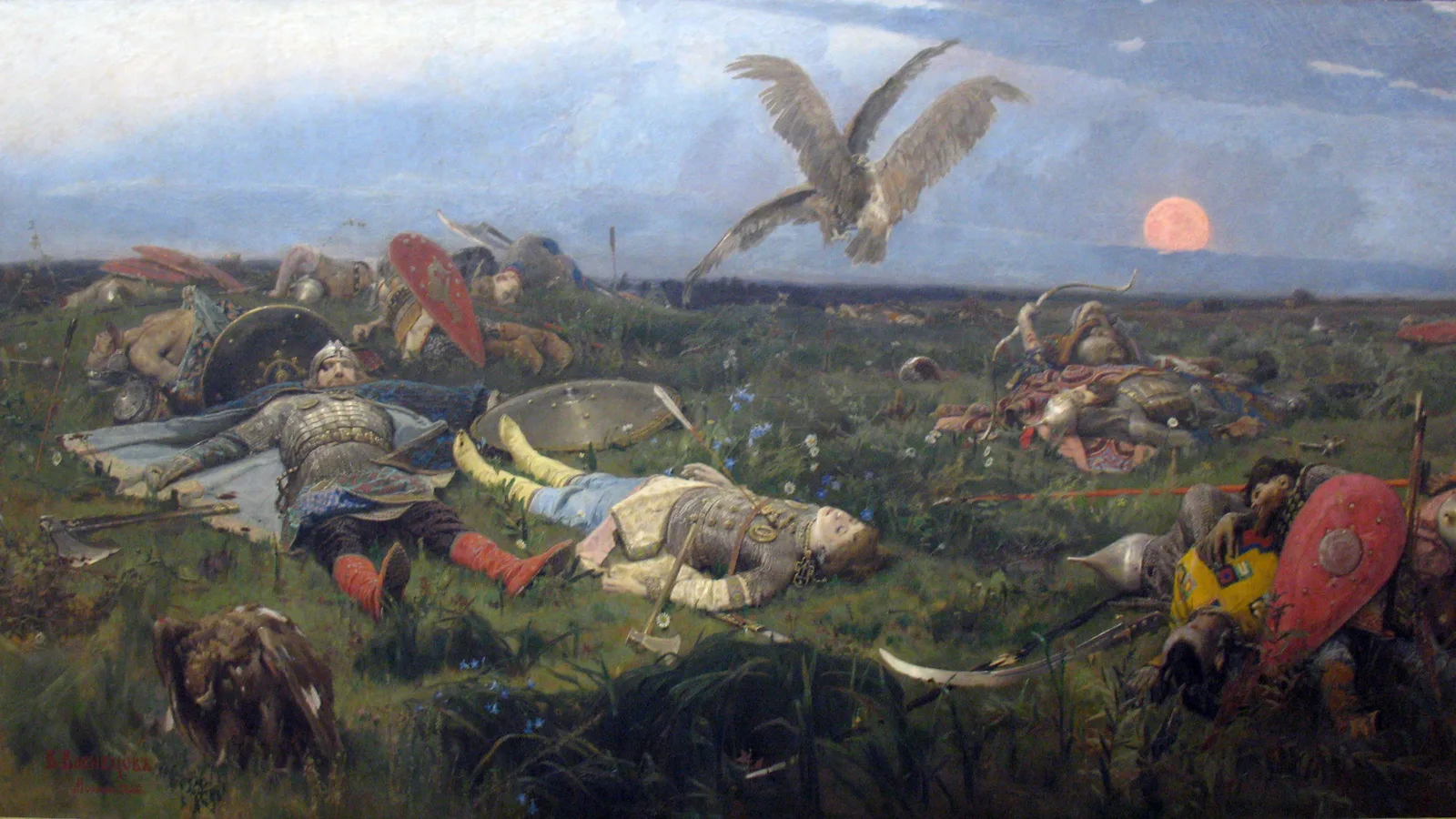
In August 1399 the Lithuanian army, with Tokhtamysh and his followers, met the Horde on the river Vorskla in today's Ukraine. Despite their cannons and armoured wagons, the Lithuanians were surrounded and crushed. The Nikon Chronicle says: "When Khan Tokhtamysh saw this he was the first to flee." Pochekaev dates the battle to 12 August 1399.
Death in Siberia
Tokhtamysh did not give up. From a base in western Siberia he fought Edigu, who now held the real power in the Horde, again and again; Pochekaev counts at least fifteen battles between 1400 and 1405. Late in 1404, after Edigu had fallen out with Timur, Tokhtamysh wrote to his old patron asking forgiveness. Pochekaev quotes the letter: "For all the evil I did I have been paid in full … If the sovereign shows mercy and forgives my guilt, I will never do such things again." Timur promised help after his campaign against China, but he died on 18 February 1405.
The end came in the winter of 1406/07. The Nikon Chronicle records under that year: "The same winter in January Khan Shadi Beg slew Khan Tokhtamysh in the Siberian land." According to Pochekaev, Edigu surprised his camp on the upper Tobol, and the sources disagree whether he was killed by Edigu, Edigu's son Nur al-Din or Khan Shadibek. The Arab historian Ibn Arabshah calls it the sixteenth battle between Tokhtamysh and Edigu.
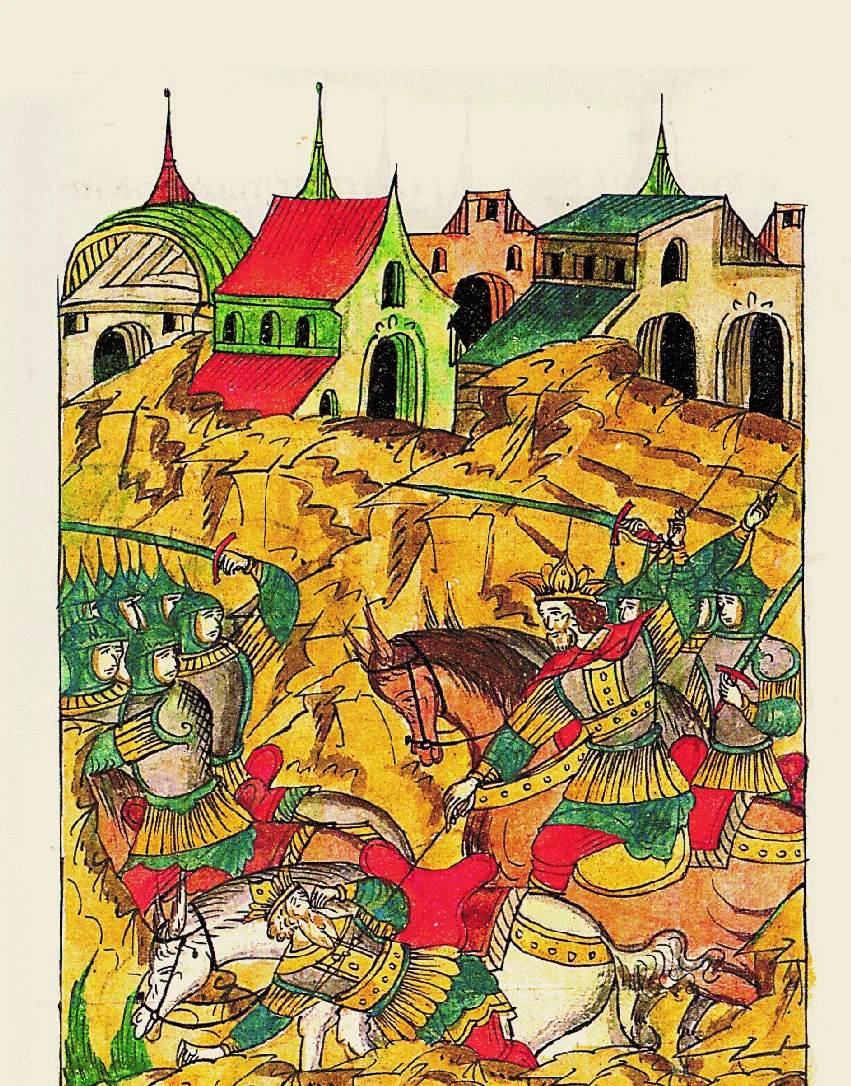
His sons fled to Lithuania and Russia. One of them, Jalal al-Din, called "Zeleni Sultan" in the Nikon Chronicle, later became khan and was shot in a fight with his own brother Karim-Berdi in 1412.
Common myths about Tokhtamysh
| Myth | What the evidence says |
|---|---|
| He attacked Moscow to avenge Mamai | Mamai was his rival, whom he overthrew weeks after Kulikovo; he attacked because Moscow had not resubmitted |
| He stormed Moscow | His assaults failed for three days; he took the city by a false promise of peace |
| The chronicles say 24,000 people died | That figure is a modern calculation from the burial payments |
| Moscow fell on Thursday 26 August 1382 | 26 August 1382 was a Tuesday; the chronicle dates conflict |
| He was always Timur's puppet | He was Timur's protégé until the mid-1380s, then his enemy for twenty years |
| He was killed near Tyumen | The sources say "in the Siberian land" and on the upper Tobol |
What the map shows next
The map of 1391 shows the Golden Horde as Tokhtamysh reunited it, with the Blue Horde, his first base, to the east. To the south lay the Timurid Empire of his patron and enemy Timur, and to the north-west the Grand Principality of Moscow, which he burned in 1382, and the Grand Duchy of Lithuania, where he later found refuge.
Sources
Primary sources
- Povest' o nashestvii Tokhtamysha, text and modern Russian translation with notes by M. A. Salmina, Biblioteka literatury Drevnei Rusi, vol. 6 (Pushkin House): http://lib.pushkinskijdom.ru/Default.aspx?tabid=4983
- The Nikonian Chronicle, vol. 4, ed. and trans. S. A. Zenkovsky and B. J. Zenkovsky (Princeton, 1988): https://archive.org/details/nikonian-chronicle-5
- Sharaf al-Din Ali Yazdi, The History of Timur-Bec, English trans. from the French of Pétis de la Croix (London, 1723): https://archive.org/details/india.history.resource.73944
- Simeonovskaia letopis', Polnoe sobranie russkikh letopisei, vol. 18 (1913)
Studies
- R. Yu. Pochekaev, Tsari ordynskie: biografii khanov i pravitelei Zolotoi Ordy, 2nd ed. (St Petersburg, 2012), ch. 12
- A. V. Zhuravel', "Kogda Tokhtamysh zakhvatil Moskvu?", Vestnik Udmurtskogo universiteta 31/4 (2021), doi:10.35634/2412-9534-2021-31-4-700-709: https://cyberleninka.ru/article/n/kogda-tohtamysh-zahvatil-moskvu
- "Kulikovskaia bitva", Pravoslavnaia entsiklopediia: https://www.pravenc.ru/text/Куликовская битва.html
- I. A. Gagin, "Toktamysh-khan v istorii Srednego Povolzh'ia: k voprosu o bitve na reke Kondurcha v 1391 godu" (2009): https://cyberleninka.ru/article/n/toktamysh-han-v-istorii-srednego-povolzhya-k-voprosu-o-bitve-na-reke-kondurcha-v-1391-godu
Image credits
- Title image: Timur and Tokhtamysh in battle, Yazdi's Zafarnama, 1436. Public domain, via Wikimedia Commons, cropped to 16:9.
- The sack of Moscow, Illustrated Chronicle, vol. 10, p. 66. Public domain, via Wikimedia Commons.
- Silver dirham of Tokhtamysh, Numismatic Museum of Athens. Photo: Sailko, CC BY-SA 4.0, via Wikimedia Commons.
- The killing of Tokhtamysh, Illustrated Chronicle, vol. 12, p. 105. Public domain, via Wikimedia Commons.