Vladimir the Great (Volodymyr in Ukrainian, Valdamarr in Old Norse, baptised Basil) was Grand Prince of Kiev from c. AD 978/980 until 1015, and the ruler who made Christianity the official religion of Kievan Rus' around AD 988. That is the year the Primary Chronicle gives, although Donald Ostrowski notes in the Encyclopedia of Russian History that "sources point to either 987 or 989 instead". A usurper who won his throne with Scandinavian mercenaries and ended it as a saint, he bound his realm to the Byzantine Empire. The Orthodox Churches of Ukraine, Russia and Belarus all trace their origins to his decision.
Who was Vladimir the Great?
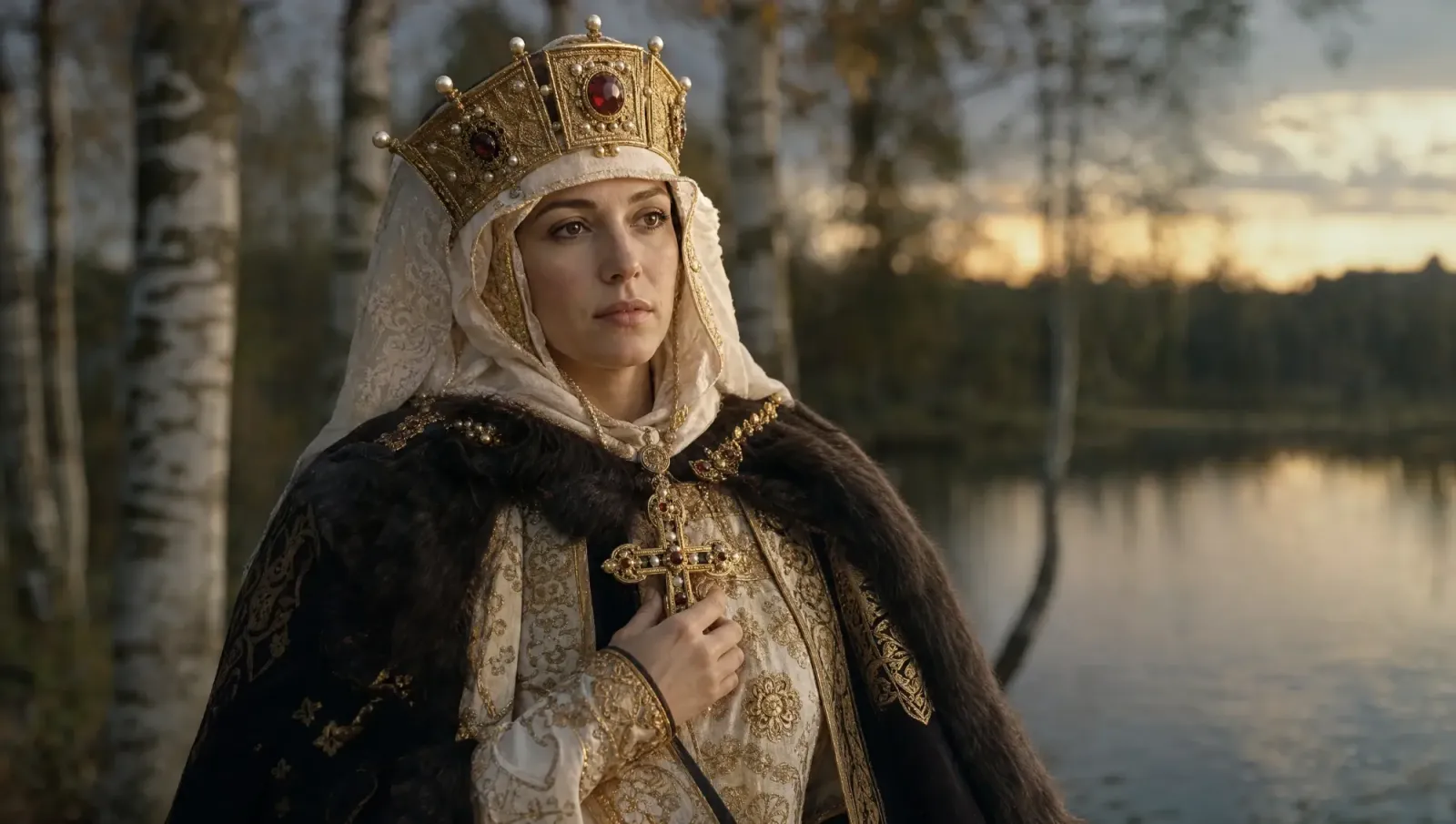
Vladimir was born around AD 956–958: Britannica and the Internet Encyclopedia of Ukraine give c. 956, other reference works c. 958. He was a younger son of Prince Sviatoslav I of Kiev by Malusha, a servant in the household of his grandmother Olga of Kiev. Malusha's brother Dobrynya became the boy's guardian and, later, his right-hand man.
That low-born mother mattered. Rivals could sneer at him as a robichich, "son of a slave", and the insult resurfaces at a key moment in his rise.
Was Vladimir a Viking?
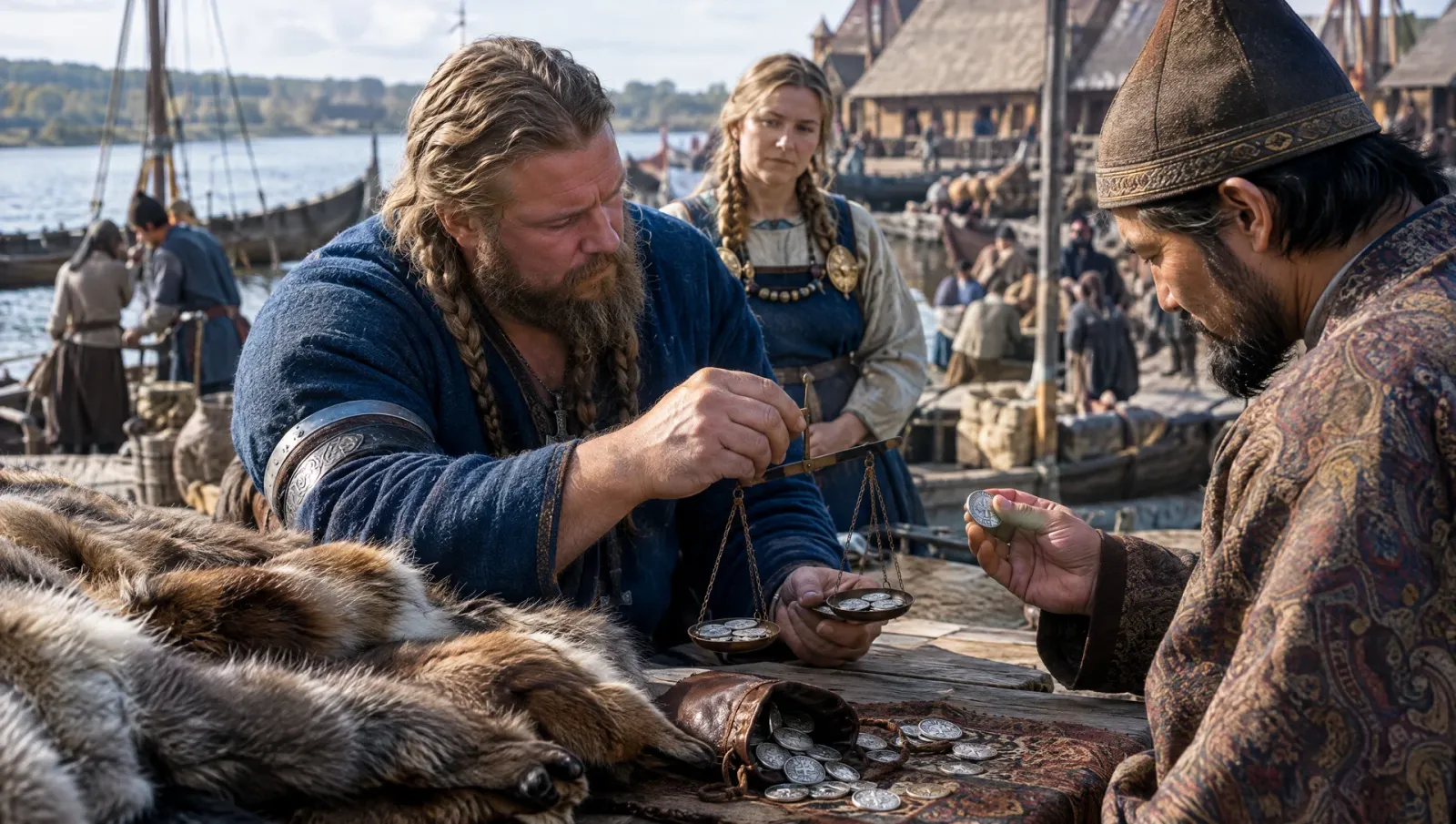
Partly. His dynasty, the Rurikids, descended from Scandinavian Rus' who had settled among the East Slavs, but by his time the family spoke Slavic and used Slavic names. Vladimir, however, won power with Varangians (Scandinavian warriors and traders working the river routes to Byzantium), and Snorri Sturluson's saga of Olaf Tryggvason calls him "King Valdamar" of Holmgard (Novgorod), claiming the future king of Norway was raised at his court for nine years. The saga was written around 1230 and its chronology does not fit Vladimir's career neatly, so treat it as memory rather than record.
Why is he called "the Great"?
The epithet is a later honour for his two big achievements: uniting the East Slavic lands under Kiev and converting them. The Church calls him isapostolos, "Equal-to-the-Apostles", a title for rulers credited with converting whole peoples. In the byliny (oral folk epics) he is Prince Vladimir "the Fair Sun" (Krasno Solnyshko), feasting among his heroes.
How did Vladimir become Grand Prince of Kiev?
In AD 969 or 970 (the sources differ) Sviatoslav made Vladimir prince of Novgorod. After Sviatoslav was killed by the Pechenegs, Turkic nomads of the steppe, in AD 972, his sons turned on each other. Around AD 977 Yaropolk of Kiev attacked his brother Oleg, who died in the fighting, and seized Novgorod; Vladimir fled "beyond the sea" to Scandinavia.
He returned with a Varangian army, expelled Yaropolk's governors and turned on Polotsk. According to the Primary Chronicle, Prince Rogvolod's daughter Rogneda had refused Vladimir, saying she would not take off the shoes of a robichich. Vladimir stormed Polotsk, killed Rogvolod and his sons and took Rogneda by force. A later chronicle passage adds that he raped her in front of her parents; historians handle that detail cautiously, and Simon Franklin and Jonathan Shepard read the marriage mainly as a bid for legitimacy.
Kiev came next. Yaropolk fled to the fortress of Rodnya, was lured to parley, and was stabbed by two Varangians as he entered. The Chronicle dates this to AD 980, which the Internet Encyclopedia of Ukraine follows. Many historians prefer AD 978 (Ostrowski's Encyclopedia of Russian History entry dates his reign 978–1015), because Jacob the Monk says Vladimir was baptised "in the tenth year" after killing his brother. According to the Chronicle, the Varangians then demanded payment, and Vladimir sent many of them off to Constantinople.
What was Vladimir's pagan reign like?
His first act, says the Chronicle, was religious. He "set up idols on the hills outside the castle with the hall: one of Perun, made of wood with a head of silver and a mustache of gold, and others of Khors, Dazh'bog, Stribog, Simar'gl, and Mokosh'" (Cross and Sherbowitz-Wetzor translation). Under AD 983 it describes a Christian Varangian who refused to hand over his son for sacrifice; both were killed. The Chronicle leaves them unnamed, but tradition calls them Theodore and John, the first martyrs of Kiev.
Historians disagree about this "pagan reform". Some see a deliberate state cult designed to unite diverse tribes; others note the list was written by a Christian monk more than a century later, and that Khors and Simargl may be Iranian borrowings.
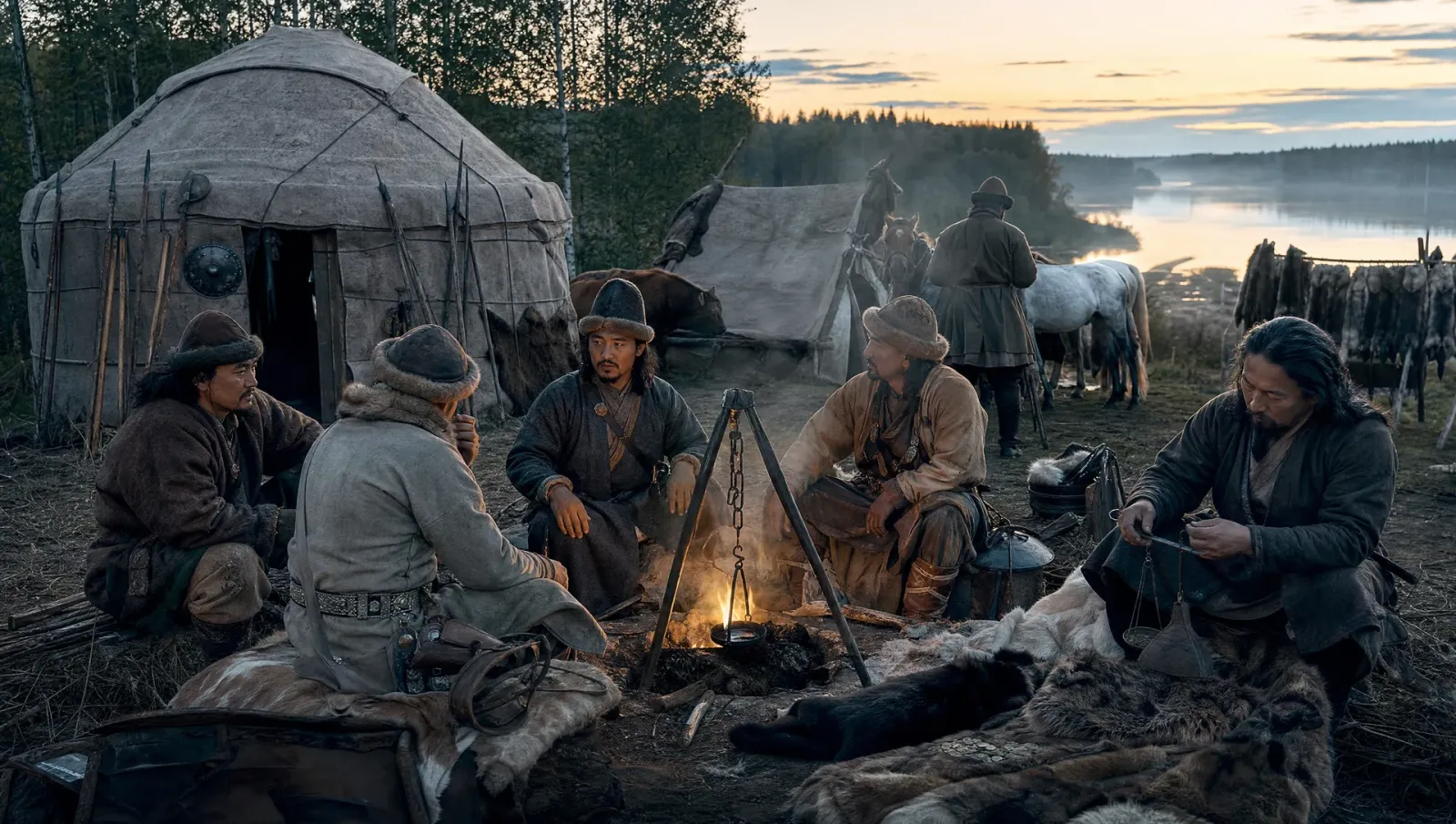
The campaigns are better attested. Vladimir took the Cherven towns and Peremyshl from the Poles in AD 981, subdued the Viatichians (AD 981–982), the Yatvingians (AD 983) and the Radimichians (AD 984), and in AD 985 attacked the Volga Bulgars with allied Torks, the people behind our article on Volga Bulgaria. The Chronicle ends that campaign in a peace sworn to last until stone floats and straw sinks. Against the Pechenegs he built lines of forts along the Irpin, Stuhna, Trubizh and Sula rivers, including Vasylkiv and Bilhorod (Belgorod).
How many wives did Vladimir the Great have?
The Chronicle lists five wives, among them Rogneda, Yaropolk's Greek widow (a former nun), a Czech and a Bulgarian, plus 300 concubines at Vyshgorod, 300 at Belgorod and 200 at Berestovo. Thietmar of Merseburg, writing within a few years of Vladimir's death, called him fornicator immensus et crudelis until he took a wife from Greece. After Anna died in 1011 he married again, a daughter of Count Kuno von Enningen.
His children are counted differently: the Internet Encyclopedia of Ukraine names 11 princes by five wives, while the Chronicle has him set "twelve sons" over his towns. They included Yaroslav the Wise, Mstislav, Iziaslav of Polotsk, Boris and Gleb, and Sviatopolk, whose father may really have been Yaropolk. Read the lurid numbers critically: the Chronicle compares Vladimir to Solomon because its story needs a great sinner before a great convert.
Why did Vladimir the Great convert to Christianity?
The Primary Chronicle tells a famous story of a "testing of the faiths" in AD 986–987:
| Faith | Envoys, per the Chronicle | Verdict, per the Chronicle |
|---|---|---|
| Islam | Volga Bulgars | Rejected: circumcision, no pork, no wine. "Drinking is the joy of the Russes." |
| Latin Christianity | "Germans" sent by the Pope | Rejected: "our fathers accepted no such principle"; his envoys later saw "no glory" in their churches |
| Judaism | Khazar Jews | Rejected: God had scattered them and taken away Jerusalem |
| Greek Christianity | A Greek scholar; then Vladimir's envoys in Constantinople | Chosen: at the liturgy "we knew not whether we were in heaven or on earth"; the boyars add that his grandmother Olga chose it |
According to Donald Ostrowski, "the scholarly consensus is that most of the account appearing in the chronicle is a later invention", and it was written some 125 years after the events. The real driver was politics. In AD 987 the general Bardas Phokas proclaimed himself emperor and threatened Basil II. Basil asked Kiev for help. According to Yahya of Antioch, as Ostrowski summarises him, Vladimir sent "six thousand troops directly to the empire", who helped crush the rebels at Chrysopolis and Abydos (13 April AD 989) and became the core of the emperor's Varangian Guard.
The price was Anna Porphyrogenita, Basil's sister, "born in the purple" (to a reigning emperor, in the palace's porphyry chamber). Constantine VII's De Administrando Imperio had insisted that "never shall an Emperor of the Romans ally himself in marriage with a nation of customs differing from and alien to those of the Roman order, especially with one that is infidel and unbaptised, unless it be with the Franks alone". So Vladimir had to be baptised, and even then a porphyrogenita marrying a northern ruler was a startling concession; Otto I's request for one had been rebuffed in AD 968.
Where was Vladimir baptised?
The Chronicle says at Korsun (Chersonesus) in Crimea, after Vladimir besieged the Byzantine city, demanded Anna and was cured of sudden blindness at the font in the Church of St Basil. It even rebukes those "who do not know the truth" and say Kiev or Vasiliev. Jacob the Monk's Memory and Praise of Prince Volodimer disagrees: Vladimir was baptised first and took Korsun "in the third year", implying baptism in AD 987 and Korsun in AD 989. Leo the Deacon's "fiery pillars" portending Cherson's capture fit AD 989, and Andrzej Poppe's classic Dumbarton Oaks Papers study argued that Vladimir took the city for Basil after it sided with the rebels.
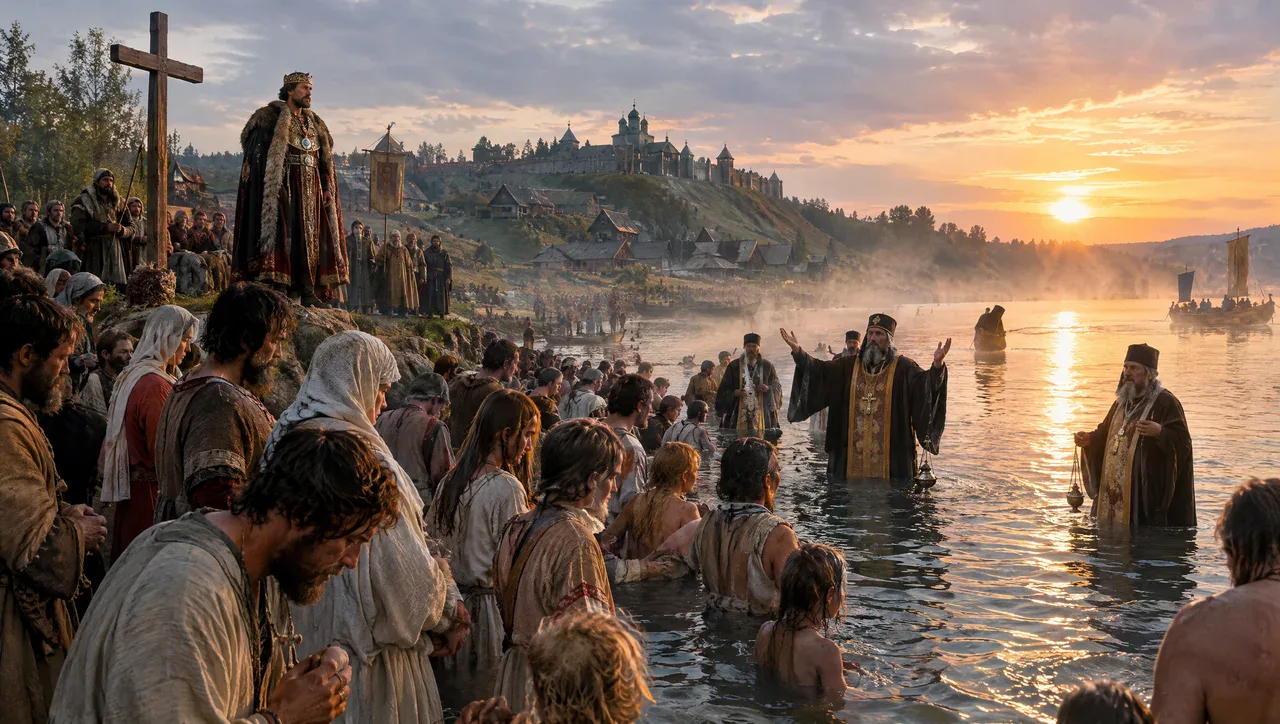
Back in Kiev, Perun was tied to a horse's tail, beaten by twelve men and thrown into the Dnieper, and the townspeople were ordered into the river for baptism. The Internet Encyclopedia of Ukraine dates the mass baptism to 1 August AD 988.
What changed after the baptism of Rus' in 988?
The Internet Encyclopedia of Ukraine is blunt: "The Christianization of Rus' was essentially engineered by Byzantium." Byzantium supplied the first bishops and missionary clergy, as well as craftsmen and books. Vladimir's showpiece was the Church of the Tithes, built AD 989–996 and funded, as its name says, with a tenth of his income. According to the Internet Encyclopedia of Ukraine, excavations of its foundations show "a three-nave structure with six pillars and wide, covered galleries on the sides", covering about 1,700 square metres, and fragments of marble sarcophagi survive. The Chronicle also says he took children of the best families for "book learning", while their mothers mourned "as for the dead".
He also struck the first Rus' coins: zlatniki (gold) and srebreniki (silver), modelled on Byzantine solidi and showing Vladimir enthroned or crowned beside a trident, the tryzub, his family's emblem. Independent Ukraine adopted the trident as its coat of arms in 1992. Diplomacy widened too. Sviatopolk married a daughter of Bolesław I of Poland, and the Internet Encyclopedia of Ukraine records papal envoys in Kiev in 986, 988, 991, 992 and 1000, with Vladimir sending his own envoys to Rome in 993 and 1001, as the ties of Kievan Rus' around 1000 reached west.
How did Vladimir die?
In 1014 his son Yaroslav, ruling Novgorod, refused to pay tribute. Vladimir fell ill while mustering troops and died on 15 July 1015 at Berestovo, near Kiev (the Internet Encyclopedia of Ukraine says Vyshhorod), and was buried beside Anna in the Church of the Tithes. His cult grew slowly. Metropolitan Hilarion's Sermon on Law and Grace praised him within decades, but formal canonisation came only after 1240. The Internet Encyclopedia of Ukraine notes that the oldest surviving reference to him as Saint Volodymyr is in the Hypatian Chronicle under 1254, and that his feast "was first celebrated in 1263".
Key dates
| Date | Event | Main source / dispute |
|---|---|---|
| c. AD 956–958 | Birth | Britannica/IEU c. 956; others c. 958 |
| AD 969/970 | Prince of Novgorod | IEU 969; Britannica 970 |
| AD 978 or 980 | Yaropolk killed; Vladimir rules Kiev | Chronicle 980; Jacob the Monk implies 978 |
| AD 980 | Pagan pantheon raised | Primary Chronicle |
| AD 987–989 | Baptism | Jacob: 987; Chronicle: 988 at Korsun |
| AD 988 | Mass baptism in the Dnieper | Chronicle; IEU: 1 August |
| AD 989 | Abydos; Korsun taken | Yahya of Antioch; Leo the Deacon |
| AD 996 | Church of the Tithes consecrated | Chronicle; IEU |
| 15 July 1015 | Death | Chronicle: Berestovo |
Is Vladimir the Great Russian or Ukrainian?
Neither and both. Kievan Rus' was a medieval realm centred on Kyiv that predates all modern nations, and Ukraine, Russia and Belarus all claim it as their starting point. "Volodymyr" is the Ukrainian form of his name, "Vladimir" the Russian.
Ukraine made 28 July the Day of the Baptism of Kyivan Rus'–Ukraine in 2008, and in 2021 added a Day of Ukrainian Statehood, first celebrated on 28 July 2022. After the Orthodox Church of Ukraine adopted the Revised Julian calendar in 2023, a law of 28 July 2023 moved both to 15 July. His best-known monument in Kyiv, on Volodymyr Hill, was unveiled in 1853, according to the Kyiv city guide. Russia made 28 July the Day of the Baptism of Rus' by law in 2010, and on 4 November 2016 President Putin unveiled a 17.5-metre statue by Salavat Shcherbakov beside the Kremlin, calling Vladimir the "spiritual founder of the Russian state". Belarus added the date to its official calendar in 2011.
What is Vladimir the Great's feast day?
15 July. In churches that still use the Julian calendar, such as the Russian Orthodox Church, that date falls on 28 July in the civil calendar; the Orthodox Church of Ukraine (since 2023), Greek Catholics and Roman Catholics keep it on 15 July.
What the map shows next
Vladimir's death set off a four-year war between his sons. Sviatopolk, branded "the Accursed" by a chronicle written for his rivals' descendants, seized Kiev; Boris and Gleb were murdered and became the first saints of Rus'; Yaroslav the Wise won by 1019 and ruled until 1054. After that, the realm Vladimir had stitched together began to split into rival principalities, as 1054 on the map shows.