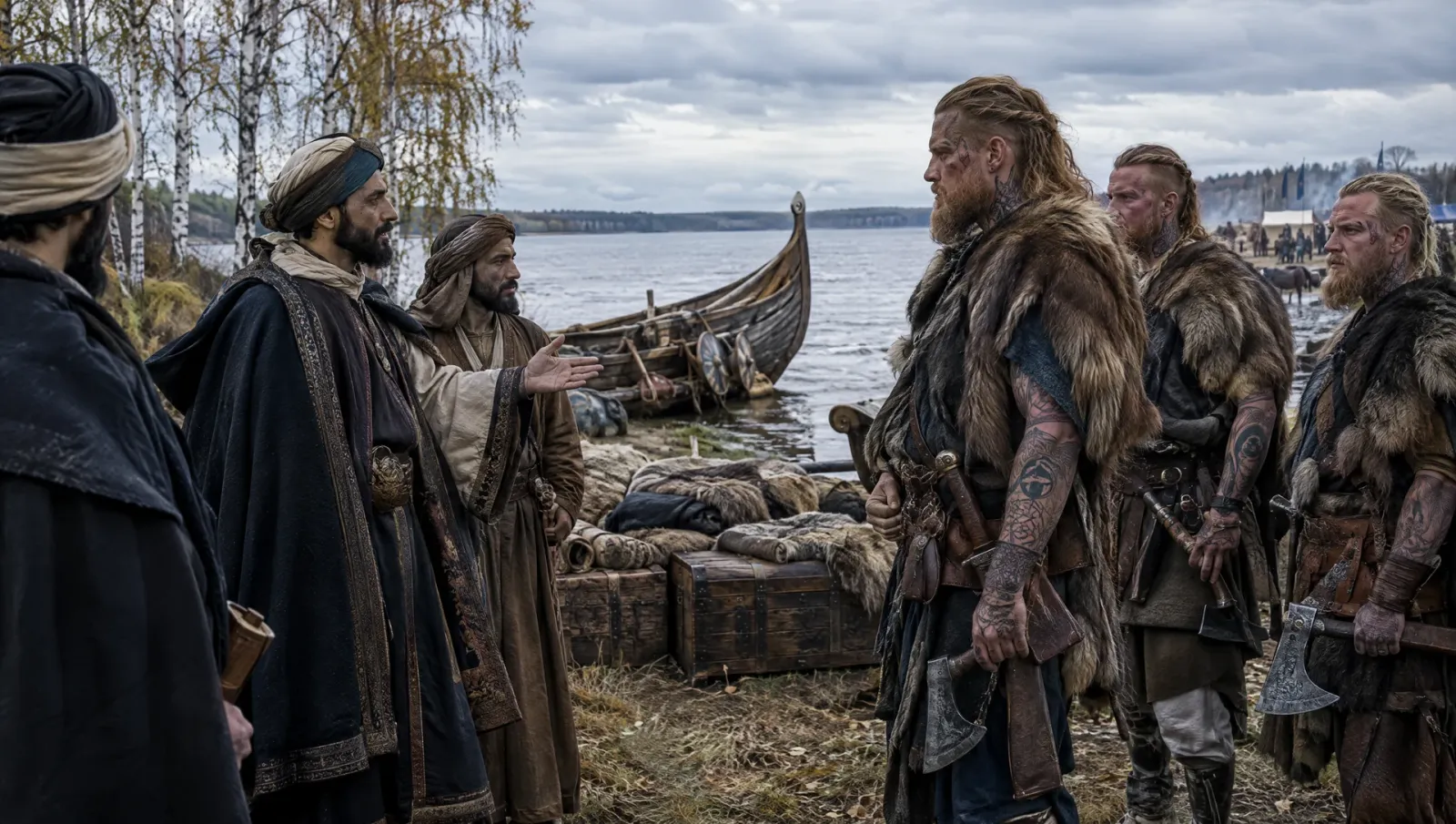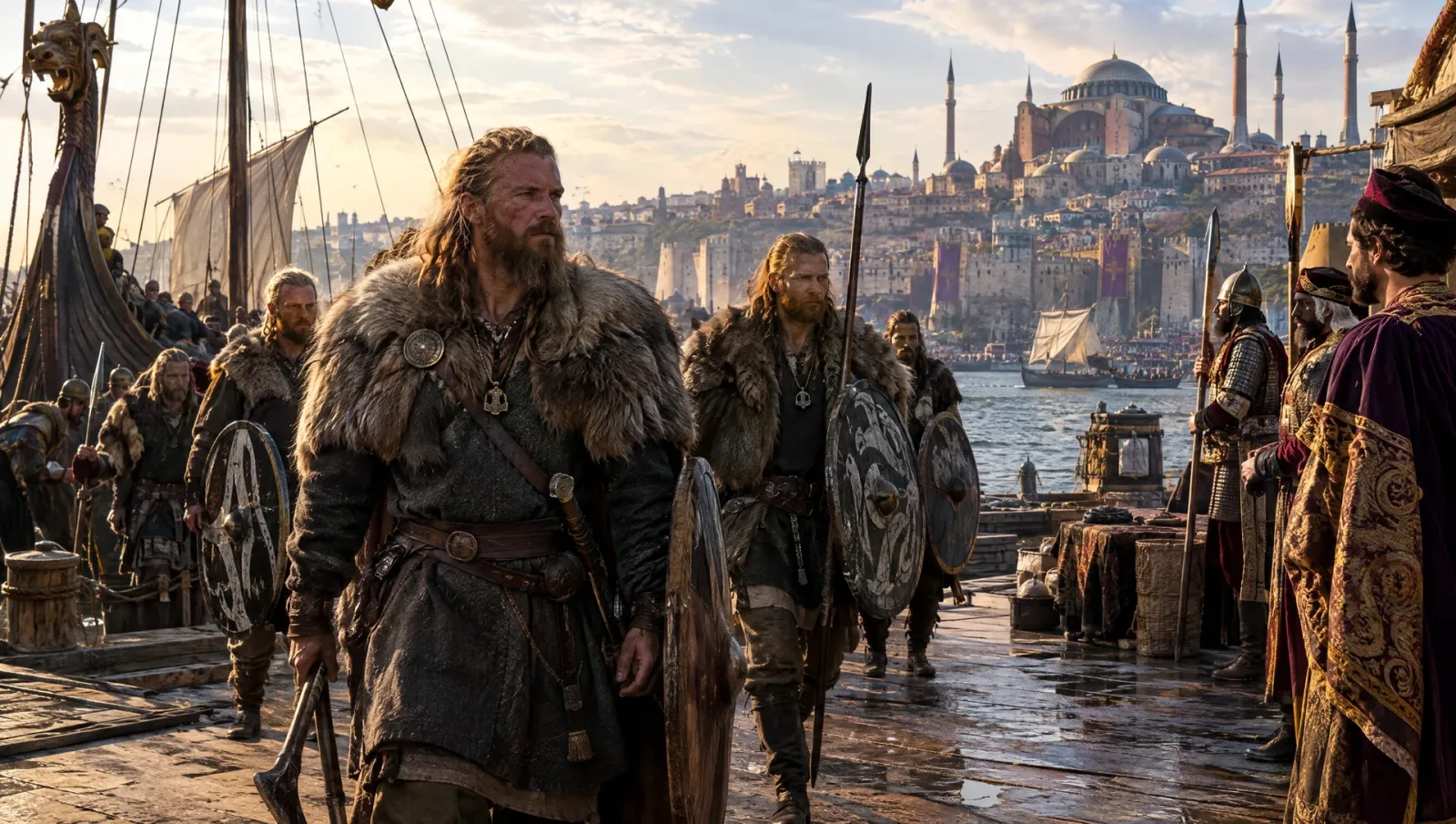
The Varangians were Scandinavians, most of them from what is now eastern Sweden, who traded, collected tribute, fought for hire and settled along the rivers of today's Russia, Ukraine and Belarus between the eighth and eleventh centuries. East Slavs and Byzantine Greeks gave them the name, and it later stuck to the Scandinavians who served the emperors in Constantinople. They matter because a Scandinavian elite, first known as the Rus', stood at the cradle of the first East Slavic state, and its name survives in "Russia" and "Belarus".
Who were the Varangians?
The Varangians are best understood as a way of life, not a tribe. A man from Uppland or Gotland might sail east as a fur trader one season, guard a prince's hall the next and come home, if he was lucky, with a purse of Islamic silver. Written sources first call these travellers Rus' and only later Varangians; archaeologists meet them in graves, brooches, weapons and silver hoards.
Ancient DNA now backs up the traditional picture of where they came from. The largest genetic study of the period, Margaryan et al., "Population genomics of the Viking world" (Nature, 2020), sequenced 442 individuals and found "a Swedish influx into the Baltic", while Danish ancestry went mainly to England and Norwegian ancestry to Ireland, Iceland and Greenland. As the journal Science summarised it, people of Swedish ancestry moved east "to the Baltics, Poland, and the rivers of Russia and Ukraine".
Key dates at a glance
| Date | Event | Main source |
|---|---|---|
| c. AD 753 | Earliest dated timber buildings at Staraya Ladoga | Dendrochronology (tree-ring dating) |
| AD 839 | Envoys calling themselves Rhos reach Louis the Pious and are identified as Swedes | Annals of St Bertin |
| 18 June AD 860 | A Rus' fleet attacks Constantinople | Homilies of Patriarch Photius; Brussels Chronicle |
| AD 862 | "Calling of the Varangians" (chronicle date) | Primary Chronicle |
| AD 882 | Oleg takes Kiev (chronicle date) | Primary Chronicle |
| AD 921–922 | Ibn Fadlan meets Rus' traders on the Volga | Ibn Fadlan's Risala |
| c. AD 913 and AD 943–944 | Rus' raids on the Caspian coast and on Barda'a | al-Mas'udi; Ibn Miskawayh |
| c. AD 948–952 | Rus' river convoys described in detail | Constantine VII, De Administrando Imperio |
| 1015 (or 1016) | Novgorodians kill Yaroslav's Varangian mercenaries | Primary Chronicle; Novgorod First Chronicle |
| 1034 | "Varangians" wintering in the Thracesian theme | John Skylitzes |
| 1036–1041 | Ingvar the Far-Travelled's expedition east | Ingvar runestones; Icelandic annals |
What does Varangian mean?
"Varangian" goes back to Old Norse væringi (plural væringjar), usually derived from vár, "pledge" or "vow". A væringi was therefore a "sworn man": someone bound by oath to a fellowship of traders or to a lord who paid him. The Encyclopedia of Ukraine glosses the word as "one who has taken an oath of allegiance", and standard English dictionaries give the same root. Some etymologists split the word into vár plus gengi, "companion", but the core idea of a pledge is not seriously disputed.
The word travelled with the men. In Old East Slavic it became varęgŭ (варягъ, modern Russian variag, Ukrainian variahy); in Byzantine Greek Varangoi (Βάραγγοι); in medieval Latin Varangus; and in Arabic warank. The earliest Arabic use, according to James Montgomery's survey of Arabic sources on the Vikings, comes in an astronomical work by al-Biruni (died after 1050), who speaks of the "Sea of the Varangians", meaning the Baltic. Rus' writers also called the Baltic the Varangian Sea. English borrowed "Varangian" only in the eighteenth century.
Where does the name Rus' come from?
"Rus'" is a different and older word. Most linguists derive it, through Finnish Ruotsi and Estonian Rootsi (both still meaning "Sweden"), from an Old Norse root rōþs- connected with rowing, which also lies behind Roslagen, the coast north of Stockholm once organised to supply rowers for the fleet. Anti-Normanist scholars have proposed alternatives, such as the River Ros south of Kiev or the Iranian-speaking Roxolani, but these have far less support.
The order of appearance matters. The Rus' enter written history in AD 839 in Latin and in AD 860 in Greek, when Photius used the name. "Varangian", by contrast, surfaces only in the eleventh century: in Byzantine historian John Skylitzes' account of 1034 (written decades later), in al-Biruni, and in the Primary Chronicle, compiled in Kiev c. 1113.
Were the Varangians Vikings?
Yes, in the broad modern sense: they were Scandinavians of the Viking Age, and the 2020 genome study counts them among the Viking diaspora. But in Old Norse a víkingr was a sea-raider and víking an expedition for plunder, and the headline of Science's report on the DNA study – "'Viking' was a job description" – makes the same point. In the East, the steady business was trade, tribute and paid service rather than hit-and-run raids, although the Rus' could raid spectacularly when it paid.
| Term | Who used it | What it meant | Period |
|---|---|---|---|
| Viking | Old Norse speakers; now historians and the public | A sea-raider or raiding voyage; today shorthand for all Viking-Age Scandinavians | Eighth–eleventh centuries; modern usage |
| Rus' | Franks (Rhos), Greeks (Rhos), Arabs (al-Rus), Slavs (Rus') | First Scandinavian rowers, traders and chiefs; later the Slavicised ruling group and its land | From AD 839 |
| Varangian | Slavs (varęgŭ), Greeks (Varangoi), Arabs (warank) | "Sworn men": Scandinavian newcomers, above all mercenaries | Eleventh century onwards in texts |
Were the Varangians and the Rus' the same people?
According to the Primary Chronicle, the Rus' were one Varangian people among several. In the Laurentian text, as translated by Samuel Hazzard Cross and Olgerd Sherbowitz-Wetzor (1953), the chronicler explains that "these particular Varangians were known as Rus', just as some are called Swedes, and others Normans, English, and Gotlanders, for they were thus named." (Older classroom adaptations render the list as "Normans, Angles, and Goths".) For a twelfth-century monk, then, "Varangian" was the umbrella term for the peoples beyond the Baltic.
The earliest outside evidence points the same way. The Annals of St Bertin record that in AD 839 a Byzantine embassy brought to Emperor Louis the Pious at Ingelheim men who said their people were called Rhos; after investigation Louis concluded that they belonged to the people of the Swedes (gentis esse Sueonum) and held them as possible spies. The same entry calls their ruler chacanus, a version of the steppe title "khagan", although historian Ildar Garipzanov has questioned how much weight that reading can bear.
Modern specialists stress that the two names are not interchangeable. The editors of Making of the Eastern Vikings: Rus' and Varangians in the Middle Ages (Brepols) put it plainly: "the terms Rus' and Varangians are not synonymous, and they were used in a different meaning in different time periods." Broadly, "Rus'" came to mean the Slavic-speaking ruling group and its country, while "Varangian" was kept for fresh arrivals from Scandinavia, usually men hired to fight.
Where did the Varangians travel? The river routes to Byzantium and Baghdad
The Primary Chronicle names a "route from the Varangians to the Greeks". The Encyclopedia of Ukraine traces it across nearly 3,000 km: the Gulf of Finland, the Neva, Lake Ladoga, the Volkhov, Lake Ilmen and the Lovat, then a portage – a stretch where boats and cargo were hauled overland between rivers – to the Dnieper, down to the Black Sea and along its western shore to Constantinople, capital of the Byzantine Empire.
Constantine VII's De Administrando Imperio (chapter 9, c. AD 948–952) is the best eyewitness-style description. It tells how Slav tributaries cut dugout boats (monoxyla) in winter and floated them to Kiev, where the Rus' fitted them out and set off each June. It also lists the Dnieper rapids under both "Rus'" and Slavic names; as historian Peter Sawyer noted, several of the Rus' forms are clearly Scandinavian – strong evidence of what language the boatmen spoke.
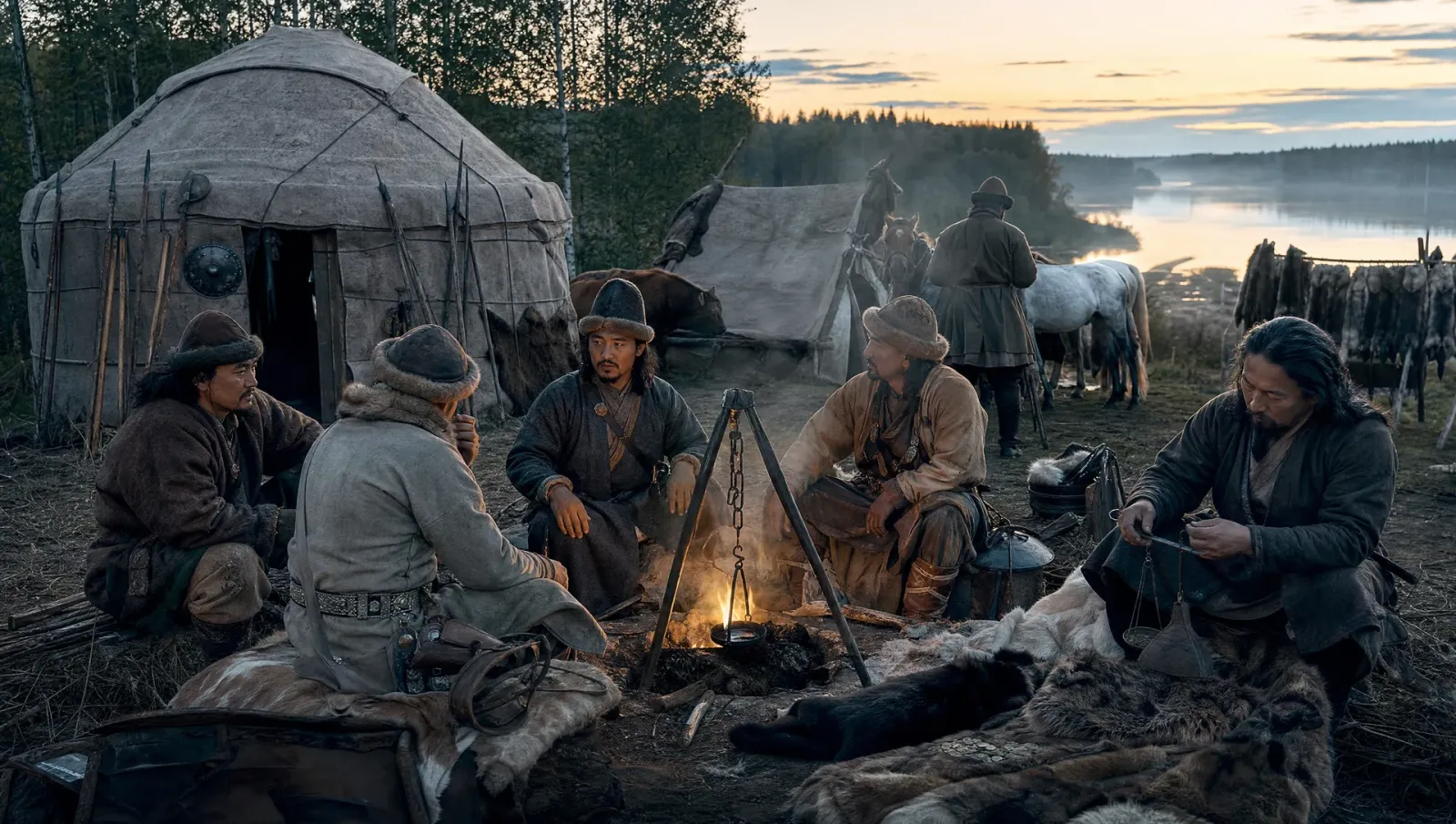
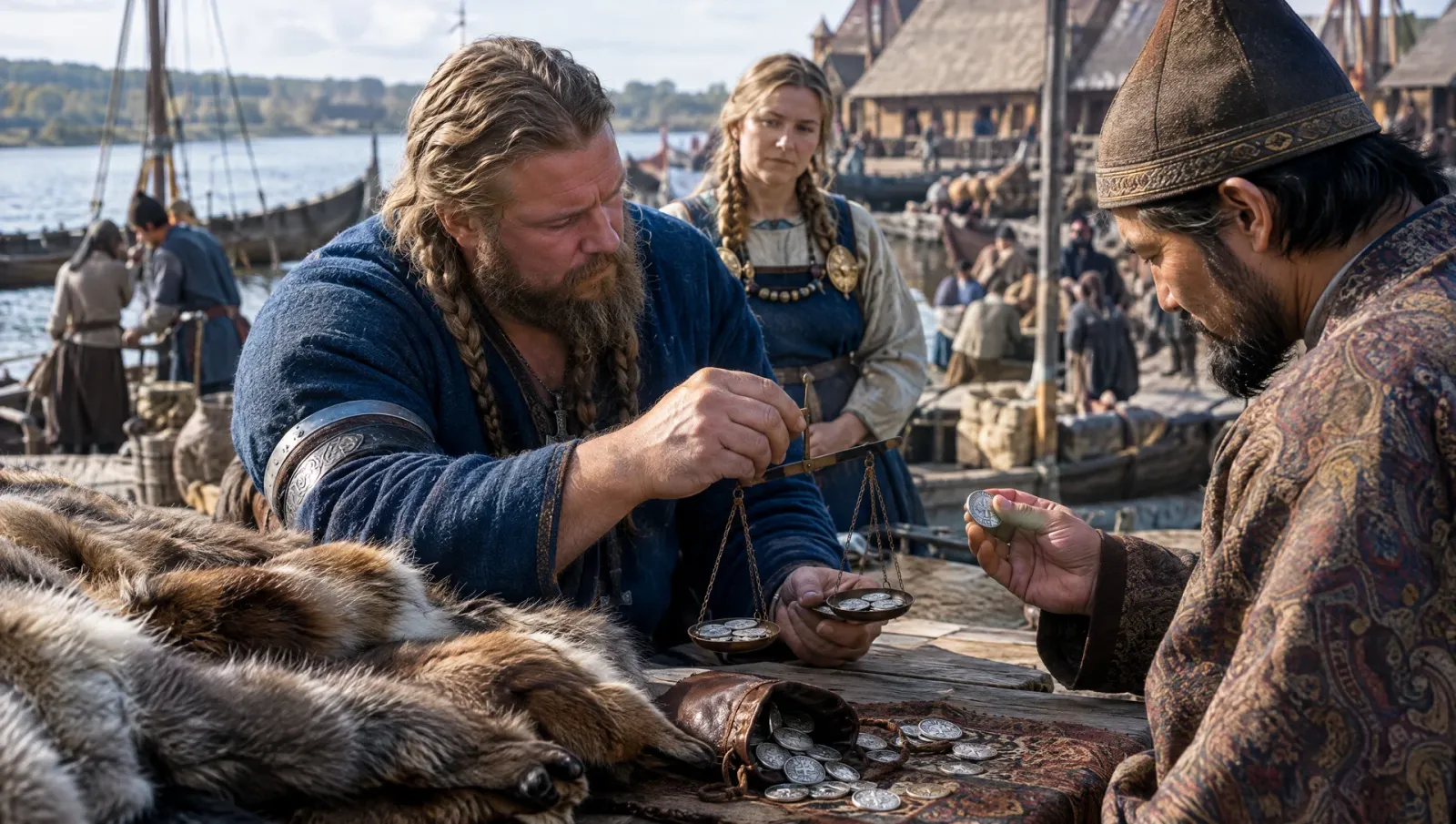
The other great artery ran down the Volga. It led past Volga Bulgaria and the Khazar Khaganate (a Turkic steppe state ruled by a khagan) to the Caspian and the silver-rich lands of the Abbasid Caliphate and later the Samanid emirs of Central Asia. Northerners sold furs and slaves and were paid in dirhams, Islamic silver coins. The historian Thomas S. Noonan (1938–2001) of the University of Minnesota called the dirham "the coin that helped fuel the Viking Age", noting that some 100,000 dirhams had been unearthed in Sweden alone. The Spillings hoard on Gotland, found in 1999, weighed 67 kg of silver before conservation and contained 14,295 coins, nearly all of them Islamic dirhams.
The Arab diplomat Ahmad ibn Fadlan, sent from Baghdad to the Volga Bulgars in AD 921–922, left the most famous portrait of these traders. He describes tall, heavily armed men who always carried an axe, a sword and a knife, and a chieftain's funeral ending in a ship cremation and the killing of an enslaved girl (English translations: Lunde and Stone, 2012; Montgomery, Mission to the Volga, 2017). The Rus' could also turn raider: they attacked Constantinople on 18 June AD 860, plundered the Caspian coast c. AD 913 and, in AD 943–944, sailed up the Kura river to seize Barda'a in the Caucasus for several months.
What was the Calling of the Varangians in 862?
The Primary Chronicle says that under AD 859 Varangians from beyond the sea were taking tribute from the Chud, Slavs, Merya and Krivichians. Under AD 862 the tribes drove them out, then fell to feuding. In Cross and Sherbowitz-Wetzor's translation, "The Chuds, the Slavs, the Krivichians, and the Ves' then said to the people of Rus', 'Our land is great and rich, but there is no order in it. Come to rule and reign over us.'" Three brothers came: Rurik settled at Novgorod, Sineus at Beloozero and Truvor at Izborsk. Later entries have two of Rurik's men, Askold and Dir, holding Kiev until Rurik's kinsman Oleg took the city in AD 882.
Treat this as a foundation legend, not a news report. The chronicle was compiled around 1113, some 250 years after the events it dates to AD 862, and its early chronology is shaky: it places the famous attack on Constantinople in AD 866, not 860. Scholars have also pointed to a close literary parallel in Widukind of Corvey's tenth-century Saxon history, where the Britons offer the Saxons a land "great and rich". The story explained, and justified, why the Rurikid dynasty ruled.
A popular twentieth-century idea held that "Sineus" and "Truvor" were never people at all, but misread Norse phrases – sine hus ("his household") and thru varing ("loyal companions"). Linguists have rejected this, because such phrases break basic Old Norse grammar; ordinary Norse names such as Signjótr and Þórvarðr fit the chronicle forms better. The brothers may be legendary, but the "misreading" theory is a myth of its own.
What does archaeology and DNA tell us?
Archaeology confirms a real Scandinavian presence, and shows it began earlier than the chronicle's 862. At Staraya Ladoga, the Aldeigjuborg of the sagas, near where the Volkhov meets Lake Ladoga, tree-ring dates put the first buildings around AD 753. A strontium-isotope study by T. Douglas Price, Vyacheslav Moiseyev and Natalia Grigoreva (Archaeological and Anthropological Sciences, 2019) of 15 later burials (eleventh–twelfth centuries) from the St Clement church cemetery "identified at least five non-local individuals with isotopic signatures that match the Malaren region of east-central Sweden". Strontium in tooth enamel records the geology of the place where a person grew up.
Gnezdovo, near Smolensk on the upper Dnieper, is the richest site. According to the Gnezdovo entry in the Encyclopedia of Russian History, more than 1,200 of an estimated 3,500–4,000 burial mounds have been excavated. Balts and Slavs make up most of the dead, and "no more than fifty mounds can be positively identified as Scandinavian" – boat cremations, rich chamber graves (timber-lined burial rooms) and women buried with oval brooches, the paired bronze clasps of Scandinavian female dress. Two chamber graves have been tree-ring dated to AD 975 and 979. Gnezdovo peaked from c. AD 920 to the 960s and was abandoned in the early eleventh century as Smolensk took over.
That pattern is the key to the whole period: a small, rich, highly visible Scandinavian minority living among much larger Slavic, Baltic and Finnic populations. The 2020 Nature study fits it, sampling Viking-Age individuals from Staraya Ladoga and Ukraine alongside a mixture of local ancestries – and even one person of Danish ancestry in Russia.
Varangian DNA and the Rurikids
Geneticists have also tested the ruling family. A haplogroup is a branch of the human family tree traced through one line, here the father-to-son Y chromosome. In 2023, Zhur et al. in Acta Naturae sequenced Prince Dmitry Alexandrovich (died 1294), a son of Alexander Nevsky, and found Y-haplogroup N1a (formerly labelled N1c1), matching most living Rurikid princes tested in genealogy projects. This lineage is common today among Finnic and Baltic peoples, which some writers have used to argue against a Scandinavian Rurik. It proves less than it seems: a single paternal line says nothing about a medieval family's language or identity, the dynasty's line before the eleventh century is unknown, and a skeleton from Lutsk, possibly Prince Izjaslav Ingvarevych, carried a different haplogroup (R1a).
The Normanist debate: who founded Rus'?
"Normanism" is the view that Scandinavians ("Normans" in older usage) founded the Rus' state. It began with German scholars at the St Petersburg Academy. Gottlieb Siegfried Bayer published De Varagis ("On the Varangians", 1729), and on 6 September 1749 Gerhard Friedrich Müller was due to give a speech on the origins of the Russian people and name. The uproar was such that the Academy set up a committee to judge whether his work harmed the empire's glory; Mikhail Lomonosov led the attack, and Müller had to set the subject aside, though he later reworked the material and reprinted it as Origines Rossicae in 1768.
Anti-Normanism – the insistence that the Rus' were native Slavs – became a long tradition in Russian and later Soviet scholarship. Dmitry Verkhoturov's 2015 study "Normanism: What's in a Name?" argues that the notion was "much of a strawman constructed by its early opponents, first of all, by Lomonosov", and that Müller's actual views were not far from today's mainstream.
That mainstream is a compromise supported by the evidence above. The name Rus', the founding dynasty and much of the early elite were Scandinavian in origin. But the state they ran was built on Slavic, Finnic and Baltic populations, borrowed the Khazar title khagan, took its religion from Byzantium and its written language from the Slavs – and its Scandinavian rulers assimilated fast. As the Encyclopedia of Ukraine notes, Varangian influence was most visible "in military organization and in personal names". The debate still carries political weight, because Russia, Ukraine and Belarus all claim the heritage of Rus'; the Varangians themselves did not know these modern borders.
What happened to the Varangians?
They became Slavs, or went home. The names of the first rulers are Norse – Oleg from Helgi, Igor from Ingvar, Olga from Helga – but Igor and Olga's son bore the Slavic name Sviatoslav, and Constantine VII already knew of him as a prince seated at Novgorod. By the time of Vladimir the Great and the baptism of Rus' in the late tenth century, the ruling house of Kievan Rus' spoke Slavic and hired Varangians instead of being Varangians.
Hired swords brought trouble. According to the Novgorod First Chronicle, Yaroslav "was keeping many Varangians in Novgorod", and when they began to assault the townsmen's wives, the Novgorodians killed them at night in Poromon's Court (the Novgorod text dates this to 1016; the Primary Chronicle and most historians to 1015). Britannica's biography of Yaroslav the Wise notes that he won Kiev in 1019 with Novgorodian support and Varangian mercenaries. That same year, by the usual dating, he married Ingegerd, daughter of the Swedish king Olof. Icelandic Eymundar þáttr tells of a Norse captain in Yaroslav's pay, but it is a saga, not a record. Novgorod even had a "Varangian church" for its northern merchants.
Across the Baltic, runestones remember those who did not come back. At least 26 Ingvar runestones, 24 of them in the Lake Mälaren region of Uppland, mourn men who died in the east with Ingvar the Far-Travelled; three Icelandic annals record Ingvar's death in 1041. The Gripsholm stone (Sö 179, c. 1040), in the Rundata translation, says that Harald, Ingvar's brother, and his companions "travelled manfully far for gold, and in the east gave (food) to the eagle". After the late eleventh century, Rus' writers increasingly used variagi for Western, Catholic Europeans in general, while new Scandinavian arrivals largely stopped.
The southern outlet: the Varangian Guard
For many young Scandinavians the rivers led all the way to Constantinople. From the reign of Basil II, Varangians formed the emperor's elite guard, and Skylitzes' reference under 1034 is among the earliest Greek uses of the name. That story – Harald Hardrada, the Anglo-Saxon recruits and the graffiti in Hagia Sophia – is told in full in our article on the Varangian Guard.
Famous Varangians and Rus'
| Name | Who they were | Main source |
|---|---|---|
| Rurik | Legendary founder at Novgorod, AD 862 | Primary Chronicle |
| Askold and Dir | Rurik's men said to rule Kiev before AD 882 | Primary Chronicle |
| Oleg (Helgi) | Took Kiev AD 882; united north and south | Primary Chronicle |
| Igor (Ingvar) | Prince of Kiev; father of Sviatoslav | Primary Chronicle; De Administrando Imperio |
| Olga (Helga) | Igor's widow and regent; baptised Christian | Primary Chronicle |
| Yaroslav's Varangians | Mercenaries in Novgorod and Kiev, 1015–1019 | Novgorod First Chronicle; Primary Chronicle |
| Ingvar the Far-Travelled | Led a Swedish expedition east, died 1041 | Ingvar runestones; Yngvars saga; Icelandic annals |
| Harald Hardrada | Served Yaroslav, then Byzantium; later king of Norway | Heimskringla; Byzantine sources |
What the map shows next
Twenty years after the chronicle's Calling of the Varangians, Oleg's move south turned scattered river posts into a state centred on Kiev. Compare Viking settlements in the north with the Rus' around AD 880, then open AD 882 on the map to watch Kievan Rus' appear on the map.