Volga Bulgaria was a medieval Turkic state at the meeting of the Volga and Kama rivers, in what is now Tatarstan in Russia, that flourished from roughly the late 9th century until the Mongols conquered it in 1236–1240. Its rulers adopted Islam officially in AD 922, which made it the northernmost Muslim state of its day. It mattered because it sat astride the river road linking the fur forests of the north with the silver of Central Asia, and because Volga Tatars and Chuvash alike still count it among their ancestors.
Where did the Volga Bulgars come from?
The Bulgars were Turkic-speaking steppe nomads. Around AD 630 they formed Old Great Bulgaria north of the Black Sea, a confederation that broke apart under pressure from the Khazar Khaganate (a khaganate is a steppe empire ruled by a khagan, or "khan of khans") in the 660s. One group under Asparukh went west and founded the First Bulgarian Empire on the Danube in AD 681. Other Bulgar groups moved north up the Volga; most historians place their arrival in the middle Volga in the 8th century, and a Tatarstan tradition links it to the Arab–Khazar wars of the 730s.
The newcomers settled among Finno-Ugric peoples, the ancestors of today's Mari and Udmurts, with the Burtas to the south and the Bashkirs to the east. The geographer Ibn Rusta, writing in the early 10th century, says the Bulgars were split into three groups: the Barsula, the Esegel and the Bulgars proper. A fourth group, the Suvar, gave its name to the city of Suvar. For a long time these clans paid tribute to the Khazars. A tributary is a subject state that keeps its own ruler but pays its overlord.
The Bulgars spoke an Oghur Turkic language. Oghur is a branch of Turkic that replaced the usual Turkic z with r and š with l. Its only living member is Chuvash. Tombstones from the 13th and 14th centuries preserve short epitaphs in this Bulgar language, written in Arabic script.
Why did Volga Bulgaria convert to Islam in AD 922?
The short answer is geopolitics. Almish son of Shilki held the title yiltawar (in Turkic, elteber), which marked him as a vassal king under the Khazars, and he wanted to break free. He wrote to the Abbasid caliph al-Muqtadir in Baghdad, asking for religious teachers, a mosque and money for a fortress against his enemies. Ahmad ibn Fadlan's account makes it clear that the enemy in question was the Khazars.
The caliph's embassy was led by the court eunuch Susan al-Rassi, with Ahmad ibn Fadlan as secretary and religious adviser. It left Baghdad on 21 June AD 921 and, according to Ibn Fadlan, reached the Bulgar ruler on 12 May AD 922. Ibn Fadlan always calls Almish the "king of the Saqaliba". Arab writers used Saqaliba loosely for the peoples of northern and eastern Europe, and also for slaves from those lands. The visit was awkward: the promised 4,000 dinars for the fortress never arrived, and Almish suspected Ibn Fadlan of pocketing them. Ibn Fadlan also objected that the Friday sermon called Almish "king". So, in the Penguin translation by Lunde and Stone, the ruler took the name Ja'far (the caliph's own name) and gave his father the name 'Abd Allah, which made him Ja'far ibn 'Abd Allah.
Islam did not arrive with Ibn Fadlan. Ibn Rusta already describes Bulgars with mosques and Quran schools, and Lunde and Stone date Almish's own conversion to around AD 900. What 922 marks is the official, caliph-backed adoption of Islam. Ibn Fadlan's report also contains the famous eyewitness description of a Rus' chieftain's ship cremation on the Volga. Tatarstan celebrates the event every 21 May at Bolgar with the Izge Bolgar Zhyeny festival ("Holy Bolgar Gathering"). The 1,100th anniversary on 21 May 2022 drew more than 20,000 people, according to the World Congress of Tatars and the Kazan newspaper Realnoe Vremya, with delegations from 76 states.
How did the Volga Bulgars get rich?
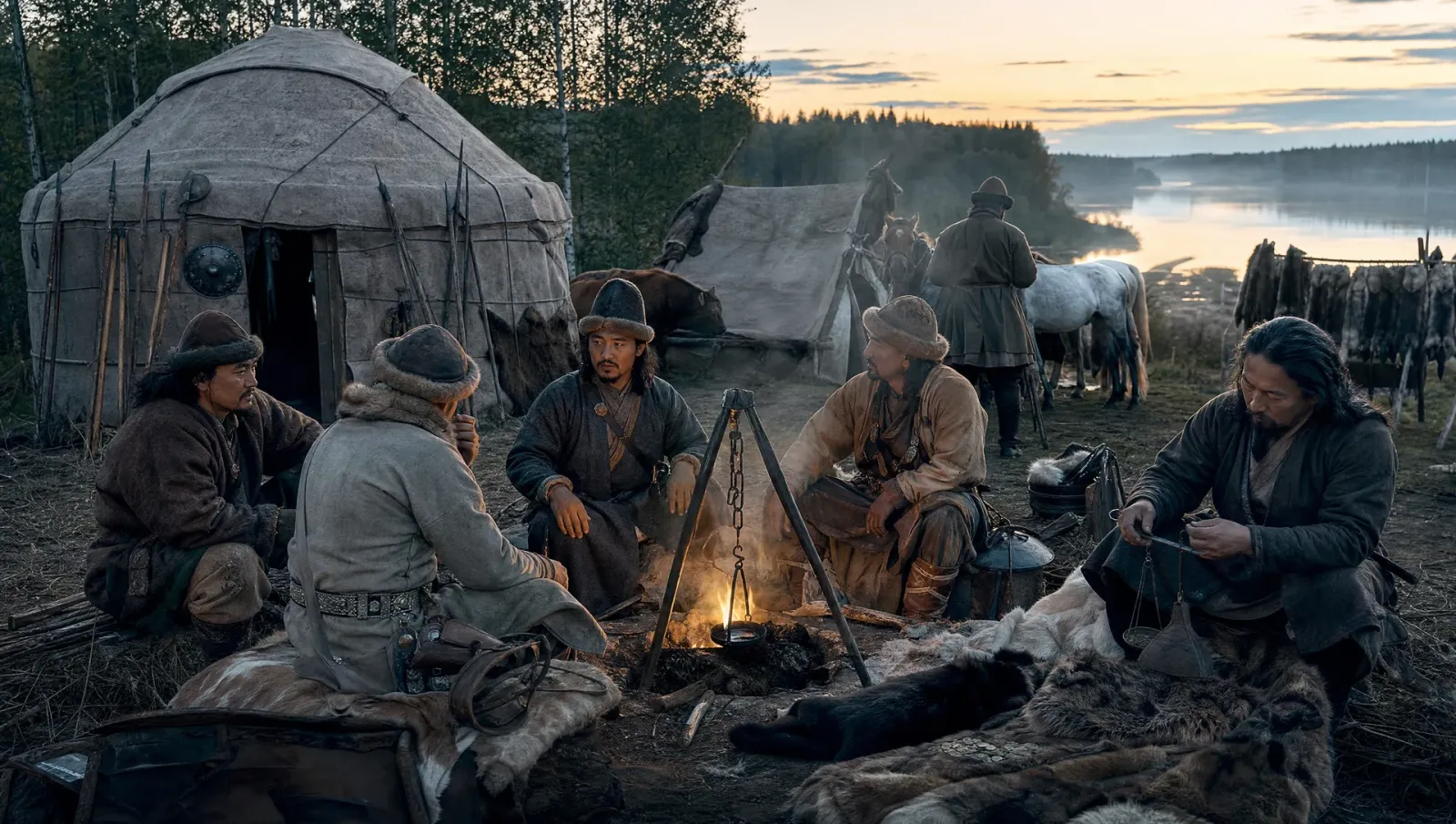
The Bulgars were middlemen. Furs such as sable, marten, squirrel and fox came down from the northern forests. The Arabs called those forests the "Land of Darkness", and the peoples there, among them the Visu and Yugra, reportedly traded with the Bulgars without ever meeting them face to face. Slaves, honey, wax and walrus ivory moved along the same route. Rus' merchants brought captives and furs down the river to Bolgar to sell to Muslim traders.
In return came silver. The historian Roman Kovalev, building on Thomas Noonan's work, writes in a 2018 study of Rus' coin finds that "starting in ca. 900 and continuing into the late tenth century, millions" of dirhams (Islamic silver coins) were carried by Muslim merchant caravans from the Samanid mints of Central Asia to the Bulgars of the middle Volga. Kovalev notes that most of these coins were then re-exported by Rus' merchants "into the Baltic basin and beyond", which is why Swedish and Gotland hoards are full of Islamic coins. The Bulgars also struck their own coins, first copies of Samanid dirhams and then issues in their rulers' names. One dirham of Mika'il ibn Ja'far, probably Almish's son, is dated AH 306 (AD 918–919).
Farming mattered too. Ibn Rusta calls the Bulgars farmers growing wheat, barley and millet. A Russian chronicle for 1024 says famine-struck people from Suzdal went to the Bulgars and brought back grain. Later there were real cities. Bolgar's walled site covers 424 hectares, and UNESCO inscribed the Bolgar Historical and Archaeological Complex on the World Heritage List in 2014. Bilär, the "Great City" of the Russian chronicles, is an even bigger site. Tatarstan's official tourism portal gives almost 800 hectares for the whole complex including suburbs, with 116 hectares of inhabited inner city and 374 of outer city, which would put it among the largest cities in medieval Europe. That figure measures the area of ruins, not a counted population.
How did Volga Bulgaria deal with Kievan Rus'?
Relations with the Rus' were a steady mix of trading and fighting. Around AD 965–969 Sviatoslav, son of Olga of Kiev, destroyed Khazaria and so ended the Bulgars' tributary status. Ibn Hawqal reports a Rus' attack on Bulghar in the same years, but historians disagree about whether Sviatoslav really struck the middle Volga.
The Primary Chronicle, compiled in Kiev in the 1110s, records that in AD 985 Vladimir of Kievan Rus' campaigned against "the Bulgars" with his uncle Dobrynya. Dobrynya looked at the captives, saw that they all wore boots, and advised looking for easier tribute-payers in bast shoes. Vladimir made peace, and the chronicle says the two sides swore to keep it until stone floated and straw sank. Under AD 986 the same chronicle describes Muslim Bulgar envoys urging Vladimir to adopt Islam. He turned them down, famously because Rus' could not give up drinking. Scholars treat this "testing of the faiths" story as partly literary.
Later, the princes of Vladimir-Suzdal went on the offensive. Andrey Bogolyubsky took the Bulgar town of Bryakhimov in 1164, Vsevolod the Big Nest attacked in 1183–1184, and in 1220 a Suzdalian army sacked Oshel. The founding of Nizhny Novgorod in 1221 was partly aimed at the Bulgars. Throughout, both sides kept signing trade agreements.
| Year | Event | Main source |
|---|---|---|
| c. 630–660s | Old Great Bulgaria forms, then breaks up | Byzantine chroniclers; Golden (1992) |
| AD 922 | Embassy arrives; Islam officially adopted | Ibn Fadlan, Risala |
| c. AD 965–969 | Rus' destroy Khazaria; Bulgar tribute ends | Ibn Hawqal; Primary Chronicle |
| AD 985 | Vladimir's campaign and peace oath | Primary Chronicle |
| 1164 | Andrey Bogolyubsky takes Bryakhimov | Russian chronicles |
| 1223 | Bulgars ambush a Mongol army | Ibn al-Athir |
| 1236 | Mongols sack Bilär and Bolgar | Russian chronicles; Rashid al-Din |
Who destroyed Volga Bulgaria?
The Mongols did. In 1223, after beating the Rus' on the Kalka, the Mongol generals Subutai and Jebe headed home past Bulgar territory. The historian Ibn al-Athir, writing far away in Mosul, reports that the Bulgars ambushed them and that the tired Mongols withdrew. Popular accounts call this the "Battle of Samara Bend", but the details and the casualty figures are thin, so treat claims of a crushing Mongol defeat with caution.
The Mongol Empire came back in force. After probing attacks from 1229, Batu's great western campaign struck in the autumn of 1236. A Russian chronicler recorded that the "godless Tatars" sacked "the good city of Bolgar", and archaeologists at Bilär have found brick buildings destroyed in that capture. Resistance and revolts went on until about 1240. The land then became part of the Ulus of Jochi (an ulus is a Mongol appanage, or people-and-territory), better known as the Golden Horde.
Bolgar recovered well: UNESCO describes it as "the first capital of the Golden Horde in the 13th century", and most of the stone mosques, minarets and mausoleums you can see there today date from the 13th–14th centuries. Its decline came later, and Britannica's entry on Bolgary states that "in 1361 Bolgary was destroyed by the Golden Horde khan Bulak-Timur". By the 1430s–1440s, power in the region had passed to the Khanate of Kazan.
Where are the Volga Bulgarians today?
The people did not vanish. Both the Volga Tatars and the Chuvash, who live mainly in Tatarstan and Chuvashia in the Russian Federation, trace ancestry to the Volga Bulgars. The Chuvash are the linguistic heirs, because Chuvash is the only surviving Oghur language. The Tatars are the religious and cultural heirs: Muslim Bulgars gradually switched to the Kipchak Turkic spoken in the Golden Horde, which grew into modern Tatar. Bashkirs and Finno-Ugric peoples also absorbed Bulgar groups. In Tatarstan, "Bulgarists", who see Volga Bulgaria as the Tatars' true root and the Horde as an occupier, argue with "Tatarists", who give the Bulgars and the Horde equal weight. The Soviet state backed the Bulgar theory in the mid-20th century. The honest answer is that all these peoples are partial heirs.
| Volga Bulgaria | Danube Bulgaria | |
|---|---|---|
| Founded | c. late 9th century (Bulgars arrive 8th century) | AD 681 |
| Religion | Islam (official AD 922) | Orthodox Christianity (AD 864/865) |
| Language | Oghur Turkic; heir: Chuvash | Bulgar elite adopted Slavic; heir: Bulgarian |
| End | Mongol conquest, 1236–1240 | Byzantine conquest, 1018 |
Did Volga Bulgaria have a flag?
No, not in the modern sense. No medieval flag has survived in any source. The "Volga Bulgaria flags" that come up online, such as black dragons or griffins on yellow fields, are modern designs made by fans, alternate-history projects and some nationalist groups. Tatarstan's winged snow leopard, the Aq Bars, is linked by legend to the Barsil clan, but it is a modern emblem. The Russian tsars' seals of the 16th–17th centuries did include a heraldic "Bulgarian" arms, but that was Muscovite heraldry for a conquered title and not something the Bulgars themselves used. Chronicles mention Bulgar banners captured in battle without describing them.
What does the map show next?
On the atlas, Volga Bulgaria around AD 955 sits between Khazaria and the Rus', just before the Khazar collapse set it free. Move forward to 1240 on the map to see the middle Volga swallowed by the Mongol world. The Bulgar cities keep going under new masters, with Bolgar now a Golden Horde town and Kazan rising in the next century.