Human verified. Last updated by our editorial team on .
Oceania · Colonial rule and the world wars
Commonwealth of Australia
1901–present
Australia is a federation of six states and two territories, created on 1 January 1901, which occupies a continent, governs itself under a constitution that began as a British statute, and has been reshaping its relationship with Britain, with Asia and with its own Indigenous peoples for more than a century.
- Existed
- 1901–present
- Shown on the map
- 1905–present
- Peak area
- 8.4M km²
- Region
- Oceania
One note on the map before anything else: the border data begins in 1905, not 1901. That is a sampling artefact — the dataset has no epoch for 1901–04 — and the entry covers federation onwards.
At a glance
| Name | Commonwealth of Australia |
| Dates | 1901–present (the site draws 1905–2024) |
| Where | The Australian continent, Tasmania and offshore islands |
| Capital | Melbourne until 1927, then Canberra |
| Government | Federal parliamentary democracy and constitutional monarchy |
| Population | 3.8 million (1901) → 26 million (2023) |
| Economy | Wool, wheat, minerals, manufacturing and services |
| Map caveat | The border data starts in 1905, four years after federation |
How did federation happen?
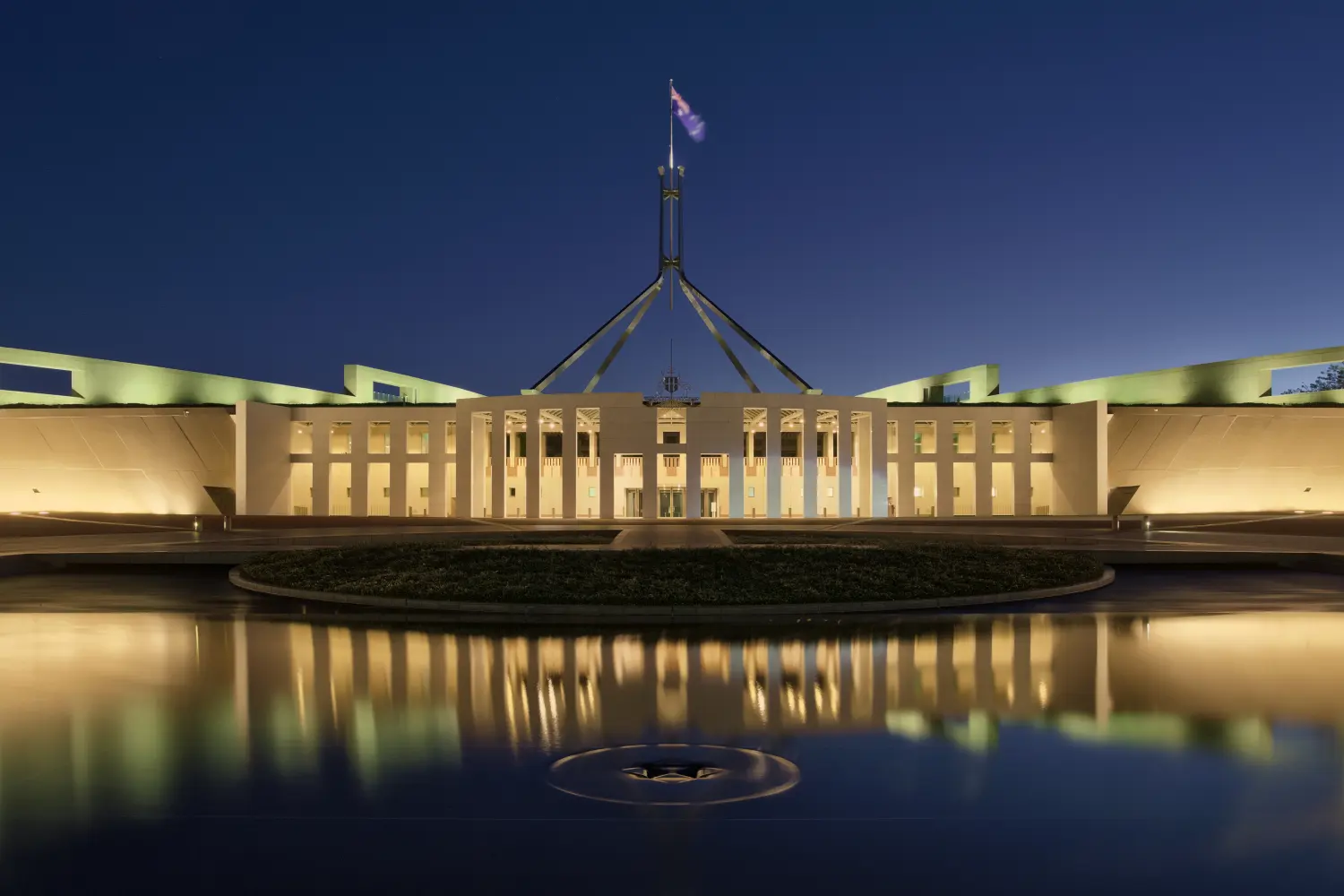
Through committees and a referendum campaign. The six colonies — New South Wales, Victoria, Queensland, South Australia, Western Australia and Tasmania — had been self-governing since the 1850s and 1890s, and they federated after a series of conventions, a draft constitution and referendums in each colony. The Commonwealth of Australia Constitution Act was passed by the British Parliament and came into force on 1 January 1901.
It created a federal government with enumerated powers, a Senate in which each state has equal representation, and a High Court; the states kept everything else. The constitution also assumed that Australia was a white country, and the first parliament made that explicit.
What was the White Australia Policy?
The defining policy of the first half-century. The Immigration Restriction Act of 1901 excluded non-European migrants, using a fifty-word dictation test in any European language chosen by the officer — a device designed to be arbitrary and to keep out Asians, Africans and Pacific Islanders. It was progressively dismantled after 1949 and formally ended in 1958, and the last racial restrictions were removed in the 1970s.
The policy shaped the country's demography, its labour movement and its sense of itself. It also shaped its foreign policy: a nation that excluded Asia had to be defended by a great power, first Britain and then the United States.
What did the wars do?
They made Australia a nation and then turned it towards America. In the First World War, 416,809 Australians enlisted and some 60,000 died; the landing at Gallipoli on 25 April 1915 — 26,111 casualties, 8,141 dead — became the country's founding myth. Two conscription referendums were defeated, in 1916 and 1917, splitting the Labor Party.
In the Second World War, the fall of Singapore in February 1942 and the bombing of Darwin shattered the assumption that Britain could protect Australia. John Curtin's statement of 27 December 1941 — that Australia looked to America, "free of any pangs as to our traditional links or kinship with the United Kingdom" — marked the shift. Australian forces fought in New Guinea, North Africa and the Pacific, and the country became an American ally for the rest of the century. It also administered the territory that became Papua New Guinea until 1975, and it has led the regional missions in Solomon Islands.
When did Australia become fully independent?
Gradually. The Statute of Westminster 1931 ended the British Parliament's power to legislate for the dominions, but Australia did not adopt it until 1942, backdated to 3 September 1939, so that the declaration of war would be its own. Appeals to the Privy Council were abolished in stages, ending in 1986; the Australia Acts of that year severed the remaining constitutional links; and the Constitution Act 1986 gave the states their own independent status.
The monarch remained head of state, and the 1999 referendum on a republic was defeated, 54.87 per cent to 45.13. The constitutional question is therefore unresolved rather than settled.
What changed after the war?
Immigration, and the end of the racial exclusion. The postwar programme brought millions of Europeans — British, then Italian, Greek, Dutch, German, Yugoslav — and transformed the cities; the end of the White Australia Policy in 1958 and the arrival of Vietnamese refugees after 1975 made the country Asian as well as European.
The 1967 referendum removed the constitutional provisions that excluded Aboriginal people from the census and allowed the Commonwealth to legislate for them; it passed with 90.77 per cent support. It did not give Aboriginal people the vote — they already had it — which is one of the most persistent myths about the referendum.
What about Indigenous Australia?
Dispossession, then a slow and contested recognition. Aboriginal and Torres Strait Islander people were dispossessed of their land by pastoral expansion, killed in frontier violence, and subjected to protection and assimilation policies that removed children from their families. The Mabo decision of 1992 overturned the doctrine of terra nullius, and the Native Title Act of 1993 created a legal process for claiming land.
The 2008 apology by Kevin Rudd acknowledged the Stolen Generations; the Uluru Statement from the Heart of 2017 asked for a Voice to Parliament, and the referendum of October 2023 was defeated, 60.06 per cent to 39.94. The gap in health, incarceration and life expectancy remains the country's most serious domestic failure.
What is Australia now?
A resource economy with a services sector, a middle power allied to the United States, and a society of 26 million people in which a third were born overseas or have a parent who was. Its politics turn on climate, housing, the cost of living and the unresolved question of Indigenous recognition.
Common myths about Australia
| Myth | What the evidence says |
|---|---|
| The 1967 referendum gave Aboriginal people the vote | They already had it; 1967 removed exclusion from the census and allowed federal legislation. |
| Australia became independent in 1901 | It became a federation; full independence came in stages, ending with the Australia Acts of 1986. |
| The White Australia Policy ended in 1973 | It was formally ended in 1958, with the last racial restrictions removed in the 1970s. |
| Gallipoli was a victory | It was a failed campaign; its importance is as a founding myth. |
| Australia was undefended in 1942 | It was defended, but by a country that had lost Singapore and could not protect it. |
| The 1999 referendum rejected a republic because Australians love the monarchy | It rejected a particular model, chosen by a constitutional convention. |
| The 2023 Voice referendum was about treaty | It was about a constitutional advisory body; treaty processes are separate and state-based. |
| Australia has no Indigenous history before 1788 | It has at least 65,000 years of it. |
Timeline of Australia
| Year | Event |
|---|---|
| 1 January 1901 | Federation |
| 1901 | Immigration Restriction Act |
| 25 April 1915 | Gallipoli landing |
| 1916, 1917 | Conscription referendums defeated |
| 1931 | Statute of Westminster |
| 1942 | Statute adopted; fall of Singapore; Darwin bombed |
| 1958 | White Australia Policy ended |
| 1967 | Referendum passes, 90.77% |
| 1975 | Constitutional crisis; dismissal of Whitlam |
| 1992 | Mabo decision |
| 1993 | Native Title Act |
| 1999 | Republic referendum defeated |
| 2008 | Apology to the Stolen Generations |
| 2023 | Voice referendum defeated, 39.94% |
What the map shows next
At 1965 on the map Australia is a postwar immigration society, and New Zealand is its closest ally.
At 2024 on the map the Voice has been defeated, and the Solomon Islands looks to Canberra again.
Common questions
- When did Australia become a country?
- On 1 January 1901, when the six colonies federated as the Commonwealth of Australia.
- When did it become fully independent?
- In stages: the Statute of Westminster was adopted in 1942, and the Australia Acts of 1986 ended the remaining links.
- What was the White Australia Policy?
- A set of laws from 1901 excluding non-European migrants, using a dictation test; formally ended in 1958.
- What did the 1967 referendum do?
- It removed the exclusion of Aboriginal people from the census and allowed the Commonwealth to legislate for them.
- What was Mabo?
- The 1992 High Court decision that overturned terra nullius and recognised native title.
- What was the 1975 crisis?
- The dismissal of the Whitlam government by the governor-general after the Senate blocked supply.
- Why did the 1999 republic referendum fail?
- Because the proposed model — a president chosen by parliament — was rejected by voters who wanted a directly elected head of state.
- What happened in 2023?
- A referendum on an Indigenous Voice to Parliament was defeated, 60.06% to 39.94%.
- How many people died at Gallipoli?
- 8,141 Australians were killed and 26,111 became casualties.
- What is Australia's place in the world?
- A middle power, allied with the United States, trading with Asia, and a member of the Commonwealth and the G20.
Sources
Every source below was consulted while writing this entry.
- Australian Dictionary of Biography.
- National Archives of Australia.
- Australian Bureau of Statistics, historical population series.
- Parliamentary Library, on the 1967 and 2023 referendums.
- Belich, Replenishing the Earth.
- Ward, Australia since the Coming of Man.
- Garton, on the wars.
- Bramston, on the 1975 crisis.
Data sources for the map
- Cliopatria v0.12 (Seshat Global History Databank, CC BY 4.0).
- Historical Basemaps (GPL-3.0).
This entry was written from the sources above and last updated .
Text available under CC BY-SA 4.0: reuse it with a credit to The World Through Time and a link to this page.
Border geometry for the map itself comes from Cliopatria v0.12 (Seshat Global History Databank, CC-BY-4.0).
See the Commonwealth of Australia in its world
Open the atlas at 1965 and every neighbour, rival and successor is on screen with it — then drag the slider and watch what happens next.
Open the map at 1965 →