Human verified. Last updated by our editorial team on .
Oceania · The modern island states
New Zealand
1840–present
New Zealand is a South Pacific state of five million people, founded on a treaty between the British Crown and Māori chiefs in 1840, which became a dominion in 1907, adopted the Statute of Westminster in 1947, and has spent the last fifty years negotiating what the treaty actually promised.
- Existed
- 1840–present
- Shown on the map
- 1948–present
- Peak area
- 298k km²
- Region
- Oceania
A note on the map: the border data draws New Zealand only from 1948. There is no territorial event that year; the likely reason is the Statute of Westminster Adoption Act, in force from 25 November 1947, which made the country fully sovereign in law. The entry covers 1840 onwards and explains the gap.
At a glance
| Name | New Zealand; Aotearoa |
| Dates | 1840–present (the site draws 1948–2024) |
| Where | Two main islands and a scattering of small ones in the South Pacific |
| Capital | Auckland until 1865, then Wellington |
| Government | Parliamentary democracy and constitutional monarchy |
| Population | About 5.2 million (2023), roughly one in six Māori |
| Treaty | Te Tiriti o Waitangi, 6 February 1840, signed by about 540 chiefs |
| Economy | Pastoral exports, then services and tourism |
| Map caveat | The border data starts in 1948, not 1840 |
What was the Treaty of Waitangi?
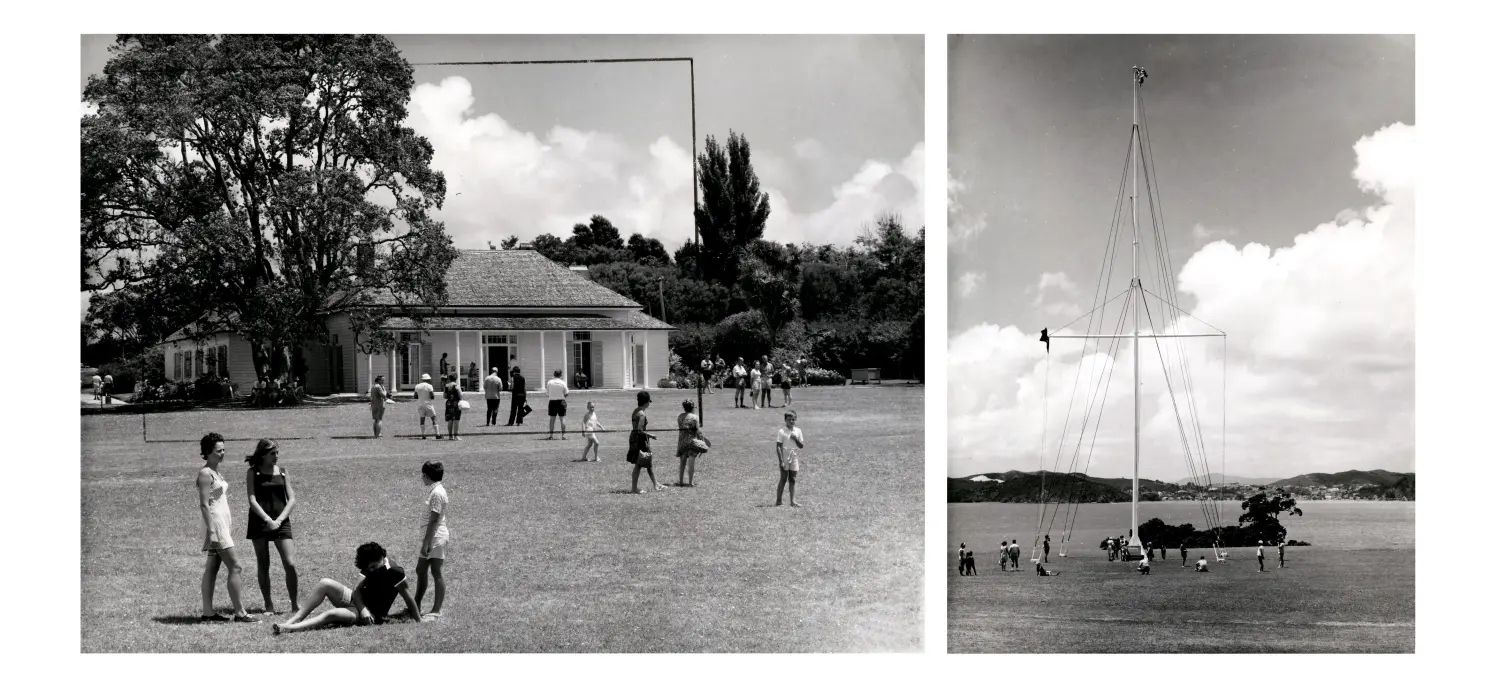
The founding document, in two languages that do not say the same thing. On 6 February 1840 at Waitangi, about forty chiefs signed a text in Māori — Te Tiriti o Waitangi — by which they ceded kāwanatanga (governance) to the Queen while retaining tino rangatiratanga (chieftainship, authority) over their lands and treasures. The English version, signed by others later, ceded "all the rights and powers of sovereignty".
About 540 chiefs signed, most of them the Māori text. The difference between ceding governance and ceding sovereignty is the central fact of New Zealand's constitutional history, and the Waitangi Tribunal was created in 1975 to inquire into breaches of the treaty — in either text.
What were the New Zealand Wars?
The wars of the 1840s to the 1870s, fought over land and sovereignty. The Northern War of 1845–46, the Wellington and Whanganui campaigns, the Taranaki and Waikato wars of the 1860s, and the campaigns against Te Kooti and Titokowaru into the 1870s cost, by Te Ara's figures, some 560 British and colonial dead, about 250 Māori killed in action, and perhaps 2,000 Māori dead in total including disease and the aftermath; around a million hectares of Māori land was confiscated.
The wars were followed by the Native Land Court, which converted communal title into individual title that could be sold, and by a long process of land loss. The treaty was largely ignored by the courts and the state for a century, and the settlements of the last forty years are the attempt to reckon with that.
When did New Zealand become independent?
In stages. It became a dominion in 1907; it adopted the Statute of Westminster in 1947, which removed the British Parliament's power to legislate for it; and the Constitution Act 1986 severed the last formal links, including appeals to the Privy Council, and entrenched the treaty in section 15 — a provision that is itself contested.
The monarch remains head of state, represented by a governor-general. The country has no written constitution in the codified sense: its constitution is a mixture of statutes, conventions and the treaty.
What made it distinctive?
Votes for women, a welfare state and a treaty settlement process. New Zealand was the first self-governing country to give women the vote, in 1893 — the bill received assent on 19 September after a petition of some 31,872 signatures — and it built one of the earliest welfare states, with old-age pensions in 1898 and a comprehensive social security system in 1938.
Since 1975 the Waitangi Tribunal has heard claims and the Crown has negotiated settlements: by January 2023, some 86 settlements worth about $2.6 billion had been concluded. In 1996 the country adopted proportional representation (MMP), which changed its politics permanently. It also took a leading role in Pacific affairs, from the Solomon Islands intervention of 2003 to the New Caledonian negotiations, alongside Australia.
What happened in 2019 and after?
The Christchurch attack of 15 March 2019, in which a gunman killed 51 people at two mosques, led within 26 days to a ban on military-style semi-automatic weapons and, after a royal commission, to 44 recommendations on intelligence and social cohesion. It was the country's worst mass shooting and it changed its gun laws and its security services.
The 2020 election gave Jacinda Ardern's Labour an outright majority; she resigned in January 2023, and Christopher Luxon's National-led government took office on 27 November 2023. In November 2024 the government introduced a Treaty Principles Bill, which tens of thousands marched against, and which the select committee process tested through 2025.
Common myths about New Zealand
| Myth | What the evidence says |
|---|---|
| The Treaty ceded sovereignty | The Māori text ceded kāwanatanga (governance) and retained tino rangatiratanga; the English text ceded sovereignty. |
| New Zealand was the first country to give women the vote | It was the first self-governing country; several others had earlier, limited franchises. |
| The New Zealand Wars were minor | About 2,000 Māori died, and around a million hectares were confiscated. |
| New Zealand became independent in 1907 | It became a dominion; full legal independence came with the Statute of Westminster in 1947 and the Constitution Act 1986. |
| The treaty is a historical document with no legal force | It is in the Constitution Act 1986, and it grounds the Tribunal and the settlement process. |
| The country has a written constitution | It has an uncodified constitution of statutes and conventions. |
| The 2019 gun law took a year | The ban passed within 26 days of the attack. |
Timeline of New Zealand
| Year | Event |
|---|---|
| 6 February 1840 | Treaty of Waitangi signed |
| 1845–72 | New Zealand Wars |
| 1865 | Wellington becomes the capital |
| 1893 | Women win the vote |
| 1898 | Old-age pensions |
| 1907 | Dominion status |
| 1931 | Statute of Westminster |
| 1947 | Statute adopted |
| 1975 | Waitangi Tribunal created |
| 1986 | Constitution Act |
| 1996 | MMP introduced |
| 15 March 2019 | Christchurch attack; 51 killed |
| 2023 | Labour loses; Luxon government |
| 2024 | Treaty Principles Bill introduced |
What the map shows next
At 1986 on the map the Constitution Act has just been passed, and Australia remains its closest partner.
At 2024 on the map the Treaty Principles Bill is before parliament, and the New Caledonian question is still unsettled.
Common questions
- When was New Zealand founded?
- The Treaty of Waitangi was signed on 6 February 1840; British sovereignty was proclaimed later that year.
- What does the treaty say?
- The Māori text cedes governance and retains chieftainship; the English text cedes sovereignty — which is why it is contested.
- When did New Zealand become independent?
- 1907 as a dominion, 1947 with the Statute of Westminster, 1986 with the Constitution Act.
- Why does the map start in 1948?
- Probably because of the 1947 adoption of the Statute of Westminster; the dataset has no earlier polygon.
- What were the New Zealand Wars?
- Wars over land and sovereignty from the 1840s to the 1870s, after which about a million hectares were confiscated.
- What is the Waitangi Tribunal?
- A permanent commission of inquiry, created in 1975, that investigates breaches of the treaty.
- How much have the settlements cost?
- About $2.6 billion across some 86 settlements by January 2023.
- What happened in Christchurch in 2019?
- A gunman killed 51 people at two mosques; the gun laws were changed within 26 days.
- Is New Zealand a monarchy?
- Yes, a constitutional monarchy with the British monarch as head of state.
- Who is the prime minister?
- Christopher Luxon, since 27 November 2023.
Sources
Every source below was consulted while writing this entry.
- Te Ara, the Encyclopedia of New Zealand.
- NZHistory, Manatū Taonga.
- Waitangi Tribunal reports.
- Legislation: the Treaty of Waitangi Act 1975, the Constitution Act 1986.
- Belich, Making Peoples and Paradise Reforged.
- King, The Penguin History of New Zealand.
- Royal Commission of Inquiry into the Christchurch attack.
Data sources for the map
- Cliopatria v0.12 (Seshat Global History Databank, CC BY 4.0).
- Historical Basemaps (GPL-3.0).
This entry was written from the sources above and last updated .
Text available under CC BY-SA 4.0: reuse it with a credit to The World Through Time and a link to this page.
Border geometry for the map itself comes from Cliopatria v0.12 (Seshat Global History Databank, CC-BY-4.0).
See New Zealand in its world
Open the atlas at 1986 and every neighbour, rival and successor is on screen with it — then drag the slider and watch what happens next.
Open the map at 1986 →