Igor of Kiev (Old Norse Ingvarr, Old East Slavic Игорь) was the Scandinavian-descended prince of Kievan Rus' who, according to the Primary Chronicle, ruled from AD 912/913 until the Drevlians killed him in AD 945. He lost a fleet to Greek fire in AD 941, signed a less generous treaty with Constantinople in AD 944 and died trying to squeeze a second tribute out of a forest tribe. His story matters because it is the clearest early window onto how the first Rus' state actually paid for itself.
Who was Igor of Kiev?
Igor was the husband of Olga and the father of Sviatoslav I, and the first ruler of Kiev whose existence is confirmed by foreign writers who never read a Rus' chronicle. Liudprand of Cremona calls him "King Igor", and Constantine VII's De Administrando Imperio names his son "Sviatoslav, son of Igor, the archon of Rus'" (an archon is simply the Byzantine word for a foreign ruler). The Primary Chronicle's editors Samuel Cross and Olgerd Sherbowitz-Wetzor note that the name Igor corresponds to Norse Ingvarr, just as Oleg is Helgi and Olga is Helga.
The nickname "the Old" (Stary) is not a later romantic invention. Metropolitan Hilarion's Sermon on Law and Grace (c. 1037–1050) already calls Vladimir the "grandson of old Igor", though there it probably means "of old" or "the elder" rather than a fixed epithet.
Most of what we know comes from the Povest' vremennykh let (Primary Chronicle), compiled in Kiev in the early twelfth century, almost two centuries after Igor's death. Its compiler, as Cross bluntly observed, had almost no native material on Igor beyond his parentage, his marriage, his treaty and his wars with the Drevlians. The dates before AD 945 were hung on a framework borrowed from Byzantine chronicles.
| Source | Written | What it says about Igor |
|---|---|---|
| Primary Chronicle (Laurentian text, trans. Cross and Sherbowitz-Wetzor 1953) | early twelfth century | Full narrative, AD 879–945; preserves the treaty text |
| Novgorod First Chronicle (younger redaction) | fifteenth-century copies of older material | Ulichian war, Peresechen, tribute granted to Sveneld |
| Liudprand of Cremona, Antapodosis V.15 | begun AD 958 | The AD 941 fleet, Greek fire, beheaded prisoners |
| Theophanes Continuatus, Symeon the Logothete | tenth century | Byzantine account of AD 941 |
| Life of St Basil the Younger | tenth century | Hagiographic account of AD 941 |
| Constantine VII, De Administrando Imperio ch. 9 | c. AD 948–952 | Tribute rounds (poliudia); Sviatoslav "son of Igor" |
| Leo the Deacon, History | late tenth century | Igor's execution by the Germans (Drevlians) |
Was Igor really Rurik's son?
According to the Primary Chronicle, yes: under AD 879 Rurik on his deathbed "entrusted to Oleg's hands his son Igor', for he was very young". The problem is arithmetic. That same chronicle marries Igor to Olga in AD 903 and, in the Hypatian Codex, has Sviatoslav born in AD 942, which would make Igor a first-time father at well over sixty. The Laurentian text, tellingly, gives no birth year for Sviatoslav at all. The Internet Encyclopedia of Ukraine therefore allows that Igor "could have been his grandson" – a question explored in our article on Rurik, founder of the Rurikid dynasty.
The most radical fix comes from Constantin Zuckerman ("On the Date of the Khazars' Conversion to Judaism and the Chronology of the Kings of the Rus Oleg and Igor", Revue des études byzantines 53, 1995). Reading the Schechter (Genizah) Letter alongside Byzantine sources, he argues that Igor reigned only from summer AD 941 to winter AD 945, with Oleg ruling until AD 941. The observation behind this is simple and unsettling: not one of Igor's recorded deeds is dated before AD 941. Oleg's regency, the treaty of AD 911 and the HLGW problem are covered in our article on Oleg of Novgorod.
How did Igor rule? Tribute, Pechenegs and the Ulichians
The Chronicle's early entries are thin but revealing, because nearly all of them concern tribute: regular payments in furs, silver or goods extracted from subject tribes.
| Date (AD) | Event | Source | Status |
|---|---|---|---|
| 879 | Rurik dies; Igor "very young" | Primary Chronicle | Chronologically doubtful |
| 903 | Olga brought from Pskov as his wife | Primary Chronicle | Doubtful |
| 913 | Igor succeeds Oleg; Drevlians resist | Primary Chronicle | Disputed (Zuckerman: 941) |
| 914 | Drevlians conquered; tribute "larger than Oleg's" | Primary Chronicle | Traditional date |
| 915 | Pechenegs enter Rus' "for the first time", make peace | Primary Chronicle | Traditional date |
| 920 | War with the Pechenegs | Primary Chronicle | Traditional date |
| 922 / 940 | Ulichians subdued, Peresechen taken after three years; tribute to Sveneld | Novgorod First Chronicle | Two different dates in one text |
| 941 (June) | Attack on Constantinople; fleet burned | Chronicle, Liudprand, Byzantine sources | Secure |
| 944 | Second expedition bought off on the Danube | Primary Chronicle | Secure |
| 944 | Treaty with Romanos I, Constantine and Stephen | Treaty text in the Chronicle (entered s.a. 945) | Secure |
| 945 | Killed by the Drevlians near Iskorosten | Primary Chronicle | Secure |
The Pechenegs, Turkic nomads of the Black Sea steppe, appear here as neighbours who could be fought, bought or hired. The Ulichians, a Slav tribe on the lower Dnieper, are where the real story lies. The Novgorod First Chronicle says that Igor's voivode (military commander) Sveneld subdued them, that the town of Peresechen held out for three years, and that Igor granted both the Ulichian and the Drevlian tribute to Sveneld – "one black marten per hearth". Igor's own retinue complained: "you have given too much to one man".
What happened when the Rus' attacked Constantinople in AD 941?
In June AD 941 a Rus' fleet crossed the Black Sea while the Byzantine navy was away fighting the Arabs. The Primary Chronicle says the Bulgarians warned the emperor that Igor was coming "with ten thousand vessels". Liudprand, whose stepfather was King Hugh of Italy's envoy in Constantinople at the time, gives "a thousand and more ships". Neither figure is a head count, but Liudprand's is at least ten times less implausible.
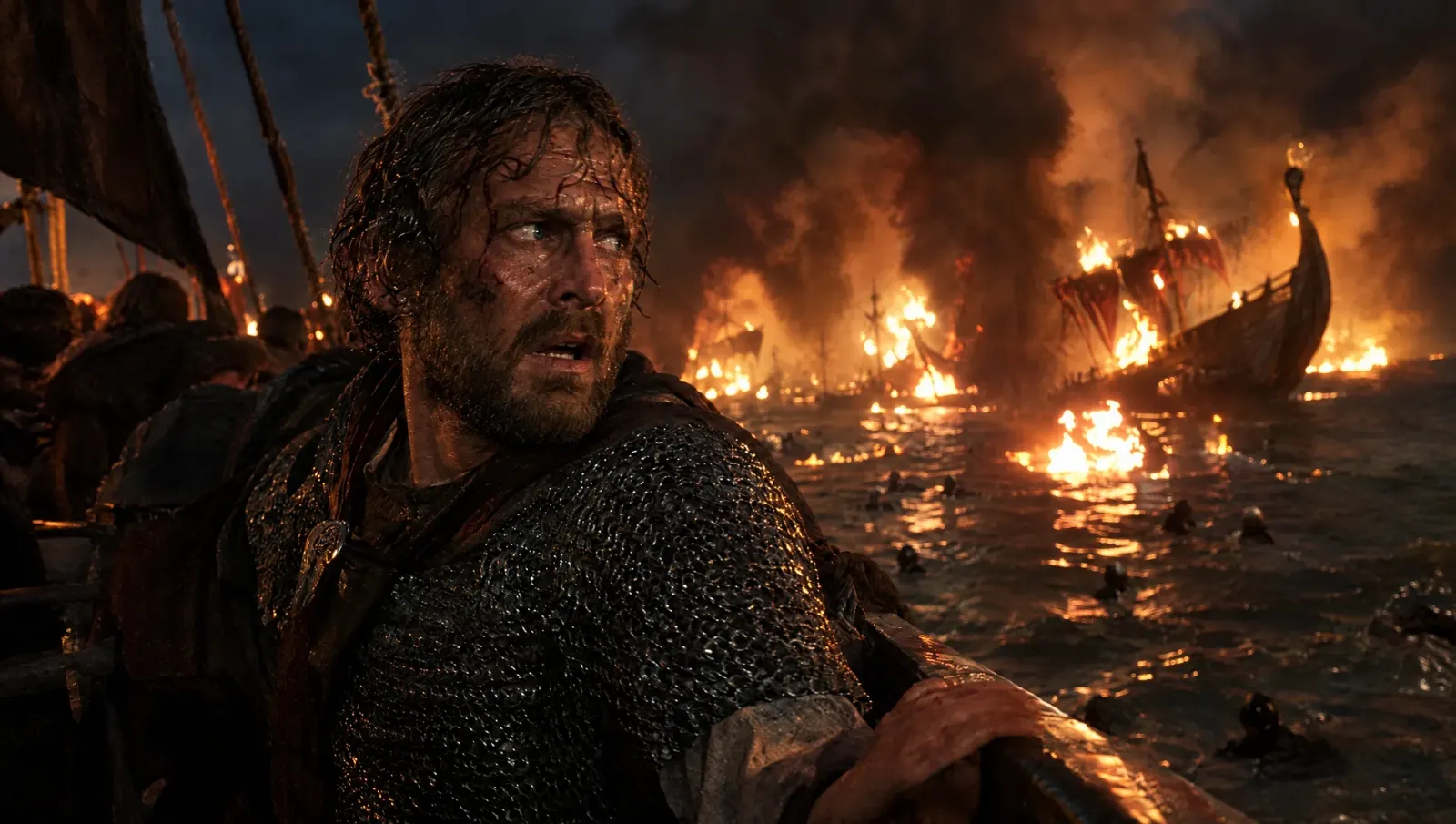
Liudprand's account is the most vivid. Romanos I found fifteen half-rotten chelandia (heavy Byzantine war galleys), had fire-throwers mounted "not just on the bow, but also on the stern and in addition on both sides", and sent them out.
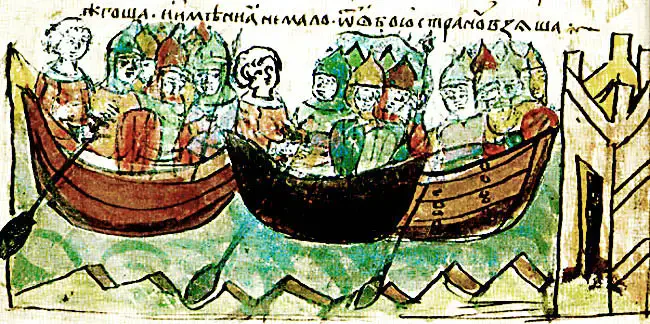
Igor, seeing so few ships, ordered their crews taken alive; the Greeks sailed into the middle of his fleet and "cast their fire all around". The Rus' leapt overboard, preferring drowning to burning. According to Byzantine sources, this squadron was led by the protovestiarios (chief chamberlain) Theophanes, and the clash took place near Hieron at the mouth of the Bosporus.
The survivors turned east and ravaged Bithynia and the Paphlagonian coast. The Chronicle, copying the continuator of the Greek chronicle of George the Monk (Hamartolos), lists atrocities including prisoners used as targets and nails driven through heads, before the patrikios Bardas Phokas and the returning eastern army of John Kourkouas cornered them.
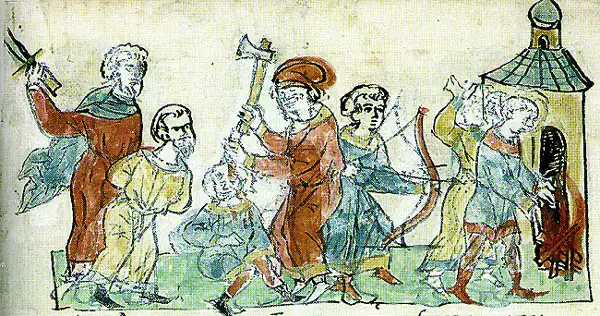
Trying to slip home in autumn, the fleet was caught again by Theophanes and destroyed. Liudprand adds that Romanos had all the prisoners beheaded in front of his stepfather.
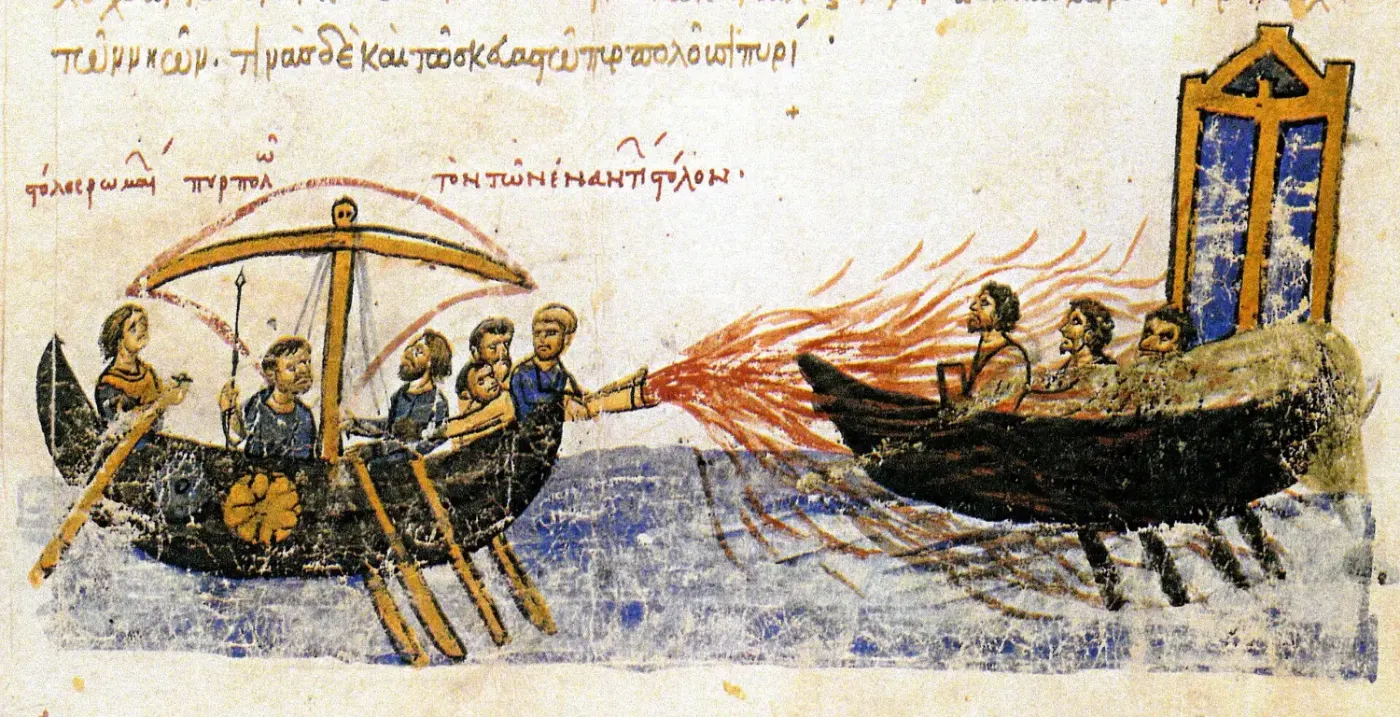
Greek fire itself remains partly mysterious. It was a liquid incendiary, probably petroleum-based, pumped under pressure through a siphon and ignited, and it kept burning on water. The exact recipe was a state secret and is still unknown. Rus' veterans, the Chronicle says, told their families that the Greeks possessed "the lightning from heaven".
What was the treaty of 944?
In AD 944 Igor tried again, this time with Varangians, Rus', Polyanians, Slavs, Krivichians, Tivertsians and hired Pechenegs. Warned by the Khersonites and the Bulgarians, the emperor sent envoys to the Danube offering tribute instead of battle. The Chronicle gives Igor's retinue a wonderfully unheroic line: "Who knows who will be victorious, we or he? Who has the sea for his ally?" They took the gold and went home, and Igor sent the Pechenegs to plunder Bulgaria instead.
The resulting treaty survives in the Chronicle under AD 945, but it was concluded with "Romanus, Constantine, and Stephen". Since Romanos I was deposed in December AD 944, it must date to AD 944. Its preamble lists dozens of mostly Norse-named envoys: Ivar for Igor, Vefast for Sviatoslav, "Isgaut for the Princess Olga", envoys for other members of the ruling house, and a long list of merchants. It is, in effect, a family portrait of the Rus' elite.
| Provision | Oleg's terms (AD 907/911) | Igor's treaty (AD 944) |
|---|---|---|
| Trade duties | Rus' "may conduct business... without payment of taxes" | No duty-free clause; silk purchases capped at 50 bezants |
| Identification | Names recorded on arrival | Envoys' gold seals and merchants' silver seals replaced by a prince's certificate |
| Crimea | Not addressed | Prince "shall not have the right to harass" Kherson and its cities |
| Dnieper mouth | Not addressed | No wintering at Belobereg or St Eleutherius; go home in autumn |
| Military duty | Rus' may serve the emperor | Rus' must repel the Black Bulgarians from Kherson and send soldiers on request |
| Captives | Ransom 20 bezants | 10 bezants for young adults, 8 for middle-aged, 5 for the old and children |
| Oath | By weapons, Perun and Volos | Pagans by Perun on the hill; Christians in the church of St Elias |
The oath is the treaty's most-quoted detail. The baptised Rus' swore "in the Cathedral, by the church of St. Elias", which the chronicler places above the creek near the Khazar quarter, adding that "many of the Varangians were Christians".
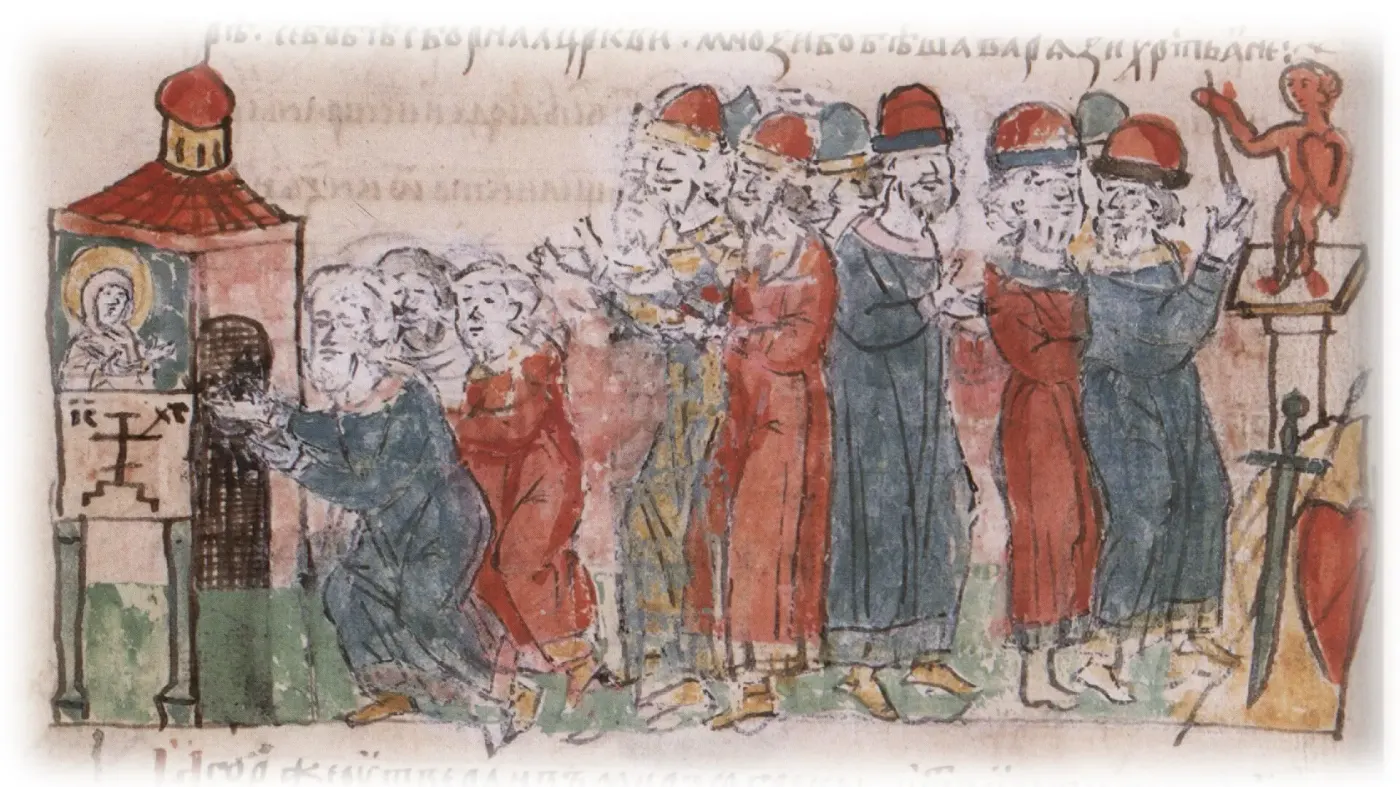
So there were Christians in Kiev a decade before Olga's baptism. The clause obliging Rus' to serve the emperor on request also helps explain the later flow of Norsemen south, described in our article on the Varangian Guard. Britannica's "Igor" entry says the treaty "was less advantageous to Kyiv than the one obtained by Oleg in 911", and the Internet Encyclopedia of Ukraine agrees.
Did Igor raid the Caspian? Barda'a, AD 943–944
In AH 332 (AD 943–944) a Rus' force sailed across the Caspian and up the Kura to seize Barda'a (Berdaa), then the chief city of Arran in today's Azerbaijan.
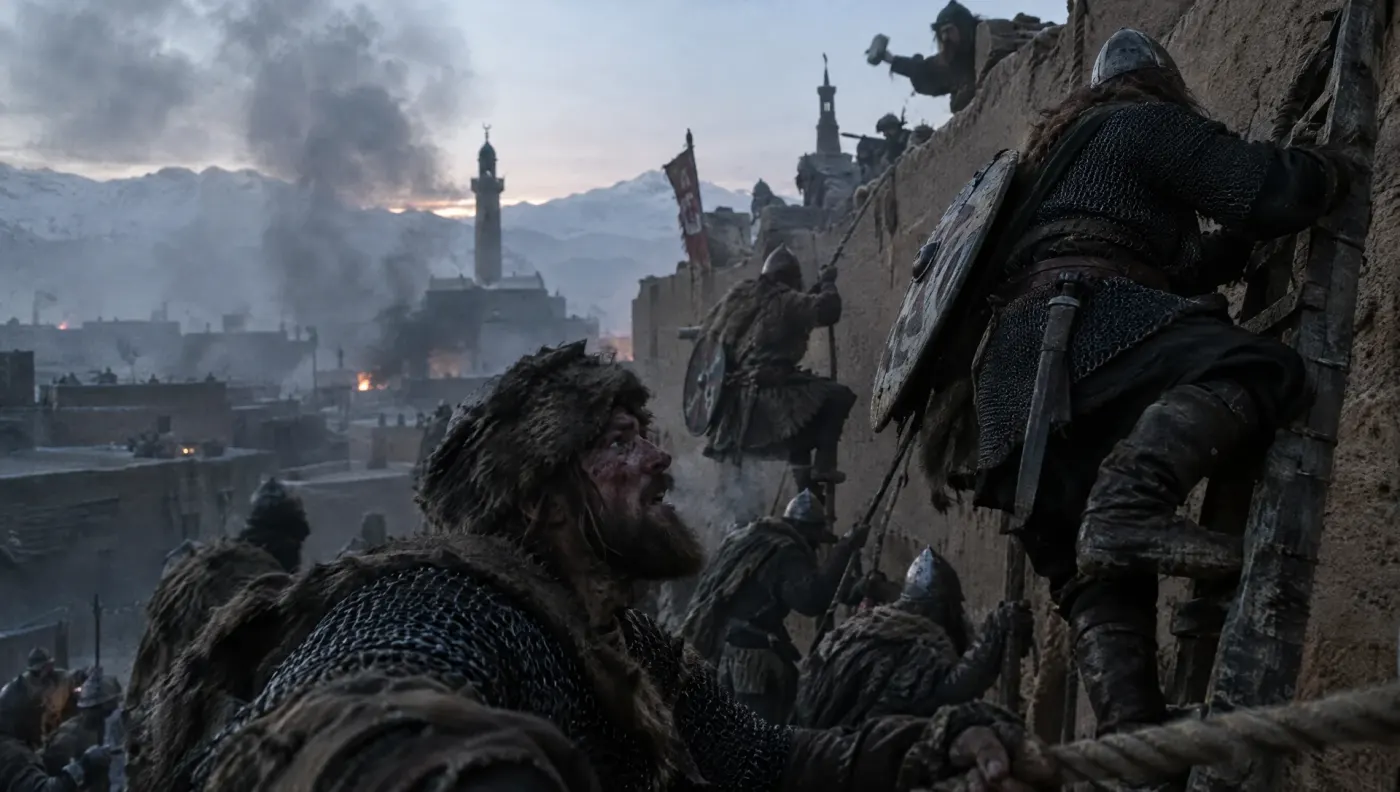
Ibn Miskawayh, a Buyid official writing within living memory, describes the occupation; the Encyclopaedia Iranica, summarising his Tajāreb, says the Rus' held the city "for several months" and that only once "their numbers had been decimated by plague" could the Musafirid ruler al-Marzuban drive them out. Ibn al-Athir's later al-Kāmil adds that the Rus' "took some ten thousand souls captive" and that a local Christian settled a ransom of "twenty dirhams for each man".
No Arabic source names Igor. The Internet Encyclopedia of Ukraine nonetheless credits "Ihor" with the campaign, and Britannica says that "Igor in 913–914 led an expedition into Transcaucasia that ended in total disaster for his forces". Both are modern inferences. Given that his Danube expedition happened in the same year, a separate, loosely affiliated Rus' war-band is at least as likely.
How did the Drevlian tribute work?
The Drevlians, the "forest people" of the Chronicle, lived west of Kiev around their stronghold of Iskorosten (modern Korosten, Ukraine). Oleg had imposed "a black marten-skin apiece" on them. Igor raised it after AD 914, then handed the proceeds to Sveneld.
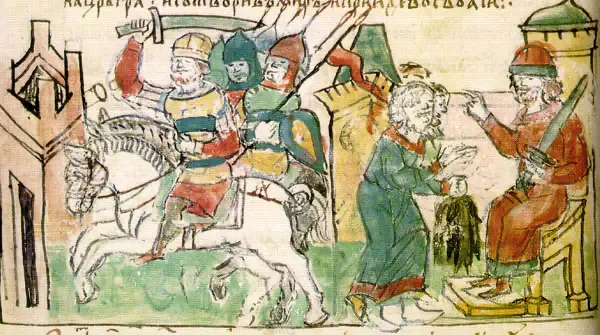
Constantine VII's De Administrando Imperio, chapter 9, describes the machinery. "When the month of November begins", the Rus' chiefs and all the Rus' leave Kiev on the poliudia, "which means 'rounds'", to the lands of the "Vervians" (usually taken as Drevlians), Dregovichians, Krivichians, Severians and other Slav tributaries, living off them all winter. In April, when the Dnieper ice melts, they come back down to Kiev. Meanwhile the tributaries cut the monoxyla (dugout boats) in which the Rus' then sailed to Constantinople each summer.
This was a closed loop. Furs, wax, honey and slaves collected in winter became the cargo sold at St Mamas in summer. Igor sent the Greek envoys of AD 944 home with "furs, slaves, and wax", precisely the goods his son later listed as the riches of Rus'. So when the treaty of AD 944 made trade dearer, the pressure fell back on the winter round.
Why did the Drevlians kill Igor?
In autumn AD 945, the Chronicle says, Igor's retinue (druzhina) complained: "The servants of Sveinald are adorned with weapons and fine raiment, but we are naked." Igor went into Dereva, raised the previous tribute and took it "by violence". Heading home, he sent most of his men ahead and turned back with a few followers to collect more.
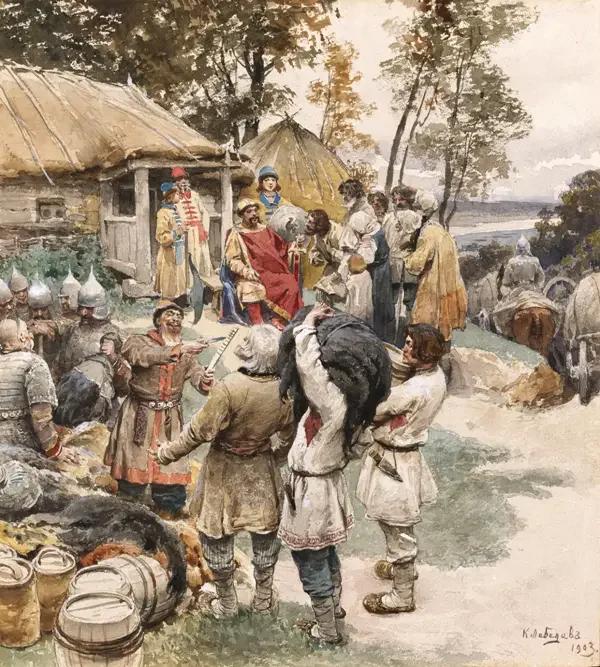
The Drevlians, meeting under their prince Mal, reasoned that a wolf which gets into the flock will carry off every sheep unless it is killed. They came out of Iskorosten and killed Igor and his small escort.
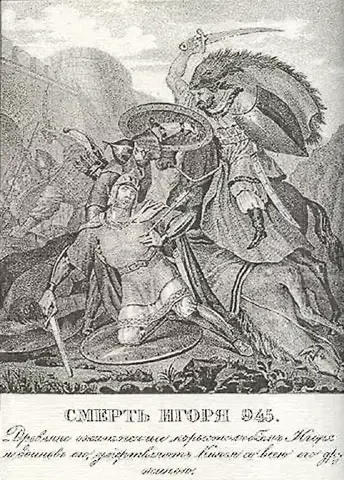
The Chronicle buries him near Iskorosten, "his tomb... even to this day". Leo the Deacon's claim that he was tied between two bent trees and torn apart is a Byzantine story, not an established fact.
The underlying cause was structural rather than moral. A prince paid his warriors from tribute, a rival commander held the richest tribute, a war had just failed to pay, and a costly treaty had cut into trade profits. A second collection broke an unwritten rule about what a tributary owed. Olga's revenge and her reform of the tribute system (fixed dues and collection points) are told in our article on Olga of Kiev. The reform was a direct answer to Igor's failure: the Chronicle has her say that she will not "impose a heavy tribute, like my husband".
Is Igor of Kiev the Prince Igor of the opera?
No. Borodin's opera Prince Igor (premiered at the Mariinsky Theatre, St Petersburg, on 23 October (4 November) 1890, and completed after Borodin's death by Rimsky-Korsakov and Glazunov) and the medieval poem The Tale of Igor's Campaign are about Igor Svyatoslavich (1151–1202), prince of Novgorod-Seversky. His failed raid on the Polovtsians (Cumans) took place in 1185, some 240 years after Igor of Kiev died. The Polovtsian Dances belong to the later Igor. The only link is the dynasty: both were Rurikids.
Our Igor's visual legacy lies instead in manuscripts. The fifteenth-century Radziwiłł Chronicle illustrates his Byzantine campaign and his death among the Drevlians, while the famous Greek-fire miniature in the Madrid Skylitzes actually shows the ninth-century rebel Thomas the Slav, not Igor's fleet.
What the map shows next
Igor's widow ruled for their young son, and Sviatoslav I turned his father's tribute state into a war machine. Within two decades he had struck at the Khazar Khaganate and marched to the Danube against the First Bulgarian Empire. See the new balance of power on the AD 965 on the map map, the year Sviatoslav smashed Khazaria.