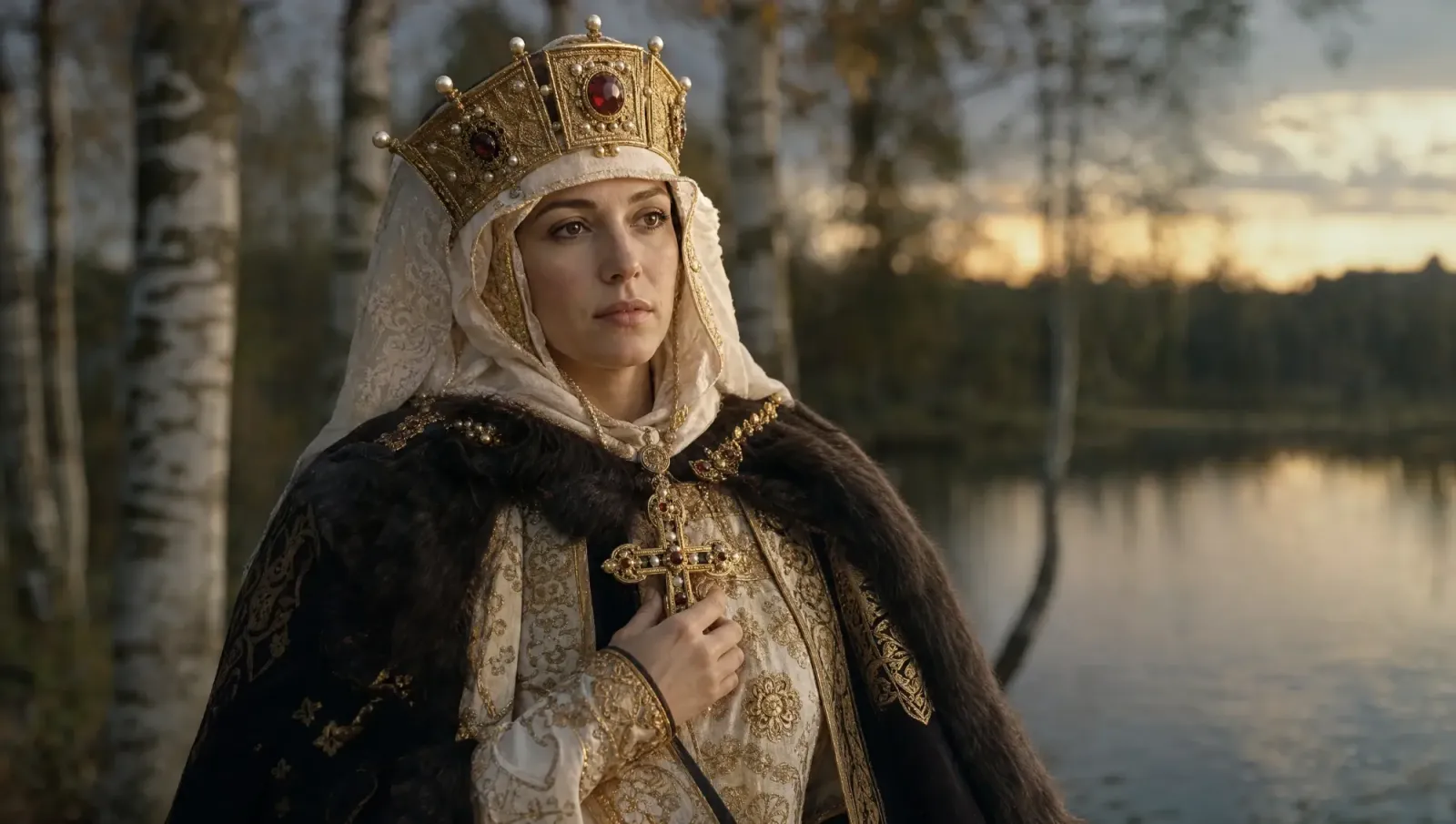
Oleg of Novgorod – Oleg the Wise, Veshchiy Oleg, in Old Norse probably Helgi – was the Varangian leader who, according to the Primary Chronicle, took over Rurik's realm in AD 879, seized Kiev in AD 882 and ruled until his death in AD 912. He matters because he is the first ruler of Kievan Rus' whose existence is anchored in a genuine document: the Rus'–Byzantine treaty of AD 911, which names him "Great Prince of Rus'". Almost everything else about him – the trick at Kiev, the ships on wheels, the shield on the gates, the snake in the skull – is a mixture of memory, saga motif and twelfth-century storytelling.
Who was Oleg of Novgorod?
The Primary Chronicle (Povest' vremennykh let, the "Tale of Bygone Years") is our main source, and it is frustratingly vague about his origins. In the standard English translation by Samuel Hazzard Cross and Olgerd P. Sherbowitz-Wetzor (1953, Laurentian text), the entry for 879 reads: "On his deathbed, Rurik bequeathed his realm to Oleg, who belonged to his kin, and entrusted to Oleg's hands his son Igor', for he was very young." So Oleg was a kinsman and, in effect, a regent – someone ruling on behalf of a child heir.
"Of his kin" is as precise as the chronicle gets. The popular claim that Oleg was Rurik's brother-in-law comes from the Joachim Chronicle, a text known only through the eighteenth-century historian Vasily Tatishchev, which names Rurik's wife as Efanda and makes Oleg her brother. The manuscript is lost, and the Ukrainian historian Oleksiy Tolochko (2004) concluded that the so-called "Tatishchev accounts" "are all fabrications, deliberately introduced by the author himself", so treat the brother-in-law story as legend. The Novgorod First Chronicle goes further in the opposite direction: it makes Oleg not a relative at all but Igor's voivode (army commander). For Rurik himself and that competing version, see our article on Rurik, founder of the Rurikid dynasty.
Three names cause confusion online. "Oleg of Novgorod", "Oleg of Kiev" and "Oleg the Wise" are the same man – Novgorod is where he started, Kiev where he ruled, and "the Wise" is one translation of his epithet. He should not be confused with Oleg Sviatoslavich, prince of the Drevlians, who died at Ovruch in AD 977, or with Oleg Sviatoslavich of Chernigov ("Gorislavich"), who died in 1115.
Why is Oleg called "the Prophetic"?
The Russian epithet veshchiy (вещий) means something between "prophetic", "wise" and "seer-like" – a person who knows what others cannot. The chronicle attaches it to Oleg after the Byzantine campaign: Cross and Sherbowitz-Wetzor translate the line as "The people called Oleg 'the Sage,' for they were but pagans, and therefore ignorant." The monk-chronicler is clearly uneasy: the nickname carries a whiff of pagan sorcery rather than Christian wisdom.
His name adds another layer. Cross and Sherbowitz-Wetzor note that "The name Oleg itself corresponds to the Norse Helgi", a name built on the Old Norse word for "holy" or "sacred". One proposal, reported in popular summaries such as Brewminate (2020) without a named originator, holds that "the pagan monarch-priests of Rus'" used a hereditary title helgu, "standing for 'holy'" – an idea that matters for the Khazar evidence discussed below. The Internet Encyclopedia of Ukraine adds that in folk oral literature the legend of Oleh as a ruler with supernatural powers "(therefore 'the Seer')" endured.
How did Oleg take Kiev in 882?
By a trick, according to the chronicle entry for 880–882. Oleg marched south with Varangians, Chuds, Slavs, Merians and Krivichians, took Smolensk and Lyubech, and arrived below the hills of Kiev, where two other Varangians, Askold and Dir, were ruling. He hid his warriors in the boats and sent messengers "representing himself as a stranger on his way to Greece on an errand for Oleg and for Igor', the prince's son". When Askold and Dir came down to greet the supposed merchants, the soldiers leapt out. Oleg told them: "You are not princes nor even of princely stock, but I am of princely birth." The child Igor was presented as Rurik's son, and Askold and Dir were killed.
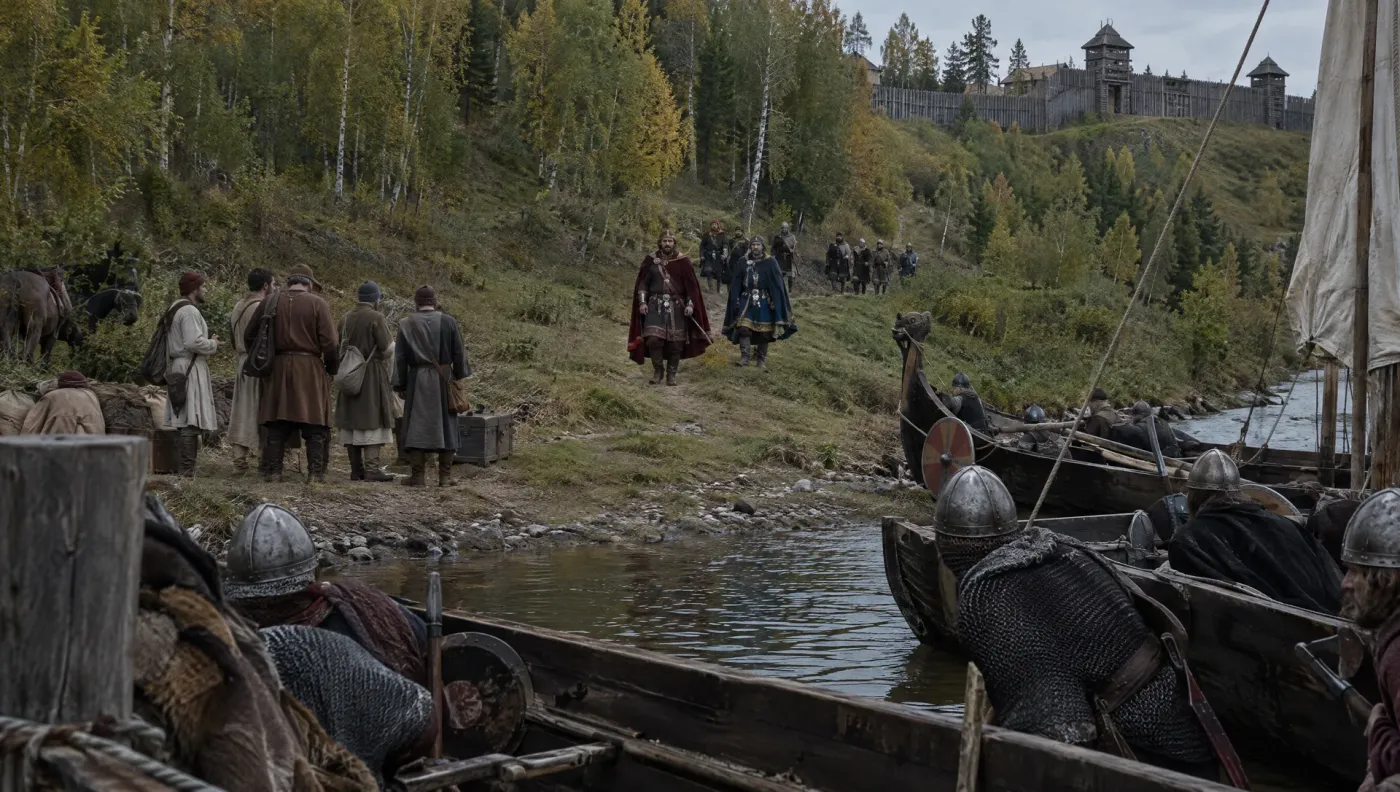
The famous phrase follows: "Oleg set himself up as prince in Kiev, and declared that it should be the mother of Russian cities." That is the exact 1953 wording – "Russian", not "Rus'" as many websites quote it. "Mother of cities" is a calque of the Greek mētropolis, meaning a capital. The scene is best read as a legitimacy story: it tells a twelfth-century Kievan audience that Rurik's line, not Askold and Dir, had the right to rule.
Building a tribute empire, 883–903
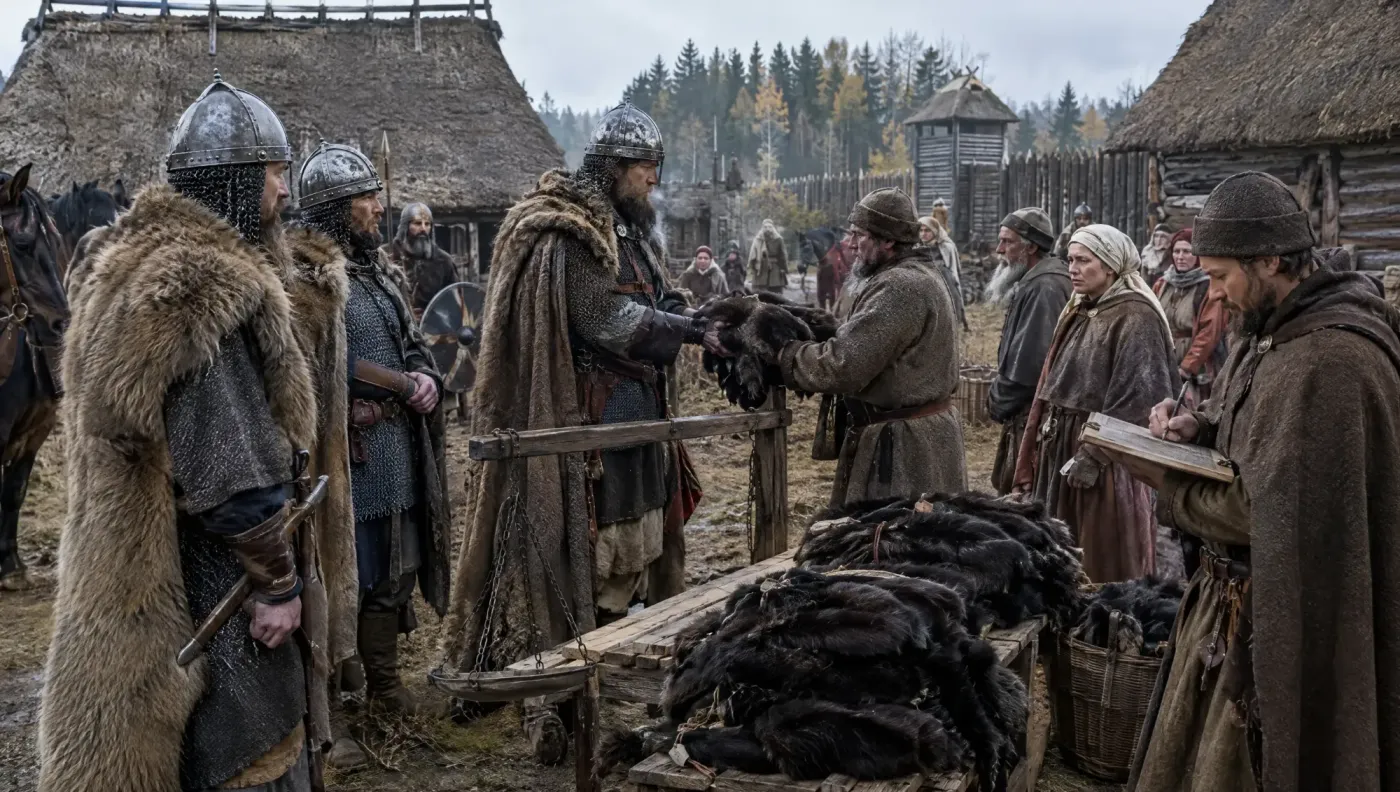
The following entries show how a river-borne war band became a state. Tribute – regular payments in furs, silver or goods – was the currency of power:
- 883: Oleg conquered the Drevlians and imposed "the tribute of a black marten-skin apiece".
- 884: he defeated the Severians, imposed "a light tribute" and forbade them to pay the Khazars, "on the ground that there was no reason for them to pay it as long as the Khazars were his enemies".
- 885: the Radimichians, who had paid the Khazars, were told to pay him instead – "a shilling apiece, the same amount".
This was a direct challenge to the Khazar Khaganate, the Turkic steppe power that had drawn tribute from the Dnieper Slavs. Under the block of years 888–898 the chronicle notes that "The Magyars passed by Kiev over the hill now called Hungarian" on their way west – a real migration of the Magyars, dated by the chronicler's arithmetic rather than by any record. Under 903 it says only that as Igor grew up, "A wife, Olga by name, was brought to him from Pskov" – the passive voice leaves Oleg's role as matchmaker implied rather than stated. Her story continues in our article on Olga of Kiev.
Did Oleg nail his shield to the gates of Constantinople?
Not quite – and possibly not at all. The chronicle entry for 904–907 describes a great expedition with "two thousand" ships against Tsargrad ("the emperor's city", the Slavic name for Constantinople). Finding the harbour closed, Oleg had his men beach the ships and fit them with wheels, so that with a favourable wind "they spread the sails and bore down upon the city from the open country".
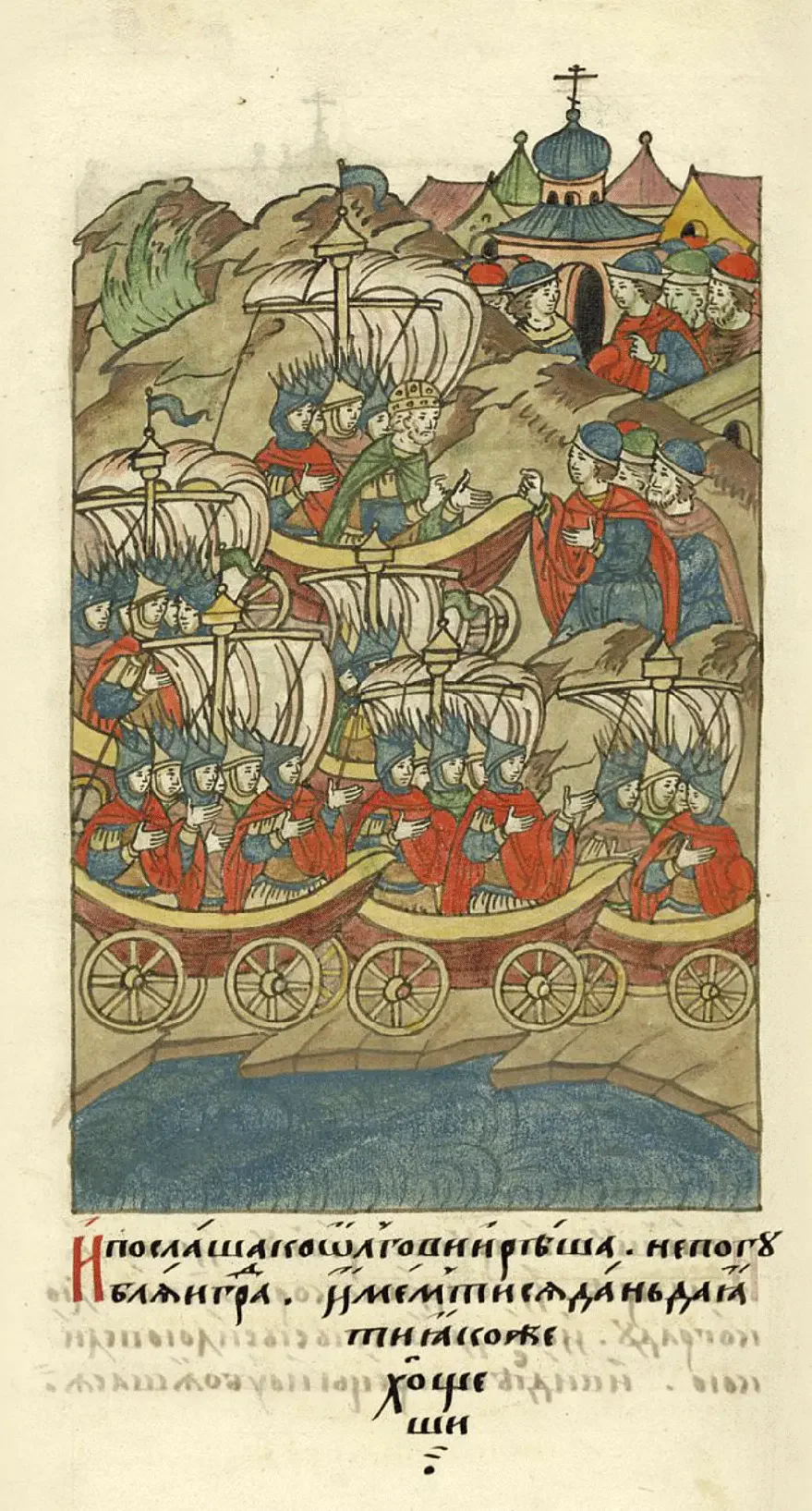
The terrified Greeks sued for peace, tried to poison Oleg, and exclaimed, "This is not Oleg, but St. Demetrius". Oleg demanded "twelve grivnji per man, with forty men reckoned to a ship".
The shield itself is less personal than legend suggests. In the Laurentian text, "The Russes hung their shields upon the gates as a sign of victory" – plural shields, hung by the army. It is the Novgorod First Chronicle, under 922, that says Oleg hung his own shield on the gates. "Nailed" is a later embellishment, popularised by nineteenth-century art and Pushkin's poem.
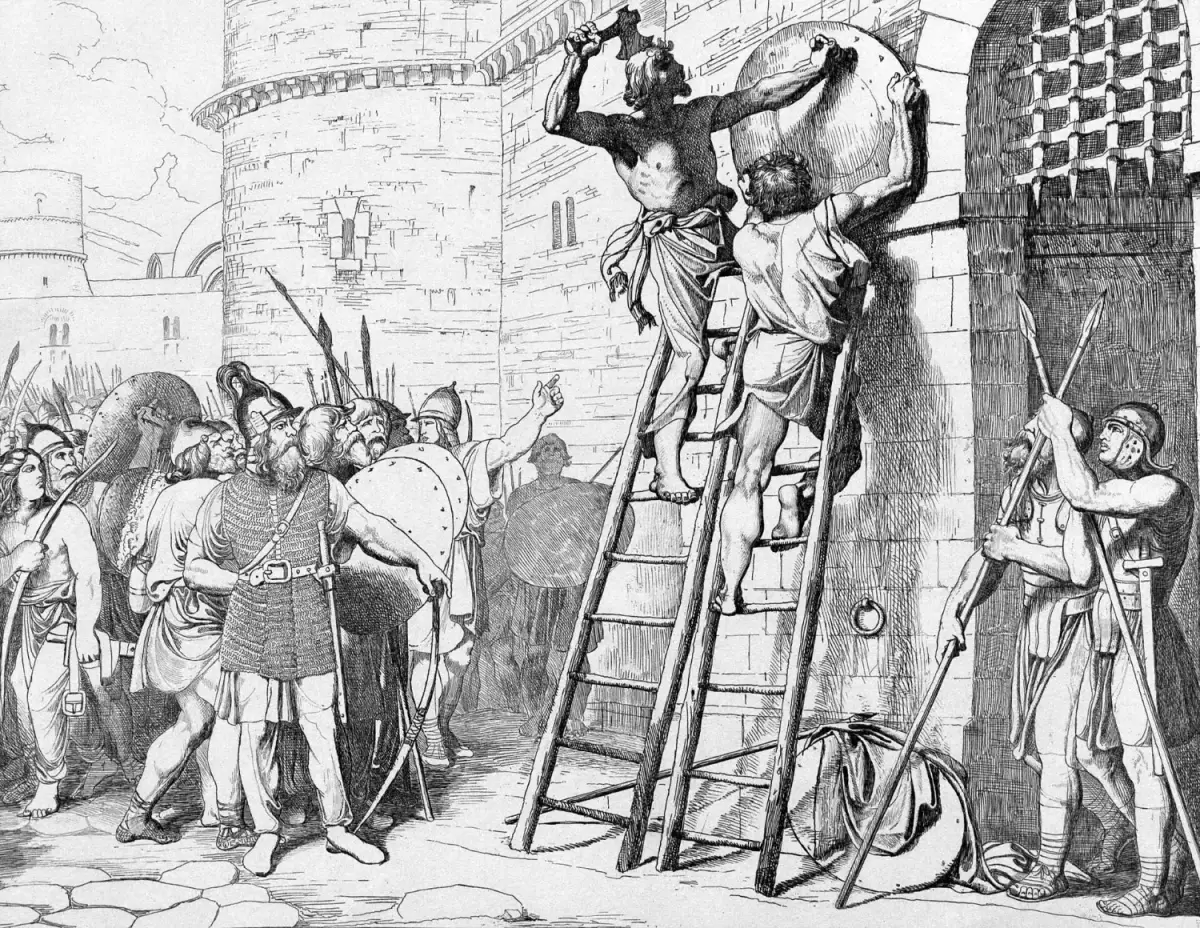
The bigger problem is silence. No Byzantine chronicle records an attack on Constantinople in AD 907, although Greek writers carefully recorded the Rus' raid of AD 860 and Igor's of AD 941. The Internet Encyclopedia of Ukraine notes that R. H. Dolley, Henri Grégoire and Omeljan Pritsak regarded the campaign – and Oleg himself – as an invention of chroniclers, while accepting that a treaty was probably signed in 911. A more recent view, by Aleksandr Romensky in Studia Ceranea (2021), argues that the "campaign" was really the Rus' entering Byzantine military service, perhaps with a provocative show of strength, later "rethought" by chroniclers as Oleg's great victory. The ships on wheels and the poisoned wine are folklore motifs; the treaty is the solid ground.
The Byzantine Empire in AD 907
What did the treaty of 911 say?
The chronicle preserves two agreements. The shorter "907" text sets out trading terms: Rus' merchants were to receive six months' supplies, live in the St Mamas quarter, and enter the city "through one gate, unarmed and fifty at a time", trading without taxes. The oath was sworn by Perun and Volos. Aleksei Shakhmatov argued that the chronicler shifted and shortened part of the genuine 911 treaty back to 907 – Romensky refers to "the so-called 'preliminary agreement' of 907, the insertion character of which was shown by Alexei Shakhmatov" – with the 911 treaty as the authentic document.
The 911 treaty is entered under the year 6420 (912) but is dated inside the text "this second of September, in the year of Creation 6420 (911), fifteenth of the indiction". An indiction is a fifteen-year Byzantine tax cycle used for dating. The treaty was addressed to Emperors Leo VI, Alexander and Constantine VII and covered:
- Crimes: a Rus' who killed a Greek, or vice versa, "shall die"; a sword blow cost five pounds of silver; theft required threefold restitution.
- Shipwreck and prisoners: stranded ships were to be helped; captives could be ransomed "for twenty bezants".
- Military service: Rus' "desirous of honoring your Emperor" could enter his service – the seed of what became the Varangian Guard.
- Inheritance and extradition: a Rus' dying in imperial service without a will had his estate sent to relatives in Rus'; fugitive criminals were to be returned.
Cross and Sherbowitz-Wetzor warn that the textual history of the treaties "is completely obscure", yet they judge that Oleg and Igor are "soundly attested, presumably with dates, by the treaties with the Greeks". It is among the oldest legal texts connected with the Rus'.
| Envoys named in the 911 treaty (Cross and Sherbowitz-Wetzor spellings) |
|---|
| Karl, Ingjald, Farulf, Vermund, Hrollaf, Gunnar, Harold, Karni, Frithleif, Hroarr, Angantyr, Throand, Leithulf, Fast, Steinvith |
All fifteen are Norse names – the translators note that "not one is Slavic". Five of them (Karl, Farulf, Vermund, Hrollaf, Steinvith) also appear as Oleg's envoys in the 907 story. For who these men were, see who were the Varangians?
How did Oleg die? The horse, the skull and the snake
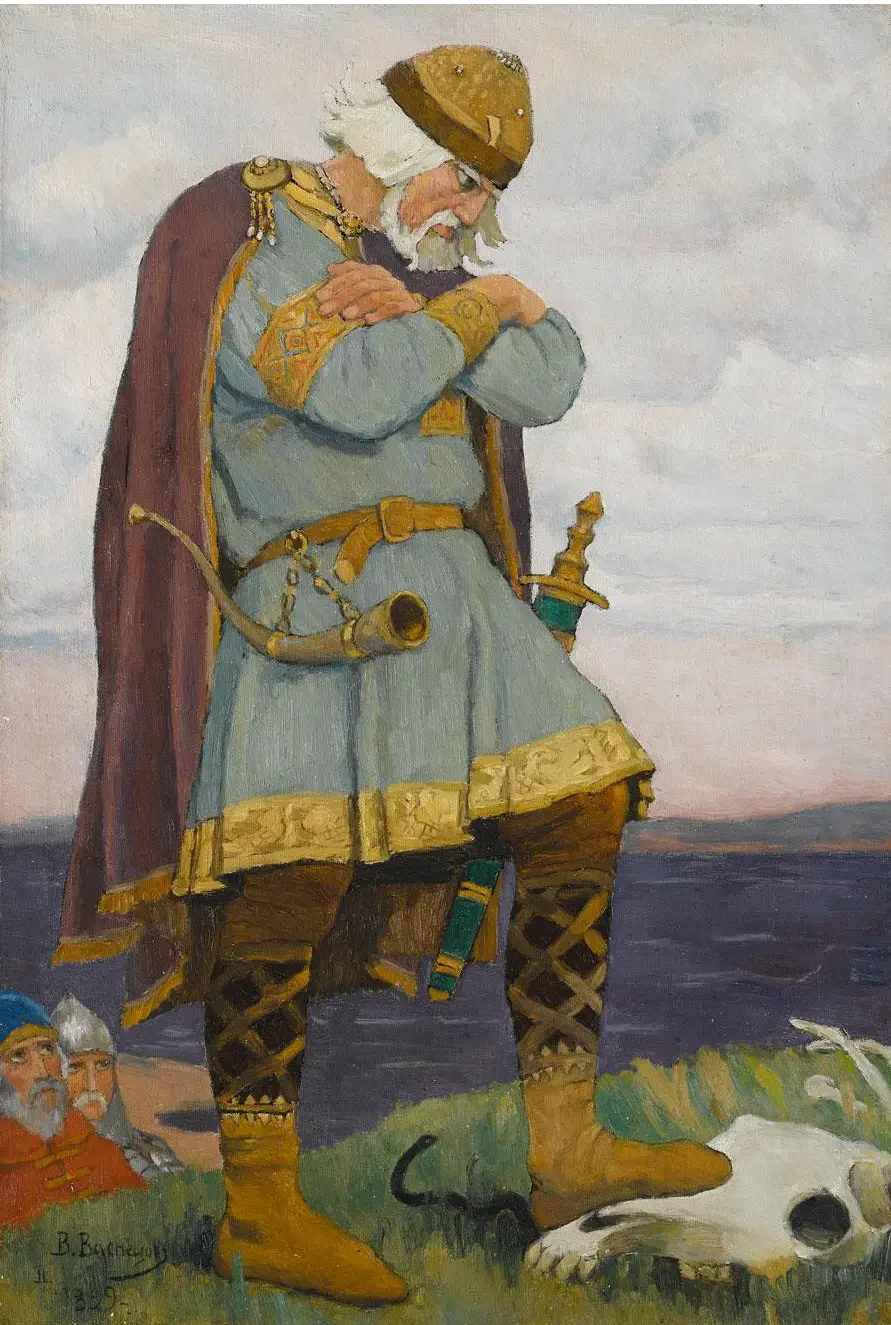
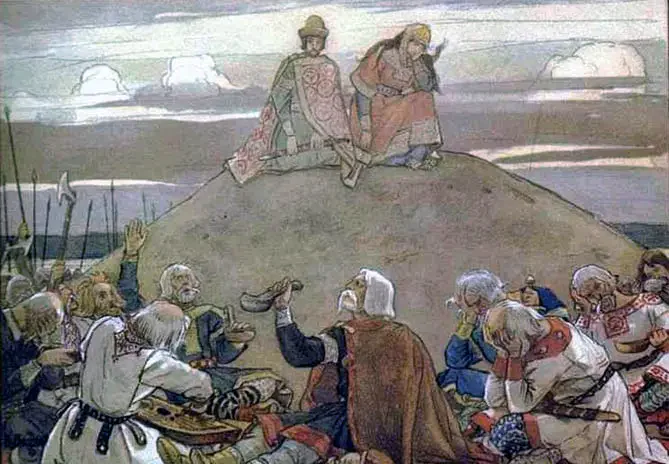
The chronicle's entry for 912 is pure legend, and a good one. Long before, Oleg had asked "the wonder-working magicians" how he would die. One replied: "Oh Prince, it is from the steed which you love and on which you ride that you shall meet your death." Oleg had the horse fed but never brought to him. In the fifth year after his return from Greece, he learned it had died, and mocked: "Soothsayers tell untruths". He rode to see the bones, stamped on the skull – "So I was supposed to receive my death from this skull?" – and "a serpent crawled forth from it and bit him in the foot". He sickened and died, and was buried on the hill of Shchekovitsa in Kiev.
The same plot drives the Icelandic Örvar-Odds saga (thirteenth century): a seeress foretells that Oddr will be killed by his horse Faxi; he kills and buries the horse, lives for centuries, returns home, and is bitten by a snake that crawls from Faxi's skull. Cross and Sherbowitz-Wetzor call Oleg's death "mythical" and "possibly derived from a Scandinavian source". Whether the saga borrowed from Rus' tradition or both drew on an older tale is unresolved.
Alexander Pushkin turned the story into his ballad Песнь о вещем Олеге ("The Song of the Wise Oleg"), dated 1 March 1822 during his exile in Kishinev and first printed in the almanac Severnye tsvety for 1825. Viktor Vasnetsov's illustrations for the 1899 centenary edition fixed the images most Russians still picture.
When and where did Oleg really die?
The sources disagree, and the disagreement is instructive.
| Source | Written | What it says | Reliability |
|---|---|---|---|
| Primary Chronicle (Laurentian text) | c. 1113; manuscript 1377 | Regent 879, Kiev 882, dies 912, buried at Shchekovitsa, Kiev; reigned "thirty-three" years | Core narrative, but dates for this period derived from Byzantine chronology and oral tradition |
| Novgorod First Chronicle (Younger Redaction) | fifteenth-century copies of older material | Oleg is Igor's voivode; campaign against Tsargrad and death under 922; "his grave is in Ladoga" | May preserve an earlier compilation; disputed |
| Treaty of 911 (in the Primary Chronicle) | 911, transmitted in translation | Names "Oleg, Great Prince of Rus'" and 15 envoys | Best evidence Oleg existed |
| Schechter Letter (Cambridge Document) | mid-tenth century, Hebrew | "HLGW", king of Rus', attacks Khazaria, Constantinople, then dies in "FRS" | Contemporary but fragmentary; identification debated |
| Örvar-Odds saga | thirteenth century | Horse-skull-and-snake death of a different hero | Literary parallel only |
The Novgorod First Chronicle passage (Nasonov's 1950 edition; the 1914 Michell and Forbes translation begins only at 1016) says Oleg went to Novgorod and on to Ladoga; "others say" that as he was going "over the sea" a snake bit him in the foot and he died, and "his grave is in Ladoga". A barrow about 10 metres high in the Sopki tract, roughly 1 km north of Staraya Ladoga, is still called "Olegova Mogila" (Oleg's grave) and is a Russian federal heritage site, but nothing ties it to him – the newspaper Realnoe Vremya notes that "No folk legends linking the name of Oleg and the hill have been recorded." Note the ambiguity: "over the sea" describes his journey; it is not a separate burial "beyond the sea", though some modern writers read it that way.

The Schechter Letter, published by Norman Golb and Omeljan Pritsak in Khazarian Hebrew Documents of the Tenth Century (Cornell, 1982), is the wild card. It describes how the Emperor Romanus I Lecapenus (r. 920–944) bribed "HLGW, king of Rus'" to attack the Khazars; defeated by the Khazar commander Pesakh, HLGW was forced to attack Constantinople, was beaten, fled to "FRS" (often read as Persia) and died there. If HLGW is Oleg, he was alive in the 940s. Constantin Zuckerman, in "On the Date of the Khazars' Conversion to Judaism and the Chronology of the Kings of the Rus Oleg and Igor" (Revue des études byzantines 53, 1995, pp. 237–270), took the letter seriously and argued for a later chronology in which Oleg and Igor overlapped; he and David Christian read it as evidence of a struggle between factions loyal to Oleg and to Igor, "a struggle that Oleg ultimately lost". Others disagree: V. Ya. Brutskus held that HLGW was another name for Igor, Georgy Vernadsky identified him with Igor's anonymous eldest son, and some read Helgi as a title.
| Key dates | Event | Source |
|---|---|---|
| AD 879 | Rurik dies; Oleg takes charge for young Igor | Primary Chronicle |
| AD 882 | Oleg takes Smolensk, Lyubech and Kiev | Primary Chronicle |
| AD 883–885 | Drevlians, Severians, Radimichians made tributaries | Primary Chronicle |
| AD 888–898 | Magyars pass Kiev | Primary Chronicle |
| AD 903 | Olga brought from Pskov as Igor's wife | Primary Chronicle |
| AD 907 | Campaign against Constantinople; first treaty | Primary Chronicle (no Byzantine confirmation) |
| 2 September AD 911 | Rus'–Byzantine treaty | Treaty text in Primary Chronicle |
| AD 912 | Oleg dies, buried in Kiev | Primary Chronicle |
| AD 922 | Oleg dies, grave in Ladoga | Novgorod First Chronicle (disputed) |
| 940s | "HLGW" dies in "FRS" | Schechter Letter (identification disputed) |
Was Oleg a real person?
Almost certainly yes – but the Oleg we can prove is much thinner than the Oleg we remember. The treaty of 911 shows a Rus' ruler of that name negotiating with Leo VI through a team of Norse envoys; that is hard evidence. The chronicle's tidy dates, however, were fitted around Byzantine events by a Kievan monk writing about two centuries later, and Cross and Sherbowitz-Wetzor show that the skeleton of dates before 945 is "entirely derived from Greek sources". The ruse at Kiev, the wheeled ships and the snake are the stuff of epic song. As the Internet Encyclopedia of Ukraine puts it, historians now "differentiate between the legendary Oleh the Seer of the Primary Chronicle and the Oleh of Rus' who negotiated a favorable treaty with Byzantium."
Byzantium took him seriously enough to sign a treaty; Encyclopaedia Britannica calls him "a semilegendary Viking (Varangian) leader" and the founder of the Kievan Rus state. The TV series Vikings (season 6, 2019–2020) cast Danila Kozlovsky as "Prince Oleg the Prophet", but its plot of Oleg meeting Ivar the Boneless is fiction. Until archaeology or a new text appears, the honest answer is that Oleg was real, powerful and largely invented at the same time.
What the map shows next
After Oleg, Igor rules Kiev, raids Constantinople in AD 941, signs his own treaty and is killed by the Drevlians; his widow Olga then governs for their son. See the realm Oleg built at AD 945 on the map.