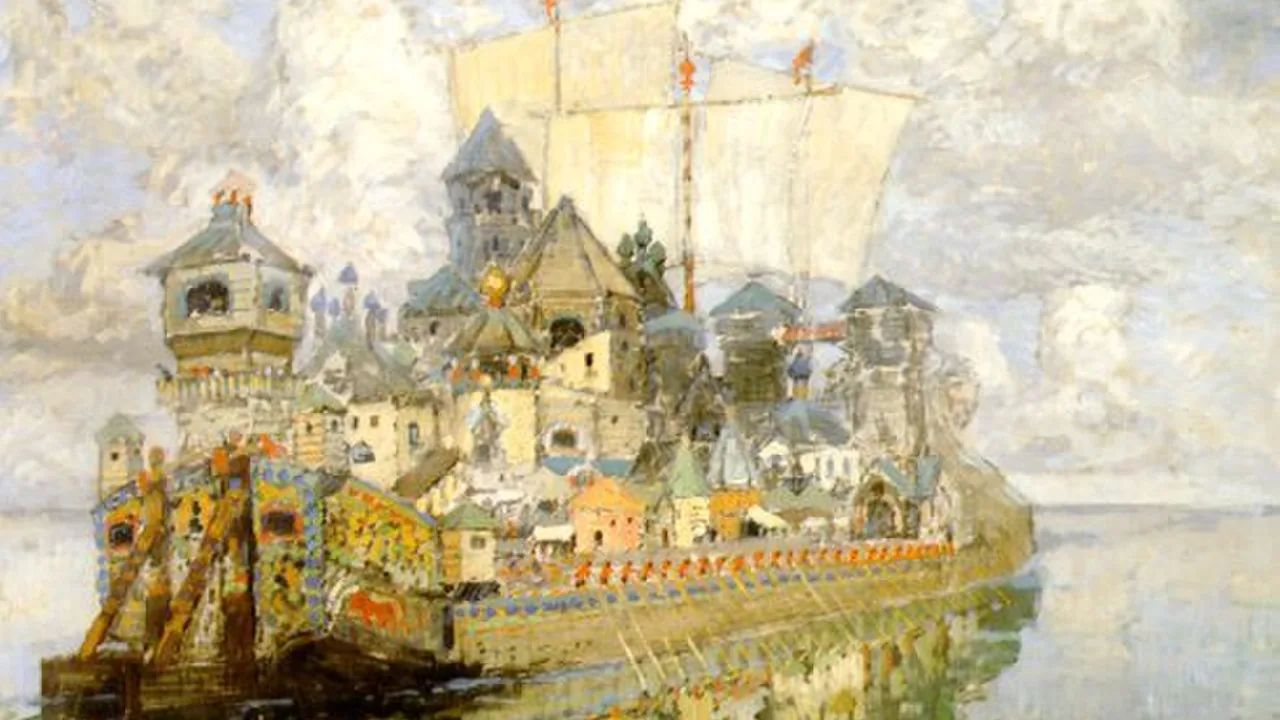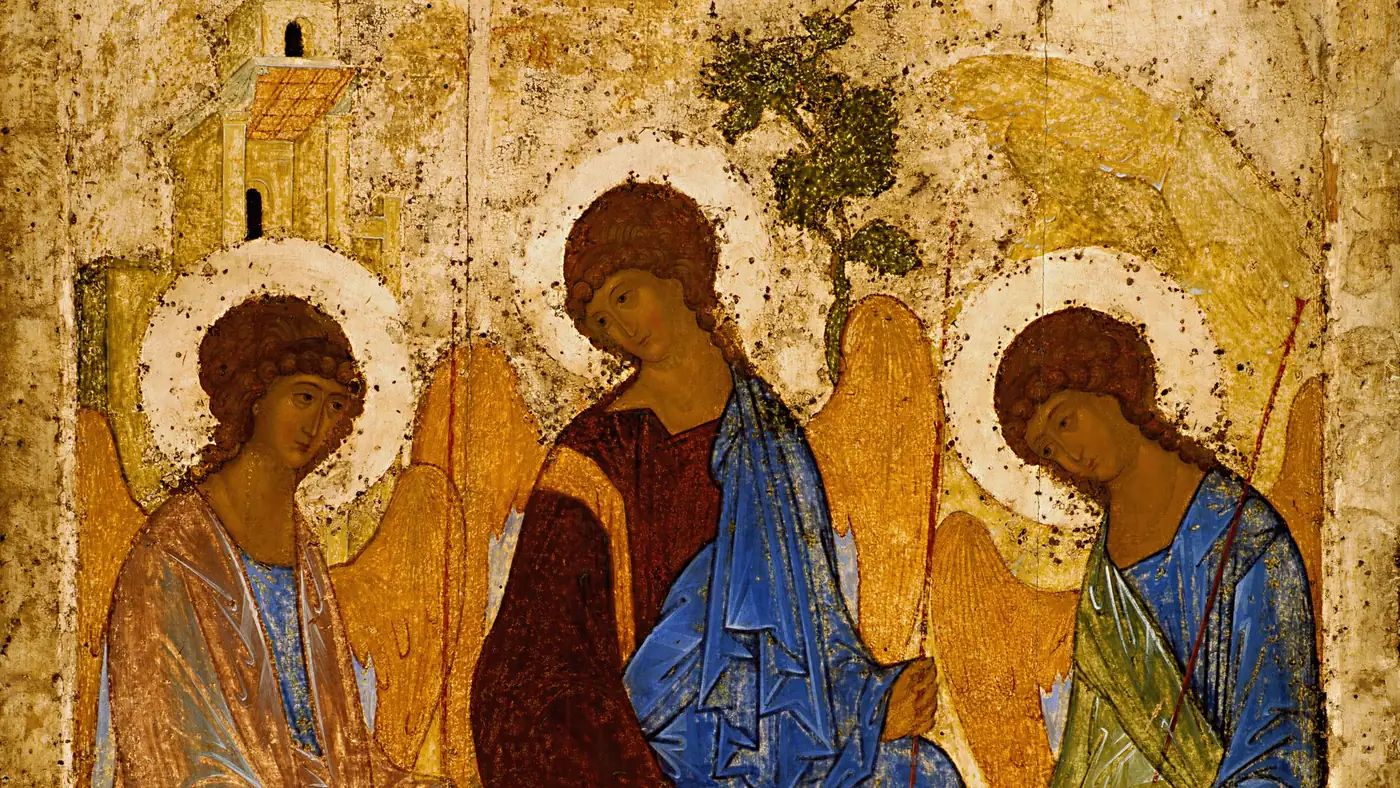
Sergius of Radonezh (died 25 September 1392) was a monk who founded the Trinity monastery in the forests north-east of Moscow, today the Trinity Lavra of St Sergius in Sergiev Posad. He became the most venerated saint of medieval Russia. His monastery was the model for dozens of others founded by his disciples, and he acted as a peacemaker and confessor for the grand princes of Moscow at the time Moscow was rising to power.
Almost everything we know about him comes from his Life, written about 26 years after his death by his disciple Epiphanius the Wise and later reworked by Pachomius the Serb. Some of the best-known stories about him, above all his blessing of Dmitry Donskoy before the Battle of Kulikovo, rest on later and less reliable texts. Even the year of his birth is disputed.
Sergius of Radonezh at a glance
| Name | Bartholomew (Varfolomei) at birth; Sergius as a monk |
| Born | 1314 or 1322 (disputed), in the land of Rostov |
| Parents | Kirill and Maria, boyars of Rostov who became poor |
| Founded | The Trinity monastery on Makovets hill, early 1340s |
| Died | 25 September 1392, at the Trinity monastery |
| Relics uncovered | 5 July 1422 |
| Canonised | By 1449 for all of Rus' (dating disputed) |
| Main source | Life by Epiphanius the Wise (c. 1418), reworked by Pachomius the Serb |
| Feast days | 25 September; 5 July |
When was Sergius born?
The sources do not agree. The Life says that he was born in the reign of the Byzantine emperor Andronikos, under Grand Prince Dmitry Mikhailovich of Tver and Metropolitan Peter, "when Akhmyl's host came", a Tatar raid that the chronicles date to 1322. But it also says that he died in 1392, having lived "78 years", which points to 1314.
Historians have split ever since. The Orthodox Encyclopedia, in its 2026 article, lists the camps: Golubinsky, N. S. Borisov and B. M. Kloss for 1314; Klyuchevsky, V. A. Kuchkin and K. A. Averyanov for 1322; and others for around 1319 or 1320. The encyclopedia itself gives his birth as "about the mid-1310s to the early 1320s". Russia's Church and state celebrated the 700th anniversary of his birth in 2014, following the 1314 date.
The traditional birthplace, the village of Varnitsy near Rostov, is a local tradition recorded only from the 18th century. Two historians, S. V. Gorodilin and Kuchkin, have proposed instead the village of Tormosovo, about 25 kilometres from Rostov (Orthodox Encyclopedia).
From Rostov to Radonezh
The Life explains why the family left Rostov. When Ivan Kalita of Moscow gained control over the Rostov principality around 1332, Moscow's agents Vasily Kocheva and Mina "laid great oppression on the city". They took property from the people of Rostov by force, and even hung the city's senior boyar, Averky, upside down. Kirill, already impoverished, moved with his family to Radonezh, a small town north-east of Moscow, where settlers were offered tax privileges.
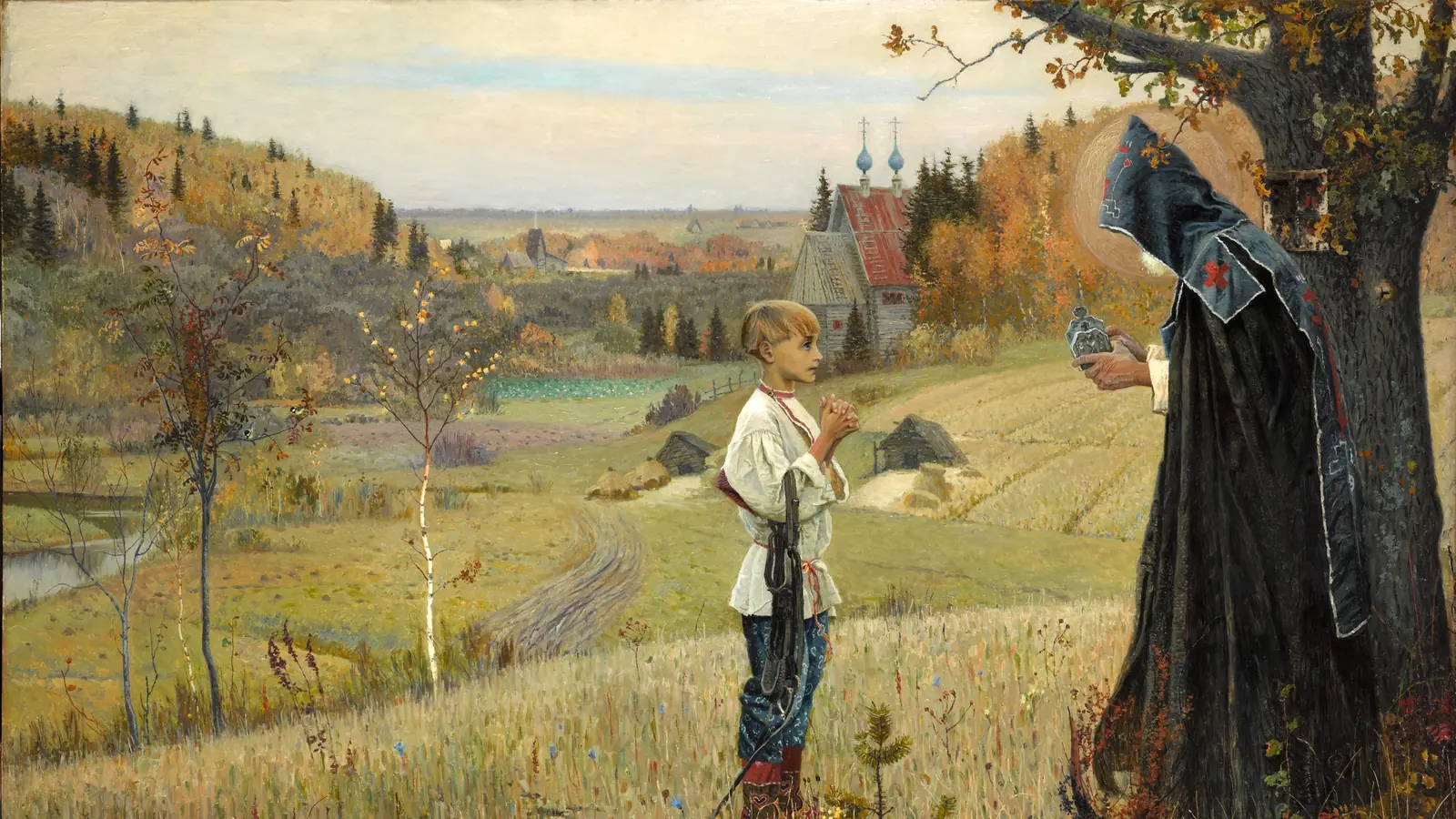
One of the Life's most famous scenes belongs to these early years. As a boy, Bartholomew could not learn to read, although his brothers learned easily. Sent out to look for his father's horses, he met a monk praying "in a field under an oak". The elder gave him a piece of holy bread, and from then on, the Life says, he could read. The Orthodox Encyclopedia suggests that the boy probably had dyslexia, a modern guess that the text itself cannot confirm.
Founding the Trinity monastery
In the early 1340s Bartholomew and his elder brother Stefan went into the forest and settled on a hill called Makovets, near the Konchura stream. They built a cell and a small wooden church, which priests sent by Metropolitan Theognostos consecrated in the name of the Holy Trinity. Stefan soon left for a monastery in Moscow. Bartholomew stayed alone.
A hegumen (abbot) named Mitrofan tonsured him as a monk on 7 October, the feast of St Sergius, whose name he took. The year is disputed. For about two years he lived as a hermit, by the Life's own reckoning "two years, or more, or less, God knows". Then other monks came to join him, until there were about twelve. Around the 1350s he was ordained priest and made hegumen of the little community.
The common life
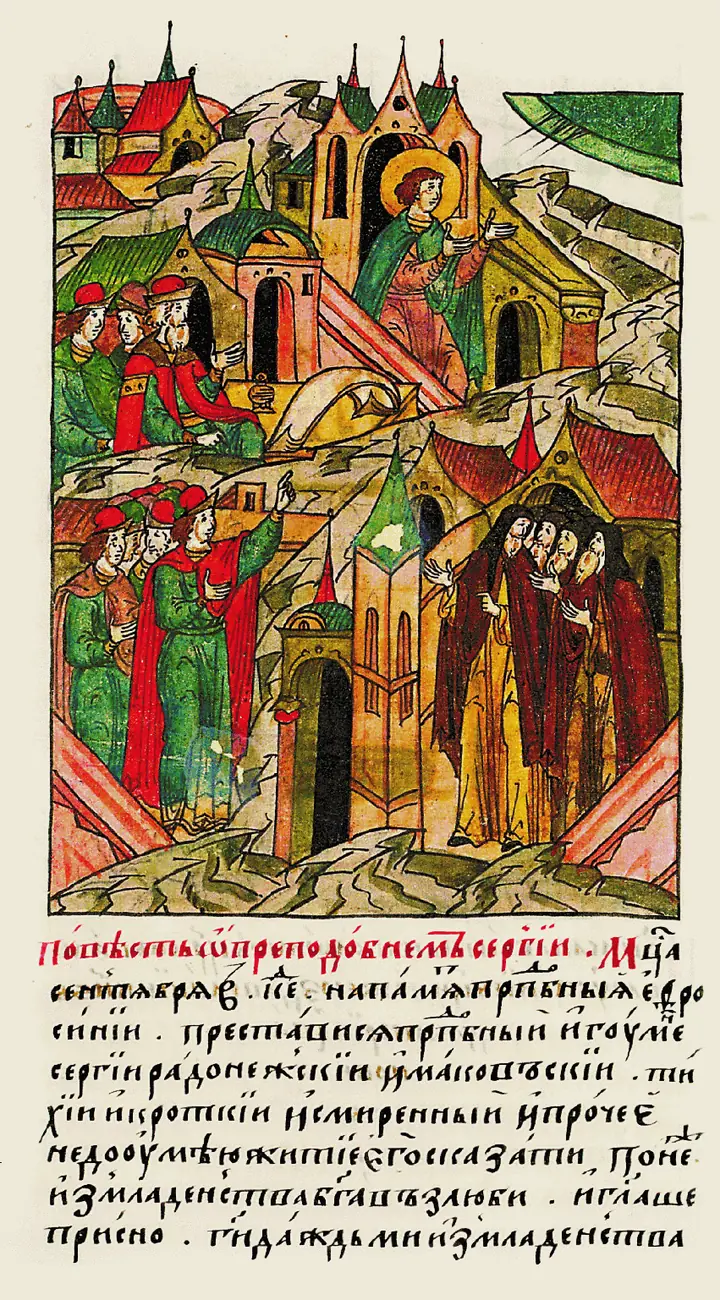
Sergius's most lasting change was to introduce the cenobitic, or common, life to his monastery: the monks would share all property, eat together and live under one rule. According to the Life, envoys of the Patriarch of Constantinople, Philotheos, brought him a letter urging him to do it:
"One thing is still lacking: you have not established the common life." (Letter of Patriarch Philotheos, in the Life, our translation)
The date of this letter is one of the debates about Sergius. Older scholarship and the editors of the Life placed it in the mid-1350s. Kuchkin connected it with a report in the Trinity Chronicle that two envoys of Philotheos came to Moscow in the winter of 1376/77, and the Orthodox Encyclopedia leans towards this later date.
The reform caused a crisis. Some monks rebelled, and Sergius's brother Stefan, who had returned, challenged him openly in the church: "Who is hegumen in this place? Was I not the first to settle here?" Sergius said nothing, left the monastery that night and founded a new one on the Kirzhach river. He returned only when the metropolitan asked him to.
The common life spread through his disciples. Monasteries founded by them and by their followers stretched across the north, and the Trinity became the model for monastic life in Muscovite Russia.
Sergius and the grand princes of Moscow
Sergius was no hermit cut off from the world. From the 1360s he served the policy of the Moscow grand princes and of Metropolitan Alexis, who governed the Church and, for a time, the young Grand Prince Dmitry Ivanovich (later Donskoy).
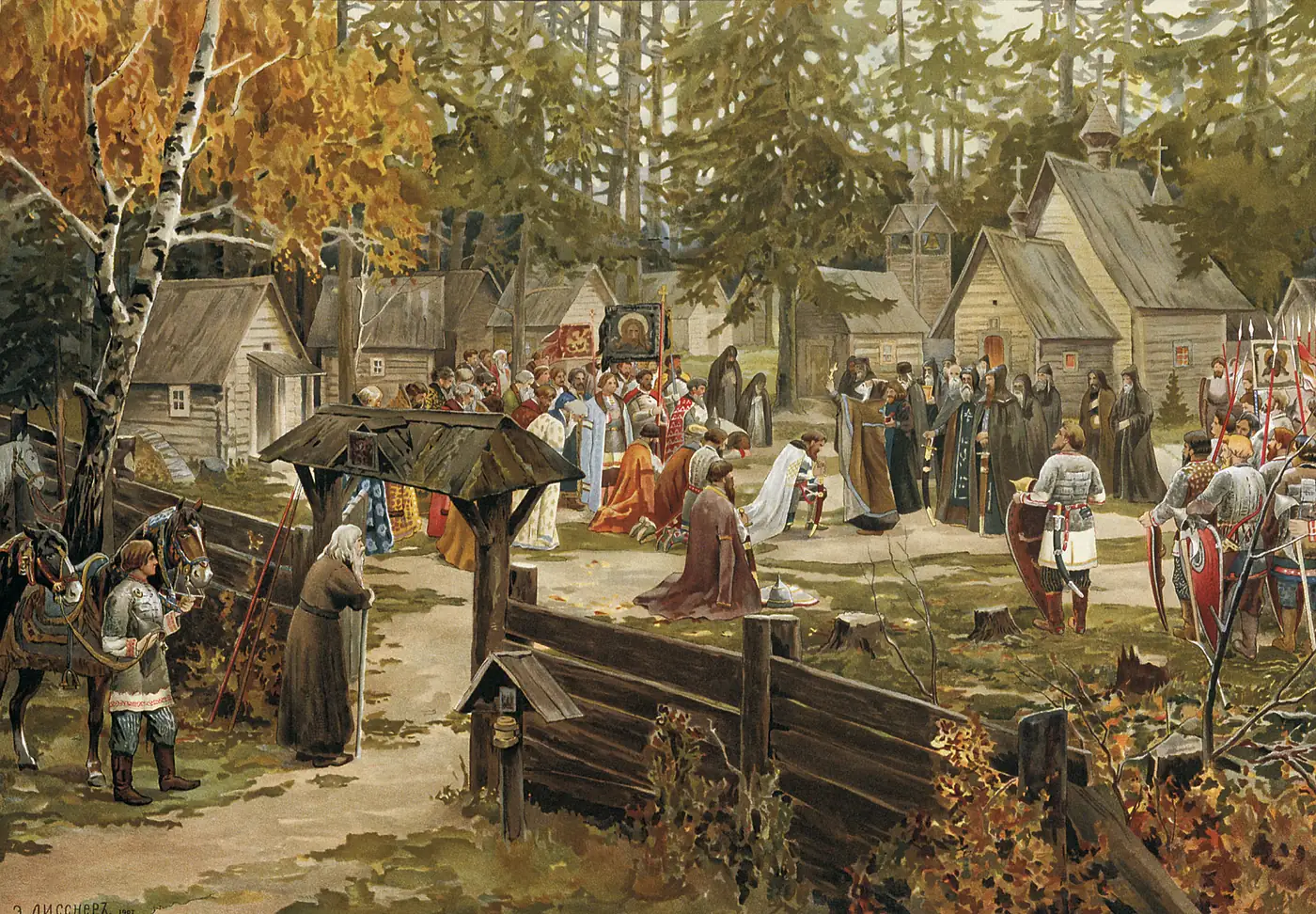
In 1365, according to the Nikon Chronicle, Sergius went to Nizhny Novgorod to summon its prince, Boris Konstantinovich, to Moscow. When Boris refused, "the reverend Abbot Sergius, following the order of Metropolitan Alexis and Grand Prince Dmitrii Ivanovich, closed all the churches" (trans. Zenkovsky). In 1374 he baptised Dmitry's son Yuri, and at the end of 1385 he travelled to Ryazan and persuaded Prince Oleg, after a war with Moscow, to make peace. In 1389 he was a witness to Dmitry Donskoy's last testament, made "before the hegumen Sergius" (Orthodox Encyclopedia).
The modern editors of his Life concluded that Sergius "consciously placed his activity in the service of the centralising aims of the Moscow princes". But he was not simply Dmitry's man. When Metropolitan Alexis died in 1378, Sergius sided with the Constantinople-appointed metropolitan Cyprian against Dmitry's own candidate, the priest Mityai. According to the Orthodox Encyclopedia, he lost his place as Dmitry's confessor for a time; he did not baptise the grand prince's sons born in 1379 and 1382. During Tokhtamysh's attack on Moscow in 1382 he took refuge in Tver.
He refused to become metropolitan
Before his death in February 1378, Metropolitan Alexis offered Sergius the succession and tried to give him a gold cross. Sergius refused:
"Forgive me, master, but you ask what is beyond my strength; and I will never agree to it. Who am I, a sinner and the worst of all men?" (Life, modern Russian translation, our English)
Did Sergius bless Dmitry Donskoy before Kulikovo?
This is the most famous story told about Sergius, and the least certain. According to the Tale of the Rout of Mamai, a text of the late 15th or 16th century, Grand Prince Dmitry visited the Trinity monastery before the battle of 1380. Sergius blessed him, foretold victory, and gave him two of his monks, Peresvet and Oslyabya, to fight in the army.
The earlier sources tell a different story:
| Source | What it says about Sergius |
|---|---|
| Short chronicle tale of Kulikovo, in the compilation of 1408 | Nothing |
| Zadonshchina, a poem about the battle | Nothing |
| Long chronicle tale, mid-15th century | A letter of blessing reached Dmitry on the Don on 6 September 1380: "That you, lord, should go forth, and God and the Holy Mother of God will help you" |
| Life of Sergius (in its reworked versions) | A visit by Dmitry to the monastery before marching against Mamai, a blessing and a promise of victory |
| Tale of the Rout of Mamai | The visit, the prophecy, and the two monks Peresvet and Oslyabya |
The Life itself, in the form that survives, does tell of a visit: hearing that Mamai was coming, Dmitry "came to St Sergius" to ask whether he should go out against the godless, and Sergius blessed him and promised victory. It does not mention Peresvet and Oslyabya, and the episode belongs to the versions of the Life reworked by Pachomius the Serb, which tie the victory to the founding of the Dubenka monastery. That monastery was in fact founded after the Battle of the Vozha in 1378 (Orthodox Encyclopedia). Historians are divided. Kuchkin and, before him, M. N. Tikhomirov argued that a visit of the princes to the Trinity before a victory over the Horde in Sergius's time can only fit the Battle of the Vozha on 11 August 1378. Borisov, Kloss and Averyanov think a visit before Kulikovo is possible; a 2023 study by I. M. Rysin argues for it (Orthodox Encyclopedia). The site's article on the Battle of Kulikovo explains how the story grew.
Death and the making of a saint
Sergius died at his monastery on 25 September 1392. The Life says that on his deathbed he urged the brethren to keep "like-mindedness with one another". A chronicle obituary of the early 15th century called him "a shepherd not only of his own flock, but a teacher and guide of all our Russian land" (quoted in the Orthodox Encyclopedia, our translation).
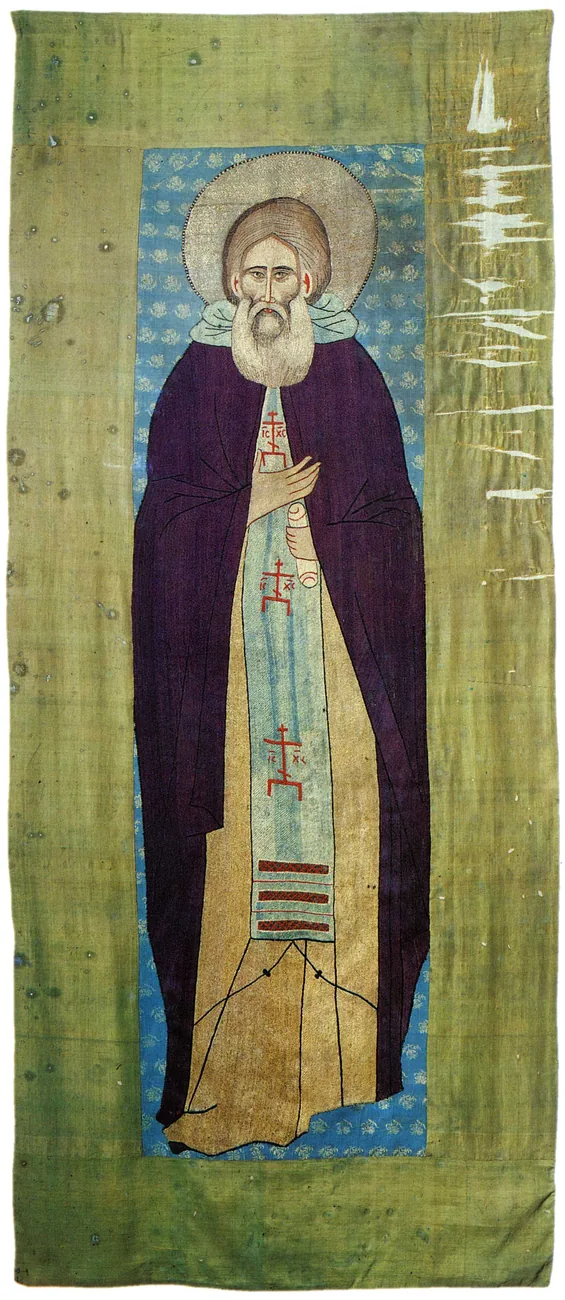
His cult grew quickly. On 5 July 1422 his relics were uncovered and placed in a new shrine, and by 1426 they were moved into the new stone Trinity Cathedral, which still stands. The embroidered pall that covered his tomb in the 1420s is the oldest surviving image of him. When he was recognised as a saint for all of Rus' is disputed: Averyanov argues that the process ended at a church council under Metropolitan Jonah in 1449, but the Orthodox Encyclopedia notes there is no single view.
Epiphanius and Pachomius: who wrote the Life?
The Life was begun by Epiphanius the Wise, a monk of the Trinity who had known Sergius. According to the Orthodox Encyclopedia, he wrote it in 1418–1419, about 26 years after Sergius's death. No copy of Epiphanius's original text survives on its own. What we have was reworked, from the late 1430s onwards, by Pachomius the Serb (also called Pachomius the Logothete), a professional writer of saints' lives who produced several versions. The text in the standard modern edition, in the Pushkin House library of Old Russian literature, is a 16th-century compilation that preserves more of Epiphanius's wording than most.
This matters for how we read it. The Life is a work of devotion, written to show a saint. It is precise about some things, such as the oppression of Rostov, and vague or contradictory about others, such as dates.
The relics after the revolution
In the Soviet period Sergius's relics became a target of anti-religious campaigns. On 11 April 1919, on the orders of the authorities and before a large crowd of believers, his tomb was opened; the remains were found to be bones. Despite protests, including one from Patriarch Tikhon, the relics were handed to the local museum, which around 1930 displayed them in a section called "The Cult of Sergius". In the autumn of 1941 they were evacuated to Solikamsk with the museum's collections, and in 1946 they were returned to the monastery (Orthodox Encyclopedia). A family tradition of the priest and philosopher Pavel Florensky says that Sergius's head was secretly replaced in 1920 to save it; the encyclopedia reports this as tradition.
"Love and unity will save us": did Sergius say it?
The phrase most often quoted as Sergius's own, "We shall be saved by love and unity" (Liubov'iu i edineniem spasemsia), appears nowhere in his Life. The Moscow Patriarchate's message for his 700th anniversary in 2014 introduced it as words "conveyed to us by pious tradition". At the anniversary celebrations at Sergiev Posad, Vladimir Putin attributed the words to Epiphanius the Wise, and Patriarch Kirill had quoted them too (Kremlin, 18 July 2014). The closest wording in the Life is his deathbed instruction to keep "like-mindedness with one another".
Common myths about Sergius of Radonezh
| Myth | What the evidence says |
|---|---|
| He was born in 1314 | Disputed; a strong group of historians prefers 1322 |
| He was born at Varnitsy near Rostov | A tradition recorded from the 18th century |
| He blessed Dmitry at the monastery before Kulikovo and sent two monks | The earliest accounts do not mention him; the visit appears in later versions of the Life, the monks only in the Tale of the Rout of Mamai; some historians date the visit to 1378 |
| He said "We shall be saved by love and unity" | Not in his Life; the Church itself calls it tradition |
| He was a hermit who stayed out of politics | He served Moscow's grand princes as envoy and peacemaker, but also opposed Dmitry over the metropolitanate |
| His Life is an eyewitness biography | It was written about 26 years after his death and survives only in later reworkings |
What the map shows next
The map of 1389 shows the Grand Principality of Moscow, the Trinity monastery's patron, beside its rivals Tver and Nizhny Novgorod, both of which Sergius visited, with the Novgorod Republic to the north and the Grand Duchy of Lithuania to the west. To the south lay the Golden Horde, reunited under Tokhtamysh.
Sources
Primary sources
- Zhitie Sergiia Radonezhskogo, text and modern Russian translation, Biblioteka literatury Drevnei Rusi, vol. 6 (Pushkin House): http://lib.pushkinskijdom.ru/Default.aspx?tabid=4989
- The Nikonian Chronicle, vol. 3, ed. and trans. S. A. Zenkovsky and B. J. Zenkovsky (Princeton, 1986): https://archive.org/details/nikonian-chronicle-5
- Letopisnaia povest' o Kulikovskoi bitve, ed. and trans. M. A. Salmina, Biblioteka literatury Drevnei Rusi, vol. 6: http://lib.pushkinskijdom.ru/Default.aspx?tabid=4981
Studies
- M. V. Pechnikov et al., "Sergii Radonezhskii", Pravoslavnaia entsiklopediia, vol. 63 (2026): https://www.pravenc.ru/text/2662834.html
- K. A. Averyanov, "Khronologiia redaktsii zhitiia Sergiia Radonezhskogo", Slavianskii al'manakh 2011: https://cyberleninka.ru/article/n/hronologiya-redaktsiy-zhitiya-sergiya-radonezhskogo
- I. M. Rysin, "K voprosu o real'nosti vstrechi… Dimitriia Donskogo i prepodobnogo Sergiia Radonezhskogo v kanun Kulikovskoi bitvy", 2023: https://cyberleninka.ru/article/n/k-voprosu-o-realnosti-vstrechi-blagovernogo-knyazya-dimitriya-donskogo-i-prepodobnogo-sergiya-radonezhskogo-v-kanun-kulikovskoy
- Message of Patriarch Kirill and the Holy Synod for the 700th anniversary of St Sergius, 2014: https://cyberleninka.ru/article/n/poslanie-svyateyshego-patriarha-kirilla-i-svyaschennogo-sinoda-arhipastyryam-pastyryam-diakonam-monashestvuyuschim-i-vsem-vernym
- President of Russia, "700th anniversary of the birth of St Sergius of Radonezh", 18 July 2014: http://en.kremlin.ru/events/president/transcripts/speeches/46246
Image credits
- Title image: Mikhail Nesterov, Vision of the Youth Bartholomew, 1889–1890, Tretyakov Gallery. Public domain, via Wikimedia Commons, cropped to 16:9.
- Illustrated Chronicle, vol. 11, p. 4. Public domain, via Wikimedia Commons.
- Ernst Lissner, Trinity Monastery, 1907. Public domain, via Wikimedia Commons.
- Embroidered pall, 1420s, Sergiev Posad Museum-Reserve. CC BY-SA 4.0, via Wikimedia Commons.