Slavic paganism, the religion of the Slavs before Christianity, is far less known than popular books and websites suggest. For the East Slavs of Kievan Rus' the medieval evidence comes down to a few sentences in the Primary Chronicle, one learned gloss of 1114 and a handful of church sermons, all written by Christians. Together they name about a dozen gods and spirits. Only one, the thunder god Perun, is well attested: princes and warriors swore by him, and Vladimir set up his idol in Kyiv in AD 980. Veles (Volos) appears as the "god of cattle". Mokosh, Khors, Dazhbog, Stribog and Simargl are little more than names. Much of what passes for "Slavic mythology" today, including goddesses such as Lada, gods such as Belobog and a cosmic battle between Perun and Veles, was reconstructed or invented between the seventeenth and twentieth centuries.
The editors of the standard English translation of the Primary Chronicle put it bluntly: "There is also very little evidence that anything like a systematic Slavic pantheon ever existed" (Cross and Sherbowitz-Wetzor, 1953, p. 38). This article sorts what the sources say from what was added later.
What is the earliest evidence for Slavic religion?
The oldest description comes from the Byzantine historian Procopius, writing around AD 550 about the Sclaveni and Antes on the Danube frontier, not about the later Rus'. "They believe that one god, the maker of lightning, is alone lord of all things, and they sacrifice to him cattle and all other victims." They "reverence, however, both rivers and nymphs and some other spirits, and they sacrifice to all these also, and they make their divinations in connection with these sacrifices" (Wars VII.14.23–24, trans. Dewing, Loeb vol. IV, p. 271).
Procopius names no god. Most scholars think his "maker of lightning" is the god later called Perun, but that is an inference. His "nymphs" are a Greek word for local spirits of water and woods.
Arabic geographers of the early tenth century add a little. Ibn Rusta says the Slavs offered millet to the sky at harvest time, and later Persian writers say they worshipped fire and burned their dead. Their information was second-hand, and they used the word Ṣaqāliba loosely for northern peoples. The Rus' funeral that Ibn Fadlan watched on the Volga in AD 922 was a Scandinavian rite, not a Slavic one (see our article on Ibn Fadlan and the Rus').
What does the Primary Chronicle say about the pagan gods?
The Primary Chronicle, compiled in Kyiv around 1113 and preserved in copies from 1377 onwards, is the main source. Its compilers were monks, writing more than a century after the conversion of AD 988.
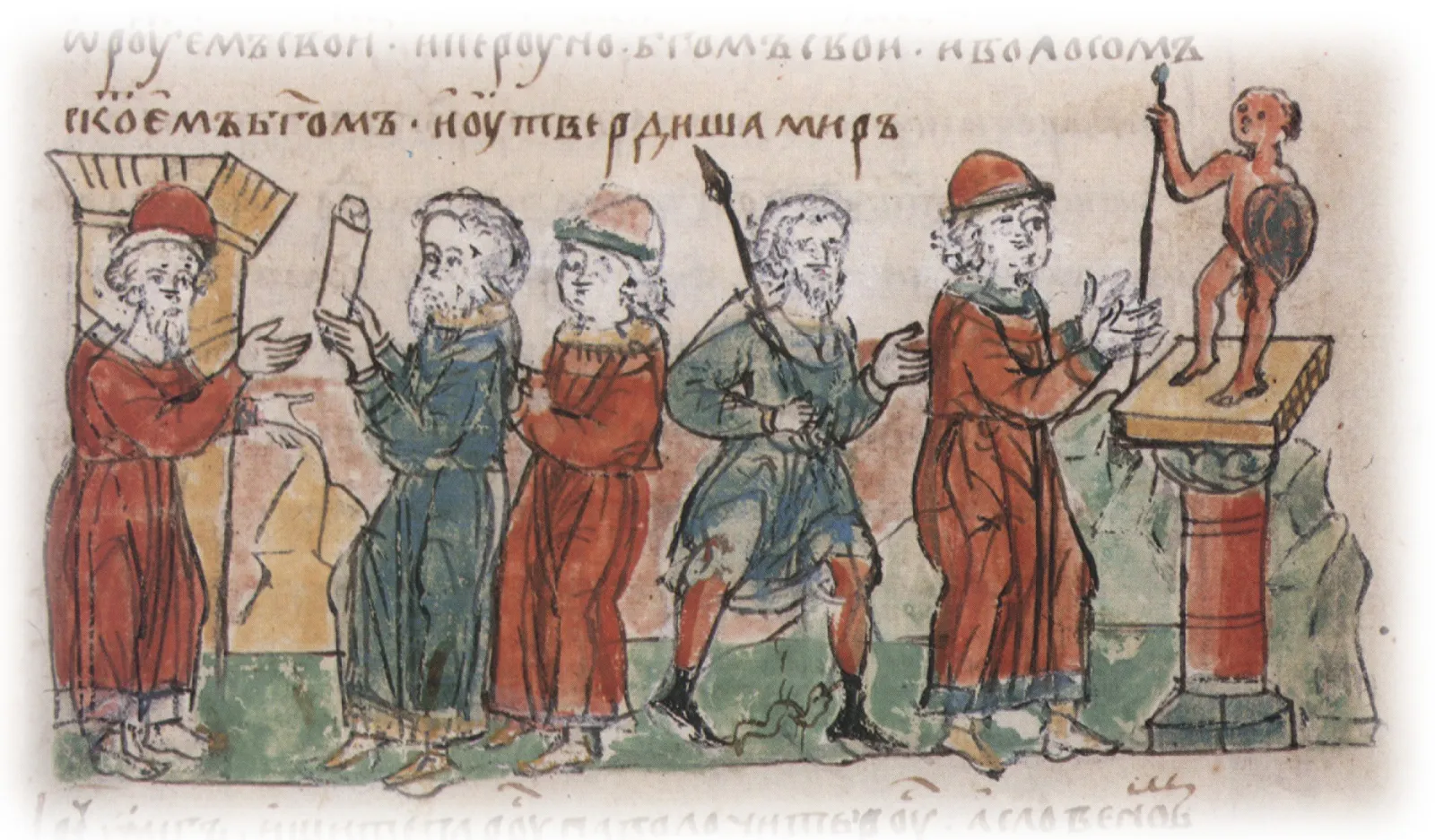
Treaty oaths. The first time the gods appear is in the peace with Byzantium under AD 907. While the Greek emperors kissed the cross, "according to the religion of the Russes, the latter swore by their weapons and by their god Perun, as well as by Volos, the god of cattle, and thus confirmed the treaty" (trans. Cross and Sherbowitz-Wetzor, p. 65). In AD 944, Prince Igor "went to a hill on which there was a statue of Perun" to swear, while the Christians among his men swore in the church of St Elias (p. 77; see our article on Igor's treaty of 944). In AD 971 Sviatoslav's men called down on any oath-breaker the curse of "the god in whom we believe, namely, of Perun and Volos, the god of flocks": "may we become yellow as gold, and be slain with our own weapons" (p. 90). The editors warn that the textual history of these treaties is "completely obscure", but the oaths are the closest thing we have to documents of pagan practice.
Vladimir's idols. In AD 980 Vladimir, newly master of Kyiv, "set up idols on the hills outside the castle with the hall: one of Perun, made of wood with a head of silver and a mustache of gold, and others of Khors, Dazh'bog, Stribog, Simar'gl, and Mokosh'" (p. 93). Mokosh is the only goddess. Volos, sworn by in the treaties, is not on the list. The chronicler adds that the people brought "their sons and their daughters to sacrifice them to these devils", and under AD 983 tells how a lot fell on the son of a Christian Varangian, who was killed with his father (p. 95). These stories come from a Christian writer who wanted to show the darkness before the conversion. Human sacrifice is plausible, but it is not independently confirmed (see our article on Vladimir's pagan reign).
The fall of Perun. After his baptism in AD 988, Vladimir "directed that the idols should be overthrown, and that some should be cut to pieces and others burned with fire. He thus ordered that Perun should be bound to a horse's tail and dragged down Borichev to the stream." Twelve men beat the idol with sticks, "not because he thought the wood was sensitive, but to affront the demon", and it was thrown into the Dnieper and pushed on until it passed the rapids (pp. 116–117). The Church of St Basil was built "on the hill where the idol of Perun and the other images had been set" (p. 117).
Customs of the tribes. The chronicle's introduction describes the Radimichians, Vyatichians and others as burning their dead: "After the bones were collected, they were placed in a small urn and set upon a post by the roadside, even as the Vyatichians do to this day" (p. 57). The passage contrasts these "pagans" with the "meek" Polianians around Kyiv. It is a moral set-piece rather than ethnography, but cremation is confirmed by archaeology (see what graves reveal about conversion).
Which other sources name Slavic gods?
The 1114 gloss. A Slavonic translation of the Byzantine world chronicle of John Malalas, copied into the Hypatian chronicle under 1114, explains Greek gods with Slavic names. Hephaestus becomes Svarog, and the Sun, his son, becomes Dazhbog: "Tsar Sun is the son of Svarog, and his name is Dazhbog" (as translated in the Encyclopedia of Religion, "Dazhbog"). This is the only medieval source for Svarog. It shows that a learned twelfth-century bookman thought of Dazhbog as the sun, but it is a translator's equation, not evidence of a cult.
Sermons against paganism. A group of Old Rus' sermons, written from the eleventh century onwards and mostly preserved in later copies, condemn people who still pray to Perun, Khors and Mokosh, to the vily (spirits, often female), and to Rod and the rozhanitsy, spirits of birth and fate who were offered bread, cheese and honey. One sermon accuses people of praying to fire in the grain-drying barn and calling it Svarozhich. The sermons are modelled on Byzantine attacks on Greek paganism, and their lists of idols may owe as much to books as to village practice. They show that the names survived in church memory long after AD 988. They do not tell us what the gods meant.
The Tale of Igor's Campaign. This poem about a raid of 1185 calls the princes of Rus' "Dazhbog's grandchildren", the winds "Stribog's grandsons" and the bard Boyan "grandson of Veles", and has a prince cross "the path of great Khors". Its only manuscript burned in Moscow in 1812, and its authenticity was long debated. Most linguists now accept it as medieval, but even then the gods are poetic decoration, not proof of worship.
The gods of Rus': what the sources actually say
| God or spirit | Where the medieval sources name it | What they say | Later additions | Evidence |
|---|---|---|---|---|
| Perun | Chronicle AD 907, 944, 971, 980, 988; Novgorod chronicle; sermons | Oath god of princes and warriors; idol with silver head and gold moustache | Thunder and the oak; enemy of a serpent-god | Strong |
| Volos / Veles | Chronicle AD 907, 971; Tale of Igor | "God of cattle" or "god of flocks", sworn by beside Perun | Underworld god, Perun's adversary, god of poetry | Name and role only |
| Mokosh | Chronicle AD 980; sermons | The only goddess in the AD 980 list | Goddess of spinning, women and moist earth | Name only |
| Khors | Chronicle AD 980; sermons; Tale of Igor | Name; "great Khors" | Sun god; Iranian origin of the name | Name only |
| Dazhbog | Chronicle AD 980; 1114 gloss; Tale of Igor | Equated with the sun, "son of Svarog" | "Giving god", ancestor of the Rus' | Name and one gloss |
| Stribog | Chronicle AD 980; Tale of Igor | Name; the winds his "grandsons" | God of winds or sky | Name only |
| Simargl | Chronicle AD 980; one sermon ("Sim and Rgl") | Name only, garbled by later scribes | Winged dog; Iranian Simurgh | Name only |
| Svarog | 1114 gloss only | Equated with Hephaestus | Supreme sky and smith god | One source |
| Rod and the rozhanitsy | Sermons | Spirits of birth and fate given food offerings | Rod as supreme creator | Sermons only |
| Lada, Kupala, Koliada, Morana, Belobog | No medieval Rus' source | – | Love goddess, midsummer god, winter god, goddess of death and winter, "white god" | Later invention or folk custom turned into a god |
West Slavic gods such as Svantevit of Rügen, Triglav of Szczecin and the "black god" of Helmold of Bosau belong to a different region and are not evidence for Rus' (see below).
Who was Perun?
Perun is the one Slavic god whose cult can be traced with confidence. His name is related to the Lithuanian thunder god Perkūnas and to Slavic words for striking and for lightning (Polish piorun still means "thunderbolt"). He was the god of the prince and his warriors: men swore by him with their weapons laid down, and Vladimir gave his idol pride of place. Places called Perun, Peryn or Perunov across the Slavic world suggest his cult was widespread. Near Novgorod, the Novgorod First Chronicle in its later redaction says that an idol of Perun was thrown into the Volkhov in AD 989, at the site still called Peryn (see our article on the Christianization of Kievan Rus').
Perun is often compared with the Scandinavian god Thor, and the comparison is apt in function: both were thunderers and protectors of warriors. But they are not the same god. Perun's name matches the Baltic Perkūnas, not Thor (Old Norse Þórr), and the idea that the Varangian princes of Kyiv simply worshipped Thor under a Slavic name is a hypothesis, not a finding.
Was Veles the enemy of Perun?
Not in any medieval source. The chronicle calls Volos only the "god of cattle", and the Old Rus' word skot meant both cattle and money, so he may have been a god of wealth as well. In 1974 the linguists Vyacheslav Ivanov and Vladimir Toporov reconstructed a "basic myth" in which the thunder god pursues and strikes a serpent-like enemy of the underworld, whom they identified with Veles. They built it from Baltic, Indian and Greek parallels and from much later East Slavic folklore. The model is influential and may well preserve something old, but no medieval Slavic text tells this story. It is a scholarly reconstruction, and later writers often repeat it as if it were myth recorded in the sources. Calling Veles "evil" or "the Slavic devil" is a Christian and modern colouring; the medieval sources do not judge him at all.
West Slavic gods are a different story
Much richer evidence survives for the pagan Slavs on the Baltic coast of Germany and Poland, but it comes from German and Danish churchmen and concerns other peoples.
- Thietmar of Merseburg (around 1012–1018) describes the temple of the Liutici at Riedegost with an idol of a god called Zuarasici, a form related to Svarozhich.
- Helmold of Bosau (around 1170) describes Svantevit of Rügen, the "god of gods", and a "black god" invoked in curses at banquets. That curse is the only medieval basis for "Chernobog". There is no medieval "Belobog".
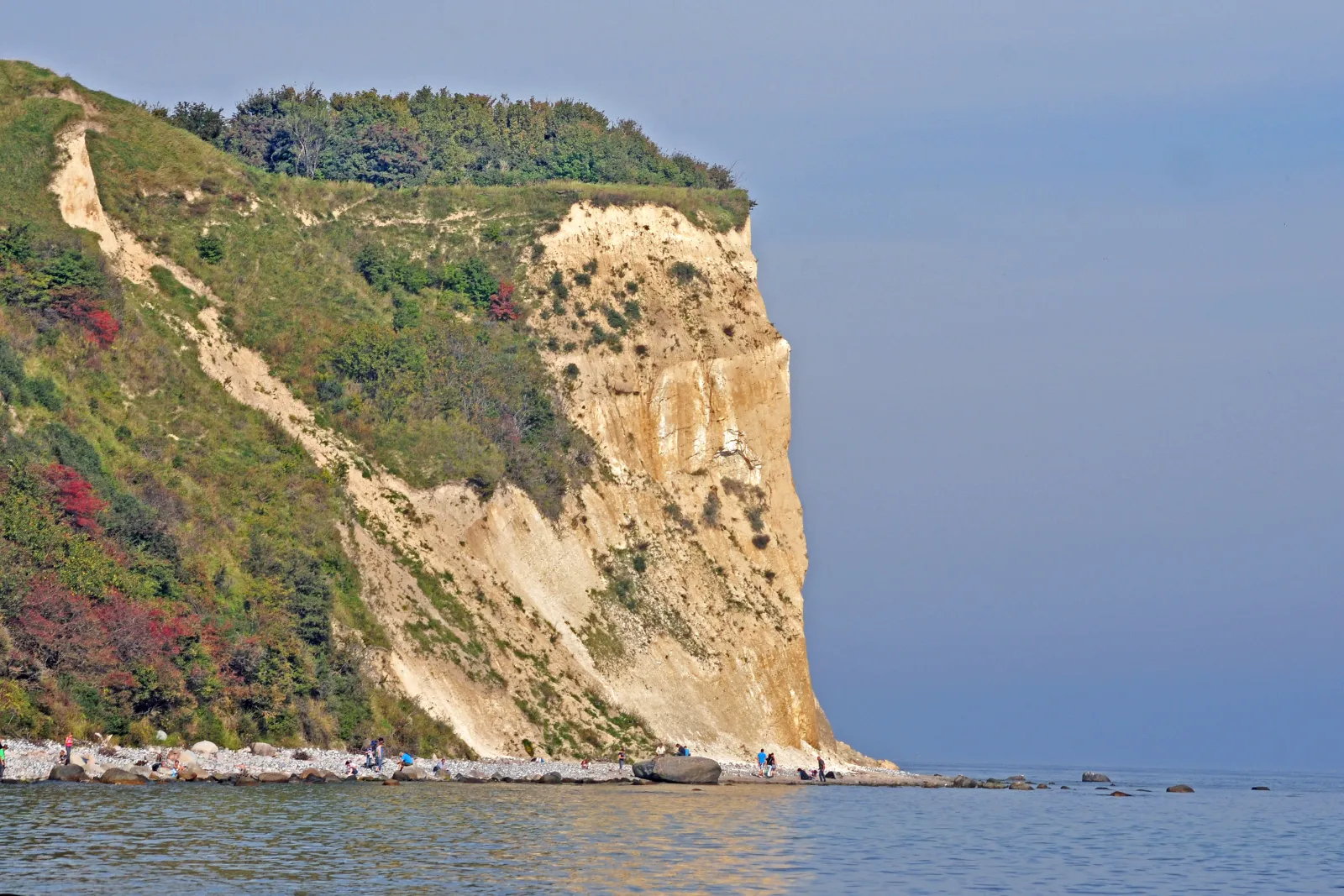
- Saxo Grammaticus tells how the Danes took the temple fortress of Arkona on Rügen in 1168 and destroyed the four-headed idol of Svantevit.
These sources show that the Baltic Slavs had temples, priests and many-headed idols. They tell us nothing direct about Kyiv or Novgorod.
What do we know about pagan worship in Rus'?
Very little that is not filtered through Christian writers. The chronicle shows idols on hills, sacrifices, oaths sworn on weapons and cremation. Sanctuaries were probably open-air hilltops and enclosures rather than temples. Archaeologists have proposed several, including a stone platform on the Starokyivska hill in Kyiv and the circular site at Peryn, but each identification is disputed.
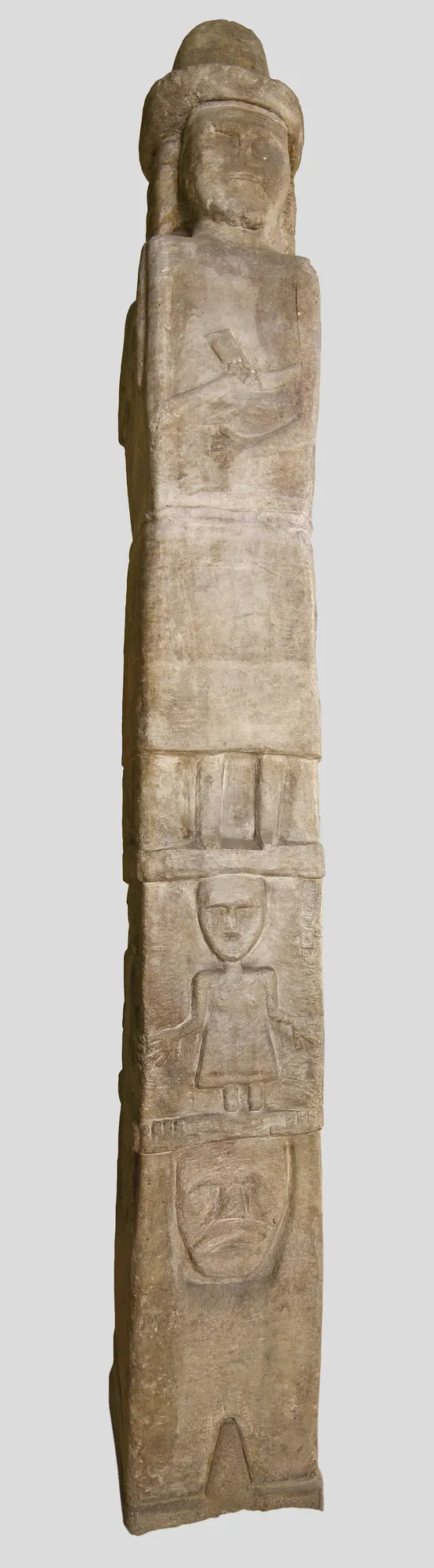
The best-known pagan monument, the four-faced stone pillar called the Zbruch idol, was found in 1848 in the river Zbruch in what is now western Ukraine. It is now in the Archaeological Museum in Kraków, which describes it as 257 cm high and "usually dated to the 10th or to the turn of the 9th and 10th centuries". Its find context was never recorded. In 2011 the archaeologists Aleksey Komar and Natalia Khamaiko argued that it might be a nineteenth-century Romantic creation, and the question remains open. Even if it is medieval, it names no god, and the popular label "Svantevit" is a guess borrowed from Rügen.
The sorcerers called volkhvy appear in the chronicle as diviners and leaders of revolts in 1024 and 1071, not as a temple priesthood (see who the volkhvy were). Household and forest spirits such as the domovoi, leshy and rusalki are known mainly from nineteenth-century folklore collectors. Festivals such as Kupala at midsummer and Koliada at midwinter were condemned by the Muscovite church in the sixteenth century as festivals, not as gods.
How much of "Slavic mythology" was invented?
A great deal. Once the old religion had gone, writers began to fill the gaps.
- Fifteenth century. The Polish chronicler Jan Długosz matched Slavic names to Roman gods, giving Polish readers a Łada compared with Mars and a Marzanna compared with Ceres. Marzanna (Morana) later became the goddess of winter and death, linked to the straw figure still drowned in spring customs.
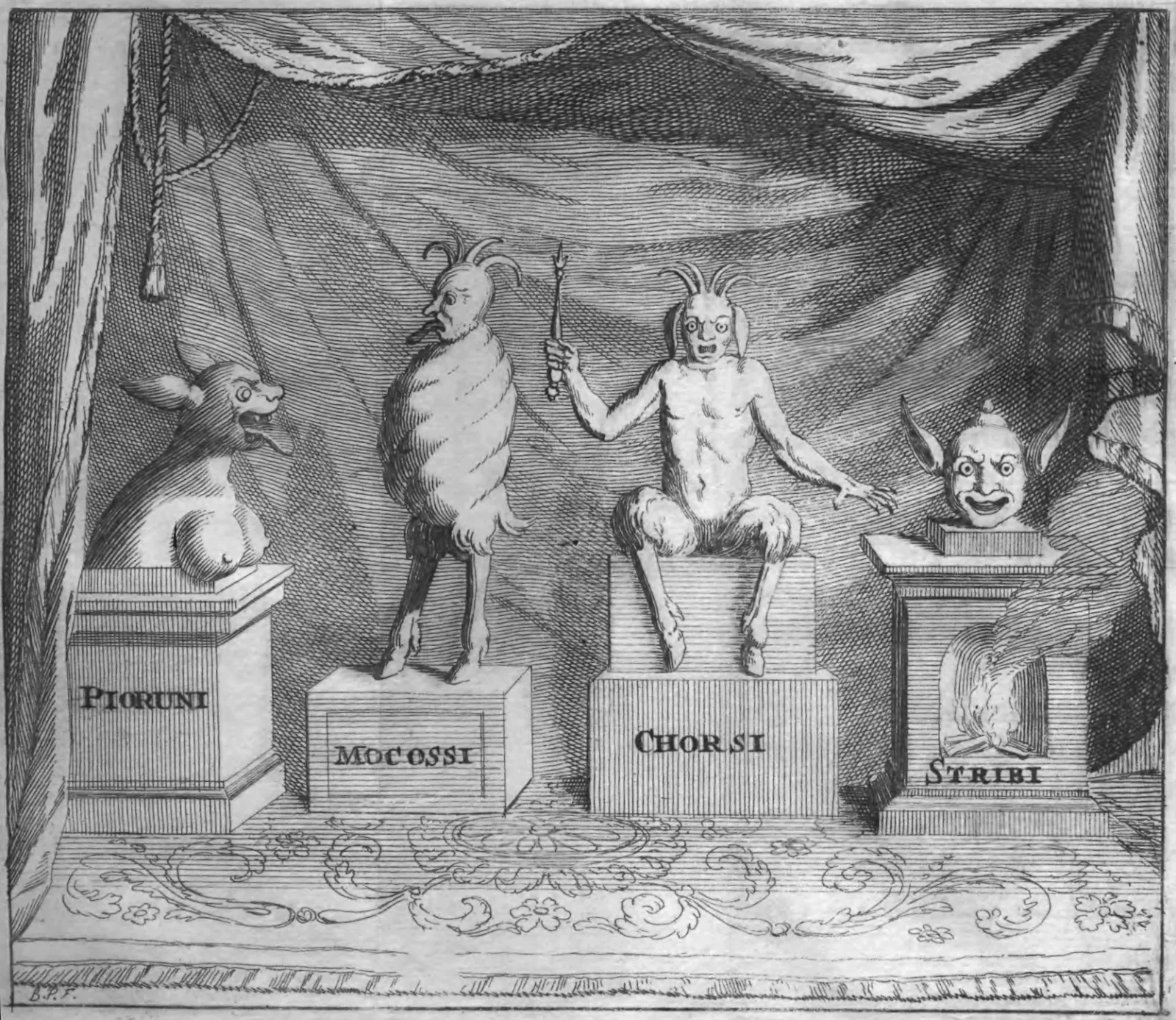
- Seventeenth century. Writers such as the compiler of the Ukrainian Gustynskaya Chronicle turned festivals and song refrains into gods: Kupala, Koliada and Lada ("lado" was a refrain in wedding songs). A misreading of the words "us zlat", "golden moustache", in the description of Perun's idol even produced a god called "Uslad".
- Eighteenth and nineteenth centuries. Dictionaries of Slavic mythology and Romantic scholars, above all Alexander Afanasyev in the 1860s, built a complete pantheon on the model of Greek and Norse myth.
- Twentieth century. The Soviet archaeologist Boris Rybakov wrote influential but heavily criticised books (1981 and 1987) that made Rod the supreme god and read pagan symbols into embroidery patterns. The archaeologist Leo Klejn, among others, criticised such reconstructions in The Resurrection of Perun (2004).
The opposite extreme also exists. In Slavic Gods and Heroes (2019), Judith Kalik and Alexander Uchitel argued that most Slavic gods were late, artificial constructions modelled on Christian figures. Reviewers, among them the historian of religion Jiří Dynda, rejected much of the book as poorly argued. Most specialists now take a middle path, set out in Juan Antonio Álvarez-Pedrosa's sourcebook Sources of Slavic Pre-Christian Religion (Brill, 2021). Perun was real and widely worshipped. The AD 980 list is probably a genuine memory of names honoured in Kyiv, though their meaning is lost. Most of the rest is reconstruction.
Another old idea, that Russians lived for centuries in "double faith" (dvoeverie), secretly pagan under a Christian surface, has also been questioned. Historians such as Eve Levin and Stella Rock have shown that the medieval word meant something else (see the double-faith debate).
What is Rodnovery, and is the Book of Veles real?
Rodnovery ("native faith") is a modern Slavic pagan movement that grew from the 1980s onwards in Russia, Ukraine, Poland and elsewhere. It is a living religion with its own communities, but it is a revival, not an unbroken survival, and it draws heavily on Afanasyev, Rybakov and the Book of Veles.
The Book of Veles (Velesova kniga), said to be a pre-Christian chronicle carved on wooden boards found in 1919, was published by émigré writers in the 1950s. No one has ever produced the boards. In 1990 the philologist Oleg Tvorogov showed that its language is an artificial mixture invented by someone who did not know the history of the Slavic languages, and specialists regard it as a twentieth-century forgery. Ideas such as the threefold world of "Yav, Prav and Nav" come from this text and from modern writers, not from medieval sources.
Slavic folklore also lives on in fiction and games such as The Witcher, which draws mostly on folk demons like the leshy and striga rather than on the gods. Perun's name and symbols have also been taken up by nationalist groups. Neither tells us what tenth-century Slavs believed.
What the map shows next
At AD 980 on the map, Kievan Rus' under Vladimir stretches from Novgorod to Kyiv, and its gods are those of the prince's hill. By 1000 on the map the idols are gone and the Byzantine Church has taken their place. Pagan Slavs remain in the map's west: in Pomerania and along the Baltic coast they kept their temples until the twelfth century, when Arkona fell in 1168.
Sources
Primary sources (in translation)
- Procopius, History of the Wars VII.14.22–24, trans. H. B. Dewing, Loeb Classical Library, vol. IV (1924), pp. 269–271. LacusCurtius: https://penelope.uchicago.edu/Thayer/E/Roman/Texts/Procopius/Wars/7C%2A.html
- The Russian Primary Chronicle: Laurentian Text, trans. S. H. Cross and O. P. Sherbowitz-Wetzor (Cambridge, MA: Mediaeval Academy of America, 1953). Cited: pp. 38 (introduction), 57, 65, 77, 90, 93, 95, 116–117.
- The Slavonic Malalas gloss in the Hypatian Chronicle, s.a. 1114, as quoted in M. Gimbutas, "Dazhbog", Encyclopedia of Religion (1987), via Encyclopedia.com: https://www.encyclopedia.com/environment/encyclopedias-almanacs-transcripts-and-maps/dazhbog
- Old Rus' sermons against paganism (Sermon of St Gregory on how the pagans worshipped idols; Sermon of the Christ-lover), in J. A. Álvarez-Pedrosa (ed.), Sources of Slavic Pre-Christian Religion (no. 5), paraphrased in the article.
Studies
- Juan Antonio Álvarez-Pedrosa (ed.), Sources of Slavic Pre-Christian Religion, Numen Book Series 169 (Leiden: Brill, 2021): https://brill.com/display/title/58358
- J. A. Álvarez-Pedrosa and E. Santos Marinas, Rituals in Slavic Pre-Christian Religion: Festivals, Banqueting, and Divination (Leeds: Arc Humanities Press, 2023), open access, DOI 10.17302/bme-9781802701173.
- Archaeological Museum in Kraków, "Światowid, the idol from Zbruch": https://ma.krakow.pl/en/tour/swiatowid-the-idol-from-zbruch/
- A. Komar and N. Khamaiko, "Zbruchskii idol: pamiatnik epokhi romantizma?", Ruthenica 10 (2011), pp. 166–217.
- V. V. Ivanov and V. N. Toporov, Issledovaniia v oblasti slavianskikh drevnostei (Moscow: Nauka, 1974).
- B. A. Rybakov, Iazychestvo drevnikh slavian (Moscow: Nauka, 1981) and Iazychestvo drevnei Rusi (Moscow: Nauka, 1987).
- L. S. Klejn, Voskreshenie Peruna: k rekonstruktsii vostochnoslavianskogo iazychestva (St Petersburg: Evraziia, 2004).
- J. Kalik and A. Uchitel, Slavic Gods and Heroes (London: Routledge, 2019), with J. Dynda, "Forgery of Deities, or Forgery of Science?", Slavia 90/4 (2021), pp. 478–487.
- S. Rock, Popular Religion in Russia: 'Double Belief' and the Making of an Academic Myth (London: Routledge, 2007); E. Levin, "Dvoeverie and Popular Religion", in S. K. Batalden (ed.), Seeking God (DeKalb, 1993), pp. 29–52.
- O. V. Tvorogov, "Velesova kniga", Trudy Otdela drevnerusskoi literatury 43 (1990), pp. 170–254.
Image credits
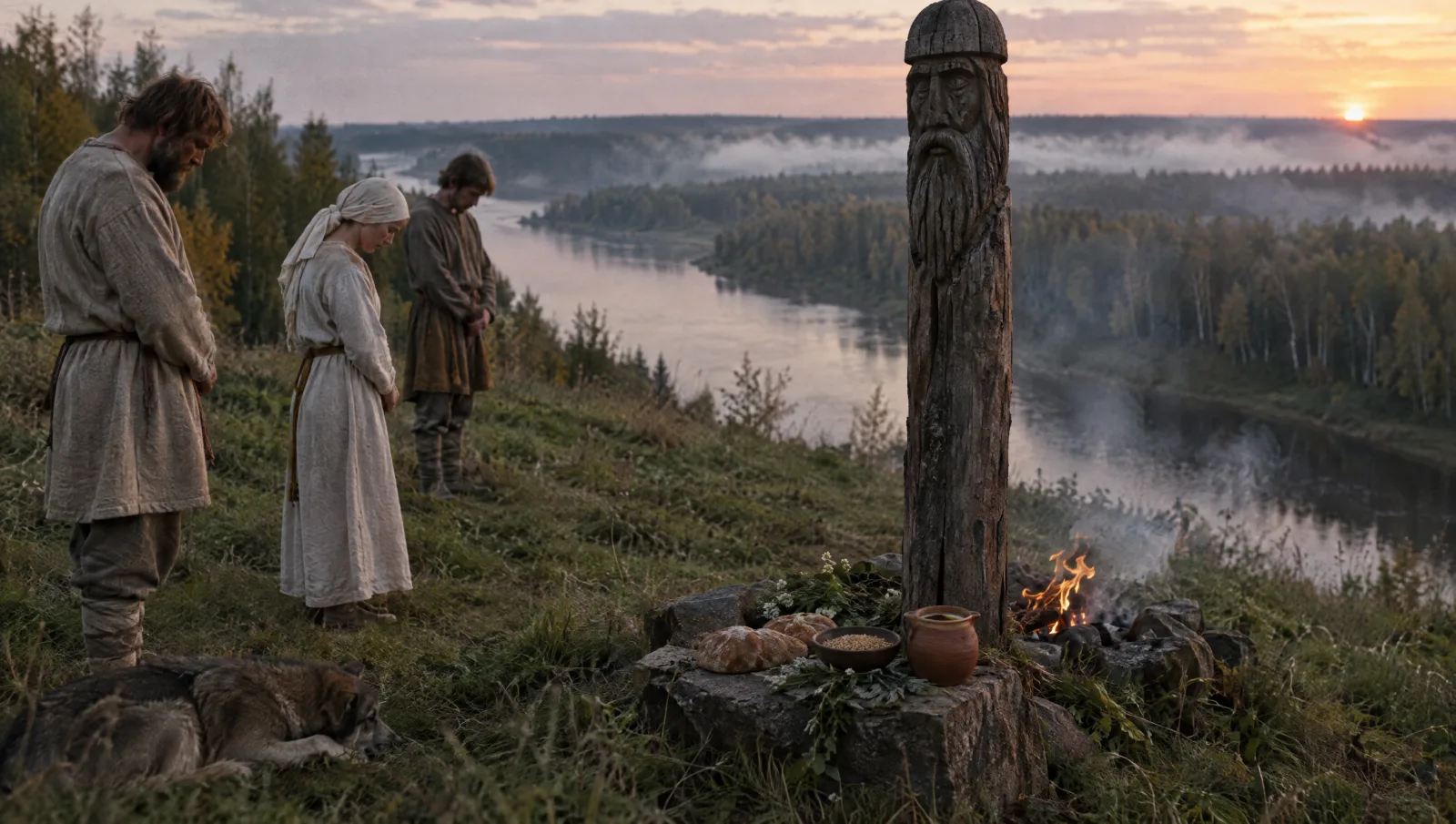
- Title image (offerings at a hilltop idol in Rus', tenth century): AI-generated illustration.
- Oleg's men swear by Perun (AD 907), Radziwiłł Chronicle (late fifteenth century). Radziwiłł Chronicle, public domain, via Wikimedia Commons.
- Cape Arkona, Rügen. Photo: W. Bulach, CC BY-SA 4.0, via Wikimedia Commons.
- The Zbruch idol, Archaeological Museum in Kraków. Photo: Archaeological Museum in Kraków, public domain, via Wikimedia Commons.
- Georg Andreas Schleusing, the idols of the Muscovites, La Religion ancienne et moderne des Moscovites (seventeenth century). Public domain, via Wikimedia Commons.