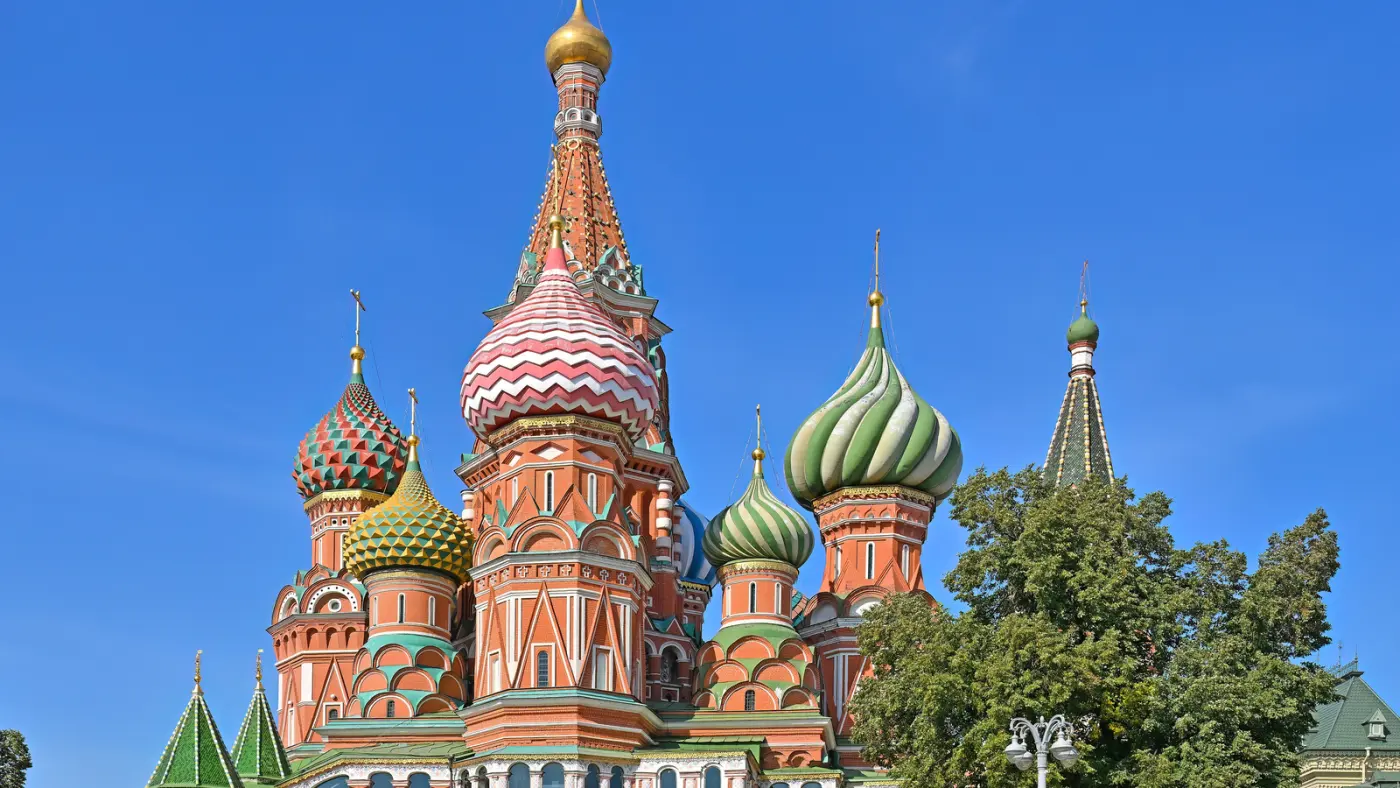
St Basil's Cathedral, officially the Cathedral of the Intercession of the Most Holy Mother of God on the Moat (Pokrovsky sobor na Rvu), stands at the southern end of Red Square in Moscow. Tsar Ivan IV, known as Ivan the Terrible, had it built between 1555 and 1561 to give thanks for the conquest of the Khanate of Kazan in 1552. It is not one church but nine, standing on a single base: a tall tent-roofed church in the middle and eight smaller churches around it, several of them named after the saints on whose feast days the Kazan campaign was won.
The name "St Basil's" came later. It belongs to a Moscow holy fool, Basil the Blessed, who was buried beside the building site and over whose grave a tenth church was added in 1588. Almost everything else people repeat about the cathedral — that Ivan had its architects blinded, that Napoleon tried to blow it up, that Stalin's men wanted it demolished — needs checking against the evidence, and this article does that.
St Basil's Cathedral at a glance
| Official name | Cathedral of the Intercession of the Most Holy Mother of God on the Moat |
| Built | 1555–1561 (seven chapels consecrated 1 October 1559; central church completed 1561) |
| Commissioned by | Tsar Ivan IV, for the conquest of Kazan (1552) |
| Architects | Barma and Postnik (Posnik), named in a sixteenth-century source |
| Churches | 9 on one base (1555–1561), plus St Basil the Blessed (1588) and St John the Blessed (1672) |
| Height | 47.5 m (central church), the tallest building in Moscow until the end of the sixteenth century |
| Status | Branch of the State Historical Museum since 1928; services again since 1990; part of the UNESCO World Heritage Site "Kremlin and Red Square" (1990) |
Why Ivan the Terrible built St Basil's Cathedral
On 2 October 1552 Ivan IV's army stormed Kazan, the capital of the Tatar khanate on the middle Volga. It was the greatest victory of his reign. Ivan returned to Moscow as a conqueror, and he gave thanks the way Russian princes had done for centuries: by building churches.
The place he chose was symbolic. Between the Kremlin wall and the trading quarter of Kitay-gorod ran a moat, and along it stood a row of small votive churches. Ivan's father, Vasily III, ruler of the Grand Principality of Moscow, had already built one there in 1514 after taking Smolensk. A wooden church of the Trinity was put up on the site in the spring of 1553. A year later Ivan replaced it with a larger wooden church of the Intercession "with chapels". The Nikon Chronicle records that it was consecrated by Metropolitan Makarii on Sunday 30 September and Monday 1 October 1554, the feast of the Intercession, in the presence of Ivan and his brother Yury.
In 1555 Ivan ordered it rebuilt in stone. The chronicle's entry for that year reads: the tsar "ordered the church of the Intercession to be founded in stone, with nine tops, which before was of wood, for the taking of Kazan, by the Frolov gate over the moat". The masons built for six years.
The nine churches and their dedications
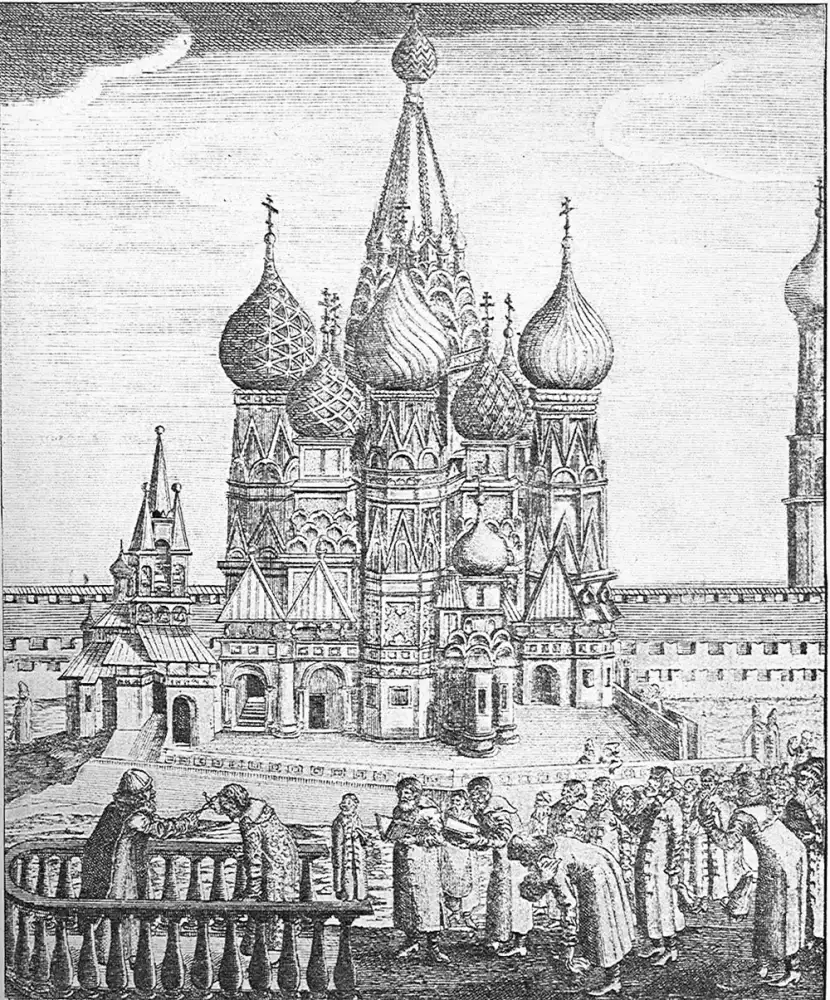
The stone cathedral has a tall tent-roofed church in the centre, four large churches on the axes facing north, south, east and west, and four smaller ones on the diagonals. Four of the chapels are named after the saints of days on which the Kazan campaign was won. The State Historical Museum, which runs the building, says so on its own pages.
| Position | Dedication | Feast day | Link to the Kazan campaign |
|---|---|---|---|
| Centre | Intercession (Pokrov) of the Mother of God | 1 October | The final storm of Kazan began on this feast in 1552 |
| North | Saints Cyprian and Justina | 2 October | Kazan was taken on 2 October 1552 |
| North-west | Gregory the Illuminator of Armenia | 30 September | The Arsk tower of Kazan was blown up on 30 September |
| North-east | Three Patriarchs of Constantinople | 30 August | The cavalry of Prince Yapancha was defeated on the Arsk field on 30 August |
| South-east | Alexander of Svir | 30 August | The same battle |
| South | St Nicholas of Velikoretsk | – | An icon of St Nicholas brought from Vyatka to Moscow in 1555 |
| East | Holy Trinity | – | The first church on the site (1553) |
| West | Entry of the Lord into Jerusalem | Palm Sunday | Goal of the Palm Sunday procession from the Kremlin |
| South-west | Varlaam of Khutyn | 6 November | A saint venerated by Ivan's family; no link to a battle |
| Added 1588 | St Basil the Blessed | 2 August | Built over his grave |
| Added 1672 | St John the Blessed (until 1916 the Nativity of the Mother of God) | – | Built over the grave of another holy fool |
The ninth church was not part of the first plan. In the summer of 1555 the tsar had a famous icon of St Nicholas brought from Velikoretsk in Vyatka; the Nikon Chronicle records that it reached Moscow on Saturday 29 June 1555, the feast of Saints Peter and Paul. A chapel of St Nicholas was added to the plan, and the eight churches became nine.
The western church explains a second meaning. On Palm Sunday the head of the Church rode in procession on a horse standing in for Christ's donkey, re-enacting the entry into Jerusalem, and the construction of the cathedral changed the route of this procession. Foreign visitors recorded that the whole building was called "Jerusalem" after its western church. The art historian Andrei Batalov, the leading specialist on the cathedral, reads the whole design as an image of the Holy City.
When was St Basil's Cathedral built?
The dates come from two chronicles and an inscription found during restoration.
- 1 October 1559. A continuation of the Nikon Chronicle records that Metropolitan Makarii consecrated seven of the chapels, "which were built to proclaim God's miracles at the taking of Kazan". The tsar and tsaritsa, their sons, Ivan's brother Yury and "the Kazan tsars Alexander and Simeon", baptised former khans of Kazan, were present. "But the great middle church of the Intercession was not completed that year."
- 1560/61. The same chronicle notes that in that year the stone church of the Intercession and the Trinity "and the other chapels" was completed, "begun after the taking of Kazan by the sovereign's vow, as God had entrusted the Kazan tsardom to him".
- 29 June 1561 (12 July in the modern calendar). During restoration in 1958, a painted inscription was found at the base of the central tent. According to the State Historical Museum, it gives this exact date for the completion of the cathedral.
Who built St Basil's Cathedral: Barma and Postnik
The cathedral is one of very few medieval Russian buildings whose architects are named. The oldest source that names them is the third version of the Life of Metropolitan Iona, written no earlier than 1560–1563 and preserved in a manuscript of 1596: "And then God gave him two Russian masters, Posnik and Barma." The Piskarev Chronicler, an early seventeenth-century text, names only one: "And the master was Barma and his fellows."
Historians disagree about whether these were two men or one.
- In 1896 a priest of the cathedral, Father Ioann Kuznetsov, published a late copy of the text, from the late seventeenth or early eighteenth century, that reads "two Russian masters, called Posnik and Barma". In 1957 N. F. Kalinin argued from this that there was only one master, "Posnik Barma", and that he was the Pskov builder Posnik Yakovlev.
- The Orthodox Encyclopaedia (Pravoslavnaya entsiklopediya) reports that Kalinin's argument has been rejected. The phrase "called" appears only in that one late copy, not in the sixteenth- and seventeenth-century manuscripts, and studies of the Pskov builders who worked in Kazan rule out identifying Posnik Yakovlev with the Moscow Posnik.
- Batalov concludes that "the origin of the masters remains unknown". The sources call them simply "Russian".
Some architectural historians think that a master trained in the Italian Renaissance had a hand in the design, as Italians had in the Kremlin cathedrals under Ivan's grandfather. The museum's 2012 guide calls this a supposition of "researchers of architecture"; no document names a foreign builder.
Did Ivan the Terrible blind the architects?
No source written in Russia says so. The story first appears in the travel account of Adam Olearius, secretary of an embassy from Holstein, who was in Moscow in the 1630s, some fifty years after Ivan's death. Describing the city, he wrote of "the artfully built church of the Holy Trinity, whose builder, when it was finished, was blinded on the orders of the tyrant, so that he could not build another like it". Olearius named no architect and gave no source.
Historians reject the story for three reasons.
- Russian chronicles describe Ivan's cruelties in great detail, but none mentions it. The fact-checking site Provereno points out that the Piskarev Chronicler says nothing about it, although it names Barma and records the terror of the oprichnina.
- The same story was told of other famous buildings across Europe and Asia. Batalov calls it "fantastic", a wandering legend about the creators of outstanding works of art, and Ivan's English contemporary Jerome Horsey told the same tale about the builder of the fortress of Ivangorod.
- The usual counter-argument — that Ivan sent "Posnik Yakovlev" to build the stone walls of Kazan — is weaker than it looks, because historians no longer think that Posnik Yakovlev was the Posnik of the cathedral.
The truth is that we know almost nothing about what happened to Barma and Postnik afterwards. But nothing suggests that they were blinded.
Who was Basil the Blessed?
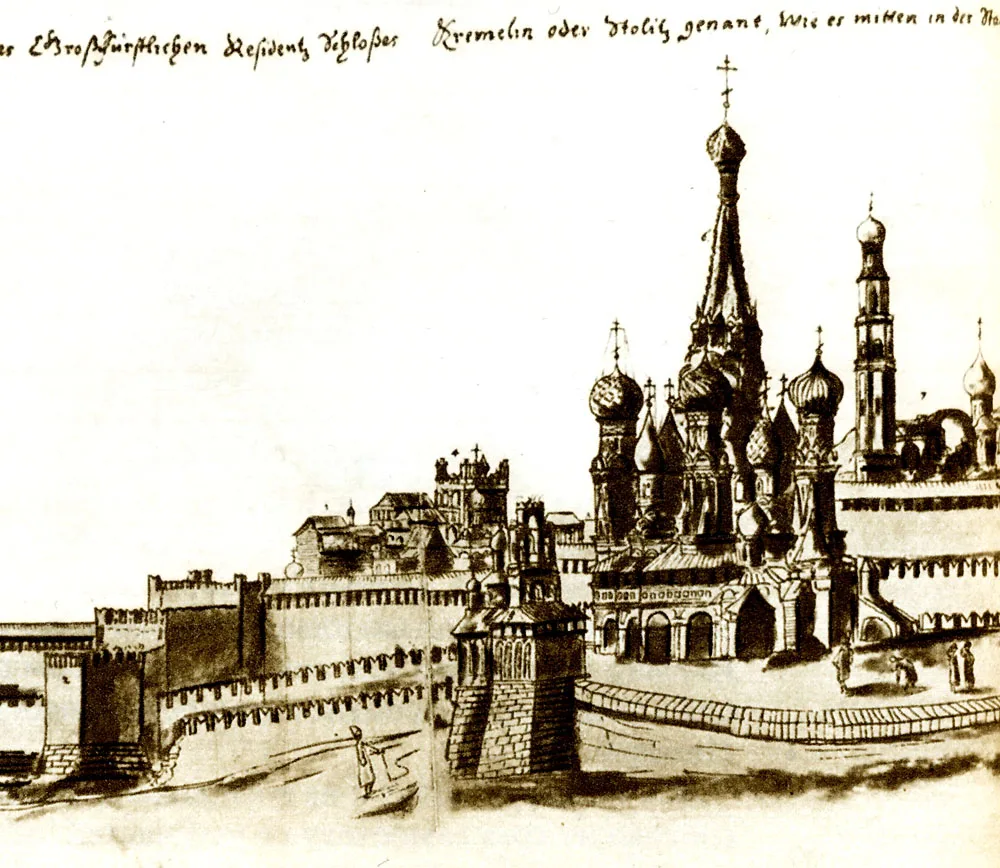
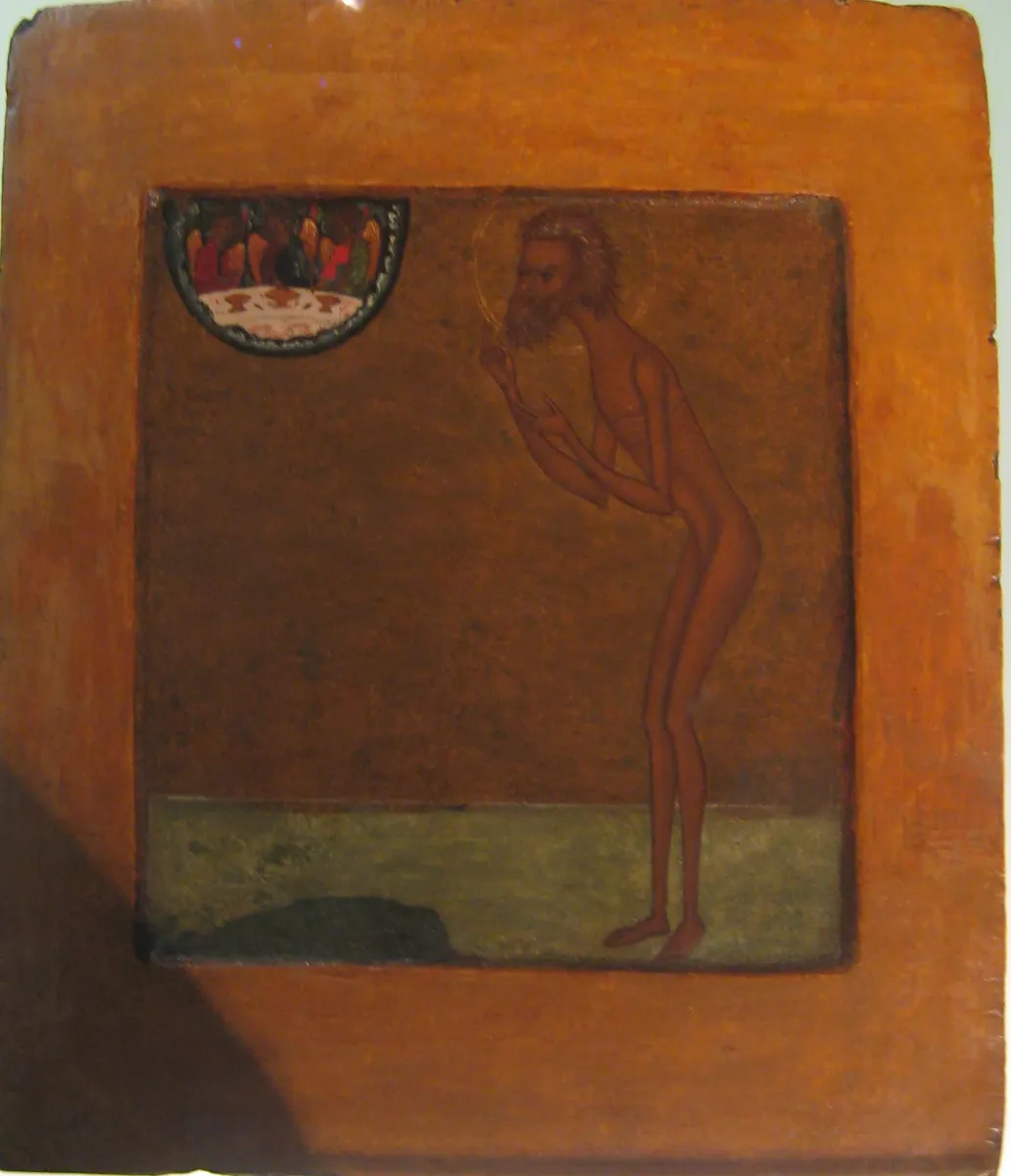
Basil (Vasily) the Blessed was a yurodivy, a "fool for Christ": one of the holy fools who lived naked or in rags on the streets of Russian towns, and who were believed to be free to tell the powerful what nobody else dared. According to the Orthodox Encyclopaedia, his full Life says that he died on 2 August 1557, and that Ivan IV and his wife Anastasia attended his funeral. He was buried in the cemetery by the cathedral, which was still being built.
Later books often give 1552 as the year of his death, which would place his grave on the site before the cathedral existed. That date first appears in a calendar of saints of 1646 and later chronicles. In a 2011 study Batalov calls it a misunderstanding.
Miracles were reported at Basil's grave from 2 August 1588. The New Chronicle (Novyi letopisets) records that Tsar Fyodor, Ivan's son, "ordered a silver shrine to be made over his grave and gilded … and ordered a stone church to be built over his grave. And his feast was fixed on the second day of August." The English envoy Giles Fletcher, in Moscow in 1588–1589, heard of him too:
Another there was, that dyed not many yeeres agoe (whome they called Basileo), that would take upon him to reproove the olde emperour, for all his crueltie and oppressions done towards his people. His body they have translated of late into a sumptuous church neere the emperours house in Mosko, and have canonized him for a saint.
Fletcher's "olde emperour" is Ivan IV. The chapel over Basil's grave became the most visited part of the cathedral, and so the whole building came to be called after him.
Was St Basil's always so colourful?
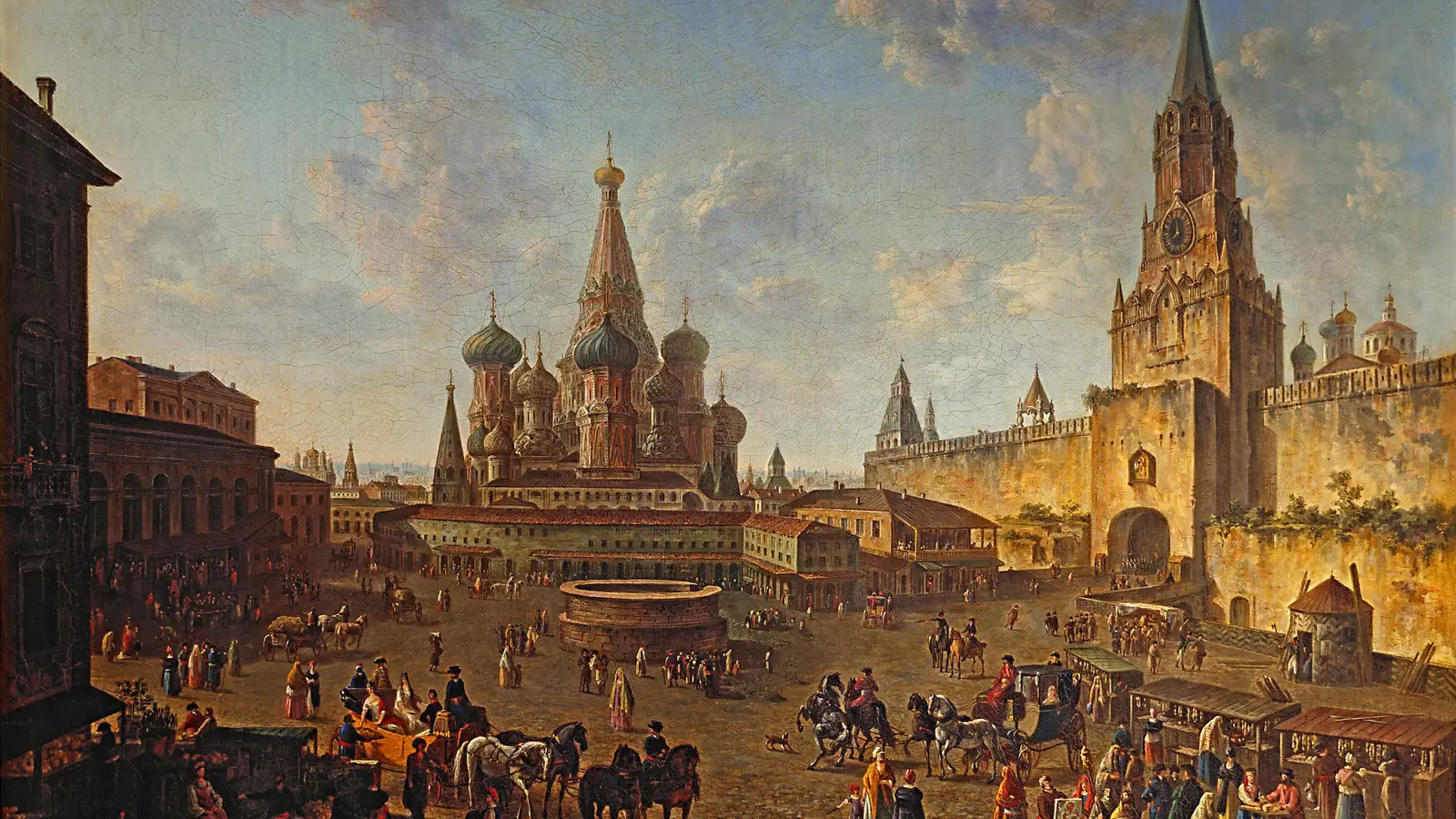
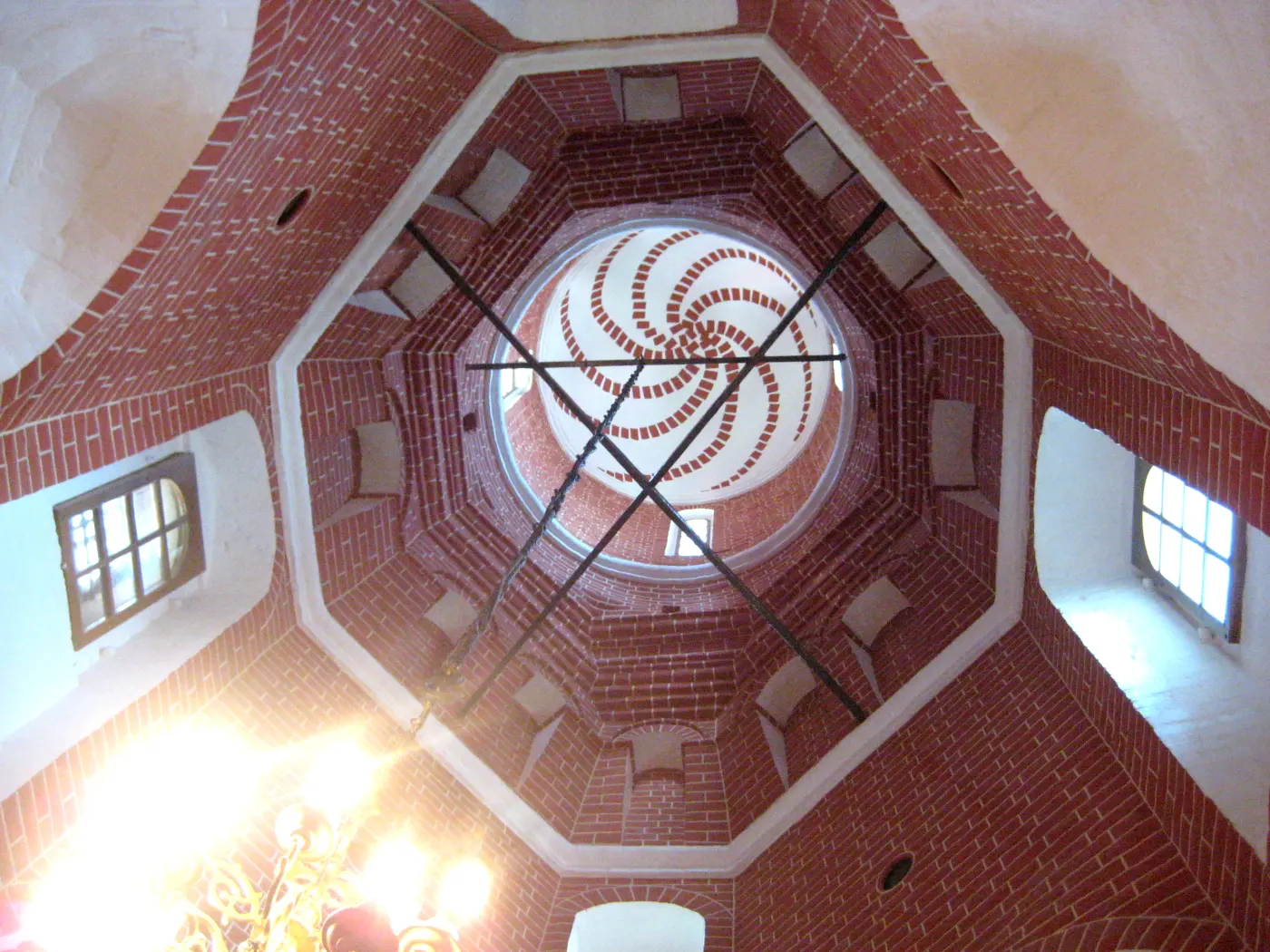
No. The cathedral that Ivan built was red and white. According to the museum's 2012 guide, the walls of all nine churches were originally painted "like brick", with an ideal pattern of brickwork, inside and out, and the details were picked out in white stone. Onion domes probably came at the end of the sixteenth century under Tsar Fyodor, and the many-coloured domes we know today date only from the repair of 1780–1784 under Catherine the Great, in the Russian Empire.
The building itself changed over the centuries:
- In the 1680s, under Tsar Fyodor Alekseyevich, the open galleries were roofed, porches with small tents were added, and the walls were covered with painted flowers and foliage. The altars of 13 votive churches on the moat were transferred into the cathedral. In the same decades, the 1670s or 1680s (the museum's own pages give both), the old open belfry was replaced by a tent-roofed bell tower.
- In 1672 the relics of another holy fool, John the Blessed, were found, and an eleventh church was built over them.
- During the restorations of 1954–1965 the painted "brickwork" of the sixteenth century was restored on the central and large churches.
Inside, the effect is still visible: the tall, narrow churches are painted with brick patterns that climb into the tents.
Did Napoleon try to blow up St Basil's Cathedral?
The army of the French Empire occupied Moscow in September and October 1812. The cathedral was looted, and the undercroft was used as stables. The State Historical Museum states that "Napoleon ordered his chief of artillery, Lariboisière, to blow up the cathedral, but the order was not carried out." We have not found a French order or a contemporary document that confirms this, and the museum's page does not cite one. The popular version, that Muscovites prayed and a sudden rain put out the fuses, is a legend; even Russian newspaper reports call it undocumented. What is certain is that the roof and domes were damaged in the great fire of Moscow, and that the building survived.
Did Stalin save St Basil's?
The best-known Soviet story is that Lazar Kaganovich, Stalin's Moscow party chief in the early 1930s, wanted the cathedral removed so that tanks could pass through Red Square during parades, and that the architect Pyotr Baranovsky refused to survey it for demolition and telegraphed Stalin. In one version, told at second hand, Kaganovich lifts the cathedral off a model of Moscow and Stalin puts it back. The stories come from recollections recorded decades later, such as those of Baranovsky's daughter.
The museum's 2012 guide is blunt: "In all accessible archives there are only materials on the restoration and museumification of the cathedral from 1918 to the 1950s. No documents indicating attempts to demolish this outstanding work of Russian architecture have been found. P. D. Baranovsky took no direct part in the restoration of the cathedral." Many other Moscow churches were demolished in those years, so the fear was real. But the specific story is undocumented.
What is documented is the fate of its clergy. Archpriest Ioann Vostorgov, rector of the cathedral since 1913, was arrested in 1918 and shot on 5 September 1918 without trial. He was canonised by the Russian Orthodox Church in 2000.
From church to museum, and back
- 1918. A decree of 5 October 1918 placed the cathedral under state protection as a monument "of national and world importance". Services in the upper churches stopped.
- 1923. On 21 May a museum opened in the building.
- 1928. It became a branch of the State Historical Museum.
- 1929. Services in the lower church of St Basil ended, and the bells were removed.
- 1931. The monument to Minin and Pozharsky, the leaders of 1612, was moved to stand by the cathedral.
- 1941–1947. The museum closed during the war, and the domes were painted over for camouflage. It reopened on 7 September 1947, the 800th anniversary of Moscow.
- 1990. Services resumed in the central church on the feast of the Intercession, 14 October 1990. In the same year UNESCO inscribed "Kremlin and Red Square, Moscow" on the World Heritage List; its description calls St Basil's "one of the most beautiful Russian Orthodox monuments".
- 1997. Sunday and feast-day services resumed in the church of St Basil on 15 August.
Since 1991 the building has been shared by the museum and the church. A long restoration of the interiors ran from 2001 to 2011, and on 21 November 2018 the restored church of St John the Blessed was opened, so that all eleven churches can be visited again. On the night of 1 August 2026 a small fire broke out in an office on the ground floor; it was put out, and no damage to the monument was reported.
Common myths about St Basil's Cathedral
| Myth | What the evidence says |
|---|---|
| Ivan the Terrible blinded the architects | First told by Olearius in the 1630s; no Russian source; a wandering legend |
| Barma and Postnik were one man | Based on one late copy; rejected by most specialists |
| The cathedral was named St Basil's from the start | Its official name is the Intercession on the Moat; Basil's chapel was added in 1588 |
| Basil was already buried there in 1552 | His Life dates his death to 2 August 1557, during construction |
| It was always this colourful | Originally red "brick" and white; the coloured domes date from 1780–1784 |
| Napoleon ordered it blown up, but rain put out the fuses | The order is reported by the museum without a cited document; the rain is legend |
| Stalin saved it from Kaganovich | Memoirs only; no archival trace of a demolition plan |
| It was built by Italians | The sources name two "Russian" masters; Italian influence is a hypothesis |
What the map shows
At 1550 the Khanate of Kazan still lies on the middle Volga, east of the Tsardom of Russia. By 1556 Kazan and the Khanate of Astrakhan have been conquered, and the Tsardom reaches the Caspian; in Moscow, the cathedral that commemorates the first of these conquests is rising beside the Kremlin. Read more about the tsar who built it in Ivan the Terrible.
Sources
Primary sources
- Patriarshaia ili Nikonovskaia letopis', PSRL vol. 13, part 1 (St Petersburg, 1904), entries for 1554–1555: https://archive.org/details/13-1_20241124
- Dopolneniia k Nikonovskoi letopisi, PSRL vol. 13, part 2 (St Petersburg, 1906), entries for 1559–1561: https://archive.org/details/13-2_20241124
- Novyi letopisets, PSRL vol. 14 (St Petersburg, 1910), ch. 20: https://archive.org/details/polnoesobranierusskihletopisejizdannoep31
- Adam Olearius, Opisanie puteshestviia v Moskoviiu, trans. P. P. Barsov (Moscow, 1868), book 3: https://www.vostlit.info/Texts/rus7/Olearij_3/text31.phtml?id=13877
- Giles Fletcher, Of the Russe Common Wealth (1591), in E. A. Bond (ed.), Russia at the Close of the Sixteenth Century (London: Hakluyt Society, 1856): https://archive.org/details/russiaatcloseofs20bond
Studies and reference works
- M. A. Makhan'ko, "Pokrova Presviatoi Bogoroditsy sobor na Rvu", Pravoslavnaia entsiklopediia, vol. 57, pp. 74–77: https://www.pravenc.ru/text/2580908.html
- "Barma", Pravoslavnaia entsiklopediia, vol. 4, p. 341: https://www.pravenc.ru/text/77556.html
- "Vasilii Blazhennyi", Pravoslavnaia entsiklopediia, vol. 7: https://www.pravenc.ru/text/Василий%20Блаженный.html
- "Ioann (Vostorgov)", Pravoslavnaia entsiklopediia: https://www.pravenc.ru/text/469081.html
- A. L. Batalov, "Pridel Vasiliia Blazhennogo sobora Pokrova na Rvu i osobennosti pochitaniia sviatogo v kontse XVI v.", Vestnik PSTGU, series 5 (2011): https://cyberleninka.ru/article/n/pridel-vasiliya-blazhennogo-sobora-pokrova-na-rvu-i-osobennosti-pochitaniya-svyatogo-v-kontse-xvi-v
- A. L. Batalov et al., Muzeinyi gid: Pokrovskii sobor (Moscow: Potanin Foundation and State Historical Museum, 2012)
- State Historical Museum, "Pokrovskii sobor (Khram Vasiliia Blazhennogo)": https://shm.ru/museum/hvb/
- State Historical Museum, "Pokrovskii sobor: istoriia": https://shm.ru/kollektsii-i-muzeynyy-kompleks/museum_history/pokrovskiy-sobor/history
- E. Buntman, "Pravda li, chto Ivan Groznyi prikazal oslepit' sozdatelei khrama Vasiliia Blazhennogo?", Provereno.media, 27 September 2023: https://provereno.media/blog/2023/09/27/pravda-li-chto-ivan-grozny-prikazal-oslepit-sozdateley-khrama-vasiliya-blazhennogo/
- Patriarchia.ru, "Posle restavratsii otkrylas' odinnadtsataia tserkov' Pokrovskogo sobora", 24 November 2018: http://www.patriarchia.ru/db/text/5309005.html
- UNESCO World Heritage Centre, "Kremlin and Red Square, Moscow": https://whc.unesco.org/en/list/545/
Image credits
- Title image: Fyodor Alekseyev, Red Square in Moscow, 1801, State Tretyakov Gallery. Public domain, via Wikimedia Commons, cropped to 16:9.
- Olearius engraving, mid-17th century. Public domain, via Wikimedia Commons.
- Meyerberg album drawing, c. 1661. Public domain, via Wikimedia Commons.
- Icon of St Basil the Blessed, State Tretyakov Gallery. Photo: shakko, CC BY-SA 3.0, via Wikimedia Commons (cropped).
- Interior of the church of Alexander of Svir. Photo: shakko, CC BY-SA 3.0, via Wikimedia Commons.
- St Basil's Cathedral in 2025. Photo: Юрий Д.К., CC BY 4.0, via Wikimedia Commons (cropped).