Ivan IV Vasilyevich (25 August 1530 – 18 March 1584), known in English as Ivan the Terrible, was grand prince of Moscow from the age of three and, from 16 January 1547, the first ruler of Russia to be crowned tsar. His reign of fifty years brought a new law code, church reform, the conquest of the Volga khanates of Kazan and Astrakhan, and the first press in Moscow. It also brought the oprichnina, a seven-year regime of terror, the sack of Novgorod, a lost war for Livonia, the burning of Moscow by the Crimean khan, and the death of his heir from a blow struck by his own hand.
Most of what the world "knows" about Ivan comes from two kinds of source that need careful handling: the letters and histories of his enemies, and the reports of foreign visitors who heard stories at second hand. This article sets out what the documents show, where historians disagree, and which famous stories do not survive a look at the evidence.
Ivan the Terrible at a glance
| Born | 25 August 1530, Moscow |
| Parents | Grand Prince Vasily III and his second wife, Elena Glinskaya |
| Grand prince | from December 1533, aged three |
| Crowned tsar | 16 January 1547, by Metropolitan Makary |
| Wives | at least six; only the first three marriages were allowed by church law |
| Heirs | Ivan Ivanovich (1554–1581); Fyodor Ivanovich, who succeeded him (tsar 1584–1598) |
| Died | 18 March 1584, Moscow |
| Buried | Archangel Cathedral, Moscow Kremlin |
Why is he called "the Terrible"?
The Russian epithet is Grozny. It does not mean "terrible" in the modern sense of "very bad". As Britannica puts it, the word reflects the older English meaning of terrible, "inspiring fear and awe", the sense in which the King James Bible calls God terrible; "Ivan the Fearsome" would be a closer translation. In the language of the time, groza was the punitive majesty of a ruler: the church council of 1551 threatens offenders that they "will be punished by the tsar's groza".
The name "Ivan IV" is a later convention. In his own lifetime he was Ivan Vasilyevich; historians number him by counting the earlier grand princes of Moscow called Ivan. Some writers, following R. G. Skrynnikov, say that the epithet Grozny does not appear in sixteenth-century sources at all and attached itself to him through later folk songs. That claim is widely repeated, but we have not been able to check it in Skrynnikov's own text.
A child on the throne, 1533–1547
Vasily III died in December 1533 and his three-year-old son was proclaimed grand prince at once. His mother, Elena Glinskaya, governed as regent until her death in April 1538. After that rival groups of boyars fought each other for control of the boy and the government. The Orthodox Encyclopaedia (Pravoslavnaya entsiklopediya), whose long article on Ivan is the most detailed modern summary, describes a country in which governors plundered the population and denunciations were used to seize the property of the rich. In 1543 the thirteen-year-old prince had Prince Andrei Shuisky put to death, the first execution ordered in his name.
The coronation of 1547: what "tsar" meant
On 16 January 1547 Metropolitan Makary crowned Ivan in the Dormition Cathedral of the Kremlin. It was not the first time a Moscow ruler had been called "tsar". Ivan III had been called tsar in some diplomatic documents, and in medieval Russia the title referred above all to the Byzantine emperor; it was also used for the khans of the Golden Horde. What was new was a church coronation under that title. According to the Orthodox Encyclopaedia, Makary prepared the decision by calling a council of all the boyars, even those in disgrace, and wrote the coronation rite himself.
The word itself is a form of the Roman imperial title caesar. It claimed a rank equal to that of an emperor, and Ivan's later letters to Elizabeth I of England (see The Muscovy Company) and John III of Sweden show how far above ordinary kings he placed himself. In the same year, 1547, the Grand Principality of Moscow gives way on the site's map to the Tsardom of Russia.
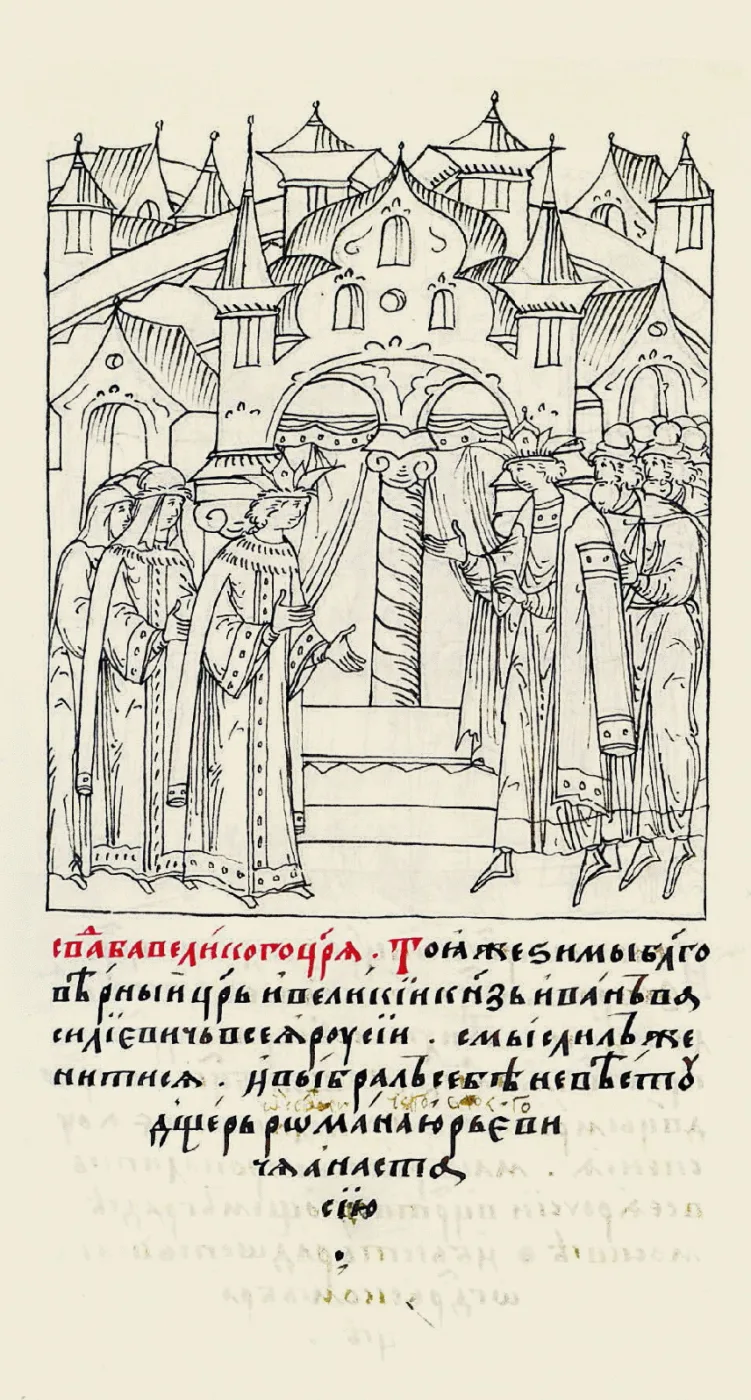
Three weeks later, on 3 February 1547, Ivan married Anastasia Romanovna Zakharyina-Yurieva, chosen at a bride-show for which summonses had gone out across the country the previous December. Her family, later called the Romanovs, would supply the next dynasty.
The fire and the riot of 1547
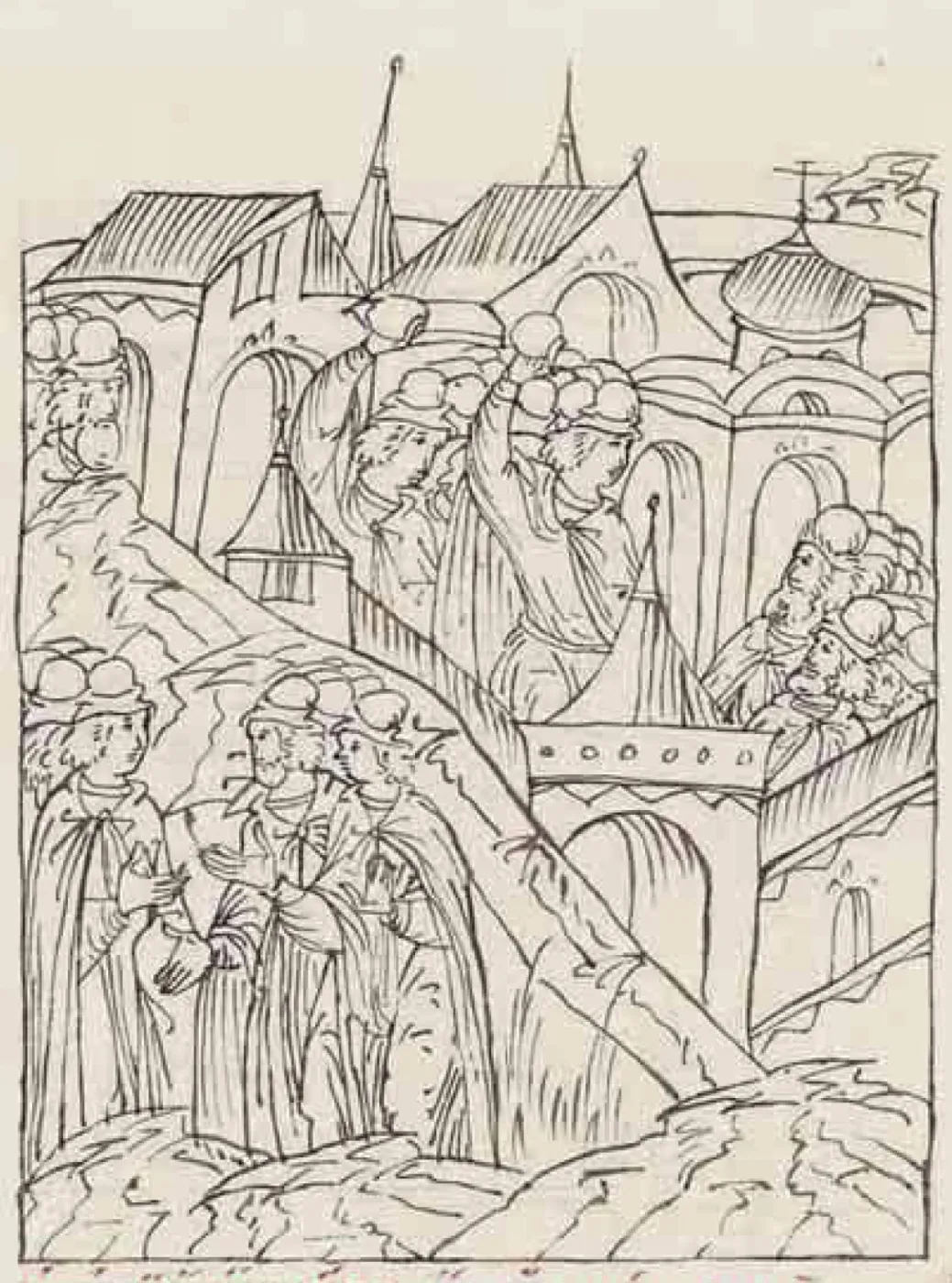
That summer Moscow burned. The great fire of 21 June 1547 destroyed most of the wooden city. The chronicles give different death tolls: 1,700 in the Chronicle of the Beginning of the Tsardom, 3,700 in the Chronograph chronicle, 2,700 in one Novgorod chronicle (Zhukov 2016). A rumour spread that the tsar's Glinsky relatives had set the city alight by sorcery. A crowd killed Ivan's uncle Yury Glinsky in the Kremlin and then marched to the tsar's residence at Vorobyovo outside the city to demand the rest of the family.
For Ivan, then sixteen, it was a lesson in how fragile his authority was. In his own later telling it was the moment he turned to God and to reform.
The reforms of the 1550s
The next decade was the constructive part of the reign. In February 1549 Ivan called what historians call the "Council of Reconciliation", where he forgave past offences and promised quick and fair justice. Its programme was carried out over the following years:
- The law code of 1550. The new Sudebnik, adopted in June 1550, required elected representatives of the local population to sit with governors when they judged cases, set penalties for judges who took bribes, and limited the tax privileges of great landowners.
- The Stoglav council of 1551. A church council, presided over by the tsar, issued a hundred chapters on worship, icon painting, monastic life and the copying of books. Two of them threaten even "tsars and nobles" who seize church property.
- Local government and the army. In the mid-1550s the system of kormlenie, under which governors lived off the districts they ruled, was abolished. A decree regulated the military service owed by landholders, and the musketeer regiments of the streltsy replaced the old town levies.
- Printing. Following the council's call for corrected church books, a state printing house was set up in Moscow in the early 1560s at the treasury's expense.
Who designed these reforms? The Orthodox Encyclopaedia names two men close to the tsar, the priest Sylvester of the Annunciation Cathedral and Aleksei Adashev, a minor nobleman from Kostroma, and admits that the sources "almost do not allow us to judge" Ivan's own part in them.
Historians disagree about the "Chosen Council":
- The name Izbrannaya rada comes from Prince Andrei Kurbsky's History of the Grand Prince of Moscow, which presents Sylvester, Adashev and their circle as a wise council that governed well until Ivan turned against it.
- Many textbooks treat this council as a real government body of the 1550s.
- A. I. Filyushkin's book The History of a Mystification: Ivan the Terrible and the "Chosen Council" (1998) argues that it never existed as an institution and that Kurbsky invented the name for his own polemical purposes.
Kazan and Astrakhan
To the east lay the Khanate of Kazan, one of the successor states of the Golden Horde and a frequent raider of Muscovite lands. After earlier failed campaigns, a large army under the tsar's command took Kazan by storm on 2 October 1552. Resistance in the khanate's lands went on until 1557. In 1556 the Astrakhan Khanate at the mouth of the Volga was taken too, so that the whole course of the river now lay under Moscow's control.
The conquests turned Muscovy into a state with large Muslim and non-Russian populations along the Volga. Ivan commemorated Kazan by building the Church of the Intercession on the Moat in Red Square, better known as St Basil's Cathedral, between 1555 and 1561. At 1556 the Tsardom reaches the Caspian.
The turn of 1560
In 1558 Ivan opened a war against the Livonian Order on the Baltic, the Livonian Confederation of today's Estonia and Latvia. The pretext was a tribute that the bishopric of Dorpat had once paid to Pskov and had not delivered. The war began well. Russian troops took Narva and Dorpat in 1558 and destroyed a Livonian army at Ermes in 1560. But Sweden, Denmark and Poland-Lithuania moved in to divide Livonia among themselves, and the war widened.
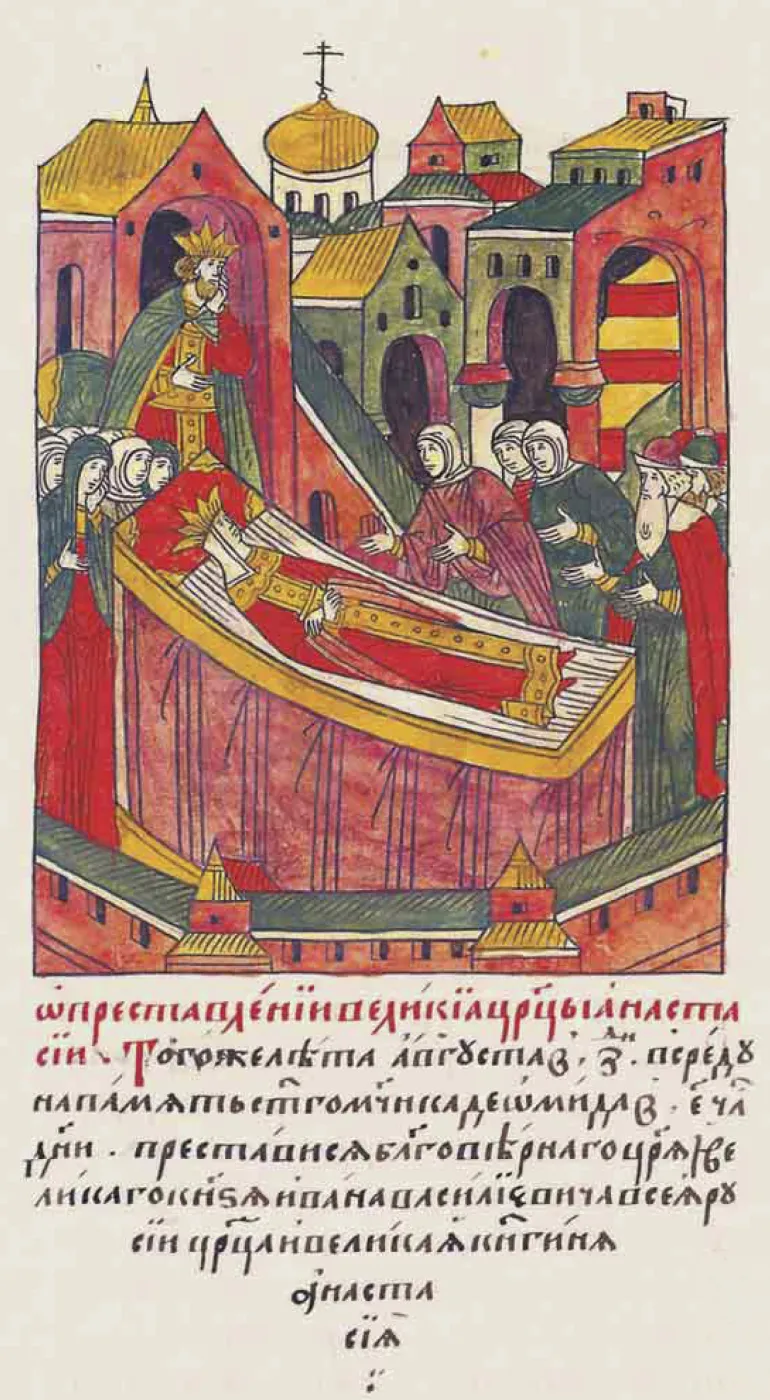
The same year marks a turning point in Ivan's life. Sylvester and Adashev fell from favour. On 7 August 1560 Anastasia died at Kolomenskoye near Moscow. Ivan came to believe that she had been poisoned, and according to Kurbsky he blamed Sylvester and Adashev for her death through sorcery.
There is modern evidence on Anastasia's death. In 2017 physicists of the Joint Institute for Nuclear Research at Dubna and Tatiana Panova of the Moscow Kremlin Museums reported that neutron activation analysis of her remains "confirmed the fact of acute mercury poisoning". Whether the mercury was given to kill her or as medicine, the analysis cannot say.
Kurbsky's flight and the famous letters
On the night of 30 April 1564 Prince Andrei Kurbsky, Ivan's governor in Livonia and a former commander at Kazan, fled from Dorpat to the Lithuanian side. From there he wrote to the tsar accusing him of rewarding the commanders who had conquered kingdoms for him with disgrace and execution. Ivan answered with a long letter defending the God-given, unlimited power of the tsar. The exchange, two letters from Ivan and three from Kurbsky, together with Kurbsky's History, is the most quoted source on the reign.
In 1971 the American historian Edward Keenan argued that the correspondence was a seventeenth-century forgery. R. G. Skrynnikov answered him at book length in 1973, and the debate has gone on since. The Orthodox Encyclopaedia article on Kurbsky (2020) summarises it: Keenan and D. C. Waugh doubted that Kurbsky was educated enough to write the works ascribed to him, while their opponents argue that he wrote most of them. Most specialists accept the letters as genuine, but anyone who quotes them should know that the question was raised.
The oprichnina, 1565–1572
In December 1564 Ivan left Moscow with his family and his treasury for Aleksandrova Sloboda, a fortified residence north-east of the capital, and announced that he was laying down his rule because of the treason of the boyars and clergy. In January 1565 a delegation of boyars and churchmen went to beg him to return. He agreed on condition that he could punish traitors as he chose and set up a separate domain under his personal control, the oprichnina (from oprich, "apart"). The rest of the country, the zemshchina, stayed under the boyar council and had to pay 100,000 roubles to set the new domain up.
The oprichniki wore black. According to the Orthodox Encyclopaedia, their horses carried dogs' heads and brooms, a sign that they would sniff out and sweep away traitors. Their inner circle of some 200 to 300 men lived at the Sloboda in a parody of a monastery, with the tsar as abbot. Executions began in February 1565; from the autumn of 1567 whole families and their servants were killed.
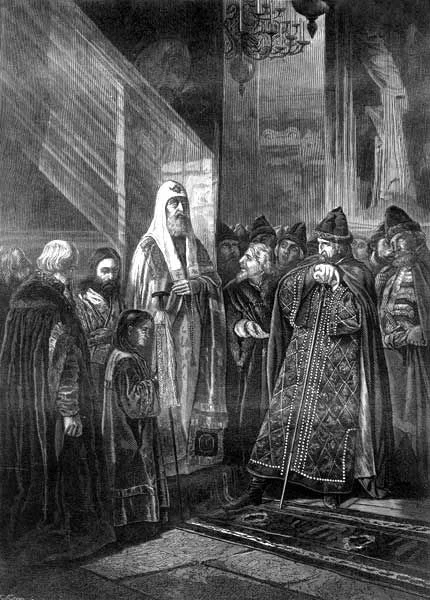
The church was not spared. Metropolitan Philip (Kolychev), the former abbot of the Solovetsky monastery, demanded that the tsar abolish the oprichnina and, on 22 March 1568, refused to bless him in the Dormition Cathedral. In November 1568 a church council deposed him and oprichniki seized him during a service. In December 1569 he was killed in a monastery at Tver by Grigory Skuratov-Belsky, known as Malyuta, the most notorious of Ivan's men.
The oprichnina was abolished in the autumn of 1572 and the word itself was forbidden. Why Ivan created it, and what it achieved, is one of the great debates of Russian history: we will cover it in its own article.
The sack of Novgorod, 1570
In the winter of 1569–1570 the oprichnina army marched on Tver, Novgorod and Pskov. Novgorod, annexed by Ivan's grandfather in 1478, was accused of planning to go over to the king of Poland and grand duke of Lithuania, Sigismund II Augustus. Ivan arrived on 8 January 1570. For weeks his men killed, plundered churches and monasteries, and destroyed property. Only on 13 February were the citizens told that they were pardoned.
How many died? The numbers in circulation differ by a factor of more than a hundred:
| Figure | Where it comes from |
|---|---|
| 700,000 | The English merchant Jerome Horsey, who also placed Novgorod on the Volga |
| 60,000 or 20,000 | What contemporaries claimed, according to Skrynnikov |
| about 40,000 | A nineteenth-century calculation: the chronicle's 1,000 dead a day multiplied by five weeks |
| 2,000–3,000 | R. G. Skrynnikov's estimate from the Synodikon of the disgraced |
Skrynnikov's argument is simple. The 40,000 figure cannot be right because Novgorod never had more than 25,000–30,000 inhabitants even at its height, and famine had already emptied it. The best source is the list of victims that Ivan himself later sent to monasteries for prayers, the Synodikon, which Skrynnikov called "a summary of the lost oprichnina archive". It preserves the report of Malyuta Skuratov in the oprichniki's own blunt jargon: in the Novgorod expedition "Malyuta finished off 1,490 people by hand, and 15 were finished off with arquebuses".
The Synodikon was compiled around 1582–1583, when Ivan sent large donations to monasteries for the souls of those he had executed. Skrynnikov's reconstruction of it contains up to about 4,000 names. That is a list of people prayed for, not a full count of the dead: servants, peasants and townsfolk often appear only as numbers or not at all.
Wars on every front: Livonia, Crimea and Molodi
The Livonian War dragged on for twenty-five years. Russian armies took Polotsk in February 1563, but were beaten near Orsha in 1564. In 1569 Poland and Lithuania joined into a single state, the Polish-Lithuanian Commonwealth, partly in answer to the Russian threat. From 1578 the war turned against Moscow: defeat at Wenden (Cēsis) in October 1578, the loss of Polotsk to King Stefan Báthory in 1579, the siege of Pskov from August 1581 and the Swedish storming of Narva on 6 September 1581.
Meanwhile the Crimean Khanate struck from the south. On Thursday 24 May 1571, Ascension Day, Khan Devlet Giray reached Moscow and the city burned. The English diplomat Giles Fletcher, writing in 1591, repeated the claim that "800,000 people or more" died "by the fire and the presse", but he introduced it with "as was sayd", and he himself counted only 41,500 houses in the whole city before the fire.
The next summer the khan returned with Ottoman troops and artillery. A Russian army under Prince Mikhail Vorotynsky stopped him at Molodi, south of Moscow, in fighting from 30 July to 2 August 1572. Most Russian historians call Molodi a decisive victory. The historian A.-Kh. Sheikhumerov (2019) argues that it was a failed siege of a Russian field fortification followed by an orderly Crimean withdrawal, which later writers turned into a pitched battle and a rout.
The truce of Yam Zapolsky with Poland-Lithuania (15 January 1582), arranged by the papal envoy Antonio Possevino, and the truce of the Plyussa with Sweden (August 1583) ended the war. Russia gave up all its conquests in Livonia, and Sweden kept Narva and Russian towns along the gulf. By one count cited in the Orthodox Encyclopaedia, the population of the Novgorod land in the early 1580s had fallen to 20.9 per cent of its level in the mid-sixteenth century.
The strange reign of Simeon Bekbulatovich
In October 1575 Ivan split the country again. He set up a baptised Tatar prince, Simeon Bekbulatovich, as "grand prince of all Rus'" over the zemshchina and kept a separate court of his own. Courtiers who petitioned him not to put "a foreigner" on the throne past his own sons were executed on Cathedral Square in November 1575. About a year later Simeon was removed. Whether this was a joke, a superstitious precaution against a prophecy, or a political manoeuvre is still debated.
How many wives did Ivan the Terrible have?
Ivan had at least six wives, and some lists give seven or eight. Orthodox church law allowed a layman three marriages at most.
| Wife | Marriage | How it ended | |
|---|---|---|---|
| 1 | Anastasia Romanovna Zakharyina-Yurieva | 3 February 1547 | died 7 August 1560 |
| 2 | Maria Temryukovna, a Kabardian princess | 1561 | died 1569 |
| 3 | Marfa Sobakina | 1571, after a bride-show | died in November 1571, weeks after the wedding |
| 4 | Anna Koltovskaya | spring 1572, with a special church dispensation | made a nun in September 1572 |
| 5 | Anna Vasilchikova | probably mid-1570s | made a nun; date and details uncertain |
| last | Maria Nagaya | probably 1580 | widowed 1584; mother of Tsarevich Dmitry (born 19 October 1582) |
The fourth marriage needed special permission. On 29 April 1572 a church council allowed it "as an exception for reasons of state", and imposed a penance: for a year the tsar was not to enter a church. The later marriages had no such sanction, which is why Dmitry, Ivan's son by Maria Nagaya, could be called illegitimate after his father's death. Two further "wives" who appear in many popular lists, Vasilisa Melentyeva and Maria Dolgorukaya, are not attested in the sixteenth-century records; their stories are usually traced to the nineteenth-century collector A. I. Sulakadzev, a known forger, and are best treated as legend.
Marriage did not stop with Maria Nagaya. Horsey writes that Ivan asked how old Elizabeth I was and how a suit for her hand might go, and that he was ready to try although "he had two wiffes livinge". In 1582 his envoy Fyodor Pisemsky went to London with instructions to negotiate for the hand of Lady Mary Hastings, a relative of the queen. Nothing came of it.
Did Ivan the Terrible kill his son?
Yes, by the testimony of almost all the sources, though not quite as the famous painting shows it. In November 1581, at Aleksandrova Sloboda, Ivan quarrelled with his eldest son and heir, Ivan Ivanovich, and struck him on the head. The tsarevich died on 19 November 1581. The Orthodox Encyclopaedia dates the blow to 14 November, or to 9 November according to other sources.
The cause is reported differently:
- Antonio Possevino, the papal envoy who arrived months later, wrote that Ivan found his son's pregnant wife in a light garment, beat her, and struck his son with his staff when the son protested.
- Giles Fletcher heard that the son died "of a blowe given him by his father upon the head in his furie with his walking staffe, or (as some say) of a thrust with a prong of it".
- Jerome Horsey wrote that the tsar gave him "a box on the ear", after which the son "fell into a burninge feavour, and died within three daies after".
- A Pskov chronicle reports a rumour that the tsar killed his son because he spoke of relieving the besieged city of Pskov.
The tsarevich's remains were examined in the 1960s. Since then some Russian writers have argued that he died of illness and that the killing is a Jesuit invention. In a 2026 review of that debate in the journal Klio, A. S. Ishchenko notes that this view is held mainly by non-specialists among the "defenders" of the tsar's memory, while historians of the period, from S. F. Platonov and S. B. Veselovsky to Skrynnikov, have accepted that the father killed his son. The killing and Ilya Repin's painting of it have their own article: Ivan the Terrible and His Son.
With the heir dead, the succession passed to Ivan's second son Fyodor, whose wife's brother Boris Godunov became the real power behind the throne.
How did Ivan the Terrible die?
Ivan died in Moscow on 18 March 1584, aged 53. Horsey, who was in Moscow at the time, describes his last afternoon. The tsar took a bath, came out "well refreshed", sat on his bed and called for a chessboard. Setting out the pieces, with Boris Godunov and other favourites around him, he "faints and falls backward". There was an outcry; people ran for vodka, rose water, his confessor and the physicians. "In the mean he was strangled and stark dead."
"Strangled" has been read as a hint at murder, but in Horsey's English it may simply mean that the tsar choked or stopped breathing. In 1963 the tombs of Ivan, his sons Ivan and Fyodor, and Prince Mikhail Skopin-Shuisky were opened in the Archangel Cathedral under the anthropologist M. M. Gerasimov. High levels of mercury were found in the remains of both Ivan and his eldest son. The experts' own conclusion, as quoted by N. F. Nedelko, was cautious: the mercury "could be due to the use of mercury-containing medicines for treatment", although acute or chronic poisoning by those medicines "cannot be completely ruled out".
Later analyses have added to the picture without closing it. Work at Dubna reported in 2019 found large amounts of mercury in the bones of Ivan's mother Elena Glinskaya as well. Mercury was a standard medicine of the time, so the high readings do not prove murder. Whether Ivan was poisoned remains open.
Common myths about Ivan the Terrible
| Myth | What the evidence says |
|---|---|
| He blinded the architects of St Basil's Cathedral so they could never build anything as beautiful again | The only source is Adam Olearius, who visited Moscow in 1636, over fifty years after Ivan's death. No Russian source mentions it, and in December 1555 Ivan sent a builder named Postnik Yakovlev to build the stone kremlin of Kazan. Horsey tells the same story about the builder of Ivangorod at Narva: a travelling tale about tyrants. |
| He was the first person to call himself tsar | He was the first to be crowned tsar (1547). Ivan III had already used the title in some diplomatic letters. |
| Grozny means "terrible" in the sense of "cruel" | It meant "fearsome" or "awe-inspiring", a quality expected of a ruler. |
| He killed 60,000 people at Novgorod | Skrynnikov's estimate from the Synodikon is 2,000–3,000. Larger figures come from hearsay and from arithmetic based on a chronicler's round number. |
| He killed his son on the spot, as in Repin's painting | The son died several days after the blow (on 19 November 1581), not at once. |
| He had eight wives | At least six are documented; two of the "extra" wives come from a nineteenth-century source suspected of forgery. |
| The mercury in his bones proves he was poisoned | The 1960s experts themselves said it could come from medicine. |
| 800,000 people died when the Crimeans burned Moscow in 1571 | That figure is Fletcher's hearsay; he wrote "as was sayd". |
Ivan the Terrible today
Ivan has become a political symbol in modern Russia. On 14 October 2016 the first monument to him was unveiled in Oryol, a city he founded. The regional governor, Vadim Potomsky, called him "a defender of our land, a tsar who expanded its frontiers". More than 500 local people had signed a petition against "a monument to a tyrant", while a poll found 72.6 per cent in favour. Patriarch Kirill opposed calls to canonise Ivan "because of his methods of governing", but said that as the founder of Oryol he deserved a monument there. A second statue, by Vasily Selivanov, was set up in Aleksandrov, the former Aleksandrova Sloboda, in December 2019.
For historians the problem remains the sources. The fullest accounts of his cruelty come from Kurbsky, his enemy, and from foreigners such as the oprichniki Heinrich von Staden, Johann Taube and Elert Kruse, the captive Albert Schlichting, and the merchants Horsey and Fletcher. They had reasons to exaggerate and often wrote down rumours. Yet Skrynnikov showed that where Schlichting's numbers can be checked against the Synodikon, they match it closely. The terror is not an invention of Ivan's enemies; only its scale and some of its most famous stories are.
What the map shows next
At 1547 the Tsardom of Russia still has the Khanate of Kazan on its eastern border. By 1556 the whole Volga is Russian, with the Crimean Khanate to the south and the Khanate of Sibir beyond the Urals, which the Cossack Yermak would attack in the last years of Ivan's life. At 1584 on the map you can see what he left: a far larger state in the east, no foothold on the Baltic, and a country exhausted by war, famine and terror. Fourteen years later his dynasty died out, and the Time of Troubles began.
Sources
Primary sources
- Giles Fletcher, Of the Russe Common Wealth (1591), and Jerome Horsey, Travels, in E. A. Bond (ed.), Russia at the Close of the Sixteenth Century (London: Hakluyt Society, 1856): https://archive.org/details/russiaatcloseofs20bond
Studies and reference works
- "Ioann IV Vasil'evich", Pravoslavnaia entsiklopediia, vol. 23 (2015), pp. 628–648: https://www.pravenc.ru/text/469782.html
- "Oprichnina", Pravoslavnaia entsiklopediia, vol. 53 (2023), pp. 42–46: https://www.pravenc.ru/text/2581441.html
- "Ioann Ioannovich", Pravoslavnaia entsiklopediia, vol. 24 (2015), pp. 289–290: https://www.pravenc.ru/text/471251.html
- "Dariia" (Anna Koltovskaia), Pravoslavnaia entsiklopediia: https://www.pravenc.ru/text/171388.html
- "Kurbskii Andrei Mikhailovich", Pravoslavnaia entsiklopediia, vol. 39 (2020), pp. 384–391
- "Anastasiia Romanovna", Pravoslavnaia entsiklopediia
- R. G. Skrynnikov, Ivan Groznyi, chapter "Novgorodskii razgrom": https://statehistory.ru/books/1/Ruslan-Skrynnikov_Ivan-Groznij/34
- A. E. Zhukov, "Letopisnye izvestiia o moskovskikh pozharakh 1547 g." (2016): https://cyberleninka.ru/article/n/letopisnye-izvestiya-o-moskovskih-pozharah-1547-g
- A. S. Ishchenko, "Ivan Groznyi i syn ego Ivan 16 noiabria 1581 goda: ubiistvo ili mif?", Klio (2026): https://cyberleninka.ru/article/n/ivan-groznyy-i-syn-ego-ivan-16-noyabrya-1581-goda-ubiystvo-ili-mif
- N. F. Nedel'ko, "A byl li ubit syn tsaria Ivana IV Groznogo?": https://cyberleninka.ru/article/n/a-byl-li-ubit-syn-tsarya-ivana-iv-groznogo
- A.-Kh. A. Sheikhumerov, "Mifologii i realii bitvy pod Molodiami" (2019): https://cyberleninka.ru/article/n/mifologii-i-realii-bitvy-pod-molodyami
- A. Iu. Dmitriev, S. B. Borzakov, K. Khramko and T. D. Panova, neutron activation analysis of the remains of Anastasiia Romanovna and Ivan Ivanovich, Physics of Particles and Nuclei Letters 15/1 (2018), doi:10.1134/S1547477118010132; seminar notice: https://www.jinr.ru/posts/30277/
- "Ivan the Terrible" and "tsar", Encyclopaedia Britannica: https://www.britannica.com/biography/Ivan-the-Terrible
- Provereno.media, "Pravda li, chto Ivan Groznyi prikazal oslepit' sozdatelei khrama Vasiliia Blazhennogo?" (27 September 2023): https://provereno.media/blog/2023/09/27/pravda-li-chto-ivan-grozny-prikazal-oslepit-sozdateley-khrama-vasiliya-blazhennogo/
- "Russia's first monument to Ivan the Terrible inaugurated", The Guardian, 14 October 2016: https://www.theguardian.com/world/2016/oct/14/russias-first-monument-to-ivan-the-terrible-inaugurated
- "Russian Orthodox church head backs Ivan the Terrible sculpture", The Guardian, 2 August 2016: https://www.theguardian.com/world/2016/aug/02/russian-orthodox-church-head-backs-ivan-the-terrible-sculpture
- RIA Novosti, report on the Oryol monument, 14 October 2016: https://ria.ru/society/20161014/1479245684.html
Image credits
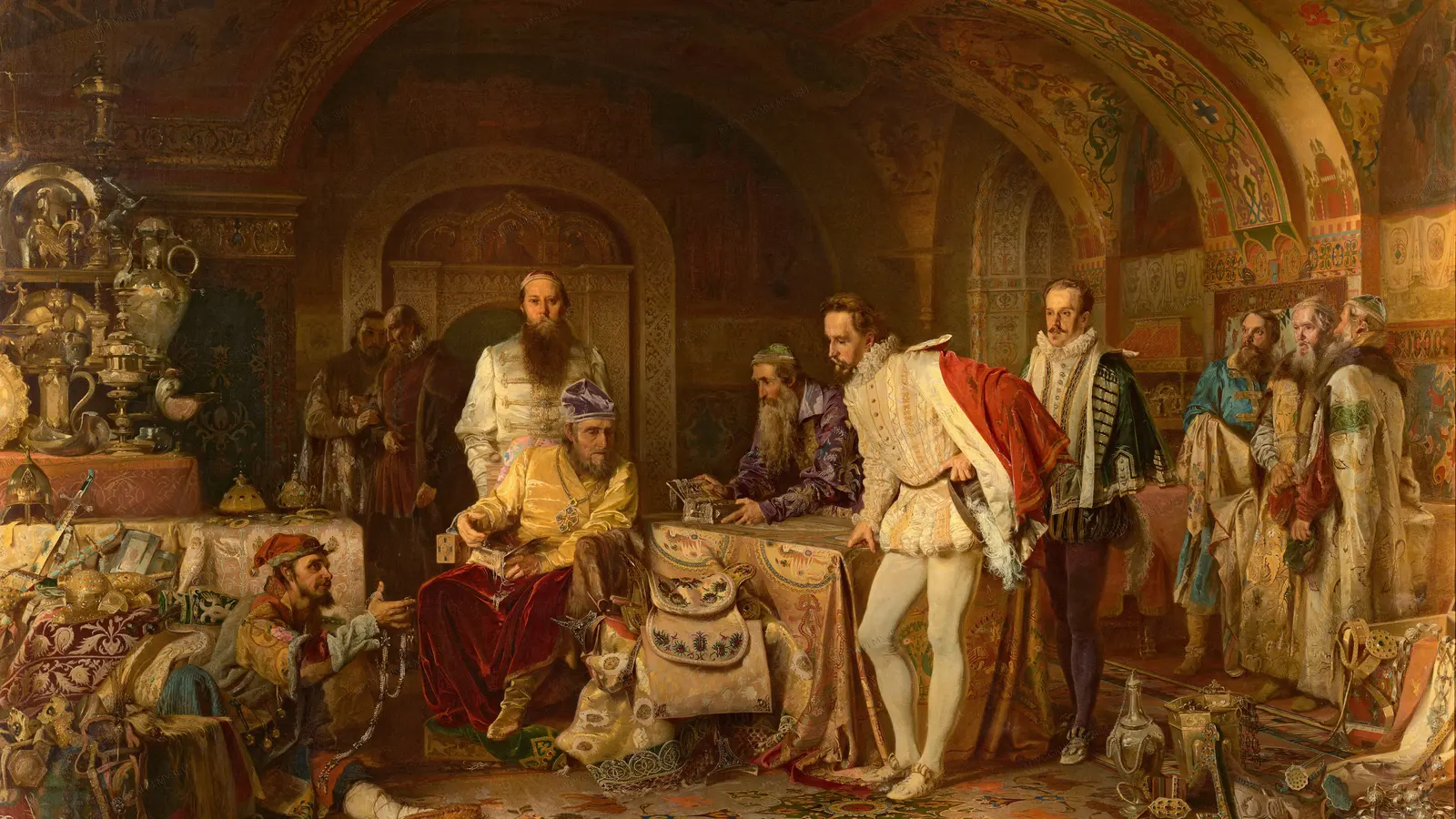
- Title image: Aleksandr Litovchenko, Ivan the Terrible Showing His Treasures to the English Envoy Horsey, 1875, State Russian Museum. Public domain, via Wikimedia Commons, cropped to 16:9.
- Wedding of Ivan IV and Anastasia, Illustrated Chronicle, vol. 20, p. 293. Public domain, via Wikimedia Commons.
- Murder of Yury Glinsky, Illustrated Chronicle, vol. 20, p. 317. Public domain, via Wikimedia Commons.
- Death of Anastasia Romanovna, Illustrated Chronicle, vol. 23, p. 251. Public domain, via Wikimedia Commons.
- Vasily Pukirev, Metropolitan Philip and Ivan IV, 1875. Public domain, via Wikimedia Commons.
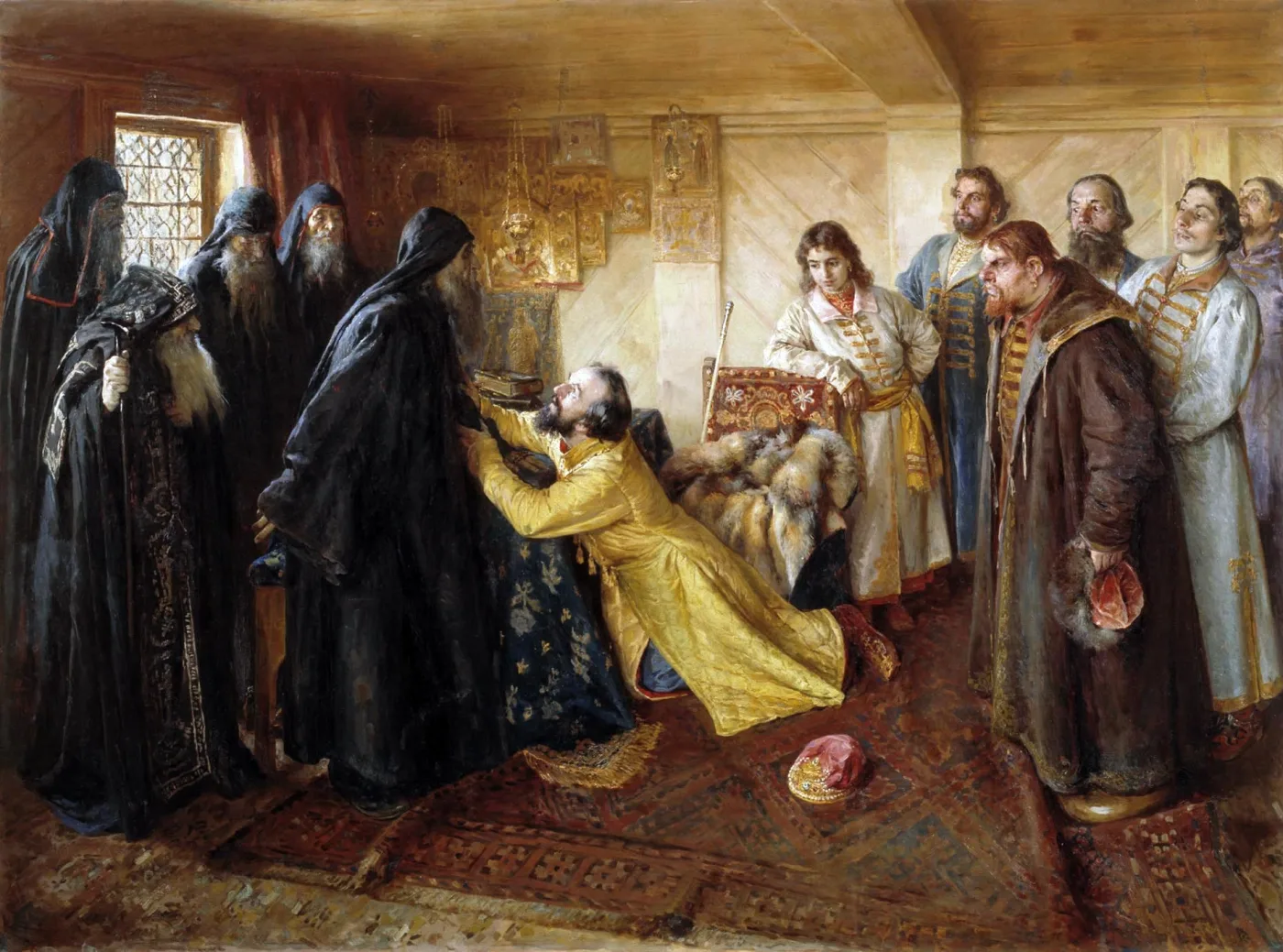
- Klavdy Lebedev, Ivan the Terrible asks to be made a monk, 1898. Public domain, via Wikimedia Commons.
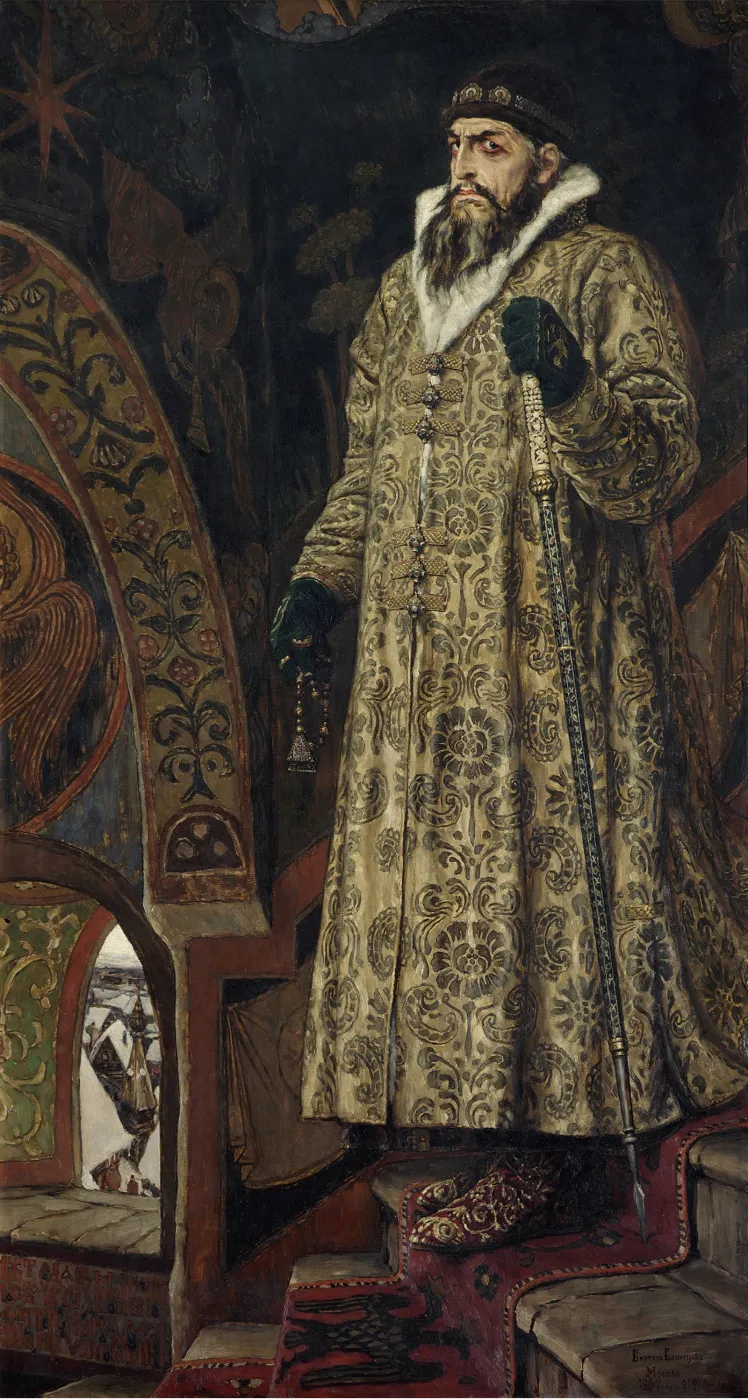
- Viktor Vasnetsov, Tsar Ivan Vasilyevich the Terrible, 1897, State Tretyakov Gallery. Public domain, via Wikimedia Commons.