Human verified. Last updated by our editorial team on .
North America · Breakaway states and civil war
California Republic
1846
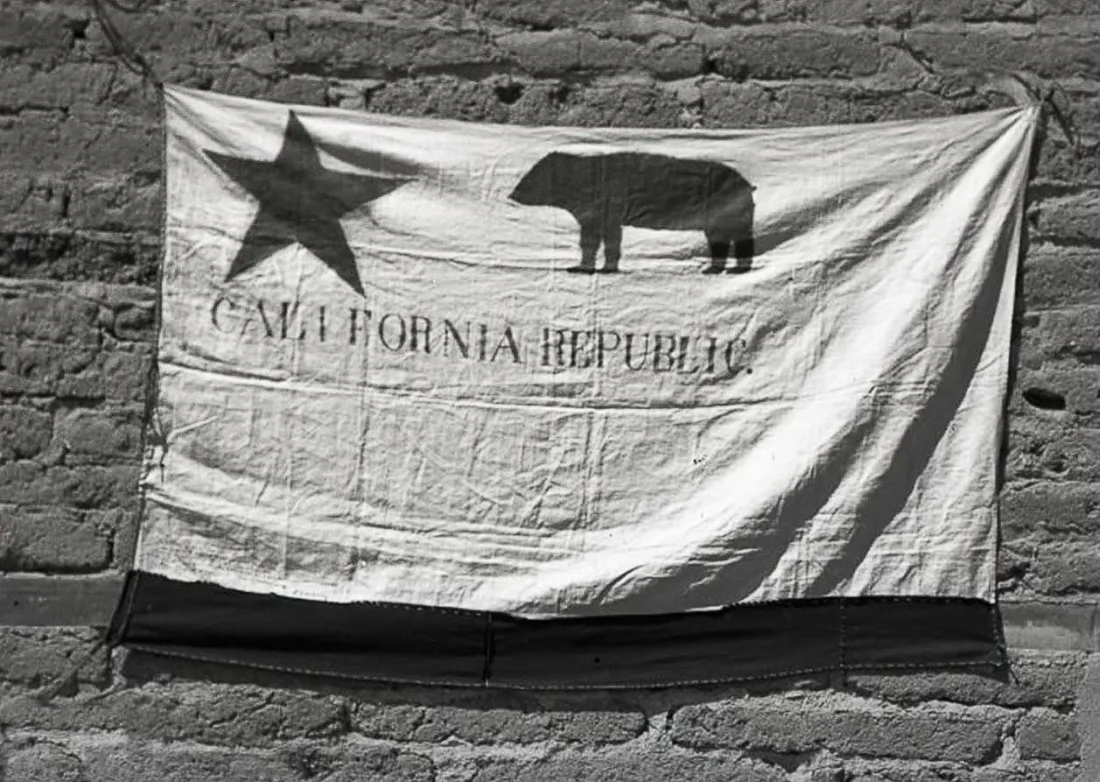
The California Republic lasted twenty-five days, covered a few hundred square miles around Sonoma, and never had a president, a constitution, a treasury or a single act of recognition. It is nevertheless one of the most famous republics in American history, because of its flag: a grizzly bear, a red star and the words "California Republic" on a strip of unbleached cotton that became the state flag of California.
- Existed
- 1846
- Shown on the map
- 1846–1847
- Peak area
- 16k km²
- Region
- North America
That is the paradox at its centre. The republic is remembered as a founding moment and was, in fact, a confused settler rising inside a war that had already begun, led by men who were not sure whether they were independent, American or both — and it ended when a United States naval officer raised a different flag over the same square.
At a glance
| Name | California Republic; the Bear Flag Republic |
| Dates | 14 June – 9 July 1846 (the map draws 1846–1847) |
| Where | Sonoma and the north bay, with scattered support in the Sacramento valley |
| Capital | Sonoma |
| Government | None: a committee of settlers, with William B. Ide as captain and commander |
| Population | A few hundred settlers in the region; the republic never counted anyone |
| Territory | About 15,600 km² on this map — the Sonoma–Napa area, not the whole of California |
| Flag | A grizzly bear, a red star and "California Republic" on unbleached cotton |
| End | 9 July 1846, when the United States flag was raised at Sonoma |
What was the California Republic?
A settler revolt against Mexican authority in northern California, declared at Sonoma on 14 June 1846 and ended on 9 July when the United States took possession. Its founders were American settlers, some of them recent arrivals, who feared that the Mexican government was about to expel them and who believed — correctly — that war between Mexico and the United States had begun.
Its extent was never defined. The rebels took Sonoma, raised a flag and issued a proclamation; they never controlled San Francisco bay, Monterey or Los Angeles, and the republic's effective territory was the town it had captured and the roads around it. On this map it is drawn at about 15,600 square kilometres, which is roughly the Sonoma–Napa region — not the state of California, and not even the whole of northern California.
Why did settlers revolt?
Because Mexican California was close to collapse and the settlers knew it. The province had two rival authorities — Pío Pico governing from Los Angeles and José Castro commanding in the north — and neither could enforce its writ. The central government in Mexico City had ordered the expulsion of unauthorized American immigrants in 1845, and although the order was not carried out, the settlers heard about it.
Two other things mattered. John C. Frémont's exploring expedition arrived in California in December 1845 with sixty armed men and refused to leave when the Mexican authorities told him to, moving to Gavilán Peak in March 1846 and then north to Oregon. And Thomas O. Larkin, the American consul in Monterey, was secretly authorised by Secretary of State Buchanan in October 1845 to encourage Californian separatism — a fact the settlers did not know but which shaped Washington's readiness to accept the result.
Who were the settlers?
A few hundred Americans in a province of some 7,000 Spanish-speaking Californians, concentrated in the Sacramento valley and around Sonoma. Most had arrived in the previous five years, many overland from Missouri and Arkansas, and they had come for land. Mexican California offered grants to foreigners who became Catholic and Mexican citizens; most of the Americans never bothered with either.
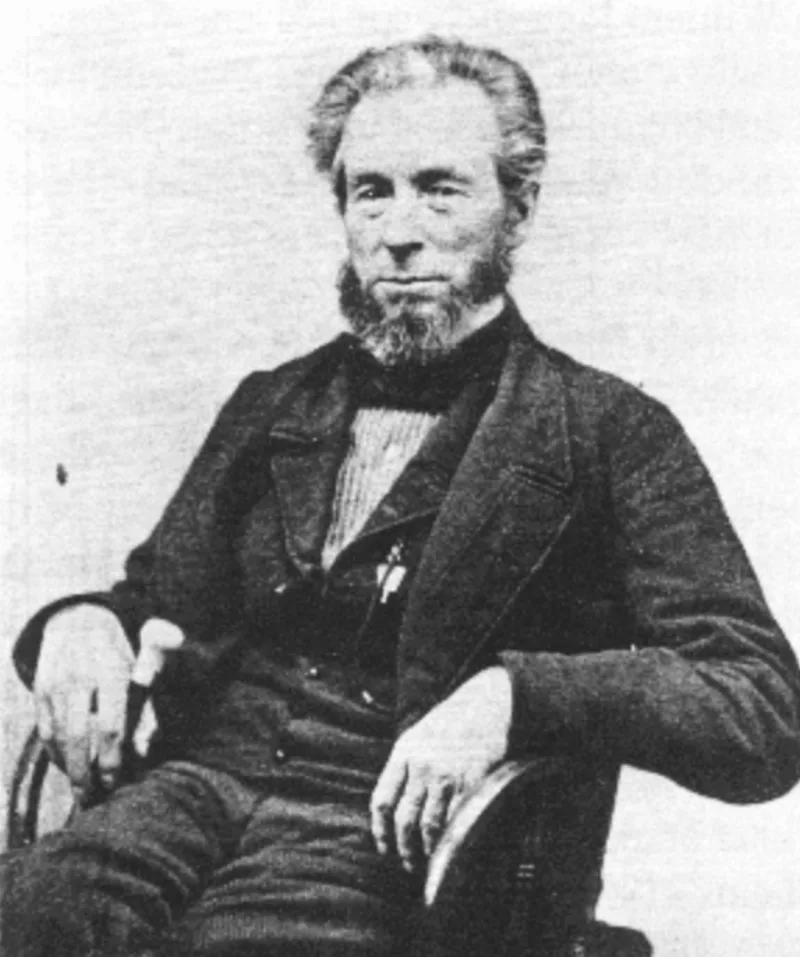
They were not a community so much as a frontier: young men, many without families, some with slaves or with ambitions to acquire them, and a leadership drawn from men like Ide — a thirty-year-old from Kentucky via Illinois, a schoolteacher and farmer, who wrote the proclamation and then found himself in command of a country.
What was the war context?
Mexico and the United States went to war in April 1846 over Texas — annexed a year after the Texas republic gave up its independence — and the news reached California by sea in June. That timing is decisive: the Bear Flag was raised in the same week that the United States declared war, and Sloat's squadron was already under orders to seize California's ports if hostilities began.
The settlers did not know the details, but they knew the direction of events. Their revolt was therefore not a surprise to Washington but a windfall: it gave the Pacific squadron a local ally, a captured town and a flag to replace. Whether Frémont encouraged the timing is still argued; that the timing served him is not.
What happened at Sonoma?
A raid, then a proclamation. On 10 June 1846 a party of settlers took a herd of horses belonging to Lieutenant Francisco Arce, and on 14 June a group of about thirty-three men entered Sonoma before dawn and arrested General Mariano Guadalupe Vallejo, the most prominent Mexican official in the north, and his brother Salvador. There was no fight; Vallejo was taken to Sutter's Fort and held.
On 15 June William B. Ide issued a proclamation — the republic's founding document — denouncing Mexican rule and promising a government of law. The flag was raised over the plaza, though the exact date is unproven: the first contemporary record of it flying is 17 June, when Lieutenant John Missroon of the USS Portsmouth saw it, and Bancroft himself calls the evidence for 14 June "very slight".
Did the republic have any laws?
Almost none. The proclamation promised a government of law and a guarantee of "life, liberty and property", and the rebels issued a few orders as a committee of the whole. There was no legislature, no court, no tax and no money; the "government" met in the Sonoma barracks, and its principal acts were to arrest Vallejo, print a proclamation and send a party to take horses.
That is why the republic's constitutional history is so thin: it was a fortnight's committee with a printing press, not a state. The absence of institutions is not a gap in the record; it is the record.
Who was in charge?
Nobody, in any constitutional sense. Ide was elected captain and commander of the rebel force, not president; there was no presidency, no constitution, no treasury, no legislature and no recognition by any state. The "republic" was a committee of settlers with a flag and a proclamation, and its authority rested on the fact that it held Sonoma.
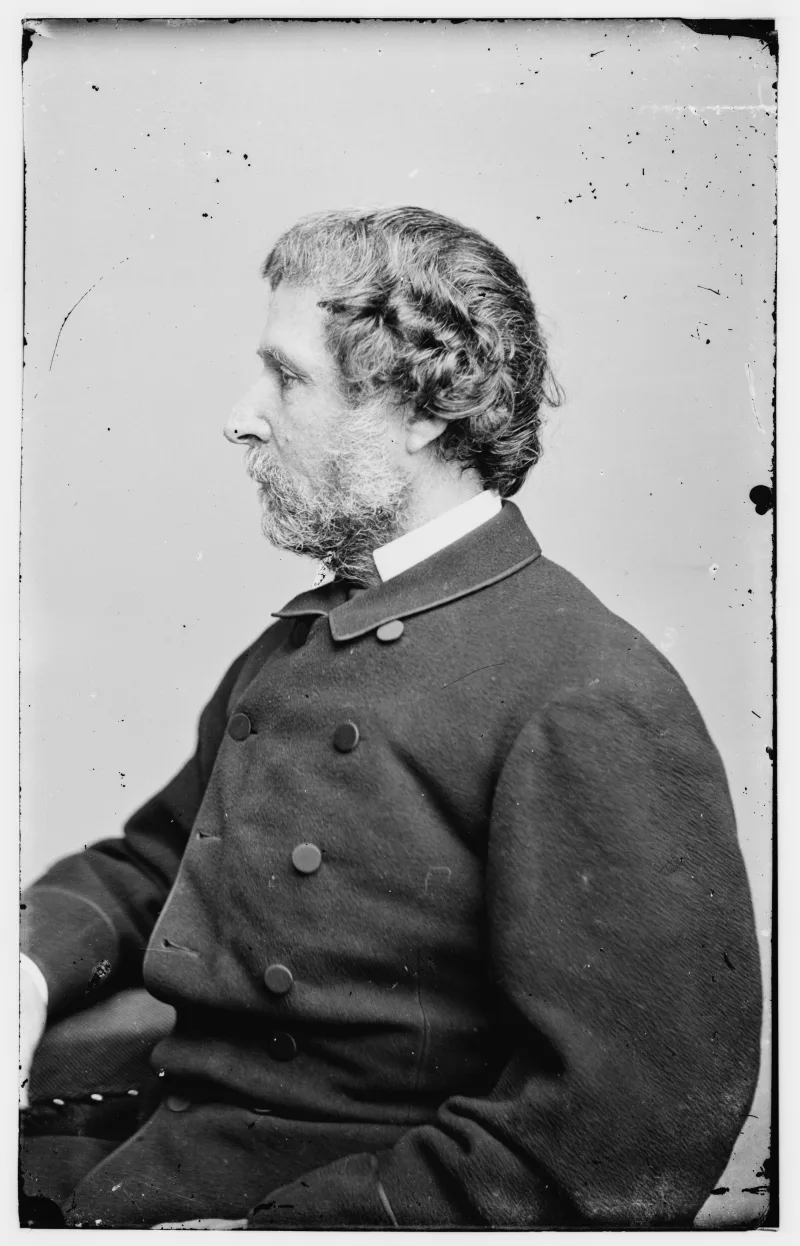
On 5 July Frémont arrived and formally assumed command of the rebel force, which meant that the republic was now led by an officer of the United States Army.
 That has often been described as a second declaration of independence; it was not. It was the moment the revolt stopped pretending to be a separate country.
What was the flag?
A grizzly bear, a red star and the words "California Republic" on a piece of unbleached cotton, made by William Todd — a nephew of Mary Todd Lincoln — and a few others in Sonoma. Todd's own account, written in 1872, describes painting the bear and the star, and the flag was later said to have been sewn onto a petticoat; the story of the petticoat is tradition rather than record.
The original was lost. The modern state flag dates from a 1911 statute and was standardised in 1953, and it is a reconstruction rather than a copy: the bear on the original was a crude, almost cartoonish figure, and the modern flag's bear is a different animal. The republic's most enduring legacy is therefore a design that nobody can now see.
What about the Californios?
They were the majority and they lost. The californios — the Spanish-speaking, largely cattle-ranching families who owned the province's land — split during 1846 between those who resisted the American takeover and those who accommodated it, and both groups were dispossessed in the decade that followed. The Land Act of 1851 required every California landowner to prove title before a federal commission, and the legal costs and delays destroyed many of the great ranches.
Vallejo himself, the man arrested at Sonoma, supported the American annexation and served in the California constitutional convention of 1849; he still lost most of his land. The republic's twenty-five days were the beginning of that process, not an interruption of it.
What happened at San Rafael?
A killing that the republic's admirers usually leave out. On 28 June 1846 a party under Kit Carson intercepted José de los Reyes Berreyesa and the twin brothers Francisco and Ramón de Haro near San Rafael, and shot them. Carson's reported words — "I have no room for prisoners" — and the detail that the bodies were stripped and a sarape sold for $25 are documented in the sources.
The killings are part of the republic's history, not an aberration from it. The revolt was a land grab conducted in wartime by armed men who regarded Mexican Californians as enemies, and the San Rafael deaths are what that looked like on the ground. Bancroft, who was not hostile to the settlers, recorded them; later popular accounts tended to forget them.
How did it end?
With a foreign flag. Commodore John D. Sloat, commanding the United States Pacific Squadron, had orders to take California in the event of war with Mexico, and on 7 July 1846 he raised the American flag at Monterey. On 9 July Lieutenant Joseph Warren Revere arrived at Sonoma, lowered the Bear Flag and raised the Stars and Stripes. The republic had lasted twenty-five days.
Frémont then organised the California Battalion, which took part in the conquest of the south, and he was later court-martialled for insubordination — a reminder that the revolt's American patron was not acting under orders. The United States annexed California by the Treaty of Guadalupe Hidalgo in 1848, two years after the flag came down — the same treaty that ended the Mexican republic's claim to the north.
How did the United States take over?
By sea, and without much fighting. Sloat's squadron arrived at Monterey on 7 July 1846, and the American flag went up without resistance; Stockton succeeded him and organised the California Battalion under Frémont, which sailed south and took Los Angeles in August. The Californios rose again in the autumn and were defeated at San Pasqual and La Mesa in December 1846 and January 1847, and the Treaty of Cahuenga in January 1847 ended the fighting.
The United States then had to decide what it had acquired. California was ceded by the Treaty of Guadalupe Hidalgo in February 1848, nine days after gold was found at Sutter's Mill, and admitted as a free state in 1850 under the Compromise of 1850. The republic of 1846 had no part in any of these decisions; it had been a fortnight's improvisation in a war that settled the question.
Was it a filibuster?
Historians have argued about this for a century and a half, and the honest answer is that it was several things at once. The filibuster reading, strongest in the older literature, sees Frémont and Larkin as agents of American expansion and the settlers as their instruments. The settlers' revolt reading sees a genuine local grievance — the expulsion order, the collapse of Mexican authority, the fear of Castro's troops — and treats Washington's role as encouragement rather than direction.
The moral catastrophe reading, associated with later critics, points to the San Rafael killings and the speed with which American settlers dispossessed a Mexican province. The revisionist middle, now the scholarly consensus, holds that the revolt was locally initiated, American-encouraged, and quickly absorbed into a war that made its independence irrelevant. All four readings agree on the facts; they disagree about what the facts mean.
Why is it called a republic?
Because the rebels called it one, in the proclamation and on the flag, at a time when "republic" was the word for a legitimate government. It was a claim to standing rather than a description of institutions: a republic without a constitution, a president or a treasury was a republic in name, and the name was the point.
The word also served the United States. A republic could be recognised, annexed and absorbed; a Mexican province in rebellion could only be conquered. By calling their rising a republic, the settlers gave Washington a fiction it could use, and California a founding myth it has kept.
What did it leave behind?
A flag, a name and a myth of origin. California became a state in 1850 with the Bear Flag as its emblem, and "California Republic" is still written on the state flag — the only American state flag that carries the word "republic". The Sonoma plaza is a state historic park, and the revolt is taught as the moment California became American.
The myth is selective. It celebrates a rising of a few dozen men, most of them recent arrivals, who killed unarmed prisoners and lost their country to a naval officer within three weeks. The flag is real, and so is the state it became; the republic is mostly a story told afterwards.
Common myths about the California Republic
| Myth | What the evidence says |
|---|---|
| William B. Ide was the republic's president | He was elected captain and commander; there was no presidency. |
| The republic declared independence on 14 June 1846 | The proclamation was on 15 June; even the flag-raising date is unproven, with the first contemporary record on 17 June. |
| Frémont declared a new republic on 5 July | He assumed command of the rebel force; there was no second declaration. |
| The Bear Flag was flown over a functioning government | There was no constitution, treasury, legislature or recognition. |
| The revolt was a spontaneous local uprising | It was locally initiated but encouraged by Larkin and sustained by Frémont's expedition; the timing followed the outbreak of war. |
| The republic covered California | It held Sonoma and the north bay; the map draws about 15,600 km², not the state. |
| The original Bear Flag survives | It was lost; the modern flag is a 1911 design, standardised in 1953. |
| The revolt was bloodless | Berreyesa and the Haro twins were shot at San Rafael on 28 June 1846. |
Timeline of the California Republic
| Year | Event |
|---|---|
| 1845 | Pío Pico becomes governor; expulsion order against unauthorised Americans |
| October 1845 | Buchanan authorises Larkin to encourage separatism |
| December 1845 | Frémont's expedition reaches California |
| March 1846 | Frémont at Gavilán Peak; withdraws north |
| 10 June 1846 | Arce's horses taken |
| 14 June 1846 | Sonoma taken; Vallejo arrested |
| 15 June 1846 | Ide's proclamation |
| 17 June 1846 | First contemporary record of the flag flying |
| 28 June 1846 | San Rafael killings |
| 5 July 1846 | Frémont assumes command |
| 7 July 1846 | Sloat raises the US flag at Monterey |
| 9 July 1846 | Revere raises the US flag at Sonoma |
| 1848 | Treaty of Guadalupe Hidalgo cedes California |
What the map shows next
At 1846 on the map the republic is a fortnight old, and the Mexican republic is at war with the United States.
At 1848 on the map California is American, and the Baja California episode is five years away.
Common questions
- What was the California Republic?
- A short-lived settler revolt in Sonoma in 1846, from 14 June to 9 July, against Mexican authority in California.
- How long did it last?
- Twenty-five days, ending when the United States flag was raised at Sonoma on 9 July 1846.
- Who was its leader?
- William B. Ide was elected captain and commander; there was no president.
- Who was Frémont?
- A United States Army officer whose exploring expedition provided the armed force behind the revolt; he took command on 5 July 1846.
- What did the flag look like?
- A grizzly bear, a red star and the words "California Republic" on unbleached cotton, made by William Todd and others at Sonoma.
- Why did the settlers revolt?
- Fear of expulsion, the collapse of Mexican authority in California, and the outbreak of war between Mexico and the United States.
- Was it a filibuster?
- It was locally initiated but encouraged by the American consul and sustained by Frémont's expedition — all four historiographical readings agree on the facts.
- Did it cover the whole of California?
- No: it held Sonoma and the north bay, about 15,600 km² on this map.
- What happened to Mexican Californians?
- They were dispossessed; the San Rafael killings of 28 June 1846 are the revolt's clearest atrocity.
- What is its legacy?
- The Bear Flag, which became the state flag of California, and the words "California Republic" that still appear on it.
Sources
Every source below was consulted while writing this entry.
Every source below was consulted while writing this entry.
Primary and official sources
- Ide's proclamation of 15 June 1846, full text.
- William Todd's 1872 account of making the Bear Flag.
- Larkin's consular correspondence and Buchanan's letter of 17 October 1845.
- Frémont's expedition records and court-martial proceedings.
- Sloat's and Stockton's reports, 1846.
- California State Parks, Sonoma State Historic Park.
- California State Library, on the Bear Flag and the 1911 statute.
Scholarship and reference works
- Hubert Howe Bancroft, History of California, vols IV–V, on the revolt and the San Rafael killings.
- Josiah Royce, California, on the revolt's character.
- Spence and Jackson, editors, on the historiographical positions.
- Harlow, Chaffin, Walker, Hawgood, Wainwright and Hussey, cited by title and summary only (not opened).
Data sources for the map
- Cliopatria v0.12 (Seshat Global History Databank, CC BY 4.0).
- Historical Basemaps (GPL-3.0).
This entry was written from the sources above and last updated .
Text available under CC BY-SA 4.0: reuse it with a credit to The World Through Time and a link to this page.
Border geometry for the map itself comes from Cliopatria v0.12 (Seshat Global History Databank, CC-BY-4.0).
See the California Republic in its world
Open the atlas at 1846 and every neighbour, rival and successor is on screen with it — then drag the slider and watch what happens next.
Open the map at 1846 →