Human verified. Last updated by our editorial team on .
North America · Independence and the new republics
Federal Republic of Mexico
1824–1864
The Federated Republic of Mexico is the name historians give to the Mexican republic between the constitution of 1824 and the French intervention of the 1860s — the country that lost Texas, lost half its territory to the United States, fought a civil war over the Church, and then survived a foreign empire imposed by Napoleon III. It is the central period of Mexican history, and the one in which the country's permanent political arguments were formed: federalism against centralism, the Church against the state, the centre against the provinces, and the constitution against the man on horseback.
- Existed
- 1824–1864
- Shown on the map
- 1824–1865
- Peak area
- 3.2M km²
- Region
- North America
The map draws it from 1824 to 1865, which is to say from the first federal constitution to the last year of the French intervention. The republic's own historians disagree about when it ended — 1864, when Maximilian arrived; 1867, when he was shot; or 1876, when Porfirio Díaz ended the Restored Republic — and the entry explains why the choice matters.
At a glance
| Name | Federated Republic of Mexico; República Federal Mexicana; the Mexican Republic |
| Dates | 1824–1864 (the map draws 1824–1865) |
| Where | Mexico after the loss of Central America: from the Rio Grande and the Californias to Yucatán |
| Capital | Mexico City (Juárez's government moved to Veracruz, then Chihuahua) |
| Government | Federal republic under the constitution of 4 October 1824; centralist 1835–46; federal again 1846, 1857 |
| Population | About 6.5–8 million; no national census was taken |
| Territory | 3.16 million km² on this map after 1848; some 4.5 million before the cession |
| Economy | Silver, agriculture, textiles; debt of 38 million pesos (1830) rising to 66.5 million (1856) |
| Religion | Catholic, with the Church's privileges the central political question |
| End | Overthrown by the French intervention 1863; restored 1867 |
What was the Federated Republic?
The state created by the constitution of 4 October 1824, which turned the empire of Iturbide into a federal republic of nineteen states and four territories, with a president, a bicameral Congress and a Supreme Court. It was a liberal constitution for its time — a bill of rights, a division of powers, federalism — and it was modelled partly on the United States and partly on the Spanish Constitution of Cádiz.
It governed a country of about seven million people, most of them indigenous peasants, in a territory that stretched from the Rio Grande to Guatemala and from the Caribbean to the Pacific. Its politics were ferocious, its finances chronic, and its constitutions frequent: the federal charter of 1824, the centralist Siete Leyes of 1836, the Bases Orgánicas of 1843, the restored federal constitution of 1846, and the liberal constitution of 5 February 1857.
Why "federated"?
Because the states, not the nation, were the original units. Mexico became independent as a set of provinces that had governed themselves under the viceroyalty, and the federal constitution of 1824 recognised that reality by giving the states residual sovereignty. "Federated" in the name marks the compromise: a nation made of states that had not surrendered their identity.
The word also marks the fragility. A federation of provinces with their own armies, revenues and parties is a permanent negotiation, and Mexico's nineteenth century was that negotiation conducted by other means. The federal republic survived because the alternative — a unitary state governed from Mexico City — could not hold the country together either.
How did the 1824 constitution work?
It created a federal republic with states that had their own constitutions, legislatures and governors, and a federal government with limited powers. Article 50 gave Congress the right to protect the states against external attack; articles 74 to 77 created the presidency; article 171 set out the procedure for amending the constitution. Catholicism was established as the religion of the nation, and the Church's property and privileges were left untouched.
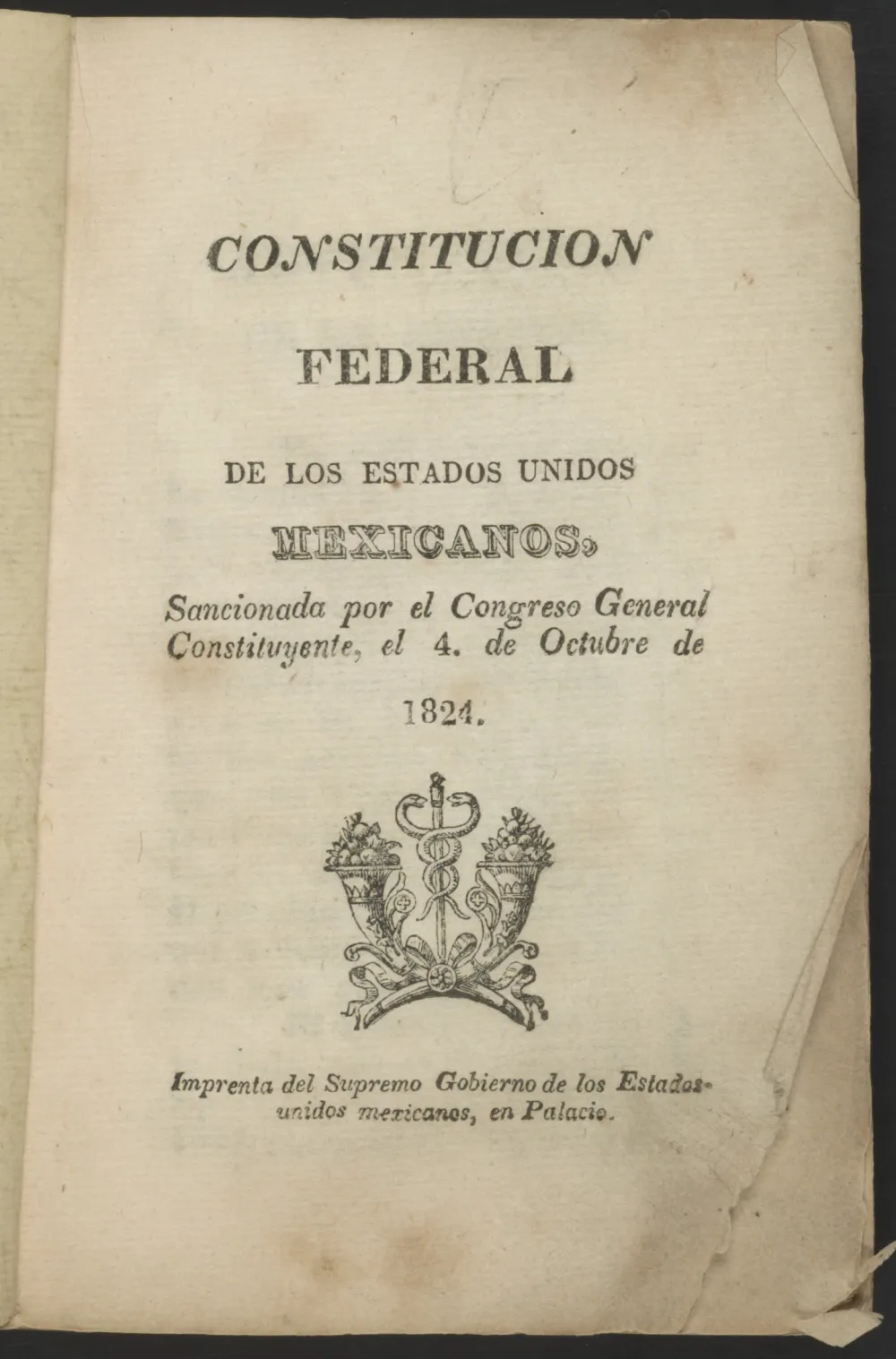
The system's weakness was that it had no arbiter. There was no judicial review of federalism, no mechanism for resolving disputes between the states and the centre except politics or force, and no tradition of loyal opposition. The result was a constitution that was renegotiated by revolt: between 1824 and 1867 Mexico had more than a thousand pronunciamientos — military declarations endorsed by a political plan — and Professor Will Fowler's count puts the figure above 1,500 for the century.
Who governed?
Twenty-odd presidents in forty years, most of them briefly, several of them twice, and one of them — Antonio López de Santa Anna — eleven times. Guadalupe Victoria was the only president to complete his term between 1824 and 1848. Vicente Guerrero abolished slavery in 1829 and was shot in 1831. Anastasio Bustamante, Manuel Gómez Pedraza, Valentín Gómez Farías, Mariano Paredes and José Joaquín de Herrera followed in quick succession, each with a plan, an army and a faction.
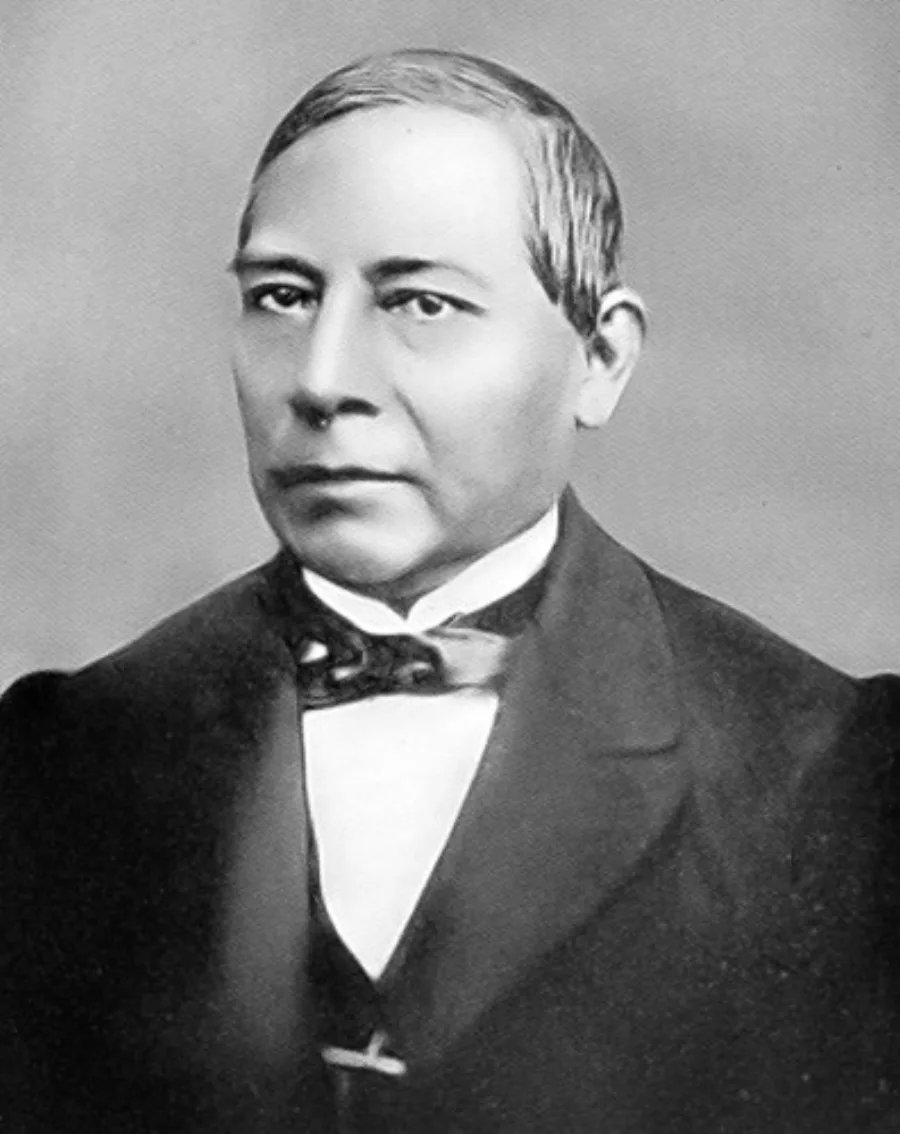
The pattern was set early: a president who tried to govern was accused of dictatorship, a president who did not was accused of weakness, and the army or the provinces decided which. Benito Juárez, the great exception, governed for fourteen years across two wars by refusing to leave office — a legitimacy that his enemies called usurpation and his allies called constitutionalism.
Why did federalism collapse in 1835?
Because the states would not obey and the centre would not share. The federalists were strongest in the provinces and the centralists in Mexico City, and the conflict was as much about money and local power as about political theory. In 1835 Congress declared itself constituent, dissolved the federal system and produced the Siete Leyes of 1836: a centralist constitution with a supreme conservative power, a narrow franchise, and governors appointed from Mexico City.
The centralist experiment lasted a decade and failed. It provoked the Texas revolt and the Yucatán secession, it alienated the provinces, and it was overthrown in 1846 when the war with the United States made federalism a patriotic cause again. The Bases Orgánicas of 1843 had already tried to soften centralism; by 1846 the federal constitution of 1824 was back in force, and Santa Anna was back in the presidency.
How did the states work?
More powerfully than the centre for much of the period. Each state had its own constitution, congress and governor, its own militia and its own revenue, and the states legislated on the questions that mattered most locally: land, labour, taxation and schooling. The state laws of 1825–36 on communal land were the first serious attempt to privatise indigenous property, twenty years before the Ley Lerdo; the federal government followed where the states had led.
Federalism in Mexico was therefore not an abstraction. It was the political expression of provincial elites who wanted to control their own revenues and their own labour force, and the centralist reaction of 1835 was an attempt by Mexico City to recapture both. The war of 1846 restored federalism because the provinces would not fight for a centre that had abolished their governments.
How was Texas lost?
By colonisation, then by centralism. Mexico invited Anglo-American settlers into Texas after 1821 — Stephen F. Austin's colony began in 1825 — because the province needed population and the government wanted a buffer against the Comanche. By 1835 there were some 30,000 Anglo settlers and about 8,000 Mexican tejanos, and the settlers had been exempted from tariffs and taxes for years.
When Santa Anna turned centralist in 1835 and abolished the state governments, Texas revolted. The battles of 1836 — the Alamo in March, Goliad, San Jacinto in April — gave the rebels a country, and the Treaties of Velasco gave them a border at the Rio Grande that Mexico never accepted. The republic survived for nine years, recognised by the United States, Britain and France, and was annexed by the United States in 1845. Mexico broke off relations, and the war followed.
What was the war with the United States?
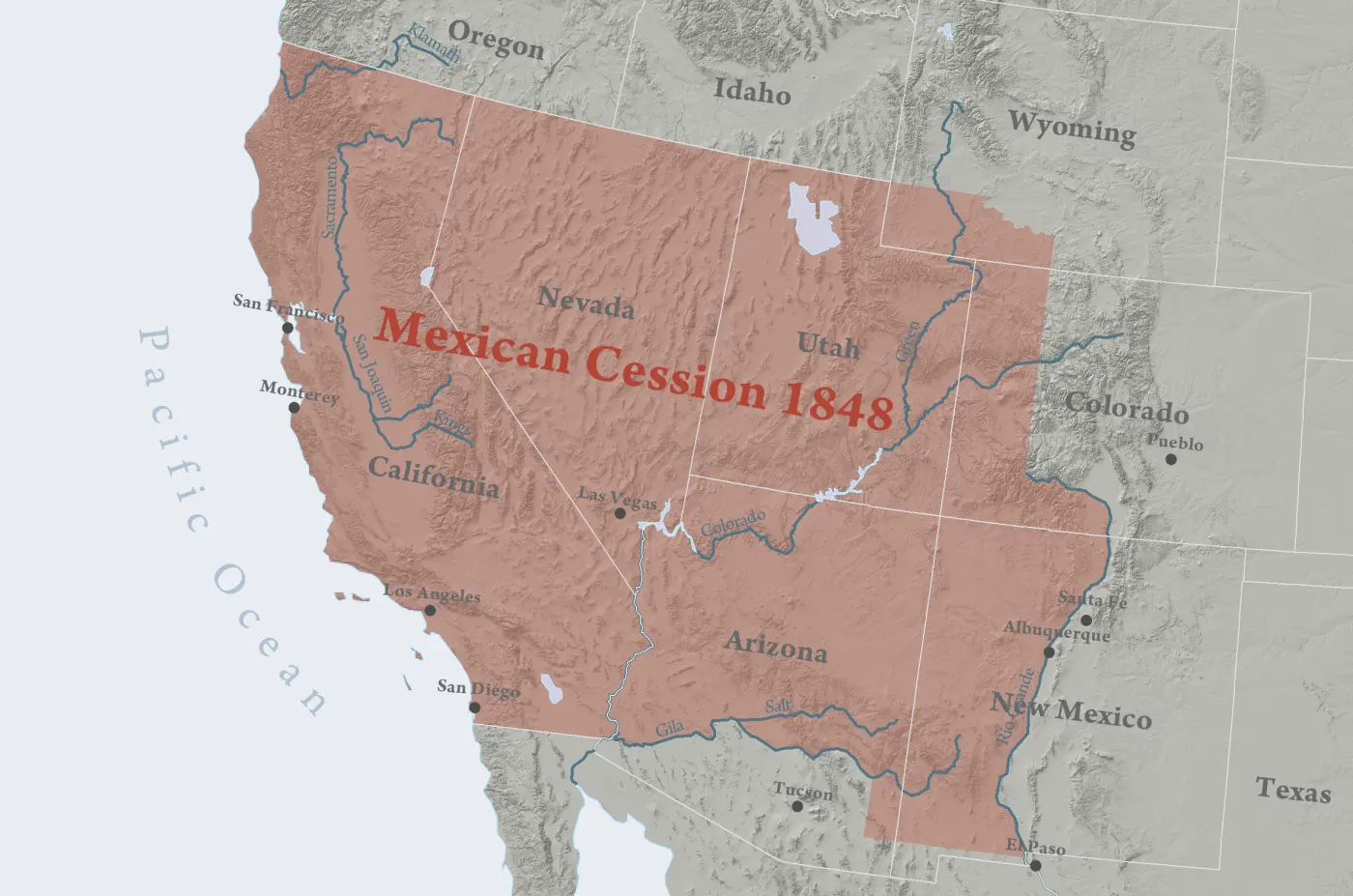
A war of conquest dressed as a border dispute. The immediate cause was the annexation of Texas and the stationing of American troops on the Rio Grande, in territory Mexico claimed; the deeper cause was American expansion westward. Congress declared war on 13 May 1846, and the campaigns took the American army into New Mexico and California, and a landing force to Veracruz and Mexico City, which fell in September 1847.
The Treaty of Guadalupe Hidalgo was signed on 2 February 1848. Mexico ceded 525,000 square miles — about 1.36 million square kilometres — for $15 million and the assumption of claims. That figure covers the territory north of the Rio Grande and west to the Pacific, excluding Texas, whose annexation had already transferred some 700,000 square kilometres. Add Texas and the total comes to about 2.06 million square kilometres. The frequently repeated "55 per cent of Mexico's territory" does not reconcile with the treaty's own acreage, and is best avoided or attributed.
The Senate consented on 10 March 1848 by 38 votes to 14 — the National Archives transcript gives 34 to 14, which appears to be a transcription error, since the contemporary counts and the "four votes fewer than two-thirds" formula only work on 38 to 14. The Gadsden Purchase of 1853 added a further 76,000 square kilometres of northern Mexico for $10 million, to build a southern railway route.
What was the Church's position?
Established, wealthy and privileged, and the central political question for thirty years. Catholicism was the religion of the nation under the 1824 constitution; the Church held property, mortgages and capital, ran the schools and hospitals, and its clergy enjoyed the fuero — trial in their own courts. Its hierarchy had been royalist in the war of independence and remained conservative in the republic, which made it the natural ally of the centralists and the natural target of the liberals.
The 1850 clergy census counted 4,615 priests and religious: a thousand two hundred and ninety-five regulars in 144 convents, and a thousand four hundred and ninety-four nuns. Their wealth was real but not the half of Mexico that legend claims; Bazant's estimate of a fifth to a quarter is the soundest figure, and even that was concentrated in mortgages and urban property rather than in land. The Reform's attack on the fuero and on corporate property was therefore as much about sovereignty as about money: who governs, the Church or the state?
What was the war of 1846–48 like on the ground?
Short, one-sided and humiliating. Zachary Taylor crossed the Rio Grande in 1846 and won at Palo Alto and Resaca de la Palma; Kearny took New Mexico and California without a battle worth the name; Winfield Scott landed at Veracruz in March 1847, bombarded the city, marched inland and beat Santa Anna at Cerro Gordo, Contreras and Churubusco. The storming of Chapultepec in September 1847 — where the young cadets known as the niños héroes died — was followed by the occupation of Mexico City.
The Mexican army fought bravely and badly: it was larger than the American force for most of the war, but its officers were political appointees, its artillery inferior, its supply chaotic and its government divided. The militias of the states did not come; the provinces negotiated their own neutrality; and Santa Anna, who commanded in the field, was suspected — with reason — of negotiating for himself. The war exposed every weakness the Reforma would later try to fix.
What did the war change?
Everything. Mexico lost the northern half of its territory, its credit, its army's reputation and its political stability. The army consumed 15 million pesos against a 13 million budget in 1848, the treasury was empty, and the government of José Joaquín de Herrera survived by borrowing and by cutting. The humiliation destroyed the prestige of the centralist experiment and of Santa Anna, who was blamed for the war and exiled.
It also created the conditions for the Reforma. The generation that came of age after 1847 — Juárez, Lerdo, Comonfort, Ocampo — concluded that Mexico had been defeated because it was not modern, and that the obstacles to modernity were the Church, the army and the communal village. The laws of 1855–59 were the programme of the post-war generation, and the War of Reform was the price of imposing it.
What was the Reforma?
A liberal assault on the corporate privileges of the Church and the army, fought out in laws between 1855 and 1859. The Ley Juárez of November 1855 abolished the fuero — the separate clerical and military courts — for all but a few cases. The Ley Lerdo of June 1856 forbade corporations, including the Church and indigenous communities, from owning land beyond what they occupied, forcing them to sell to tenants and buyers. The Ley Iglesias regulated clerical fees. The constitution of 5 February 1857 entrenched these reforms and added a bill of rights. It also provoked a revolt: the bishop of Puebla denounced the constitution, the conservatives declared it void, and Comonfort, who had promulgated it, staged a coup against his own government in December 1857 rather than fight the Church. That coup opened the War of Reform.
It did not separate Church and state. Article 123 gave Congress jurisdiction over public worship, and the constitution established Catholicism without forbidding other faiths — a compromise that satisfied nobody. Its structural omissions were worse: no Senate, no vice-president, so that when a president died there was no clear successor and no upper chamber to arbitrate. Both gaps caused crises within fifteen years.
What was the War of Reform?
A civil war, 1858–61, between the liberal government of Benito Juárez and the conservative government based in Mexico City. It was fought over the constitution, the Church's property and the question of who legitimately governed. Both sides had presidents, cabinets, armies and foreign recognition; both printed money; both borrowed.
Juárez's government, driven from the capital, issued the Laws of Reform at Veracruz in July 1859: the separation of Church and state, the nationalisation of Church property, civil marriage and civil registration, and religious toleration. Article 3 protected Catholic worship "as well as that of any other" — the law was anti-clerical in its property clauses and tolerant in its religious ones, a distinction its enemies ignored. The liberals won at Silao in August 1860 and at Calpulalpan in December, and Juárez entered Mexico City in January 1861.
Who owned the land?
Not, as the old story has it, a Church that owned half of Mexico. Jan Bazant's study of the disentailment puts ecclesiastical property at perhaps a fifth to a quarter of the national wealth, and shows that Miguel Lerdo de Tejada's father's much-quoted figure of a hundred and eighty million pesos was methodologically inflated. The Church was rich — it held mortgages, urban property, rural estates and capital — but the biggest landowner in Mexico was the hacienda, and the biggest loser from the Reform was not the Church but the indigenous communities.
The Ley Lerdo required communities to divide their communal lands into individual plots and sell them. The result, across the later nineteenth century, was the transfer of millions of hectares from villages to hacendados and speculators. The government knew: a circular of 9 October 1856 ordered that plots worth less than 200 pesos be given free to their tenants, which is the clearest evidence that ministers understood peasants were being swindled. The policy was not reversed until the revolution of 1910.
What happened to the indigenous population?
It remained the majority, and it lost its land. The constitution of 1824 made Indians citizens, which abolished the legal category and with it the colonial protections — the república de indios, the communal lands, the separate courts. The state laws of 1825–36 and then the Ley Lerdo converted communal property into individual plots to be sold, and the buyers were usually not the villagers.
The consequences were slow and catastrophic. By 1910 perhaps 90 per cent of the rural population was landless, and the revolution that began in 1910 was in large part a revolt for land. The liberal reformers of 1856 believed they were creating a nation of small proprietors; they created a nation of peons, and the Zapatista demand for land in 1911 was the bill for the Reform.
What was the economy like?
Poor, indebted and regional. Silver remained the great export and the state's main revenue, but the mines were undercapitalised and the mints struck far less than before 1810. Agriculture was the largest sector — maize, wheat, sugar, pulque, cotton — and the hacienda the dominant institution, with peonage enforced by debt and by law. Textiles were the one significant industry, concentrated in Puebla and the Bajío. The first railway, from Veracruz towards San Juan, opened in 1850.
The public debt was the recurring crisis: 38 million pesos in 1830, 66.5 million by 1856, and insolvency in 1861. The army consumed the largest share of the budget — 15 million pesos against a 13 million budget in 1848 — and the war with the United States destroyed the credit of the state. Foreign lenders — British, then French, then Spanish — held the paper, and it was the suspension of payments on 17 July 1861 that gave Napoleon III his pretext.
What was the American role?
Decisive, and double. The United States was the model for Mexican federalism, the victor of 1848, and the patron of the liberals in the Reform. Juárez's government negotiated the McLane–Ocampo treaty of 1859, which would have sold transit rights across the Isthmus of Tehuantepec and granted naval bases in exchange for money and recognition; the Senate rejected it, partly because it looked like another annexation. The conservatives, meanwhile, looked to Europe.
In 1861 the United States was at war with itself and could do nothing to stop France; in 1865, with the Civil War over, Seward's diplomacy and a demonstration on the Rio Grande helped persuade Napoleon III to withdraw. The Mexican republic survived partly because its northern neighbour was distracted and then because it was no longer distracted — a dependence that shaped Mexican politics for the next century.
How did the republic survive the French?
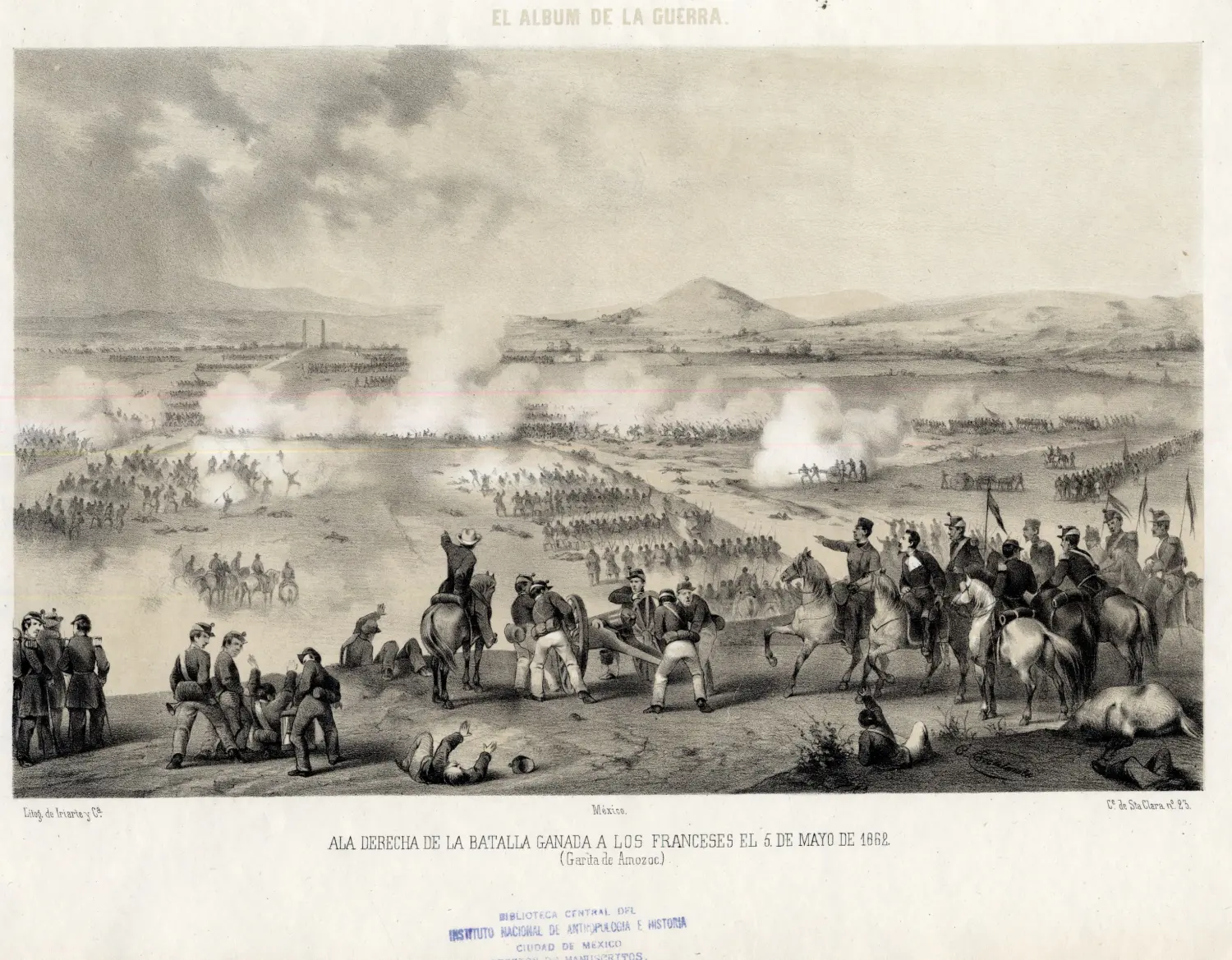
Barely, and by refusing to lose. The Convention of London of October 1861 sent British, Spanish and French forces to Veracruz to collect the debt; Britain and Spain withdrew when they realised France intended to overthrow the government, and the French marched inland alone. They were checked at Puebla on 5 May 1862 — Zaragoza's force was about 4,850 men, and French casualties were 482 by Lorencez's own table — and then took the city in May 1863 and entered Mexico City in June.
Juárez's government retreated north, to San Luis Potosí, then Chihuahua, then Paso del Norte, and governed from a wagon with a printing press. It kept the republic's legal existence alive, which was the whole point: the empire could hold the cities, but it could never make the republic cease to exist. The Assembly of Notables that offered the crown to Maximilian in July 1863 claimed constituent sovereignty while handing the succession to a foreign prince, which is the empire's constitutional absurdity in a sentence.
The French withdrew from 1866 as their own war with Prussia approached, and the republicans took Querétaro in May 1867. Maximilian was shot on 19 June 1867.
How did the republic govern in wartime?
By emergency decree, and it knew it. Juárez's government governed under the constitution of 1857 when it could and by decree when it could not: it suspended constitutional guarantees, confiscated property, conscripted and taxed by order. On 8 November 1865, with the government at Chihuahua and the empire at its height, Juárez decreed the prorogation of his own term of office, reasoning openly from "the supreme law of necessity" — the most revealing document of the republic's constitutional crisis, because it shows a liberal government arguing that the constitution must bend to survive.
The republicans called it necessity; the imperialists called it dictatorship; and both were describing the same fact. The Mexican republic of the 1860s was a government of laws that survived by suspending them, and the tension between legality and survival is the central theme of its politics.
When did the Federated Republic end?
Historians give three answers. 1864, when Maximilian accepted the crown and the republic lost the capital — the answer the map implies, since the border data ends in 1865. 1867, when the Restored Republic began and Juárez returned — the answer Mexican constitutional history prefers, because the republic never legally ceased. 1876, when Porfirio Díaz ended the Restored Republic and began the Porfiriato — the answer social historians prefer, because the Liberal state only became stable then.
The most useful answer is that "Federated Republic" describes a constitutional form rather than a fixed period. Mexico was a federal republic in 1824, a centralist republic in 1836, a federal republic again in 1846 and 1857, and an empire in 1864 — and through all of it the constitution, the states and the Liberal party persisted as claims. Cosío Villegas's phrase, quoted by Cárdenas Ayala, is that the republic was a form of government that could be suspended without being abolished.
What was the Restored Republic?
The fourteen years after 1867, when Juárez and then Lerdo de Tejada governed under the constitution of 1857. It was a period of reconstruction, of railways and foreign investment, and of political closure: Juárez's attempt to amend the constitution by plebiscite in 1867 failed, his re-election in 1871 provoked a revolt, and he died in office on 18 July 1872. Lerdo succeeded under article 79, pushed through the 1873 and 1874 reforms — including the separation of Church and state and the abolition of the death penalty for political crimes — and was overthrown by Díaz in 1876.
The Restored Republic is where the liberal project became the Porfiriato: the same men, the same constitution, the same railways, with the opposition suppressed instead of courted. Díaz's slogan — "no re-election" — was the promise he broke, and the revolution of 1910 was the result.
Common myths about the Federated Republic
| Myth | What the evidence says |
|---|---|
| Mexico ceded 55 per cent of its territory in 1848 | The cession was 525,000 square miles, about 1.36 million km²; 2.06 million with Texas. The 55 per cent figure does not reconcile with the treaty's acreage. |
| The Church owned half of Mexico | Bazant puts ecclesiastical property at a fifth to a quarter; the 180 million peso figure is methodologically inflated. |
| The 1857 constitution separated Church and state | It did not: article 123 gave Congress jurisdiction over worship. Separation came with the 1859 Laws of Reform and the 1873 reforms. |
| Juárez governed from the capital throughout | His government was driven to Veracruz in 1858 and to Chihuahua and Paso del Norte in 1863–64. |
| The French were defeated at Puebla in 1862 and went home | They took Puebla in 1863 and Mexico City in June 1863; the empire lasted until 1867. |
| The Reforma was popular | It was a liberal project imposed on a Catholic peasantry; the War of Reform was fought to a military decision, not won by acclamation. |
| Texas was lost because Mexico neglected it | It was lost because Mexico invited Anglo colonisation and then abolished the state government that the colonists had sworn to. |
| The republic ended in 1864 | It lost the capital, not its legal existence; the Restored Republic began in 1867. |
Timeline of the Federated Republic
| Year | Event |
|---|---|
| 1824 | Federal constitution, 4 October |
| 1827 | Expulsion law against Spaniards |
| 1829 | Guerrero abolishes slavery |
| 1835 | Congress declares for centralism |
| 1836 | Siete Leyes; Texas independence |
| 1838–39 | Pastry War |
| 1843 | Bases Orgánicas |
| 1845 | United States annexes Texas |
| 1846 | War with the United States; federal constitution restored |
| 2 February 1848 | Treaty of Guadalupe Hidalgo |
| 1853 | Gadsden Purchase; Santa Anna returns |
| 1855 | Ley Juárez; Ayutla revolution |
| 1856 | Ley Lerdo |
| 5 February 1857 | Liberal constitution |
| 1858–61 | War of Reform |
| 1859 | Laws of Reform |
| 1861 | Liberal victory; debt suspension, 17 July |
| 5 May 1862 | Battle of Puebla |
| 1863 | French take Mexico City; Assembly of Notables |
| 1867 | Querétaro; Maximilian shot, 19 June |
What the map shows next
At 1836 on the map Texas has declared independence, and the Republic of Texas is nine years old.
At 1848 on the map the northern territories are gone to the United States, and the Confederacy is thirteen years away.
Common questions
- What was the Federated Republic of Mexico?
- The Mexican republic from the 1824 constitution to the French intervention, covering the loss of Texas, the war with the United States and the Reform.
- When did it exist?
- 1824 to 1864 on the map; 1824 to 1867 in constitutional terms, since the republic never legally ceased.
- Why did Mexico lose Texas?
- Because it invited Anglo-American colonisation after 1821, then abolished the state governments in 1835, provoking a revolt that Mexico could not suppress.
- How much territory did Mexico lose in 1848?
- 525,000 square miles, about 1.36 million km², for $15 million; about 2.06 million km² if Texas is included.
- What was the Reforma?
- The liberal laws of 1855–59 that abolished corporate privileges, forced the Church to sell its property and separated Church and state.
- What was the War of Reform?
- The civil war of 1858–61 between Juárez's liberal government and the conservative government in Mexico City.
- Did the constitution of 1857 separate Church and state?
- No. Article 123 gave Congress jurisdiction over worship; separation came in 1859 and 1873.
- How did the republic survive the French intervention?
- By refusing to surrender its legal existence: Juárez's government moved north and governed from Chihuahua and Paso del Norte until the French withdrew in 1866–67.
- Why did France invade Mexico?
- Officially to collect debts after the 1861 suspension of payments; in practice Napoleon III wanted to install a client monarchy in the Americas.
- What was the Restored Republic?
- The period 1867–76 when Juárez and Lerdo governed under the 1857 constitution, ending with Díaz's revolt.
Sources
Every source below was consulted while writing this entry.
Every source below was consulted while writing this entry.
Primary and official sources
- The Federal Constitution of 4 October 1824, articles 2–5, 50, 74–77 and 171.
- The 1827 expulsion law, from the Archivo General de la Nación Boletín.
- Guerrero's abolition decree of 1829.
- The Siete Leyes of 1836 and the Bases Orgánicas of 1843, from UNAM's Museo de las Constituciones.
- The Treaty of Guadalupe Hidalgo (2 February 1848), US National Archives and the State Department historian.
- The Ley Juárez (1855), Ley Lerdo (1856) and Ley Iglesias.
- The Constitution of 5 February 1857, article 123.
- The Laws of Reform (1859), including article 3.
- The Convention of London (1861) and the debt suspension decree of 17 July 1861.
- Juárez's Apuntes and the Chihuahua manifesto.
- The 8 November 1865 decree proroguing Juárez's term.
- Arrillaga, Memoria de Hacienda (1823), for the inherited debt.
Scholarship and reference works
- Jan Bazant, Alienation of Church Wealth in Mexico.
- Will Fowler, on the pronunciamiento and the St Andrews database.
- INEHRM, La guerra entre México y los Estados Unidos (2024), double-blind reviewed.
- Olveda, on the abolition of slavery, SciELO.
- Medina Reyes, on the expulsion of the French, SciELO.
- Cárdenas Ayala, on periodisation and Cosío Villegas.
- Pani, on the Mexican imperialists.
- Hamnett and Thomson, cited only where openly available (their books are lending-only).
Data sources for the map
- Cliopatria v0.12 (Seshat Global History Databank, CC BY 4.0).
- Historical Basemaps (GPL-3.0).
This entry was written from the sources above and last updated .
Text available under CC BY-SA 4.0: reuse it with a credit to The World Through Time and a link to this page.
Border geometry for the map itself comes from Cliopatria v0.12 (Seshat Global History Databank, CC-BY-4.0).
See the Federal Republic of Mexico in its world
Open the atlas at 1845 and every neighbour, rival and successor is on screen with it — then drag the slider and watch what happens next.
Open the map at 1845 →