Sadko is the hero of one of the best-known Russian byliny, the oral epic songs of the Russian north. A poor gusli-player from Novgorod, he wins the favour of the sea tsar with his music, becomes the richest merchant in the city, sails the seas with thirty ships, and is taken down into the underwater kingdom before returning home. Ilya Repin painted him, Nikolai Rimsky-Korsakov wrote an opera about him, and a Soviet film of 1952 sent him around the world.
Behind the legend there may be a real man. The Novgorod First Chronicle records that in the spring of 1167 a certain "Sotko Sytinich" founded a stone church in Novgorod. Almost nothing else is known about him, and the songs about Sadko were written down only in the 18th and 19th centuries. But the world the bylina describes, a city of rich merchants trading with Gotland and Germany, is well documented by the chronicle, treaties, excavations and the birchbark letters of Novgorod.
Sadko at a glance
| Who | Hero of Novgorod byliny (oral epic songs): a gusli-player who becomes a rich merchant |
| Historical figure? | Possibly Sotko (Sedko) Sytinich, founder of a stone church in Novgorod in 1167 |
| Only medieval record | One line in the Novgorod First Chronicle, under 1167 |
| Songs written down | 18th century (Kirsha Danilov collection) and 1860s–1870s (Olonets region) |
| Main versions | Rybnikov; Gilferding, from the singer A. P. Sorokin (1871); Kirsha Danilov nos. 28 and 47 |
| Later works | Repin's painting (1876), Rimsky-Korsakov's opera (1897), Ptushko's film (1952) |
Was Sadko a real person?
The only medieval record is a single entry in the Novgorod First Chronicle for the year 6675 (1167):
"The same spring Sedko Sitinits founded the stone Church of the Holy Martyrs Boris and Gleb under Knyaz Svyatoslav Rostislavits, and Vladyka Ilya." (Novgorod First Chronicle, trans. Michell and Forbes, 1914)
The older, Synodal copy of the chronicle spells the name Sъdko Sytinits; the younger Commission copy has Sotko Sytinits. The chronicle says nothing about his trade or his music. It does not call him a merchant. Another entry, under 1049, adds that the old wooden cathedral of St Sophia had stood "where Sotko has now built the stone church of Saints Boris and Gleb above the Volkhov". On 14 October 1173 Archbishop Ilya consecrated the new church "in the town", that is, in the citadel.
Was this Sotko the Sadko of the songs? The Brockhaus and Efron encyclopedia (1900) thought the oldest core of the bylina was "probably" a song about him. The folklorist S. N. Azbelev (2004) points out that 17th-century Novgorod chronicles call the founder "Sotko the rich", which matches the songs. But the songs make Sadko build a church of St Nicholas, not of Boris and Gleb. The identification is plausible, but it cannot be proven.
Building a stone church was a costly undertaking, and the chronicle usually names princes or archbishops as founders. That Sotko founded one in his own name suggests he was a very wealthy man, perhaps a merchant, but the chronicle does not say how he made his money.
What the bylina says
The bylina survives in several versions. The Brockhaus and Efron encyclopedia knew nine, all recorded in the Olonets region north of Lake Onega, of which only two are complete. The fullest was sung in 1871 by A. P. Sorokin to the collector Alexander Gilferding. Its story, as the encyclopedia summarises it:
- The wager. Sadko, a poor gusli-player who entertains Novgorod's merchants and boyars, plays all day on the shore of Lake Ilmen. The water tsar, pleased, tells him to bet the rich merchants that there is a fish with golden fins in the lake. With the tsar's help Sadko catches it, wins the wager, and becomes a trader.
- Buying Novgorod. At a feast Sadko boasts that he can buy up every ware in the city. For two days he buys everything in the market, but on the third day new goods arrive from Moscow, and he admits defeat. In Isabel Hapgood's English version of 1886, he says: "Sadkó the merchant is rich, but glorious Nóvgorod is still richer!"
- The sea tsar. Sadko loads thirty ships and sails out. At sea the ships stop dead, even in a strong wind. The sea tsar wants tribute; barrels of gold, silver and pearls do not satisfy him, and lots are cast to find a living victim. The lot falls on Sadko, who is lowered into the sea on an oak plank with his gusli.
- The underwater kingdom. The sea tsar wants to hear him play. When he dances to the music, the sea rises and ships sink, until St Nicholas appears as an old man and tells Sadko to break the strings. The tsar then wants Sadko to marry a maiden of the sea. On St Nicholas's advice he chooses Chernava, and after the wedding feast wakes on the bank of the river Chernava, near Novgorod, as his ships arrive on the Volkhov. In thanks he builds a church of St Nicholas.
An 18th-century version in the collection of Kirsha Danilov (no. 47) has Sadko himself admit to his crew that he has sailed the sea for twelve years and never paid tribute to the sea tsar. When he wakes, he finds himself near Novgorod with one foot in the river Volkhov, and recognises his own parish church of St Nicholas.
Where do the motifs come from?
The scholars of the late 19th century, as the Brockhaus and Efron encyclopedia reports, disagreed about the sources of the story:
- Alexander Veselovsky pointed to the Old French romance Tristan le Léonois, whose hero Sadoc flees by ship and is caught in a storm, and saw the name as coming from the Hebrew Tsadok, "the righteous".
- Vsevolod Miller compared the sea tsar with the Finnish water god Ahti and Sadko the musician with Väinämöinen of the Finnish epic.
- I. Mandelshtam answered that the parallels Miller found in the Kalevala were later additions by its compiler, Elias Lönnrot.
The encyclopedia concluded that the immediate sources of the bylina were unknown. What is clear is that a Novgorod tale gathered motifs from far and wide, the golden fish, the wager, the sea that demands a victim, around a local name.
The merchant world behind the legend
The bylina makes Sadko a hero for his trading, not for feats of arms. The Brockhaus and Efron encyclopedia called him "a representative of Novgorod's trade, a merchant hero". Whatever the truth about Sotko, the world of Novgorod's merchants in his time is well documented.
Merchants from overseas
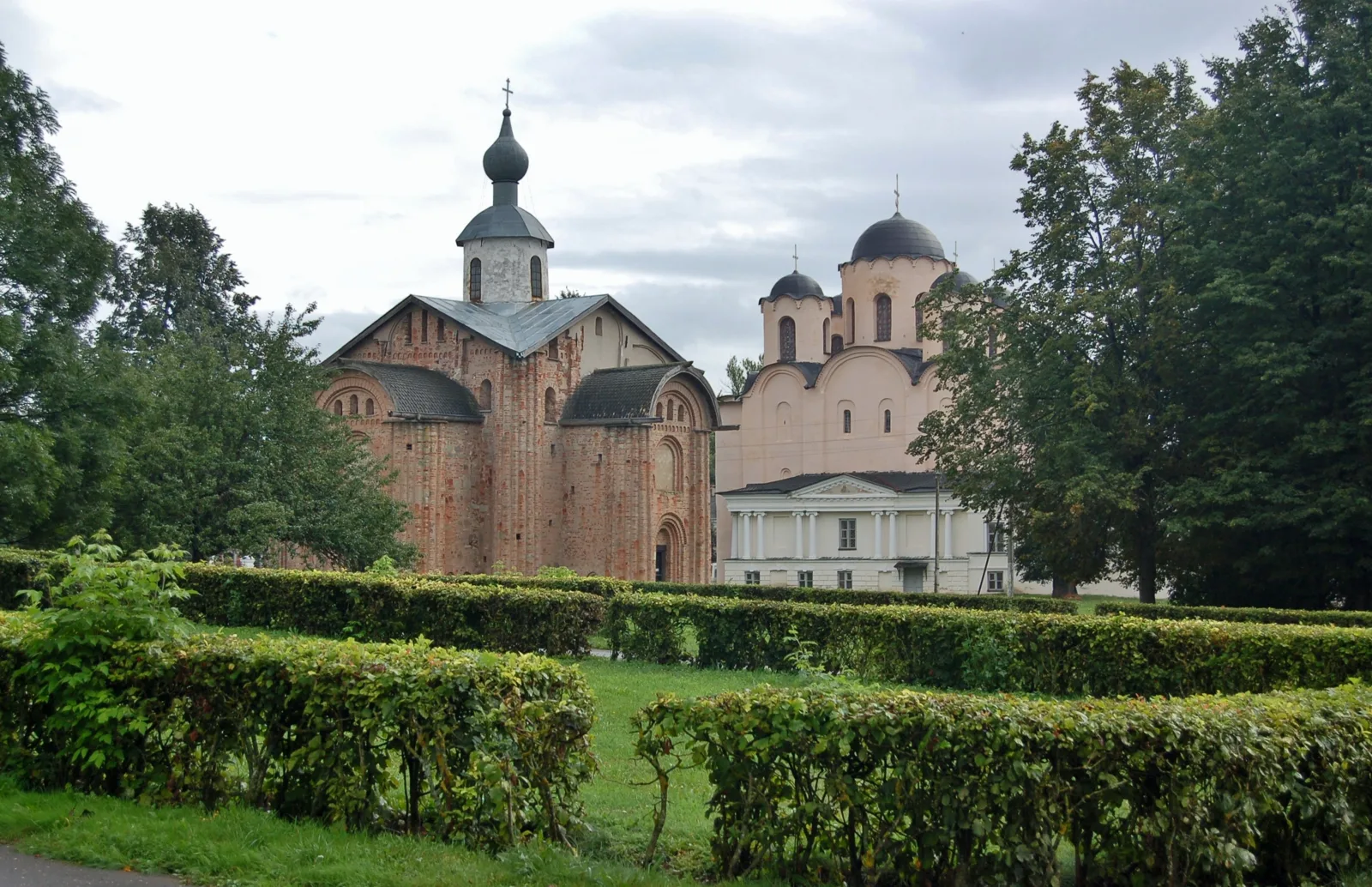
The Novgorod chronicle shows foreign merchants as a permanent part of the city. In 1115 "the foreign merchant, Voi, laid the foundation of a church to St. Theodore of Tyre". In 1156 "the oversea merchants put up the Church of the Holy Friday on the market place", and in 1207 they completed it. When a great fire swept the city in 1217, "in the Varangian church all the countless Varangian merchandise was burnt".
The "Varangian church" was the church of St Olaf at the Gotland court, the trading yard of merchants from the island of Gotland in the Baltic. A treaty of 1268/69 lists its property: "the court of the Gotlanders with the church and cemetery of St Olaf and the adjoining meadows". German merchants had their own court, the Peterhof, which later became one of the main foreign offices of the Hanseatic League. The historian E. A. Melnikova (2019) argues that both the Gotland court and Novgorod's own trading yard in Visby on Gotland existed by about 1130.
Trade could turn violent. In 1142 a Swedish fleet of 60 boats attacked Novgorod merchants returning from overseas. In 1188 Novgorod merchants were attacked on Gotland and in German lands, and "in the spring they let no man of their own go beyond sea" (Novgorod First Chronicle).
The merchants' guild of St John
Novgorod's own wealthiest merchants were organised in the "Ivanskoe sto", the merchant hundred of the church of St John the Forerunner on Opoki. A charter attributed to Prince Vsevolod Mstislavich (who ruled Novgorod until 1136) gave the guild two elders to manage "the affairs of St John's, of trade and of the merchants, and the commercial court". According to the historian M. A. Nesin (2015), new members had to pay their entry fee in cloth from Ypres in Flanders. The date and authenticity of the charter are disputed; the surviving text is later than Vsevolod's time.
Merchants' letters on birch bark
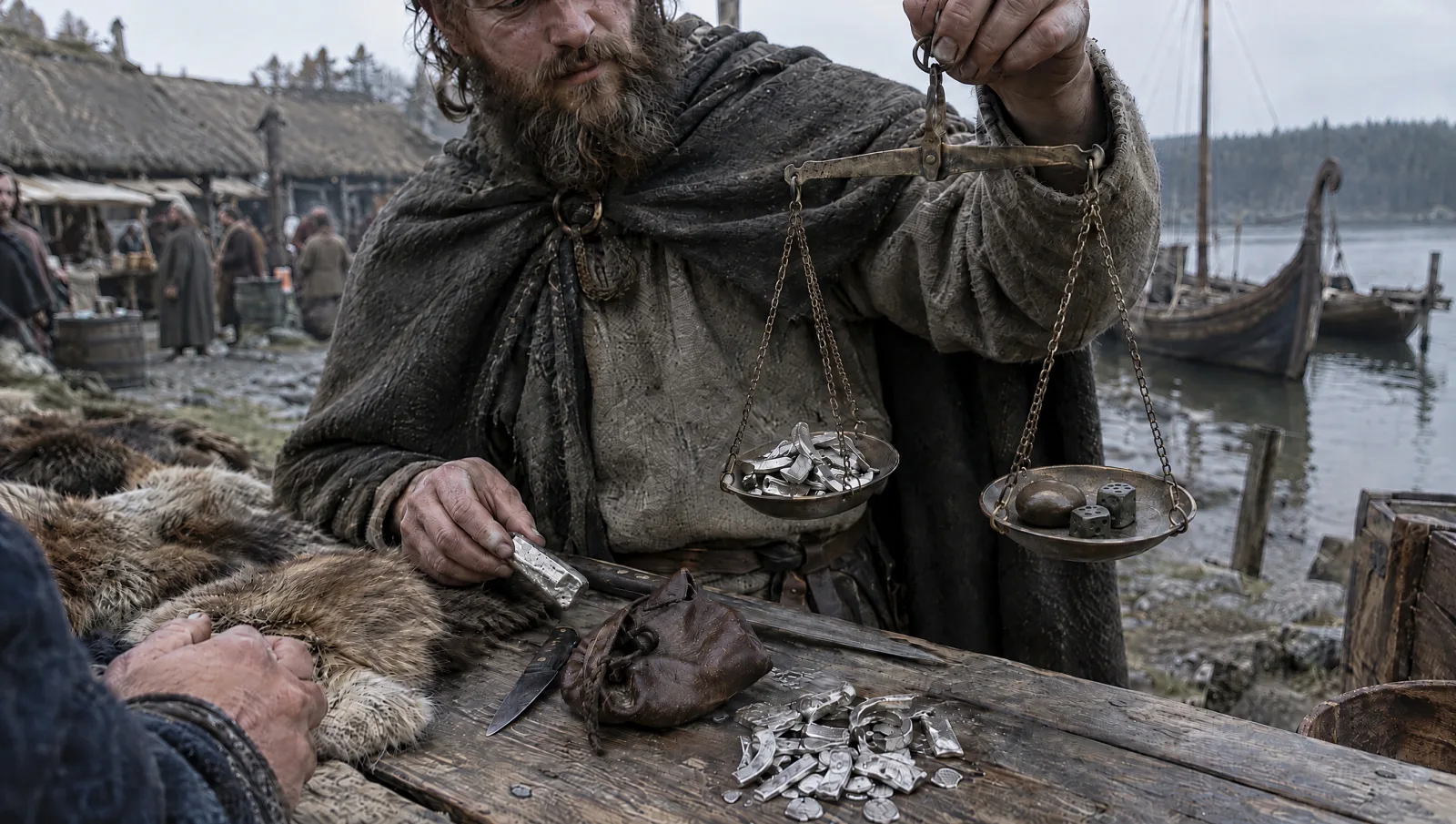
The best evidence for everyday trade comes from the birchbark letters found in Novgorod's waterlogged soil since 1951. They show merchants buying and selling on credit, sending goods and chasing debts. A letter of around 1160–1180 reads, in R. Kovalev's translation: "I sold all of the tin, lead, and all of the forged [metal] goods. Now, I do not have a [need] to go to Suzdal'." A letter of the mid-13th century records a sale of forty beaver pelts for ten grivnas of silver. These are the kinds of men the bylina made into Sadko.
Sadko in art and music
The 19th-century collections made Sadko famous in Russia's cities.
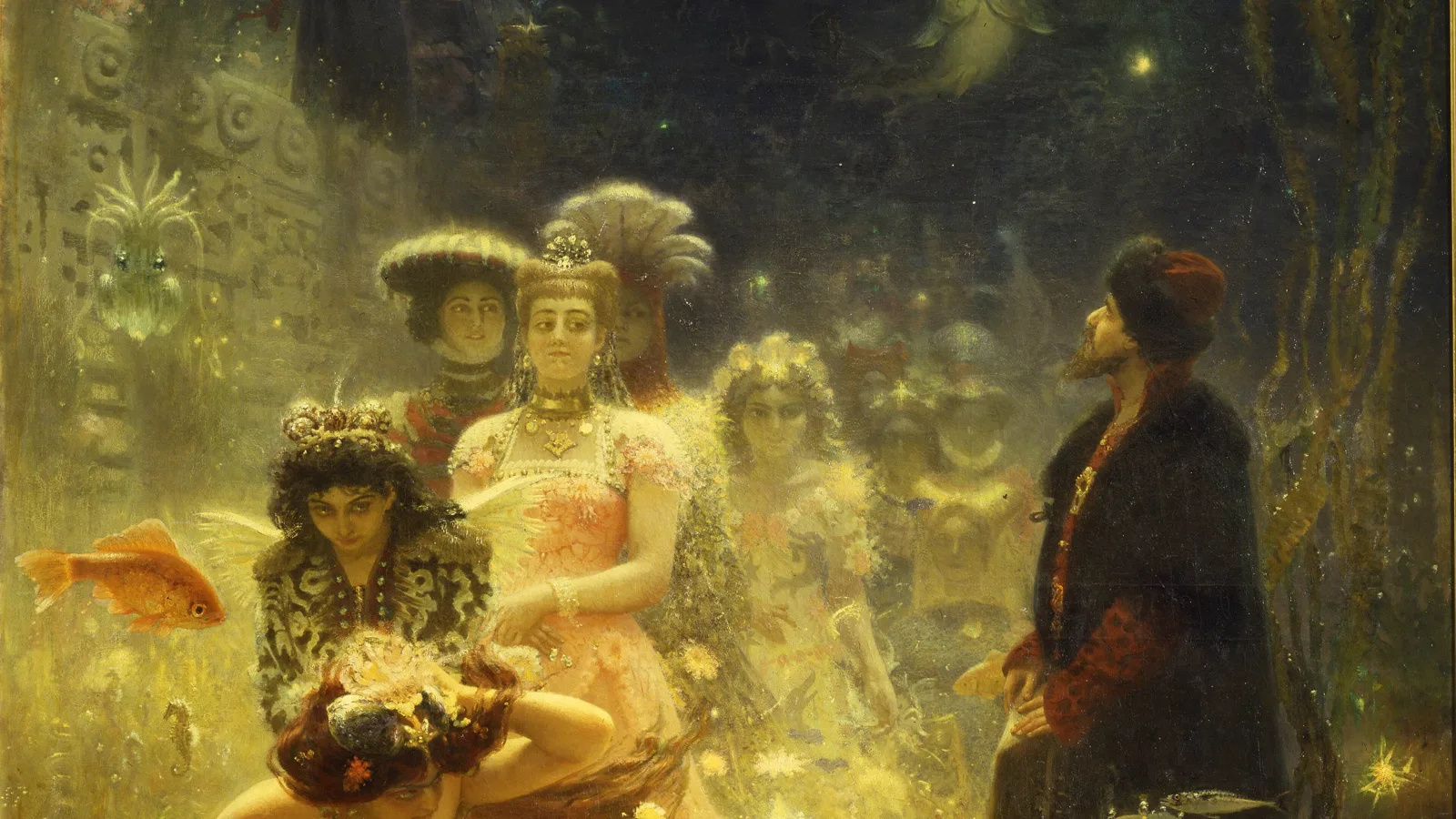
- Ilya Repin painted Sadko in the Underwater Kingdom in 1876.
- Nikolai Rimsky-Korsakov wrote first a symphonic picture called Sadko and then, in 1897, a full opera, which was staged the same year by a private opera company in Moscow (Brockhaus and Efron). The opera gives the sea tsar a daughter, the princess Volkhova, who does not appear in the versions of the bylina summarised above.
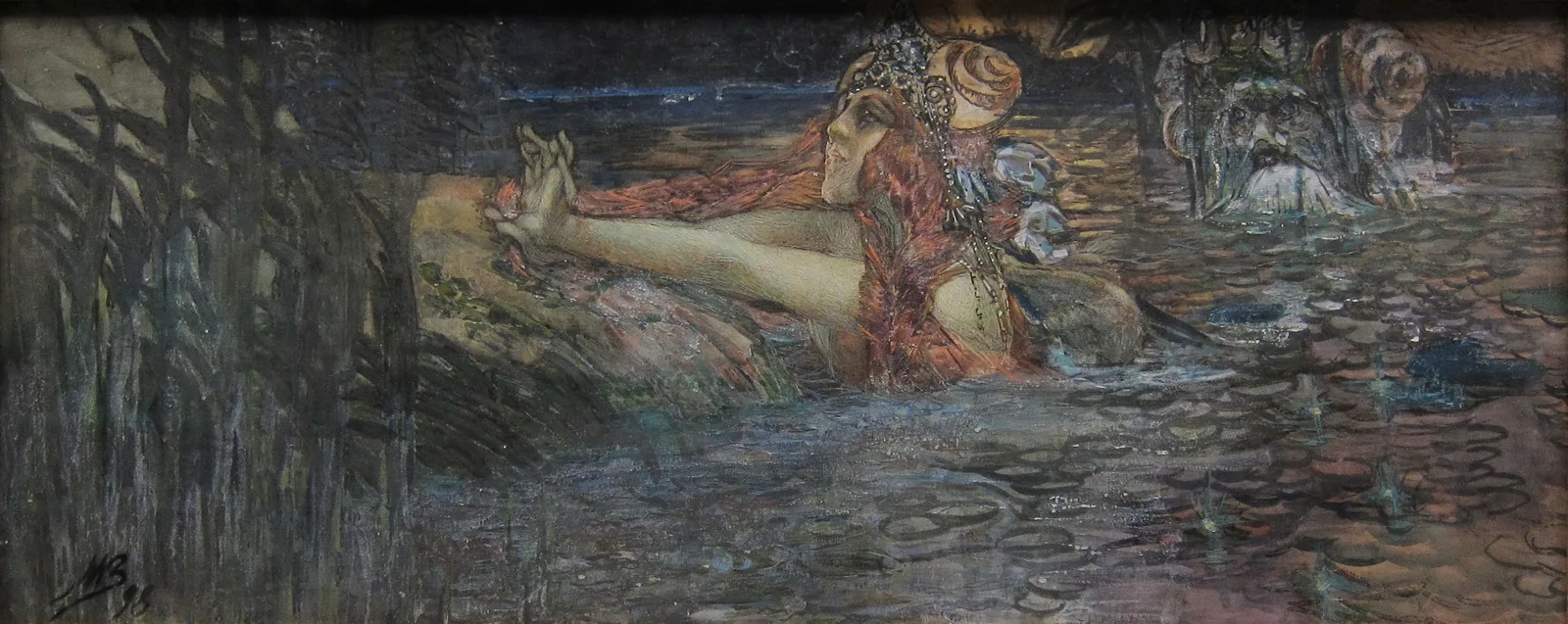
- Mikhail Vrubel painted the farewell of the sea tsar and the princess Volkhova in 1898.
- Aleksandr Ptushko's film Sadko (Mosfilm, 1952) sent the hero abroad in search of the "bird of happiness". It won a Silver Lion at the Venice Film Festival in 1953.
These works shaped the popular picture of Sadko far more than the songs themselves.
Common myths about Sadko
| Myth | What the evidence says |
|---|---|
| Sadko is a well-documented historical merchant | One chronicle line names a Sotko Sytinich who founded a church in 1167; it does not call him a merchant or a musician |
| The real Sadko built the church of St Nicholas | The chronicle's Sotko built the church of Saints Boris and Gleb; the songs name St Nicholas and other churches |
| The bylina is a medieval text | It was written down only from the 18th century on; the songs may be older, but their medieval form is unknown |
| Sadko married the sea princess Volkhova | Volkhova comes from Rimsky-Korsakov's opera; in the bylina the bride is Chernava |
| Sadko searched the world for the bird of happiness | That comes from the 1952 film, not the bylina |
What the map shows next
The map of 1167 shows the Novgorod Republic at the centre of a trading world that reached across the Baltic to the Kingdom of Sweden and the German lands of the Holy Roman Empire, and east to Volga Bulgaria. To the south lay the Principality of Kiev and the Principality of Rostov-Suzdal, whose markets the birchbark merchants mention.
Sources
Primary sources
- The Chronicle of Novgorod, 1016–1471, trans. R. Michell and N. Forbes (London, 1914), entries for 1115, 1142, 1156, 1167, 1173, 1188, 1207, 1217: https://archive.org/details/chronicleofnovgo00michrich
- Novgorodskaia pervaia letopis' starshego i mladshego izvodov, ed. A. N. Nasonov (Moscow, 1950): https://archive.org/details/novhorodskyj_litopys
- Kirsha Danilov, Drevnie rossiiskie stikhotvoreniia, nos. 28 and 47: ru.wikisource.org
- I. F. Hapgood, The Epic Songs of Russia (New York, 1886): https://archive.org/details/epicsongsofrussi00hapguoft
- Birchbark letters nos. 420 and 439, gramoty.ru, with English translations by R. Kovalev: https://gramoty.ru/birchbark/document/show/novgorod/439/
Studies
- "Sadko", Entsiklopedicheskii slovar' Brokgauza i Efrona, vol. 28a (1900): https://ru.wikisource.org/wiki/ЭСБЕ/Садко
- S. N. Azbelev, "Ustnaia istoriia Velikogo Novgoroda", Vestnik PSTGU (2004): https://cyberleninka.ru/article/n/ustnaya-istoriya-velikogo-novgoroda-1
- E. A. Melnikova, "Sushchestvoval li dvustoronnii novgorodsko-gotlandskii dogovor doganzeiskogo vremeni?", Peterburgskii istoricheskii zhurnal (2019): https://cyberleninka.ru/article/n/suschestvoval-li-dvustoronniy-novgorodsko-gotlandskiy-dogovor-doganzeyskogo-vremeni
- M. A. Nesin, "Novgorodskie tysiatskie v XIII v." (2015): https://cyberleninka.ru/article/n/novgorodskie-tysyatskie-v-xiii-v
Image credits
- Title image: Ilya Repin, Sadko in the Underwater Kingdom, 1876. Public domain, via Wikimedia Commons, cropped to 16:9.
- Mikhail Vrubel, The Sea Tsar Takes Leave of the Princess Volkhova, 1898. Public domain, via Wikimedia Commons.
- Churches on Yaroslav's Court, Veliky Novgorod. Photo: Bahnfrend, 2006, CC BY-SA 4.0, via Wikimedia Commons.