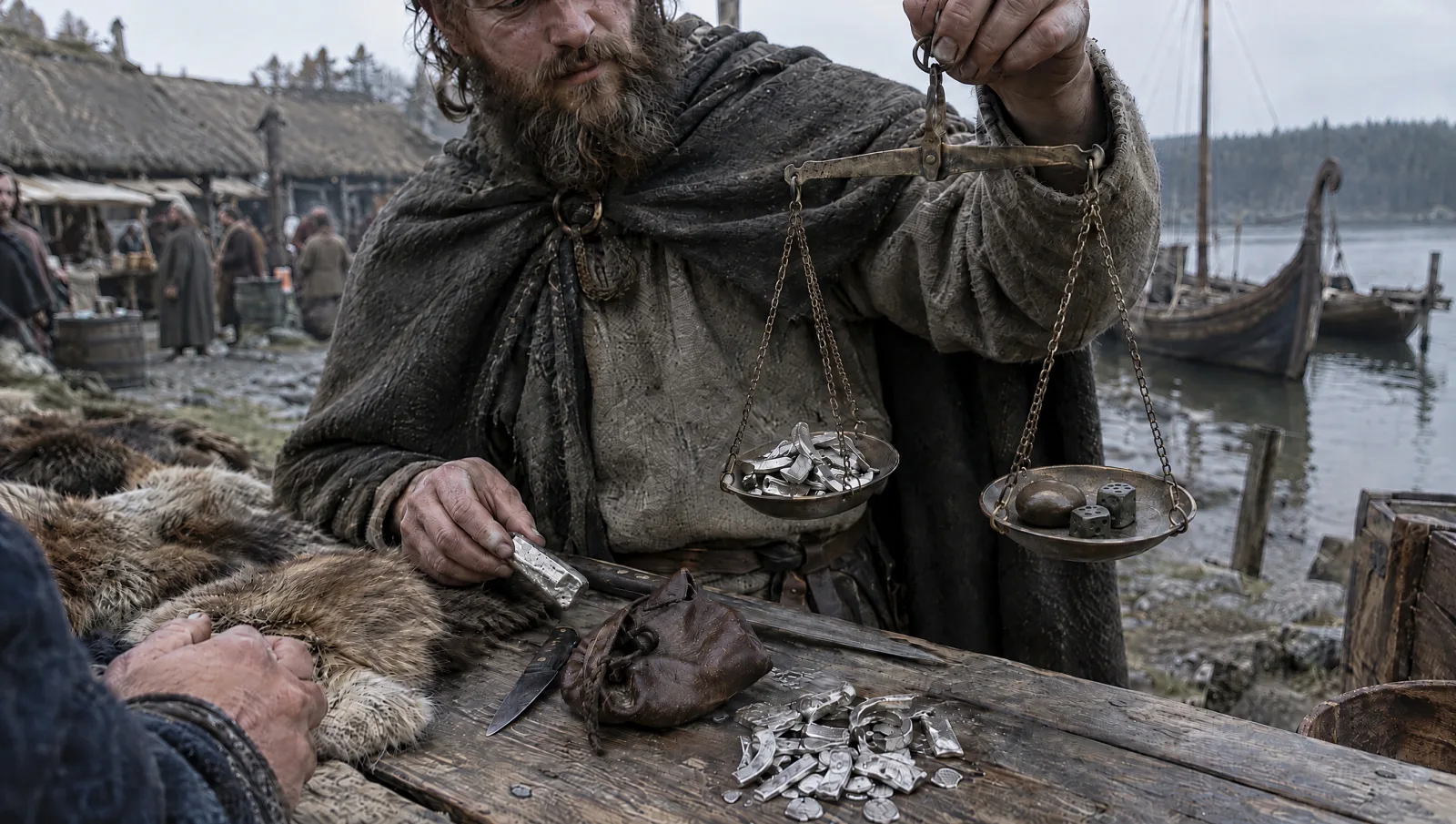
The Vikings had money, but most of it was not counted coin by coin. In Scandinavia and the lands the Vikings settled, silver was money whatever its shape: Arab coins called dirhams, bars of cast silver, arm-rings and neck-rings, and the chopped-up pieces of all of them known as hacksilver. Traders weighed it on small folding scales against standard weights and cut a nick into it to check it was solid. Only from about AD 995 did Scandinavian kings strike coins of their own on any scale, and the coins people now call "Viking coins" are mostly foreign: Islamic, English and German.
Buried silver is how we know all this. Hoards from Gotland to Lancashire, some holding tens of kilos of metal, show how the system worked and where the silver came from.
Did the Vikings have money?
Yes. What they did not have, for most of the Viking Age, was coinage of the western kind. The archaeologist Jane Kershaw sums it up: the economy of northern Europe "was divided into two currency zones stretching either side of the River Elbe". To the north and east, "including Scandinavia", "weighed silver was used as payment". To the west, in the Frankish and English kingdoms, "locally issued coin served as the primary form of silver currency" (Kershaw, Antiquity, 2017).
In the northern zone a coin was simply a piece of silver of a known purity. A merchant could take a whole dirham, half a dirham or a bent fragment of a bracelet, and all of it was worth exactly what it weighed. Silver also served as stored wealth and as jewellery. According to Ibn Fadlan, who met Rus' traders on the Volga in AD 922, their women wore a neck-ring for every 10,000 dirhams their husbands owned (see our article on Ibn Fadlan and the Rus').
How did Vikings pay with silver?
They weighed it. A Viking-Age trader carried a small bronze balance with folding arms and a set of weights. Two standard types of weight spread through Scandinavia and the Baltic from the AD 860s and 870s:
- Cubo-octahedral weights: small, dice-like copper-alloy weights of about 0.75 to 4.5 grams, with "1, 2, 3, 4 or 6 punched dots" on their faces to show their value.
- Oblate-spheroid weights: larger, flattened balls with an iron core and a brass casing, used for bigger payments.
Both copy Islamic models in their shape and, "less certainly", in a shared unit of about 4 grams (Kershaw 2017).
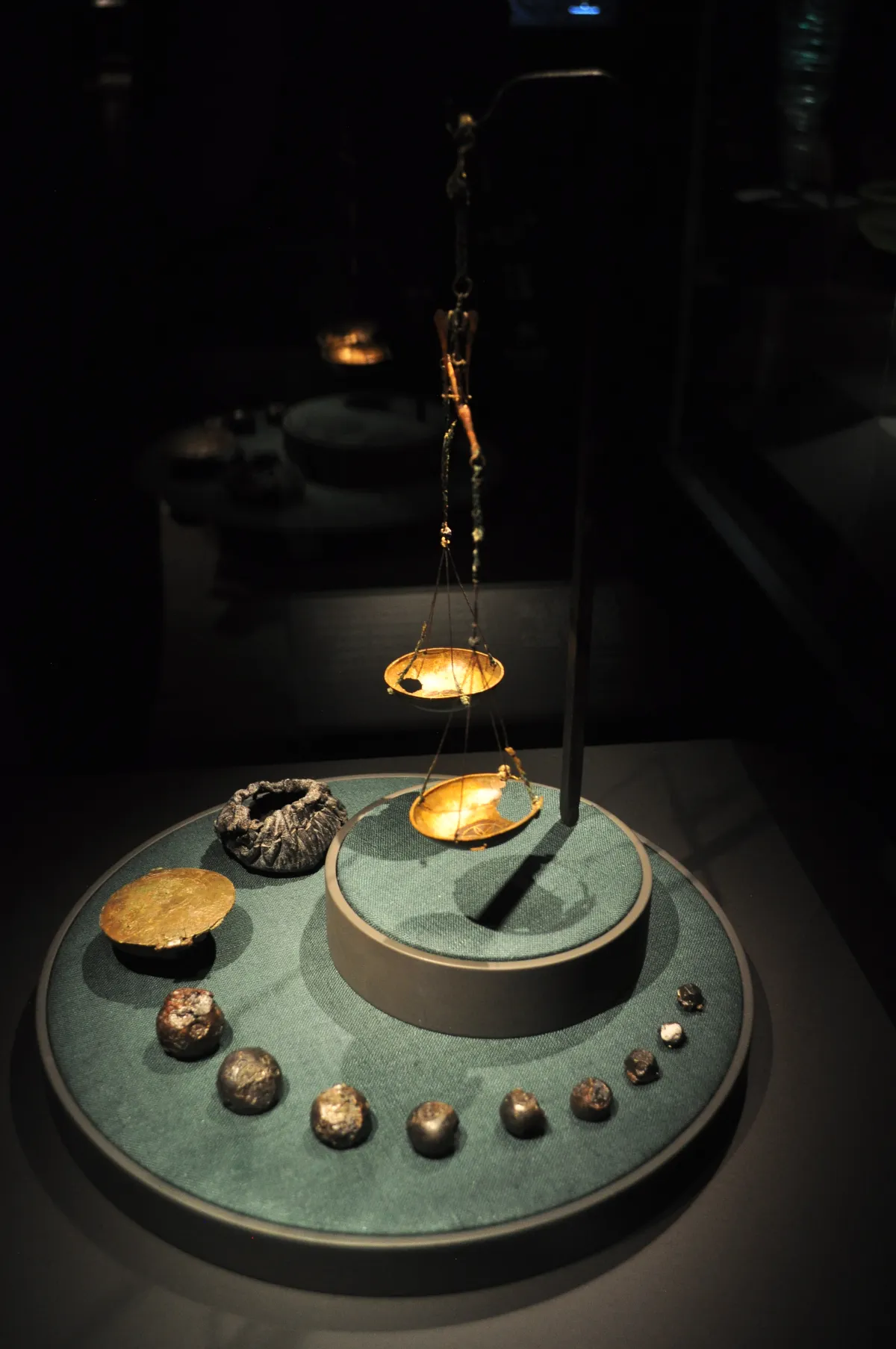
The weights were made for real transactions. In England, 34 oblate-spheroid and 26 cubo-octahedral weights are now known as single finds, and the 32 oblate spheroids whose weight has been recorded "cluster within the 10-40g range". As Kershaw notes, a weight represents the smallest sum that could be weighed with it, so people were regularly paying out at least that much silver (Kershaw 2017). Merchants at Staraya Ladoga, at the other end of the Viking world, used the same kind of scales and weights (see our article on Staraya Ladoga).
Weighing told the merchant how much silver he held, but not whether it was real. For that he used his knife. Many ingots and coins carry "nicks": "small, crescent-shaped knife cuts … characteristic Viking-Age testing marks designed to expose plated forgeries and/or to assess silver fineness" (Kershaw 2017). The test seems to have worked. Of 13 English ingots tested by X-ray fluorescence, 11 contained more than 90 per cent silver.
What is hacksilver?
Hacksilver is silver cut into pieces to make up a payment. Ingots, coins, arm-rings, neck-rings and brooches were chopped with a chisel until the scale balanced. Some were hacked so small that in England deliberately cut dirhams weigh on average just 0.57 grams, "less than a quarter of a complete coin" (Kershaw 2017).
Archaeologists can tell hacksilver from loot or scrap. "The same hoard seldom contains more than one fragment of the same object", which means the other pieces had already passed on to other hands (Kershaw 2017, citing Birgitta Hårdh). A cut bracelet was small change that had been circulating. In the Silverdale hoard from Lancashire, which dates from around AD 900, 141 of the more than 200 items were fragments of arm-rings and ingots "that had been chopped into smaller pieces" (Art Fund).
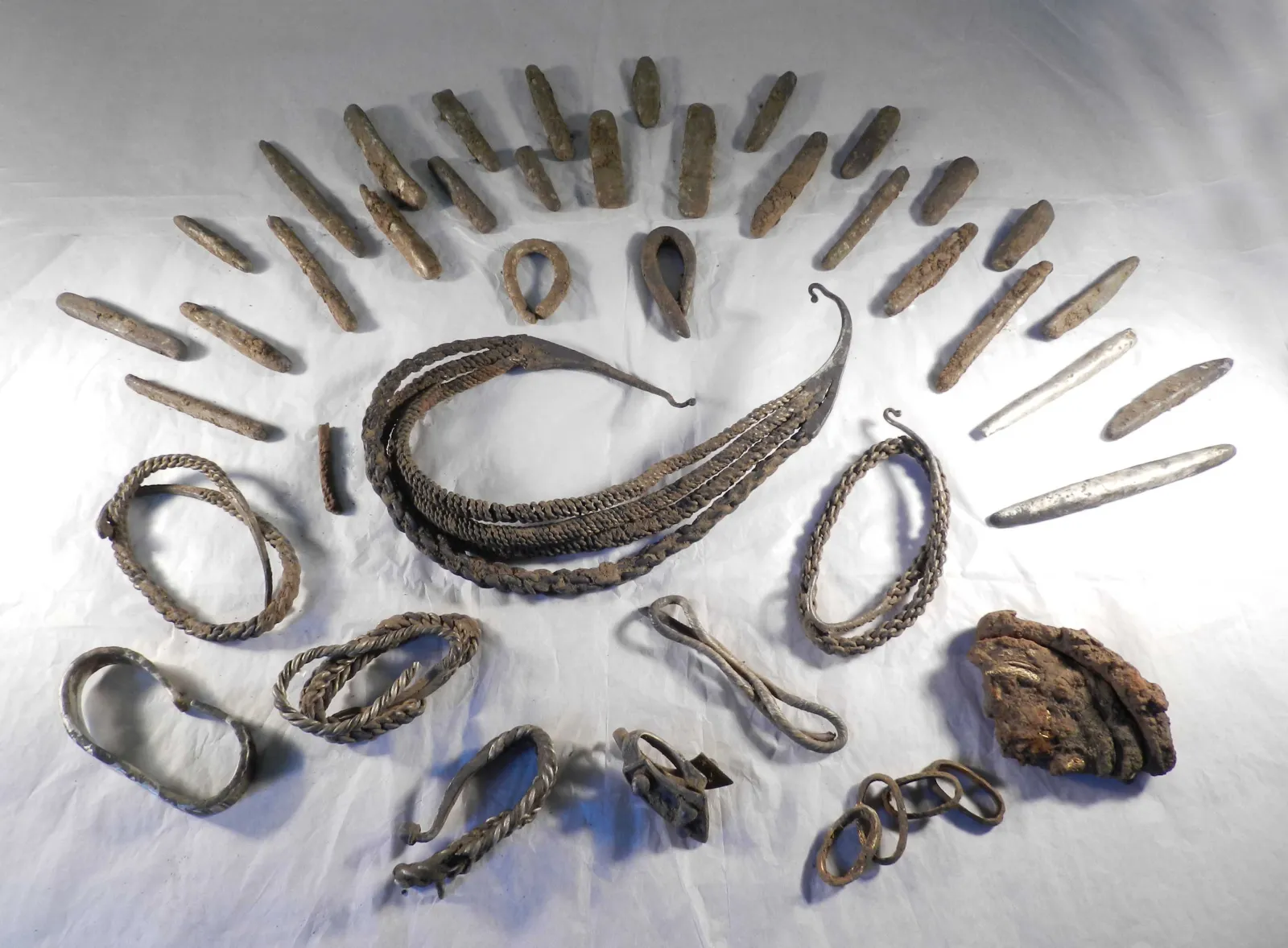
Ingots were the other main form. Viking-Age ingots "are typically cigar-shaped", easy to store, to carry and to cut (Kershaw 2017). They were also pure. The 29 ingots in the Bedale hoard from North Yorkshire include examples tested at the British Museum at 96 and 97 per cent silver, and several carry testing nicks (Portable Antiquities Scheme, treasure report 2012 T373).
Where did Viking silver come from?
Most of it came from the Islamic world. Scandinavians in Russia acquired dirhams "through the sale of slaves and furs", and the numbers recorded from the Scandinavian countries, mostly from the century between AD 840 and 940, "total in excess of 170,000" (Kershaw 2017, citing Svein Gullbekk). Other counts are higher or lower because they count different things: finds from one country, coins in museum collections, or hoards and single finds together. Our Viking Settlements entry gives two of them. Whatever the total, far more dirhams were melted down on arrival and recast as ingots and jewellery.
The route, the rhythm of the imports and the end of the flow around 1013 are covered in our article on when the silver ran out. The coins were struck under the Abbasid caliphs and, from the AD 890s, above all by the Samanid emirs of Central Asia. Lead-isotope analysis of more than 100 dated dirhams has now traced their metal to many sources, from Morocco to the Tien Shan mountains, and points to an Abbasid "mining boom" (Merkel, Oravisjärvi and Kershaw, Antiquity, 2023).
Silver also came from the west. The Cuerdale hoard holds Anglo-Saxon and Viking coins together with coins "from the Middle East, Italy and the Frankish kingdom" (Ashmolean Museum). Some of it was trade and some was plunder or tribute, and once in Scandinavian hands it all went into the same melting pot.
Did the Vikings in England use coins?
Yes, and weighed silver as well. When the Great Army arrived in AD 865, it brought the bullion economy with it. Its winter camp at Torksey on the Trent (AD 872–873) has produced hacksilver, weights and dirhams. For a long time historians thought the settlers soon gave this up. In the old view, coins in the Danelaw passed "by tale, rather than by weight", that is, they were counted rather than weighed.
Metal-detector finds have changed the picture. Kershaw collected 183 single finds of bullion from the Danelaw: 44 ingots, 14 pieces of cut jewellery, 65 dirhams and 60 weights. Her conclusion is that "bullion and coin appear to have co-existed for some seventy or eighty years, from c. 865 to the c. 930/40s, and possibly beyond" (Kershaw 2017). This was a true dual currency.
The settlers were not short of coins. From about AD 895 to AD 918 the St Edmund Memorial coinage, struck in the name of the East Anglian king killed by the Great Army, was produced "by at least 70 moneyers across East Anglia and east Mercia". The Viking kings of York issued their own pennies too. So why keep weighing silver? Kershaw suggests several reasons:
- it suited large payments;
- it was accepted across the whole Viking world;
- it was easy to test and kept its value, while coin in southern England had been debased as low as 18 per cent silver in the third quarter of the ninth century;
- it showed that its owner belonged to the Scandinavian world;
- and, most bluntly, "silver bullion could not be taxed". Kings profited each time coins were reminted, and a bar of silver bypassed the moneyer.
The bullion turns up in the countryside, not in the towns. "No silver bullion finds or weights are recorded from Thetford, Norwich or Lincoln", all of them towns with mints.
When did the Vikings start making their own coins?
Early, but on a small scale. Small silver pennies were struck at the Danish trading towns of Ribe and Hedeby from the AD 820s. A recent study of 540 of them dates the earliest Ribe type to "c. 820/30-c. 850" and shows that minting went on for the rest of the ninth century (Feveile 2025). Even so, in the ninth century "coin production was confined to southwest Scandinavia, and coin circulation limited to" Ribe and Hedeby and their surroundings (Kershaw 2017).
The Vikings in Britain and Ireland coined sooner and more freely than those at home:
- East Anglia and York. The St Edmund coinage, and pennies of the kings of York down to Eric in the AD 950s.
- Silverdale. One coin in the hoard names a ruler, AIRDECONUT, otherwise unknown. Scholars read it as an English spelling of the Norse name Harthacnut. Its reverse reads DNS REX, Latin for "lord king" (Archaeology, 2012).
- Dublin. Sihtric Silkbeard's moneyers struck the first coins made in Ireland in the late AD 990s, "close copies" of an English penny of Æthelred II (British Museum).
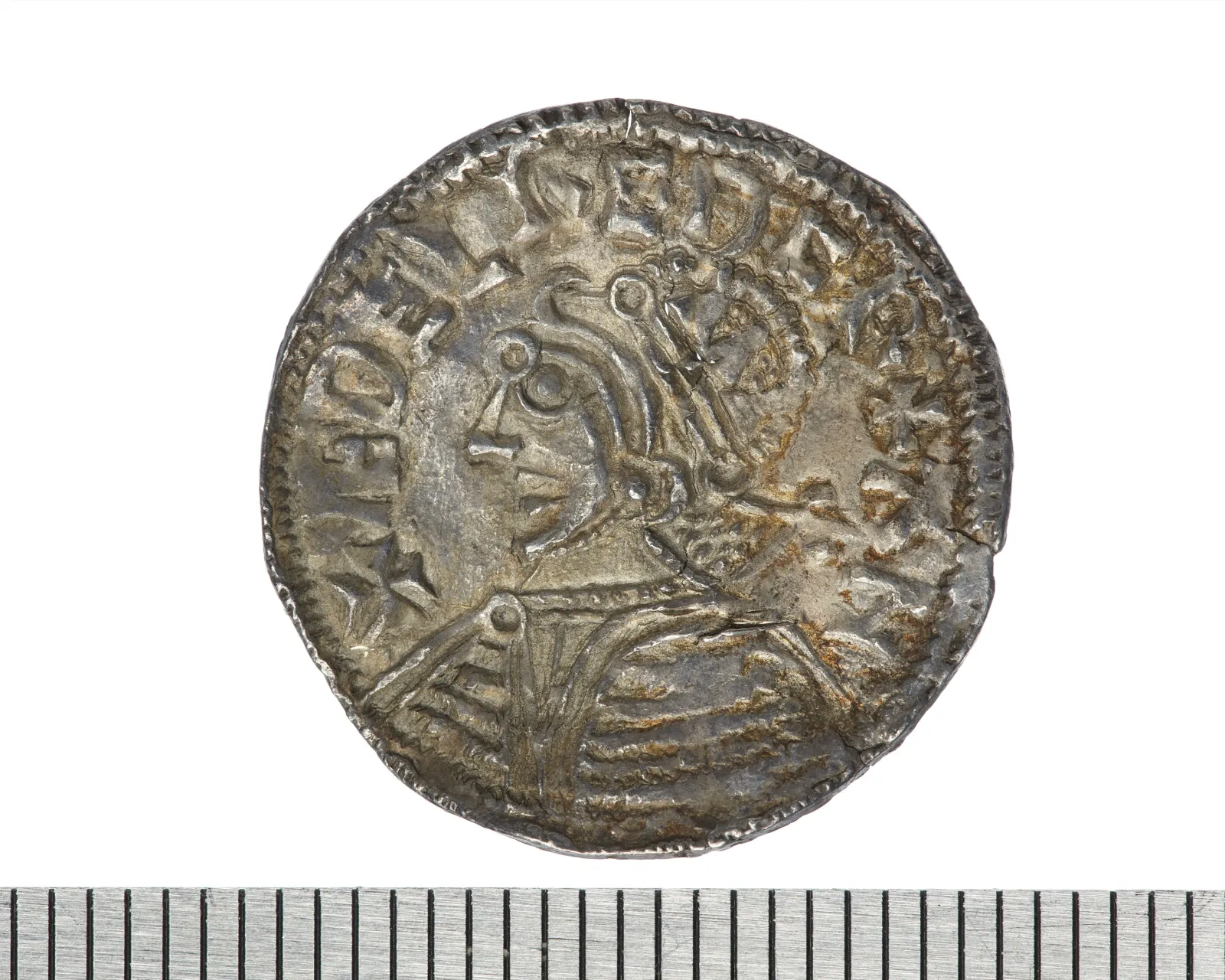
Royal coinages in Scandinavia began only around the year 1000 (Kershaw 2017). In Sweden, Olof Skötkonung had pennies struck at Sigtuna "in around 995 AD", modelled on the English "Crux" type of Æthelred II (Ekonomiska museet, Stockholm). Even then the old habits survived: a hoard of almost 5,000 coins buried in Østerdalen in Norway around 1046, just as Harald Hardrada was building a national coinage, still contained hacksilver (The Past, 2026). In Rus', Vladimir the Great struck the first native gold and silver coins (see our article on Vladimir the Great), but silver ingots, the grivna, remained the unit of account.
The great Viking hoards
| Hoard | Found | Buried | What it held |
|---|---|---|---|
| Spillings, Gotland, Sweden | 1999 | After AD 870 | Two silver hoards of about 25 and 41 kg: over 14,000 coins, almost all Islamic, and some 500 arm-rings, plus a third hoard of bronze |
| Cuerdale, Lancashire | 1840 | c. AD 905 | About 40 kg: some 7,500 coins and 1,000 ingots, ornaments and cut fragments, in a lead chest |
| Vale of York, near Harrogate | 2007 | Late AD 927 or early 928 | 617 coins, 67 silver objects and a gold arm-ring, with a silver cup made in a Frankish workshop |
| Galloway, Scotland | 2014 | c. AD 900 | More than 100 objects: arm-rings, ingots, a pectoral cross, a lidded silver vessel and a gold bird-shaped pin |
| Silverdale, Lancashire | 2011 | c. AD 900 | More than 200 items in a lead container, including coins and 141 hacksilver fragments |
| Watlington, Oxfordshire | 2015 | Late AD 870s | About 200 coins, 15 ingots and 7 pieces of jewellery |
| Bedale, North Yorkshire | 2012 | c. AD 850–950 | 29 silver ingots, neck-rings, an arm-ring and a brooch, with a gold-decorated sword pommel; about 4 kg in all |
| Østerdalen, Innlandet, Norway | announced 2026 | c. 1046 | At least 4,886 coins, mostly English and German, with hacksilver |
Spillings is the largest Viking silver hoard ever found. Two caches of silver and a third of bronze were dug up on a farm on Gotland on 16 July 1999, and excavation the next year showed they had been buried inside a house. The youngest coin identified so far was struck in AD 870 (Swedish History Museum).
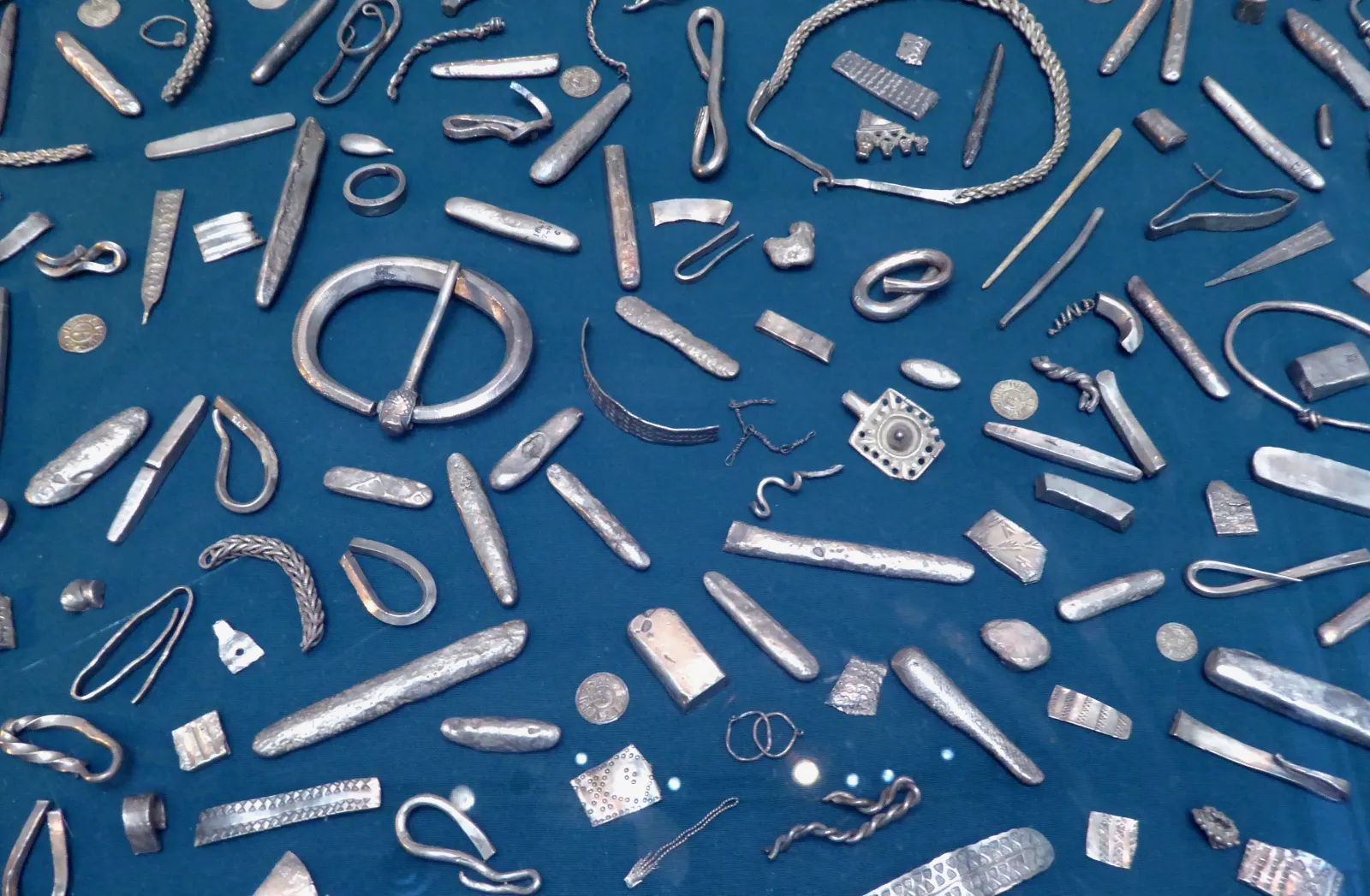
Cuerdale was found by workmen digging on the embankment of the River Ribble near Preston in 1840. Its latest coins date from AD 901–905, the probable date of burial, and it included "bullion from Ireland" (Ashmolean Museum). Many historians connect it with the Vikings expelled from Dublin in AD 902. The find was split among more than 170 recipients, and parts survive in the British Museum, National Museums Liverpool and the Ashmolean.
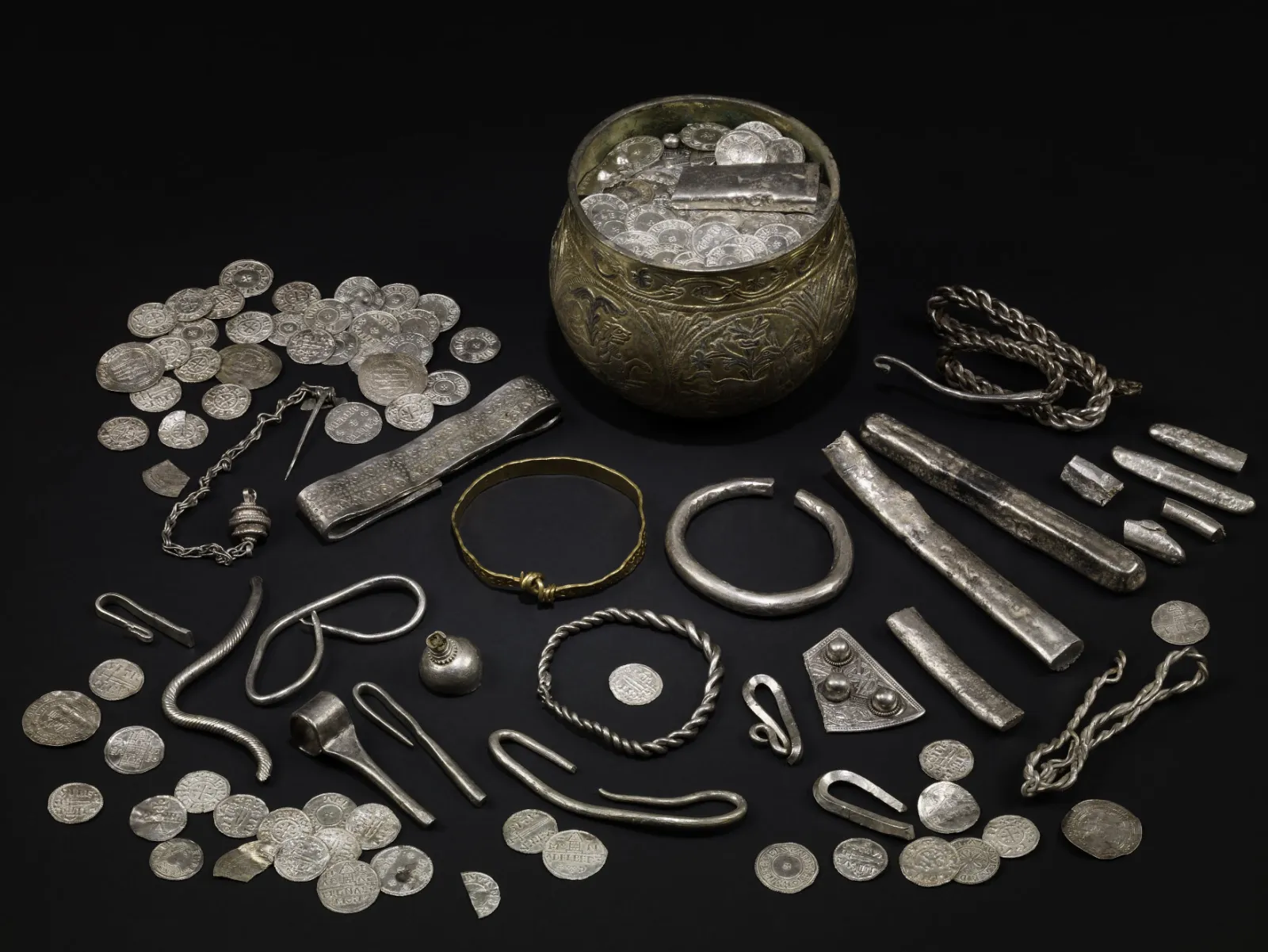
The Vale of York hoard was found by two metal-detectorists between York and Harrogate in 2007. One of its coins, almost new, celebrates Æthelstan's capture of York in AD 927, so the hoard "was buried in late 927 or early 928" (York Museums Trust). Its coins come "from as far away as Afghanistan, Russia, and Scandinavia" (Archaeology, 2007).
Watlington contains 13 examples of the rare "Two Emperors" penny, showing Alfred of Wessex and Ceolwulf II of Mercia seated side by side. According to the Ashmolean, this "suggests an alliance between the kingdoms", which sits awkwardly with the Anglo-Saxon Chronicle's picture of Ceolwulf as a Viking puppet.
Galloway is a special case. National Museums Scotland calls it "a Viking-age hoard, not a Viking hoard". Few of its objects came directly from Scandinavia, and its broad-band arm-rings were "most likely" made in Ireland, from "recycled good-quality silver, mainly coins". But the silver economy behind it was "indisputably an innovation of the Viking Age".
Why did Vikings bury their silver?
There was no bank, so a hole in the ground under a house floor or beside a landmark was the safe place for savings. Most hoards were probably meant to be dug up again. Those we find are the ones that never were, because the owner died, fled or forgot. War made that more likely. The Watlington hoard was buried around the time of Alfred's victory at Edington in AD 878 (National Lottery Heritage Fund).
A second explanation comes from the sagas. In the Ynglinga saga, Snorri Sturluson says that Odin ordered the dead to be burned with their goods, so that "every one will come to Valhalla with the riches he had with him upon the pile". He adds that a man "would also enjoy whatever he himself had buried in the earth" (ch. 8, trans. Laing). Snorri wrote around 1225, two centuries after the Viking Age, so this is a medieval writer's explanation, not proof of Viking belief. Archaeologists still debate how many hoards were offerings rather than savings. The Spillings silver, hidden inside a house, looks more like savings than sacrifice.
How much was Danegeld?
In the later Viking Age a great deal of English silver flowed the other way, as tribute paid to Danish armies. The Anglo-Saxon Chronicle records the payments under Æthelred II and Cnut. It calls them simply tribute; the name "Danegeld" is later.
| Year | Payment recorded in the Anglo-Saxon Chronicle |
|---|---|
| AD 991 | 10,000 pounds, the first payment, on the advice of Archbishop Sigeric, after Viking raids on the east coast |
| AD 994 | 16,000 pounds, after Olaf Tryggvason and Sweyn Forkbeard attacked London |
| 1002 | 24,000 pounds |
| 1007 | 30,000 pounds (36,000 in other manuscripts and translations) |
| 1012 | 48,000 pounds, paid after the murder of Archbishop Ælfheah |
| 1014 | 21,000 pounds to the fleet at Greenwich |
| 1018 | 72,000 pounds from all England, plus 10,500 from London, under Cnut |
A pound was 240 silver pennies, so the first payment alone meant 2.4 million coins. The chronicler's figures are round numbers and may be exaggerated, but they explain why so many English pennies of Æthelred and Cnut have been found in Scandinavia. They also explain why Scandinavian kings, when they began to strike coins, copied English ones.
Common myths about Viking coins
- "The Vikings had no money." They had silver, and weighed silver was money. In the Danelaw they used coins as well.
- "Viking coins were made by Vikings." Most coins found in Viking hoards were struck by others: Abbasid and Samanid dirhams, English and Frankish pennies, and later German coins.
- "Hacksilver is loot." Cut silver is currency. The cutting and the test nicks show it being used to pay.
- "Danegeld was a single ransom." The Chronicle records at least seven payments between AD 991 and 1018, rising from 10,000 to 72,000 pounds.
- "The Vikings minted coins from the start." Apart from small issues at Ribe and Hedeby, Scandinavian kings struck coins only from about AD 995.
Genuine Viking-Age coins do come up for sale, usually English pennies or dirhams from old collections. New finds are another matter. In England and Wales a find that counts as treasure must be reported within 14 days (GOV.UK). Two detectorists who found a hoard near Leominster in Herefordshire in 2015 did not declare it as treasure, and they were jailed in 2019. Only about a third of the hoard has been recovered. In 2023 two more men were convicted over 44 of its coins, valued at about £766,000 (Shropshire Star, 2023).
What the map shows next
At AD 900 on the map the Danelaw covers eastern England beside Wessex, and far to the east the Samanid Empire is minting the dirhams that will end up in Viking hoards. By 1000 on the map, England is a single kingdom paying tribute to Danish fleets, and the kings of Denmark and Sweden are beginning to strike their own coins on English models.
Sources
Primary sources (in translation)
- The Anglo-Saxon Chronicle, trans. J. Ingram (London, 1823), annals for 991, 994, 1002, 1007, 1012, 1014 and 1018. Project Gutenberg: https://www.gutenberg.org/ebooks/657
- Snorri Sturluson, Ynglinga saga, ch. 8 "Odin's Lawgiving", in Heimskringla, trans. S. Laing (London, 1844): https://sacred-texts.com/neu/heim/02ynglga.htm
Studies and museum sources
- J. Kershaw, "An early medieval dual-currency economy: bullion and coin in the Danelaw", Antiquity 91, no. 355 (2017), pp. 173–190, DOI 10.15184/aqy.2016.249. Open-access manuscript: https://ora.ox.ac.uk/objects/uuid:ad41a969-d724-4232-ab5c-6f208bc6acf7
- S. W. Merkel, J. Oravisjärvi and J. Kershaw, "Sources of early Islamic silver: lead isotope analysis of dirhams", Antiquity 97, no. 396 (2023), pp. 1564–1580, DOI 10.15184/aqy.2023.165: https://www.cambridge.org/core/journals/antiquity/article/sources-of-early-islamic-silver-lead-isotope-analysis-of-dirhams/853EB2CBE002FE8ECFF7FF142D8CBB20
- C. Feveile, "Pennies for the King's Towns: Ribe and Haithabu pennies from the 9th century", By, marsk og geest 37 (2025): https://tidsskrift.dk/BMG/article/view/159728
- Portable Antiquities Scheme, treasure case 2012 T373 (the Bedale hoard), report by B. M. Ager, British Museum, 2012: https://finds.org.uk/database/artefacts/record/id/504460
- Ashmolean Museum, "The Cuerdale Hoard": https://britisharchaeology.ashmus.ox.ac.uk/highlights/cuerdale-hoard.html
- Ashmolean Museum, The Watlington Hoard: Case Study, Collaborative Outreach (2017): https://www.ashmolean.org/sites/default/files/ashmolean/documents/media/watlington_hoard_case_study_collaborative_outreach.pdf ; and National Lottery Heritage Fund, "Major boost to the Ashmolean's bid for Viking hoard" (2016): https://heritagefund.org.uk/news/major-boost-ashmoleans-bid-viking-hoard
- York Museums Trust, "The Vale of York Hoard": https://yorkmuseumstrust.org.uk/?p=5499
- "Viking Hoard" (the Harrogate/Vale of York hoard), Archaeology 60, no. 6 (Nov./Dec. 2007): https://archive.archaeology.org/0711/trenches/viking.html
- National Museums Scotland, "How 'Viking' is the Galloway Hoard?": https://www.nms.ac.uk/discover-catalogue/how-viking-is-the-galloway-hoard
- Swedish History Museum, "The world's largest Viking treasure" (Spillings): https://historiska.se/en/explore-history/history-hub/the-worlds-largest-viking-treasure/
- "Silver Viking Coin", Archaeology (March/April 2012) (Silverdale hoard): https://archaeology.org/issues/march-april-2012/artifacts/silver-viking-coin/
- Art Fund, "Silverdale Viking Hoard": https://www.artfund.org/our-purpose/art-funded-by-you/silverdale-viking-hoard
- Ekonomiska museet – Kungliga myntkabinettet, penny of Olof Skötkonung, Sigtuna, c. 995–1000: https://pengar.ekonomiskamuseet.se/object_details.php?object=7A8D0650-3DB3-46CA-87DF-8163BAC024A3&e=no&l=en
- British Museum, silver penny of Sihtric III of Dublin, museum no. 1838,0919.8: https://www.britishmuseum.org/collection/object/C_1838-0919-8
- "Norway's largest known Viking Age hoard found", The Past (2026): https://the-past.com/news/norways-largest-known-viking-age-hoard-found/
- "Two men found guilty of trying to sell part of Viking hoard found close to Shropshire border", Shropshire Star, 28 April 2023: https://www.shropshirestar.com/news/crime/2023/04/28/two-men-found-guilty-of-trying-to-sell-part-of-viking-hoard-found-close-to-shropshire-border
- GOV.UK, "Report treasure, wreck material or archaeological finds": https://www.gov.uk/treasure
Image credits
- Title image (a trader weighing hacksilver at a Viking-Age market): AI-generated illustration.
- Collapsible scale, weights and pouch from Valsgärde boat grave 12. Photo: Joe Mabel, CC BY-SA 4.0, via Wikimedia Commons.
- The Bedale hoard. Photo: The Portable Antiquities Scheme / The Trustees of the British Museum, CC BY-SA 2.0, via Wikimedia Commons.
- The Cuerdale hoard in the British Museum. Photo: Ethan Doyle White, CC BY-SA 4.0, via Wikimedia Commons.
- The Vale of York hoard. Photo: Portable Antiquities Scheme, CC BY 2.0, via Wikimedia Commons.
- Penny of Olof Skötkonung, Sigtuna, Economy Museum – Royal Coin Cabinet, Stockholm. Photo: Helena Bonnevier, SHM, CC BY 4.0, via Wikimedia Commons.