Ahmad ibn Fadlan was a tenth-century Muslim jurist and secretary who travelled with a caliphal embassy from Baghdad to the king of the Volga Bulgars in AD 921–922. His report, known as the Risala ("letter" or "report"), is the earliest sustained first-person travel narrative in Arabic. It also contains the only eyewitness description of a Rus' chieftain's ship cremation, which is why historians of the Vikings still argue over every line of it.
He was a real person, not a Hollywood invention, but almost everything we know about him comes from his own pages. Below you will find who he was, the route he took, the peoples he described, what he actually wrote about the Rus', how reliable it is, and how the text survived to reach Michael Crichton and Antonio Banderas.
Who was Ibn Fadlan?
The opening line of the Risala gives his full name as Ahmad ibn Fadlan ibn al-Abbas ibn Rashid ibn Hammad and calls him the mawla (client) of Muhammad ibn Sulayman. The Encyclopaedia Iranica entry by C. E. Bosworth identifies this patron as the head of the war department who had reconquered Egypt from the Tulunids, and states plainly that "nothing is known" of Ibn Fadlan beyond what his account tells us. Birth and death dates circulating online (such as 879–960) have no basis in any medieval source.
He was probably a faqih, an expert in Islamic law, and he served the Abbasid caliph al-Muqtadir (r. 908–932), ruler of the Abbasid Caliphate. His own job description was precise: to read the caliph's letter to the Bulgar king, hand over the gifts, and supervise the jurists and teachers sent with the mission. The ambassador himself was Susan (Sawsan) al-Rassi, a eunuch and freedman of the courtier Nadhir al-Harami, accompanied by Tikin the Turk and Bars the Saqlab (a "Slav", though Saqaliba was a loose Arabic label for northern peoples).
Was he an Arab? Later tradition and many modern writers say so, and the Rus' man at the funeral addresses him as one. But Richard Frye and the Encyclopaedia of Islam both stress that his origin, ethnicity and education cannot be established with certainty, so treat "Arab" as likely rather than proven.
Why did Ibn Fadlan travel to the Volga in 921?
Almish, king of the Volga Bulgars, had written to Baghdad asking for religious instruction, a mosque and pulpit, and money for a fortress against his overlords, the Jewish-ruled Khazar Khaganate. The embassy was the caliph's answer; the political story, including the fortress money and Almish's new name Ja'far ibn Abdallah, is told in our article on Volga Bulgaria and its conversion to Islam. Bosworth also reports the economic reading of M. A. Shaban (1976): that the mission answered "an earlier joint approach from the Samanid vizier Abū ʿAbdallāh Jayhānī… and the Bulghar king", both keen to tap the fur trade flowing between the Volga and Muslim Central Asia.
The route: from Baghdad to the Volga
The embassy left Baghdad on 11 Safar 309 AH, which the Risala itself converts to 21 June 921. (The Hijri, or AH, calendar is lunar and counts from the Prophet's emigration to Medina in 622.) It followed the old Khurasan road through Hamadan, Rayy and Nishapur to Merv, crossed the Oxus and reached Bukhara, capital of the Samanid Empire, where the vizier al-Jayhani, probably the geographer of that name, arranged an audience with the young amir Nasr II.
Here the plan began to unravel. The fortress was to be paid for with 4,000 dinars from the revenues of Arthakhushmithan, an estate in Khwarazm belonging to the disgraced vizier Ibn al-Furat. The estate's agent, al-Fadl ibn Musa, had the official meant to collect the money, Ahmad ibn Musa, arrested at Merv, so the cash never arrived. After 28 days in Bukhara the embassy moved on without it.
Winter caught them in Khwarazm. At Jurjaniyya (Gurganj) the Oxus froze for three months; Ibn Fadlan reports that his beard turned into a block of ice and his cheek froze to his pillow. The jurists and teachers turned back to Baghdad. On 4 March 922 the rest set out with a caravan that Ibn Fadlan says numbered 3,000 horses and 5,000 men, crossing the Ustyurt plateau, the Oghuz steppe and a long series of rivers, including the Ural (Jayikh), where men and camels drowned.
Key dates of the journey
| Date (Hijri / CE) | Place | Event | Source |
|---|---|---|---|
| 11 Safar 309 / 21 June 921 | Baghdad | Embassy departs | Risala (Lunde and Stone; Montgomery) |
| Autumn 921 | Bukhara | Audience with Nasr II; 28-day stay | Risala; Lunde and Stone introduction |
| Winter 921–922 | Jurjaniyya (Gurganj) | Oxus frozen; three-month wait; jurists turn back | Risala; Iranica |
| 2 Dhu al-Qa'da 309 / 4 March 922 | Jurjaniyya | Caravan leaves for the steppe | Risala (Lunde and Stone) |
| March–April 922 | Oghuz lands, Pechenegs, Bashkirs | Seven-day debate on the envoys' fate; river crossings | Risala |
| 12 Muharram 310 / 12 May 922 | Bulgar king's camp, near the Volga–Kama confluence | Arrival after 70 days from Jurjaniyya | Risala; Iranica |
| Unknown | Baghdad? | Return journey, not preserved | Iranica; Lunde and Stone |
In all, the outward trip covered roughly 4,000 km (AramcoWorld's figure is 2,500 miles) and took almost eleven months. We do not know when, or even with certainty whether, Ibn Fadlan got home. Bosworth writes that the account "is apparently based on the official report which he made to the caliphal administration in Baghdad after he returned", and Yaqut claims his copy included the journey back, but that section is lost.
Who did Ibn Fadlan meet on the way?
The Oghuz Turks. The Oghuz on the Ustyurt plateau get the longest ethnographic treatment before the Rus'. Ibn Fadlan admires their hospitality (a Muslim trader needed an Oghuz host-friend to cross their country) but condemns their neglect of ritual washing and their women's lack of veiling. Their chief Inal the Younger had converted to Islam and then renounced it. The army commander Atrak (Etrek) son of Qataghan kept the envoys for seven days while his commanders debated whether to cut them in two, strip them, or trade them to the Khazars for prisoners. Iranica rightly calls this the only eyewitness picture of the Oghuz before the Seljuks, their descendants, took Baghdad in 1055.
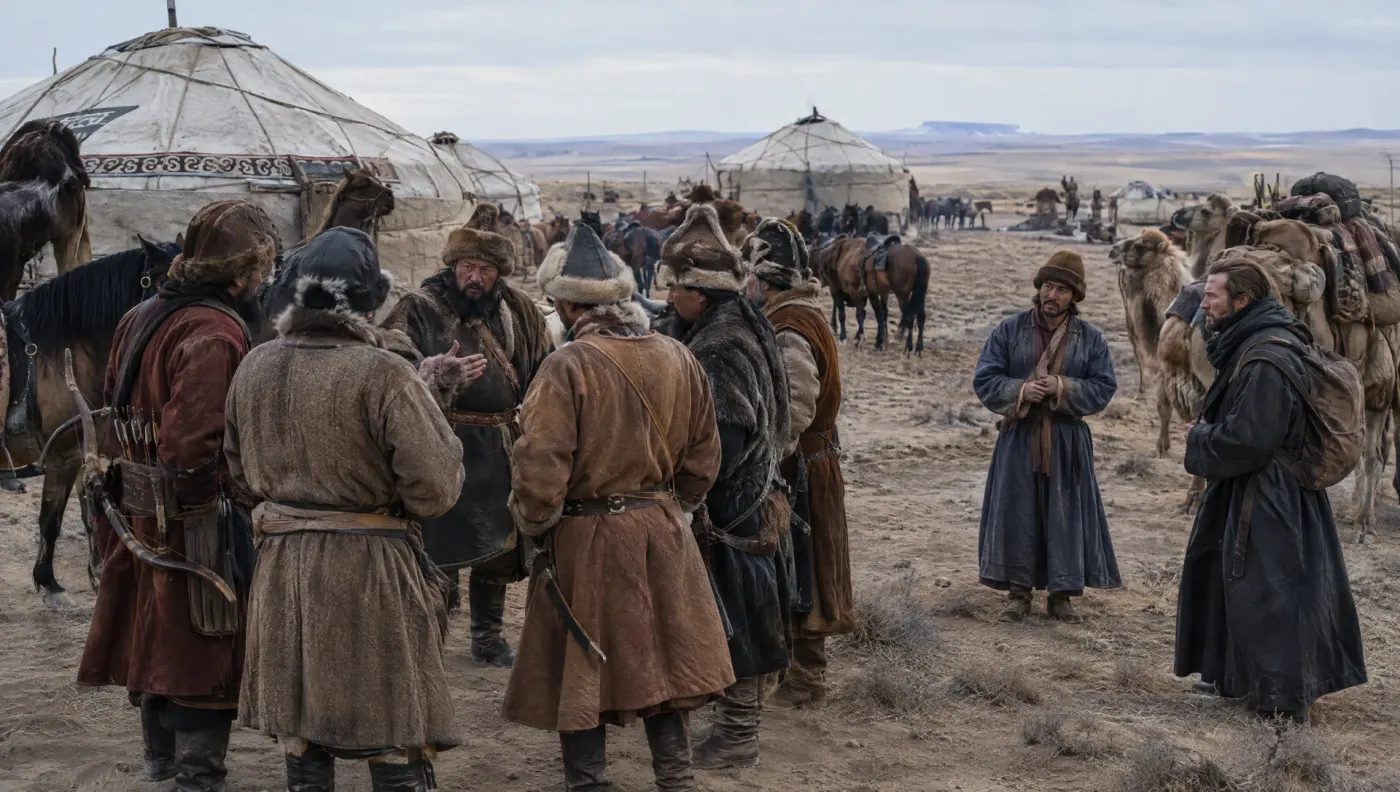
The Pechenegs and Bashkirs. The Pechenegs, camped by a lake, struck him as poor compared with the Oghuz; he stayed only one day. The Bashkirs he calls the dirtiest and most dangerous of the Turks. He records that each man carried a carved wooden phallus, kissed it before journeys or battle and addressed it as "Lord", explaining that he came from such a thing and knew no other creator. He also lists clans that revered snakes, fish and cranes.
The Volga Bulgars. At Almish's camp Ibn Fadlan saw the northern lights, which he took for armies of red mist fighting in the sky (the locals laughed at the frightened visitors), and found the summer nights too short to fit in the prayers. The king told him of the Wisu (the Finnic Ves'), three months' journey north, where the summer night lasts less than an hour, and showed him the bones of a "giant" said to have come from Gog and Magog, with a head "like a great beehive" (Lunde and Stone). Ibn Fadlan is careful to say this is the king's story; Lunde and Stone wonder whether the skeleton was a bear's.
The Khazars, by hearsay. Ibn Fadlan never visited Khazaria. His notes describe a sacral khagan (supreme ruler) who appears in public rarely, rules through a deputy, the khagan beg, who leads the army, and is allegedly killed if he reigns beyond forty years. Royal tombs, he was told, were hidden beneath a diverted river, and the men who buried the king were beheaded. The Jewish faith of the Khazar king is noted, and the Mashhad text breaks off in the middle of this section.
What did Ibn Fadlan say about the Vikings (the Rus')?
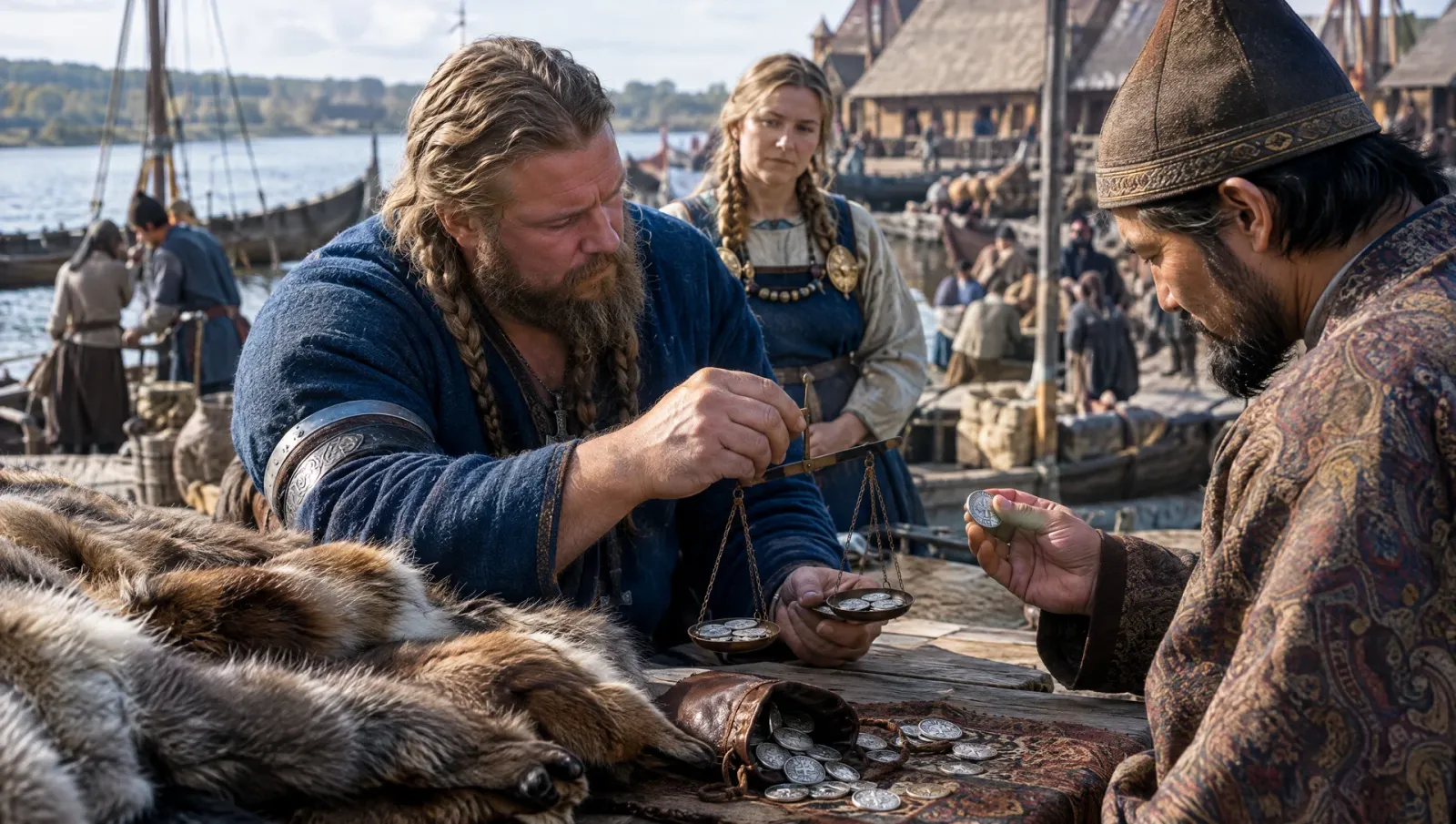
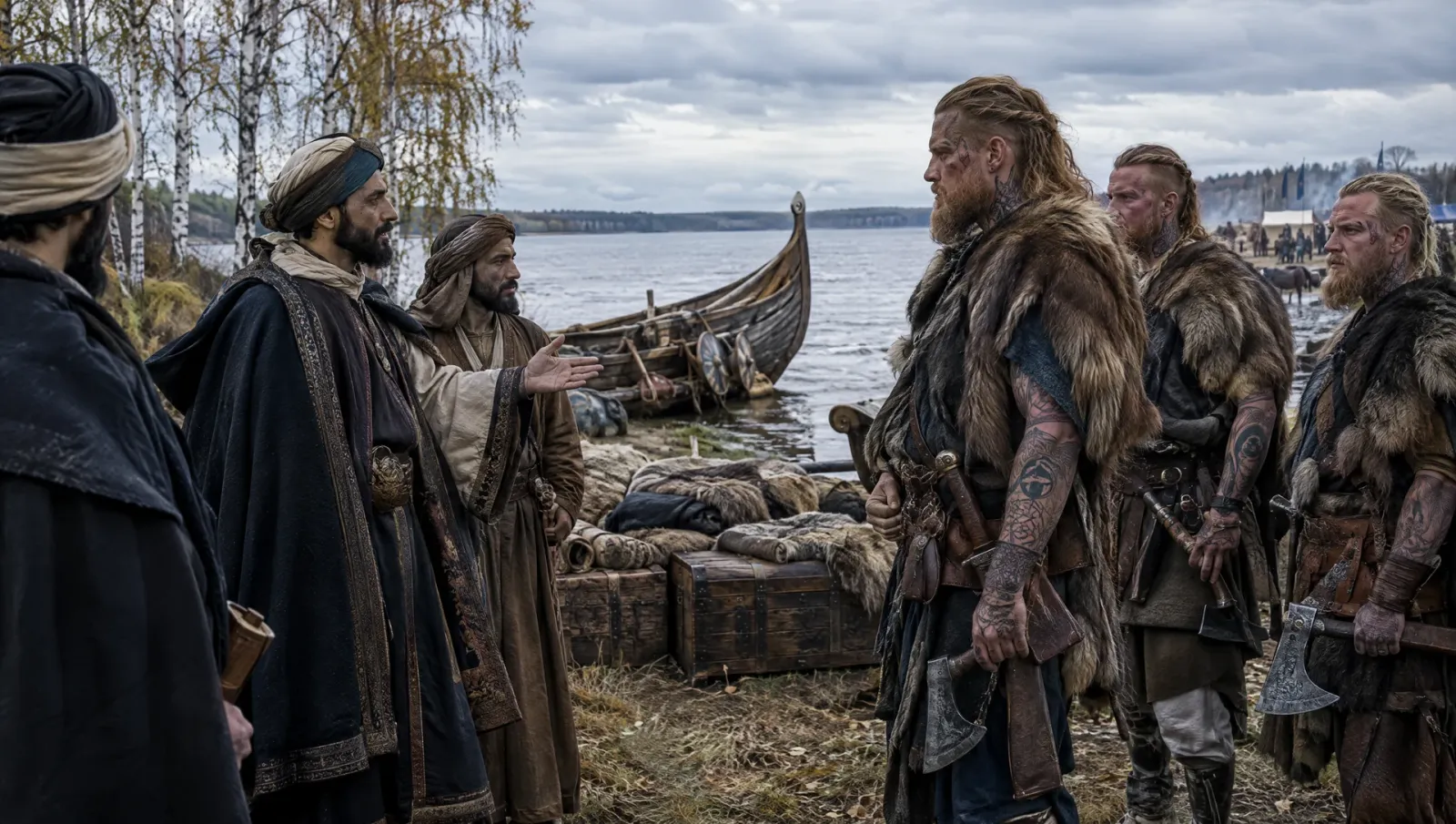
Ibn Fadlan met the Rus' (al-Rusiyya) not in Scandinavia but where they had come to trade on the Volga (which he calls the Itil) near the Bulgar camp. His description opens with admiration. In James Montgomery's 2000 translation he says he had "never seen more perfect physiques than theirs—they are like palm trees", fair and reddish; the older English version quoted from Johannes Brøndsted renders it "tall as date palms, blond and ruddy". Each man, he says, always carries an axe, a sword and a knife, the swords being broad, grooved and "Frankish". The men are covered in dark green tattooed lines and figures: from "the tip of his toes to his neck" in Montgomery and in Lunde and Stone, but "from the tip of his nails" in Frye. The Arabic allows either, which is why popular quotations disagree.
The women wear breast ornaments of iron, silver, copper or gold according to their husbands' wealth, and neck-rings: one for every 10,000 dirhams (silver coins) the husband owns. Their most prized ornaments are green beads, bought at a dirham each. Archaeology bears out much of this: oval brooches, neck-rings and glass beads turn up in Scandinavian and Russian graves, and Frankish sword blades dominate finds in Rus' territory.
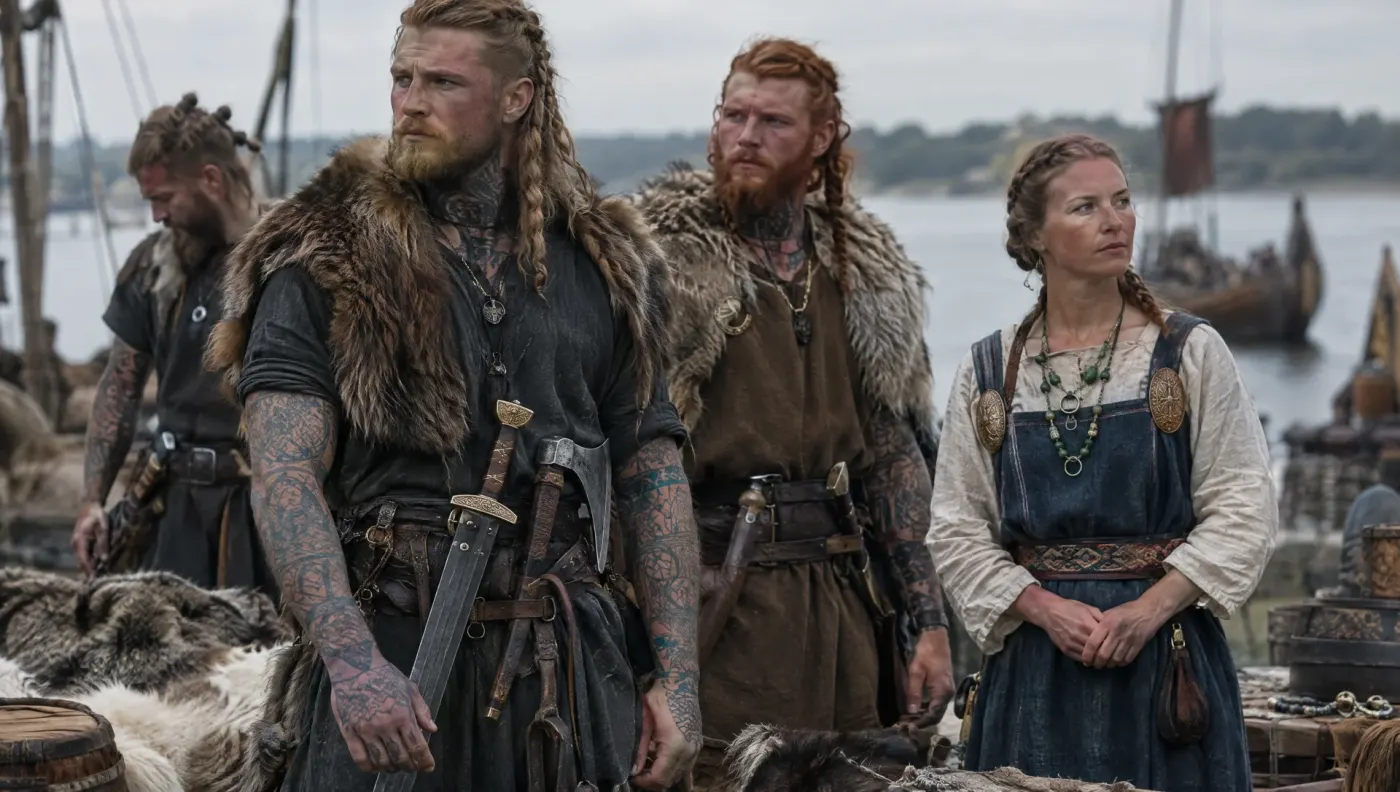
Then comes the passage that launched a thousand "Vikings were dirty" memes. The Rus', he writes, are "the filthiest of all Allah's creatures" (Montgomery) or "the filthiest of God's creatures" (Lunde and Stone). They do not clean themselves after relieving themselves or after sex, and every morning a slave girl carries a single basin from man to man, each washing his face and hair in it, then blowing his nose and spitting into it. His standard is Islamic ritual purity (wudu' and washing after janaba), not modern hygiene: he says in the same breath that they wash their faces and hair daily. Montgomery even suggests the basin scene has details Ibn Fadlan could scarcely have witnessed himself.
He also describes the Rus' praying before tall wooden figures with human faces, promising offerings in return for a buyer "with many dinars and dirhams", and their trade in furs and enslaved women, whom they used sexually in front of one another. For the wider picture of Rus' trade routes and silver, see our guide to who the Varangians were.
The Rus' ship funeral: what Ibn Fadlan saw
Ibn Fadlan heard that when a Rus' leader died, cremation was "the least" of what was done, and he made a point of attending one. The dead man lay in a temporary grave for ten days while funeral clothes were sewn. His wealth was divided into three: for his family, his garments, and alcohol for the mourners. His household was asked who would die with him, and a young enslaved woman said she would. From then on, the text says, she could not turn back.
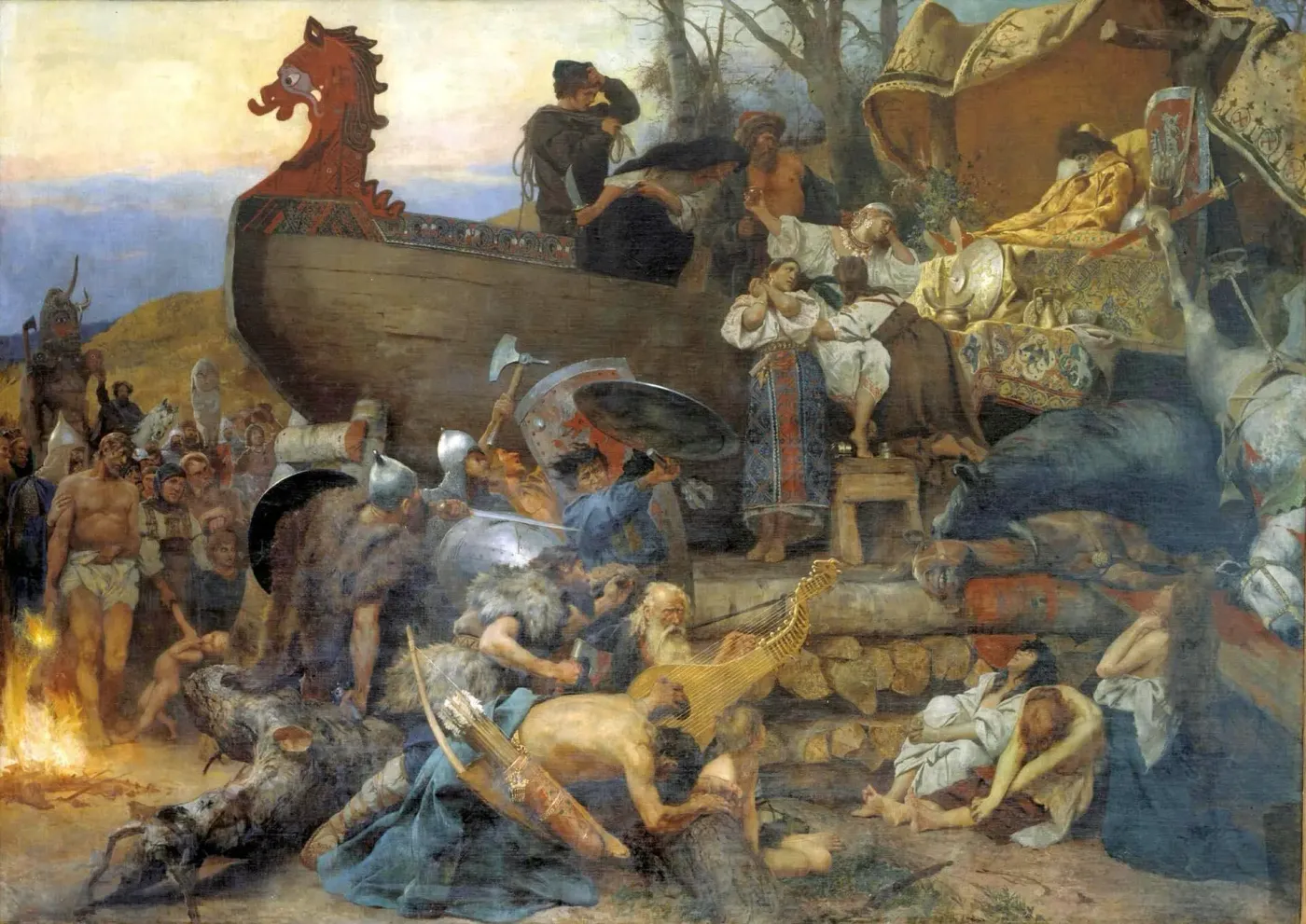
On the day of the cremation his ship was hauled ashore onto a wooden platform, and a couch with Byzantine silk cushions was set in a tent on deck. An old woman the Rus' called the "Angel of Death" ran the ceremony. The corpse, dressed in a silk caftan with gold buttons and a sable-trimmed cap, was propped up inside with drink, food and weapons; a dog, two horses, two cows, a cock and a hen were killed and thrown aboard. The enslaved woman went from tent to tent, and each man had sex with her, telling her to tell her master he did it out of love for him. She was lifted three times over a door-like frame and said, through the interpreter, that she saw her parents, her dead kin, and her master in a green Paradise calling for her.
The end was brutal, and it should be described plainly. She was given intoxicating drink, dragged into the tent, and raped by six men while others beat their shields to drown her screams. Then two men strangled her with a cord while the Angel of Death stabbed her repeatedly between the ribs. The word "volunteer" should not mislead anyone: she was enslaved, drugged and under intense social pressure, and could not meaningfully consent to any of it. Afterwards the dead man's nearest male relative, naked, lit the pyre, and ship, bodies and goods burned in about an hour.
As the fire roared, a Rus' man told the interpreter: "You Arabs are a foolish lot!" (Montgomery; Lunde and Stone have "You Arabs are fools!"). You bury those you love so worms eat them, he explained; we burn ours so they enter Paradise at once. Finally the Rus' raised a round mound over the site and set up a post of khadank wood, usually identified as birch, carved with the names of the dead man and of the Rus' king. A widely reproduced older English version of the whole scene can be read in the University of Utah's Ethics of Suicide archive.
Is Ibn Fadlan's account reliable?
Broadly yes, but it is a Muslim jurist's report, filtered through an interpreter, of people in transition. Most scholars accept that he was an eyewitness who observed carefully and rarely indulged in marvels. Montgomery calls his account "almost scientific" in its restraint while noting its religious chauvinism, and Lunde and Stone praise his lack of condemnatory comment. Where he relies on hearsay (the giant, the Khazars, the Wisu) he usually says so.
The harder question is who his Rus' were. Scholars broadly fall into three camps:
- A snapshot of assimilation. Montgomery ("Ibn Faḍlān and the Rūsiyyah", Journal of Arabic and Islamic Studies 3, 2000) avoids simply calling them Vikings or Russians. He sees a Scandinavian-origin trading elite absorbing Slavic, Finnic and Khazar ways. Their "king" with 400 companions and forty slave girls on his throne looks like a Turkic sacral ruler, and the "Angel of Death" and the verdant Paradise may be Islamic glosses.
- Scandinavians, but eastern ones. Thorir Jonsson Hraundal ("New Perspectives on Eastern Vikings/Rus in Arabic Sources", Viking and Medieval Scandinavia 10, 2014) treats the Volga–Caspian Rus' as predominantly Scandinavian traders and warriors. He also argues that some funeral elements fit Turkic steppe practice better than anything known in the Norse homelands.
- A Viking funeral script. Neil Price's Children of Ash and Elm (2020) uses the account almost as a script of a Viking-Age funeral seen through Muslim eyes. Matthew Delvaux criticised this choice in The Medieval Review (2021), writing that Price "chooses not to address significant problems, such as Thorir Jonsson Hraundal's arguments".
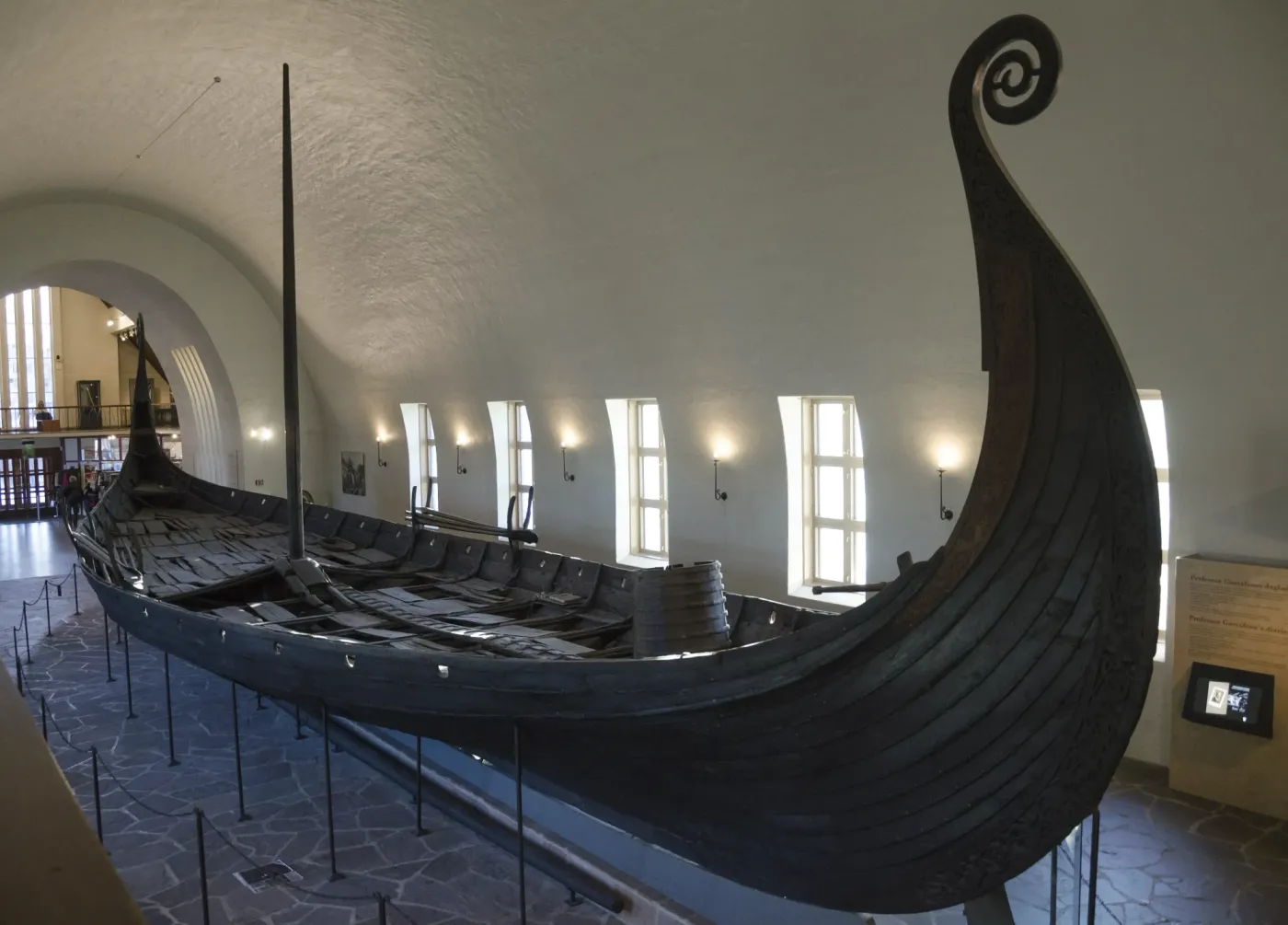
Archaeology neither proves nor disproves the details. Boat graves with cremation are known from the Plakun cemetery at Staraya Ladoga and from Gnezdovo and Timerevo in Russia. Norway's Oseberg ship burial, dated by tree-rings to the autumn of 834, contained two women, sacrificed animals and rich textiles, but it was an inhumation, not a cremation. As Foote and Wilson observed, the Angel of Death, the ritual sex and the naked fire-lighter cannot be paralleled in Norse sources, but many other details can. Princeton's Making the Viking Age project offers a useful student discussion of this "indigenisation" problem.
How did the Risala survive?
For centuries the text was known only through extracts quoted by the geographer Yaqut al-Hamawi in his Mu'jam al-buldan (completed in the 1220s), under entries such as Itil, Bulghar, Bashghird, Khazar, Khwarazm, Rus and Wisu. Yaqut probably found a copy in Merv or Gurganj around 1219–1220, just before the Mongols destroyed Gurganj. In 1823 Christian Martin Frähn, then at St Petersburg, published these extracts with a German translation, recognising their value for early Russian history.
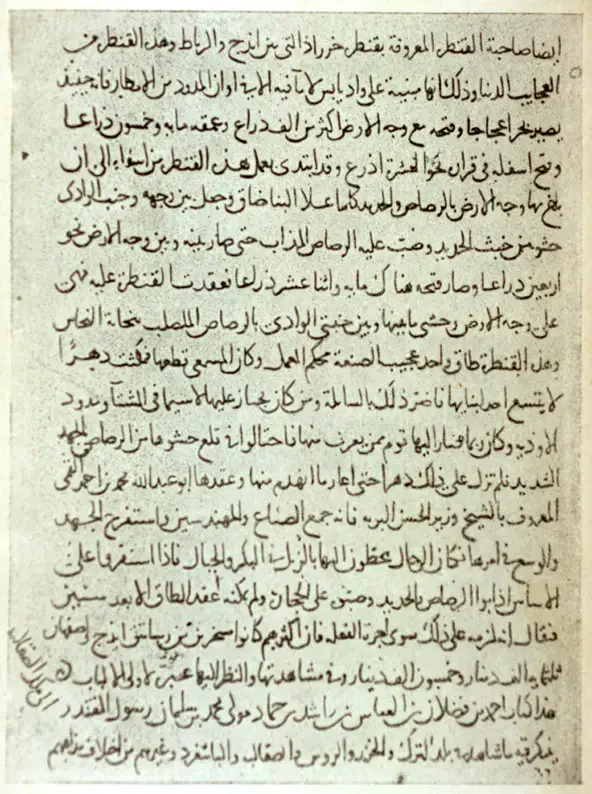
The breakthrough came in 1923, when the Bashkir scholar and émigré Ahmed Zeki Velidi Togan found a fuller text in the library of the shrine of Imam Reza in Mashhad, Iran (Astan-e Qods Razavi, MS 5229). The manuscript is a geographical miscellany that also contains Ibn al-Faqih and Abu Dulaf; it is usually dated to the thirteenth century, though Lunde and Stone say eleventh. Togan published his edition and German translation, Ibn Faḍlāns Reisebericht, in Leipzig in 1939. The Mashhad text is close to Yaqut's but not identical, and both appear to abridge a longer original that is now lost.
Translations of the Risala
| Translator | Year | Publisher | Notes |
|---|---|---|---|
| A. Z. V. Togan | 1939 | Brockhaus, Leipzig | First edition of the Mashhad text, German |
| A. P. Kovalevsky | 1956 | Kharkov | Russian, with facsimile photographs |
| Marius Canard | 1958 | Annales de l'Institut d'Études Orientales, Algiers | French |
| H. M. Smyser | 1965 | Franciplegius (NYU Press) | English, Rus' section only |
| Richard N. Frye | 2005 | Markus Wiener, Princeton | Ibn Fadlan's Journey to Russia; full English with commentary |
| Paul Lunde and Caroline Stone | 2012 | Penguin Classics | Ibn Fadlan and the Land of Darkness; with other Arab travellers |
| James E. Montgomery | 2014; 2017 | NYU Press, Library of Arabic Literature | Bilingual in Two Arabic Travel Books (2014); English-only Mission to the Volga (2017) |
Where should you start? For a readable paperback with context, Lunde and Stone. For the most exact rendering and the Arabic text, Montgomery's Mission to the Volga from the Library of Arabic Literature, which Speculum predicted "should become definitive". Judith Gabriel's 1999 AramcoWorld article "Among the Norse Tribes" remains a good short introduction.
Ibn Fadlan and The 13th Warrior: fact and fiction
Michael Crichton met Ibn Fadlan's Rus' passage as a student and built his 1976 novel Eaters of the Dead around it. The early chapters paraphrase real translations (Crichton credits Blake and Frye and Albert Stanburrough Cook), then the envoy is carried off to Scandinavia to fight the monsters of Beowulf. The book is framed with spoof scholarly apparatus and fictional manuscripts. Lunde and Stone point out that one of its invented experts, "Per Fraus-Dolus", translates as "through fraud and trickery".
John McTiernan's film The 13th Warrior (1999) cast Antonio Banderas as "Ahmed ibn Fahdlan". Wikipedia's entry puts its budget at "$85–160 million" against a worldwide gross of about $61.7 million, calling it "the biggest box-office bomb of 1999, with losses of up to $129 million."
| Fact vs fiction: The 13th Warrior | |
|---|---|
| Film | History |
| Ibn Fadlan is a court poet exiled for an affair | He was a jurist-secretary on an official embassy |
| He sails to Scandinavia with Buliwyf's warriors | He never went further north than the Volga Bulgars |
| He learns Norse by listening round the fire | He relied throughout on an interpreter |
| He fights cannibal "Wendol" beside Beowulf | Pure fiction, borrowed from Beowulf |
| The funeral opens the story | Close to the real account, though sanitised |
In Tatarstan, where the Volga Bulgars are claimed as ancestors, Ibn Fadlan is remembered differently: as the witness to the 922 conversion. The 1100th anniversary was marked at the UNESCO-listed site of Bolgar on 21 May 2022. Ahead of the day, Realnoe Vremya reported that "1,000 imams from 76 Russian regions and seven countries" had confirmed they would attend, and the Tatar World Congress later put the crowd at more than 20,000. The programme included a staged retelling of his journey and the premiere of a feature film called Ibn Fadlan.
What the map shows next
The world Ibn Fadlan described was about to change. Within two generations the Rus' of Kievan Rus' had become Slavic-speaking, and in 965 Prince Sviatoslav destroyed the Khazar Khaganate whose khagan Ibn Fadlan had only heard about. Explore that moment on AD 965 on the map.