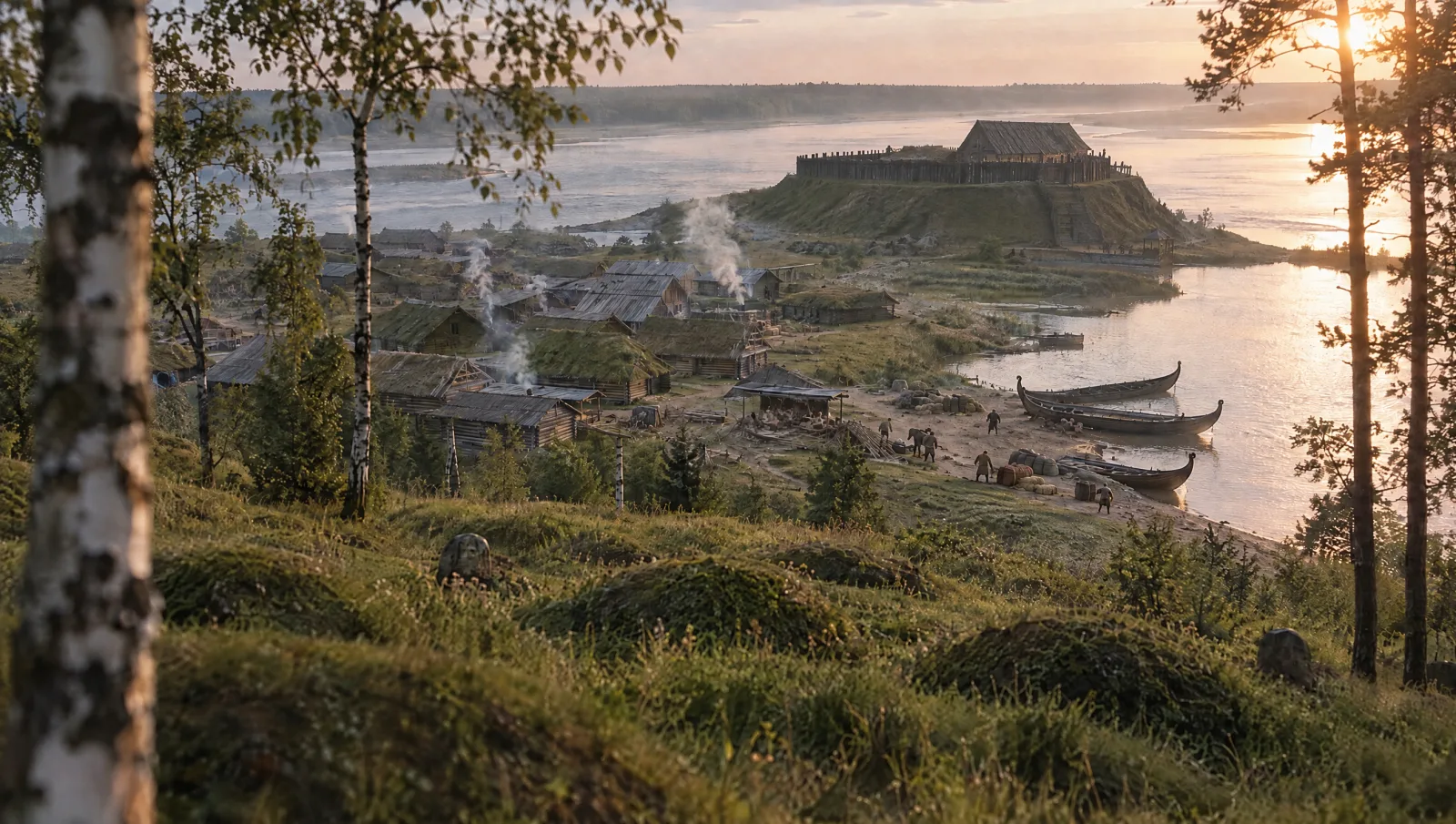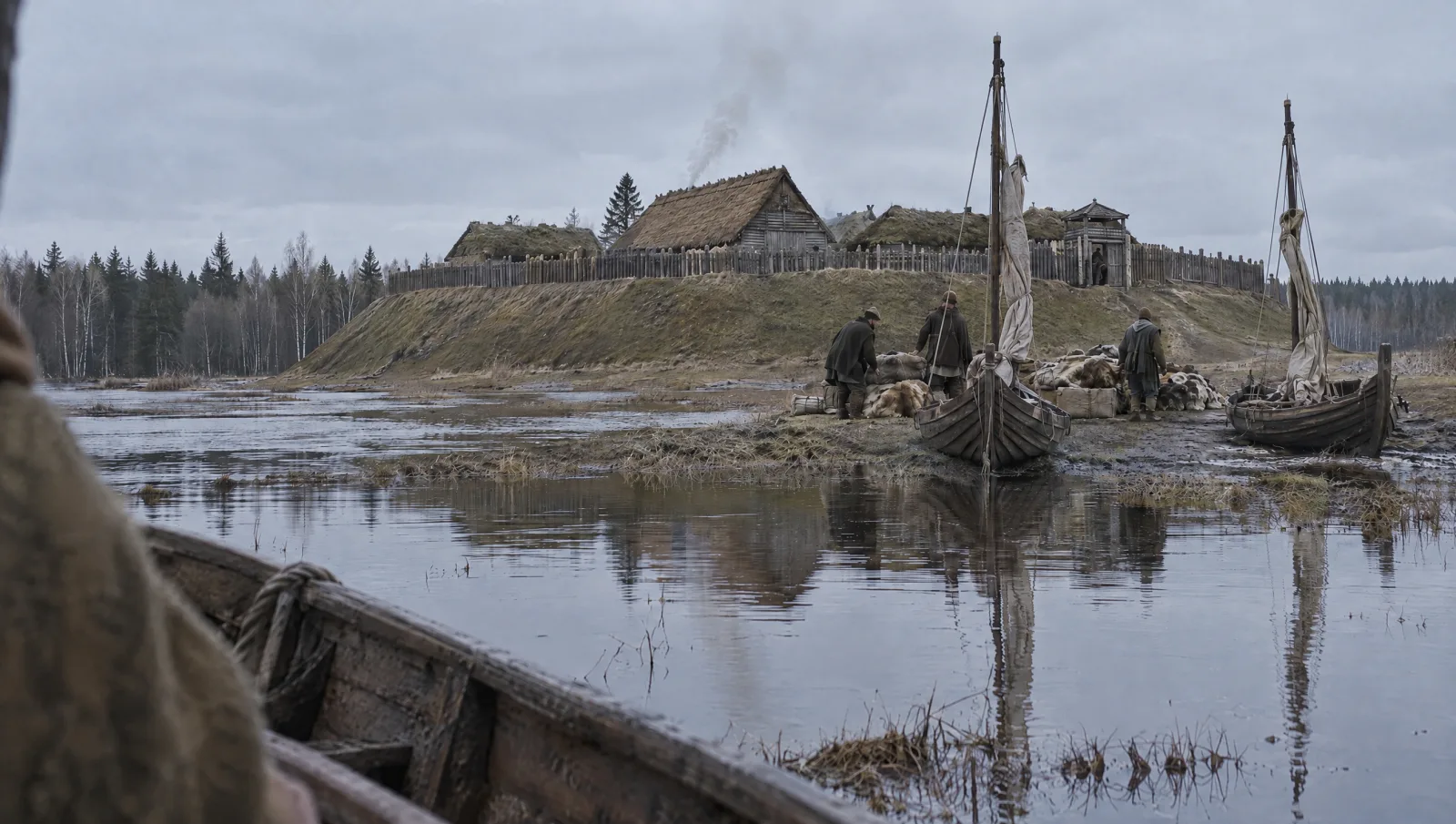
Staraya Ladoga ("Old Ladoga"), the Aldeigjuborg of the Norse sagas, is the earliest dated Viking-Age trading town in eastern Europe. It lies on the Volkhov river about 12 km above Lake Ladoga, and the oldest timber found there was felled in AD 753. Scandinavians, Finns and Slavs lived side by side in it, and for three centuries it was the gateway from the Baltic into the river roads to the Caspian and to Byzantium.
The famous dates are only the start. The settlement's waterlogged soil has preserved eleven building levels, a hidden set of smith's tools with a figure of Odin, a stick carved with runes, and boat graves across the river. This article follows what the excavations show, what the sagas and chronicles say, and how far "first capital of Russia" holds up.
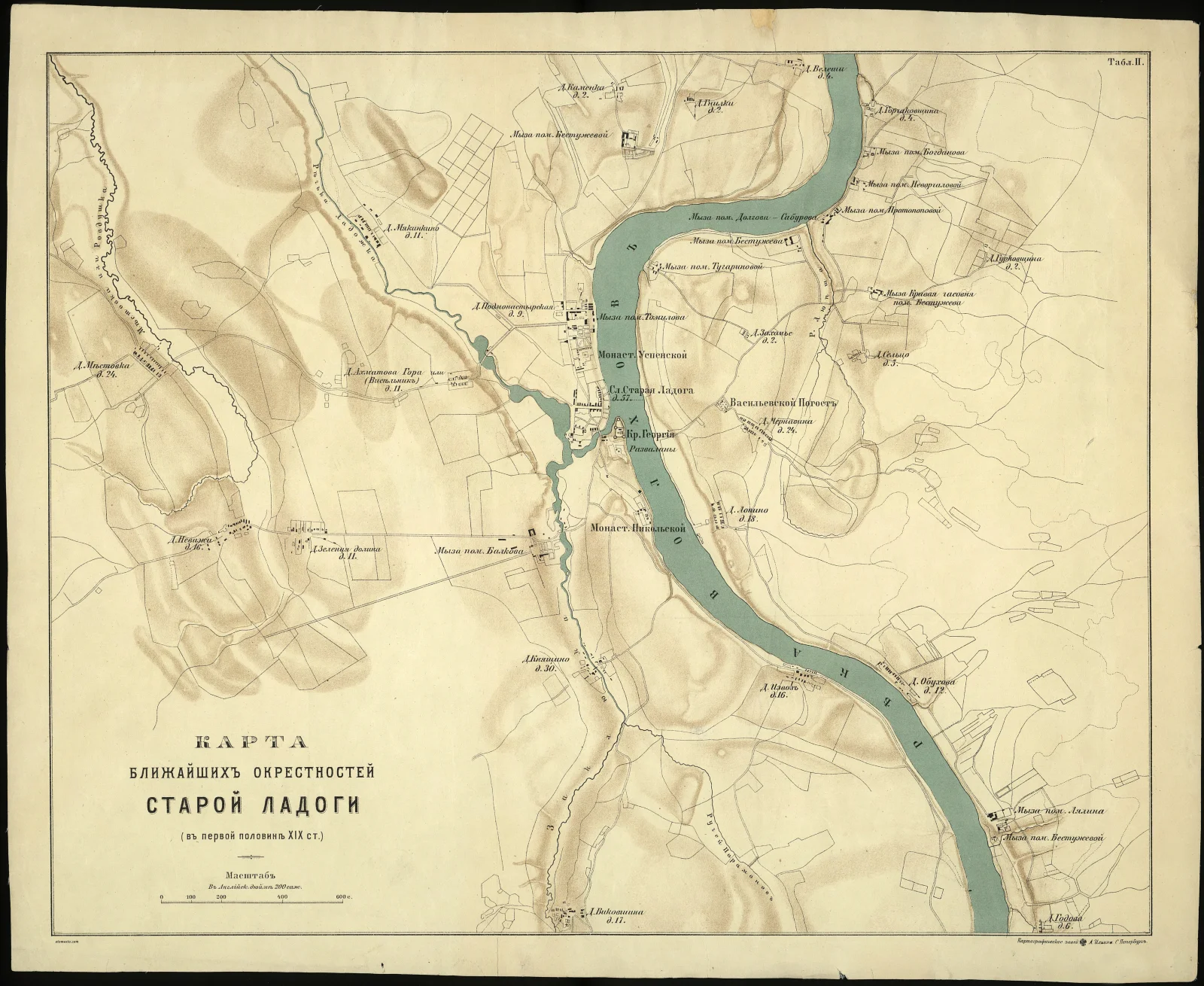
Where is Staraya Ladoga, and why there?
Staraya Ladoga lies on the west bank of the Volkhov, where the small Ladozhka river joins it. In the words of the archaeologist Natalia Grigorjeva (also spelled Grigoreva) of the Institute for the History of Material Culture in St Petersburg, it is "twelve kilometres from the southern shore of Lake Ladoga". Ships from the Baltic sailed up the Neva, some 74 km, into Lake Ladoga, then about 100 km along its southern shore to the mouth of the Volkhov, she notes in her 2021 chapter on the site.
A few kilometres upstream the Volkhov broke into rapids, guarded in the late ninth century by a Norse-Slavic fort at Novye Duboviki. Ladoga was therefore the last easy anchorage for sea-going ships. Here cargo, crews and boats changed for the river journey south, as our article on the Viking trade routes to the East explains. The early settlement was small: Russian archaeologists put it at 2–4 hectares, and less than a fifth of that has been dug.
Aldeigja, Ladoga, Old Ladoga: what does the name mean?
The Norse called the place Aldeigja, and the sagas call it Aldeigjuborg, "the fort of Aldeigja". Most linguists trace the name to a Finnic river name. The historian Tatjana Jackson argues that "Ladoga" first named the little river, then the town and only later the lake, and derives it from a Finnic form meaning "river of the lowlands". Others prefer a Karelian word for "wave", and Eugene Helimski proposed a Germanic Aldauga, "old source". In each case the Slavic form Ladoga arose by swapping the first sounds, ald- to lad-. All of these are proposals, not certainties.
"Staraya" came much later. In 1702–1704 Peter the Great built a shipyard and a new town, Novaya Ladoga, near the mouth of the Volkhov and ordered the inhabitants to move there. From 1704 the old town was "Old" Ladoga, and today it is a village.
How old is Staraya Ladoga? The smithy of 753
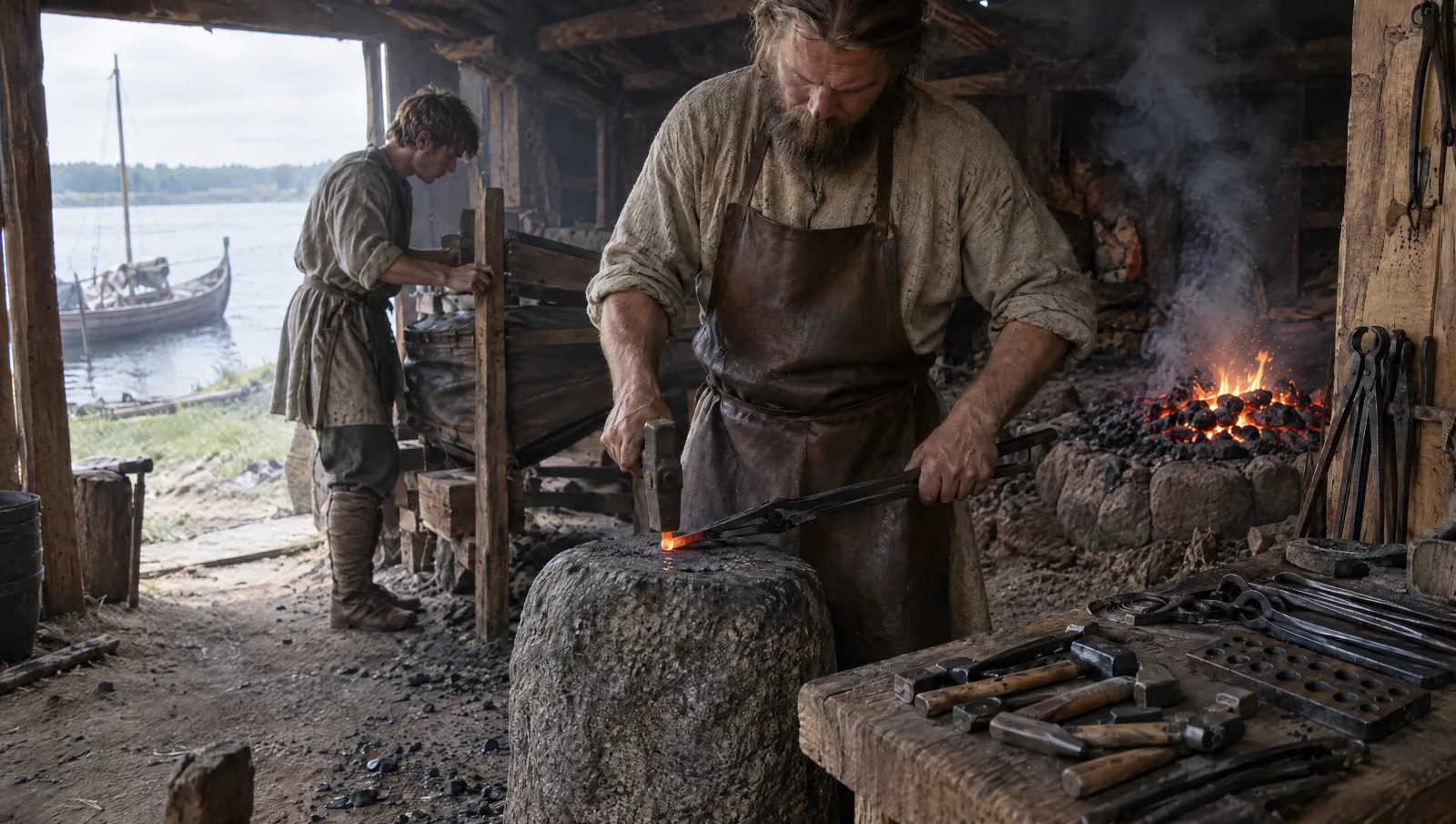
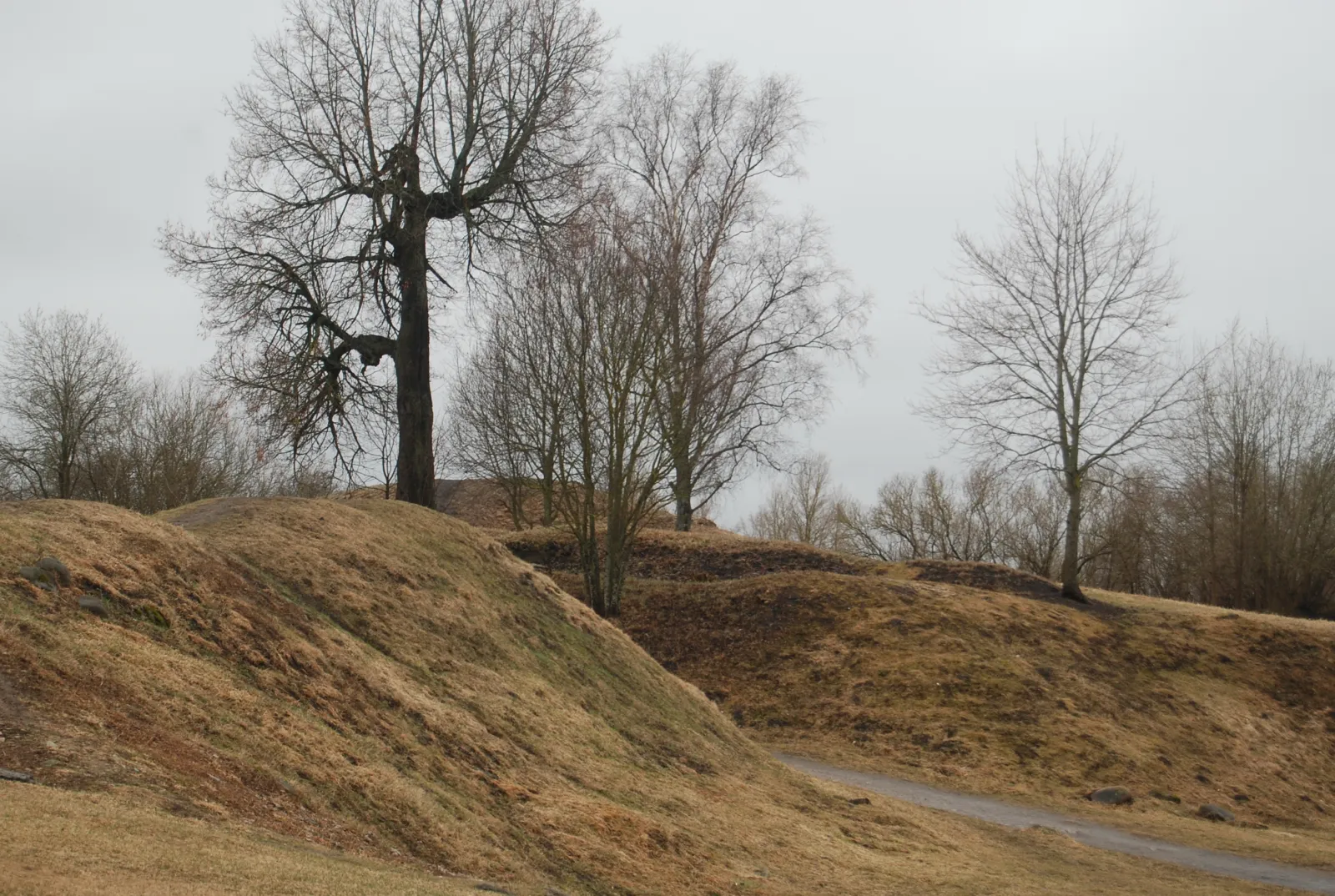
The oldest layers lie under the so-called Earth Fort (Zemlyanoe gorodishche), just south of the stone fortress. Its name comes from earthen ramparts of the sixteenth and seventeenth centuries, which buried the Viking-Age town and preserved it. In Russian archaeologists' sequence, summarised by Gleb Lebedev, the lowest level (about AD 750–760) held three large post-built halls of roughly 12 by 6 metres with central hearths, a small log building and a smithy. A granite boulder served as the anvil. Tree-ring dating gives AD 753 as the year the smithy's timber was felled, the earliest date from the site.
In a ditch beside the smithy Evgeny Ryabinin found a hoard of 26 craft tools: seven pairs of tongs, two small anvils, three jeweller's hammers, chisels, shears, drills, two wire draw-plates, a whetstone, the handle of a box that probably held them, and a bronze finial showing Odin flanked by his two ravens. Lebedev calls them "unquestionably of Scandinavian manufacture", with close parallels in Vendel-period Scandinavia. The tools seem to have been hidden when the smithy went out of use in the mid-760s. Their owner made ship rivets, knives and arrowheads and cast bronze.
Ladoga was not founded in empty country. People had lived along the Volkhov since the Stone Age. At Lyubsha, a small hillfort nearby, Ryabinin's excavations from 1996 uncovered a Slavic settlement of the eighth to mid-ninth centuries, fortified with dry-stone facing that Lebedev calls the oldest stone fortification in north-western Rus'. Scandinavians arrived in a region that already traded and built.
What do the excavations show? Eleven levels and five fires
Excavated layer by layer since 1911, the Earth Fort has given one of the best-dated sequences in Viking-Age Europe. The archaeologist S. L. Kuzmin divided the eighth- to tenth-century deposits into eleven building levels, each dated to within decades by tree-rings.
| Level | Approximate date (AD) | What it shows |
|---|---|---|
| I | 750–760 | Three halls, a log house and the smithy of 753 |
| II | mid-760s–780 | Smithy abandoned; the tool hoard hidden |
| III | 780–810 | A glass workshop using eastern techniques and raw materials; the first hoard of Islamic silver |
| IV | 811–c. 840 | A large hall built with timber felled in 811 and at least seven houses; ends in fire |
| V | c. 840–c. 865 | Several large halls, a runic stick, a neck-ring with Thor's hammers; ends in a fire that killed a woman and a child |
| VI | c. 865–890s | One hall rebuilt; the smithy back in use |
| VII | 890s–920s | A hall built partly of ship timber, with over 200 glass beads and 30 pieces of amber |
| VIII–IX | 920s–970s | A two-storey "palace"-like hall; workshops with over 300 antler blanks; a fire in the 950s |
| X–XI | to 997, and after | Destroyed by the fire of 997, then rebuilt |
Across the Ladozhka, a second quarter now called Varangian Street has timbers felled between AD 842 and 857. There, in the 1970s, V. P. Petrenko excavated more than 40 log buildings in layers up to 3.8 metres deep, and found traces of a further fire in 1015. By the tenth century, according to Rae Ostman's survey, the town had a regular street grid and slightly more than a thousand inhabitants.
The large halls stand out. Ostman describes one built in AD 894, about 17 by 10 metres, with an inner room around its hearth. Ryabinin compared such halls with the large wooden houses that, according to Ibn Fadlan, groups of Rus' traders built on the Volga. Whether they were merchants' houses, chieftains' halls or both is an interpretation, not a fact.
The fire of about AD 865 falls close to the Primary Chronicle's story of the Varangians being driven out and then invited back in 859–862. It is tempting to connect the two, but the chronicle's early dates were worked out centuries later, so a burnt layer cannot confirm them.
Who lived in Staraya Ladoga?
From the start, the town was mixed. The smith's tools and the Odin figure are Scandinavian, while spiral temple rings, worn by Slavic women, appear in the settlement and its graves. Ostman lists Balts, Finns, Slavs and Scandinavians, and notes that their material culture "became more homogenized" over time. She adds that attempts to match the two main house types to particular ethnic groups "have been unsuccessful".
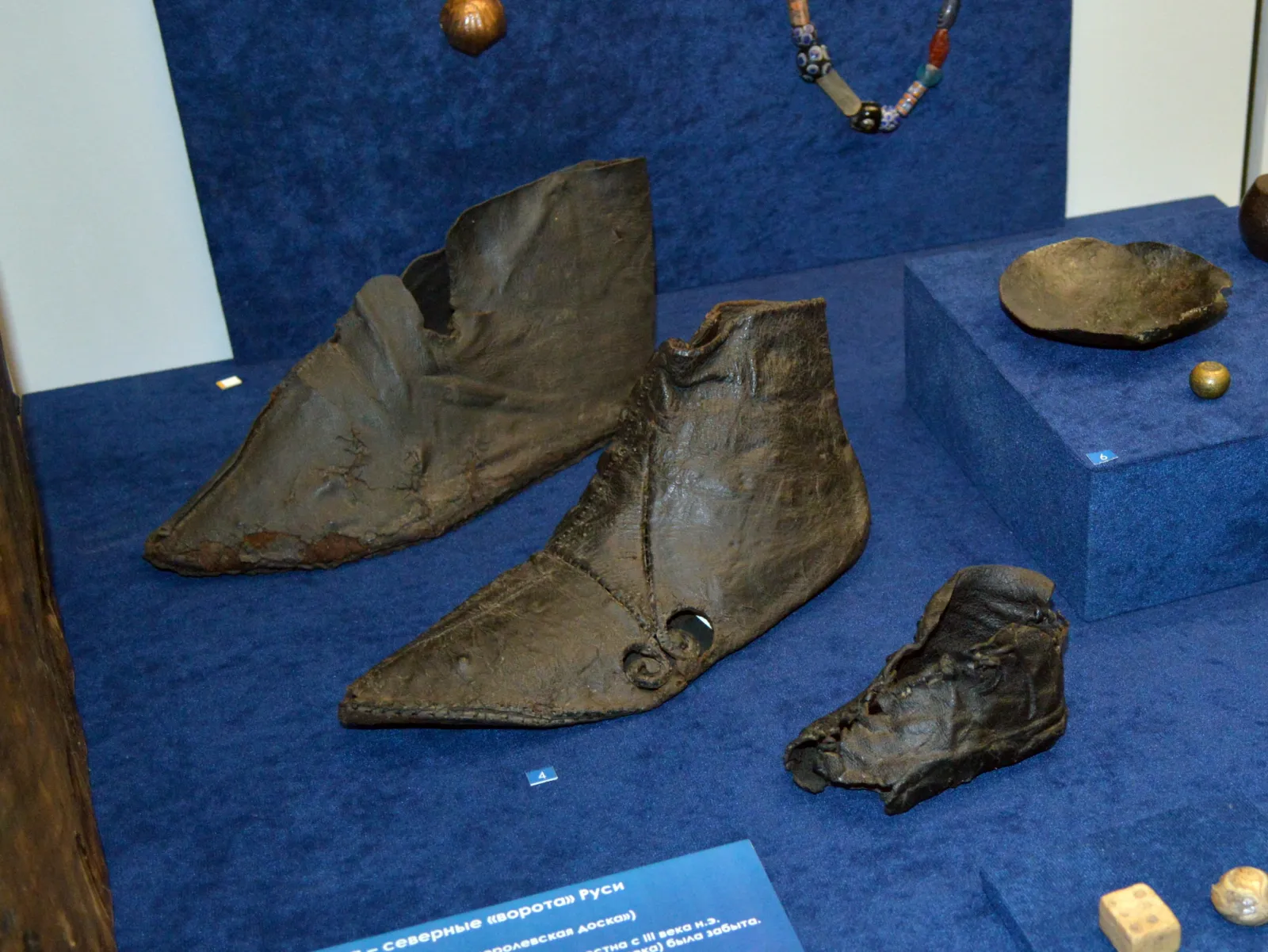
Almost every house shows craft work. Archaeologists have found glass-bead and amber working, bronze casting, antler combs, wood turned on lathes, more than 400 spindle whorls, and leather shoes preserved in the wet ground. People kept cattle, pigs, sheep, goats, horses and hens. They hunted beaver, fox, lynx and seal for meat and pelts.
Science has added names to the picture for later centuries. In 2019 T. Douglas Price, Vyacheslav Moiseyev and Natalia Grigoreva measured strontium in the teeth of 15 people buried in the eleventh and twelfth centuries at the church of St Clement. At least five had grown up away from Ladoga, with isotope values that match the Mälaren region of east-central Sweden. Scandinavians were still coming to Ladoga two centuries after the first smithy.
What does the Staraya Ladoga runic stick say?
In 1950 excavators found a fir stick 42 cm long with a line of runes carved along 12 cm of it. Lebedev places it in a large hall of the ninth-century Level V. It carries about 52 "short-twig" runes of the Swedish-Norwegian type, one of the earliest runic texts from eastern Europe.
Nobody agrees what it says. The runologist Jurij Kusmenko lists the main readings in a 2010 paper:
- a shield poem naming mythological figures (Gerd Høst, 1960);
- praise of a dead warrior (Wolfgang Krause, 1960);
- a charm on an arrow (Kiil, 1964);
- a verse about ploughing the fertile earth (Ottar Grønvik, 2004).
Kusmenko himself points out that the forked stick has the shape of a short distaff, a stick that held fibre for spinning. He reads the inscription as a spinner's charm ending with the owner's name: "Neflaug (or Iflaug) possesses (this distaff)." Two more objects with runes, among them a small amulet, have since been found at Ladoga.
Plakun and the Sopki: Ladoga's cemeteries
Across the Volkhov from the fortress lies Plakun, a low terrace where about fifteen mounds were excavated between 1940 and 1971. They are probably only a tenth to a fifth of the original cemetery. The excavator Vladislav Ravdonikas called it the first group of graves in the Ladoga region that could be "definitely and reliably" linked with Scandinavians.
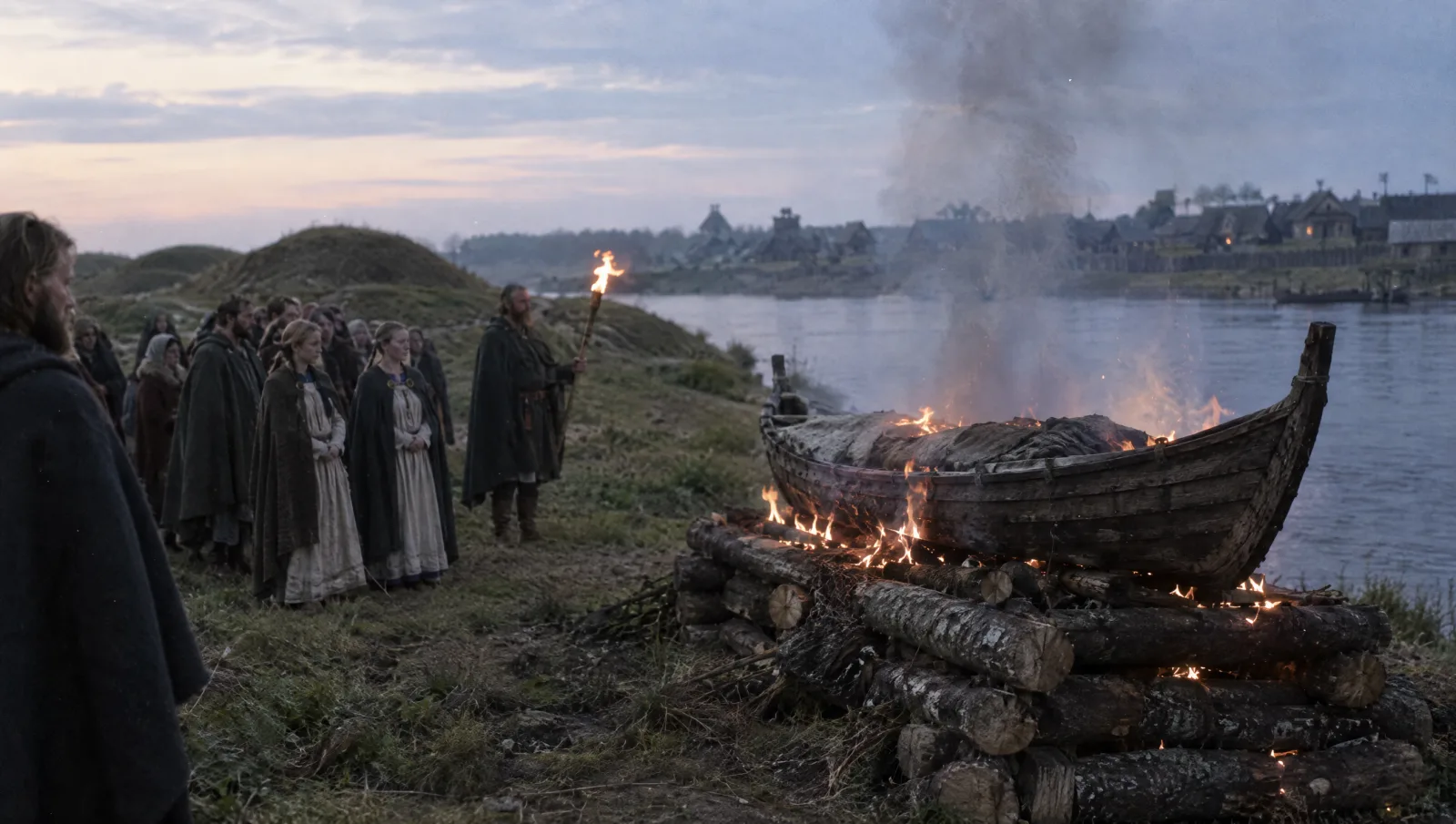
Four mounds held cremations in boats, recognisable from 40 to more than 200 iron ship rivets in the pyre layer. One contained a sword thrust into the ground, and another an urn with carnelian and rock-crystal beads. Mound 7 held a woman's grave with a jug made in the Rhineland in the first third of the ninth century, inlaid with a silver-foil cross. Lebedev links jugs of this kind to the Christian mission of Ansgar at Birka. Women's graves led the archaeologist Gali Korzukhina to see Plakun as a cemetery of Scandinavians "living here permanently and even with families".
Mound 11 covered a timber burial chamber, tree-ring dated to the 880s. It has even been proposed as the grave of Rurik himself, an idea most scholars treat as speculation. In August 2026 a team led by Natalia Grigorjeva and Marianna Pavlova re-excavated a Plakun chamber grave first opened in 1968. They found a battle axe, ship rivets and a cross-shaped pendant, and regional officials announced it as the burial of one of Ladoga's earliest Christians. That claim still awaits scholarly publication.
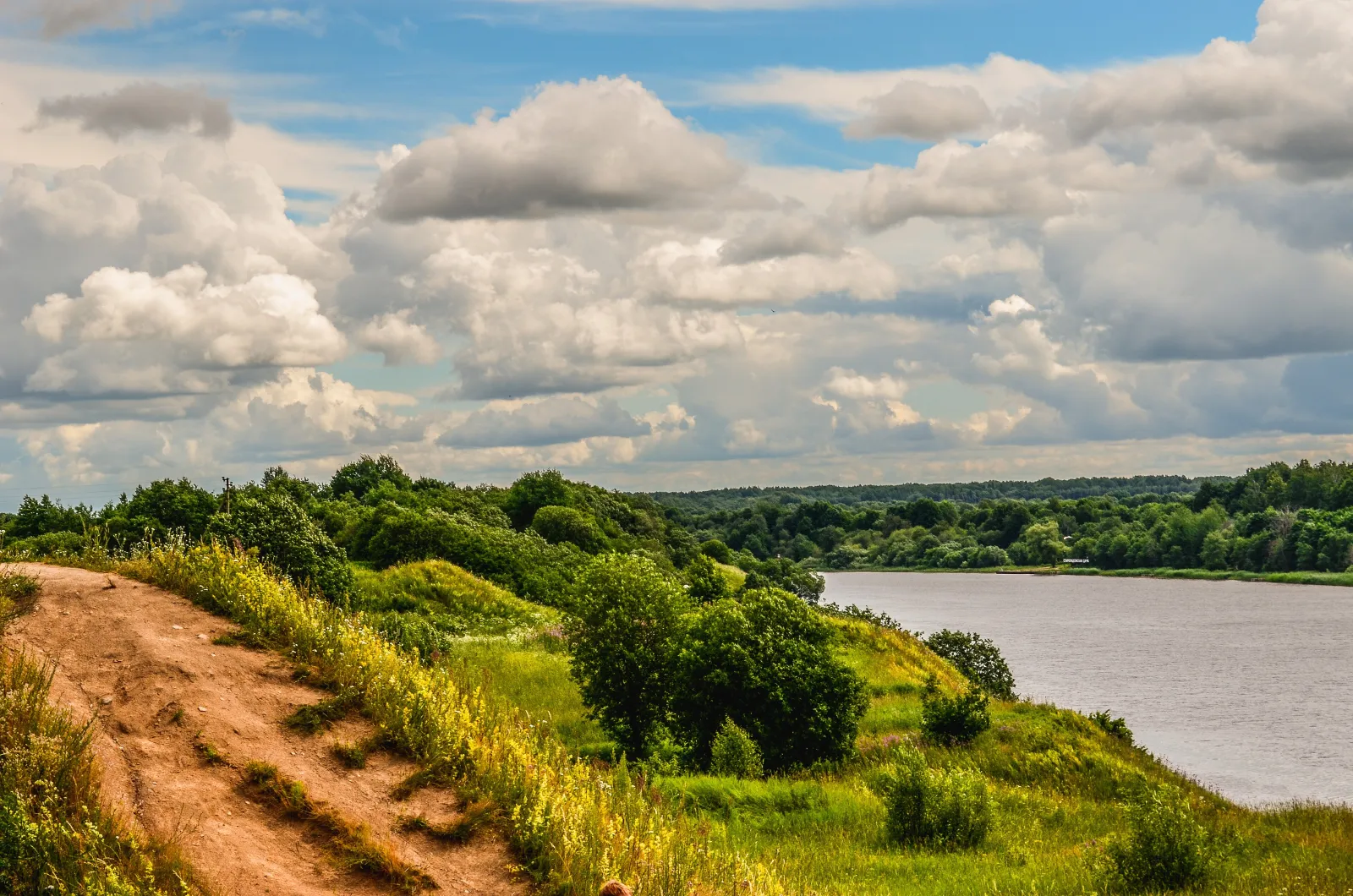
Further north along the Volkhov rise the Sopki, large burial mounds that the Russian heritage register dates to the eighth and ninth centuries. More than thirty survive. Some show Baltic burial customs, and who built the others is still debated. One, about 10 metres high, is known as Olegova Mogila, "Oleg's grave", after the Novgorod chronicle's note that Oleg's grave is in Ladoga.
Silver, beads and the trade that made Ladoga
Ladoga's wealth came from long-distance exchange. A hoard of 28 Islamic silver coins and three fragments, buried after AD 786, is the earliest closely dated hoard of dirhams in eastern Europe; our Rus' glossary entry describes it. Its silver came up the rivers from the Abbasid Caliphate through the lands of the Khazars.
At about the same time, Ladoga's glassworkers began making beads with a recipe that needed potash from the ash of steppe plants, raw material that could only arrive by the Volga route. Russian archaeologists describe a "triple exchange" in which beads bought furs, furs bought silver, and silver bought more beads and other goods. Merchants weighed their silver on folding scales with standard weights, and both have been found in the Earth Fort.
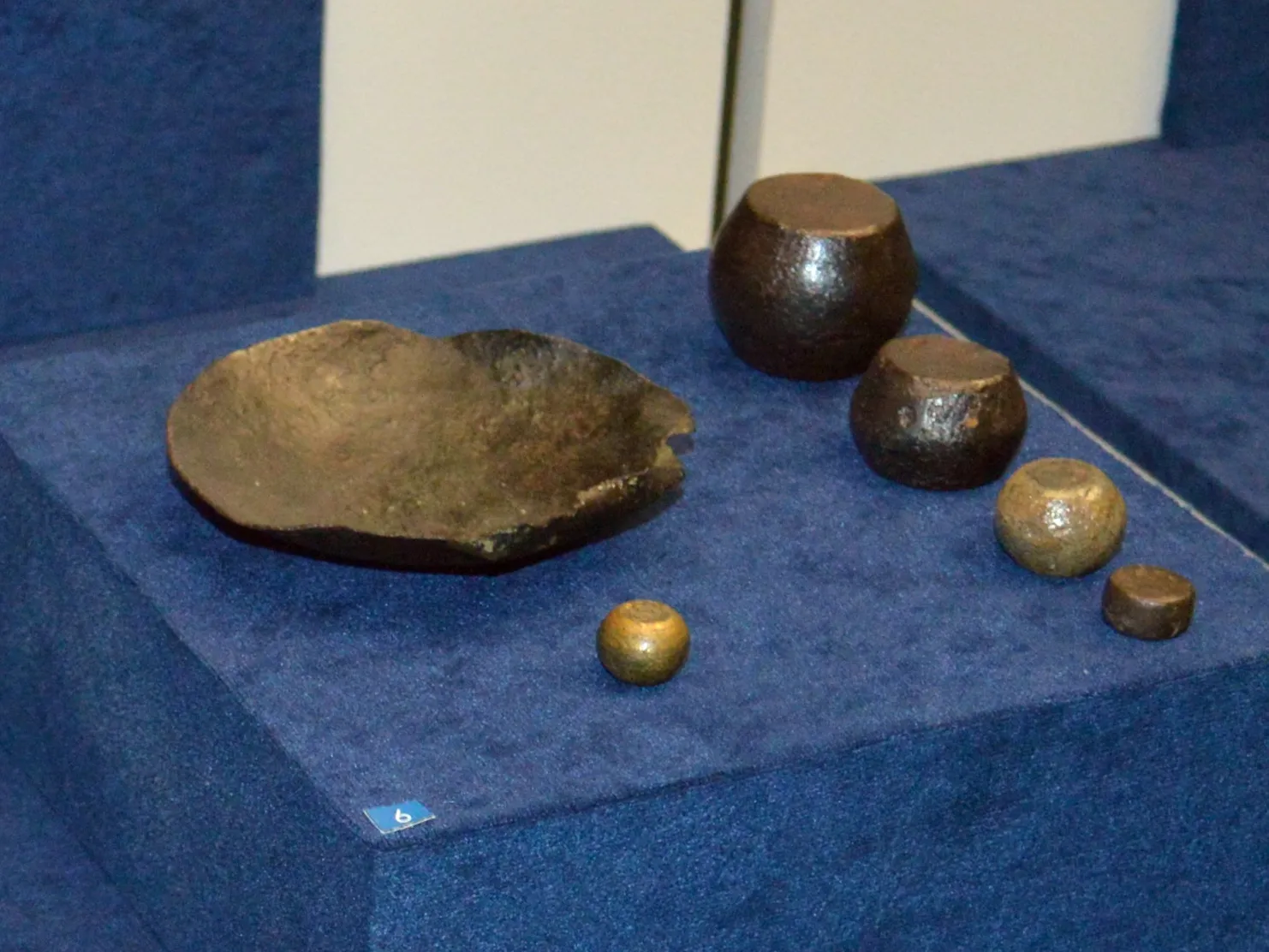
Goods came from every direction. Ostman lists combs from Frisia, swords from the Frankish kingdom, amber from the Baltic, and carnelian and rock-crystal beads, silk and silver from the East. Furs, honey, timber and slaves went the other way.
Aldeigjuborg in the sagas and chronicles
Written sources reach Ladoga late. The Hypatian version of the Primary Chronicle, which was compiled around 1113, has Rurik settle first at Ladoga before moving to Novgorod. The Novgorod First Chronicle places Oleg's grave there. A 2023 study by Nadezhda Platonova argues that both stories reflect the politics of the eleventh and early twelfth centuries more than the events of the ninth.
The sagas remember Aldeigjuborg as a prize. In Snorri Sturluson's Heimskringla, the Norwegian Earl Eiríkr Hákonarson, raiding in Russia, "came to Aldeigioburg and besieged it until he took the castle; and he killed many people" (Samuel Laing's 1844 translation). The raid is conventionally dated to about AD 997, and the excavators found a fire layer of that date across the town. About 1019, according to the sagas, Yaroslav the Wise gave Ladoga to his Swedish bride Ingegerd, and the Swedish jarl Rögnvaldr Úlfsson governed it as an earldom (see our article on Yaroslav the Wise).
Under Novgorod, Ladoga became a fortified outpost on the Baltic road. According to the Novgorod First Chronicle, in 1116 "Paul, Posadnik of Ladoga, laid the foundations of the town of Ladoga in stone"; the Hypatian Chronicle puts this under 1114. In 1153 Bishop Nifont of Novgorod founded the stone church of St Clement. In 1164 a Swedish fleet attacked: the townspeople burnt their own houses, held the fort until a Novgorodian army arrived, and the chronicle records that the Swedes "had come in 55 boats, 43 boats they took".
The fortress and St George's church
The stone fortress on the point between the Volkhov and the Ladozhka was first built in 1114 or 1116. Most of its standing walls and towers belong to sixteenth-century rebuilding and later restoration. Stone defences uncovered in 1973 have been dated by their excavator, Anatoly Kirpichnikov, to around AD 900, but Lebedev notes that their date has remained "a subject of discussion".
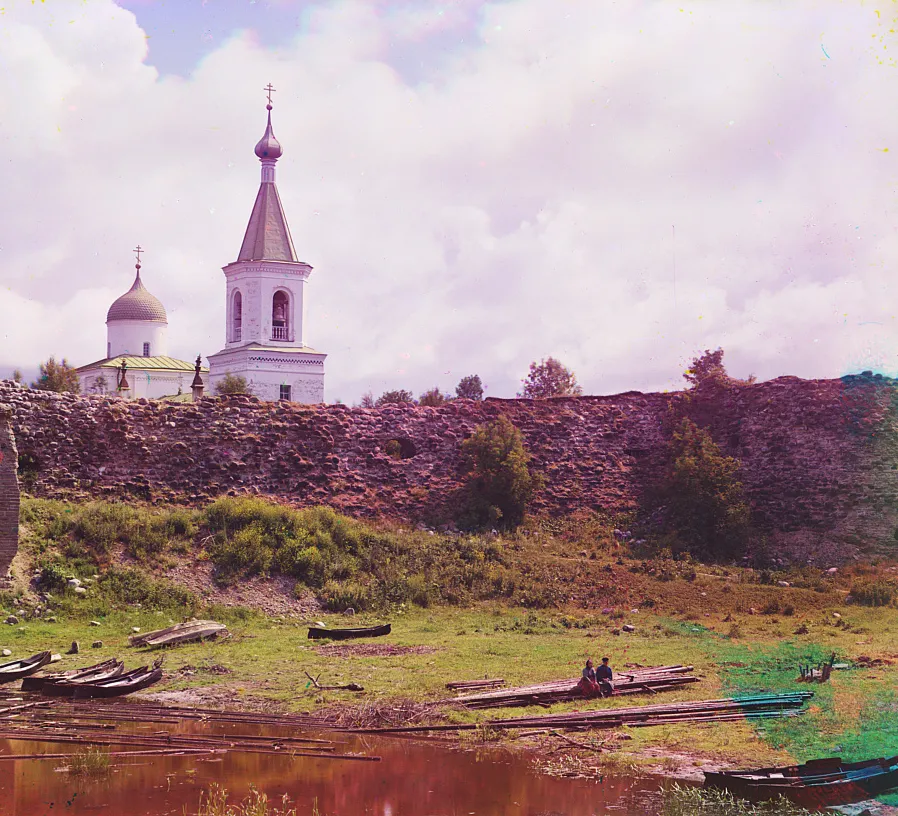
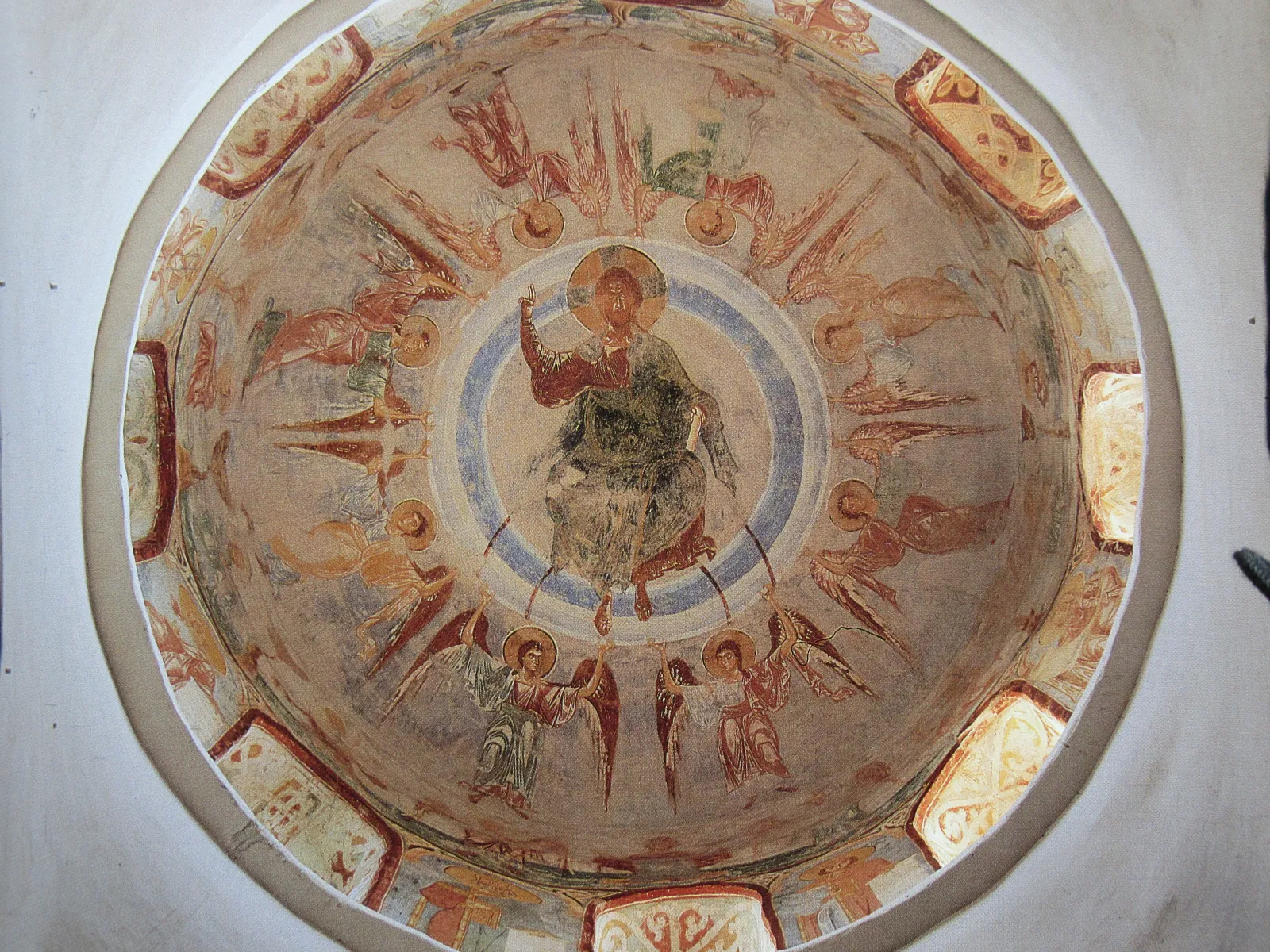
Inside the walls stands the small church of St George, one of the few buildings in Russia to survive from before the Mongol invasion. The art historian Vladimir Sarabyanov dates it to between 1180 and 1200. About a fifth of its original frescoes survive, including an almost complete Ascension in the dome and a scene of St George and the dragon. Their style suggests painters trained in the tradition of the Byzantine Empire.
Was Staraya Ladoga the first capital of Russia?
Not in any sense a historian would use. The phrase is a modern heritage label. In 2003 the village celebrated its 1,250th anniversary, counting from the smithy timber of AD 753, and President Vladimir Putin visited. Exhibitions and books have called it the "ancient capital" of northern Rus'.
Specialists describe Ladoga differently. Ostman calls it "a multi-ethnic trade town". Grigorjeva calls it "an important emporium of the global North" until Novgorod brought it firmly under its control in the early twelfth century. In the eighth and ninth centuries there was no Russian state to have a capital. The Rus' polity that grew from these river towns is claimed as an ancestor by Russia, Ukraine and Belarus alike, and its later centre was Kyiv. Staraya Ladoga's real claim is better: the place where the story of the Rus' can first be dated, year by year, in the ground.
What the map shows next
At AD 850 on the map, Ladoga is one of a string of Viking footholds from the Baltic to the upper Volga, and our article on the Varangians follows them south. By 1000 on the map the town belongs to Kievan Rus', ruled from Kyiv through Novgorod. By 1200 on the map it is a fortress of the Novgorod Republic facing the Kingdom of Sweden across the Baltic. Peter the Great's new town of 1704 finally turned the first Viking town in the East into "Old" Ladoga.
Common questions
What is Staraya Ladoga?
A village on the Volkhov river in north-western Russia, on the site of the earliest dated Viking-Age trading town in eastern Europe. The Norse called it Aldeigja or Aldeigjuborg.
Did Vikings live in Staraya Ladoga?
Yes. A Scandinavian tool hoard with an Odin figure from the 760s, a ninth-century runic stick, boat cremations at Plakun, and 11th–12th-century burials of people raised in central Sweden all show it.
What does Aldeigjuborg mean?
"The fort of Aldeigja". Aldeigja is the Norse form of a name most linguists trace to a Finnic river name, perhaps meaning "river of the lowlands".
Why is it called Old Ladoga?
Peter the Great founded Novaya ("New") Ladoga near the mouth of the Volkhov in 1702–1704 and moved the inhabitants there, so the original town became "Old" Ladoga.
Is Prince Oleg buried at Staraya Ladoga?
The Novgorod First Chronicle says his grave is in Ladoga, and a mound about 10 metres high is called Oleg's grave, but the identification is traditional only.
How old is the Staraya Ladoga fortress?
The first stone walls were built in 1114 or 1116. Most of what stands today belongs to sixteenth-century rebuilding and later restoration.
Sources
Primary sources (in translation)
- Robert Michell and Nevill Forbes (trans.), The Chronicle of Novgorod 1016–1471 (London: Camden Society, 1914), pp. 9 (1116), 21 (1153), 24 (1164). PDF: https://faculty.washington.edu/dwaugh/rus/texts/MF1914.pdf
- Snorri Sturluson, Heimskringla, trans. Samuel Laing (1844), Saga of Olaf Tryggvason. Wikisource: https://en.wikisource.org/wiki/The_Heimskringla;_or,_Chronicle_of_the_Kings_of_Norway/Volume_1/Saga_6
- Russkii biograficheskii slovar', vol. 13 (1902), "Pavel, posadnik novgorodskii", on the 1114 (Hypatian) and 1116 (Novgorod) dates for the stone fortress: https://azbyka.ru/otechnik/Spravochniki/russkij-biograficheskij-slovar-tom-13/10
Studies and reference works
- Natalia Grigorjeva, "Archaeological Evidence for Staraya Ladoga as an Early Scandinavian Emporium of the Global North", in The Global North: Spaces, Connections, and Networks before 1600 (Arc Humanities Press, 2021), pp. 37–52, DOI 10.1017/9781641894906.003: https://www.cambridge.org/core/books/abs/global-north/archaeological-evidence-for-staraya-lagoda-as-an-early-scandinavian-emporium-of-the-global-north/A050190A003274AB05E9A5B1190D1781
- G. S. Lebedev, Epokha vikingov v Severnoi Evrope i na Rusi (St Petersburg, 2005), chapter "Arkheologiya Ladogi". It summarises S. L. Kuzmin (2000), E. A. Ryabinin (1980, 1985) and V. A. Nazarenko (1985). Online copy: https://arheologija.ru/arheologiya-ladogi/
- Rae Ostman, "Staraya Ladoga", in Ancient Europe 8000 B.C.–A.D. 1000: Encyclopedia of the Barbarian World (2004): https://www.encyclopedia.com/humanities/encyclopedias-almanacs-transcripts-and-maps/staraya-ladoga
- T. Douglas Price, Vyacheslav Moiseyev and Natalia Grigoreva, "Vikings in Russia: origins of the medieval inhabitants of Staraya Ladoga", Archaeological and Anthropological Sciences 11 (2019), 6093–6109: https://link.springer.com/article/10.1007/s12520-019-00897-2
- Jurij Kusmenko, "A runic inscription on a distaff from the Viking Age: a new interpretation of the runic inscription on the stick from Staraya Ladoga", preprint, 7th International Symposium on Runes and Runic Inscriptions (Oslo, 2010): https://www.khm.uio.no/english/research/publications/7th-symposium-preprints/documents/kusmenko.pdf
- Nadezhda I. Platonova, "Old Russian Ladoga in the context of the Varangian legend: revision of sources and interpretations", Studia Slavica et Balcanica Petropolitana 2023/2: https://slavica-petropolitana.spbu.ru/en/arkhiv/388-studia-slavica-et-balcanica-petropolitana-2023-2/fontes-historical-sources/1014-platonova-nadezhda-igorevna-old-russian-ladoga-in-the-context-of-the-varangian-legend-revision-of-sources-and-interpretations.html
- St Petersburg State University, "Scholars from St Petersburg State University uncover secrets of Eastern Europe's oldest Christian burial site in Staraya Ladoga" (news, 12 August 2026): https://english.spbu.ru/news-events/news/scholars-st-petersburg-state-university-uncover-secrets-eastern-europes-oldest
- Russian Life, "(Very) Old Ladoga" (November/December 2003): https://russianlife.com/magazine/nov-dec-2003/very-old-ladoga/
- Wikipedia: "St. George's Church, Staraya Ladoga" (citing V. D. Sarabyanov, 2003), "Novaya Ladoga", "Novye Duboviki" and "Lake Ladoga" (etymology, citing T. N. Jackson, 1994, and E. Helimski).
Image credits
- Title image (the smithy at Ladoga, built with timber felled in AD 753): AI-generated illustration.
- Map of the surroundings of Staraya Ladoga, first half of the nineteenth century. Map: A. Ilyin cartographic establishment, public domain, via Wikimedia Commons.
- The Earth Fort beside the stone fortress. Photo: Cyrill70, CC BY-SA 4.0, via Wikimedia Commons.
- Leather shoes from the Earth Fort, eighth and ninth centuries (State Hermitage). Photo: Lapot, CC0, via Wikimedia Commons.
- A boat cremation at Plakun: AI-generated illustration.
- The Sopki tract on the Volkhov. Photo: Aleksandrovy AG, CC BY-SA 4.0, via Wikimedia Commons.
- Scale pan and weights from the Earth Fort. Photo: Lapot, CC0, via Wikimedia Commons.
- The fortress walls and St George's church in 1909. Photo: Sergey Prokudin-Gorsky, Library of Congress, public domain, via Wikimedia Commons.
- The Ascension in the dome of St George's church. Photo: Mortier.Daniel, CC BY-SA 4.0, via Wikimedia Commons.