Vladimir Monomakh (1053–1125) was grand prince of Kyiv from 1113 until his death, and for a generation before that the most powerful prince in Rus'. He led the princes' war against the Polovtsians (Cumans), the nomads of the southern steppe, and pushed them far from the borders of Rus'. He was also a writer: his Instruction to his sons, with an account of his own life, is the only autobiography left by a ruler of early Rus'.
Under Monomakh and his son Mstislav, Kyivan Rus' held together for the last time before it broke up into rival principalities. He is also the man behind one of Russia's most famous symbols, the "Cap of Monomakh", although the cap is not his. What follows separates what the sources say about him from what later centuries added.
Vladimir Monomakh at a glance
| Born | 1053, son of Prince Vsevolod Yaroslavich and a Byzantine princess |
| Names | Vladimir; baptismal name Vasilii (Basil); surname Monomakh, from his mother's family |
| Prince of | Rostov, Smolensk, Chernigov (1078–1094), Pereyaslavl (1094–1113) |
| Grand prince of Kyiv | 20 April 1113 – 19 May 1125 |
| Wives | Gytha, daughter of Harold II of England; a second wife (died 1107); probably a third |
| Notable sons | Mstislav the Great, Yaropolk, Vyacheslav, Yuri Dolgoruky (founder of Moscow) |
| Known for | Wars against the Polovtsians, the princes' councils, the Instruction, the law on interest |
| Died | 19 May 1125, near Pereyaslavl; buried in St Sophia, Kyiv |
Who was Vladimir Monomakh?
Vladimir was born into the ruling family of Rus', the Rurikids. He was a grandson of Yaroslav the Wise. The Primary Chronicle records his birth under the year 1053: "A son was born to Vsevolod by the Greek Princess, and he named him Vladimir" (trans. Cross and Sherbowitz-Wetzor).
In his Instruction he introduces himself in his own words:
"I, wretched man that I am, by my pious and glorious grandsire Yaroslav named at baptism Basil (Vasiliy) and with the Russian name Vladimir, surnamed Monomakh by my beloved father and mother…" (trans. Cross and Sherbowitz-Wetzor)
The surname came from his mother's side. The chronicle never names her. Because of the name Monomakh, historians long assumed she was a daughter of the Byzantine emperor Constantine IX Monomachos (ruled 1042–1055). The evidence allows less. As the translators of the Primary Chronicle put it, "all that one is warranted to deduce from these indications is that the princess in question was of the house of Constantine IX, even perhaps only descended from it in the female line." The Orthodox Encyclopedia calls her a "relative (daughter?)" of the emperor.
The English princess
Monomakh's first wife was Gytha, daughter of Harold II, the last Anglo-Saxon king of England, who fell at Hastings in 1066. No Rus' chronicle mentions her. The marriage is known from Western and Scandinavian writers: the Danish historian Saxo Grammaticus says that Harold's sons fled to Denmark "with their sister", and that King Sweyn gave the girl in marriage "to the king of the Ruthenians, Waldemar". The Norse sagas Fagrskinna and Morkinskinna tell the same story. The marriage probably took place in the early or mid-1070s.
Their eldest son, Mstislav, was born in Novgorod in 1076; the sagas know him by the English name Harald. Whether Gytha was also the wife whose death the chronicle records on 7 May 1107, or died earlier, is disputed. According to the Orthodox Encyclopedia, Monomakh married a second wife around 1099, the mother of Yuri Dolgoruky, and married again after 1107.
A prince on the move
Monomakh spent most of his life in the saddle. His autobiography lists his journeys as a young prince: to Rostov "through the Vyatichians", to Poland, to Bohemia, to Smolensk, Novgorod and Vladimir-in-Volhynia, and again and again against the Polovtsians. He counted his campaigns at the end:
"Among all my campaigns, there are eighty-three long ones, and I do not count the minor adventures. I concluded nineteen peace treaties with the Polovcians with or without my father's aid." (trans. Cross and Sherbowitz-Wetzor)
The literary scholar Dmitry Likhachev, who edited the text, counted only 69 campaigns actually listed in it. Monomakh also described how hard he rode: once from Chernigov to his father in Kyiv "in one day before Vespers".
He was prince of Chernigov from 1078, while his father Vsevolod ruled Kyiv. When Vsevolod died on 13 April 1093, Monomakh could have taken Kyiv. He did not. He let his cousin Svyatopolk Izyaslavich, the son of his father's elder brother, become grand prince, in keeping with the principle that seniority passed between the branches of the family.
In 1094 his cousin Oleg Svyatoslavich came with Polovtsian allies and besieged him in Chernigov, the city of Oleg's father. After eight days, Monomakh gave in:
"I took pity on the souls of our Christian subjects, and upon the burned villages and monasteries, and said, 'It is not for the pagans to boast.' I therefore gave my cousin his father's place, and retired myself to my father's domain of Pereyaslavl'." (trans. Cross and Sherbowitz-Wetzor)
He rode out of Chernigov with his family and fewer than a hundred men, through the Polovtsian ranks, which "licked their lips at us like wolves", as the original says. Pereyaslavl, on the edge of the steppe, was his base for the next twenty years.
The council of Lyubech and the blinding of Vasilko
The princes of Rus' were constantly at war with each other, and the Polovtsians profited from it. In 1097 the leading princes met at Lyubech on the Dnieper and agreed that each branch of the family should keep its own inheritance: "let each of us guard his own domain". They sealed it with an oath on the cross.
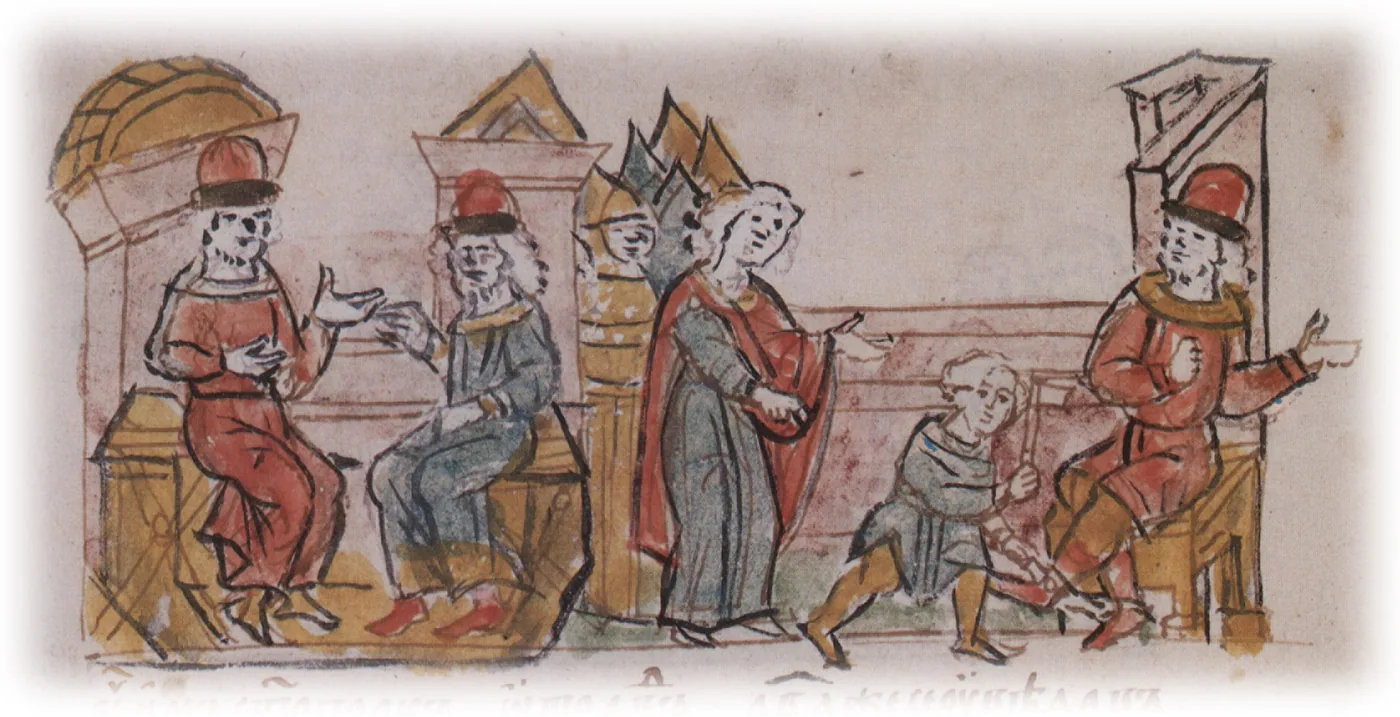
Within weeks the agreement was broken. Prince David Igorevich persuaded Grand Prince Svyatopolk that Prince Vasilko of Terebovl was plotting against them. Vasilko arrived at Kyiv on 4 November, was seized and taken to Belgorod, where a shepherd of Svyatopolk's put out his eyes with a knife. When Monomakh heard of it, the chronicle says, he wept: "Such a crime as this has never been perpetrated in Rus' in the time of either our grandfathers or our fathers" (trans. Cross and Sherbowitz-Wetzor). He gathered the other princes and forced Svyatopolk to act against David.
The war against the Polovtsians
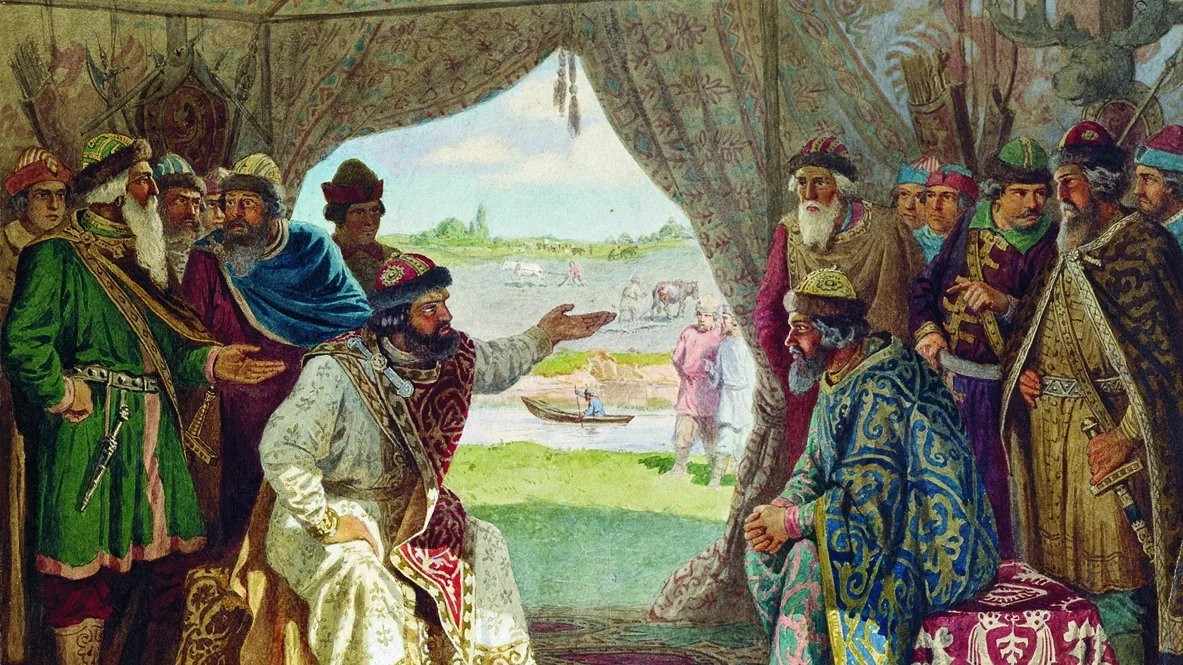
After Lyubech, Monomakh and Svyatopolk ruled Rus' almost as partners, and Monomakh turned the princes' energy against the steppe. In the spring of 1103 the two princes met at Dolobsk near Kyiv with their retainers. Svyatopolk's men objected that a campaign in spring would ruin the peasants by taking their horses from the plough. Monomakh answered:
"I am surprised, comrades, that you concern yourselves for the beast with which the peasant plows. Why do you not bear in mind that as soon as the peasant begins his plowing, the Polovcian will come, shoot him down with his bolt, seize his horse, ride on into his village, and carry off his wife, his children, and all his property? Are you concerned for the horse and not for the peasant himself?" (trans. Cross and Sherbowitz-Wetzor)
The princes rode into the steppe. On 4 April 1103, by the Suten river, they won a great victory in which, the chronicle says, "twenty Polovcian princes were slain". The captured khan Beldyuz offered a ransom; Monomakh refused, saying: "Your blood be upon your own head", and had him killed.
The greatest campaign came in 1111. The princes set out in Lent, reached the Don, took the Polovtsian towns of Sharukan and Sugrov, and on Friday 24 March fought the Polovtsians on the stream Degeya. On Monday 27 March, in Holy Week, the decisive battle was fought "on the river Salnitsa" (Kyivan Chronicle). The chronicler describes the campaign almost as a holy war: priests sang hymns of the Cross before the army, and in the battle the Polovtsians fell "struck down by an invisible angel". A later chronicle passage, under the year 1201, recalls the legend that Monomakh "drank the Don with a golden helmet".
Grand prince of Kyiv, 1113
Svyatopolk died on 16 April 1113. The next day the people of Kyiv held a council and invited Monomakh to take the throne. He refused, mourning his cousin. Then the city rose. The Kyivans plundered the house of Putyata, the tysiatsky (city commander), and attacked the Jews. They sent to Monomakh again, the Kyivan Chronicle says, with a threat:
"Come, prince, to Kyiv. If you do not come, know that much evil will arise: it will not only be Putyata's house or the sotskys' or the Jews that are plundered, but they will go on to your sister-in-law, and the boyars, and the monasteries, and you will answer for it, prince, if the monasteries are plundered." (Kyivan Chronicle, our translation)
Monomakh came. He entered Kyiv on Sunday 20 April 1113 and was met by Metropolitan Nikifor and the bishops, "and all the people were glad, and the rebellion died down".
Soon afterwards he called his commanders to his residence at Berestovo, and they limited the interest that moneylenders could take. The "Statute of Vladimir Vsevolodich" survives in the long version of the Russkaya Pravda, the law code of Rus': a creditor who had already taken interest three times could not claim his capital. Historians link the law to the debts behind the uprising, but its exact scope is still debated (Orthodox Encyclopedia).
Ruling Rus', 1113–1125
As grand prince, Monomakh controlled most of Rus'. According to the Orthodox Encyclopedia, he held "the greater part of Rus' with the exception of Chernigov, Polotsk and, at first, Volhynia". Princes who resisted, Gleb of Minsk and Yaroslav Svyatopolchich of Volhynia, lost their lands. He placed his sons in the key cities: Mstislav in Novgorod and, from 1117, at Belgorod near Kyiv, so that Kyiv would pass to him; Yuri in the north-east, where Monomakh had probably founded the town of Vladimir-on-Klyazma around 1108.
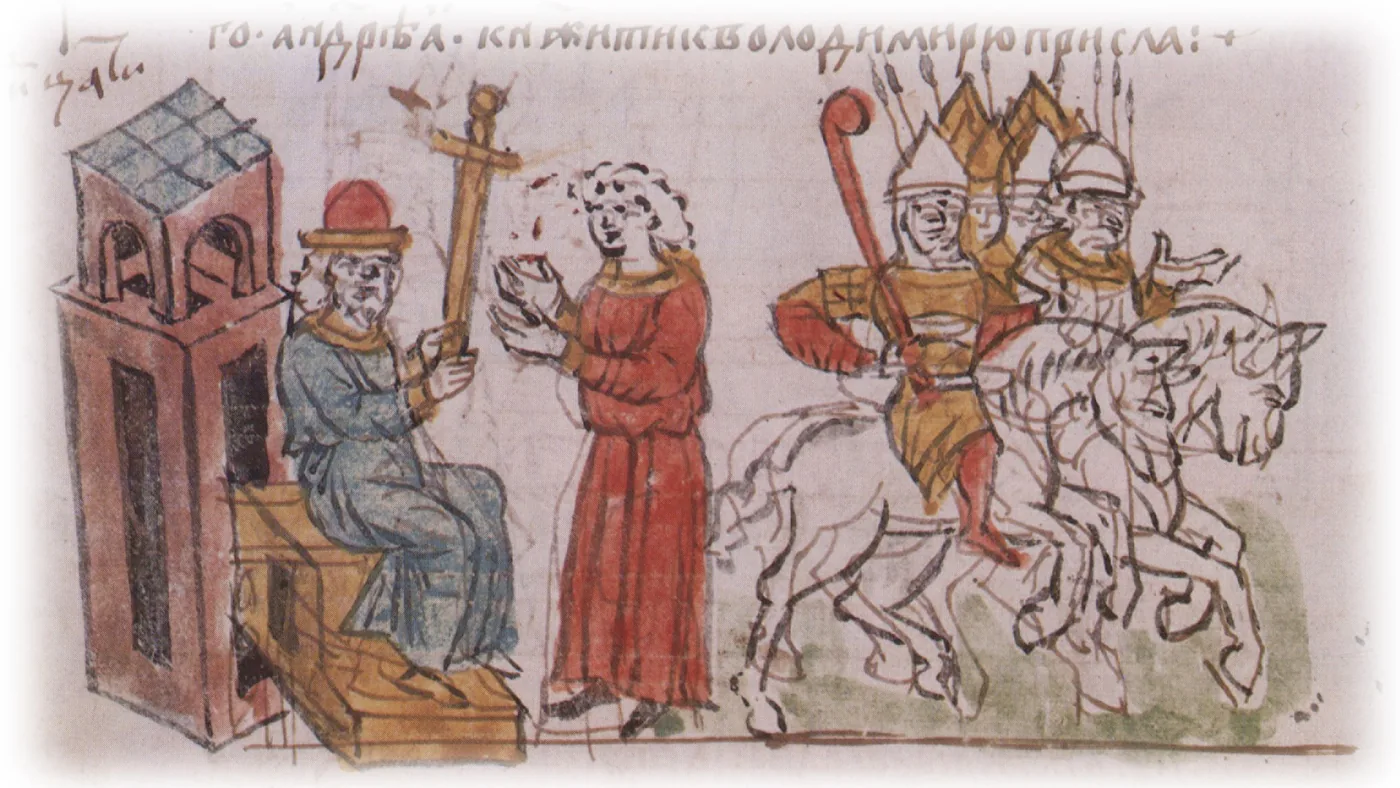
He also reached beyond Rus'. He married a daughter (or sister) to a Byzantine pretender, Leo, who claimed to be the son of Emperor Romanos IV Diogenes, and supported Leo's attack on Emperor Alexios I. After Leo's death in 1116, troops from Rus' briefly held towns on the lower Danube (Orthodox Encyclopedia). In 1116, too, the monk Sylvester signed a copy of the Primary Chronicle "during the reign of Prince Vladimir in Kiev". How far Monomakh shaped that chronicle is debated; the site's article on the Primary Chronicle explains the arguments.
Monomakh died on 19 May 1125 at his church on the river Alta near Pereyaslavl, the place where St Boris had been murdered. The Kyivan Chronicle mourned him as the prince "who illumined the land of Rus' like the sun sending out its rays; his fame went out to all lands, and he was most terrible to the pagans, a lover of his brothers and of the poor, and a good sufferer for the land of Rus'" (our translation). He was buried in St Sophia in Kyiv beside his father, and his eldest son Mstislav took the throne the next day.
The Instruction of Vladimir Monomakh
Monomakh's Instruction (Pouchenie) survives in only one manuscript, the Laurentian Chronicle of 1377, where it was inserted under the year 1096. It has three parts: the Instruction proper, advice for his sons; the account of his journeys and campaigns; and a letter to his cousin Oleg, written after Oleg's men killed Monomakh's son Izyaslav in 1096. The beginning of the text is lost. The core was probably written around 1099–1100, and the list of journeys continued to 1117 or later (Orthodox Encyclopedia).
He opens with an image of old age: "As I sat upon my sledge, I meditated in my heart and praised God". In early Rus', the dead were carried on sledges, so "sitting on the sledge" meant being near the end of life. His advice mixes piety with very practical rules:
"Give to the orphan, protect the widow, and permit the mighty to destroy no man. Take not the life of the just or the unjust, nor permit him to be killed." (trans. Cross and Sherbowitz-Wetzor)
"When you set out to war, be not inactive, depend not upon your captains, nor waste your time in drinking, eating, or sleeping. Set the sentries yourselves." (trans. Cross and Sherbowitz-Wetzor)
"Laziness is the mother of all evil; what a man knows, he forgets, and what he does not know he does not learn." (trans. Cross and Sherbowitz-Wetzor)
He praised his father, who "though he remained at home in his own country, still understood five languages", and told his sons to love their wives "but grant them no power over you". And he described the dangers of the hunt, which he loved:
"Two bisons tossed me and my horse on their horns, a stag once gored me, one elk stamped upon me, while another gored me, a boar once tore my sword from my thigh, a bear on one occasion bit my kneecap…" (trans. Cross and Sherbowitz-Wetzor)
The letter to Oleg is one of the most personal texts of early Rus'. Although Oleg's men had killed his son, Monomakh offered peace: "Oh long-suffering and wretched man that I am! My soul, long hast thou wrestled with my heart, and thou hast conquered it."
Is the Cap of Monomakh really his?
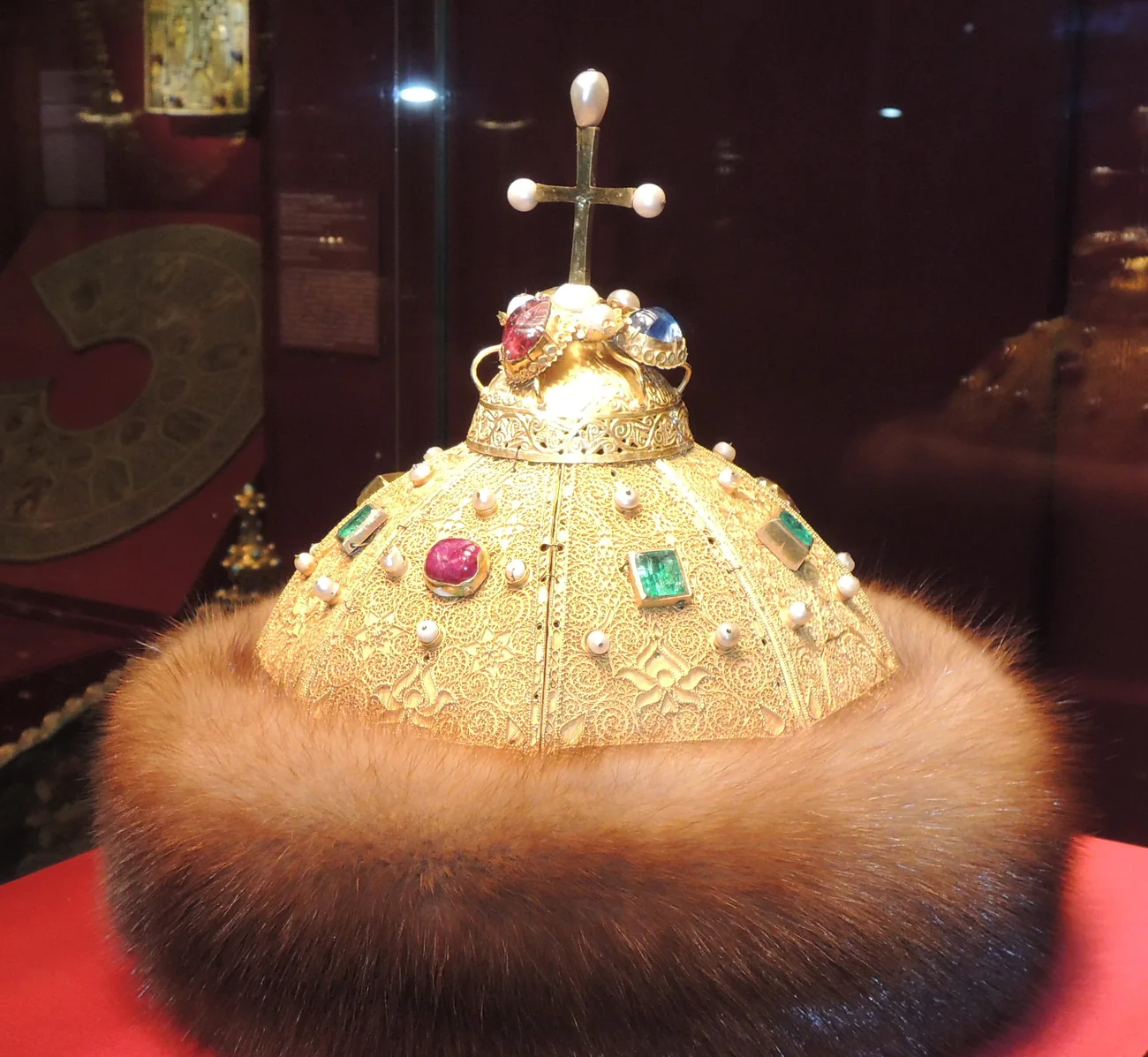
No. The Cap of Monomakh, the gold crown of the Moscow grand princes and tsars, now in the Kremlin Armoury, has nothing to do with Vladimir Monomakh. According to the Moscow Kremlin Museums, it is first mentioned as a "golden cap" in the testaments of Grand Prince Ivan Kalita in the 1330s. It received the name "Cap of Monomakh" only at the end of the 15th century under Ivan III and was first used as a symbol of supreme power in 1498.
The legend that Emperor Constantine Monomachos sent the crown to his grandson Vladimir appears in the 16th-century Tale of the Princes of Vladimir, written to show that the Moscow rulers inherited their power from Byzantium. The Kremlin Museums point out the problem: "Vladimir Monomakh was only 2 years old when his grandfather, the Byzantine emperor, died." They consider it most likely that the cap was a gift from Khan Uzbek of the Golden Horde to Ivan Kalita, and date it, with a question mark, to the first half of the 14th century.
Common myths about Vladimir Monomakh
| Myth | What the evidence says |
|---|---|
| The Cap of Monomakh belonged to him | First recorded in the 1330s, named after him only in the late 15th century; probably of Golden Horde origin |
| His mother was the daughter of Constantine IX | The chronicle says only "the Greek princess"; she was of the emperor's family, perhaps his daughter |
| He seized Kyiv by force | In 1093 he left Kyiv to his cousin; in 1113 he came only after a second invitation and a riot |
| He united all of Rus' | He ruled most of it, but not Chernigov or Polotsk |
| The Instruction is a deathbed testament | The core dates from around 1099–1100; "sitting on the sledge" is a figure for old age |
| Russian chronicles record his English marriage | They don't; it is known from Saxo Grammaticus and Norse sagas |
What the map shows next
The map of 1113 shows Kievan Rus' with its principalities: Kyiv, Pereyaslavl, Monomakh's base for twenty years, Chernigov, held by Oleg's family, Smolensk, Rostov-Suzdal in the north-east, Volhynia and the Novgorod lands. To the south, beyond the Black Sea, lay the Byzantine Empire of his mother's family.
Sources
Primary sources
- The Russian Primary Chronicle: Laurentian Text, trans. S. H. Cross and O. P. Sherbowitz-Wetzor (Cambridge, Mass., 1953), including Appendix I (the Instruction) and Appendix II (the letter to Oleg).
- Poucheniie Vladimira Monomakha, text prepared by O. V. Tvorogov, trans. and commentary by D. S. Likhachev, Biblioteka literatury Drevnei Rusi, vol. 1 (Pushkin House): http://lib.pushkinskijdom.ru/default.aspx?tabid=4874
- Ipatian Chronicle (Kyivan Chronicle), Polnoe sobranie russkikh letopisei, vol. 2, s.a. 6619–6633: https://archive.org/details/2_20241121_20241121_1922
- The Chronicle of Novgorod 1016–1471, trans. R. Michell and N. Forbes (London, 1914): https://archive.org/details/chronicleofnovgo00michrich
- Extensive Russkaya Pravda (Troitsky copy), art. 48, "Ustav Volodimer' Vsevolodicha": ru.wikisource.org: Пространная Русская Правда
Studies
- A. V. Nazarenko, "Vladimir (Vasilii) Vsevolodovich Monomakh", Pravoslavnaia entsiklopediia, vol. 8: https://www.pravenc.ru/text/159100.html
- D. S. Likhachev, "Vladimir Vsevolodovich Monomakh", Slovar' knizhnikov i knizhnosti Drevnei Rusi, vol. 1: http://lib.pushkinskijdom.ru/Default.aspx?tabid=3771
- "Gytha of Wessex", Medieval Princesses project, St Petersburg State University: https://medieval-princesses.spbu.ru/en/articles/gytha-of-wessex
- Moscow Kremlin Museums, "Shapka Monomakha": https://kreml.ru/ru/masterpieces/sapka-monomaxa
- Moscow Kremlin Museums, online collection, inv. R-3: https://collectiononline.kreml.ru/entity/OBJECT/36575
Image credits
- Title image: Aleksei Kivshenko, The Council of Dolobsk, late 19th century. Public domain, via Wikimedia Commons, cropped to 16:9.
- Radziwiłł Chronicle miniatures. CC BY-SA 4.0, via Wikimedia Commons.
- Cap of Monomakh. Photo: Shakko, CC BY-SA 4.0, via Wikimedia Commons, cropped.