Human verified. Last updated by our editorial team on .
North America · Breakaway states and civil war
Confederate States of America
1861–1865
The Confederate States of America existed for four years and was never recognised by any foreign government. It was created to preserve slavery, said so in its founding documents, and was destroyed by a war that ended slavery. Everything else about it — the constitution, the army, the currency, the flag, the memory — follows from that.
- Existed
- 1861–1865
- Shown on the map
- 1861–1865
- Peak area
- 1.7M km²
- Region
- North America
It is also the most contested subject in American history, and the contest is not about the facts. The facts are documented in extraordinary detail: the secession ordnances, the declarations of causes, the Confederate constitution, the census, the statutes, the military records. What is contested is what the facts mean, and whether the country was a legitimate state or a rebellion, a defence of liberty or a defence of slavery.
At a glance
| Name | Confederate States of America |
| Dates | February 1861 – May 1865 (the map draws 1861–1865) |
| Where | Eleven states from Virginia to Texas, plus claimed territory in Kentucky, Missouri and the Indian Territory |
| Capital | Montgomery, Alabama (February–May 1861), then Richmond, Virginia |
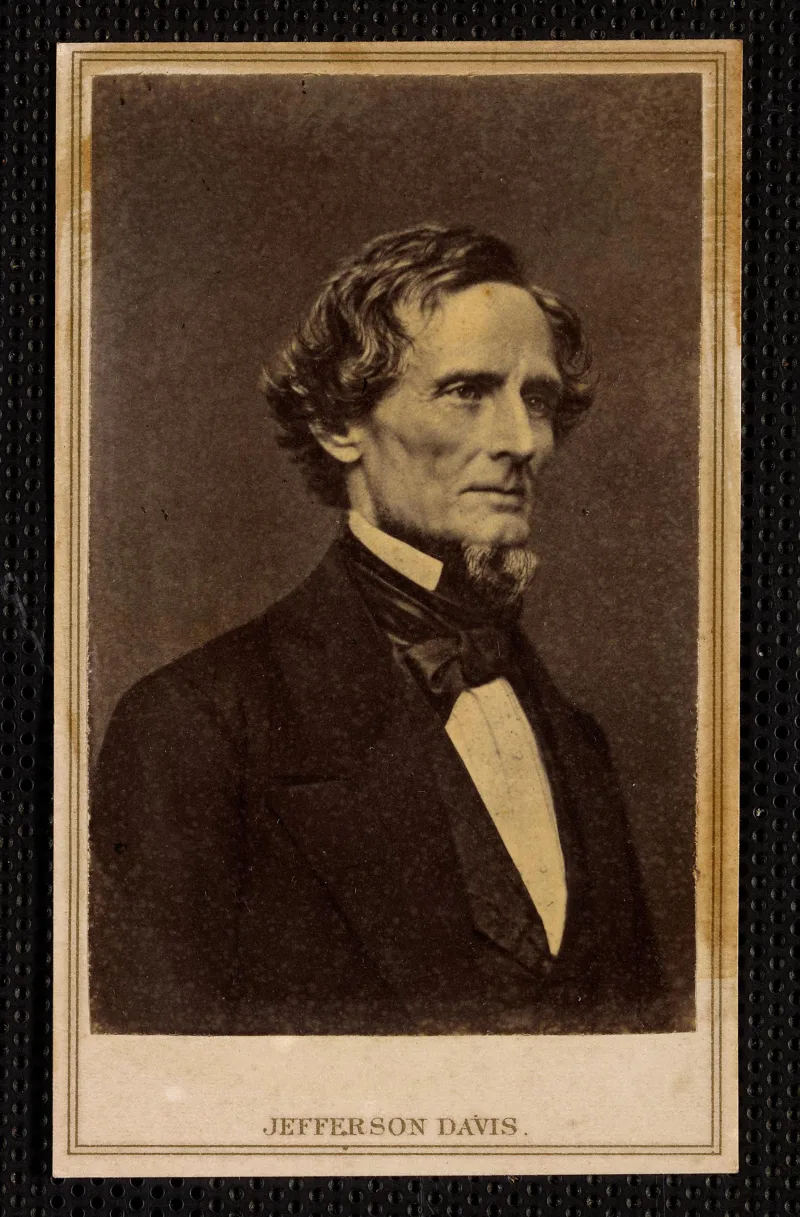
| President | Jefferson Davis, elected November 1861, inaugurated 22 February 1862; one six-year term, no re-election |
| Population | 9,103,333: 5,449,463 white, 3,521,110 enslaved (38.7 per cent), 132,760 free Black |
| Economy | Cotton exports, enslaved labour, a blockade, and inflation above 9,000 per cent |
| Army | Conscription from April 1862; the Twenty-Slave Law; some 1.5 million men served at some point |
| End | Richmond evacuated 2–3 April 1865; Lee surrendered 9 April; Davis captured 10 May |
What was the Confederate States of America?
A union of eleven slaveholding states that seceded from the United States between December 1860 and May 1861, formed a government at Montgomery in February 1861, moved it to Richmond in May, and fought a four-year war to establish its independence. It raised armies of over a million men, issued its own currency, ran its own postal service and negotiated — unsuccessfully — for European recognition.
It was also, in its own founders' words, a state founded on racial slavery. The vice-president said so in a public speech in March 1861; the seceding states said so in their declarations of causes; and the constitution said so in explicit clauses protecting slave property. The attempt to present the Confederacy as a war for states' rights or tariff policy is a later construction, and it does not survive contact with the documents.
Why did the states secede?
Because Abraham Lincoln's election in November 1860 convinced the slaveholding states that slavery would be confined and eventually abolished. South Carolina seceded on 20 December 1860, and six more states followed before Lincoln took office: Mississippi, Florida, Alabama, Georgia, Louisiana and Texas. The convention that took South Carolina out had 169 delegates, 153 of them slaveholders, and voted unanimously.
The declarations of causes are explicit. Mississippi said: "Our position is thoroughly identified with the institution of slavery — the greatest material interest of the world." Georgia complained that the North had "attempted to enforce upon us a doctrine of equality between the races". Texas said the Northern states were "proclaiming the debasing doctrine of equality of all men, irrespective of race or colour". South Carolina devoted most of its declaration to the subject.
The Upper South seceded only after Fort Sumter, and for a different mix of reasons — Virginia, North Carolina, Tennessee and Arkansas objected to coercion as much as to emancipation. But the war that followed was fought over the future of slavery, and both sides knew it.
How did secession actually happen?
Quickly, and by convention. South Carolina's legislature called a convention, the convention voted an ordinance, and the state was out — the model was repeated across the Lower South between December 1860 and February 1861. The conventions were elected on a franchise that excluded most Black people and, in some states, most poor whites, and their delegates were overwhelmingly slaveholders.
The seceded states met at Montgomery in February 1861, wrote a provisional constitution, elected Davis and Stephens, and declared themselves a nation. The Upper South held back. Virginia, North Carolina, Tennessee and Arkansas rejected secession in early 1861, and only left after Fort Sumter and Lincoln's call for troops — a decision they justified as resistance to coercion, which is true as far as it goes: they were not willing to fight for slavery until they were asked to fight against the South.
What was the Confederate constitution?
A modified copy of the United States constitution, adopted on 11 March 1861, and the modifications are the argument. The preamble drops "to promote the general welfare" and "provide for the common defence" — phrases which appear nowhere in the Confederate text — and substitutes the preservation of "the separate and sovereign character of each State".
It gave the president a single six-year term with no re-election, and a line-item veto. It forbade protective tariffs and federal internal improvements. And it protected slavery in four explicit provisions, including a clause guaranteeing the right to take enslaved people into any territory of the Confederacy — the very question the Dred Scott case had failed to settle — and a clause preventing any law impairing slave property.
Alexander Stephens, the vice-president, described the new government in a speech at Savannah on 21 March 1861: its "foundations are laid, its cornerstone rests, upon the great truth that the negro is not equal to the white man; that slavery, subordination to the superior race, is his natural and normal condition". The speech survives in a contemporary compilation that warns it was "very imperfectly reported", but the passage is not in dispute.
The document's architecture is worth noting because it is often described as a states' rights constitution. It was, in form: it preserved state sovereignty, limited federal power and forbade the central government from interfering with slavery in the states. But it also required the federal government to protect slavery in the territories and to return fugitives, and it made slave property a constitutional right that no state could impair — which is to say it centralised the protection of slavery while decentralising everything else.
It also entrenched the planter interest in other ways. It protected the interstate slave trade explicitly, required the return of fugitives across state lines, and provided that no amendment could be made to the slavery clauses without the consent of every state — a guarantee that no future majority could abolish the institution.
How did the government work?
Badly, and under strain. Jefferson Davis was elected president in November 1861 — the only presidential election the Confederacy ever held — and inaugurated on 22 February 1862 for a six-year term with no possibility of re-election. There was no presidential contest in 1864; the congressional elections of 1863 were the only other national vote.
Conscription came in April 1862, the first in American history: all white men aged eighteen to thirty-five, later extended to forty-five, with substitutes and exemptions. The Twenty-Slave Law exempted one white man per plantation with twenty or more enslaved workers, and its amendments only widened the resentment it caused — a rich man's war and a poor man's fight, in the phrase of the time.
The government also suspended habeas corpus, and Davis's own message of 1864 admits that the writ was being used to evade conscription. In February 1862 he told the Congress that "there has been no act on our part to impair personal liberty"; five days later it authorised him to suspend the writ. It is the clearest illustration of the Confederacy's constitutional problem: a state founded on local sovereignty that could only survive by centralising power.
What was Confederate diplomacy like?
Based on a theory that failed. "King Cotton" held that Britain and France, dependent on Southern cotton, would recognise the Confederacy and break the blockade to keep the mills running. The Confederacy therefore withheld cotton from the market in 1861 in an attempt to force intervention — a policy that emptied the warehouses, ruined the merchants and gave Britain time to find cotton in Egypt and India.
Recognition never came. There was a moment when it seemed close: Palmerston's cabinet debated intervention after the second battle of Manassas in September 1862, and the Confederate government believed that a European offer of mediation was imminent. Antietam, and then the Emancipation Proclamation, ended the possibility. The British and French governments granted the Confederacy belligerent status, which allowed them to trade and to treat captured ships under international law, but stopped short of recognition. The Trent affair of November 1861 — the removal of two Confederate envoys from a British ship bound for British North America, later Canada — nearly brought Britain into the war against the United States, and the Confederacy's hopes rose and fell with each diplomatic crisis. In the end, the Emancipation Proclamation made recognition impossible: no British government could recognise a slaveholding republic after 1863 without facing its own abolitionist public.
Who lived there?
Nine million people, of whom nearly four million were enslaved. The 1860 census for the eleven states gives 9,103,333 people: 5,449,463 white, 3,521,110 enslaved — 38.7 per cent of the population — and 132,760 free Black people. In South Carolina the enslaved were 57.2 per cent of the population, and in Mississippi 55.2 per cent: two states in which the majority of the people were owned by the minority.
The white population was divided by class, region and interest. The planters who dominated politics were a small minority; most white Southerners were yeoman farmers who owned no slaves, and the mountain counties of Tennessee, Virginia and North Carolina were largely Unionist. The Confederacy's internal war — against deserters, Unionists and its own poor — was as bitter as its war against the North.
What was the economy like?
Cotton, and the belief that cotton would win the war. The eleven states — among them the former Republic of Texas — produced 5,198,077 bales of 400 pounds in 1860, and 84.9 per cent of the crop was exported — most of it to Britain and France. The "King Cotton" theory held that Europe would intervene to keep the supply; instead, Britain found alternative sources in Egypt and India, and the blockade bit.
The blockade reduced exports to a fraction of pre-war levels, and the government's response — printing money, impressing goods, taxing in kind — destroyed the currency. Inflation doubled by early 1862, reached thirteen times prices by mid-1863, and exceeded 9,000 per cent over the war. The Impressment Act of 26 March 1863 set schedules around half of market prices, and the tax in kind took a tenth of farm produce. By March 1865 the government had issued some $500 million in unpaid certificates.
The result was hunger in the cities and resentment in the countryside. The Richmond bread riot of 2 April 1863 — often misdated to 1862 — was led by women demanding food, and it was one of dozens of such disturbances across the South.
What was the home front like?
Increasingly desperate. The blockade cut imports of salt, medicine, coffee and machinery; the impressment of horses, wagons and food hit farmers; and the tax in kind took a tenth of produce at a moment when labour was short because enslaved workers were leaving. Refugees flooded Richmond and other cities, and the Confederate government's own employees were paid in a currency that lost value every month.
The war also divided white Southerners. Conscription exemptions favoured the rich; mountain counties in Tennessee, Virginia and North Carolina resisted both secession and the draft; and by 1864 the Confederate army was losing more men to desertion than to battle in some departments. The government's response was coercion — martial law, hostage-taking, executions — which deepened the alienation it was trying to cure.
The blockade runners were the economy's other half. Fast steamers ran from Nassau, Bermuda and Havana into Wilmington, Charleston and Mobile with medicine, rifles, cloth and coffee, and out with cotton; the trade was profitable enough to attract British capital and to corrupt the officials who licensed it. It never replaced the lost export trade, and it collapsed the ports one by one as the Union navy closed them.
Southern industry was thin. The Confederacy had iron works at Richmond and Selma, a powder mill at Augusta, and shipyards at Norfolk until it was abandoned; it had some 9,000 miles of railroad by the estimate usually given, with different gauges that made through-running difficult and no capacity to replace rails or locomotives. By 1864 the network was worn out, and the government's priority was moving troops rather than food.
What was society like?
A slave society with a besieged yeoman majority. The planters owned the land and the people; the yeomen owned their farms and their pride; the poor whites owned neither. The war made all three poorer, and it made the enslaved majority indispensable and dangerous at the same time.
Slavery collapsed during the war, not after it. As Union armies advanced, enslaved people left the plantations in tens of thousands — "self-emancipation", in the historians' phrase — and the Confederate labour system came apart. Virginia lost 61 per cent of its adult male enslaved population by March 1865, from 65,720 to 25,697; Richmond lost 70 per cent, and Rappahannock County 72 per cent. The Confederacy's last debate, in March 1865, was whether to arm enslaved men as soldiers — a proposal that conceded the whole argument and came too late to matter.
What about the border states and the Indian Territory?
Four slave states stayed in the Union — Delaware, Maryland, Kentucky and Missouri, whose loyalty mattered as much to the United States as Virginia did to the Confederacy — and their loyalty was the war's first political question. Lincoln's caution towards them shaped the timing of emancipation: the Emancipation Proclamation exempted Tennessee, southern Louisiana and parts of Virginia precisely because those areas were under Union control, and it did not touch the border states at all, because they were not in rebellion.
The Indian Territory — modern Oklahoma — was split. The Five Civilised Nations had signed treaties with the Confederacy in 1861, supplied troops, and fought a civil war within the Civil War; the Cherokee principal chief John Ross eventually went over to the Union, and the territory was devastated. The Confederacy also claimed Kentucky and Missouri, with shadow governments and stars on its flag, though it never controlled them.
How did the war go?
From Fort Sumter on 12–13 April 1861 to Appomattox on 9 April 1865, with the only deaths at Sumter occurring in the surrender salute. The Confederacy won the first great battle at Manassas in July 1861 — a rout, not a pursuit — and the war in the east settled into a pattern of Confederate tactical brilliance and strategic exhaustion.
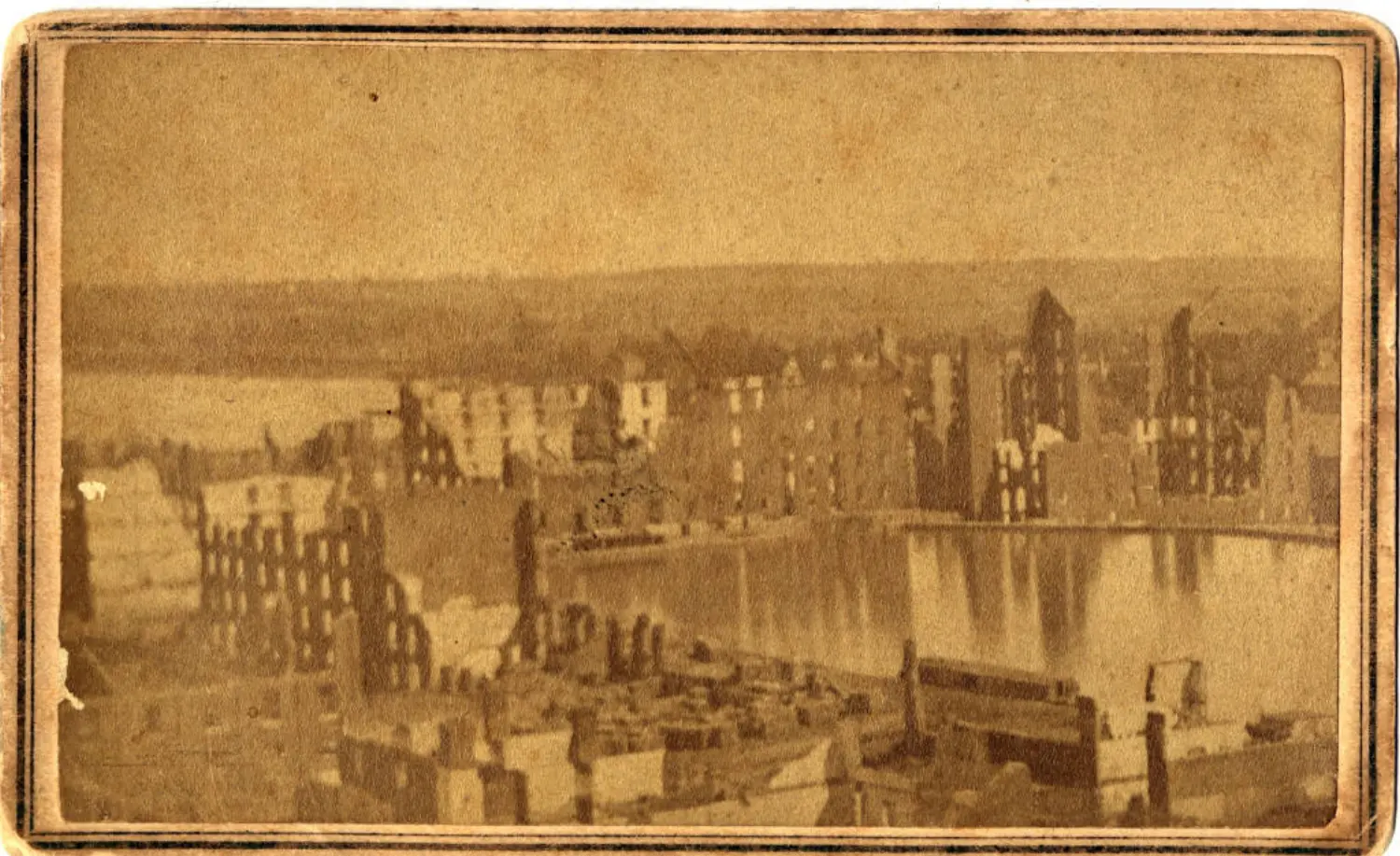
The turning point was 1863: Antietam in September 1862 gave Lincoln the victory he needed to issue the Emancipation Proclamation; Gettysburg in July 1863 ended Confederate hopes of invading the North; and Vicksburg fell the next day, giving the Union the Mississippi. In 1864 Sherman took Atlanta and marched to the sea, and Grant's campaign in Virginia ground down Lee's army at Petersburg. Richmond was evacuated on 2–3 April 1865, much of it burned by the retreating Confederates themselves, and Lee surrendered a week later.
The war in the west was decided earlier than the war in the east. Grant took Forts Henry and Donelson in February 1862, Shiloh in April, and New Orleans fell in April 1862 — the Confederacy's largest city and its main port, lost without a fight. By 1863 the Confederacy had lost the Mississippi, Tennessee and most of Arkansas, and the trans-Mississippi was cut off from Richmond.
The eastern war was a series of bloody checks: the Seven Days, Second Manassas, Fredericksburg and Chancellorsville were Confederate victories that cost the Army of Northern Virginia irreplaceable men; Antietam and Gettysburg were the battles that ended the South's chances of winning in the North. Lee's tactical genius prolonged the war; it could not change its arithmetic. Lee's two invasions of the North — in September 1862 and June–July 1863 — were attempts to win a decisive battle on Union soil, break Northern morale and force recognition; both ended in retreat, and the second cost him a third of his infantry.
The war's scale was unprecedented in the Americas. The Union mobilised some two million men and the Confederacy perhaps 1.5 million at some point in the war, out of a white population of five and a half million; whole cohorts of Southern men were killed or maimed. Railroads, telegraphs and rifled muskets made the killing more efficient, and the trench lines at Petersburg in 1864–65 anticipated the Western Front.
The naval war mattered as much as the land war. The Union blockade, declared in April 1861 and tightened over four years, cut the Confederacy's exports by more than two-thirds; the Confederate commerce raiders — Alabama, Florida, Shenandoah — destroyed Union merchant shipping around the world and kept the war at sea long after the armies had stopped. The Shenandoah was still taking prizes in the Pacific in August 1865, months after Appomattox, because her captain did not know the war had ended.
What did emancipation do?
It turned the war into a revolution. The Emancipation Proclamation of 1 January 1863 declared free the enslaved people in the states in rebellion — and only there, exempting Tennessee, southern Louisiana and parts of Virginia already under Union control, which is why it is both the great act and a limited one. It made the destruction of slavery a Union war aim and opened the army to Black soldiers.
Some 180,000 Black men served in the United States Colored Troops — the National Park Service gives three different figures (178,975, "over 200,000" and "almost 200,000 soldiers and sailors") and the discrepancy is unresolved. They fought in every major campaign from 1863, and the Confederacy's response at Fort Pillow in April 1864 — the massacre of surrendering Black troops — showed what it thought of the new policy. The Thirteenth Amendment, passed in January 1865 and ratified in December, abolished slavery everywhere.
How did it end?
With the army, then with the government.
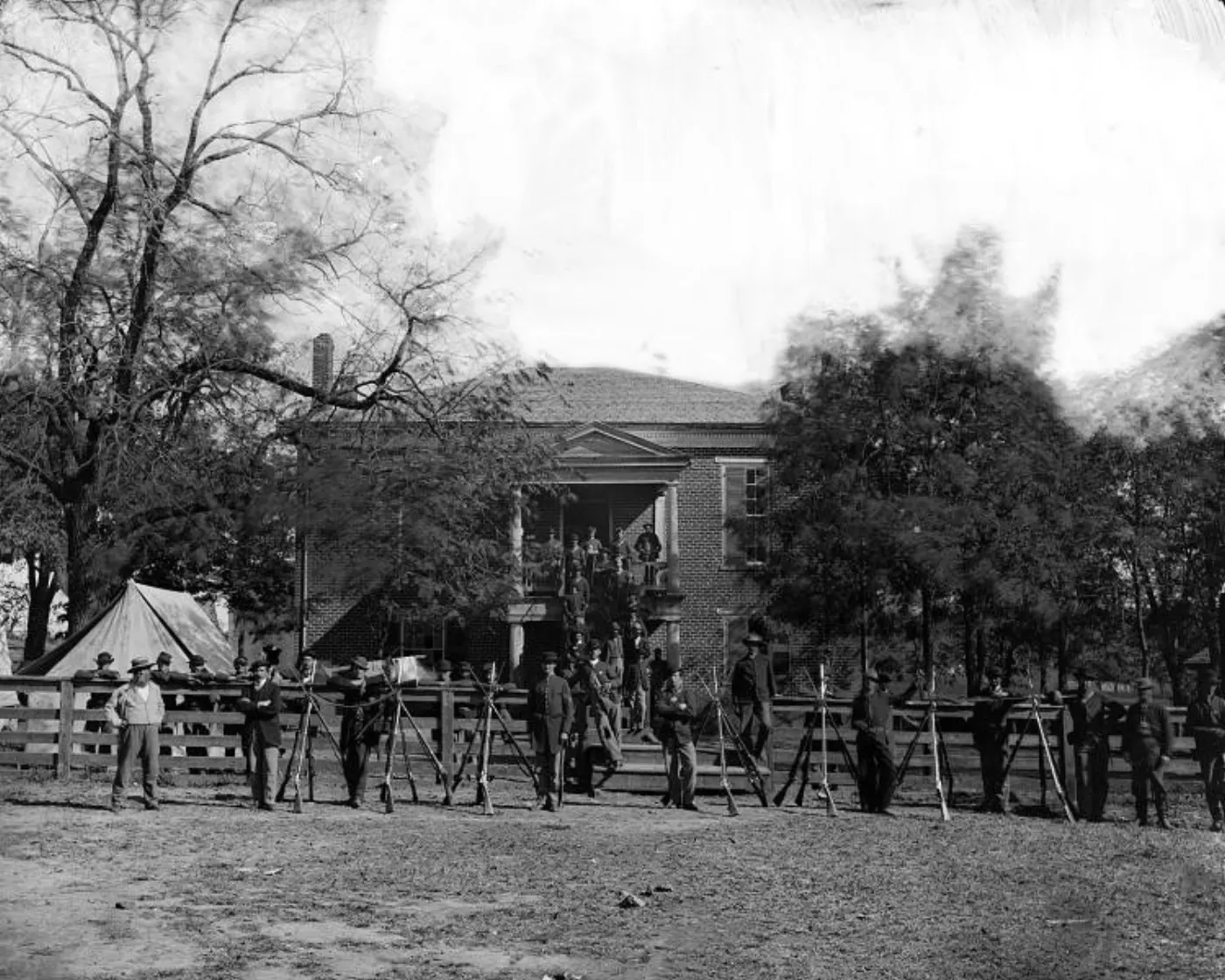
Lee's surrender at Appomattox on 9 April 1865 was followed by Johnston's to Sherman on 26 April — 89,270 men, though some accounts give "30,000 plus nearly 50,000" — and by Kirby Smith's in the trans-Mississippi, with terms on 26 May and formal surrender on 2 June. The last Confederate forces at sea surrendered in November, and the last land forces in the Indian Territory in June.
Richmond fell on 3 April, Davis fled and was captured on 10 May in Georgia, and the Confederate government ceased to exist. Lincoln was assassinated on 14 April, and his successor's amnesties — Johnson's of May 1865 excepted fourteen classes of Confederates, including those with taxable property above $20,000 — set the terms of Reconstruction. Juneteenth, 19 June 1865, marks the arrival of the news in Texas.
The surrender terms set the pattern for the rest. Grant's at Appomattox paroled Lee's army on condition that officers keep their sidearms and men their horses, and that they return home without prosecution — a political act as much as a military one, designed to end the war quickly rather than to punish. Johnston's surrender to Sherman on 26 April was initially more generous, and was repudiated by Washington; Kirby Smith's in the trans-Mississippi came on 26 May with the formal surrender on 2 June, and the last Confederate naval forces surrendered in November.
Davis was captured on 10 May in Georgia, dressed — according to the celebrated and disputed account — in his wife's cloak, and was imprisoned for two years. He was indicted for treason but never tried: the government concluded that a trial would require it to prove that secession was illegal, and that a conviction was uncertain and an acquittal catastrophic. The case was dropped in 1869.
How many died?
More than any other American war, and the exact number is still argued. The traditional figure is 620,000 military deaths; the revisionist figure, from J. David Hacker's analysis of census records, is about three-quarters of a million, with a range of roughly two-thirds to five-sixths of a million. Some fifty thousand civilians died. The National Park Service's two headline totals are casualties, not deaths, and its own components do not add up to its totals.
The dead were overwhelmingly young men, and the losses fell hardest on the South, which had a quarter of the white population and lost a far higher proportion of its military-age men. The war also killed an unknown number of enslaved people, whose deaths were not counted as losses by either side.
The Lost Cause was not a spontaneous folk memory. It was organised: the United Daughters of the Confederacy, founded in 1894, raised monuments, wrote textbooks, lobbied school boards and ran essay contests for children; the Sons of Confederate Veterans did the political work; and the historical profession, for a generation, largely accepted a version of Reconstruction that treated it as a disaster inflicted on a noble South.
Its central claims — that the war was about states' rights, that slavery was a benign institution, that enslaved people were loyal and contented, that the Confederacy was defeated only by numbers — are contradicted by the documents the secessionists themselves wrote. What the Lost Cause achieved was not historical accuracy but political power: it gave white Southerners a usable past, and it justified the Jim Crow order that followed.
Hacker's method is worth explaining because it is the reason the number changed. He reconstructed the 1860 and 1870 censuses by age and sex cohort and measured the shortfall of military-age men in 1870 against what the 1860 population implied, then adjusted for known enlistments, immigration and the undercount of the 1870 census. The result — 750,000, plus or minus 100,000 — is an estimate, not a count, and it is more defensible than the 620,000 figure, which descends from a nineteenth-century compilation.
The human cost fell unevenly. The South lost roughly a quarter of its white military-age men, and some communities lost most of a generation. The war also killed enslaved people in unknown numbers — through starvation, disease, labour and massacre — and those deaths were not recorded as war losses by either side.
How is it remembered?
Through the Lost Cause: a movement, beginning in the 1870s and institutionalised by the United Daughters of the Confederacy and its allies, which taught that the war was about states' rights, that slavery was benign, that Confederate soldiers were heroes and that the South was defeated by numbers rather than by anything else. It built the monuments, wrote the schoolbooks and shaped the memory for a century.
The monuments came in two waves, as the American Historical Association and the Southern Poverty Law Center have documented: the first around 1890–1920, at the height of Jim Crow and the disenfranchisement of Black voters, with a peak of fifty monuments in 1911; the second around 1950–1970, in reaction to the civil rights movement, with nine school namings in 1965 alone. The removals since 2015 are the third wave, and they are contested: in 2025 nine Army bases were renamed back to Confederate names, reversing a decision of 2020–23.
Academic history has been clear for two generations. The secession documents, the Cornerstone Speech and the Confederate constitution are the primary evidence, and they say what they say.
Common myths about the Confederacy
| Myth | What the evidence says |
|---|---|
| The war was about states' rights, not slavery | The seceding states' own declarations of causes name slavery as the cause; the Confederate constitution protects it in four clauses. |
| The Confederate constitution was the US constitution with slavery left to the states | It required slavery's protection in the territories and barred any law impairing slave property. |
| Davis was elected in 1864 | There was one presidential election, in November 1861, for a six-year term; 1863 was congressional. |
| The Twenty-Slave Law exempted overseers from the start | The original Exemption Act of 21 April 1862 had no overseer clause; the Twenty-Slave Law came later, and its amendments widened the resentment. |
| Inflation was caused by the blockade alone | It was caused by printing money, impressment at below-market prices and tax in kind; prices rose over 9,000 per cent. |
| The Richmond bread riot was in 1862 | It was 2 April 1863. |
| 620,000 died | The best current estimate is about three-quarters of a million, with a range of roughly two-thirds to five-sixths of a million. |
| The monuments are neutral memorials | They came in two political waves, 1890–1920 and 1950–1970, documented by the AHA and the SPLC. |
Timeline of the Confederate States of America
| Year | Event |
|---|---|
| November 1860 | Lincoln elected |
| 20 December 1860 | South Carolina secedes |
| January–February 1861 | Six more states secede; Montgomery convention |
| 11 March 1861 | Confederate constitution adopted |
| 21 March 1861 | Stephens's Cornerstone Speech |
| 12–13 April 1861 | Fort Sumter |
| May 1861 | Capital moves to Richmond; Virginia, Arkansas, Tennessee, North Carolina secede |
| November 1861 | Davis elected; the only presidential election |
| 22 February 1862 | Davis inaugurated |
| 16 April 1862 | Conscription Act |
| 21 April 1862 | Exemption Act |
| 1 January 1863 | Emancipation Proclamation |
| 2 April 1863 | Richmond bread riot |
| 26 March 1863 | Impressment Act |
| July 1863 | Gettysburg and Vicksburg |
| 1864 | Atlanta campaign; Sherman's march; Fort Pillow |
| March 1865 | Black-soldier law |
| 2–3 April 1865 | Richmond evacuated and burned |
| 9 April 1865 | Lee surrenders |
| 26 April 1865 | Johnston surrenders |
| 10 May 1865 | Davis captured |
| 2 June 1865 | Kirby Smith surrenders |
| 19 June 1865 | Juneteenth |
What the map shows next
At 1861 on the map the Confederacy has just been formed, and the United States is about to fight for its existence.
At 1865 on the map the Confederacy is gone, and the Maderistas are forty-five years away.
Common questions
- What was the Confederate States of America?
- A union of eleven slaveholding states that seceded from the United States in 1860–61 and fought a four-year war for independence, defeated in 1865.
- Why did the Southern states secede?
- To preserve slavery. Their declarations of causes say so explicitly, and the Confederate constitution protects slave property in four clauses.
- Was the Civil War about slavery?
- Yes. The seceding states said so; the Confederate vice-president said so; and the war ended with the abolition of slavery by the Thirteenth Amendment.
- Who was the Confederate president?
- Jefferson Davis, elected in November 1861 for a single six-year term.
- How many states joined?
- Eleven: South Carolina, Mississippi, Florida, Alabama, Georgia, Louisiana, Texas, Virginia, Arkansas, Tennessee and North Carolina.
- How many people lived in the Confederacy?
- 9,103,333 in the 1860 census, including 3,521,110 enslaved people — 38.7 per cent of the population.
- What was the Twenty-Slave Law?
- An exemption from conscription for one white man per plantation with twenty or more enslaved workers, later amended; it caused deep resentment among ordinary soldiers.
- How did the Confederacy end?
- Richmond fell in April 1865, Lee surrendered on 9 April, and the remaining armies surrendered by June; Davis was captured on 10 May.
- How many died in the Civil War?
- About three-quarters of a million military deaths by the best current estimate, with a range of roughly two-thirds to five-sixths of a million, plus some fifty thousand civilians.
- Was the Confederacy recognised by other countries?
- No. Britain and France declined to recognise it, and the King Cotton theory failed.
Sources
Every source below was consulted while writing this entry.
Every source below was consulted while writing this entry.
Primary and official sources
- The secession ordnances, 1860–61, and the declarations of causes of South Carolina, Mississippi, Georgia and Texas (Avalon Project).
- The Constitution of the Confederate States, 11 March 1861, articles I and IV.
- The Confederate Statutes at Large (1862), including the Conscription Act of 16 April 1862, the Exemption Act of 21 April 1862 and the habeas corpus Acts.
- The Journal of the Congress of the Confederate States, volume 1.
- Richardson, Messages and Papers of the Confederacy, volume 1.
- Stephens's Savannah speech of 21 March 1861, in the 1866 Cleveland compilation.
- The 1860 census, National Archives.
- The Emancipation Proclamation, 1 January 1863, and the Thirteenth Amendment.
- National Park Service, on Fort Sumter, the USCT and the casualty figures.
- National Archives, on the amnesties and the surrender records.
Scholarship and reference works
- James McPherson, Battle Cry of Freedom.
- Drew Gilpin Faust, This Republic of Suffering.
- Gary Gallagher, on Confederate nationalism.
- Stephanie McCurry, Confederate Reckoning.
- William Freehling, on secession.
- Caroline Janney, on the Lost Cause.
- J. David Hacker, on the death toll (figures via Binghamton's release; the article itself is paywalled).
- American Historical Association and Southern Poverty Law Center, on monument waves.
- David Blight, on memory and Reconstruction.
Data sources for the map
- Cliopatria v0.12 (Seshat Global History Databank, CC BY 4.0).
- Historical Basemaps (GPL-3.0).
This entry was written from the sources above and last updated .
Text available under CC BY-SA 4.0: reuse it with a credit to The World Through Time and a link to this page.
Border geometry for the map itself comes from Cliopatria v0.12 (Seshat Global History Databank, CC-BY-4.0).
See Confederate States of America in their world
Open the atlas at 1861 and every neighbour, rival and successor is on screen with it — then drag the slider and watch what happens next.
Open the map at 1861 →