Batu Khan (about 1205–1255) was a grandson of Genghis Khan and the ruler of the western part of the Mongol Empire. Between 1236 and 1242 he was the nominal commander of the great Mongol campaign to the west, which destroyed Volga Bulgaria, conquered the princes of Rus', took Kyiv and crushed the Hungarian army at Mohi. He then settled on the lower Volga, built the town of Sarai and ruled the western steppes as the senior prince of the Mongol family. His state is known to historians as the Golden Horde.
Batu is one of the few early Mongol rulers whom Europeans saw with their own eyes. Two Franciscan envoys stood before him in his tent, in 1246 and 1253, and both wrote down what they saw. Their reports, together with the Persian historians and the Rus' chronicles, show a ruler who was feared, careful and, as Carpini put it, richer and more powerful than anyone except the Great Khan himself.
Who was Batu Khan?
| Born | About 1205–1207; no medieval source gives the year directly |
| Father | Jochi, eldest son of Genghis Khan (died probably 1225; older view 1227) |
| Mother | Öki Fujin, of the Qonggirat people (Rashid al-Din) |
| Ruled | The western ulus (realm) of Jochi, from about 1225 (or 1227) to 1255 |
| Capital | Sarai, on the lower Volga |
| Title | Sayin Khan, "the good khan" |
| Died | Probably 1255, at Sarai |
| Successor | His son Sartaq |
Batu was the second son of Jochi, the eldest son of Genghis Khan. Genghis Khan had divided the Mongol peoples and their pastures among his four sons by his chief wife; Jochi received the westernmost lands, and after his death, probably in 1225, Batu took over his father's share, although his elder brother Orda was alive. The Persian historian Rashid al-Din, writing around 1300 at the court of the Mongol rulers of Iran, says Orda "was content with Batu's being the ruler".
The name Batu means "firm" in Mongolian. The Rus' chronicles call him Batyi, the Latin writers Bati, Bathy or Baatu. Rashid al-Din says he "was called Sayin-Khan", the "good khan". His English translator, John Andrew Boyle, argued that "good" here meant "late" or "deceased": a polite posthumous title, used so that people need not speak the dead ruler's name.
In the family Batu counted for more than his share of the land. Rashid al-Din writes that after Genghis Khan's death "he became the senior of all [the Khan's] grandsons", and that "in the quriltai, no one dared to contravene his word, nay, all the princes were obedient and submissive to him" (trans. Boyle, 1971). A quriltai was the great assembly of Mongol princes that chose khans and decided on wars.
The Mongol campaign to the west (1236–1242)
The decision was taken at a quriltai in Mongolia in 1235. The new Great Khan, Ögödei, Batu's uncle, sent an army to complete the conquest of the western steppes, where Mongol armies had already raided in the 1220s. Princes from every branch of the family went with it: Batu and his brothers, Ögödei's sons Güyük and Qadan, Chagatai's grandson Büri, and Tolui's son Möngke, the future Great Khan.
Batu was the senior prince, but he was not the real general. The historian Peter Jackson puts it plainly: the army was "headed in effect by the veteran noyan Sübe'etei but under the nominal command of Batu" (Jackson, 2018). Sübe'etei, often spelled Subutai, had fought for Genghis Khan for thirty years and had already led the raid that defeated the Rus' and the Cumans on the Kalka river in 1223.
The campaign moved in stages:
| Date | Event |
|---|---|
| 1236–1237 | Volga Bulgaria conquered and its city of Bulghar sacked |
| 21 December 1237 | Ryazan taken after a short siege |
| February 1238 | Vladimir, the capital of the grand prince, stormed after a siege of about a week |
| 4 March 1238 | Grand Prince Yuri II killed in battle on the Sit' river |
| Spring 1238 | Kozelsk holds out for seven weeks; the spring thaw saves Novgorod |
| 1239 | Chernigov sacked |
| 6 December 1240 | Kyiv falls; another chronicle tradition gives 19 November |
| 1241 | Invasion of Poland and Hungary |
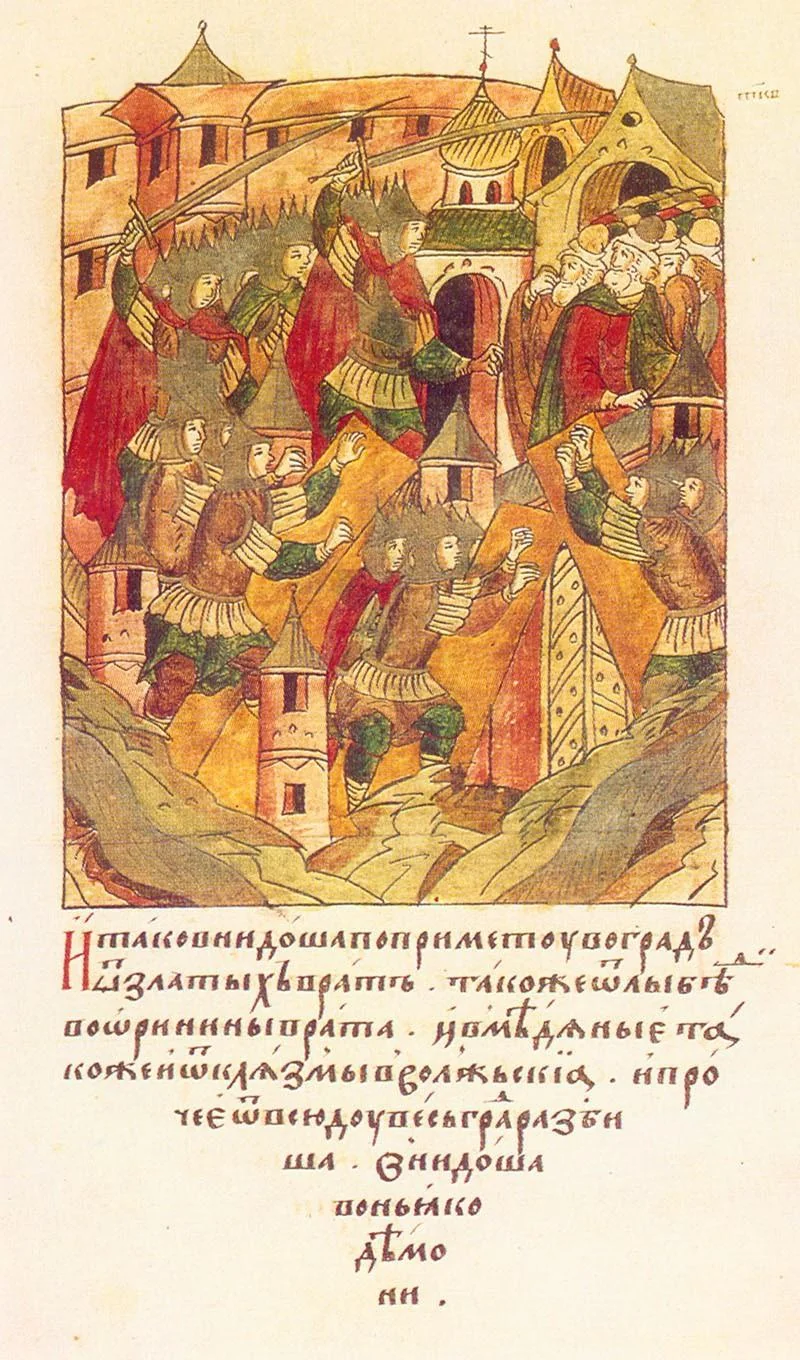
The Rus' were never one state. They were a family of principalities ruled by princes of the same dynasty, often at war with each other, and the Mongols took them one by one. Rashid al-Din, who drew on Mongol records, gives the length of the sieges: Ryazan in three days, Vladimir in eight, Kozelsk in two months. The Rus' chronicles say seven weeks.
Kyiv, the old capital and seat of the metropolitan, fell at the end of 1240. The Galician-Volhynian Chronicle remembered the noise of Batu's army outside the walls: one could not hear a voice "for the creaking of his carts, the bellowing of his camels and the neighing of his herds of horses" (our translation). When the papal envoy John of Plano Carpini passed through five years later, he found "an innumerable multitude of dead mens skulles and bones lying vpon the earth" and wrote that of the great city "there doe scarce remaine 200. houses" (Hakluyt's translation, ed. Beazley, 1903).
The campaign was also a family quarrel. The Secret History of the Mongols, written in Mongolian in the 13th century, preserves a report that Batu sent to Ögödei from the campaign. At a parting feast after the destruction of the city of Meget in the Caucasus, Batu, "quite the eldest among those princes who were present", drank the first bowls of ceremonial wine. Büri and Güyük rode off in anger. Büri called Batu one of the "old women with beards", and Güyük spoke of "those old women with quivers like Batu". Ögödei was furious with his own son. Güyük had set out "under the shelter of Sübe'etei" and the whole army, he said, but "while you haven't yet acquired as booty even the hoof of a kid, you make yourself into a hero", and he sent him back to Batu to be judged (trans. de Rachewiltz, §§275–277). The quarrel would shape Mongol politics for the next ten years.
Batu in Poland and Hungary (1241)
In the spring of 1241 the Mongols struck at Latin Europe on two fronts. A smaller army under Batu's brother Orda and Chagatai's son Baidar invaded Poland. It defeated Bolesław V of Kraków in March and on 9 April 1241 destroyed the army of Duke Henry II of Silesia at Legnica. Batu was not there. He and Sübe'etei led the main army through the Carpathian passes into Hungary.
King Béla IV of Hungary brought his army to the plain of Mohi by the Sajó river. On 10 or 11 April 1241, depending on the source, the Mongols crossed the river, attacked his camp from two sides and surrounded it. The Hungarians had drawn up their wagons in a ring, and the ring became a trap. The Mongols let groups of Hungarians break out through their ranks, among them Béla and his brother Kálmán, and cut the fugitives down on the road. Béla fled and later took refuge on the Adriatic coast.
The Persian historian Juvaini, who served the Mongols and finished his history in about 1260, tells a story about Batu before the battle. When the two armies drew close, "Batu went up on to a hilltop; and for one day and night he spoke to no one but prayed and lamented; and he bade the Moslems also assemble together and offer up prayers" (trans. Boyle, 1958). Whatever its truth, the story shows how Batu's own people remembered him: a ruler who sought the help of heaven, and of every religion's God, before a battle.
The fullest Hungarian account is the Carmen miserabile, the "sorrowful lament" of Master Roger, an Italian cleric who was captured by the Mongols and escaped. He named the invaders' leaders: "The king of kings and lord of the Tatars who entered Hungary was called by his name Bathus" (our translation). He gave Batu 500,000 men. Juvaini claimed instead that the Hungarians were twice as numerous as the Mongols. Neither figure is a count. No reliable count of either army survives.
The Mongols spent the rest of 1241 east of the Danube. On 25 December the river froze, and they crossed it. Qadan chased the king to the Dalmatian coast. Then, in the spring of 1242, the whole army turned back.
Why did Batu leave Hungary in 1242?
Contemporaries were baffled, and historians still argue. The main explanations are:
| Explanation | Evidence | Problem |
|---|---|---|
| The Great Khan Ögödei had died (11 December 1241) | Carpini heard this in 1246 | Batu never went to Mongolia for the election; he stopped on the Volga |
| Batu wanted to watch the succession | His feud with Güyük; the long struggle that followed | A motive, not a source statement |
| Losses and unrest | A commander killed at Sandomierz; Cuman revolts in the rear | Hard to measure |
| Not enough grazing | The Hungarian plain could not feed Mongol horses for long (Denis Sinor) | The Mongols had wintered in Hungary |
| A wet spring turned the plain into marsh | Tree rings show a cold, wet early 1242 (Büntgen and Di Cosmo, 2016) | Rejected by Pinke and colleagues (2017): the rain improved the grass |
Jackson notes the weakness of the first and best-known explanation: as Sinor pointed out, Ögödei's death would only explain the retreat if Batu had gone to the election, and he did not. Jackson's own view is that several reasons worked together, including Batu's wish "to keep a watchful eye on developments in Mongolia should his enemy Güyüg be elected qaghan" (Jackson, 2018).
Historians disagree most sharply over the climate. In 2016 the dendrochronologist Ulf Büntgen and the historian Nicola Di Cosmo argued that a cold, wet spring flooded the Hungarian plain, reducing pasture and the mobility of the cavalry. A year later a team of Hungarian historians, archaeologists and an environmental scientist answered in the same journal. They pointed to King Béla's own letter to the pope, which says the Mongols were settling down and keeping their herds in Hungary, and argued that the spring rain after a long drought made the grazing better, not worse.
Batu and the princes of Rus'
The Mongols did not occupy Rus'. They left the princes in place, made them come to Batu's camp to submit, and collected tribute. Batu's camp became the place where the fate of Rus' princes was decided.
The first to come was the grand prince of Vladimir, Yaroslav Vsevolodovich, the father of Alexander Nevsky. In 1243, the Laurentian Chronicle reports (the Novgorod chronicle says 1242), he went to Batu, who "honoured Yaroslav greatly, and his men, and let him go, and said to him: Yaroslav, be the eldest of all the princes in the Russian land" (our translation). Batu had made the grand prince his man. The other princes followed in 1244 and 1245, each going to Batu "about his patrimony".
Not every visit ended well. The most famous victim was Michael, prince of Chernigov and for a time of Kyiv. Carpini, who passed through Batu's camp around the same time, heard that the Mongols made him pass between two fires, the usual purification for visitors, and then told him to bow to the south, to Genghis Khan. Michael answered that "he would gladly bow to Batu and his servants, but he would not bow to the image of a dead man, because it is not allowed for Christians to do this" (our translation). One of Batu's guards kicked him in the chest until he collapsed, and he was beheaded with a knife; his boyar Fyodor died with him. The Novgorod chronicle dates his death to 1245, the Laurentian Chronicle to 20 September 1246. The Russian Orthodox Church honours both as martyrs.
Daniel of Galicia, the most powerful prince of the south-west, made the journey "to Batu, on the Volga" as well. The chronicle puts the visit under 1250, but many historians date it to 1245. The Galician-Volhynian Chronicle preserves a remarkable scene. Batu received him with the words: "Daniel, why have you not come before? But now that you have come, that too is good. Do you drink black milk, our drink, mare's kumis?" Daniel answered: "Until now I have not drunk it; now, since you command, I drink." "Now you are one of us, a Tatar," said Batu. The chronicler could not contain himself: "O evil honour of the Tatars!" (our translation). After twenty-five days Batu let him go home with his lands confirmed.
In 1247 Alexander Nevsky and his brother Andrei went to Batu in their turn, and Batu sent them on to the Great Khan in Mongolia. The story of Alexander's dealings with the Mongols is told in our article on Alexander Nevsky.
Batu and the Great Khans
After Ögödei died, Batu refused to come to the quriltai to elect a successor. Rashid al-Din says he excused himself because he "was seized, because of his great age, with a sudden attack of paralysis" (trans. Boyle, 1971). Without the senior prince the election was delayed for almost five years. When Batu's old enemy Güyük was finally made Great Khan in 1246, the two were close to war. In 1248 Güyük set out westwards with an army and died on the way in April 1248. Many historians believe he was marching against Batu.
Batu then made a Great Khan himself. In 1251, with his support, the princes chose Möngke, the son of Tolui, who had fought beside Batu in Rus'. Rashid al-Din puts a speech into Batu's mouth: Möngke "is extremely competent, talented, and fit for kingship. When he is present how can another be Qa'an?" Batu sent his brother Berke and his son Sartaq with three tümens, units of nominally ten thousand men, to see the election through. The family of Ögödei lost the throne. Büri, who had insulted Batu years before, was among the princes put to death.
The two men then shared the empire. Möngke told Rubruck that as the sun spreads its rays everywhere, so his power and Batu's spread everywhere. Batu ruled the west as he wished, but he still deferred to the Great Khan on matters of state. When Rubruck asked to stay in his lands as a missionary, Batu's answer was that he "may not do this without the permission of Mangu chan" (trans. Rockhill, 1900), and he sent the friar on to Mongolia.
What was Batu like?
The European envoys give us two portraits drawn from life.
John of Plano Carpini, sent by Pope Innocent IV, reached Batu's camp in April 1246. He described a ruler who "caries himselfe very stately & magnificently, hauing porters and all officers after the maner of the Emperour, and sittes in a lofty seate or throne together with one of his wiues". His tents of linen "were once the kings of Hungaria". Carpini's judgement was short: "The sayd Bathy is courteous enough vnto his owne men, and yet is hee had in great awe by them: he is most cruel in fight: he is exceedingly prudent and politique in warre, because he hath now continued a long time in martiall affaires" (Hakluyt's translation, ed. Beazley, 1903).
William of Rubruck, sent by King Louis IX of France, came in the late summer of 1253. He was overwhelmed by the size of the camp: "When I saw the ordu of Baatu, I was astonished, for it seemed like a great city stretched out about his dwelling, with people scattered all about for three or four leagues." Batu sat "on a long seat as broad as a couch, all gilded, and with three steps leading up to it, and a lady was beside him". Rubruck thought him about as tall as a French knight he knew, "and his face was all covered at that time with reddish spots". Batu had twenty-six wives, each with her own great tent. When the friar told him that he would "not have the celestial goods" unless he became a Christian, "he quietly smiled, and the other Moal began clapping their hands, laughing at us" (trans. Rockhill, 1900).
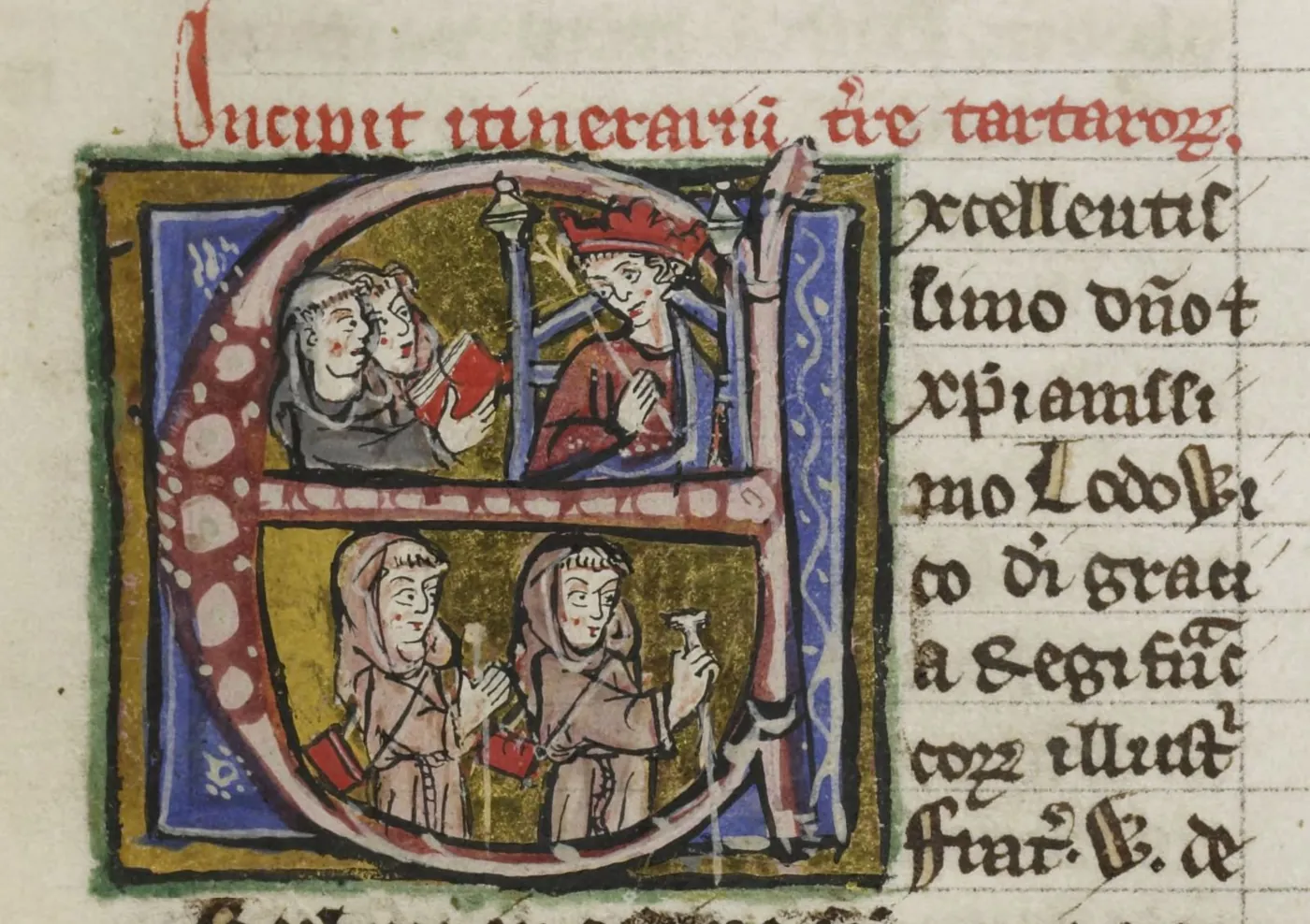
Juvaini, a Muslim who served the Mongol rulers of Iran, stresses something else. Batu, he writes, "was a king that inclined towards no faith or religion: he recognized only the belief in God and was blindly attached to no sect or creed. His bounty was beyond calculation and his liberality immeasurable" (trans. Boyle, 1958). Batu's son Sartaq was said to be a Christian. Juvaini believed it; Rubruck, who met him, thought it was a story spread by the Nestorian clergy.
Sarai and the "Golden Horde"
Batu spent his summers moving along the Volga with his camp and his winters further south. Juvaini says that he "abode in his own encampment, which he had set up in the region of the Etil [the Volga]; and he built a town there which is called Sarai; and his word was law in every land". Sarai, "the palace", lay on the Akhtuba, the eastern arm of the lower Volga. Under his successors it grew into the capital of the western Mongol state.
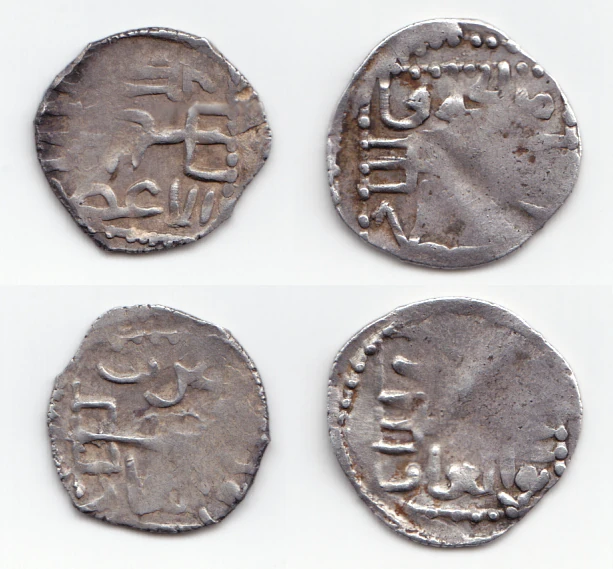
Batu never called his realm the Golden Horde. The Mongols spoke of the ulus of Jochi, the realm of Jochi's family, and the Rus' chronicles simply of "the Horde". The name "Golden Horde" first appears in a Russian text of the 16th century, the History of Kazan. Jackson's formula is careful: Batu "effectively founded the Mongol power in the Pontic and Caspian steppes, later known to historians as the 'Golden Horde'".
When did Batu die?
The sources disagree. Rashid al-Din says that "Batu died at Sarai on the banks of the Etil in the year 650/1252-1253, being forty-eight years of age". Juvaini left a blank where the year should be. Boyle, following the French orientalist Paul Pelliot, concluded: "In fact, Batu's death probably occurred about the middle of 1255." Some Russian reference works prefer 1256.
His son Sartaq was at Möngke's court when the news came. Möngke confirmed him as ruler, but Sartaq died on the way home; some historians think he was poisoned. A young prince, Ulaghchi, ruled for a short time under the regency of Batu's widow Boraqchin. By about 1257 Batu's brother Berke had taken power. Berke was a Muslim, and within a few years he was at odds with his cousin Hülegü, the Mongol ruler of Iran.
Common myths about Batu Khan
| Myth | What the evidence says |
|---|---|
| Batu was the military genius of the western campaign | The experienced general Sübe'etei led the army in practice; Batu held the supreme command as the senior prince |
| Batu won the Battle of Legnica | Legnica (9 April 1241) was won by Orda and Baidar; Batu was fighting in Hungary |
| Batu rushed home to elect a new Great Khan | He stayed on the Volga and refused to attend the quriltai for years |
| Batu founded a state called the Golden Horde | The name is much later; contemporaries spoke of the ulus of Jochi or "the Horde" |
| "Sayin Khan" means Batu was kind | The title may be a posthumous euphemism, "the late khan" (Boyle) |
| Batu was born in 1209 | No medieval source gives that year; Rashid al-Din's figures point to about 1205 |
| The climate drove the Mongols out of Hungary | A hypothesis from 2016, strongly disputed since 2017 |
What the map shows next
On the map of 1236 the Rus' principalities still stand, among them Ryazan, Chernigov and Kiev, while Volga Bulgaria has already fallen. By 1241 the Mongol Empire covers the Rus' lands and reaches the borders of the Kingdom of Hungary and the Polish duchies such as Silesia. Two generations after Batu, at 1294, the map shows his realm as the separate Golden Horde, with the Ilkhanate to the south.
Sources
Primary sources
- Rashid al-Din, The Successors of Genghis Khan, trans. J. A. Boyle (New York, 1971), pp. 55–71 and 107–123: https://archive.org/details/Boyle1971RashidAlDin
- 'Ala-ad-Din 'Ata-Malik Juvaini, The History of the World-Conqueror, trans. J. A. Boyle, vol. 1 (Manchester, 1958), pp. 266–271: https://archive.org/details/dli.pahar.3131
- John of Plano Carpini, Ystoria Mongalorum, Latin text and Hakluyt's English translation, in C. R. Beazley (ed.), The Texts and Versions of John de Plano Carpini and William de Rubruquis (London, 1903): https://archive.org/details/textsversionsofj00hakluoft
- The Journey of William of Rubruck to the Eastern Parts of the World, 1253–55, trans. W. W. Rockhill (London, 1900): https://archive.org/details/journeyofwillia00ruys
- Master Roger, Carmen miserabile, in Chronica minora (Budapest, 1885), ch. 19: https://archive.org/details/ChronicaMinora
- The Chronicle of Novgorod, 1016–1471, trans. R. Michell and N. Forbes (London, 1914), entry for 1245: https://archive.org/details/chronicleofnovgo00michrich
- Laurentian Chronicle, Polnoe sobranie russkikh letopisei, vol. 1 (Leningrad, 1926–1928), entries 6751–6755: https://archive.org/details/psrl_tom1_lavrentyevskaya_letopis_1926
- Galician-Volhynian (Hypatian) Chronicle, Polnoe sobranie russkikh letopisei, vol. 2 (St Petersburg, 1908), entries 6748 and 6758.
Studies
- P. Jackson, The Mongols and the West, 1221–1410, 2nd ed. (London and New York, 2018), chs. 3–4.
- U. Büntgen and N. Di Cosmo, "Climatic and environmental aspects of the Mongol withdrawal from Hungary in 1242 CE", Scientific Reports 6 (2016), 25606: https://www.nature.com/articles/srep25606
- Z. Pinke, L. Ferenczi, B. Romhányi, J. Laszlovszky and S. Pow, "Climate of doubt: a re-evaluation of Büntgen and Di Cosmo's environmental hypothesis for the Mongol withdrawal from Hungary, 1242 CE", Scientific Reports 7 (2017), 12695: https://www.nature.com/articles/s41598-017-12128-6
- The Secret History of the Mongols, trans. I. de Rachewiltz, shortened ed. by J. C. Street (Bellingham, 2015), §§270–277: https://archive.org/details/the-secret-history-of-the-mongols-a-mongolian-epic-chronicle-of
- V. V. Trepavlov, "Batyi", Bol'shaia rossiiskaia entsiklopediia, vol. 3 (Moscow, 2005), p. 109 (archived copy): https://web.archive.org/web/2020id_/https://bigenc.ru/text/1856821
- Zh. M. Sabitov, "Politicheskaia istoriia ulusa Dzhuchi v 1256–1263 godakh", Zolotoordynskoe obozrenie 2015: https://cyberleninka.ru/article/n/politicheskaya-istoriya-ulusa-dzhuchi-v-1256-1263-godah
- "Batu Han", TDV İslâm Ansiklopedisi, vol. 5 (Istanbul, 1992), pp. 208–210: https://islamansiklopedisi.org.tr/batu-han
- A. V. Parunin, "O nekotorykh obstoiatel'stvakh upotrebleniia termina 'Orda' i ego epitetov v pis'mennykh istochnikakh", Srednevekovye tiurko-tatarskie gosudarstva 2018: https://cyberleninka.ru/article/n/o-nekotoryh-obstoyatelstvah-upotrebleniya-termina-orda-i-ego-epitetov-v-pismennyh-istochnikah
Image credits
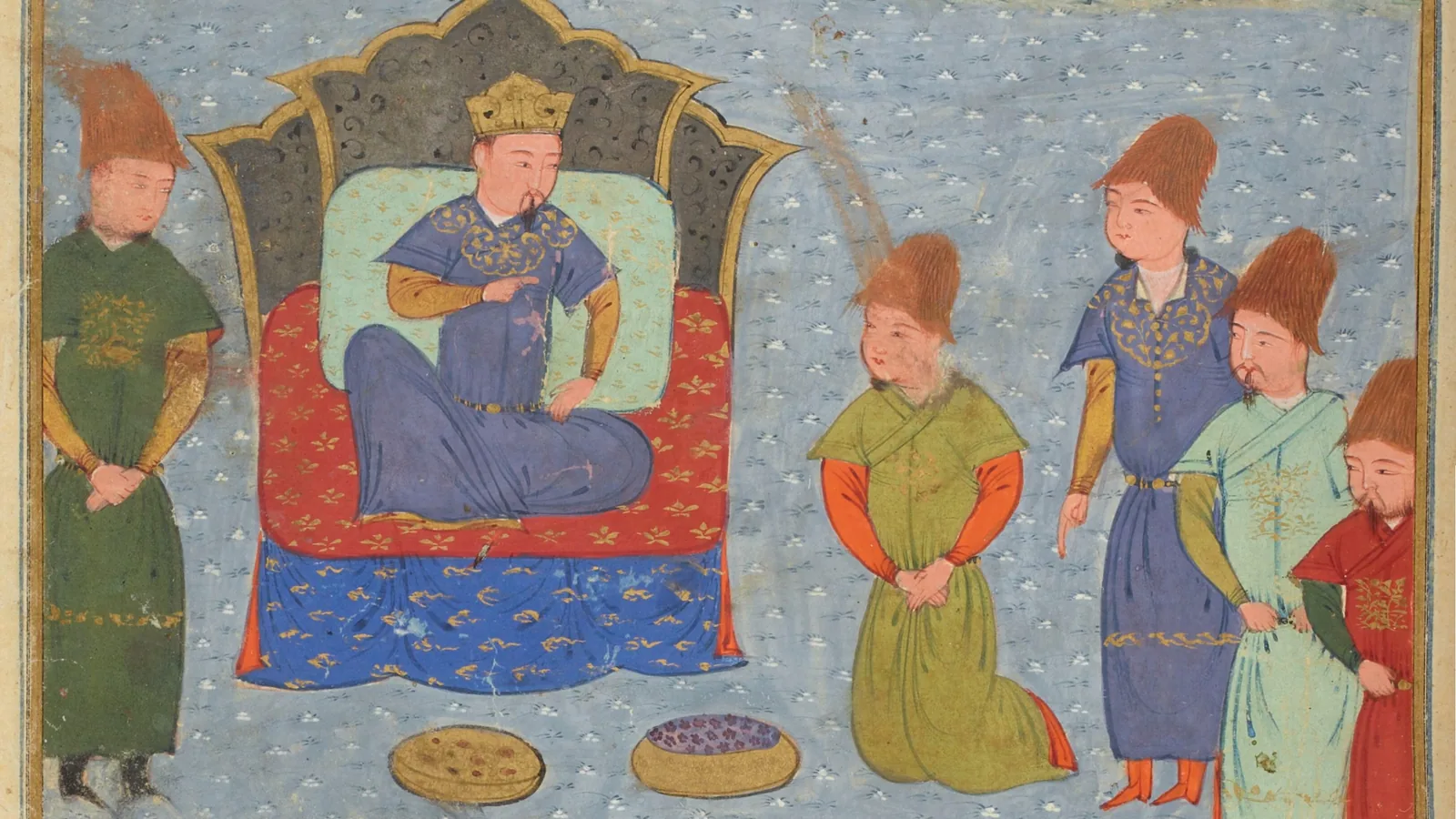
- Title image: a Mongol khan enthroned, Rashid al-Din, Jami' al-tawarikh, Bibliothèque nationale de France, Suppl. persan 1113, fol. 91r. Public domain, via Wikimedia Commons, cropped to 16:9.
- Capture of Vladimir, Illustrated Chronicle. Public domain, via Wikimedia Commons.
- Rubruck's Itinerarium, Corpus Christi College, Cambridge, MS 66A, fol. 67r. Public domain, via Wikimedia Commons.
- Dirhams of the Bulghar mint. Photo: Петров Эдуард, CC BY-SA 4.0, via Wikimedia Commons.