Boris Fyodorovich Godunov (c. 1551 – 13 April 1605) ruled Russia for twenty years: first as regent for his brother-in-law, Tsar Fyodor I, from about 1585, then as tsar himself from 1598 until his sudden death in 1605. He was the first tsar to be elected by an Assembly of the Land rather than born to the throne. He established the Moscow Patriarchate, beat off the last great Crimean attack on Moscow, made peace with Sweden, and sent young Russians to study in the West. His reign ended in famine and civil war, and his dynasty died with his son, murdered weeks after his own death.
Most people know a different Boris: the guilt-ridden tsar of Alexander Pushkin's play (1825) and Modest Mussorgsky's opera (1874), haunted by the child he had murdered to reach the throne. That Boris was built in the nineteenth century, above all by the historian Nikolai Karamzin. Whether the real Boris had Tsarevich Dmitry killed in 1591 is still unproven. This article separates the tsar from the legend.
Boris Godunov at a glance
| Born | c. 1551 |
| Family | Godunovs, a service family of Kostroma; father Fyodor Ivanovich Godunov; raised by his uncle Dmitry Ivanovich Godunov |
| Wife | Maria Grigoryevna, daughter of Malyuta Skuratov (married by 1571) |
| Children | Fyodor II (tsar April–June 1605); Xenia (c. 1582–1622) |
| Regent | c. 1585–1598, for Tsar Fyodor I, husband of his sister Irina |
| Tsar | elected 17 February 1598, crowned 1 September 1598 |
| Died | 13 April 1605, Moscow |
| Buried | Trinity-Sergius monastery (now Lavra), Sergiyev Posad |
Where did Boris Godunov come from?
The Godunovs were a family of middling Moscow servitors from Kostroma. Family tradition traced them to a Tatar prince, Murza Chet, who supposedly left the Golden Horde for Moscow in the fourteenth century, was baptised and founded the Ipatiev monastery at Kostroma. The Orthodox Encyclopaedia (Pravoslavnaya entsiklopediya) calls this a "later legend" first written down in the 1560s, just when the Godunovs were rising at court. So the much-repeated phrase "Boris the Tatar" rests on a family story, not on evidence.
Boris lost his father early and was raised by his uncle Dmitry Ivanovich Godunov, who held a post in Ivan the Terrible's bedchamber. According to the historian B. N. Floria in the Orthodox Encyclopaedia, Boris entered service in 1567, when he was admitted to Ivan IV's oprichnina court. His position there was secured by marriage to a daughter of Malyuta Skuratov, the most feared of the oprichniki. At Ivan IV's wedding to Marfa Sobakina on 28 October 1571, Malyuta and his son-in-law served together as the bride's attendants.
The decisive step was another marriage. Boris's sister Irina married Ivan's son, the future Tsar Fyodor I. The Orthodox Encyclopaedia dates this to 1575; older reference works give 1580.
How did Boris rule Russia as regent?
When Ivan the Terrible died in 1584, the new tsar Fyodor I was pious but unable to govern. Boris quickly became boyar and konyushy, master of the horse, the highest rank at court. At the reception of the Polish–Lithuanian envoy Lew Sapieha on 2 June 1584 he already stood "at the sovereign's place, above the bodyguards". When the tsar's uncle Nikita Romanovich Yuriev fell gravely ill in 1585, Boris became the real ruler of Russia. Within two years he had removed his rivals: Prince Ivan Mstislavsky was forced to become a monk, and Prince Ivan Shuisky was exiled and killed.
Foreign visitors saw who held power. The English envoy Giles Fletcher, in Moscow in 1588–1589, wrote that "all matters are advised and determined upon by Borris Federowich Godonoe, brother to the empresse, with some five or sixe more whom it pleaseth him to call. If they come, they are rather to heare then to give counsel." The English merchant Jerome Horsey called him simply "lord protector".
His achievements as regent were real.
- The Patriarchate (1589). Boris led the negotiations with the Patriarch of Antioch in 1586 and with Patriarch Jeremiah II of Constantinople, who came to Moscow. On 26 January 1589 Jeremiah installed Metropolitan Job as the first Patriarch of Moscow in the Dormition Cathedral. When a council in Constantinople confirmed the new patriarchate in 1590, its members thanked Boris in a special letter.
- Sweden. A war with Sweden from 1590 recovered Ivangorod, Yam and Koporye, lost under Ivan IV. The peace signed at Teusina near Ivangorod in 1595 confirmed them, together with Korela, while Russia renounced Narva.
- The Crimean raid of 1591. In July 1591 Khan Gazi Giray of the Crimean Khanate marched on Moscow with an army that contemporaries put at 100,000, 150,000 or even 400,000 men. On 4 July he skirmished for hours with the Russian army in its wooden mobile fortress (gulyai-gorod) outside the city, and in the early hours of 5 July he fled. The Donskoy monastery was founded on the site of the Russian camp.
Did Boris Godunov murder Tsarevich Dmitry?
On 15 May 1591 Ivan the Terrible's youngest son Dmitry, aged eight, died of a knife wound to the throat in the town of Uglich, where he lived with his mother. A mob killed Moscow's official in the town, Mikhail Bityagovsky, and others accused of murdering him. A commission headed by Prince Vasily Shuisky arrived on 19 May and questioned 140 people. Witnesses said that the boy suffered from epilepsy and had been playing a knife game with other boys in the courtyard when "the falling sickness came upon him, and he fell on the knife". On 2 June 1591 the commission reported to a joint session of the Boyar Duma and the Church council, which ruled that his death was an accident.
Rumours that Boris had arranged the death spread at once. They gained force in 1605, when a pretender claiming to be the "saved" Dmitry overthrew the Godunovs, and in 1606, when Vasily Shuisky, now tsar himself, needed to discredit any new pretender. Shuisky had the boy's remains brought to Moscow, and the Church declared him a martyr "slain by his wicked slave Boris Godunov". The first written accounts of murder date from that spring and summer.
Historians disagree.
- Unproven or accident. Sergei Platonov (1921) wrote that the accusation was "made by Shuisky's government and by the Church, but was not confirmed by any document and remained unsupported". Ruslan Skrynnikov argued that the death "benefited not so much Boris as his enemies", who used it to try to overthrow him.
- Murder. Alexander Zimin (1986), after analysing the investigation file, the polemical literature and the foreign accounts, wrote that he inclined "rather to the version of murder than to the version of self-stabbing".
- A medical reading. L. V. Stolyarova and P. V. Belousov, a historian and a psychiatrist (2014), concluded from the witness statements that Dmitry died not in a single fit but during status epilepticus, a series of seizures following one another.
The Orthodox Encyclopaedia sums up: "Researchers' opinions differ … they have no facts that could confirm or refute this accusation." Floria adds that the other charges made against Boris at the time, that he poisoned Tsar Fyodor and tried to smuggle a substitute baby into the royal bedroom, "were obvious inventions".
Did Boris Godunov create serfdom?
In part. Under Ivan IV, peasants had been forbidden to leave their landlords in certain "forbidden years", as an emergency measure. Floria writes that under Boris this "temporary" ban became "a permanent norm of law", and that the new land surveys of the 1580s and early 1590s were used to return runaways to the estates where they were registered. On 24 November 1597 a decree issued in Tsar Fyodor's name set a five-year limit: peasants who had fled within the last five years were to be searched for and returned to their masters.
Whether this makes Boris the "founder of serfdom" was already argued in the nineteenth century. Mikhail Pogodin and Nikolai Kostomarov answered no. Kostomarov wrote in 1858 that "justice requires" the question to be answered "in Boris's favour, with a negative answer". Serfdom grew over a century, from the forbidden years of the 1580s to the Law Code of 1649.
How did Boris Godunov become tsar?
Fyodor I died childless on 7 January 1598, and with him the Moscow line of the Rurikids. His widow Irina, Boris's sister, entered the Novodevichy convent, and Boris went with her. On 17 February 1598 an Assembly of the Land (Zemsky sobor), led by Patriarch Job, elected him tsar. Boris refused at first, then accepted on 21 February after processions to the convent. He was crowned in the Dormition Cathedral on 1 September 1598. An election charter, drawn up in the patriarch's circle, used Byzantine examples to defend the people's right to choose a ruler.
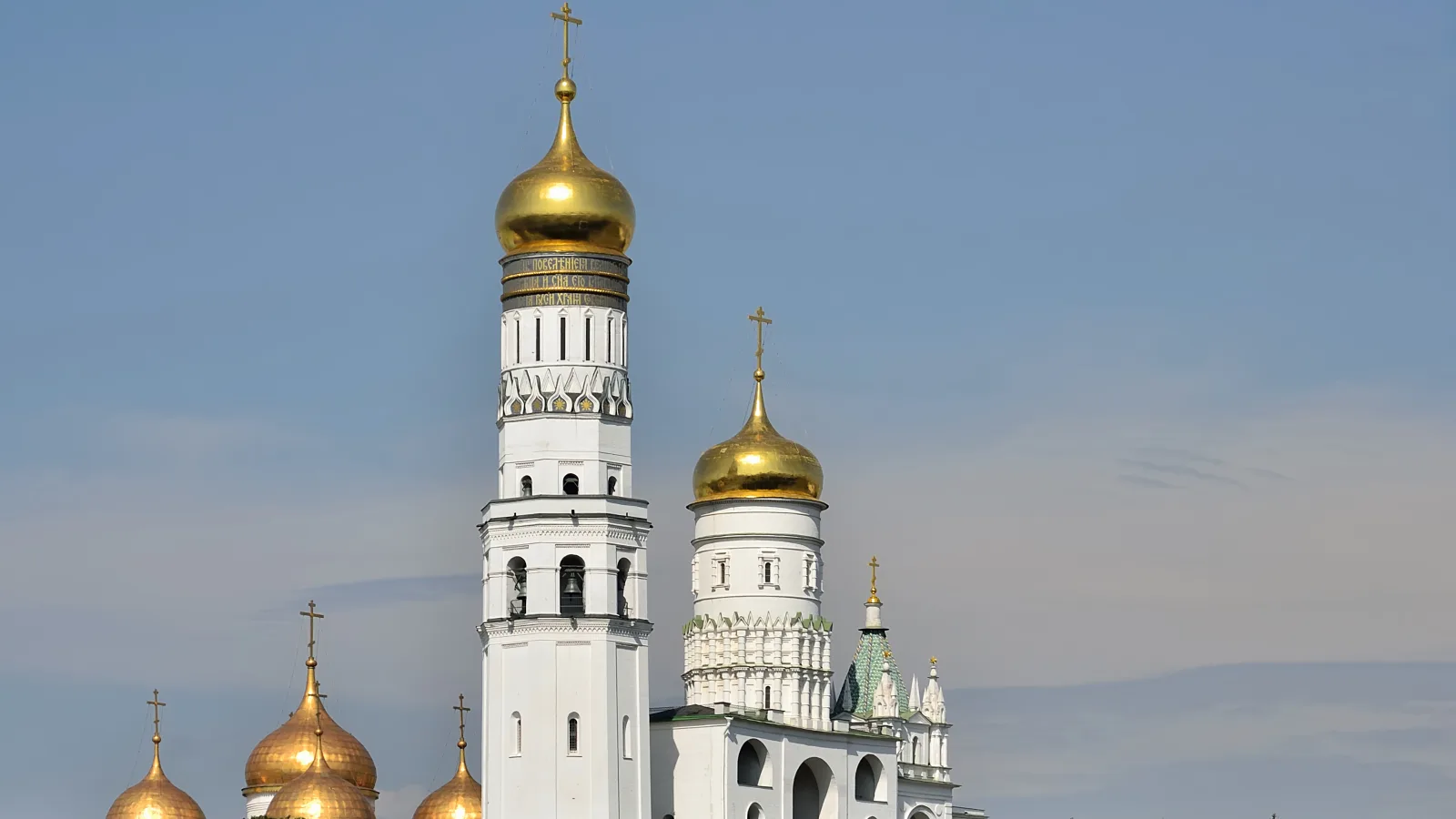
His reign began well. Floria notes that the start was marked by payments to the nobility and wide tax relief. Boris had ambitious plans for Moscow: in 1598–1599 a stone platform, the Lobnoe mesto, was built on Red Square, and he planned a great Church of the Resurrection in the Kremlin modelled on the church of the Holy Sepulchre in Jerusalem, which was never built. In 1600 he had the Ivan the Great Bell Tower raised and gilded. An inscription in three bands beneath the dome still records that "by command of the great sovereign tsar and grand prince Boris Fyodorovich … this church was completed and gilded in the second year of their reign, 108" (7108 in the Byzantine era, that is 1600).
The architectural historian M. I. Rzyanin pointed out in 1946 that Boris did not build the tower, which dates from 1505–1508; he only added its top storey. Rzyanin also notes that the common story that Boris built it to give work to the starving cannot be right: the inscription is dated 1600, two years before the famine.
Why did Boris Godunov send students abroad?
Boris was more open to the West than any tsar before Peter the Great. Karamzin wrote that "in his zealous love for civil education Boris surpassed all the ancient crowned heads of Russia, intending to found schools and even universities". In 1600 he sent a German, Johann Cramer, to recruit professors and doctors; according to the Russian Biographical Dictionary the plan for a school taught by foreigners met resistance from the clergy.
Instead Boris sent young noblemen abroad. Karamzin says there were 18, sent to London, Lübeck and France. Platonov is more precise: "It is documented that five were sent to Lübeck and four to England." He adds: "Not one of those sent ever came back." Some died, and some stayed abroad.
He also tried to marry his daughter Xenia into a European royal house. Her fiancé, Duke John (Hans) of Denmark, brother of King Christian IV, arrived in August 1602 and died in Moscow on 29 October 1602. Rumour blamed Boris.
What went wrong for Boris Godunov?
Floria notes that Boris was seriously ill from 1599. In late 1600 or early 1601 he turned on the Romanovs, the family of Tsar Fyodor I's mother and his most dangerous rivals. After a servant denounced Alexander Nikitich Romanov for keeping a "poison root", the brothers were exiled. Fyodor Nikitich Romanov was forced to become a monk under the name Filaret, and his small son Michael, the future first Romanov tsar, was sent away to Beloozero.
Then came the great famine of 1601–1603, when the harvests failed after a cold, wet summer. Boris organised public works and distributed grain, but Floria judges these measures "inadequate to the scale of the disaster". Hunger and banditry undermined the regime. In October 1604 a man claiming to be Tsarevich Dmitry, saved from Uglich, invaded from Poland-Lithuania. Boris's army beat him at Dobrynichi in January 1605, but the pretender was not destroyed. The famine and False Dmitry are told in full in our article on the Time of Troubles.
How did Boris Godunov die?
Suddenly. On 13 April 1605 Boris fell ill after a meal and died within hours, after taking monastic vows on his deathbed under the name Bogolep. The contemporaries disagree about the cause.
- The French captain Jacques Margeret, who served in Moscow, wrote that he died "of apoplexy", a stroke.
- The German chronicle of Conrad Bussow says that "Boris took poison. In the morning of 13 April he was still well and fresh, and by evening he had died."
The Orthodox Encyclopaedia says that he "died unexpectedly of a stroke". Bussow's chronicle also gives the most famous epitaph: Boris "lived like a lion, reigned like a fox, died like a dog".
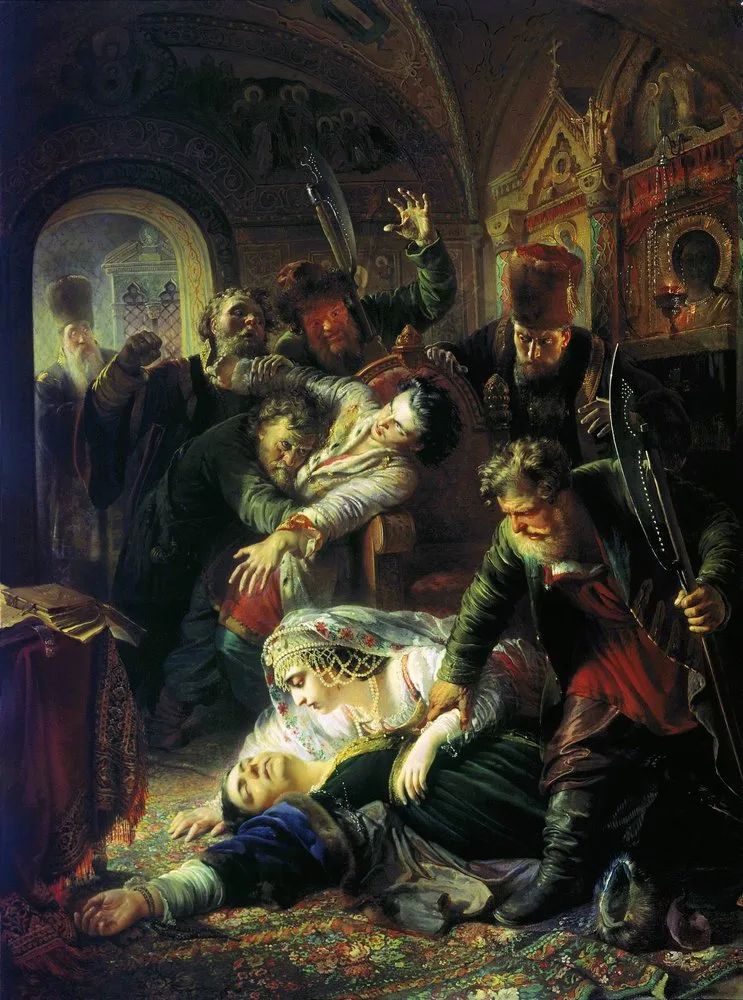
His family did not survive him. On 1 June 1605 a rising in Moscow overthrew the Godunovs, and on 10 June agents of the pretender murdered Boris's son, the sixteen-year-old Fyodor II, and his widow Maria. Xenia was spared and later made a nun. Boris's body was taken from the Archangel Cathedral and reburied in a minor convent. Under Tsar Vasily Shuisky the remains of Boris, Maria and Fyodor were moved to the Trinity-Sergius monastery; the two Orthodox Encyclopaedia articles date this to September 1606 and August 1607 respectively. Xenia, who died in 1622, was buried beside them. Their graves lie in a small vault by the Dormition Cathedral of the Lavra.
How did Karamzin make Boris a murderer?
The Boris of the stage was built from one book. In 1824 Nikolai Karamzin published volumes 10 and 11 of his History of the Russian State, covering the reigns of Fyodor I and Boris. Karamzin followed the seventeenth-century chronicles and the Church's verdict of 1606: in his account Boris planned the killing at Uglich, and he ends the scene with the line, "The wish of the wicked lover of power was fulfilled!" At the same time he praised Boris as a gifted ruler destroyed by his own crime. That double portrait, a great statesman with a murdered child on his conscience, is the Boris of Pushkin and Mussorgsky.
Pushkin's Boris Godunov
Alexander Pushkin began his tragedy in December 1824, in exile at his family estate of Mikhailovskoye, and finished it on 7 November 1825. Writing to his friend Pyotr Vyazemsky, he described reading it aloud alone: "My tragedy is finished; I read it aloud, by myself, and clapped my hands and shouted, well done Pushkin, you son of a bitch!"
The play follows Karamzin closely, and Pushkin dedicated it to his memory: "To the memory, precious to Russians, of Nikolai Mikhailovich Karamzin, this work, inspired by his genius, is dedicated with reverence and gratitude." Boris is haunted by guilt:
And everything is sick, the head spins round, And bloody boys appear before the eyes… One longs to flee, but there is nowhere… horror! Yes, pitiful is he whose conscience is unclean.
The first version went to Nicholas I's censorship through the head of his secret police, Alexander Benckendorff, and was not allowed into print. A revised text appeared in St Petersburg on 22–23 December 1830, with 1831 on the title page. It ends with a famous stage direction. When the boyar Mosalsky announces that Boris's widow and son have "poisoned themselves" and orders the crowd to cheer "Tsar Dimitry Ivanovich", "the people are silent" (Narod bezmolvstvuet). In Pushkin's manuscript, as P. V. Annenkov noted in 1855, the people had cheered. The play was banned from the stage until 1866 and first performed, with cuts, on 17 September 1870.
Mussorgsky's opera Boris Godunov
Modest Mussorgsky wrote his own libretto from Pushkin's play. He composed the first version between October 1868 and 15 December 1869. It had seven scenes, no love story and almost no female roles. In February 1871 the committee of the Imperial Theatres turned it down. Mussorgsky then revised the opera, adding a Polish act with a love scene for Marina Mniszech and the pretender, and a final scene of popular revolt in the forest near Kromy; he finished on 23 June 1872.
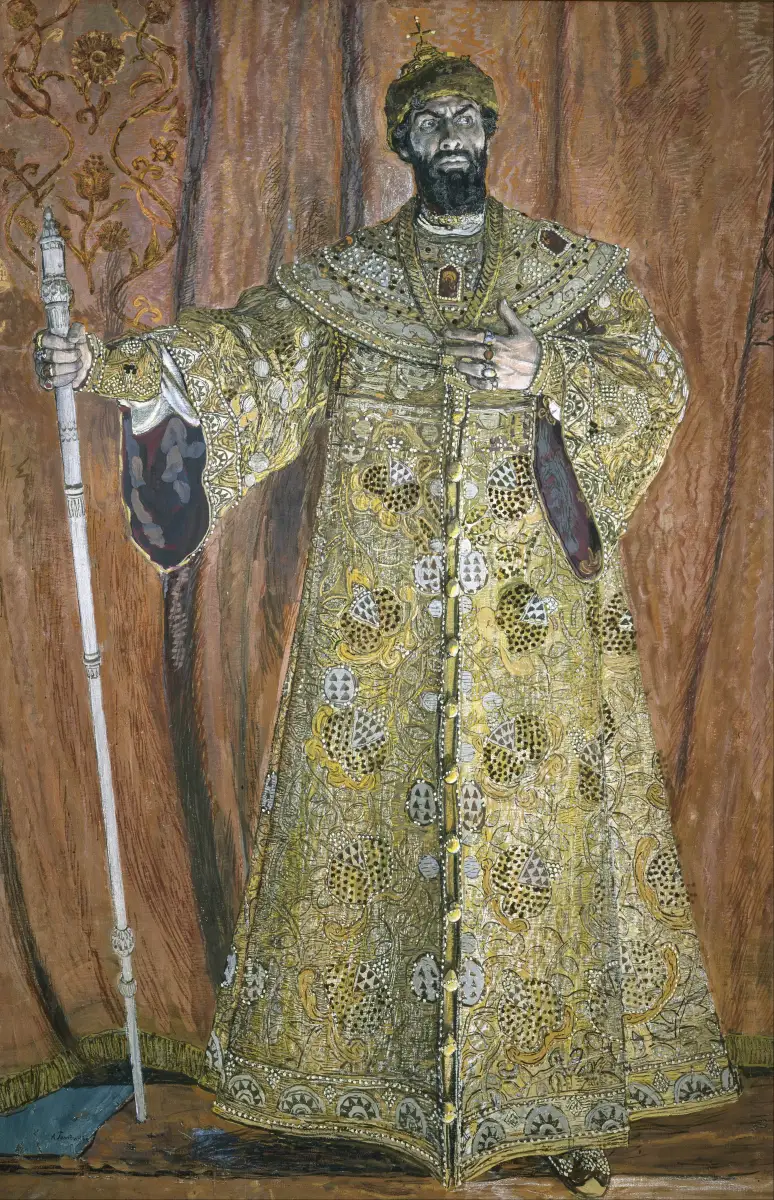
The revised opera had its premiere at the Mariinsky Theatre in St Petersburg on 27 January 1874 (8 February in the modern calendar), with cuts. Ivan Melnikov sang Boris and Eduard Nápravník conducted. After Mussorgsky's death in 1881 his friend Nikolai Rimsky-Korsakov re-orchestrated and rearranged the score (1896, revised 1908). Rimsky's version made the opera famous, above all through the bass Fyodor Chaliapin, who sang Boris in the Bolshoi Theatre's revival of 1901–1916.
Which Boris Godunov is the "real" one is still debated: Mussorgsky's original of 1869, his revision of 1872, or Rimsky-Korsakov's arrangement, long the standard in the opera houses. The original version is performed again today: the Mariinsky Theatre staged it on 6 February 2026.
Common myths about Boris Godunov
| Myth | What the evidence says |
|---|---|
| Boris certainly murdered Tsarevich Dmitry | The 1591 commission found an accident; the murder version appears in writing only in 1606; historians remain divided |
| Boris was a Tatar | The descent from Murza Chet is a family legend written down in the 1560s |
| Boris poisoned Tsar Fyodor I | A contemporary rumour that Floria calls an "obvious invention" |
| Boris poisoned himself | Bussow says poison, Margeret says a stroke; modern historians accept a stroke |
| Boris founded serfdom | He made the ban on peasants leaving permanent and set a five-year search limit (1597), but serfdom developed over a century; already in 1858 Pogodin and Kostomarov rejected the label |
| Boris built the Ivan the Great Bell Tower | It dates from 1505–1508; Boris raised and gilded it in 1600 |
| He built the tower to feed the starving | The inscription is dated 1600; the famine began in 1601 |
| Pushkin's play was performed in his lifetime | It was banned from the stage until 1866 and first staged in 1870 |
Timeline of Boris Godunov
| Date | Event |
|---|---|
| c. 1551 | Birth |
| 1567 | Enters Ivan IV's oprichnina court |
| 28 October 1571 | Attends Ivan IV's wedding with his father-in-law Malyuta Skuratov |
| 1584 | Boyar and master of the horse under Fyodor I |
| 1585 | Becomes de facto ruler of Russia |
| 26 January 1589 | Job installed as first Patriarch of Moscow |
| 15 May 1591 | Death of Tsarevich Dmitry at Uglich |
| 4–5 July 1591 | Crimean attack on Moscow repelled |
| 1595 | Peace of Teusina with Sweden |
| 24 November 1597 | Decree on the five-year search for runaway peasants |
| 7 January 1598 | Death of Fyodor I |
| 17 February 1598 | Elected tsar |
| 1 September 1598 | Crowned |
| 1600 | Ivan the Great Bell Tower raised and gilded |
| 1600–1601 | Fall of the Romanovs |
| 1601–1603 | Great famine |
| October 1604 | False Dmitry invades |
| 13 April 1605 | Death of Boris |
| 10 June 1605 | Fyodor II and Maria Godunova murdered |
| 1824 | Karamzin, History of the Russian State, vols 10–11 |
| 7 November 1825 | Pushkin finishes Boris Godunov |
| 1869 | Mussorgsky's first version of the opera |
| 27 January 1874 | Premiere of the opera at the Mariinsky Theatre |
| 6 February 2026 | Mariinsky stages the original 1869 version |
What the map shows
At 1591 the Tsardom of Russia under the regent Boris is at war with the Kingdom of Sweden, faces the Crimean Khanate in the south and borders the Polish–Lithuanian Commonwealth in the west. At 1600 Boris is tsar and the state reaches deep into Siberia. At 1605, the year of his death, the Time of Troubles is beginning. Read more about the man whose death made Boris regent: Ivan the Terrible.
Sources
Primary sources
- Giles Fletcher, Of the Russe Common Wealth (1591), and Jerome Horsey, Travels, in E. A. Bond (ed.), Russia at the Close of the Sixteenth Century (London: Hakluyt Society, 1856): https://archive.org/details/russiaatcloseofs20bond
- Skazaniia sovremennikov o Dimitrii Samozvantse, ed. N. Ustrialov, vol. 1 (St Petersburg, 1859), with the chronicle of Conrad Bussow and Jacques Margeret's Estat de l'Empire de Russie: https://archive.org/details/skazanijasovremennikovodimitriisamozvant62
- N. M. Karamzin, Istoriia gosudarstva Rossiiskogo, vols 10–11 (St Petersburg, 1824), via ru.wikisource
- A. S. Pushkin, Boris Godunov (St Petersburg, 1831): https://ru.wikisource.org/wiki/БорисГодунов(Пушкин))
- A. S. Pushkin, letter to P. A. Vyazemsky, about 7 November 1825: https://rvb.ru/pushkin/01text/10letters/1815_30/01text/1825/1355_172.htm
- A. S. Pushkin, Polnoe sobranie sochinenii, vol. 7 (Moscow–Leningrad, 1948), textual notes
- M. P. Mussorgsky, Boris Godunov, scores and premiere details: https://imslp.org/wiki/Boris_Godunov_(Mussorgsky,_Modest))
Studies and reference works
- B. N. Floria, "Boris Feodorovich Godunov", Pravoslavnaia entsiklopediia, vol. 6 (2009): https://www.pravenc.ru/text/153195.html
- B. N. Floria and A. A. Turilov, "Dimitrii Ioannovich", Pravoslavnaia entsiklopediia, vol. 15: https://www.pravenc.ru/text/178207.html
- "Iov", "Ol'ga (Godunova Kseniia Borisovna)", "Ipat'evskii monastyr'" and "Donskoi monastyr'", Pravoslavnaia entsiklopediia
- S. F. Platonov, Boris Godunov (Petrograd, 1921), via ru.wikisource
- A. A. Zimin, V kanun groznykh potriasenii (Moscow, 1986), chapter on the death of Tsarevich Dmitry
- L. V. Stolyarova and P. V. Belousov, "Smert' tsarevicha Dmitriia v Ugliche 15 maia 1591 g.: novaia versiia", Peterburgskii istoricheskii zhurnal 2014, no. 1
- N. I. Kostomarov, "Dolzhno li schitat' Borisa Godunova osnovatelem krepostnogo prava?" (1858), via ru.wikisource
- "Boris Feodorovich (Godunov)", Russkii biograficheskii slovar', via ru.wikisource
- M. I. Rzyanin, Ivan Velikii (Moscow, 1946): http://www.rusarch.ru/rzyanin1.htm
- Presidential Library, "Vyshel ukaz tsaria Fedora Ioannovicha ob 'urochnykh letakh'": https://www.prlib.ru/history/619780
- "Boris Godunov (drama)", Bol'shaia rossiiskaia entsiklopediia, and M. P. Alekseev, "Remarka Pushkina 'Narod bezmolvstvuet'" (1972)
- E. V. Demidova, "K istorii postanovok opery 'Boris Godunov' … na stsene imperatorskogo Bol'shogo teatra", Iskusstvo muzyki: teoriia i istoriia 34 (2026), doi:10.51678/2307-5015-2026-34-312-357
- Mariinsky Theatre, Boris Godunov (2026 production): https://www.mariinsky.ru/playbill/repertoire/opera/godunov_2026/
Image credits
- Title image: Ivan the Great Bell Tower. Photo: Dmitry Ivanov, 2016, CC BY-SA 4.0, via Wikimedia Commons, cropped to 16:9.
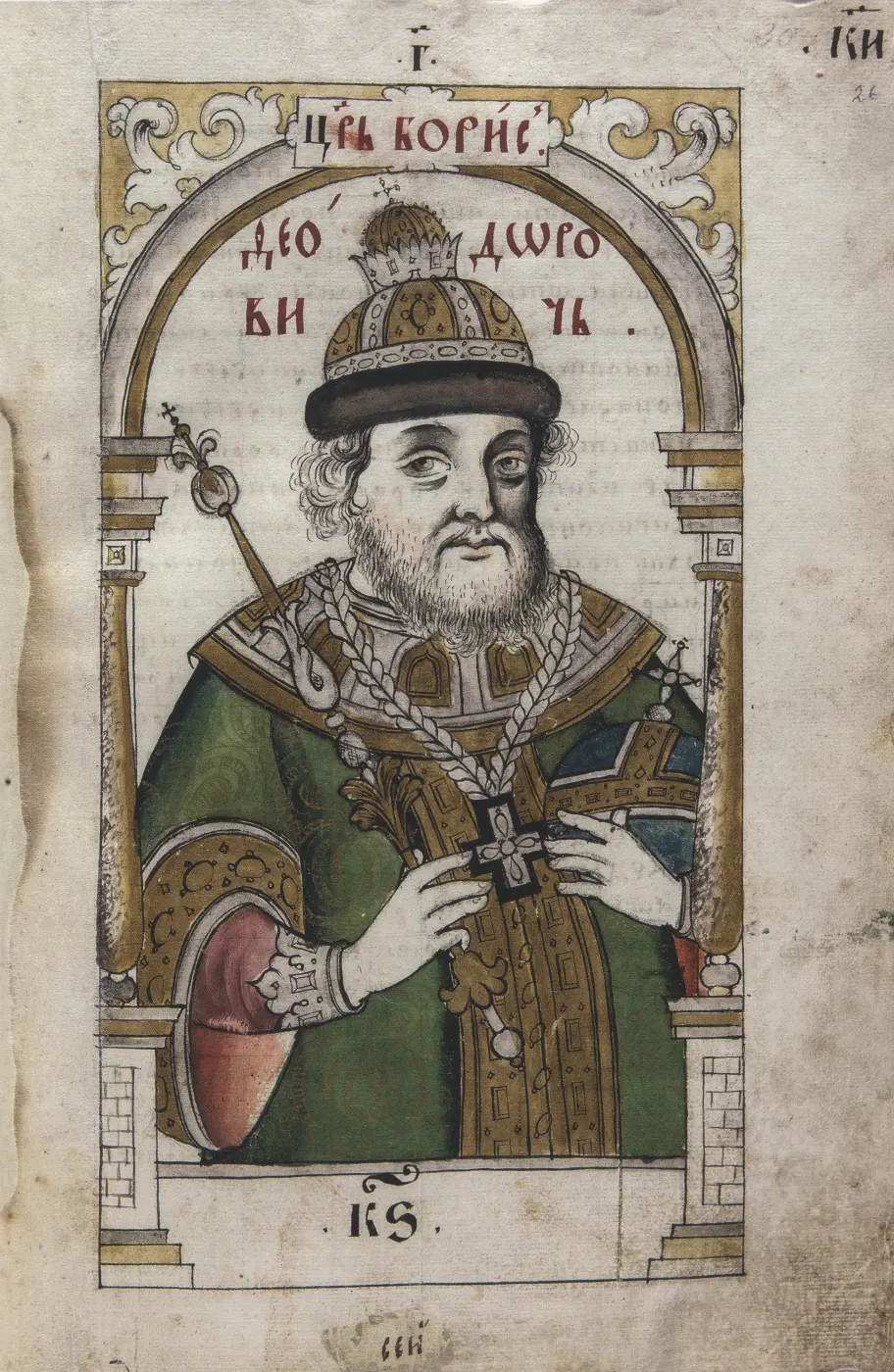
- Boris Godunov in the Titulyarnik, late 17th century, State Historical Museum. Public domain, via Wikimedia Commons.
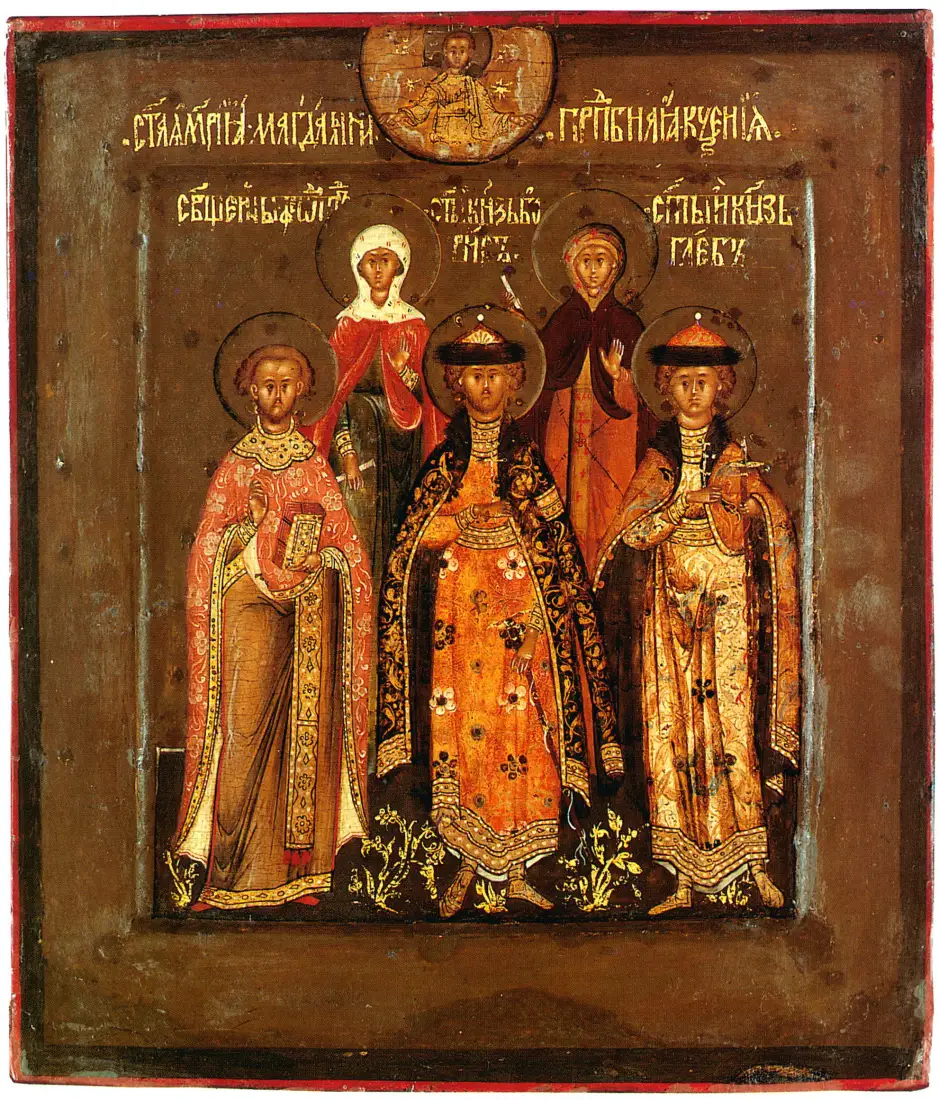
- Godunov family icon, c. 1600. Public domain, via Wikimedia Commons.
- Konstantin Makovsky, The Murder of Fyodor Godunov and his Mother, 1862. Public domain, via Wikimedia Commons.
- Alexander Golovin, Fyodor Chaliapin as Boris Godunov, 1912. Public domain, via Wikimedia Commons.