Ivan III Vasilyevich (22 January 1440 – 27 October 1505), known as Ivan the Great, was grand prince of Moscow from 1462 to 1505. In forty-three years he absorbed the city-republic of Novgorod (1478) and the grand principality of Tver (1485), stopped paying tribute to the Horde and saw off its last great army on the Ugra river (1480), rebuilt the Moscow Kremlin with Italian architects, and issued the first law code for the whole country (1497). When he died, the patchwork of Russian principalities in the north-east had become one state, ruled by a "sovereign of all Rus'".
He is less famous than his grandson Ivan the Terrible, and his biographers have often found him dull: cautious, patient and seldom on a battlefield. That is the point. Ivan III won most of what he gained without great battles, by pressure, purchase, marriage and waiting.
Ivan III at a glance
| Born | 22 January 1440, Moscow |
| Parents | Grand Prince Vasily II "the Dark" and Maria Yaroslavna |
| Reigned | 27 March 1462 – 27 October 1505 (co-ruler with his father from the late 1440s) |
| Title | Grand prince of Vladimir, Moscow "and all Rus'"; "sovereign of all Rus'" |
| Wives | Maria Borisovna of Tver (married 1452, died 1467); Sophia (Zoe) Palaiologina (married 12 November 1472, died 1503) |
| Successor | his son Vasily III (1505–1533) |
| Buried | Archangel Cathedral, Moscow Kremlin |
A childhood in a civil war
Ivan grew up in the last and most brutal phase of the war for the Moscow throne between his father and his father's cousins. On 16 February 1446 Dmitry Shemyaka seized Vasily II and had him blinded; the six-year-old Ivan and his brother were hidden by loyal servants, then handed over, and spent a short time in captivity with their father. To win allies, Vasily betrothed Ivan, aged about seven, to Maria, daughter of Grand Prince Boris of Tver. The wedding followed on 4 June 1452.
From the late 1440s, the Orthodox Encyclopaedia (Pravoslavnaya entsiklopediya) notes, Ivan appears in documents beside his father with the title of grand prince. When Vasily II died on 27 March 1462, his 22-year-old son had been ruling with him for years, and no rival contested the succession. That in itself was new.
Novgorod: from the Shelon to the veche bell
The richest prize in northern Russia was the Republic of Novgorod, a city-state with its own assembly, the veche, elected officials and vast lands reaching the White Sea and the Urals. In 1470–1471 part of its elite turned to Casimir IV, king of Poland and grand duke of Lithuania, for protection. Ivan answered with war.
On Sunday 14 July 1471 Ivan's advance guard routed a Novgorodian army on the Shelon river. The Moscow chronicle claims that the Novgorodians had 40,000 men and lost 12,000 dead, against some 5,000 Muscovites; these are the victor's figures and cannot be checked. In August Novgorod made peace, promised to break with Lithuania and paid 15,500 roubles.
Seven years later Ivan came to finish the job. In December 1477, outside the besieged city, his envoys told the Novgorodians the terms in words recorded by the Nikon Chronicle: "There will be no veche bell in our patrimony of Novgorod. There will be no posadniks, and we will conduct our own government." On 13 January 1478 the city's leaders swore allegiance. After Ivan's return, the bell that had summoned the assembly was carried to Moscow and hung in a belfry there alongside the other bells.
What followed was a revolution in landholding. Ivan deported the Novgorodian boyars and much of the merchant elite, confiscated their estates and those of the church (the archdiocese lost three quarters of its land), and handed the land to servitors from Moscow as pomestie: land held on condition of military service, which belonged to the state rather than to the holder. The pomestie would become the backbone of the Russian army for two centuries.
Gathering the Russian lands
Novgorod was the largest acquisition, but not the only one. Ivan used every method available:
| Year | Land | How |
|---|---|---|
| 1460s | Yaroslavl | The princes surrendered their patrimony and received it back as servitors |
| 1472 | Dmitrov | Ivan kept the appanage of his dead brother Yury instead of sharing it with his other brothers |
| 1474 | Rostov | The princes sold their remaining half of Rostov to Ivan |
| 1478 | Novgorod | War (1471) and annexation |
| 1485 | Tver | Siege; the last grand prince fled to Lithuania |
| 1489 | Vyatka | Siege of Khlynov; leaders executed, leading families deported |
| 1494, 1503 | Vyazma; Chernigov–Seversk lands | Wars with Lithuania |
Tver, Moscow's oldest rival, fell almost without a fight. When a Moscow army appeared before the city, its grand prince Mikhail Borisovich, the brother of Ivan's first wife, fled to Lithuania by night, and on Monday 12 September 1485 Tver surrendered.
How much did the state grow? Popular books often say that Ivan "tripled" Muscovy's territory, but we have not found a scholarly source that measures it. Soviet encyclopaedias give about 430,000 km² in the early 1460s and 2.8 million km² by the 1530s, a figure that includes the reign of his son.
Did the Stand on the Ugra end the Tatar yoke?
For two centuries the princes of north-eastern Russia had paid tribute, the vykhod, to the khans of the Golden Horde and taken their patents to rule from them. By Ivan's time the Horde had split into several khanates. Its main heir, the Great Horde of Khan Akhmat, still claimed Moscow's tribute.
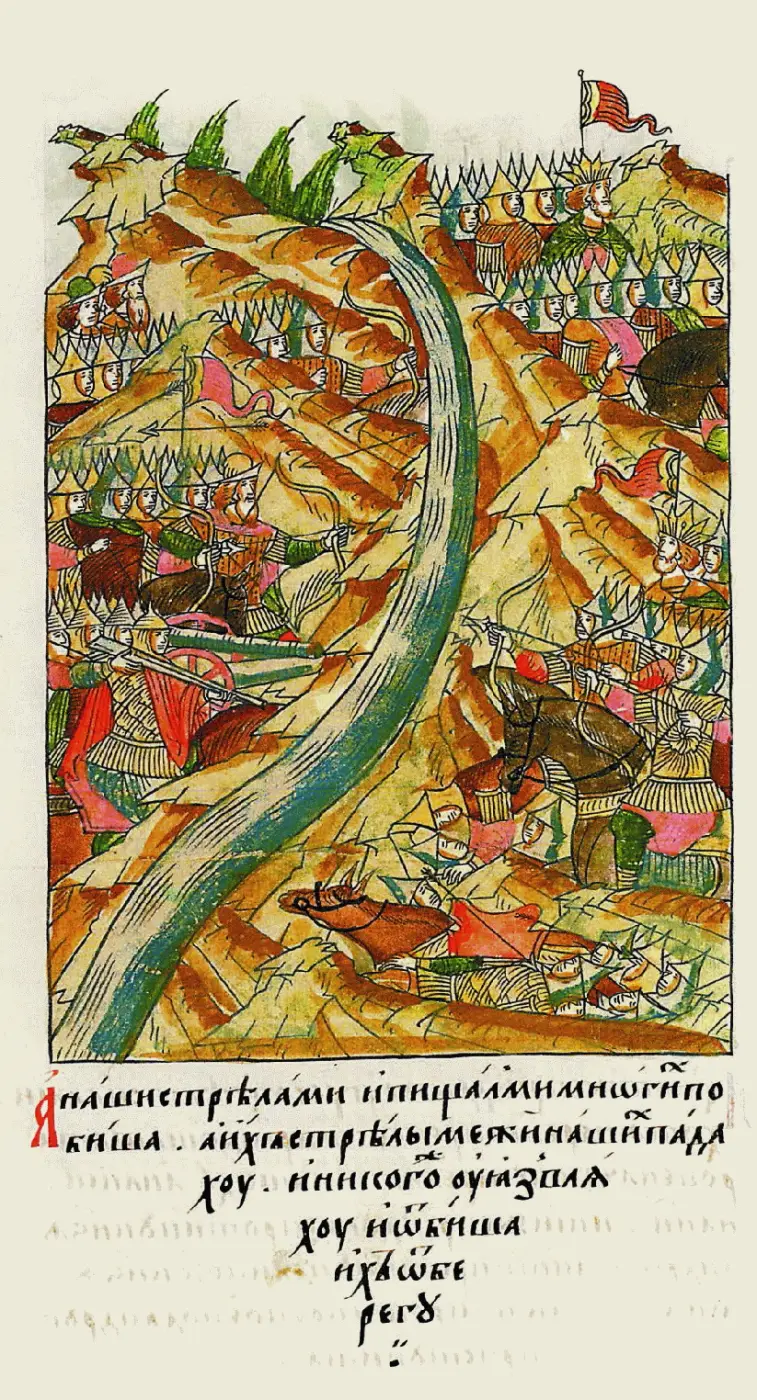
In 1472 Akhmat marched on Moscow and was stopped on the Oka at Aleksin. According to the Orthodox Encyclopaedia, Ivan then stopped paying the tribute, and Russia "became de facto independent". In 1480 Akhmat came again, in alliance with Lithuania. On 3 October Ivan joined his army on the Ugra, a tributary of the Oka. Through October the two armies exchanged fire across the river, with bows and early firearms, and the Tatars failed to force a crossing. Then, on 11 November 1480, something the chronicler called a marvel happened: both armies withdrew, each fleeing from the other. In January 1481 Akhmat was killed in his camp by Ibak, khan of Tyumen, and Nogai chiefs.
Later Russian tradition made the "Stand on the Ugra" the end of the "Tatar yoke". Historians disagree about how much it changed:
- The Orthodox Encyclopaedia (B. N. Florya) dates Moscow's real independence to the end of tribute after 1472 and sees 1480 as Akhmat's failed attempt to turn the clock back.
- T. R. Galimov and I. M. Mirgaleev (2019) point out that the chronicles credit neither side with a victory, and that payments to other Tatar khanates continued.
- O. Penskoy and T. Penskaia (2022) stress that Moscow's alliance with Mengli Giray of Crimea, agreed in 1480, mattered more: it was Crimea that destroyed the Great Horde in the summer of 1502.
- Charles Halperin (2025) notes that the term "Tatar yoke" itself is a later construction.
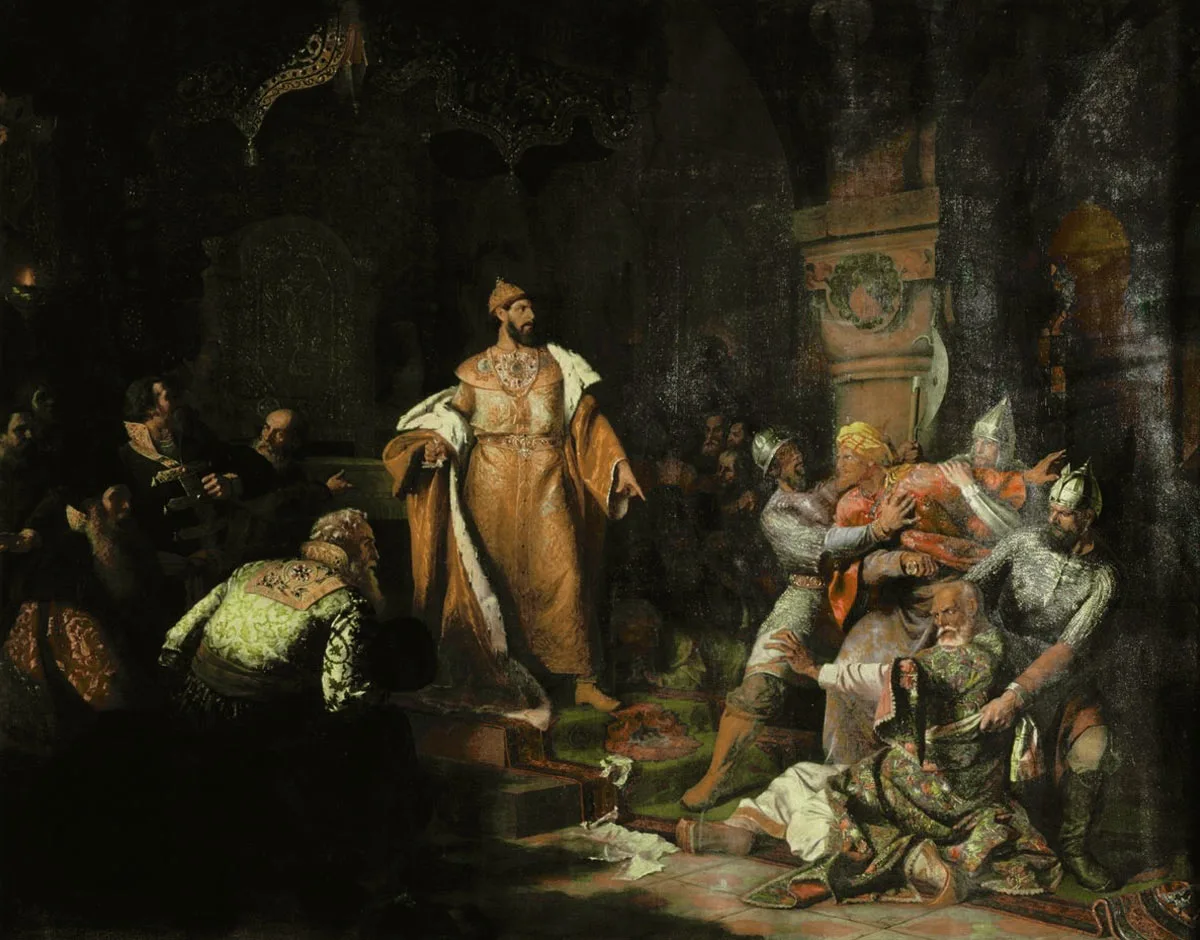
The story that Ivan tore up the khan's letter and trampled on his image is a legend. It comes from the sixteenth-century Kazan History, written decades later, and Galimov and Mirgaleev call it the chronicler's invention.
Sophia Palaiologina and the Byzantine question
Ivan's first wife, Maria of Tver, died on 22 April 1467; poison was suspected, and one of her servants, Natalia Poluektova, was blamed. In 1472 he married again, this time Zoe Palaiologina, niece of Constantine XI, the last Byzantine emperor, who had been raised in Rome under papal protection. Renamed Sophia, she arrived in Moscow on 12 November 1472 and married Ivan the same day in a temporary wooden church inside the unfinished cathedral.
The marriage has been credited with a great deal: Byzantine court ceremonial, the double-headed eagle, the idea of Moscow as a "Third Rome". Most of that does not hold up. The Habsburg diplomat Sigismund von Herberstein, who visited Moscow decades later, heard that Sophia used to tell Ivan "she had married a slave of the Tartars" and urged him to stop receiving the khan's envoys standing. It makes a good story, but it is hearsay. Sophia has her own article: Sophia Palaiologina.
The Kremlin rebuilt by Italian masters
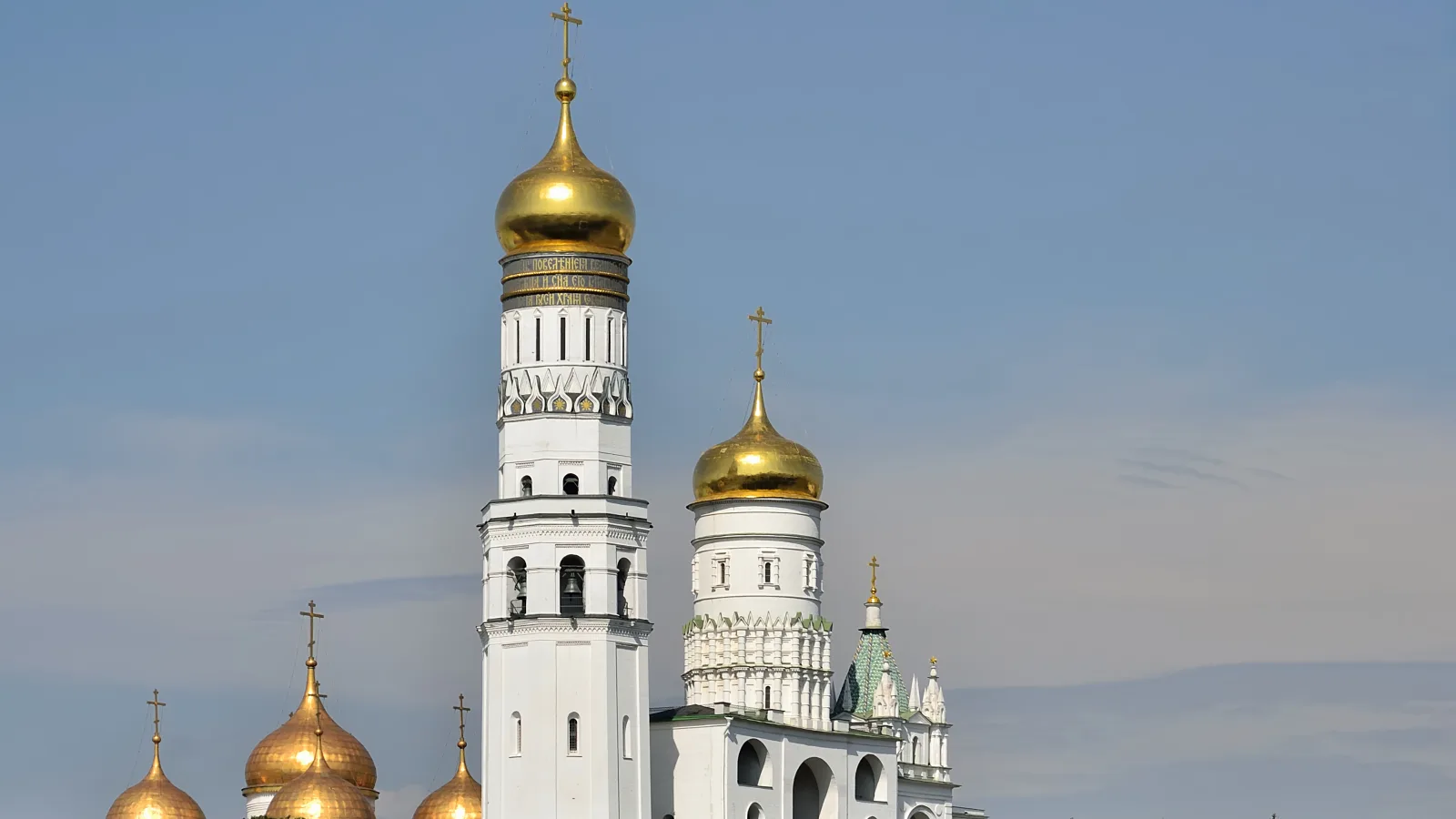
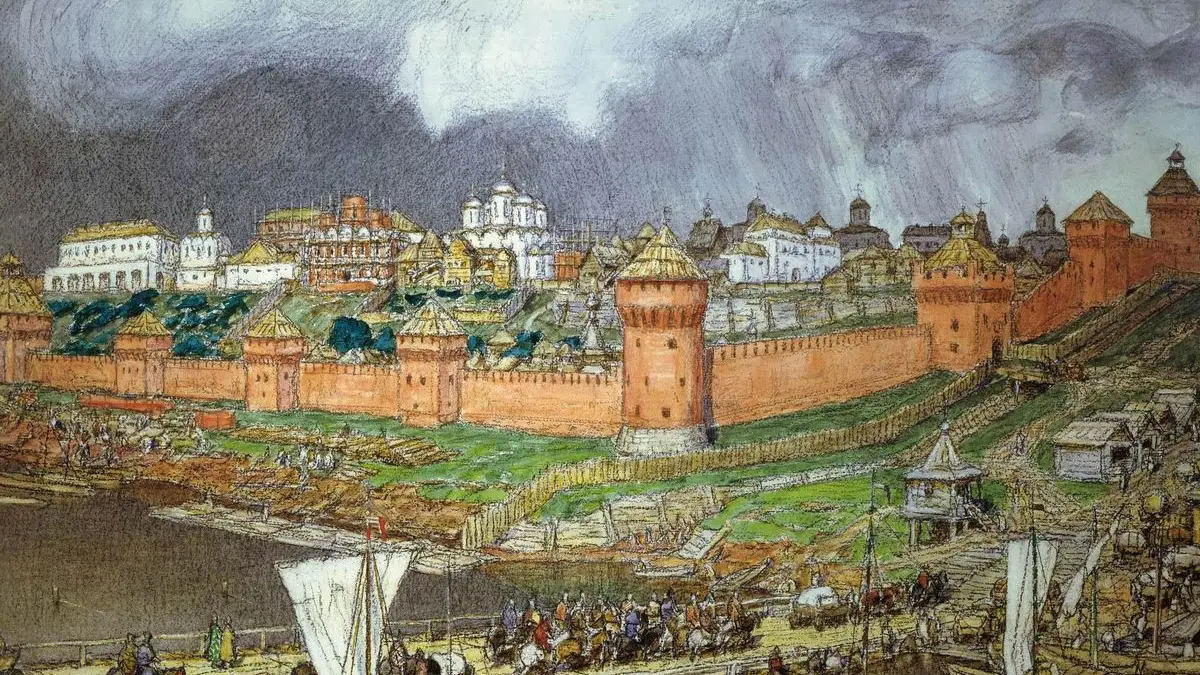
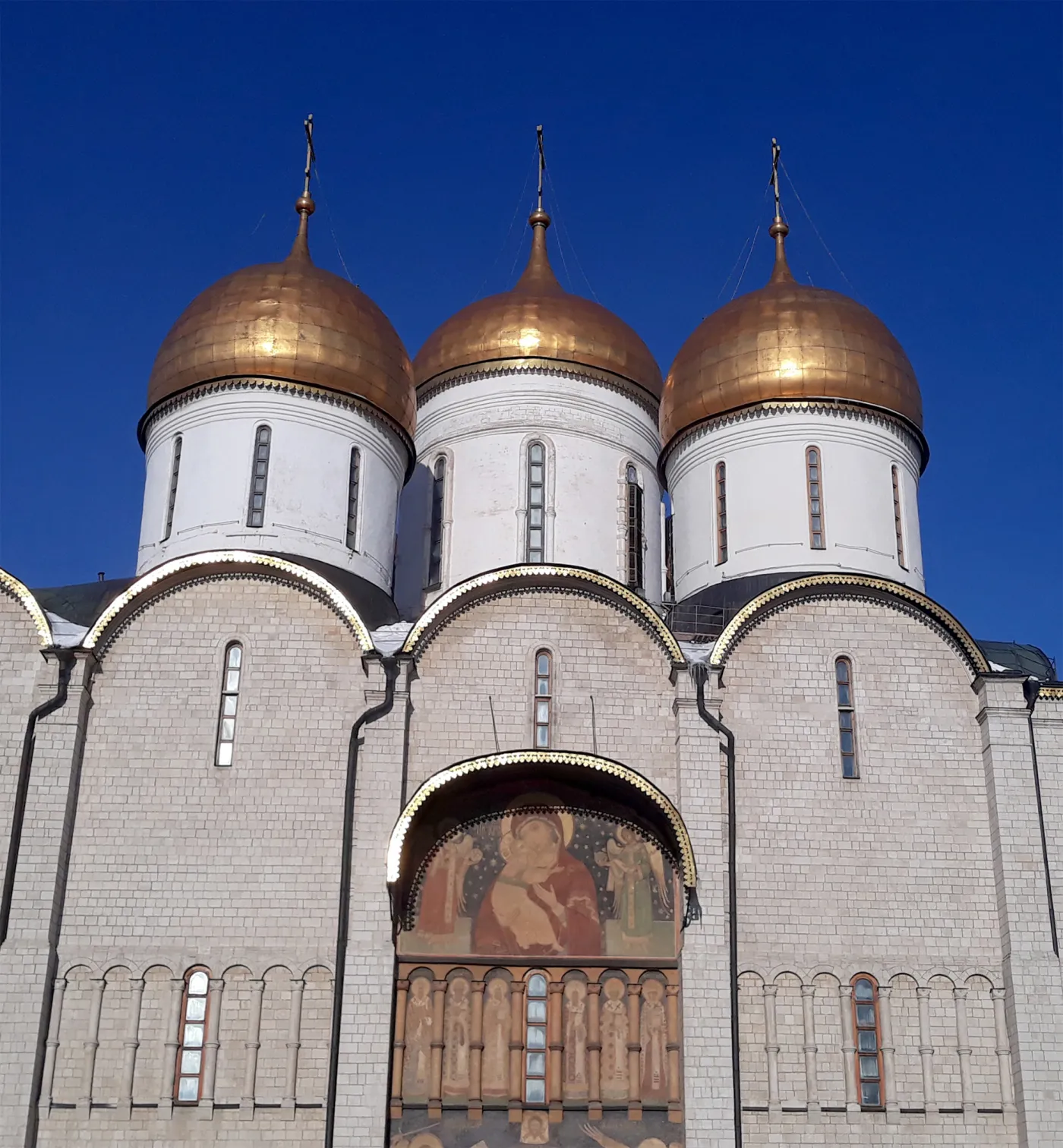
When Ivan came to power, the Kremlin was still largely the white-stone fortress of Dmitry Donskoy, and its main church, the Dormition Cathedral, was falling apart. Russian builders started a new cathedral in 1472; on 20 May 1474 it collapsed. Ivan sent to Italy for an architect. On Easter Sunday, 26 March 1475, the Bolognese engineer Aristotele Fioravanti arrived in Moscow with Ivan's envoy Semyon Tolbuzin. His Dormition Cathedral was consecrated on 12 August 1479 and is still standing.
More Italians followed. Marco Ruffo and Pietro Antonio Solari built the Palace of Facets for receptions (1487–1491). From 1485 the Kremlin walls and towers were rebuilt in brick, a work completed only under Ivan's son in 1516. In 1505, a few months before Ivan's death, the old Archangel church was pulled down to make way for the new Archangel Cathedral, built by Aleviz Novy.
The Sudebnik of 1497 and the new state
In September 1497 Ivan issued a law code, the Sudebnik: "In the year 7006, in the month of September, the grand prince Ivan Vasilyevich of all Rus' with his children and boyars laid down the law on how boyars and okolnichie are to judge." It set out procedure and fees for courts across the whole country, the first time one set of rules had applied to all of Ivan's lands.
One article had long consequences. Peasants could leave their landlord only once a year, in the week before and the week after St George's Day in autumn, and only after paying a fee for the years they had lived there. It was not yet serfdom, but it was the first step towards binding the peasant to the land.
Around the same time Ivan's seal took on a new emblem. The earliest dated seal impression with the double-headed eagle, on the reverse of an image of a horseman slaying a serpent, is attached to a charter of 1497. Its legend reads: "Ioann, by the grace of God sovereign of all Rus' and grand prince of Vladimir, and Moscow, and Novgorod, and Pskov, and Tver…". Where the eagle came from is still argued over. The traditional answer is Byzantium, through Sophia; others see a response to the Habsburg emperor's double-headed eagle; and A. Beliakov (2025) shows that the eagle was already in use in Moscow by the 1480s, in a version designed by northern Italian masters. He calls the debate, now over a century old, "far from resolved".
A struggle for the succession
Ivan's eldest son, Ivan the Young, had been proclaimed co-ruler no later than 1471. He died in 1490, leaving a son, Dmitry, by his wife Elena of Moldavia. That set two parties against each other at court: Elena and her son on one side, Sophia and her son Vasily on the other.
At first Elena's side won. Late in 1497 Vasily was accused of plotting against his father and his supporters were executed. On Sunday 4 February 1498, in the Dormition Cathedral, Ivan crowned his fourteen-year-old grandson Dmitry as grand prince and co-ruler, in a rite modelled on the Byzantine coronation of a co-emperor and with the "cap of Monomakh". Then Ivan changed his mind. On 11 April 1502 Dmitry and his mother were placed under arrest, and three days later Vasily was proclaimed grand prince of all Rus' and co-ruler. Dmitry died in prison in 1509.
The quarrel was mixed up with a religious one. Several of Elena's allies at court, including the diplomat Fyodor Kuritsyn, were linked to the so-called heresy of the "Judaizers", which had spread from Novgorod to Moscow. After years of hesitation Ivan gave way to the churchmen who demanded its suppression. In December 1504 a council condemned the heretics, and on 27 December Ivan Volk Kuritsyn and two others were burned in a cage in Moscow.
"Sovereign of all Rus'": what Ivan claimed
Ivan was never crowned tsar, but he used a title that said a great deal: "sovereign of all Rus'". It claimed not only the lands he ruled but also the Russian lands under Lithuania. In 1503 his envoys told the Lithuanians that "not only our patrimony, the towns and districts now under us, but the whole Russian land, by God's will, from of old, from our ancestors, is our patrimony". Ivan was even called tsar on occasion, as in a 1474 treaty with the Livonian Order, though the title became official only with his grandson's coronation in 1547.
The claim was backed by war. In 1494 Lithuania ceded Vyazma and the Verkhovskie principalities. In the war of 1500–1503 a Muscovite army destroyed the Lithuanian army on the Vedrosha river on 14 July 1500 and captured its commander. The truce of March 1503 gave Moscow Chernigov, Novgorod-Seversky, Bryansk and Toropets.
What were the accomplishments of Ivan the Great?
| Achievement | When |
|---|---|
| Annexed Novgorod and its vast northern lands | 1471–1478 |
| Annexed Tver, Yaroslavl, Rostov and Vyatka | 1460s–1489 |
| Stopped paying tribute to the Horde; Stand on the Ugra | 1472; 1480 |
| Alliance with Crimea that led to the end of the Great Horde | 1480; 1502 |
| Rebuilt the Moscow Kremlin with Italian architects | 1475 onward |
| First law code for the whole state (Sudebnik) | 1497 |
| Spread pomestie service landholding | from 1478 |
| Won Chernigov–Seversk lands from Lithuania | 1494, 1503 |
| Adopted the title "sovereign of all Rus'" and the double-headed eagle | 1480s–1490s |
Why "the Great"?
The Austrian diplomat Sigismund von Herberstein, who came to Moscow in 1517 and 1526, called him "Ivan the Great", and according to Britannica he was the first to do so. Herberstein's portrait of him is not flattering. Ivan, he wrote, "was only once engaged in war, when the principalities of Novogorod and Tver were taken possession of; at other times he never used to go to battle, but nevertheless always carried off the palm of victory". He was so harsh, Herberstein had heard, that women who met him "almost always fainted with terror at the sight of him".
The only description by someone who actually met him is kinder. The Venetian Ambrogio Contarini, in Moscow in 1476–1477, wrote that Ivan was 35 years old, "tall but thin; altogether a very handsome man".
Ivan died on 27 October 1505 and was buried in the Archangel Cathedral that he had just begun. His will left Vasily 66 towns, including Moscow, Novgorod, Pskov and Tver, and his four younger sons 30 between them: the old system of sharing out appanages had given way to a single heir.
Common myths about Ivan III
| Myth | What the evidence says |
|---|---|
| The Stand on the Ugra in 1480 ended the Tatar yoke | Tribute had stopped after 1472; there was no battle; payments to other khanates continued, and the Great Horde fell only in 1502, to Crimea |
| Ivan tore up the khan's letter | A story from the sixteenth-century Kazan History |
| Ivan III proclaimed Moscow the "Third Rome" | The monk Filofei formulated the idea in letters of 1523/24 under Vasily III; it had no official status, and became famous only after the letters were published in the 1860s |
| Sophia brought the double-headed eagle from Byzantium in 1472 | The first dated seal is from 1497; its origin, Byzantine or Habsburg, is still debated |
| Ivan III was the first tsar | He was sometimes called tsar, but the first crowned tsar was his grandson Ivan IV (1547) |
| Ivan tripled the size of Muscovy | No scholarly measurement supports the exact figure |
| He died in 1506 | Herberstein's year 7014 runs from September 1505; Ivan died on 27 October 1505 |
What the map shows next
At 1462 the Grand Principality of Moscow is one Russian state among several, with the Republic of Novgorod to the north and Tver to the west. At 1480 Novgorod has been annexed and the Golden Horde still lies to the south, with the Khanate of Kazan on the Volga and the Crimean Khanate, Ivan's ally, by the Black Sea. By 1505 on the map Moscow is the only Russian state in the north-east. Ivan's grandson took the next step: read about Ivan the Terrible, the first crowned tsar.
Sources
Primary sources
- The Nikonian Chronicle, vol. 5, ed. and trans. S. A. Zenkovsky and B. J. Zenkovsky (Princeton, 1989): https://archive.org/details/nikonian-chronicle-5
- Sigismund von Herberstein, Notes upon Russia, trans. R. H. Major, vol. 1 (London: Hakluyt Society, 1851): https://archive.org/details/notesuponrussiab01herbuoft
- Sudebnik of 1497, text after Rossiiskoe zakonodatel'stvo X–XX vekov, vol. 2 (Moscow, 1985): https://ru.wikisource.org/wiki/Судебник1497года
Studies and reference works
- B. N. Florya, "Ioann III Vasil'evich", Pravoslavnaia entsiklopediia, vol. 23, pp. 613–628: https://www.pravenc.ru/text/469780.html
- "Zhidovstvuiushchie", Pravoslavnaia entsiklopediia: https://www.pravenc.ru/text/182289.html
- T. R. Galimov and I. M. Mirgaleev, "K voprosu o traktovke 'Stoianiia na Ugre' 1480 g.", Zolotoordynskoe obozrenie 7/4 (2019), 652–662, doi:10.22378/2313-6197.2019-7-4.652-662
- O. V. Penskoy and T. N. Penskaia, "Postordynskii mir i soiuz Ivana III i Mengli-Gireia I", Zolotoordynskoe obozrenie 10/4 (2022), 868–898, doi:10.22378/2313-6197.2022-10-4.868-898
- C. J. Halperin, "A Note on Recent Research on the Term the 'Tatar Yoke'", Zolotoordynskoe obozrenie 13/1 (2025), 8–16
- A. V. Beliakov, "Vremia poiavleniia dvuglavogo orla na gosudarevykh pechatiakh", Quaestio Rossica 13/2 (2025), 559–575, doi:10.15826/qr.2025.2.982
- M. Poe, "'Moscow, the Third Rome': The Origins and Transformations of a 'Pivotal Moment'", NCEEER working paper (1997)
- S. M. Solov'ev, Istoriia Rossii s drevneishikh vremen, vol. 5, chapter 5
- St Petersburg State University, "Dvor russkikh kniagin' XI–XVI vv.": articles on Sofiia Paleolog and Mariia Borisovna: https://medieval-princesses.spbu.ru/
- J. L. I. Fennell, "Ivan III", Encyclopaedia Britannica: https://www.britannica.com/biography/Ivan-III
- UNESCO World Heritage Centre, "Kremlin and Red Square, Moscow": https://whc.unesco.org/en/list/545/
Image credits
- Title image: Apollinary Vasnetsov, The Moscow Kremlin under Ivan III, 1921. Public domain, via Wikimedia Commons, cropped to 16:9.
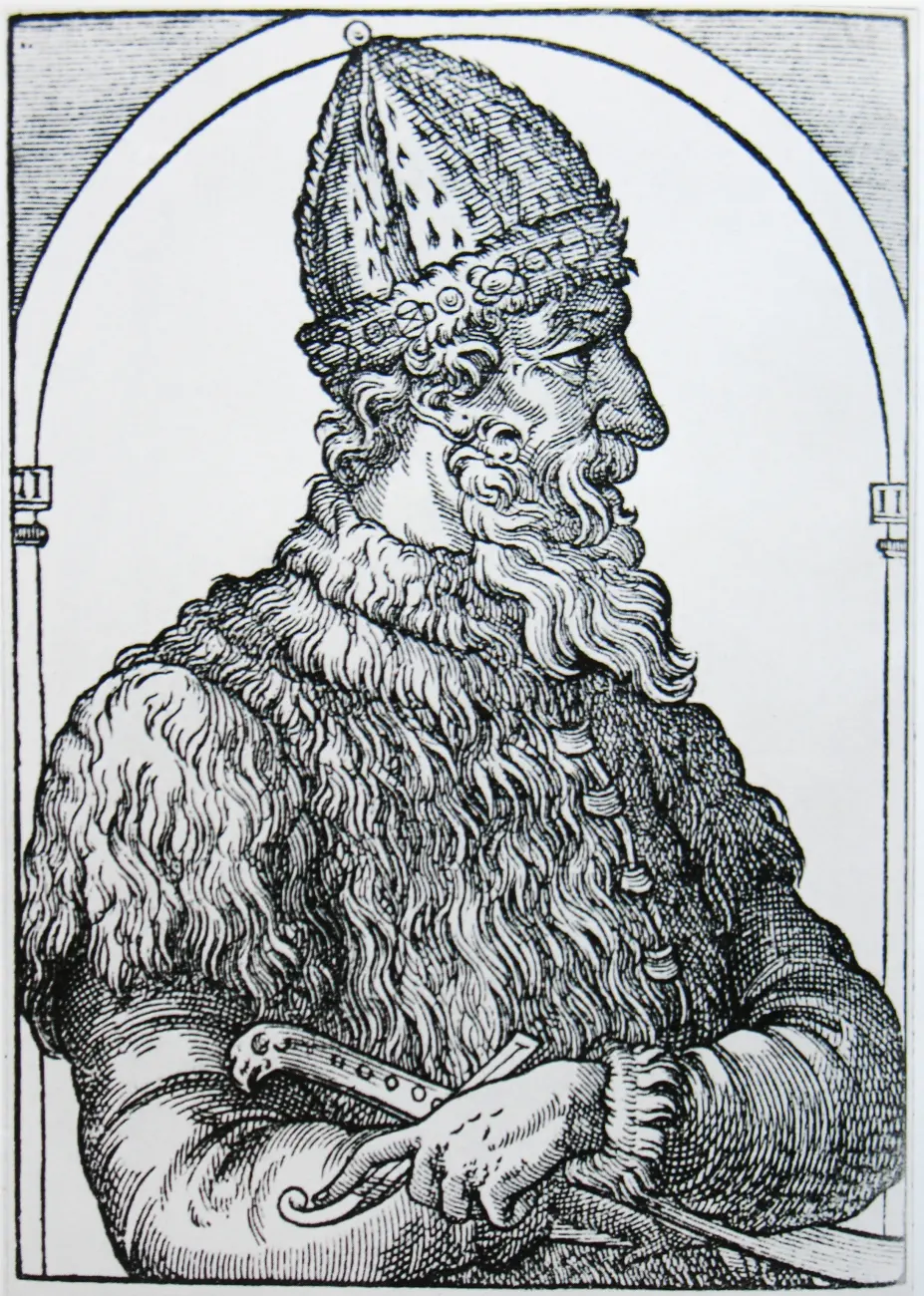
- Portrait of Ivan III from Thevet's Cosmographie universelle, 1575. Public domain, via Wikimedia Commons.
- The Stand on the Ugra, Illustrated Chronicle, vol. 16, p. 462. Public domain, via Wikimedia Commons.
- Dormition Cathedral. Photo: acediscovery, CC BY 4.0, via Wikimedia Commons.
- Nikolai Shustov, Ivan III Tears Up the Khan's Letter, 1862. Public domain, via Wikimedia Commons.