The Time of Troubles (Smutnoe vremia, or simply Smuta) was the crisis that almost destroyed the Russian state between the end of its old dynasty in 1598 and the election of Michael Romanov as tsar in 1613. In fifteen years Russia suffered one of the worst famines in its history, saw three tsars die violently and three men claim to be a dead prince, broke apart in civil war, and was invaded by Poland-Lithuania and Sweden. In 1610 a Polish garrison entered the Moscow Kremlin, and Russian boyars swore allegiance to a Polish prince. It took a popular army raised in the provinces, led by a Nizhny Novgorod townsman, Kuzma Minin, and Prince Dmitry Pozharsky, to drive the Poles out in October 1612.
Most historians now call it Russia's first civil war. The Great Russian Encyclopedia (2023) says that this view, argued by A. L. Stanislavsky, "prevails" in current scholarship, and traces its causes to a crisis of society left by Ivan the Terrible's oprichnina and the lost Livonian War, sharpened by the famine of 1601–1603. The dates are a convention. The Orthodox Encyclopaedia (Pravoslavnaya entsiklopediya) and the Great Russian Encyclopedia both end the Troubles not in 1613 but with the peace treaties of 1617 and 1618.
The Time of Troubles at a glance
| Dates | 1598 (death of Fyodor I) – 1613 (election of Michael Romanov); some historians end it in 1617–1618 |
| Rulers | Boris Godunov (1598–1605), Fyodor II (1605), False Dmitry I (1605–1606), Vasily Shuisky (1606–1610), the "Seven Boyars" (1610–1612) |
| Famine | 1601–1603; at least 127,000 burials in Moscow alone |
| Pretenders | False Dmitry I (killed 1606), False Dmitry II (killed 1610), False Dmitry III (Pskov, 1611–1612) |
| Foreign powers | Poland-Lithuania (Kremlin garrison 1610–1612, Smolensk taken 1611); Sweden (Novgorod taken 1611) |
| Turning point | Second Militia of Minin and Pozharsky; Kitay-gorod stormed 22 October 1612, Kremlin surrendered 26–27 October 1612 (Old Style) |
| End | Michael Romanov elected 21 February 1613; peace of Stolbovo (1617) and truce of Deulino (1618) |
How did the Time of Troubles begin?
With the end of a dynasty. Ivan the Terrible's son Fyodor I, a pious tsar who left government to others, died childless on 7 January 1598. The New Chronicle (Novyi letopisets) records that he died on that day, which was a Saturday. He was the last tsar of the Moscow branch of the Rurikids, the family that had ruled Rus' for more than seven centuries.
His younger brother Dmitry had died seven years earlier, on 15 May 1591, aged eight, in the town of Uglich, where he lived in semi-exile with his mother. A government commission under Prince Vasily Shuisky questioned 140 people and concluded that the boy had stabbed himself with a knife during an epileptic fit. Rumours that Boris Godunov, Fyodor's brother-in-law and the real ruler of Russia, had had him murdered began at once. The Orthodox Encyclopaedia notes, however, that the first written accounts of a murder date from 1606, after Godunov's family had fallen. Whether Dmitry was killed is still unknown.
With no Rurikid heir, an Assembly of the Land (Zemsky sobor) elected Boris Godunov tsar on 17 February 1598. He accepted on 21 February and was crowned on 1 September 1598. He was an able administrator, but a tsar without royal blood was vulnerable, and the next years would test him beyond his means.
What caused the famine of 1601–1603?
The summer of 1601 was a disaster. The monk Avraamy Palitsyn, cellarer of the Trinity-Sergius monastery, wrote that God "darkened the sky with clouds, and so much rain poured down that all people fell into horror". The rain lasted "for ten weeks", and before the harvest "a strong frost struck all the work of men's hands". The climatologists E. P. Borisenkov and V. M. Pasetsky, who collected the chronicle evidence in 1983, list twelve weeks of rain, summer frosts in late July and August, and snow on 1 September. The harvest failed again in 1602. By 1603 rye cost eighteen times as much as in 1601.
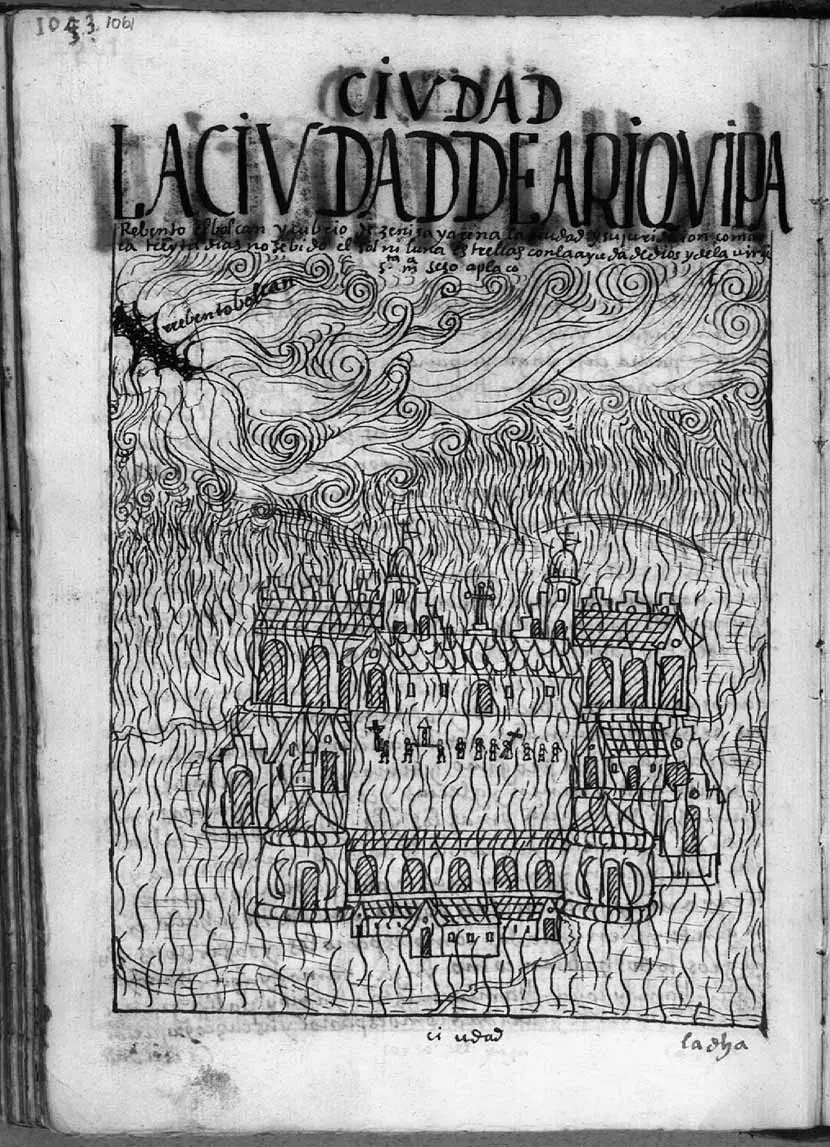
Science has added a possible cause. In February 1600 the volcano Huaynaputina in southern Peru exploded in the largest eruption in the recorded history of the Andes. Tree rings show that the summer of 1601 was one of the coldest in the northern hemisphere: a study by Sam White and colleagues (2022) gives a cooling of −1.6 °C, "the most significant cooling recorded in the Northern Hemisphere reconstruction over the past 1500 years".
Historians and scientists disagree about whether the volcano caused the Russian famine.
- Kenneth Verosub and Jake Lippman (2008), who first collected the evidence for 1601 from around the world, wrote that it "does not prove that the 1600 eruption of Huaynaputina had a significant climatic or human impact".
- White and colleagues find the cold "consistent with, but not indicative of" a volcanic trigger. They cite ice cores showing that Huaynaputina released less sulphur than expected, and note that the cooling may have begun in the 1590s.
- They also stress that "the cold alone does not solely explain the human suffering". The historian Sergei Nefedov (2009) points out that one bad harvest would not have caused a famine if peasants had still had reserves. Decades of war and the oprichnina had left them none.
Borisenkov and Pasetsky, writing in 1983, do not mention a volcano at all. The link was made only after 1998, when tree-ring studies identified the cold summer.
How many people died in the famine?
Nobody knows. The figures that circulate come from three contemporaries, and they measure different things.
- Avraamy Palitsyn: "in two years and four months, counting by the tsar's order, they buried in three pauper pits 127,000, in Moscow alone". He adds that the dead buried at Moscow's more than 400 churches were not counted.
- Jacques Margeret, a French captain in Russian service: more than 120,000 died in Moscow alone and were buried in three cemeteries outside the city at the tsar's expense.
- Conrad Bussow, a German mercenary: "more than 500,000" in Moscow alone, which he had "heard from some merchants and trustworthy officials".
Bussow's figure is hearsay and implausibly high for a single city. Even so, it has travelled. Verosub and Lippman's 2008 paper turned it into "more than 500,000 people … between 1601 and 1603" for the whole of Russia, and later papers repeat it. Palitsyn's 127,000 is the most concrete figure, and it counts only burials in Moscow.
Boris Godunov tried to help. The Orthodox Encyclopaedia says he organised public works, distributed grain from the state stores and fought speculators, but these measures "proved inadequate to the scale of the disaster". In November 1601 he temporarily allowed peasants to leave their landlords. Armed bands of the hungry roamed the country, some reaching Moscow itself.
Who was False Dmitry?
In 1603 a young man appeared in Poland-Lithuania claiming to be Tsarevich Dmitry, saved from his murderers at Uglich (see False Dmitry I). He found support among Polish magnates, above all Jerzy Mniszech, voivode of Sandomierz. On 25 May 1604 the "tsarevich" promised to marry Mniszech's daughter Marina and to give her Novgorod and Pskov.
Boris Godunov's government declared that he was Grigory Otrepyev, a runaway monk. The Orthodox Encyclopaedia gives his biography: Yury Otrepyev, son of a minor nobleman from Galich, served in the households of the Romanovs and Prince Cherkassky, became a monk after they fell from favour in 1600, and worked as a copyist at the Chudov monastery for Patriarch Job. This identification remains the most widely held. The Orthodox Encyclopaedia adds that the theory of a plot by boyars hostile to Godunov behind the pretender has no supporting evidence.
His campaign was nearly a failure.
- In October 1604 he crossed into Russia with a small army.
- On 21 January 1605 the tsar's army beat him at Dobrynichi near Sevsk.
- On 13 April 1605 Boris Godunov died suddenly, and his son Fyodor II became tsar.
- In May the tsar's army at Kromy went over to the pretender.
- On 1 June 1605 a rising in Moscow overthrew the Godunovs; Fyodor II and his mother were killed.
- On 20 June 1605 "Dmitry" entered Moscow.
- On 21 July he was crowned in the Dormition Cathedral, with a crown that the Emperor Rudolf II had sent to Boris Godunov.
He ruled for less than a year. Marina Mniszech came to Moscow with a large Polish retinue and was crowned on 8 May 1606. Nine days later, on 17 May 1606, a rising organised by aristocratic conspirators around Vasily Shuisky, joined by the townspeople and the musketeers of Moscow, killed the tsar.
Vasily Shuisky and the civil war
On 19 May 1606 Prince Vasily Shuisky, the man who had investigated Dmitry's death in 1591, was proclaimed tsar in Red Square; he was crowned on 1 June. To discredit any new pretender he had the remains of the real Dmitry brought from Uglich to Moscow and the boy proclaimed a saint. The story that Godunov had had Dmitry murdered now became official.
Shuisky never controlled the whole country.
- Bolotnikov's rising, 1606–1607. A rising in the southern towns, joined by Cossacks, runaway slaves and peasants, reached Moscow under Ivan Bolotnikov and Istoma Pashkov, who besieged the city in October 1606. He was driven back on 2 December and surrendered at Tula on 10 October 1607, on a promise of his life that Shuisky broke.
- False Dmitry II, 1607–1610. In July 1607 a second "Dmitry" appeared. According to the Barkulabovo chronicle he had been a schoolteacher in eastern Belarus. Supported by Polish and Lithuanian troops and Cossacks, he beat Shuisky's army at Bolkhov in May 1608 and set up a rival court at Tushino, just outside Moscow. Marina Mniszech "recognised" him as her husband, and Filaret Romanov, father of the future tsar, became his "patriarch". Russia had two tsars and two governments.
In February 1609 Shuisky turned to Sweden. By the treaty of Vyborg he received Swedish and mercenary troops in exchange for the town of Korela. His young cousin Mikhail Skopin-Shuisky and the Swedish commander Jacob De la Gardie fought their way south from Novgorod and lifted the blockade of Moscow on 12 March 1610. Skopin-Shuisky, the most popular man in Russia, died on 23 April 1610 after a feast, amid rumours of poison.
How did the Poles take the Kremlin?
Sweden's intervention brought in its enemy. King Sigismund III of the Polish–Lithuanian Commonwealth, who was also a claimant to the Swedish throne, declared war in the autumn of 1609 and laid siege to Smolensk. On 4 July 1610 (24 June in the Russian calendar) Hetman Stanisław Żółkiewski routed Shuisky's army and its foreign mercenaries at Klushino. "Yesterday, 4 July," he reported, "we joined battle with them, before the sun rose."
In Moscow, Shuisky was deposed on 17 July 1610 and forcibly made a monk two days later. A council of boyars under Prince Fyodor Mstislavsky took power, the government later called the "Seven Boyars". On 17 (27) August 1610 the boyars agreed with Żółkiewski to make Sigismund's son, Prince Władysław, tsar, on condition that he convert to Orthodoxy. According to Żółkiewski, "up to 10,000 and more" Muscovites swore allegiance to Władysław that day.
At the end of September 1610, against the protests of Patriarch Hermogen, the boyars let a Polish garrison into the Kremlin. Sigismund, however, wanted the throne for himself, and Władysław never came. False Dmitry II was killed near Kaluga on 11 December 1610. Smolensk fell on 3 June 1611, after a siege of almost two years, and on 16 July 1611 the Swedes stormed Novgorod. By the summer of 1611 Russia had no tsar, a foreign garrison in its capital, and two of its greatest cities in foreign hands.
Who were the Seven Boyars?
The name Semiboyarshchina, "the rule of the seven boyars", was invented by writers in the 1830s. The Great Russian Encyclopedia says that the word was probably first used by Alexander Bestuzhev in a story of 1831 and entered scholarship in 1832–1833. A chronicle of 1616–1617 speaks of "seven Moscow boyars", but the encyclopedia states that "the exact number and personal composition" of the council "are unknown". The historian V. G. Ananyev's reconstruction includes Mstislavsky, Andrei Trubetskoy, Fyodor Sheremetev, Ivan Romanov and Boris Lykov throughout, and other princes, such as Vasily Golitsyn and Ivan Vorotynsky, for part of the time.
In Russian memory they became the men who sold Moscow to the Poles. In fact they were a council of the leading aristocrats, caught between a deposed tsar, a pretender's army at the gates and a Polish army in the field. They did sign the treaty with Żółkiewski and let the garrison into the Kremlin, and some of them stayed in the besieged Kremlin with the Poles until 1612.
Minin and Pozharsky: how was Moscow freed?
The first attempt failed. In March 1611 Moscow rose against the garrison; the Poles set fire to the city, and Prince Dmitry Pozharsky was badly wounded in the fighting. A First Militia under Prokopy Lyapunov, Prince Dmitry Trubetskoy and the Cossack leader Ivan Zarutsky besieged the Poles, but in July 1611 Cossacks killed Lyapunov in their camp, and the militia broke up into quarrelling camps.
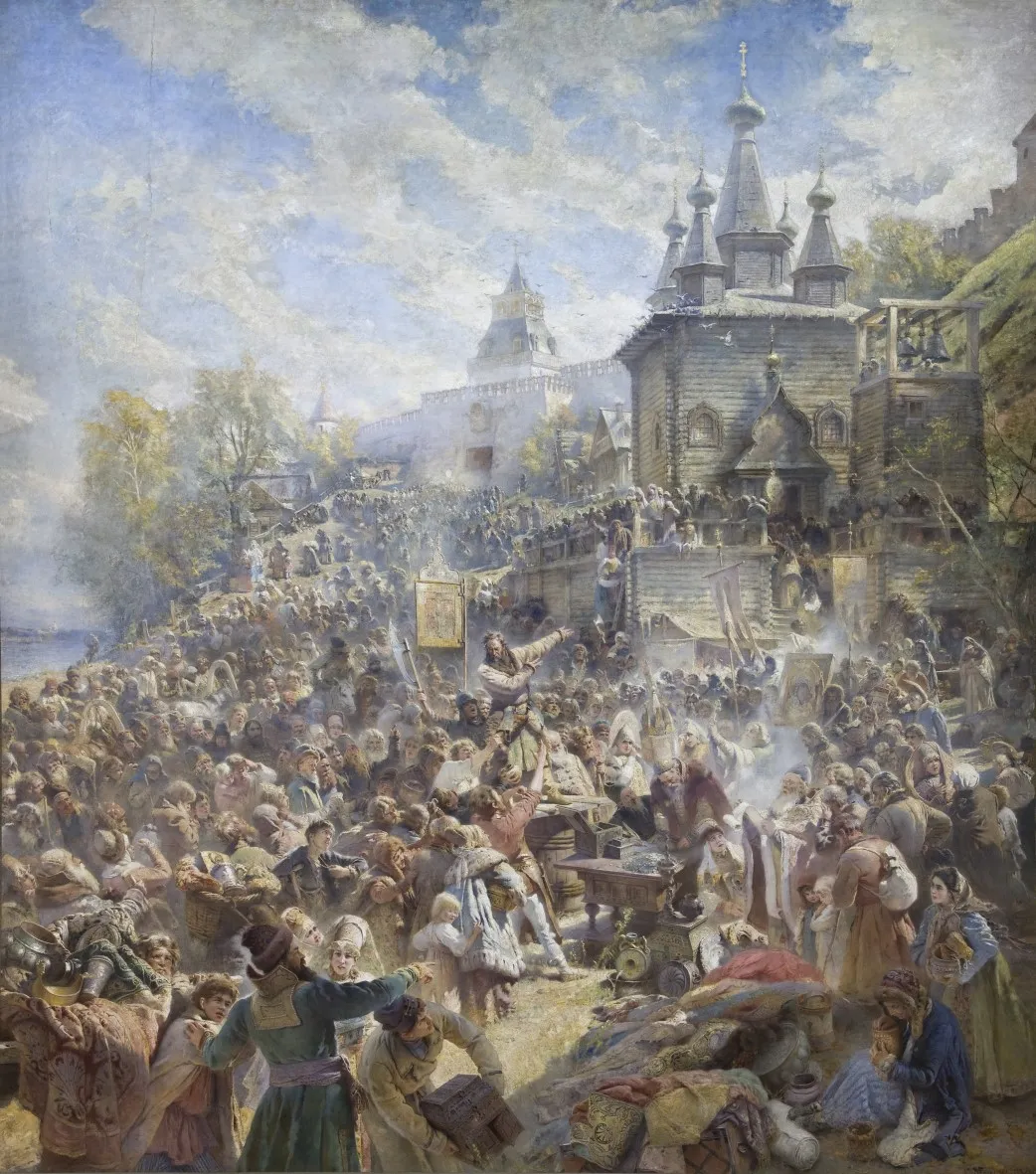
The second attempt came from Nizhny Novgorod on the Volga. In September 1611 the townsmen elected Kuzma Minin as their zemsky starosta, the head of the town community. According to the Orthodox Encyclopaedia, Minin was a townsman of modest means; the nickname "Sukhoruk" and the stories of his birth in Balakhna and Tatar origin "are not confirmed by modern research". He appealed to the people of Nizhny Novgorod to help "the Muscovite state", took charge of collecting money for a new army, and with the town invited Prince Dmitry Pozharsky, a Rurikid prince and an experienced commander, to lead it.
- February 1612. The Second Militia left Nizhny Novgorod. In the spring at Yaroslavl it formed a "Council of All the Land", a provisional government, and grew to about 10,000 men.
- 20 August 1612. Pozharsky reached Moscow with 7,000–8,000 men and about 3,000 Cossacks.
- 22 and 24 August. He fought off a Polish–Lithuanian relief army of about 8,000 under Hetman Jan Karol Chodkiewicz, with help at the decisive moment from Trubetskoy's Cossacks and a charge led by Minin himself.
- 22 October 1612. The militia stormed Kitay-gorod, the walled trading quarter next to the Kremlin. Palitsyn dates it to "the 22nd day of October, the commemoration of our holy father Averky".
- 26–27 October 1612. The starving garrison in the Kremlin signed a surrender treaty on 26 October. On 27 October one Polish regiment surrendered to Trubetskoy and the other to Pozharsky and Minin. The New Chronicle says that the victors found tubs of salted human flesh in the Kremlin.
Why does Russia celebrate 4 November?
Since 2005 Russia has marked 4 November as the Day of National Unity (Den' narodnogo edinstva). It was created by Federal Law No. 200-FZ of 29 December 2004, which added the line "4 November – Day of National Unity" to the list of Russia's days of military glory.
The holiday commemorates the liberation of Moscow in 1612, but the date does not match a single event of that autumn. The storming of Kitay-gorod and the Kremlin's surrender fell on 22–27 October in the Julian calendar then used in Russia, which in 1612 ran ten days behind the modern calendar: 1–6 November. 4 November is, however, the date on which the Russian Orthodox Church, which still uses the Julian calendar, now celebrates the feast of the Kazan icon of the Mother of God (22 October Old Style). The militia carried this icon, and the Orthodox Encyclopaedia says that Kitay-gorod was taken "with the Kazan icon" on 22 October 1612 and that 22 October "became the day of Russia's liberation from the interventionists".
How did the Time of Troubles end?
In January 1613 delegates from towns across Russia gathered in Moscow for an Assembly of the Land to elect a tsar. The candidates included Prince Trubetskoy, Prince Mstislavsky and Charles Philip, a son of the Swedish king. According to the Orthodox Encyclopaedia, Pozharsky had been willing to accept the Swedish prince if he came quickly and became Orthodox.
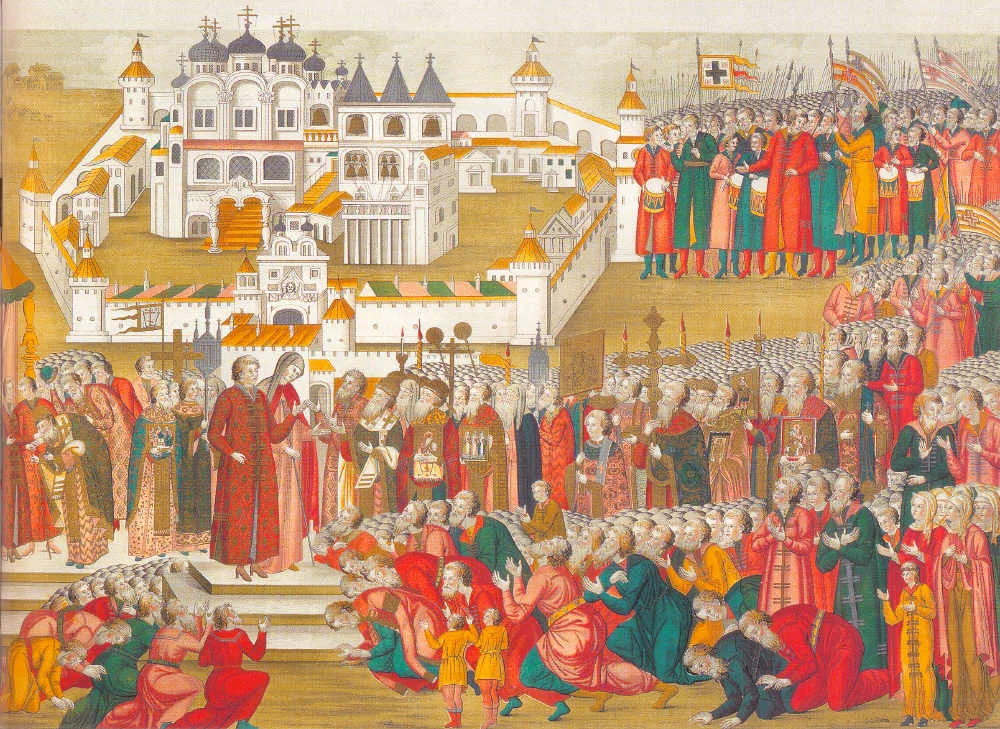
On 21 February 1613 the Assembly chose Michael (Mikhail) Romanov, the sixteen-year-old son of Filaret and a first cousin once removed of the last Rurikid tsar, Fyodor I. The election charter dates the choice to "the first week of Lent, on which the Orthodoxy of the holy fathers is celebrated". His candidacy, the Orthodox Encyclopaedia notes, was put forward by the free Cossacks of the camps around Moscow. The Swedish commander De la Gardie reported that Michael was proclaimed by the Cossacks against the will of the boyars. On 14 March an embassy found him and his mother at the Ipatiev monastery in Kostroma, and on 11 July 1613 he was crowned.
The wars went on. By the treaty of Stolbovo (27 February 1617) Sweden returned Novgorod but kept Ivangorod, Koporye, Oreshek, Korela and Ingria, cutting Russia off from the Baltic, and received 20,000 silver roubles. In 1618 Władysław marched on Moscow to claim his throne and was beaten back on 1 October. The truce of Deulino (1 December 1618) left Smolensk, Chernigov and other towns to the Commonwealth for fourteen and a half years, and brought Filaret home from Polish captivity in 1619.
Who was Ivan Susanin?
Ivan Susanin is the peasant hero of the Troubles, made famous by Mikhail Glinka's opera A Life for the Tsar (1836). In the legend he led a Polish detachment that was hunting the newly elected Michael Romanov into a forest or swamp near Kostroma, saved the tsar and was killed for it.
The only contemporary document is a charter of 30 November 1619, which granted land to his son-in-law Bogdan Sabinin. It says that Susanin was seized by "Polish and Lithuanian people", who tortured him "with great and immeasurable tortures" to learn where the tsar was, and that he "did not tell about us … and for that was tortured to death". The Russian Biographical Dictionary notes that no chronicle or foreign report mentions him, and that the story of the man who led the enemy astray first appears in a speech to Catherine II in 1767 and in a local history of 1792. The Orthodox Encyclopaedia mentions the swamp only "according to some traditions", and suggests that the raiders may have been Zaporozhian Cossacks in Polish service.
Common myths about the Time of Troubles
| Myth | What the evidence says |
|---|---|
| Boris Godunov had Tsarevich Dmitry murdered | The 1591 commission found an accident in an epileptic fit; the murder version appears in writing only in 1606. It is still unresolved |
| Half a million people died of famine in Moscow | Bussow's hearsay figure; Palitsyn counted 127,000 burials in three pits in Moscow over two years and four months |
| The volcano Huaynaputina caused the famine | The cold summer of 1601 fits the eruption, but scientists say a link is "consistent with" the evidence, not proven; social causes mattered too |
| False Dmitry was the real tsarevich | The government identified him as Grigory Otrepyev, and most historians accept this; no evidence supports a boyar plot behind him |
| Seven named boyars sold Moscow to the Poles | The name was coined in the 1830s, and the number and membership of the council are unknown |
| Moscow was liberated on 4 November 1612 | Kitay-gorod was stormed on 22 October and the Kremlin surrendered on 26–27 October (Old Style), 1–6 November in today's calendar; 4 November is today's date of the Kazan icon feast |
| Minin was called "Sukhoruk" and was of Tatar origin | The nickname, his birth in Balakhna and the Tatar origin are not confirmed by modern research |
| Ivan Susanin led the Poles into a swamp | The 1619 charter says only that he died under torture without betraying the tsar; the swamp story appears in the 18th century |
| Michael Romanov was freely elected by all the land | Cossack pressure decided the election |
Timeline of the Time of Troubles
| Date | Event |
|---|---|
| 15 May 1591 | Death of Tsarevich Dmitry at Uglich |
| 7 January 1598 | Death of Fyodor I, the last Rurikid tsar of Moscow |
| 17 February 1598 | Boris Godunov elected tsar |
| February 1600 | Huaynaputina erupts in Peru |
| 1601–1603 | Great famine |
| October 1604 | False Dmitry I invades Russia |
| 13 April 1605 | Death of Boris Godunov |
| 20 June 1605 | False Dmitry I enters Moscow |
| 17 May 1606 | False Dmitry I killed; Vasily Shuisky becomes tsar |
| 1606–1607 | Bolotnikov's rising |
| 1608–1610 | False Dmitry II's court at Tushino |
| February 1609 | Treaty of Vyborg with Sweden |
| 4 July 1610 | Battle of Klushino |
| 17 July 1610 | Shuisky deposed |
| 17 (27) August 1610 | Boyars agree to elect Władysław |
| September 1610 | Polish garrison enters the Kremlin |
| 3 June 1611 | Smolensk falls to the Commonwealth |
| 16 July 1611 | Swedes storm Novgorod |
| September 1611 | Minin elected in Nizhny Novgorod |
| 22 October 1612 | Second Militia storms Kitay-gorod |
| 26–27 October 1612 | Kremlin garrison surrenders |
| 21 February 1613 | Michael Romanov elected tsar |
| 11 July 1613 | Michael crowned |
| 27 February 1617 | Treaty of Stolbovo with Sweden |
| 1 December 1618 | Truce of Deulino with Poland-Lithuania |
| 29 December 2004 | Law creating the Day of National Unity on 4 November |
What the map shows
At 1598 the Tsardom of Russia stretches from the White Sea to the Caspian and into Siberia, under its new tsar Boris Godunov. At 1610 the Polish–Lithuanian Commonwealth is at war with Russia, the Kingdom of Sweden has troops in the north, and the Crimean Khanate holds the southern steppe. By 1613 the Tsardom has a new dynasty, but Smolensk and Novgorod are still in foreign hands. Read more about the tsar who began it all in Ivan the Terrible.
Sources
Primary sources
- Skazanie Avraamiia Palitsyna, ed. O. A. Derzhavina and E. V. Kolosova (Moscow–Leningrad, 1955): https://archive.org/details/1955_20231204
- Novyi letopisets and Povest' o chestnom zhitii tsaria Feodora, PSRL vol. 14 (St Petersburg, 1910): https://archive.org/details/14-1_20241124
- Utverzhdennaia gramota ob izbranii na Moskovskoe gosudarstvo Mikhaila Fedorovicha Romanova, ed. S. A. Belokurov (Moscow, 1906): https://archive.org/details/utverzhdennajagramotaobizbraniinamoskovs67
- Skazaniia sovremennikov o Dimitrii Samozvantse, ed. N. Ustrialov, vol. 1 (St Petersburg, 1859), with the chronicle of Conrad Bussow (published as "Ber") and Jacques Margeret's Estat de l'Empire de Russie: https://archive.org/details/skazanijasovremennikovodimitriisamozvant62
- Zapiski getmana Zholkevskogo o Moskovskoi voine, ed. P. Mukhanov (St Petersburg, 1871): https://archive.org/details/zapiskigetmanazholkevskogoomoskovskojvoj97
- Federal Law No. 200-FZ of 29 December 2004: http://kremlin.ru/acts/bank/21852
Studies and reference works
- "Smutnoe vremia", Pravoslavnaia entsiklopediia (2026): https://www.pravenc.ru/text/2875451.html
- B. N. Floria, "Boris Feodorovich Godunov", Pravoslavnaia entsiklopediia: https://www.pravenc.ru/text/153195.html
- "Dimitrii Ioannovich", Pravoslavnaia entsiklopediia: https://www.pravenc.ru/text/178207.html
- "Lzhedmitrii I" and "Lzhedmitrii II", Pravoslavnaia entsiklopediia, vol. 40 (2020): https://www.pravenc.ru/text/2463625.html
- "Vasilii Ioannovich Shuiskii", "Minin", "Pozharskii" and "Mikhail Feodorovich", Pravoslavnaia entsiklopediia: https://www.pravenc.ru/text/2580866.html
- "Kazanskaia ikona Bozhiei Materi", Pravoslavnaia entsiklopediia: https://www.pravenc.ru/text/1320206.html
- V. D. Nazarov, "Smutnoe vremia", and "Semiboiarshchina", Bol'shaia rossiiskaia entsiklopediia
- "Susanin, Ivan Osipovich", Russkii biograficheskii slovar': https://ru.wikisource.org/wiki/РБС/ВТ/Сусанин,ИванОсипович
- "Stolbovskii dogovor" and "Deulinskoe peremirie", Entsiklopedicheskii slovar' Brokgauza i Efrona
- E. P. Borisenkov and V. M. Pasetskii, Ekstremal'nye prirodnye iavleniia v russkikh letopisiakh XI–XVII vv. (Leningrad, 1983)
- K. L. Verosub and J. Lippman, "Global Impacts of the 1600 Eruption of Peru's Huaynaputina Volcano", Eos 89:15 (2008), 141–142, doi:10.1029/2008EO150001
- S. White et al., "The 1600 CE Huaynaputina eruption as a possible trigger for persistent cooling in the North Atlantic region", Climate of the Past 18 (2022), 739–757, doi:10.5194/cp-18-739-2022
- S. A. Nefedov, "Prichiny Smuty", working paper, Institute of History and Archaeology, Ural Branch of the Russian Academy of Sciences (2009): http://www.ihist.uran.ru/files/NefedovUI2009.pdf
- Presidential Library, "Den' voinskoi slavy Rossii – Den' narodnogo edinstva": https://www.prlib.ru/history/619688
Image credits
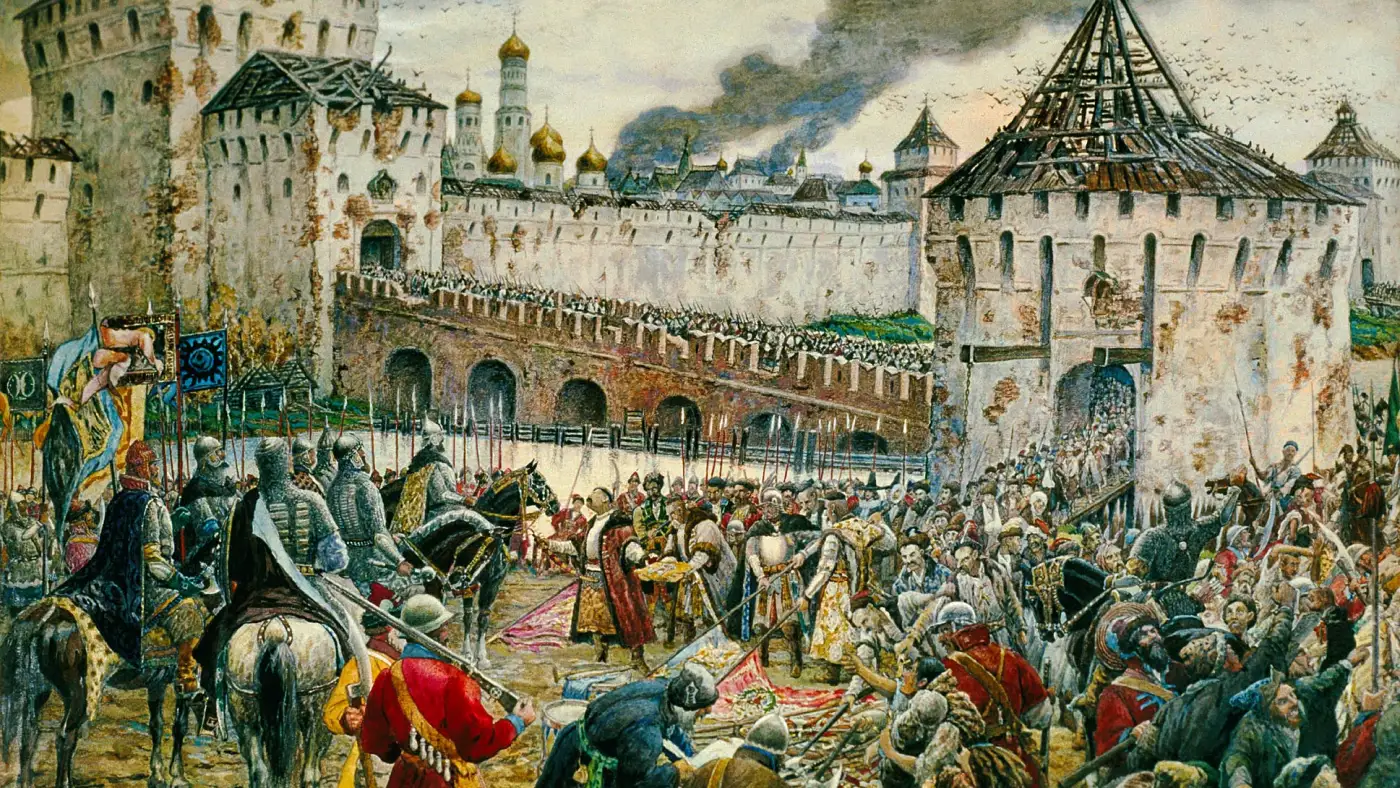
- Title image: Ernest Lissner, The Expulsion of the Poles from the Kremlin, Museum of Moscow. Public domain, via Wikimedia Commons, cropped to 16:9.
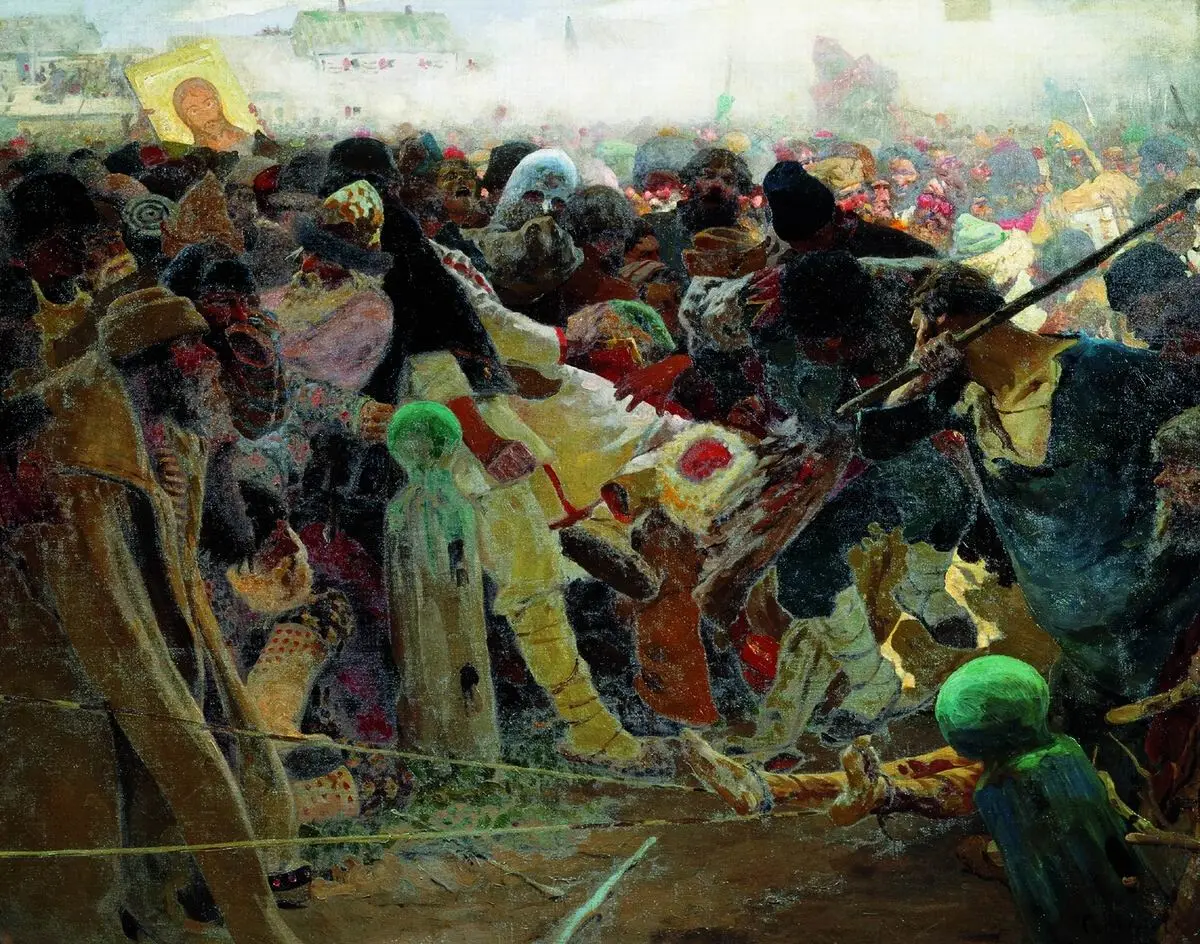
- Sergei Ivanov, Time of Troubles, 1897. Public domain, via Wikimedia Commons.
- Felipe Guamán Poma de Ayala, Arequipa under the ash of Huaynaputina, c. 1615. Public domain, via Wikimedia Commons.
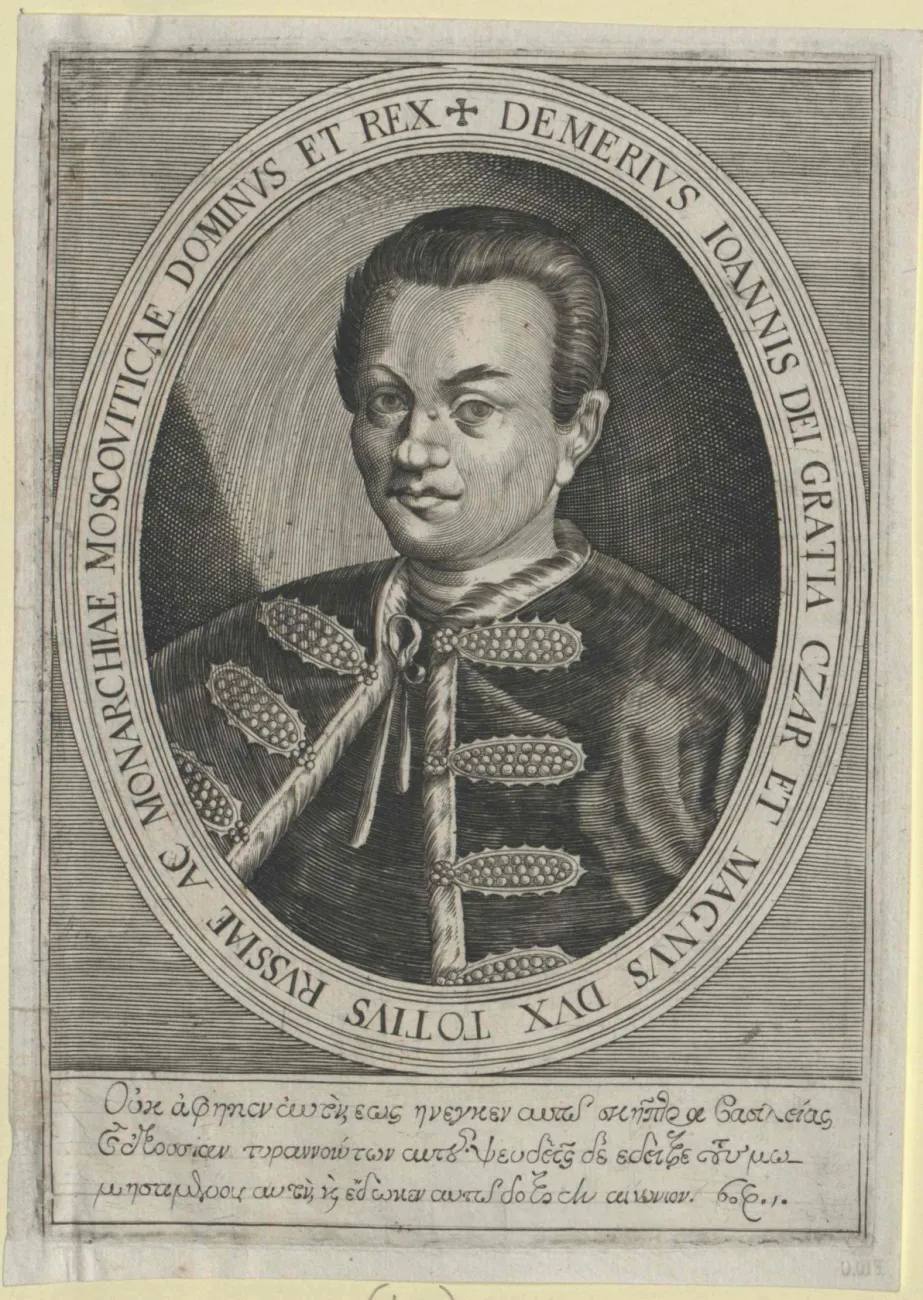
- Portrait engraving of False Dmitry I, Austrian National Library. Public domain, via Wikimedia Commons.
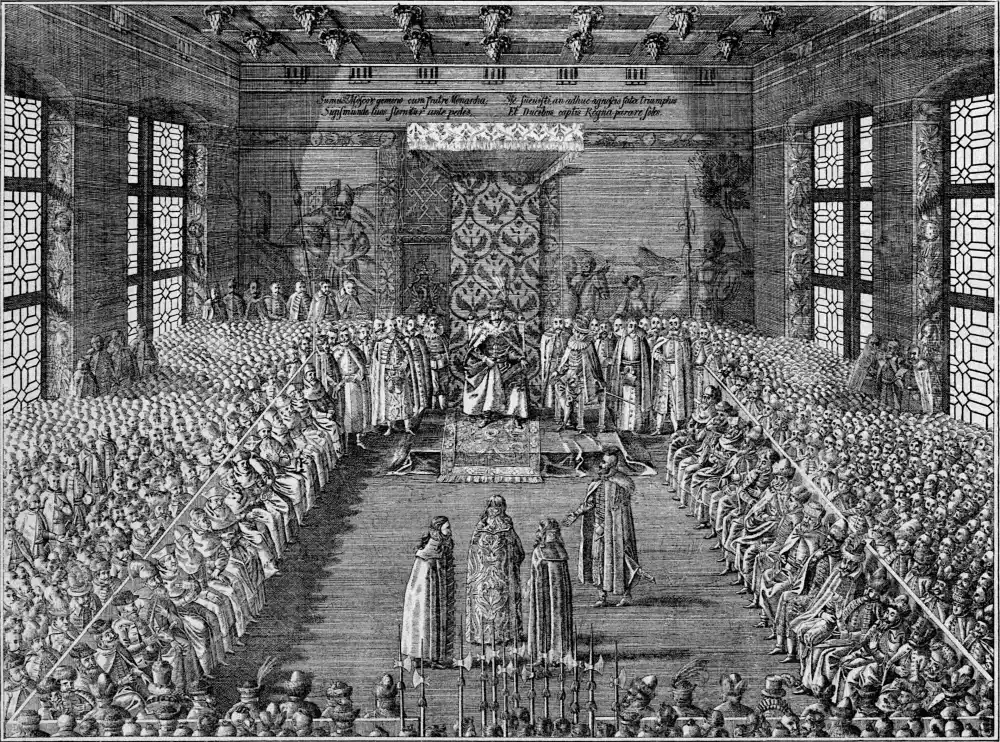
- Tomasz Makowski, Shuisky before Sigismund III at the Warsaw Sejm, 1613. Public domain, via Wikimedia Commons.
- Konstantin Makovsky, Minin's Appeal, 1896. Public domain, via Wikimedia Commons.
- Miniature from the Book on the Election of Michael Romanov, 1672–1673. Public domain, via Wikimedia Commons.