In the spring of 1241 Mongol armies invaded Poland and Hungary. On 9 April a Mongol force defeated and killed Duke Henry II of Silesia near Legnica. Two days later, on the river Sajó near the village of Mohi, the main Mongol army destroyed the army of King Béla IV of Hungary. For a year the Mongols occupied the Hungarian plain, crossed the frozen Danube and chased the king to the Adriatic coast. Then, in the spring of 1242, they left and never returned in force.
Few events of the 13th century are better documented by eyewitnesses. A canon of Várad (today Oradea), Master Roger, was captured by the Mongols and wrote an account of the invasion within two years of his escape. Thomas, archdeacon of Split, described the battle at Mohi and Béla's flight to Dalmatia. A Templar wrote to the king of France with news from Poland. Their reports correct several popular myths, about poison gas, Teutonic grand masters and sacks of ears.
The Mongol invasion of 1241 at a glance
| When | February 1241 to spring 1242 |
| Mongol leaders | Batu (overall), with Subutai; Orda and Baidar in Poland; Qadan, Büri and others in Hungary |
| Main battles | Chmielnik (18 March), Legnica (9 April), Mohi (11 April, some historians 10 April) |
| Defeated rulers | Bolesław V of Kraków; Henry II of Silesia (killed); Béla IV of Hungary (fled) |
| Furthest reach | Meissen and Lusatia in the west; the Adriatic coast at Split and Trogir in the south |
| Withdrawal | Spring 1242, through Bosnia, Serbia and Bulgaria to the steppe |
| Main eyewitness sources | Rogerius, Carmen miserabile; Thomas of Split, Historia Salonitana; letter of Ponce d'Aubon |
Why did the Mongols attack Poland and Hungary?
The invasion was part of the great western campaign that Ögödei, Genghis Khan's successor, launched in 1236. Its army, under the nominal command of Batu and in practice led by the veteran Subutai, had already destroyed the Volga Bulgars and the Kipchaks (Cumans) and conquered the Rus' principalities, taking Kiev in December 1240 (see The Mongol Invasion of Rus' and Batu Khan).
Hungary had given refuge to the Cuman khan Köten (Rogerius's "Kuthen") and his people, who had fled from the Mongols; for the Mongols, the Cumans were runaway subjects. To prevent the Poles from coming to Béla's aid, the Mongols sent a separate force north. Peter Jackson's history of the Mongols and the West describes four Mongol armies converging on Hungary, plus a fifth that first passed through Poland.
The campaign in Poland
Sandomierz and Chmielnik
The northern force, led by Batu's brother Orda and by Baidar, a son of Chaghatai, attacked Sandomierz on 13 February 1241 and withdrew when it met resistance. On 18 March Baidar defeated the army of Bolesław V, duke of Kraków and Sandomierz, at Chmielnik. Bolesław fled to Hungary. The Mongols found Kraków abandoned and burned it; the Polish historian Gerard Labuda dates this to 28 March.
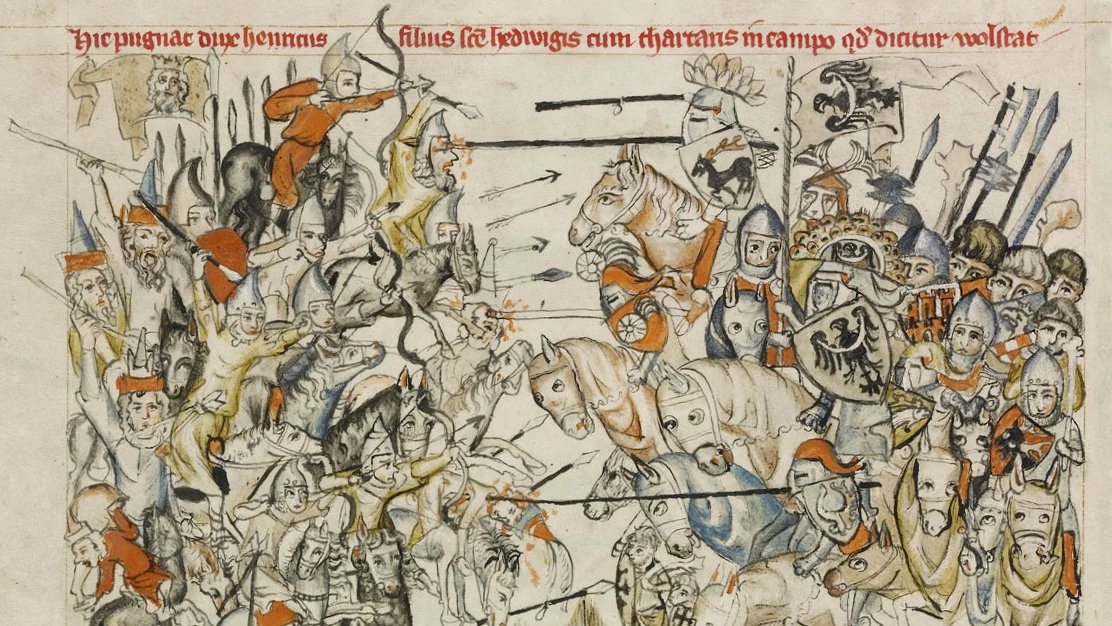
The Battle of Legnica, 9 April 1241
The Mongols then moved west into Silesia. Near Legnica (German Liegnitz) they met the army of Duke Henry II the Pious of Silesia, the son of St Hedwig. Jackson summarises the battle:
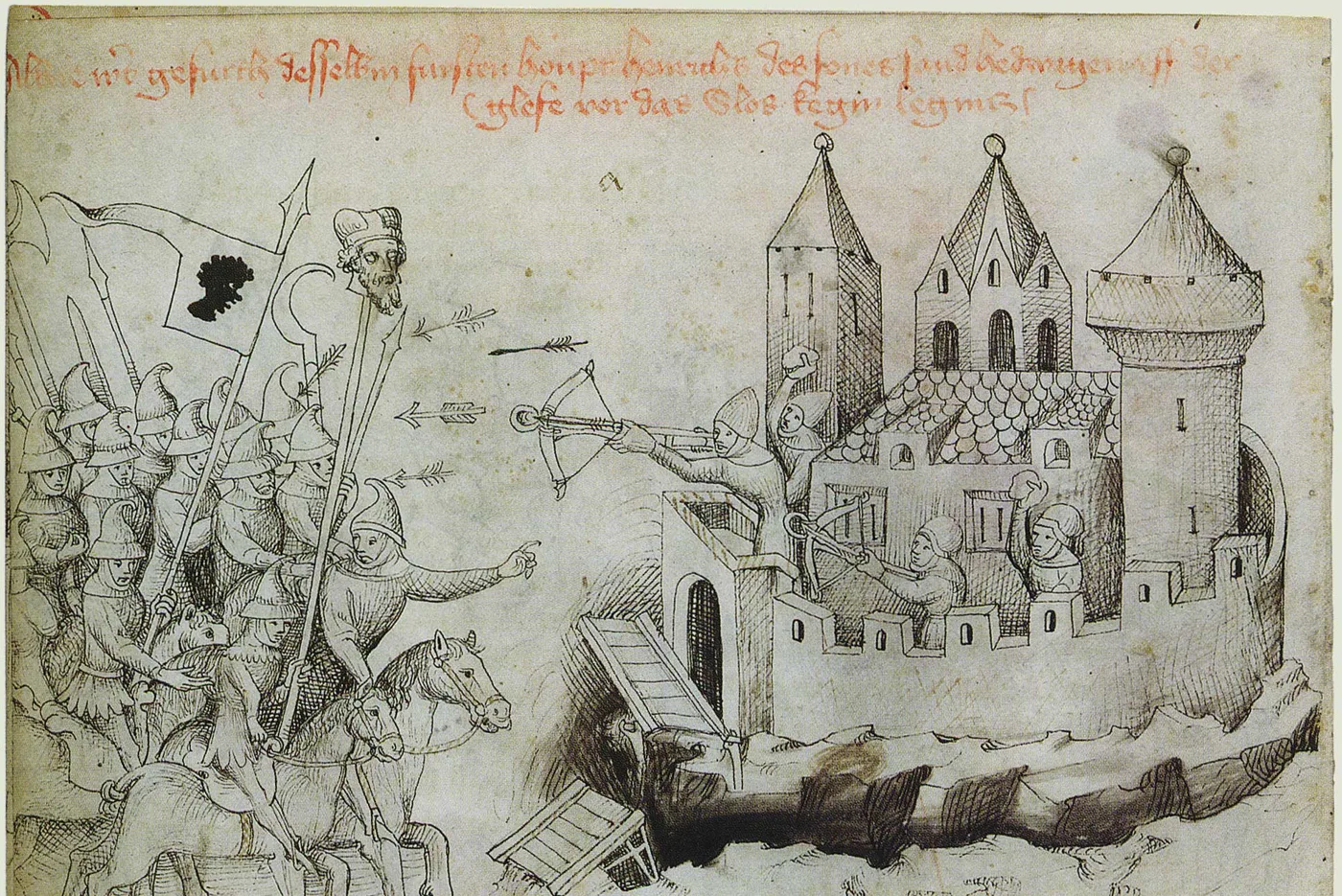
"The duke, unable to wait for the assistance of his kinsman King Václav (Wenceslas) of Bohemia and assisted only by Duke Mieszko of Oppeln (Opole), the Bohemian margrave Boleslas and some Templars, was overwhelmed and killed, and his head carried around on a lance for several days to inspire terror in the population." (Jackson, 2018)
King Wenceslas of Bohemia was only a day's march away. The date of 9 April is accepted in scholarship. Labuda estimated Henry's army at around 7,500 men (older works said 10,000) and the Mongols at perhaps 8,000 to 10,000. Where exactly the battle was fought is disputed. The traditional site is Legnickie Pole (Wahlstatt), where a Benedictine abbey now stands; some historians locate the field about 9 kilometres south-west of Legnica, while Labuda placed it further west, closer to Legnica castle.
What the Templar wrote
The earliest report from the battle is a letter to King Louis IX of France from Ponce d'Aubon, master of the Knights Templar in France. He passed on what Templar brothers from Poland had told him:
"We make known to your highness that the Tartars have destroyed and laid waste the land that belonged to Henry, the duke of Poland, and killed him with many of his barons, and six of our brothers and three knights and two sergeants and 500 of our men are dead; and three of our brothers, whom we know well, escaped." (Ponce d'Aubon, 1241, our translation)
The Templars also lost "two of the best houses and three towns" in Poland and everything they owned in Bohemia and Moravia. Ponce warned that if the Christian armies were beaten, the Mongols "will find no one who can stand against them as far as your land". The Polish historian Bartłomiej Burzyński (2012) argues that the round figure of 500 "seems a fiction", and that the Templars at Legnica were a small group of brothers with men from the order's villages.
Myths about Legnica
Much of the popular picture of Legnica comes from Jan Długosz, a Polish historian who wrote his Annals in the second half of the 15th century, more than 200 years after the battle.
| Claim | What the evidence says |
|---|---|
| The Teutonic Order fought, and its master Poppo von Osterna died | Poppo was not killed; he lived until about 1269 and later became grand master. At most a few Teutonic knights from Silesia took part |
| The Grand Master of the Templars reported nine dead brothers | The letter came from the Templar master in France; it names six brothers dead and three escaped |
| Batu led the Mongols at Legnica | Batu was in Hungary. Długosz confused him with Baidar, as his modern editors note |
| The Mongols used a smoke or poison weapon | Only Długosz tells of a banner that gave off stinking smoke; no 13th-century source mentions it |
| The Mongols filled nine sacks with the ears of the dead | Also only in Długosz, writing in the 15th century |
After Legnica, the northern Mongol force raided Meissen and Lusatia, then turned south through Moravia to join Batu in Hungary. On the way it raided Austria north of the Danube, including Korneuburg near Vienna.
The campaign in Hungary
Béla IV had been warned. Rogerius says the king sent his palatine (chief official) with an army to hold the "Russian Gate", the Verecke pass in the Carpathians. On 10 March 1241, news reached Béla and his barons at Buda that the Mongols had broken through. Thomas of Split says that 40,000 men with axes went ahead of the Mongol army, "cutting through the forests, laying roads and removing every obstacle from the entrances". Rogerius gives the invading army as 500,000 men, a number no modern historian accepts; the climate historians Ulf Büntgen and Nicola Di Cosmo (2016) cite a modern estimate of about 130,000.
The Battle of Mohi, April 1241
On 6 April Béla's army reached the plain of Mohi, beside the river Sajó. The Mongols camped on the far bank, partly hidden in woods. Thomas of Split describes the Hungarian camp:
"They all packed themselves together as if in a very narrow pen, placing their wagons and shields all round as a fortification of the camp. The tents were so crowded, and their ropes so tied and tangled together, that the way through was completely blocked … They thought this a protection, but it turned into their greatest danger." (Thomas of Split, ch. 37, our translation)
According to Thomas, Batu climbed a hill, studied the Hungarian camp, and told his men that the enemy, though numerous, "cannot escape our hands. For I have seen them shut in like a herd in a very narrow pen."
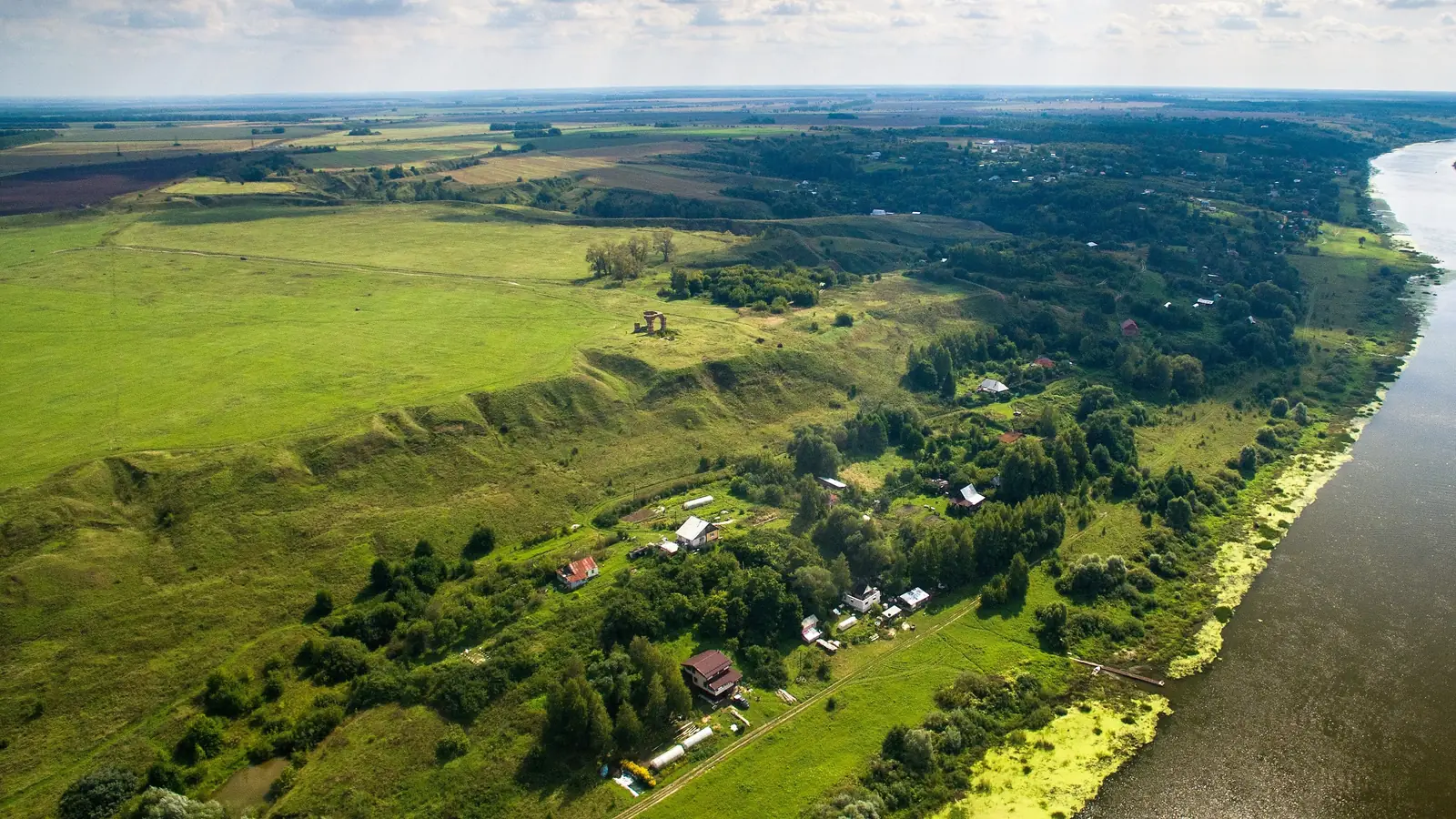
That night the Mongols attacked the bridge over the Sajó. A deserter from the Rus' warned the Hungarians, and the king's brother Kálmán, with Archbishop Ugrin of Kalocsa, drove the first Mongols off the bridge. Thinking the battle won, most of the army went to sleep. But the Mongols set up seven siege engines at the bridgehead, drove off the guards with stones and arrows, and crossed, "some over the bridge, others through the fords". Rogerius says they found "a ford far from the army". At dawn the Hungarian camp was surrounded.
Rogerius describes the arrows that followed:
"So thick was the shower of arrows that it almost cast a shadow over the fighters, and the arrows flew through the air like locusts and grasshoppers going in swarms." (Rogerius, ch. 28, our translation)
The Mongols set fire around the camp, then left a gap open. When the Hungarians fled through it, the Mongols rode alongside them and cut them down. Thomas describes valuables thrown away on the road, gold and silver vessels and purple garments, ignored by the pursuers, who cared only for killing. Many fugitives were driven into a marsh and drowned. Among the dead were Ugrin of Kalocsa, Archbishop Matthias of Esztergom and several bishops. Rogerius writes that so many thousands were killed "that no estimate can be made". Béla escaped. Kálmán, badly wounded, fled to Croatia and died soon afterwards.
The Mongol side of the battle, including the dispute between Batu and Subutai over the crossing, is told in the article on Subutai.
When was the Battle of Mohi?
The sources do not give a firm date. The editor of Thomas and Rogerius in the Monumenta Germaniae Historica (1892) marked the night attack as 10/11 April and the battle as 11 April, following an Austrian annal. Jackson gives 10 April. Most Hungarian and recent works use 11 April.
A year of occupation
For the rest of 1241 the Mongols held Hungary east of the Danube. Rogerius, who lived for months as a captive among the Mongols, describes their methods: they let the people live for a time so that they would gather the harvest and the grapes, "but they did not want them to consume what had been gathered". He concluded that the Mongols meant to winter in Hungary, and later learned he was right. On 25 December 1241 the Danube froze, and the Mongols crossed to the west bank. Batu and Subutai attacked Esztergom, and Qadan pursued Béla.
The king fled to the Dalmatian coast and found refuge on the island town of Trogir. After a failed attempt on Split, Qadan appeared before Trogir and tried in vain to make the townspeople surrender the king. Towards the end of March 1242 he withdrew through Bosnia and Serbia, burning Kotor and plundering Drivasto and Svač, where, in Thomas of Split's phrase quoted by Jackson, the Mongols left "nobody to piss against a wall".
Why did the Mongols leave in 1242?
The withdrawal baffled contemporaries, and historians still argue over it.
- The death of Ögödei. The Franciscan John of Plano Carpini, who travelled to Mongolia in 1245–1247, heard that the army withdrew because of news that the Great Khan Ögödei had died on 11 December 1241. But as the historian Denis Sinor pointed out, this would explain the withdrawal only if Batu had then gone to Mongolia to take part in the election of a successor, and he did not.
- Pasture. Sinor argued that the Hungarian plain could not feed the Mongols' horses for long, and that they returned to the wider grasslands of the Pontic steppe, where Batu soon founded his capital, Sarai.
- Climate. Büntgen and Di Cosmo (2016) used tree rings and written sources to show that the summers of 1238–1241 were warm and dry, followed by cold, wet conditions in early 1242, which may have turned the plain into marsh and reduced pasture.
- Against the climate thesis. A team led by Zsolt Pinke (2017) answered that Hungary had more than enough forage, and pointed to a letter in which Béla IV himself wrote that the land was suited to the Mongols and their herds.
- Divisions in the Mongol leadership. Jackson notes that Batu had quarrelled with his cousins Güyük and Büri, and that Güyük had already left the campaign.
No single reason is accepted by all historians. What is clear is that the Mongols did not leave because they had been defeated. Ponce d'Aubon's warning that no one could stop them shows how they appeared to Europe in 1241.
Common myths about the Mongol invasion of 1241
| Myth | What the evidence says |
|---|---|
| Teutonic grand master Poppo von Osterna died at Legnica | He survived until about 1269 |
| The Mongols used poison gas at Legnica | Only Długosz, 200 years later |
| Batu fought at Legnica | Orda and Baidar commanded there; Batu was in Hungary |
| The Hungarians fought from a strong wagon fortress | Thomas describes an overcrowded camp ringed with wagons and shields that became a trap |
| Ögödei's death alone saved Europe | Historians list several causes; Batu never went to Mongolia for the election |
| The Mongols were beaten and driven out | They withdrew of their own accord after a year in Hungary |
What the map shows next
The map of 1241 shows the Kingdom of Hungary, where the Mongols stayed for a year, and to the north the Duchy of Silesia, whose duke fell at Legnica, beside the Duchy of Greater Poland and the Duchy of Masovia. West of them lay the Kingdom of Bohemia, whose king arrived too late for Legnica, within the Holy Roman Empire. To the east stretched the Mongol Empire, and on the Baltic the lands of the Teutonic Order.
Sources
Primary sources
- Rogerius, Carmen miserabile super destructione regni Hungariae per Tartaros, in Chronica minora (Budapest, 1885): https://archive.org/details/ChronicaMinora
- Thomas of Split, Historia Salonitana, ch. 36–39, ed. O. Holder-Egger, MGH Scriptores 29 (1892), pp. 585–598: https://www.dmgh.de/mgh_ss_29/index.htm#page/585/mode/1up
- Letter of Ponce d'Aubon to Louis IX (1241), in Historiae regum Franciae continuatio Parisiensis, MGH Scriptores 26 (1882), pp. 604–605: https://www.dmgh.de/mgh_ss_26/index.htm#page/604/mode/1up
- 'Ala al-Din 'Ata-Malik Juvaini, The History of the World-Conqueror, trans. J. A. Boyle (Manchester, 1958): https://archive.org/details/dli.pahar.3131
Studies
- P. Jackson, The Mongols and the West, 1221–1410, 2nd ed. (London, 2018), ch. 3
- U. Büntgen and N. Di Cosmo, "Climatic and environmental aspects of the Mongol withdrawal from Hungary in 1242 CE", Scientific Reports 6 (2016): https://doi.org/10.1038/srep25606
- Z. Pinke et al., "Climate of doubt: a re-evaluation of Büntgen and Di Cosmo's environmental hypothesis for the Mongol withdrawal from Hungary, 1242 CE", Scientific Reports 7 (2017): https://doi.org/10.1038/s41598-017-12128-6
- B. Burzyński, "Templariusze w walce z najazdem mongolskim na Polskę w 1241 roku", Słupskie Studia Historyczne 18 (2012): https://web.archive.org/web/20140402182611/http://ssh.apsl.edu.pl/baza/wydawn/ssh018/burzynski.pdf
- J. Długosz, Roczniki czyli kroniki sławnego Królestwa Polskiego, book 7, Polish trans. with notes based on G. Labuda (Warsaw, 1973–), used for the editors' notes on dates, numbers and the battlefield
- J. Laszlovszky, S. Pow and T. Pusztai, "A muhi csata és az 1241-es tatárjárás", Magyar Régészet (winter 2016): https://web.archive.org/web/20170317235412/http://files.archaeolingua.hu/2016T/Laszlovszky_Pow_Pusztai_H16T.pdf
Image credits
- Title image: the Battle of Legnica, Hedwig Codex, 1353, J. Paul Getty Museum, Ms. Ludwig XI 7. Public domain, via Wikimedia Commons, cropped to 16:9.
- Henry's head before Legnica castle, Hedwig manuscript of 1451, Wrocław University Library. Public domain, via Wikimedia Commons.
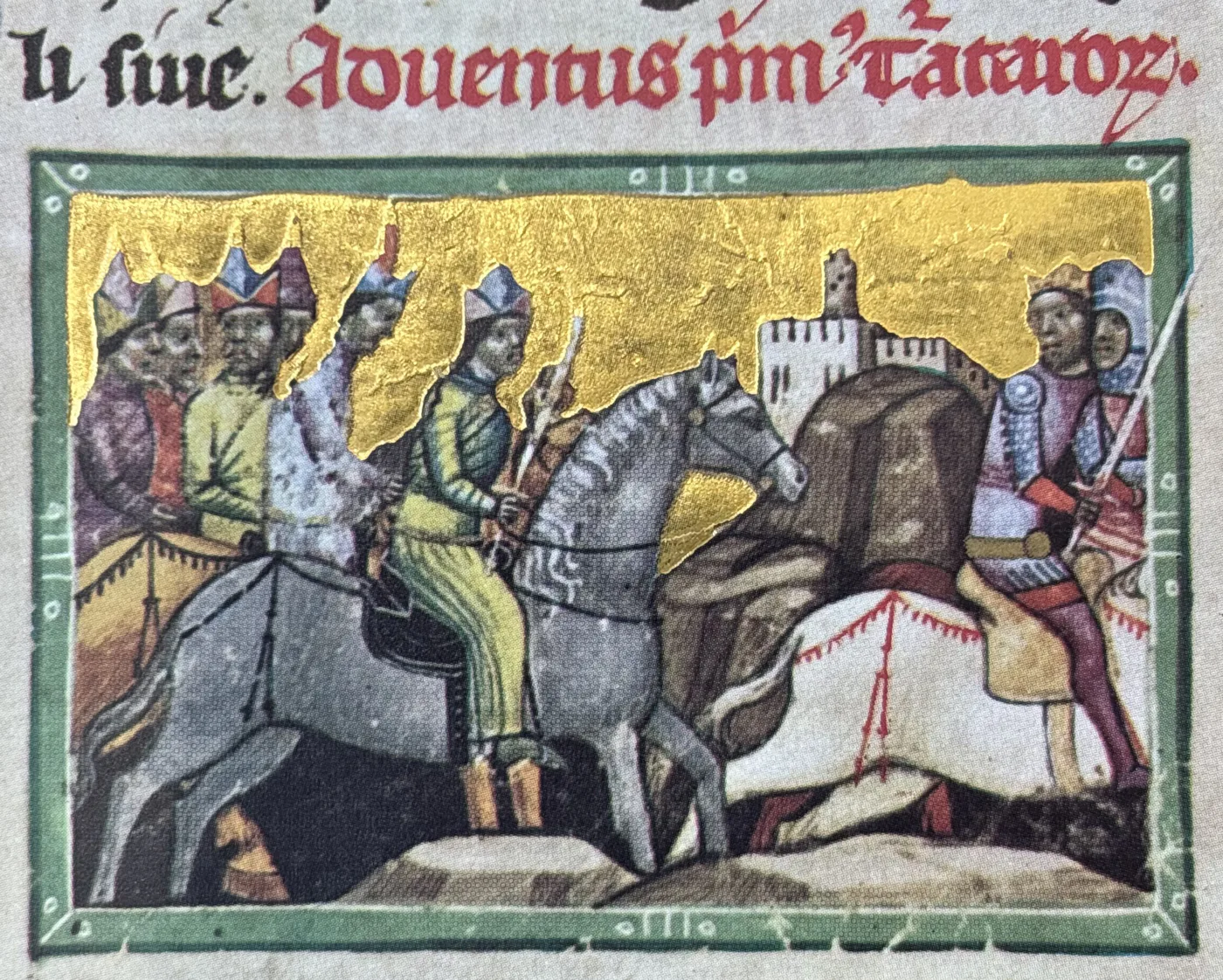
- "The first coming of the Tatars", Illuminated Chronicle, about 1360. Public domain, via Wikimedia Commons.
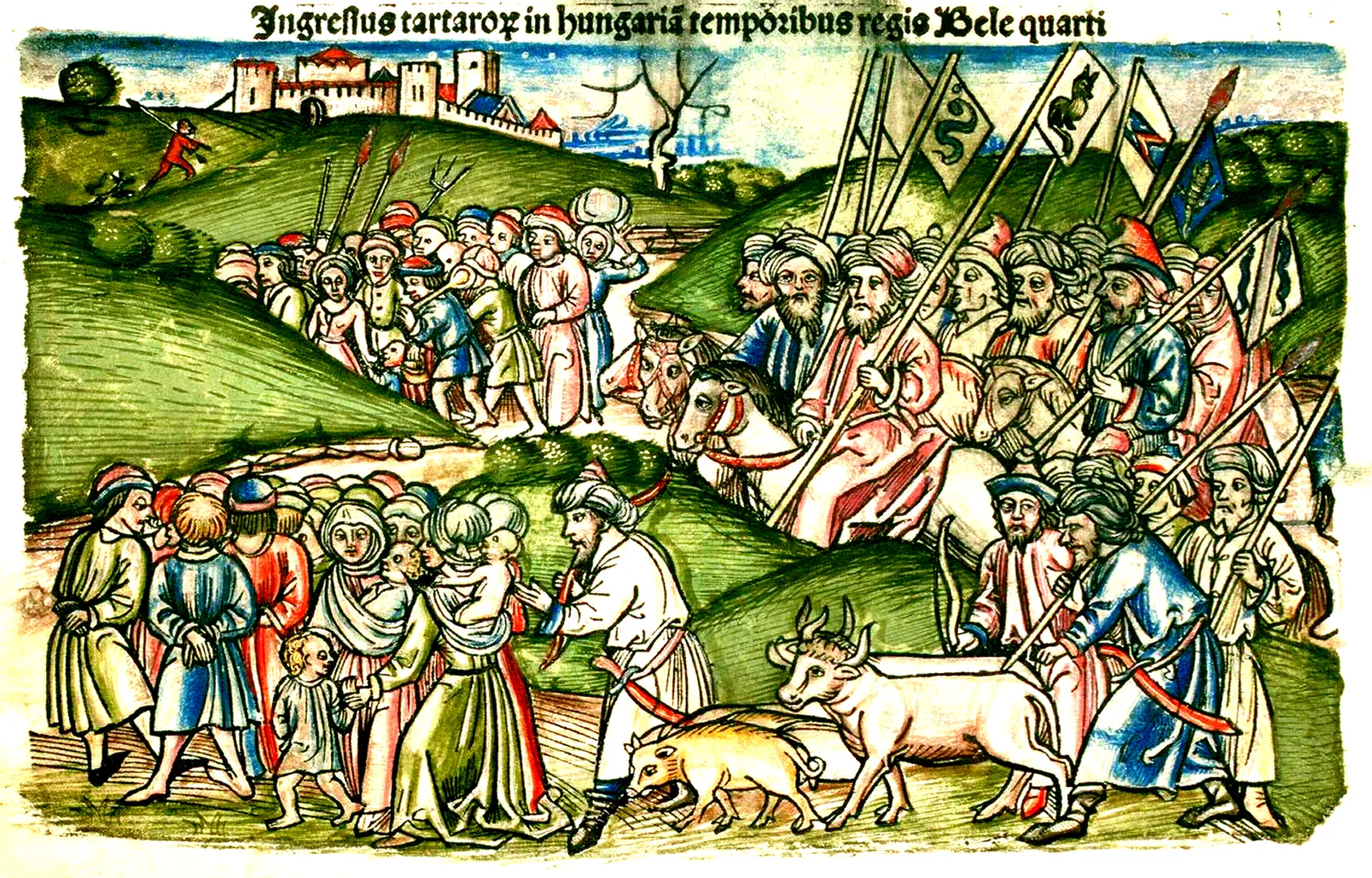
- Thuróczy, Chronica Hungarorum, 1488. Public domain, via Wikimedia Commons.