The Old Believers are the Russian Orthodox Christians who refused the church reforms that Patriarch Nikon began in 1653, and the split they caused is known in Russian as the raskol, the schism. Nikon, patriarch from 1652, ordered Muscovites to cross themselves with three fingers instead of two and had the service books corrected to match Greek practice. Opponents led by Archpriest Avvakum saw this as an attack on the faith of their fathers. The Great Moscow Council of 1666–1667 deposed Nikon himself but upheld his reforms and cursed everyone who rejected them. Avvakum was burnt in 1682, Boyarynya Morozova was starved to death in 1675, and the Solovetsky monastery held out against the tsar's troops for more than seven years. The Russian Orthodox Church lifted its curses only in 1971; by then the Old Believers had survived three centuries of persecution in their own churches.
The Old Believers at a glance
| What | The schism (raskol) in the Russian Church over the liturgical reforms of the 1650s |
| Who began the reforms | Patriarch Nikon (1605–1681), patriarch 1652–1666, with Tsar Alexis |
| First order | Nikon's memorandum to the Moscow churches before Lent 1653: three fingers, fewer prostrations |
| Leading opponents | Archpriest Avvakum, Ivan Neronov, Bishop Pavel of Kolomna, Boyarynya Morozova, the monks of Solovki |
| Decisive council | Great Moscow Council, 1666–1667: Nikon deposed, his reforms upheld, opponents anathematised |
| Martyrs | Morozova starved at Borovsk (1675); Avvakum burnt at Pustozersk (1682) |
| Armed resistance | Solovetsky monastery, 1667/1668–1676 |
| Curses lifted | By the Moscow Patriarchate's Synod in 1929 and the Local Council of 1971 |
(Dates are Old Style, the Julian calendar then used in Russia; in the seventeenth century add ten days for the modern calendar.)
Who was Patriarch Nikon?
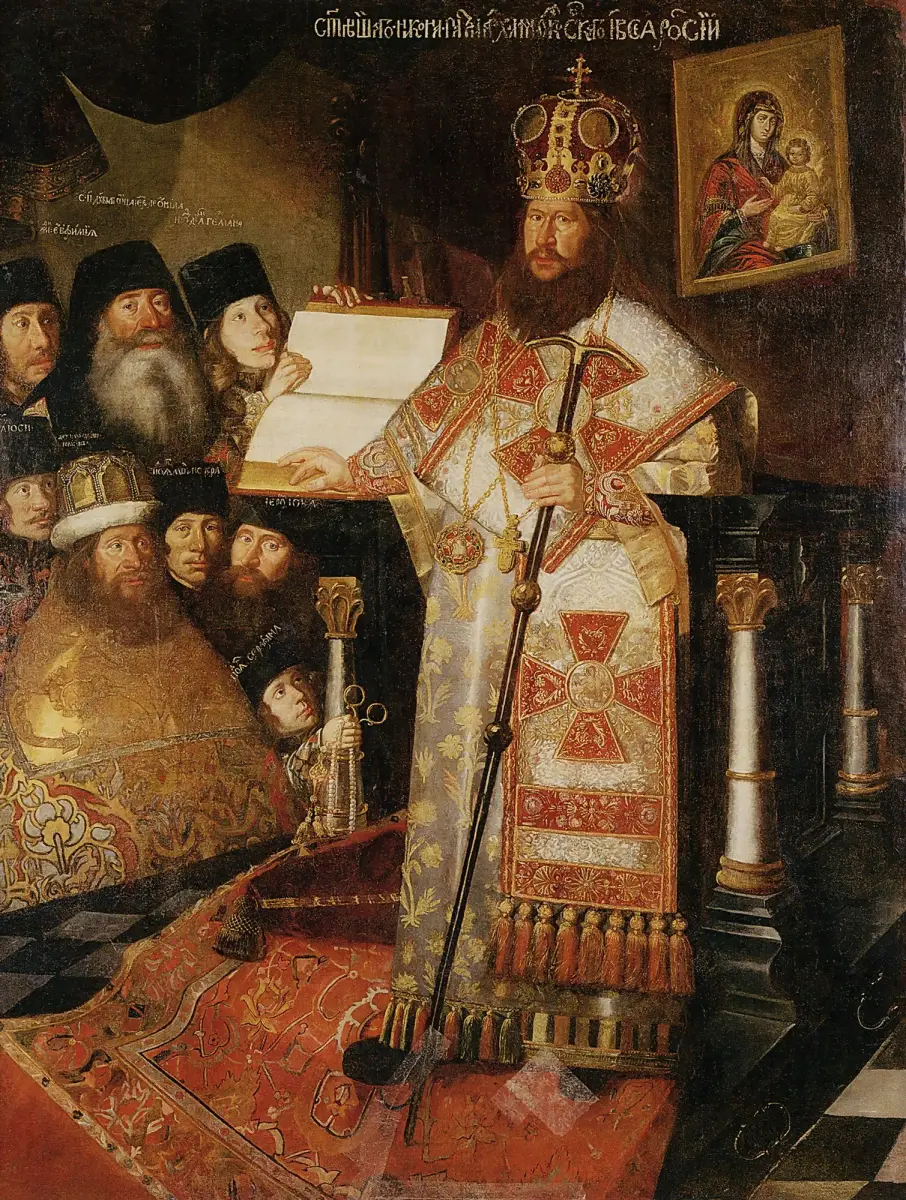
Nikon was born Nikita Minov in May 1605 in the village of Vel'demanovo near Nizhny Novgorod, in the Tsardom of Russia, the son of a peasant. His fellow countryman Avvakum later claimed that Nikon's father was a cheremisin, a Mari; later tradition made him a Mordvin, and neither can be proved. Nikita became a village priest, then a monk: around 1636 he took vows as Nikon at the Anzer hermitage on the Solovetsky islands in the White Sea, where, his servant and biographer Ivan Shusherin says, he made a thousand prostrations a day.
In 1646 he was presented to the young Tsar Alexis, who made him archimandrite of the Novospassky monastery in Moscow, the burial place of the Romanov family. That put him in the circle of the "zealots of piety", a group of reforming clergy around the tsar's confessor Stefan Vonifat'ev that also included Ivan Neronov and a young priest called Avvakum. They wanted a stricter, more devout church life, and they had the young tsar's ear. In March 1649 Nikon became Metropolitan of Novgorod.
When Patriarch Iosif died in April 1652, the tsar and a church council asked Nikon several times to take his place. According to the nineteenth-century church historian Metropolitan Makarii, he accepted only on a condition: "If you promise to obey me as your chief archpastor and father in everything." He was enthroned on 25 July 1652, and his title soon gained the words "great sovereign", a style otherwise used for the tsar. (The translations from Russian in this article are our own, except where a translator is named.)
What did Nikon change, and why?
The first blow came in a single sheet of paper. Before Lent 1653, Avvakum reports, Nikon sent a memorandum (pamiat') to the Moscow churches. In the 1924 translation by Jane Harrison and Hope Mirrlees, it read: "According to the tradition of the holy Apostles and the Fathers, it is not seemly to make obeisance in church to the knee, it should be no lower than the girdle, and moreover it behoves you to sign yourselves with three fingers." Avvakum and his friends "met together and took counsel. It was as if Winter was of a mind to come; our hearts froze." The memorandum itself does not survive, and it had no council's approval; the historian S. V. Lobachev dates it to early 1654 rather than 1653.
Councils followed. A council held in the tsar's palace from 27 February to 2 May 1654, with five metropolitans, four archbishops, one bishop, eleven archimandrites and abbots and thirteen archpriests, decided to correct the service books "against the old parchment and Greek books". In March 1655 a council with Patriarch Makarios III of Antioch and Patriarch Gavriil of Peć approved the first corrected book, the Sluzhebnik (Missal), and a corrected text of the Creed. On the Sunday of Orthodoxy, 24 February 1656, Makarios, Gavriil and Metropolitan Grigorios of Nicaea pronounced an anathema in the Kremlin's Dormition Cathedral on everyone who crossed himself with two fingers.
The Orthodox Encyclopaedia lists the changes that provoked the sharpest reaction:
| Before the reform (the "old rite") | After the reform |
|---|---|
| Sign of the cross with two fingers | Three fingers |
| The name of Jesus spelt Isus | Iisus |
| Alleluia sung twice ("double") | Alleluia sung three times |
| Processions sunwise (posolon') | Processions against the sun |
| Eight-pointed cross | Four-pointed cross |
| Old number of prosphoras (communion loaves) and old seal | Number of prosphoras and the seal on them changed |
| Full prostrations during the Prayer of St Ephrem | Most replaced by bows from the waist |
These were only the visible changes. The book historian N. I. Sazonova counted more than 3,000 changes in the Book of Needs (Trebnik) and the Book of Hours alone, and the corrected Sluzhebnik went through six editions between 1655 and 1658. Nikon was just as brisk with images. In 1655, the Syrian traveller Paul of Aleppo wrote, the patriarch took icons painted in the new Western manner "with his right hand one after another, showed them to the people and threw them onto the iron floor plates, so that they broke, and ordered them to be burnt".
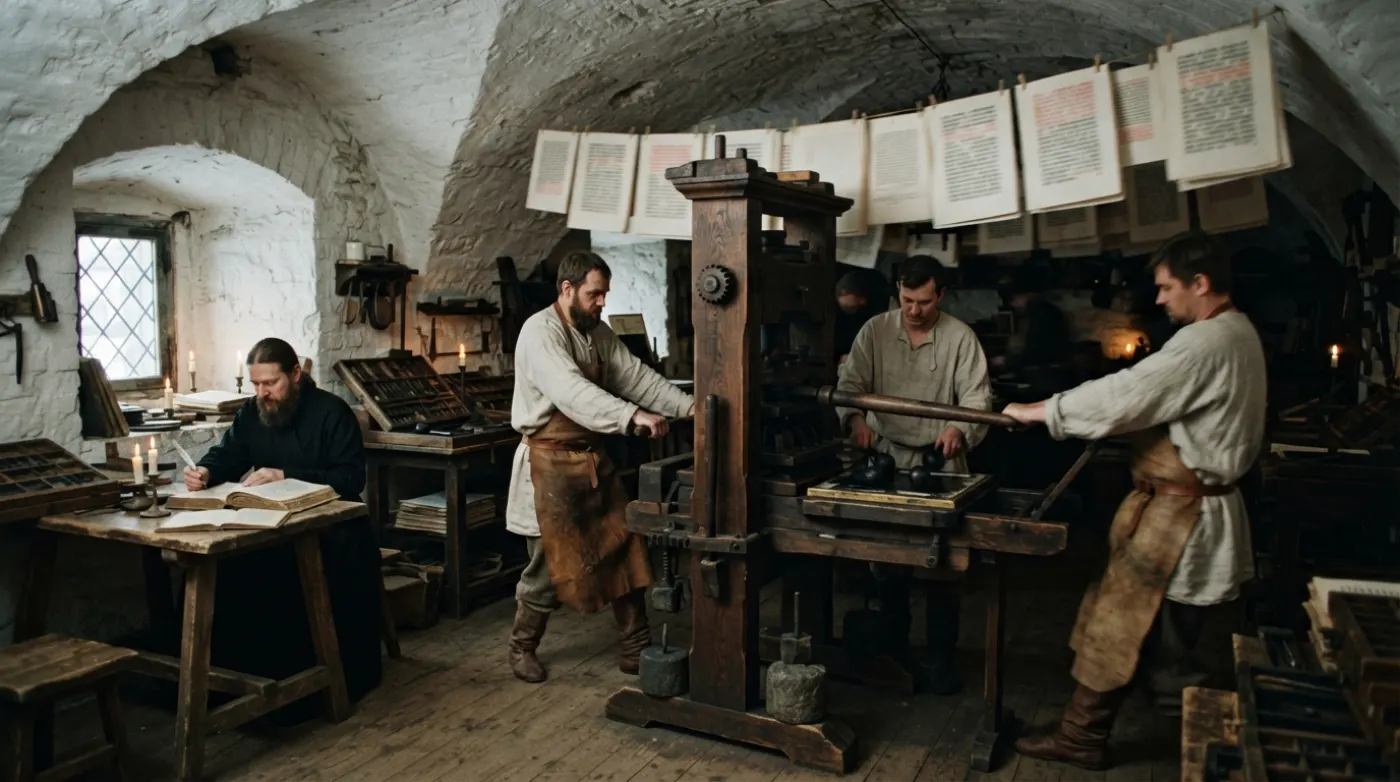
Why? The official answer was a return to the true Greek tradition, from which Russian practice had supposedly strayed. A recent Orthodox Encyclopaedia article (2026) puts the main aim differently: the reform was political, to bring Russian church practice into line with that of the Ukrainians and Belarusians, then subjects of the Polish–Lithuanian Commonwealth, "to ensure the smooth entry of these peoples into the Russian state". In these same years Muscovy went to war with the Commonwealth, with Nikon's blessing according to his biographer Shusherin; the Muscovite church was preparing to take in a flock that crossed itself with three fingers.
Did Nikon really go back to the ancient Greek books?
No, and it was not his opponents who first said so. The correctors declared in their prefaces that they were following Greek originals and ancient manuscripts. The Orthodox Encyclopaedia concludes that "in practice, however, the correction was carried out mainly from south-west Russian printed editions". The Moscow printers' own proof copies show it:
- the proof copy of the 1655 Sluzhebnik is a Sluzhebnik printed at Striatyn in 1604;
- the Lenten Triodion of 1656 was corrected from Kyiv editions of 1627 and 1648;
- the Trebnik of 1658 was based on the Kyiv Trebnik of 1646.
The Kyiv books had themselves been revised in the first half of the seventeenth century against Greek service books printed in Venice, which the Kyiv editors called correct, while the Slavonic ones held "many and countless errors". So Muscovy was being brought into line with the Greek church of its own day, filtered through Kyiv, not with the Byzantine church that had converted Kievan Rus'.
And on the most famous point, the old Russian practice was the more ancient one. In 1892 the church historian Evgeny Golubinsky wrote: "At the moment we accepted Christianity from the Greeks, the two-finger sign was in general use among them for the sign of the cross, and we naturally borrowed it from them. But in the course of time, from the end of the twelfth to the second half of the thirteenth century, the three-finger sign came into general use among them instead." The Russian Stoglav council of 1551 had declared two fingers the only proper form; Moscow had simply kept what the Byzantine Empire later dropped.
Historians disagree about how to judge the reform:
- N. F. Kapterev (1909–1912) saw it as the product of Nikon's and the tsar's admiration for the Greeks. His research had already cost him dearly: in the 1880s he showed from documents that Arsenii the Greek, one of the leading correctors, had been a Jesuit and later a Muslim, and the Synod's lay head K. P. Pobedonostsev cancelled his doctorate on the grounds that he spoke disrespectfully of the Greek Church.
- The Orthodox Encyclopaedia (2022–2026), the Russian Orthodox Church's own reference work, now stresses politics: unity with the Orthodox of Ukraine and Belarus. It also concedes that "both patriarch and tsar attached to the differences of ritual a significance they did not have".
- D. S. Mirsky, in his preface to the 1924 English translation of Avvakum's Life, argued that for an Old Russian the faith "was of a piece—Dogma and Ritual". He compared the quarrel to English churchmen going "to the stake for the Authorized Version".
Who resisted first?
The first opponents were Nikon's old friends. The zealots of piety had expected one of their own, Vonifat'ev, to become patriarch, and they were reformers themselves, only in the opposite direction. Ivan Neronov was arrested on 4 August 1653. Avvakum, who had been standing in for Neronov at his church, was arrested on 13 August, chained in the Andronikov monastery, beaten and starved, and on 17 September 1653 exiled with his family to Tobolsk in Siberia. By the autumn the zealots' circle had broken up.
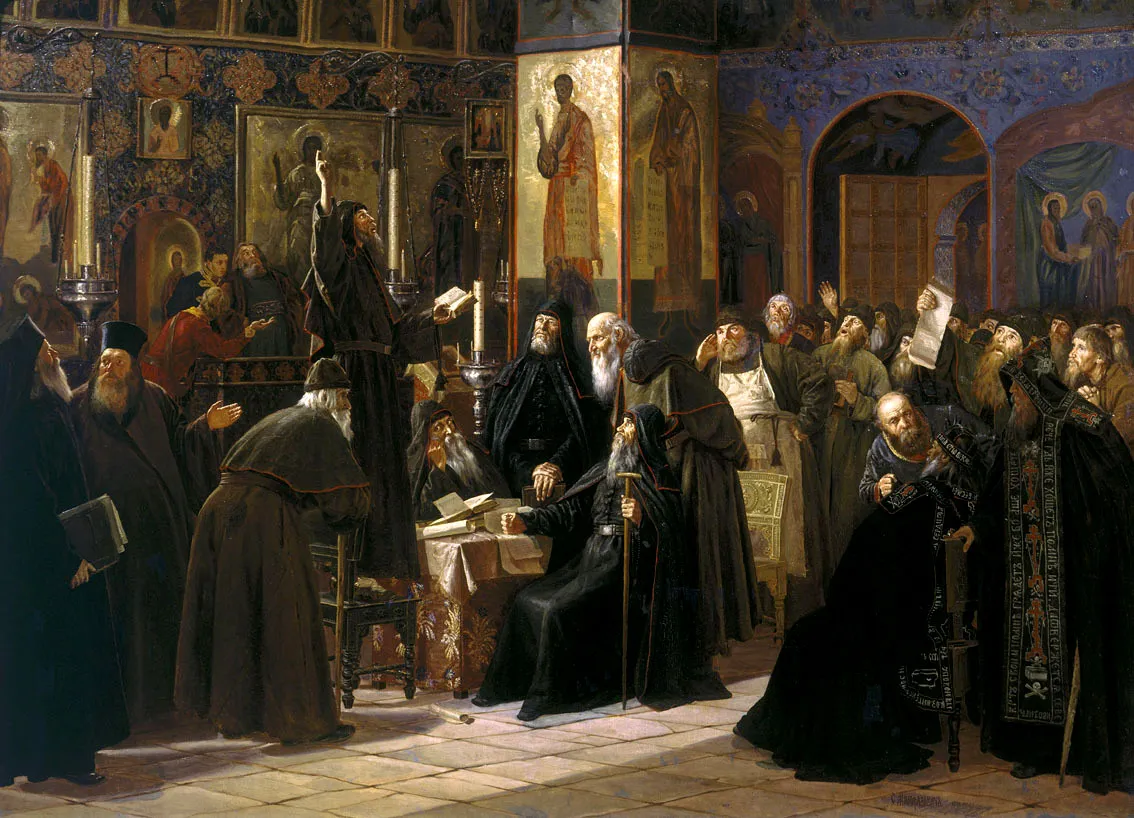
One bishop objected at the 1654 council: Pavel of Kolomna. Nikon deposed him on his own authority and exiled him to the Paleostrovsky monastery, where he died in 1656. The Old Believers remember him as their first martyr, and his deposition by a single man later became one of the charges against Nikon. The monks of the Solovetsky monastery decided at their own "black council" on 8 June 1658 to refuse the new books and not to receive communion from priests who used them.
Why did Nikon fall?
Nikon's fall had nothing to do with the reforms. The title "great sovereign", the growth of the patriarch's estates and his habit of meddling in the private lives of the elite had made enemies among the boyars, and his position depended entirely on his friendship with the tsar. The friendship cooled. On 4 July 1658, at a reception for the Georgian prince Teimuraz, the courtier Bogdan Khitrovo struck Nikon's servant; the tsar refused the patriarch any redress and then stayed away from his service on 10 July.
That day, the palace records say, Nikon "before all the people… renounced his patriarchal rank and on the ambo took off all his episcopal vestments… put on a simple mantle and cowl" and left the cathedral. Next day he withdrew to his Resurrection monastery on the river Istra, the "New Jerusalem" he had founded in 1656. He told the tsar's envoys that a new patriarch could be elected, adding: "if I ever wish to be patriarch, may I be accursed and anathema."
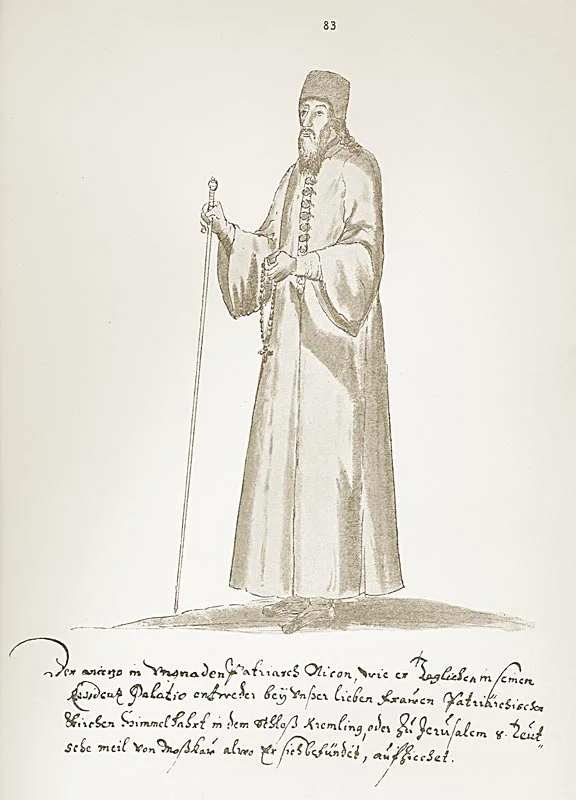
He did not mean it, or soon changed his mind. For eight years the Russian Church had a patriarch who neither ruled nor resigned. A council in 1660 found that he had left of his own will and that a new patriarch should be chosen, but nothing was done. In 1662 Paisios Ligarides, a Greek metropolitan of Gaza, arrived and began building the case against him. On the night of 17–18 December 1664 Nikon suddenly reappeared in the Dormition Cathedral, stood in the patriarch's place and blessed the congregation, before being sent back to his monastery. The Dutch traveller Nicolaes Witsen, who visited him in May 1665, found a man "rash and hasty… of strong build, rather tall, with a red… face", whose head had been touched by "neither comb nor scissors" since he left Moscow.
What did the Great Moscow Council of 1666–1667 decide?
The tsar solved the problem by calling the largest church council in Russian history. It met in two stages. From 29 April 1666 Russian bishops alone dealt with the opponents of the reform: eighteen of them had been brought to Moscow, and the tsar's stated aim was to persuade, not to condemn. Most gave in. Avvakum, the deacon Fedor and the priest Nikita Dobrynin were defrocked and anathematised in the Dormition Cathedral on 13 May 1666; Fedor and Nikita recanted a few weeks later, Avvakum did not.
The second stage brought the Greeks. Patriarch Paisios of Alexandria and Patriarch Makarios of Antioch reached Moscow on 2 November 1666, and from 28 November the council tried Nikon. He was charged with slandering the tsar, with leaving his see without lawful cause, with deposing Bishop Pavel illegally, with having a cross carried before him in the Catholic manner and with founding monasteries on land taken from other dioceses. On 12 December 1666, in the Chudov monastery in the Kremlin, he was stripped of his patriarchal and his priestly rank and sent as a simple monk to the Ferapontov monastery near Beloozero. The council then elected a new patriarch, Ioasaf II.
The Russian bishops had their own fight with the Greeks over who ranked higher, tsar or patriarch, and forced a compromise formula into the sentence: "The tsar has precedence in civil affairs, and the patriarch in church affairs." But on the reforms there was no compromise. In 1667 the council ordered all the faithful to keep to the corrected books, called the old Russian rites non-Orthodox and said of the fathers of the 1551 Stoglav council that they "philosophised in their ignorance, without reason, as they themselves wished". Everyone who disobeyed was given over "to anathema and curse… as heretics and the disobedient". The man was condemned and his reform made law. "The schism was accomplished," as Mirsky put it in 1924.
Who was Archpriest Avvakum?
Avvakum Petrov was born on 20 November 1620 in Grigorovo, also near Nizhny Novgorod, the son of a village priest. In 1638 he married a blacksmith's daughter, Anastasia Markovna, who bore him five sons and three daughters and followed him into every exile. He was ordained priest in 1644, and in 1647 he was already fleeing with his family to Moscow from a local strongman who persecuted him.
His first exile took him across Siberia. From Tobolsk he was sent on to Dauria, east of Lake Baikal, with the expedition of the governor Afanasy Pashkov, which set out on 18 July 1656; on 15 September Pashkov had him knouted for writing a note criticising his cruelty. Two of his sons died during the nearly eleven years in Siberia. In his Life he recalls his wife, worn out on the frozen road, asking: "How long, archpriest, are these sufferings to last?" "Markovna! till our death." "So be it, Petrovitch; let us be getting on our way" (tr. Harrison and Mirrlees).
Back in Moscow in 1664, Avvakum was courted with gifts and the offer of a post as a book corrector, but he "grumbled again" and petitioned the tsar to restore the old piety. After the council, on 26 August 1667, he and his companions the priest Lazar', the priest Nikifor and the monk Epifanii were sentenced to Pustozersk, a fort on the river Pechora in the far north. The next day Lazar' and Epifanii had their tongues cut out. On 14 April 1670 came a second "execution": Lazar', Epifanii and the deacon Fedor lost their tongues again and their right hands, and Avvakum, "instead of the death penalty", was put in an earthen pit on bread and water.
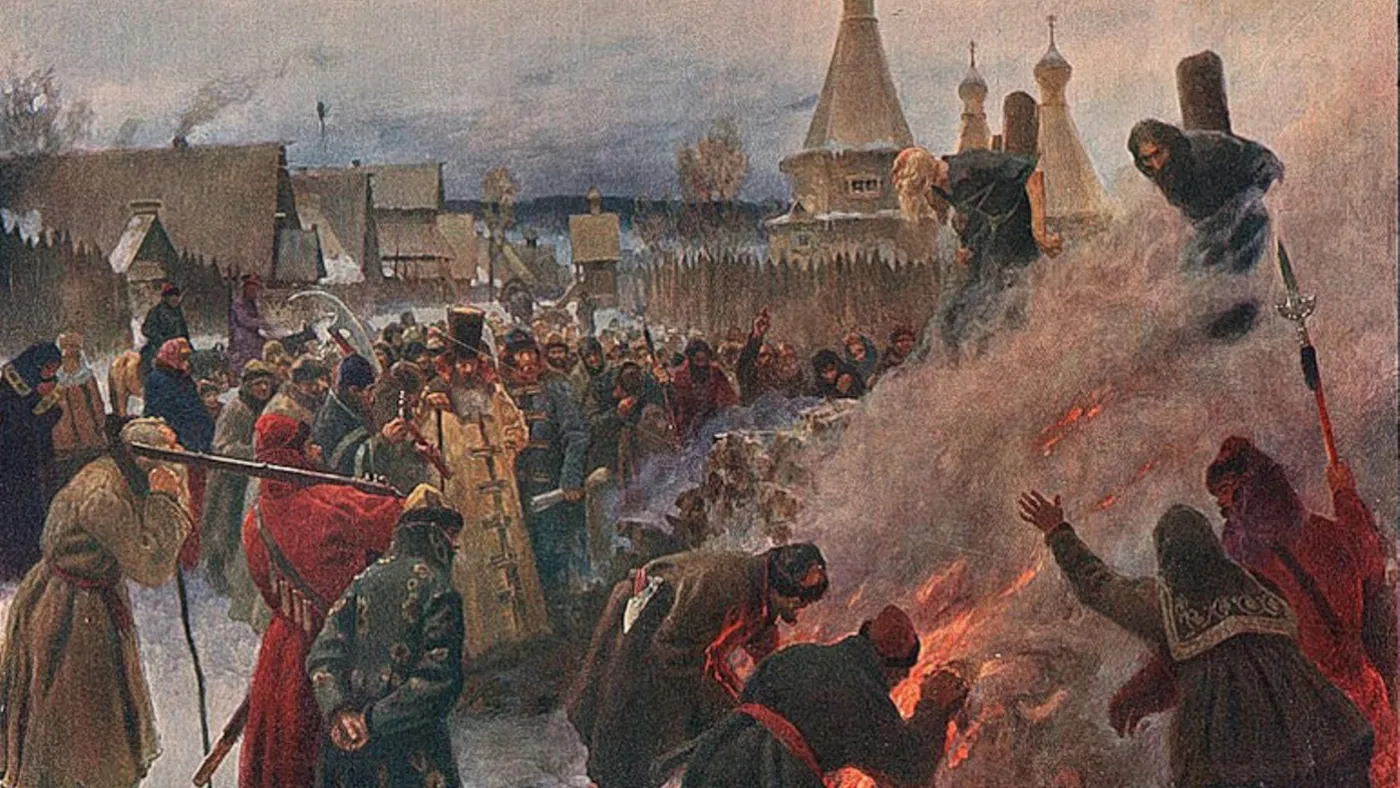
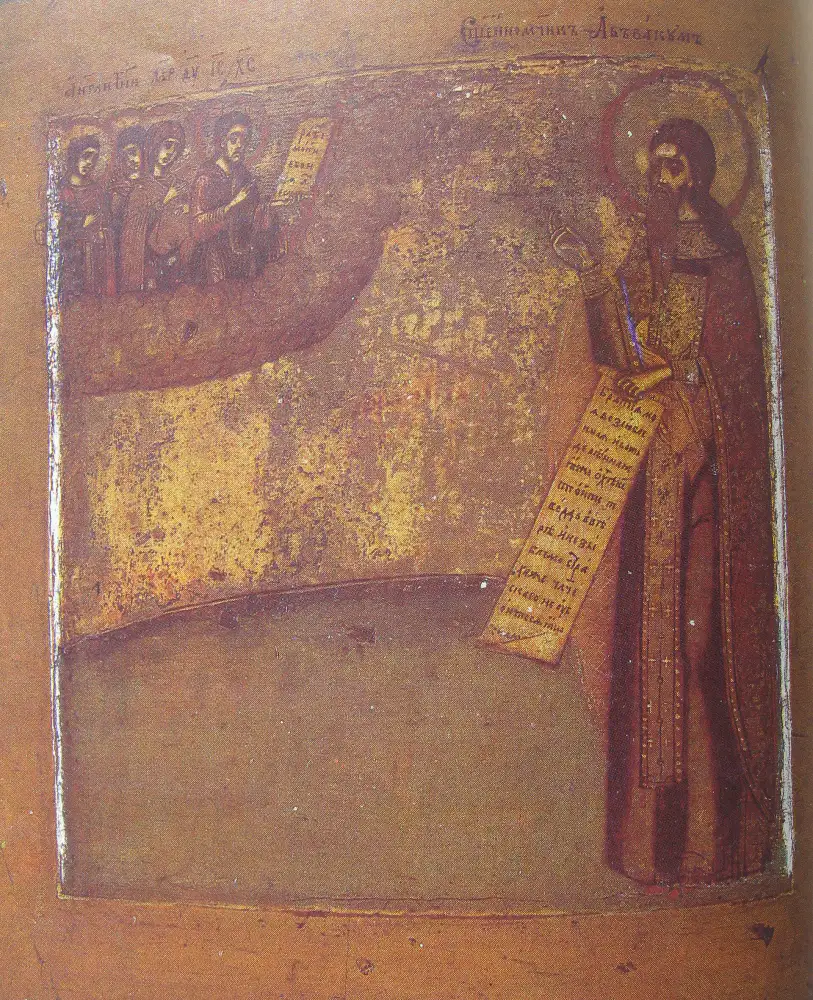
In that pit he wrote the Life of the Archpriest Avvakum, Written by Himself (1672–1675), an autobiography in vivid, almost spoken Russian, which survives in three author's versions, two in his own hand. From Pustozersk his letters went out to his followers through Mezen', where his family was held. In January 1681 Moscow Old Believers threw "blasphemous scrolls" in the cathedrals and smeared tar on the royal tombs, and the authorities blamed Avvakum's influence. On 14 April 1682 Avvakum, Lazar', Epifanii and Fedor were burnt in a log frame at Pustozersk "for great blasphemies against the royal house". The Old Believers of the Belokrinitsa church venerate him as a hieromartyr; their council established his veneration in 1916.
Who was Boyarynya Morozova?
Feodosia Prokop'evna Morozova was born in Moscow on 21 May 1632 into the Sokovnins, a Moscow gentry family. In 1649 she married the boyar Gleb Morozov, brother of Boris Morozov, the tsar's former tutor, brother-in-law and one of the richest landowners in Russia. Widowed in 1662, she controlled a vast fortune for her son Ivan, and her house north of the Kremlin became a refuge for the old faith. Avvakum lived there from the spring of 1664 until 22 August; in his Life he calls her and her sister, Princess Evdokia Urusova, his spiritual daughters, "martyrs for Christ".
The tsar sent first the boyar B. I. Troekurov and then Prince P. S. Urusov, her sister's husband, to make her "submit, accept their newly published laws", or "great misfortunes" would follow. She refused. On the night of 15–16 November 1671 she and her sister were arrested, and on 18 November they refused, under interrogation in the Chudov monastery, to take communion by the new books. Her son died soon afterwards, and in January 1672 all her property was sold. She was tortured, and burning on Bolotnaya Square in Moscow was considered.
She was not burnt. At the turn of 1673 and 1674 the tsar had the sisters and their companion Maria Danilova sent to Borovsk, to a harsh imprisonment. At the end of June 1675 fourteen prisoners there were burnt, among them Morozova's servant Ivan and the nun Iustina. The three women were put into a deep earthen pit, and the guards were forbidden, on pain of death, to give them food or water. Urusova died first. Morozova died of hunger on the night of 1–2 November 1675. Her Life, written by her elder brother Fedor Sokovnin, and Vasily Surikov's painting of 1887, which shows her being driven past the Chudov monastery on a sledge with two fingers raised, made her famous far beyond the Old Believers.
What happened at the Solovetsky monastery?
The great monastery on the islands of the White Sea, whose library was one of the best in the country, had refused the new books since 1658. It sent petition after petition to Moscow: the "Fifth Petition" of 1667 survives in more than 150 copies. When a new abbot arrived in September 1667, a general assembly of monks and lay workers refused to receive him, and the Fourth Petition told the tsar: "command, sovereign, that your royal sword be sent against us, and move us from this rebellious life to that untroubled and eternal life, for we are not against you, great sovereign." O. V. Chumicheva, who wrote the Orthodox Encyclopaedia article on the rising, calls this a contradictory mix of defiance, readiness for martyrdom and formal loyalty.
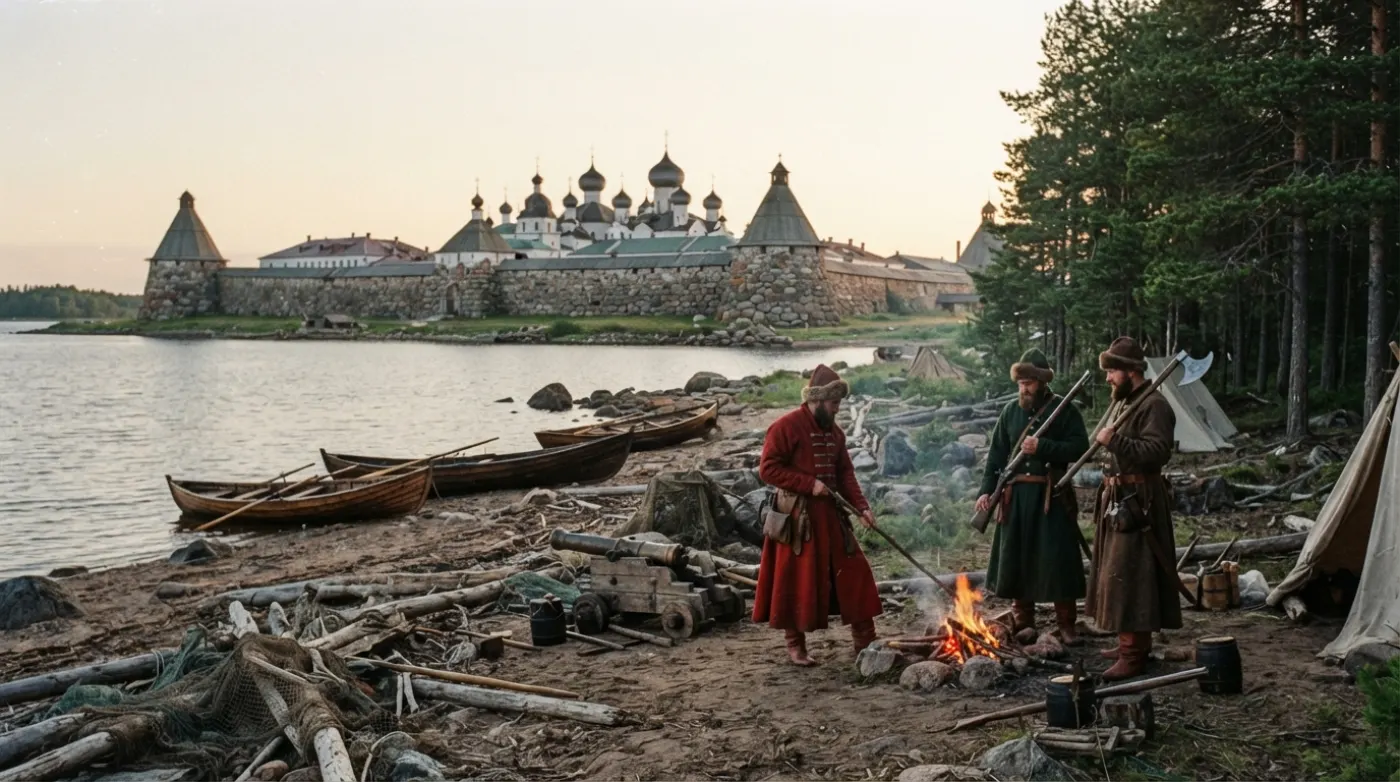
The siege began on 22 June 1668, with a small force of strel'tsy under I. Volokhov, and for years it was more a blockade with occasional gunfire. The local Pomor people kept the monastery supplied, usually in winter when the troops withdrew to the mainland. On 28 December 1673 the monastery's council stopped prayers for the tsar altogether, and many monks called the island "un-tsarish land". A third commander, I. A. Meshcherinov, tightened the siege. On the night of 21–22 January 1676 the strel'tsy entered through a badly walled-up passage by the White Tower, shown to them by a monk called Feoktist who had left the monastery. Of 62 men captured, 28 were executed. When a new abbot arrived, only 14 of the 200–300 monks who had lived there before the rising were left.
The rising has been read in very different ways. The official church view of the eighteenth and nineteenth centuries blamed lay rebels for coercing peaceful monks. Soviet historians kept the scheme but reversed the values, praising the lay workers as fighters against feudalism and stressing the role of men from the army of Stenka Razin. Chumicheva and E. M. Iukhimenko, who brought large amounts of new documents into use from the 1980s, call that Razinite role "mythical". The Old Believer legend of the heroic death of the former archimandrite Nikanor is not confirmed by the documents either; he probably died in the last months of the siege.
Why did Old Believers burn themselves?
Many Old Believers expected the end of the world. The Kyiv archimandrite Zacharias Kopystensky (died 1627) had added the year 1000 to 666, the number of the Beast, and predicted a great apostasy for 1666; when his work was published in Moscow, the historian Damian Cyrocki notes, the place of the Antichrist's appearance was moved from Rome to Moscow. To people who believed that Moscow was the last true Christian empire, the Third Rome, a church that cursed the old rite in 1666–1667 looked like the fulfilment.
Persecution and capture, with the risk of renouncing the faith under torture, made some choose death first. Followers of the hermit Kapiton burnt themselves as early as 1665 and 1666, Cyrocki writes, citing Robert Crummey. Avvakum himself approved of self-immolation in letters to his disciple Krasheninnikov, not as a way to salvation in itself but as the only means, in some cases, of escaping "from the hands of the tormentors". The burnings (gari) grew in the 1680s: E. M. Iukhimenko has studied those around Kargopol in 1683–1684, and Cyrocki reports that when troops tried to retake the Paleostrovsky monastery in 1687, the 2,700 people inside chose to burn themselves. Figures like these are hard to verify.
What happened to Nikon?
Nikon spent almost ten years at Ferapontov. In one of his 38 letters to the tsar from there he wrote: "I am now sick, naked and barefoot… and I have had no cross on me for the third year; I am ashamed to go into the other cell where I bake bread and cook." Conditions eased after 1672, and by 1674 he had a large staff of servants. After the death of Tsar Alexis in January 1676 he was moved to the Kirillo-Belozersky monastery.
Alexis's son Tsar Fedor wrote to the Eastern patriarchs on 26 June 1681 asking them to pardon Nikon and allowed him to return to New Jerusalem. He never arrived. He died on 17 August 1681 on the river Kotorosl' near Yaroslavl and was buried at New Jerusalem with the rite for a patriarch, in the tsar's presence. In 1682 Constantinople granted the pardon, and the church again commemorated him as patriarch. When archaeologists opened his tomb in 2013, they found the sarcophagus empty. More on his royal patron in our article on Tsar Alexis.
Who are the Old Believers today?
Persecution hardened after 1682. The "Twelve Articles" issued under the regent Sophia in 1685 made it a mass affair, and Old Believers began to flee to the edges of the empire and abroad, to the Polish–Lithuanian Commonwealth, Sweden and Courland. Under Peter I the state became more tolerant but kept economic pressure and legal restrictions on them, which lasted until the edict on religious toleration of 17 April 1905 in the Russian Empire.
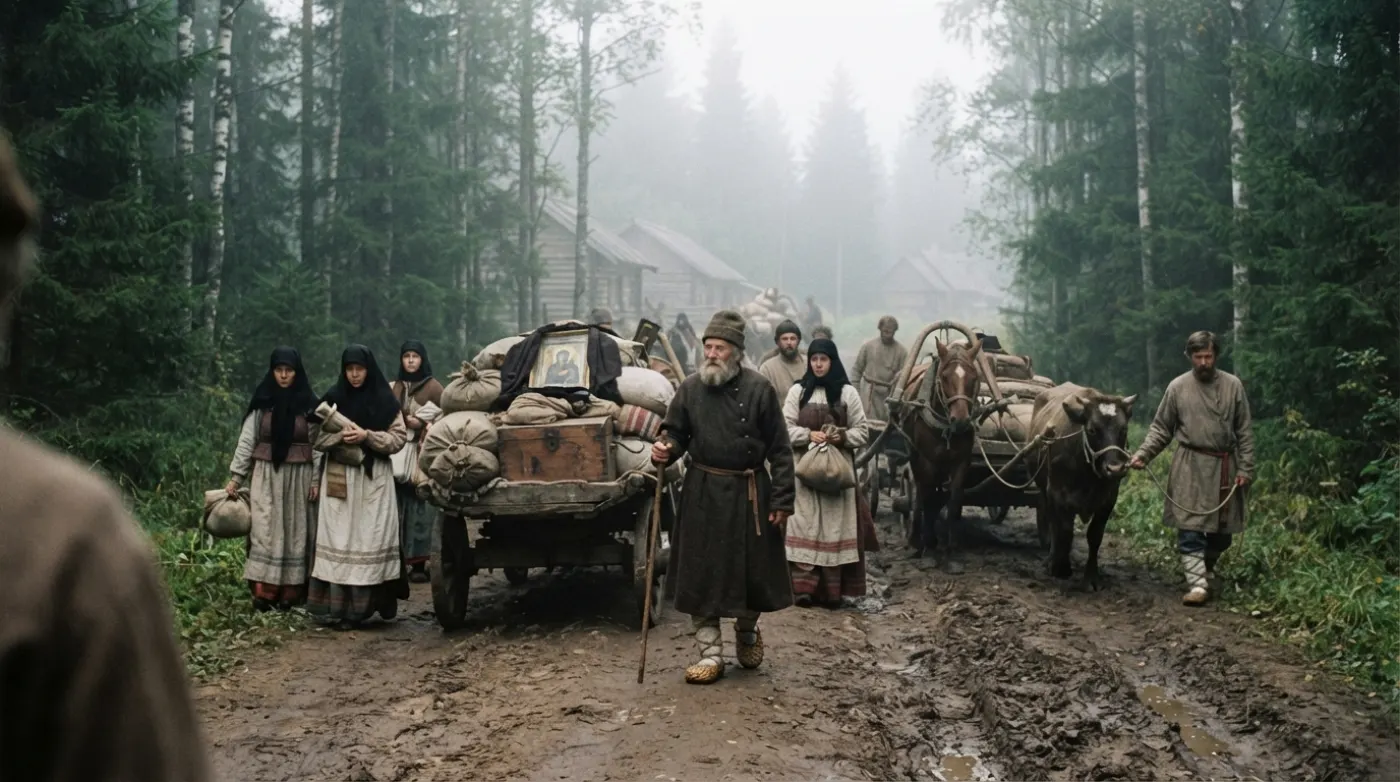
Without bishops of their own, the Old Believers split over the question of priests. The popovtsy (priestly) accepted priests who came over from the official church and in 1846–1847 gained their own hierarchy, named after the monastery of Belaya Krinitsa. The bespopovtsy (priestless) concluded that the Antichrist already reigned, that true priesthood had ended, and that laymen must perform the few sacraments that could still be had. Radical priestless groups such as the beguny ("runners") rejected the state altogether, and their writings preserve the legend of the invisible city of Kitezh.
How many Old Believers there were is guesswork. The 1897 census counted 2,204,596 "Old Believers and those deviating from Orthodoxy", a self-declared category. Scholars working from registers and censuses, Cyrocki reports, estimate between about 10 and 25 million before 1917. In 1913 the Ministry of the Interior registered 1,268 Old Believer communities. Today there is no census figure at all: an article on the website of the Russian Orthodox Old-Rite Church gives "3 to 5 million" in Russia, "by the most optimistic forecasts". The most famous Old Believers of modern times are probably the Lykov family, whom Soviet geologists found living in the western Sayan mountains of Siberia in 1978, cut off from the world for decades.
The official church made its peace slowly. In April 1929 the Patriarchal Synod of the Church in the Soviet Union, under Metropolitan Sergii, declared the old rites salvific. On 2 June 1971 the Local Council of the Russian Orthodox Church, meeting at the Trinity-Sergius Lavra, confirmed that the old rites were "salvific, like the new rites, and equal in honour to them", and that the curses of 1656 and 1667 were to be regarded "as if they had never been". The Russian Orthodox Church Outside Russia went further in 2000 and repented of its part in the persecutions. The Old Believer churches remain separate. In 2022 Moscow got its first monument to Avvakum, at the Old Believer centre of Rogozhskaya sloboda, and in October 2025 a monument to Morozova was unveiled in Borovsk, next to a monument to Avvakum.
Common myths about the Old Believers
| Myth | What the evidence says |
|---|---|
| Nikon restored the ancient Greek and Slavonic texts | The books were corrected mainly from seventeenth-century Ruthenian printed books (Kyiv, Striatyn), themselves aligned with Venetian Greek editions |
| The two-finger sign was a Russian error | It was the older Greek usage; the Greeks moved to three fingers between the late twelfth and the thirteenth centuries |
| Nikon was deposed because of his reforms | He was condemned for slandering the tsar, abandoning his see and other offences; the same council upheld his reforms |
| When Nikon fell, his reforms fell with him | The council of 1666–1667 made them binding and cursed their opponents |
| Boyarynya Morozova was burnt at the stake | She was starved to death in an earthen pit at Borovsk on 2 November 1675 |
| Avvakum died in 1681 | The 1924 English translation says so; the Orthodox Encyclopaedia gives 14 April 1682 |
| Solovki was a peasant rising led by Razin's men | Chumicheva calls the Razinite role a Soviet myth; the monastery's own council led the resistance |
| The Russian Orthodox Church still curses the Old Believers | The curses were declared void in 1929 and again by the Local Council of 1971 |
Timeline
| Date (Old Style) | Event |
|---|---|
| 1551 | The Stoglav council declares the two-finger sign the only proper form |
| May 1605 | Nikon (Nikita Minov) born near Nizhny Novgorod |
| 20 November 1620 | Avvakum born at Grigorovo |
| 25 July 1652 | Nikon enthroned as patriarch |
| Before Lent 1653 | Nikon's memorandum on the three-finger sign |
| August–September 1653 | Neronov and Avvakum arrested; Avvakum exiled to Siberia |
| February–May 1654 | Reform council in the tsar's palace; Bishop Pavel of Kolomna deposed |
| 1655 | Corrected Sluzhebnik printed |
| 24 February 1656 | Anathema on the two-finger sign in the Dormition Cathedral |
| 10 July 1658 | Nikon lays aside his vestments and leaves Moscow |
| 13 May 1666 | Avvakum defrocked and anathematised |
| 12 December 1666 | Nikon deposed and sent to the Ferapontov monastery |
| 1667 | The council upholds the reforms and curses their opponents |
| 22 June 1668 | Siege of the Solovetsky monastery begins |
| 16 November 1671 | Boyarynya Morozova arrested |
| 2 November 1675 | Morozova dies of hunger at Borovsk |
| 22 January 1676 | Solovetsky monastery taken |
| 17 August 1681 | Nikon dies near Yaroslavl |
| 14 April 1682 | Avvakum and three companions burnt at Pustozersk |
| 17 April 1905 | Edict on religious toleration |
| April 1929 | Patriarchal Synod declares the old rites salvific |
| 2 June 1971 | Local Council lifts the curses of 1656 and 1667 |
What the map shows
At 1666 the Tsardom of Russia stretched from the White Sea, where the monks of Solovki were about to defy the tsar, across Siberia, which Avvakum had crossed on his way to Dauria and back. To the west lay the Polish–Lithuanian Commonwealth, whose Orthodox subjects in Ukraine and Belarus were part of the background to Nikon's reform. For how the Romanov dynasty came to rule this state, see our article on the election of Michael Romanov in 1613.
Sources
Primary sources
- Avvakum Petrov, Zhitie protopopa Avvakuma, im samim napisannoe, Old Russian text after the edition by A. N. Robinson, Zhizneopisaniia Avvakuma i Epifaniia (Moscow, 1963), via ru.wikisource
- The Life of the Archpriest Avvakum by Himself, trans. Jane Harrison and Hope Mirrlees, preface by D. S. Mirsky (London: Hogarth Press, 1924)
- "Deianie Pomestnogo Sobora Russkoi Pravoslavnoi Tserkvi ob otmene kliatv na starye obriady", 2 June 1971, Zhurnal Moskovskoi Patriarkhii 1971, no. 6
- Pervaia vseobshchaia perepis' naseleniia Rossiiskoi imperii 1897 g., distribution by religion, via Demoscope Weekly
Studies and reference works
- "Nikon", Pravoslavnaia entsiklopediia, vol. 50, pp. 732–750 (online 28 December 2022)
- "Bol'shoi Moskovskii Sobor 1666–1667 gg.", Pravoslavnaia entsiklopediia, vol. 5, pp. 679–684 (online 2009)
- "Avvakum Petrov", Pravoslavnaia entsiklopediia, vol. 1, pp. 83–87
- "Morozova Feodosiia Prokop'evna", Pravoslavnaia entsiklopediia, vol. 47, pp. 40–43
- O. V. Chumicheva, "Solovetskoe vosstanie", Pravoslavnaia entsiklopediia, vol. 64, pp. 728–731 (online 2026)
- "Staroobriadchestvo", Pravoslavnaia entsiklopediia, vol. 66, pp. 115–117 (online 2026)
- "Knizhnaia sprava", "Dvoeperstie", "Kapterev", "Bespopovtsy" and "Pomestnyi Sobor Russkoi Pravoslavnoi Tserkvi 1971 g.", Pravoslavnaia entsiklopediia
- "Avvakum Petrov (1620–1682)", Presidential Library, St Petersburg
- N. F. Kapterev, Patriarkh Nikon i tsar' Aleksei Mikhailovich, 2 vols (Sergiev Posad, 1909–1912)
- E. E. Golubinsky, K nashei polemike so staroobriadtsami (Moscow, 1892)
- Damian Cyrocki, "Old Believers", Critical Dictionary of Apocalyptic and Millenarian Movements (2026), doi:10.17863/cam.136363
- S. V. Taranets, "Staroobriadchestvo v Rossiiskoi Federatsii kontsa XX – nachala XXI v.", website of the Russian Orthodox Old-Rite Church (2018)
- Sophie Pinkham, "A century in the Siberian wilderness: the Old Believers who time forgot", The Guardian, 22 January 2026
- RIA Novosti, "V Moskve otkryli pervyi pamiatnik protopopu Avvakumu", 15 November 2022; Russkaia vera, "V Borovske otkryli pamiatnik boiaryne Morozovoi", 2025
Image credits
- Title image: Pyotr Myasoyedov, The Burning of Archpriest Avvakum, 1897, State Museum of the History of Religion. Public domain, via Wikimedia Commons, cropped to 16:9.
- Patriarch Nikon with the Brethren of the New Jerusalem Monastery, unknown artist, c. 1660–1665, New Jerusalem Museum. Public domain, via Wikimedia Commons.
- Patriarch Nikon, drawing from the album of Augustin von Meyerberg, 1661–1662. Public domain, via Wikimedia Commons.
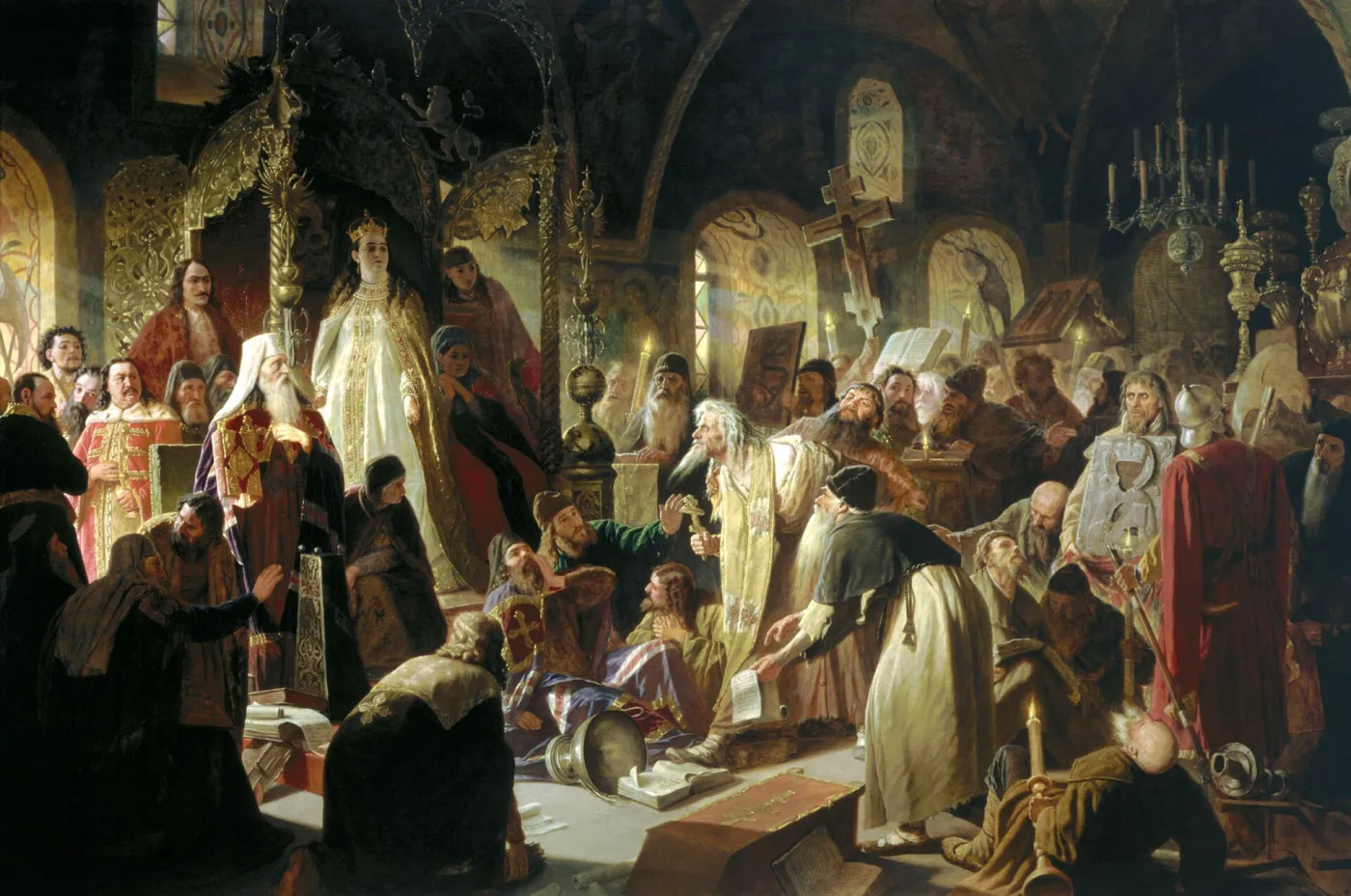
- Vasily Perov, Nikita Pustosviat: Dispute on the Faith, 1880–1881, State Tretyakov Gallery. Public domain, via Wikimedia Commons.
- Old Believer icon of Avvakum, date uncertain. Public domain, via Wikimedia Commons.
- Sergei Miloradovich, The Black Council, 1885, State Tretyakov Gallery. Public domain, via Wikimedia Commons.