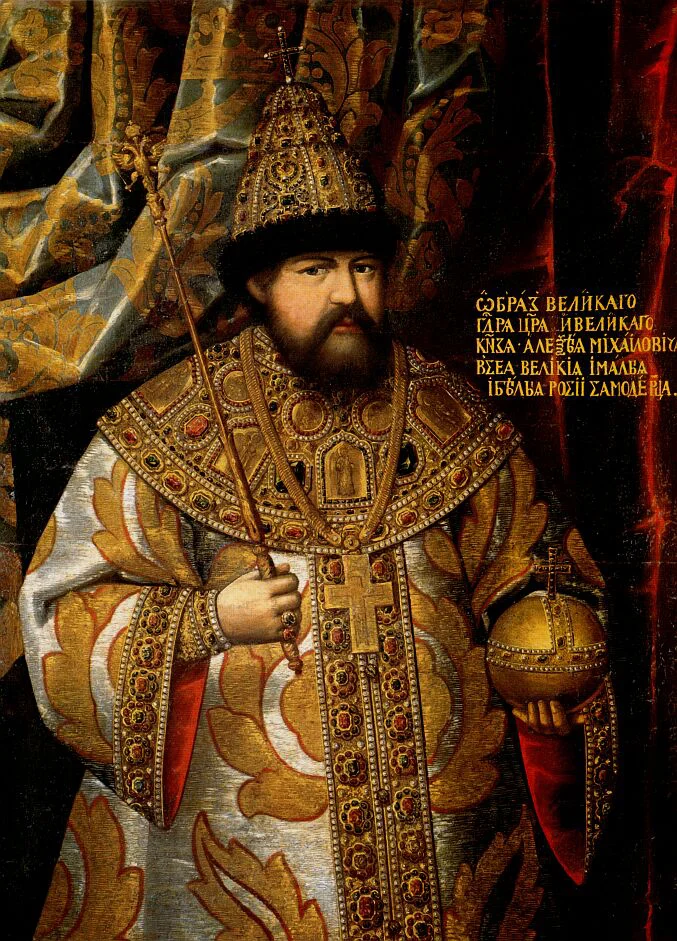
Alexis of Russia (Aleksei Mikhailovich, 1629–1676) was the second tsar of the Romanov dynasty, ruling from 1645 until his death in January 1676. He is remembered as Tishaishy, "the Most Gentle" or "the Most Quiet", yet his thirty years on the throne were among the most turbulent of the century: the Salt Riot of 1648, a new law code in 1649 that tied the peasants to the land for good, a war with Poland–Lithuania from 1654 to 1667, the Copper Riot of 1662, the schism of the Russian Church and the rising of Stenka Razin. He won back Smolensk, gained the Cossack lands east of the Dnieper and, for a time, Kiev, and built up a bureaucracy and a personal chancellery that answered to him alone. Historians now read "Most Gentle" as a court title rather than a portrait. Alexis was also the father of three tsars, Fyodor III, Ivan V and Peter the Great, and of Sophia, regent for her younger brothers.
(He should not be confused with Alexei Nikolaevich, the haemophiliac son and heir of Nicholas II, who was killed with his family in 1918.)
Alexis of Russia at a glance
| Name | Aleksei Mikhailovich Romanov; in English usually Alexis |
| Born | March 1629, Moscow (9 or 10 March Old Style; sources differ) |
| Reign | 13 July 1645 – 29 January 1676; crowned 28 September 1645 |
| Parents | Tsar Michael Romanov and Tsaritsa Evdokia Streshneva |
| Epithet | Tishaishy, "the Most Gentle" |
| Wives | Maria Miloslavskaya (married 1648, died 1669); Natalya Naryshkina (married 1671) |
| Children who reigned | Fyodor III (1676–1682), Ivan V (1682–1696), Peter I (from 1682); Sophia was regent from 1682 |
| Main events | Salt Riot (1648), Law Code (1649), war with Poland–Lithuania (1654–1667), break with Patriarch Nikon (1658), Copper Riot (1662), Razin's rising (1670–1671) |
| Died | 29 January 1676, Moscow; buried in the Archangel Cathedral of the Kremlin |
(Dates are Old Style, the Julian calendar used in Russia; in the 17th century add ten days for the modern calendar.)
Who was Tsar Alexis?
Alexis was born in Moscow in March 1629, the son of Michael Romanov, the first tsar of the new dynasty, and his second wife, Evdokia Streshneva. From the age of five he was in the care of a dyadka, a tutor and guardian: the boyar Boris Morozov. According to the Orthodox Encyclopaedia, he learnt to read at five, began writing at seven and church singing at nine, and by the age of twelve had a small library of religious and secular books of his own. The encyclopaedia calls him "one of the most educated people of his time".
He was publicly presented as heir at fourteen. Both his parents died in 1645, and at sixteen he became tsar. Grigory Kotoshikhin, a clerk of the Ambassadorial Office who fled abroad and wrote a description of Muscovy in Stockholm in 1666–1667, noticed a difference from earlier elections. Earlier tsars had given written undertakings to rule with the advice of the boyars, he wrote, but "the present tsar was chosen to the tsardom, and he gave no such written undertaking as earlier tsars used to give, and none was asked of him, because they took him to be very quiet; and therefore he writes himself 'autocrat' and rules his state according to his own will". (The translations from Russian in this article are our own.)
For the first years he left government to Morozov. He spent his life reading, praying and hunting. The Orthodox Encyclopaedia describes him as devout, never missing a service, often rising at night to pray, demanding that everything follow its proper order (chin), and "quick-tempered but quick to calm down".
Why was Alexis called "the Most Gentle"?
The epithet Tishaishy is the first thing most people know about Alexis, and it is the most misleading. The historian Igor Andreev, writing in the Great Russian Encyclopaedia, puts it bluntly: the widespread picture of Alexis as a "most gentle" tsar "is inaccurate: Tishaishy is not a description of Alexis by his contemporaries, but an element of the title, which had limited currency in panegyric literature and in church practice".
In an article of 2013, Andreev explains that tishaishy ("most quiet, most serene") was a semi-official title of Muscovite rulers that came into use as early as the 16th century. It was applied to Alexis's father and to his sons, "including Peter, who was not quiet at all". The word made sense after the Time of Troubles, when Russians longed above all for "quiet and peace". Andreev's summary is that Alexis was "doomed" to be Tishaishy in the sense that his policy had to promise quiet, but that he managed this "being by no means a 'most gentle' man and politician".
The 19th century read the title as a character sketch. The Brockhaus and Efron Encyclopaedia described Alexis as having "a remarkably mild, good-natured character", quoting Kotoshikhin's "very quiet". Contemporaries gave a more mixed picture. Samuel Collins, the English physician who served at his court for nine years, wrote in The Present State of Russia, published in 1671 after his death:
"His Imperial Majesty is a goodly person, … of a sanguine complexion, light brown hair, his beard uncut, he is tall and fat, of a majestical deportment, severe in his anger, bountiful, charitable, chastely uxorious, very kind to his sisters and children, of a strong memory, strict in his devotions, and a favourer of his religion."
(Spelling modernised.) Collins added that "this Emperour is of a warlike spirit". The Russian Biographical Dictionary records that in one session of the council Alexis struck his own father-in-law for boasting.
Who was Boris Morozov?
Boris Ivanovich Morozov was the most powerful man in Russia in the first years of the reign. According to the Great Russian Encyclopaedia, he became the boy's dyadka in 1633, probably designed his education, and remained for him, in Alexis's own words, "a friend in place of my own father". After 1645 he effectively headed the government and ran several government offices at once.
Morozov also arranged the tsar's marriage. In 1647 Alexis chose Evfimia Vsevolozhskaya as his bride, but the match was broken off. The historian Russell Martin, as summarised in a 2015 review of his book, argues that Morozov and Ilya Miloslavsky together separated the young tsar from his chosen bride. On 16 January 1648 Alexis married Maria Ilyinichna Miloslavskaya, Ilya's daughter; Morozov sat "in the father's place" at the wedding and soon married her sister Anna. The tsar's guardian was now also his brother-in-law.
Morozov was also very rich. The Great Russian Encyclopaedia credits him with 330 villages in nineteen districts and more than 27,400 male serfs, and quotes the diplomat Augustin Meyerberg, who said he had "the same greed for gold as people usually have thirst for drink".
What was the Salt Riot of 1648?
To repair the treasury, Morozov's government introduced new indirect taxes. A decree of 7 February 1646 put a new duty on salt. According to the Great Russian Encyclopaedia, it came to about half the market price of salt, did not bring in the expected revenue, and was meant to replace two direct taxes; the government then demanded those direct taxes for 1646–1647 as well. At the same time officials close to Morozov were notorious for extortion, above all Leonty Pleshcheev, head of the Zemsky Office.
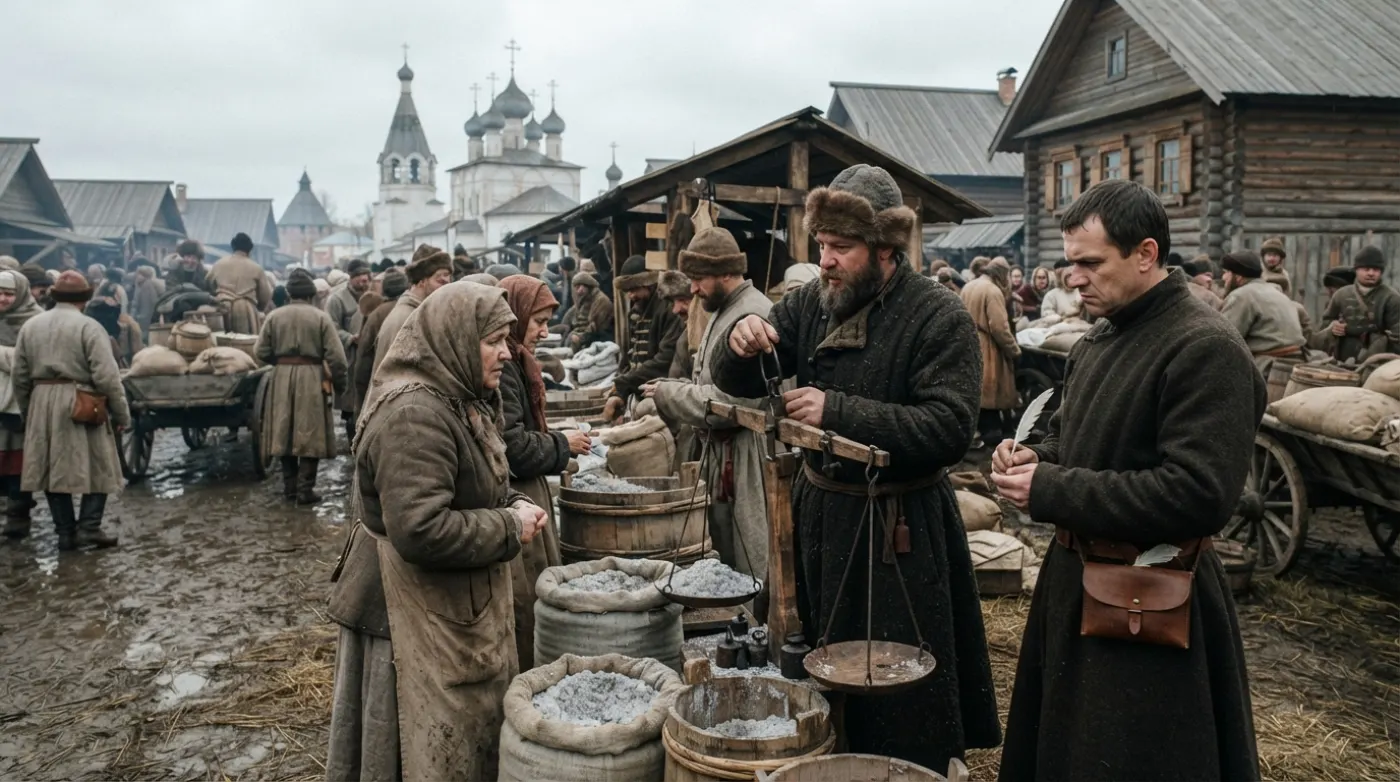
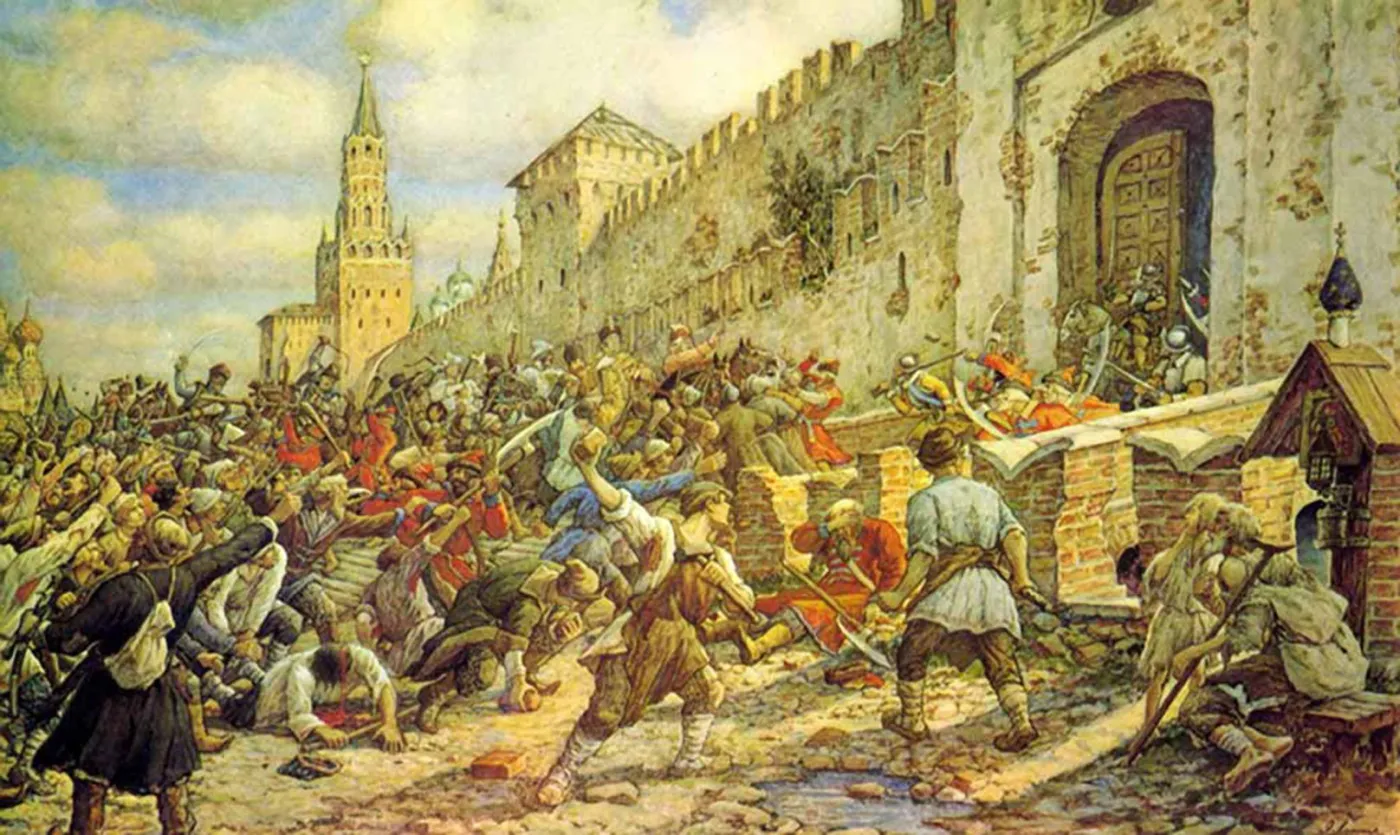
The rising began on 1 June 1648, when townspeople tried to hand petitions to the tsar on his way back from the Trinity monastery and were beaten off by the streltsy, the musketeers of the guard. On 2 June a crowd surrounded Alexis again as he rode back to the Kremlin. The streltsy, whose pay had been cut, refused Morozov's order to disperse it. Houses of Morozov and other grandees were looted, and the official Nazary Chistoy, who was blamed for the salt duty, was beaten to death. On 3 June fires destroyed several thousand houses.
Alexis gave in. On 3 June he handed Pleshcheev over to the crowd, which killed him; on 5 June the head of the Artillery Office, Pyotr Trakhaniotov, was executed. The tsar would not give up Morozov. Adam Olearius, secretary of the Holstein embassies to Moscow in the 1630s, whose book on Muscovy includes an account of the riot, says that Alexis appealed to the people in tears not to demand the man "who, like a second father, had brought him up and raised him". The Great Russian Encyclopaedia says the tsar begged the boyars to kill him rather than Morozov. On 12 June Morozov was sent away to the Kirillo-Belozersky monastery. He was back in Moscow that autumn, but never regained his former power.
The riots spread. According to the Orthodox Encyclopaedia, urban risings "rolled through the whole country" in 1648–1650, reaching even Siberia. The townsmen and provincial gentry who had flocked to Moscow used the moment: on 10 June 1648 they submitted a joint petition demanding legal reform, and an Assembly of the Land called on 16 July agreed to meet their main demands.
What was the Sobornoe Ulozhenie of 1649?
The Sobornoe Ulozhenie, the "Council Law Code", was the great law code of 17th-century Russia. In July 1648 a commission of five, headed by Prince Nikita Odoevsky, was set to draft it; on 1 September 1648 an Assembly of the Land of elected men of "various ranks" met in Moscow, and in 1649 it adopted the code. It was printed in May 1649. According to the Great Soviet Encyclopaedia, it had 25 chapters and 967 articles, and it drew on the Law Code of 1550, the decree books of the government offices, petitions of the gentry and townsmen, Byzantine church law and the Lithuanian Statute of 1588. Boris Morozov's signature, the Great Russian Encyclopaedia notes, stands first among the boyars'.
| Chapter or theme | What it did |
|---|---|
| Chapters 1–3 | Protected the Church and the person and court of the tsar; even an "intent" against the sovereign's health or honour became a capital crime |
| "Judgement concerning peasants" | Abolished the time limit for recovering runaway peasants, binding them and their families to their lords for good |
| "On townspeople" | Bound townsmen to their towns and to the town tax, and abolished tax-free private settlements in towns |
| "On the judicial process" | The longest chapter: procedure, fees and fines |
| Church and courts | Put clergy under secular courts in civil cases; a Monastery Office followed in 1650 |
The code answered the demands of the gentry and townsmen of 1648, and above all completed the enserfment of the peasantry; that story belongs in our article on serfdom in Russia. It remained the basis of Russian law until the first half of the 19th century.
How did Alexis govern?
After 1648 Alexis took more of the government into his own hands, though he long needed a close adviser. Andreev argues that a second "mentor" followed Morozov: Nikon, whom Alexis met in 1646 when he came to Moscow as abbot of a northern monastery, made metropolitan of Novgorod in 1649 and patriarch in 1652. Alexis called him his "special friend". Their partnership drove the church reforms that split Russian Orthodoxy; the story of the reforms and of the Old Believers is told in our article on Nikon and the Old Believers. The two men fell out, Nikon left the patriarchal throne in 1658, and in 1666 a church council in which Alexis acted as one of the chief accusers deposed him.
The bigger change was in how Russia was run. The Assembly of the Land, which had elected Michael Romanov in 1613, faded: after the assembly of 1653 that agreed to take the Zaporozhian Cossacks under the tsar's protection, no other assembly met in Alexis's reign. The Boyar Duma lost weight. The government offices (prikazy), according to the Orthodox Encyclopaedia, doubled from about 40 to 80 during the reign, and the number of clerks more than tripled, from about 800 to 2,800.
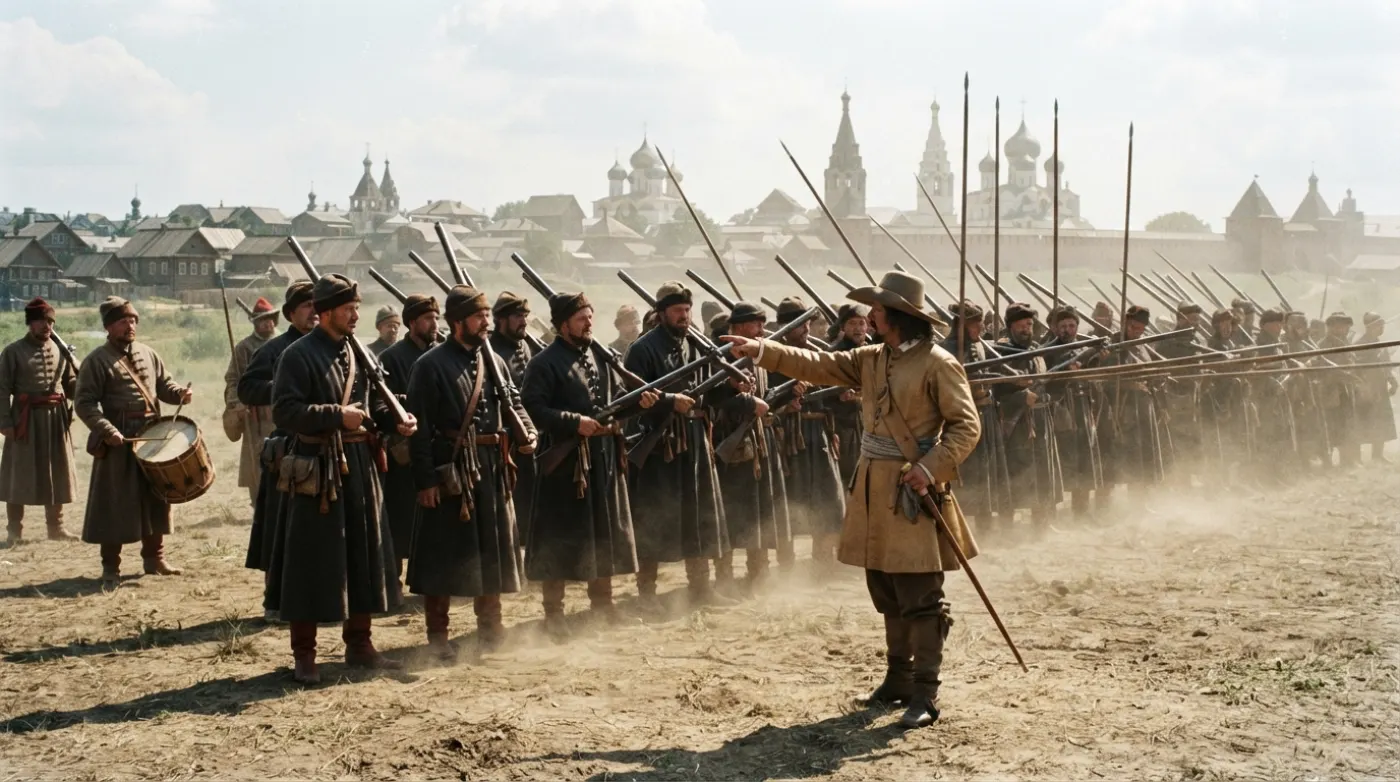
The army changed too. "Regiments of the new order", infantry, dragoons and cavalry drilled on Western lines by hired foreign officers, became a large part of the forces. Foreign specialists of every kind were invited, and in 1652 they were settled together in the "German Quarter" outside Moscow.
What was the Privy Chancellery?
The most personal of Alexis's creations was the Prikaz tainykh del, the Office of Secret Affairs, usually called the Privy (or Secret) Chancellery. According to the Great Russian Encyclopaedia, it was founded during the campaign of 1655 (the Orthodox Encyclopaedia says 1654) and dealt with matters "decided by Tsar Alexei Mikhailovich alone, without the members of the Boyar Duma". It answered directly to the tsar, supervised diplomacy, administration and justice, and ran some of his estates, his falconry and, from 1663, the Grain Office that fed the Moscow streltsy.
Andreev explains its birth by the tsar's impatience. Alexis's letters demand that things be done "without delay" and "in haste"; one dawdling official is told he is "good for nothing, you don't write a single line". The office's clerks watched over governors, ambassadors and judges, and foreigners began to see royal spies everywhere. The chancellery did not survive its creator: it was abolished by decree on 18 February 1676, three weeks after his death.
What was the Thirteen Years' War?
Alexis's greatest venture abroad was the war of 1654–1667 against the Polish–Lithuanian Commonwealth, known in English as the Thirteen Years' War. It grew out of the Cossack revolt in Ukraine led by Bohdan Khmelnytsky. On 1 October 1653 an Assembly of the Land in Moscow agreed to take the Cossacks into the tsar's allegiance, and in January 1654 the Cossack council at Pereiaslav swore loyalty; the background is told in our article on Bohdan Khmelnytsky.
On 18 May 1654 Alexis himself set out for the front. His armies took town after town in what is now Belarus, and on 23 September 1654 Smolensk, ceded to the Commonwealth in 1618, surrendered. In 1655 Minsk, Vilnius, Kaunas and Grodno fell, and Alexis rode in state into Vilnius. He was present in person at the siege of Smolensk and visited Polotsk, Vitebsk, Mogilev, Grodno, Kaunas and Vilnius, and, the Orthodox Encyclopaedia says, came home with new ideas for court life taken from Polish and Ukrainian models. His title grew to "autocrat of all Great and Little and White Russia".
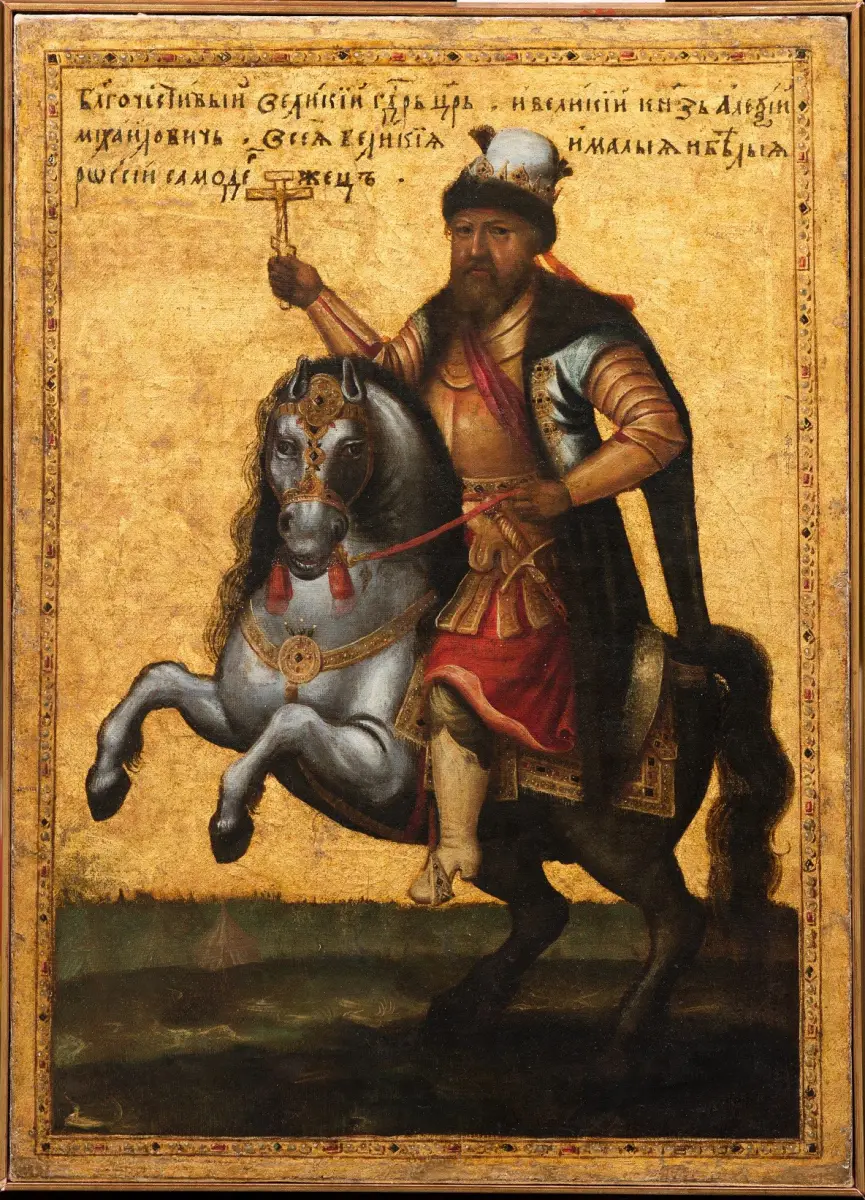
Then the war turned. When Sweden invaded Poland in 1655, Moscow feared a Swedish Baltic and in 1656 opened a war against the Swedish Empire; Alexis besieged Riga in person and failed. That war was suspended in 1658 and closed by the Peace of Kardis in 1661, which gave back all his Baltic conquests. In Ukraine, Khmelnytsky's successor Ivan Vyhovsky went over to Poland in 1658. Russian armies were defeated at Konotop in 1659 and at Chudnov in 1660, and by November 1661 Vilnius was lost. Andreev notes that Alexis "warred for almost half his reign" and "was by no means the defending side". Collins described the result in 1671: the empire "is impoverish'd, depopulated and spoil'd so much in ten years, as it will not recover its pristine prosperity in forty".
The war ended in a draw that favoured Moscow. The Truce of Andrusovo, signed near Smolensk on 20 January 1667 (some sources give 13 January), was negotiated by Afanasy Ordin-Nashchokin. It was concluded for thirteen years. Russia kept Smolensk and the Seversk lands and the Cossack Hetmanate on the left bank of the Dnieper; Kiev on the right bank was to be handed back to the Commonwealth by April 1669; and the two old enemies promised to stand together against the Ottoman Empire and the Crimean Khanate.
| Year | War event |
|---|---|
| 1653 | Assembly of the Land agrees to take the Cossacks under the tsar (1 October) |
| 1654 | Pereiaslav council (January); Alexis leaves Moscow (18 May); Smolensk surrenders (23 September) |
| 1655 | Minsk, Vilnius, Kaunas and Grodno taken; Sweden invades Poland |
| 1656 | War with Sweden; siege of Riga fails |
| 1658 | Truce with Sweden; Hetman Vyhovsky joins Poland |
| 1659–1661 | Defeats at Konotop (1659) and Chudnov (1660); Peace of Kardis with Sweden (1661); Vilnius lost (1661) |
| 1667 | Truce of Andrusovo (January) |
Why did the Copper Riot happen in 1662?
To pay for the war, the government began in 1656 to issue copper coins at the face value of silver. At first they circulated well. Then, Kotoshikhin complains, soldiers were paid in copper while silver grew scarce, and counterfeiters flooded the market; in the spring of 1662 Ilya Miloslavsky himself was found to have protected some of them. According to the Brockhaus and Efron Encyclopaedia, from 1658 a copper rouble was worth ten or twelve times less than a silver one, in the 1660s twenty or twenty-five times less. Collins wrote that copper money "fell from an hundred to one, till at last it was call'd in, to the undoing of many men. Divers hang'd themselves".
On the morning of 25 July 1662 leaflets appeared in Moscow accusing the tsar's father-in-law Ilya Miloslavsky, Fyodor Rtishchev, Ivan Miloslavsky and the merchant Vasily Shorin of treason. A crowd went to find Alexis at his palace in Kolomenskoe, south of the city, where he was at mass. He came out, refused to read the leaflet, and struck hands with one of the petitioners as a promise to investigate. A second, larger crowd arrived; the historian Denis Lyapin puts it at about 7,000, of whom no more than a hundred were active.
Kotoshikhin describes the end. Alexis "cried out and ordered the courtiers and streltsy who were with him to beat and cut down those people to the death and to take the living". The crowd was unarmed. More than a hundred, by Kotoshikhin's count, drowned trying to escape across the Moscow river. Lyapin says that about 2,000 people were arrested and punished with mutilation, the knout and exile: "the authorities had not used such cruel reprisals as a punishment since the Time of Troubles". The copper coinage was reduced the following year and withdrawn in 1664.
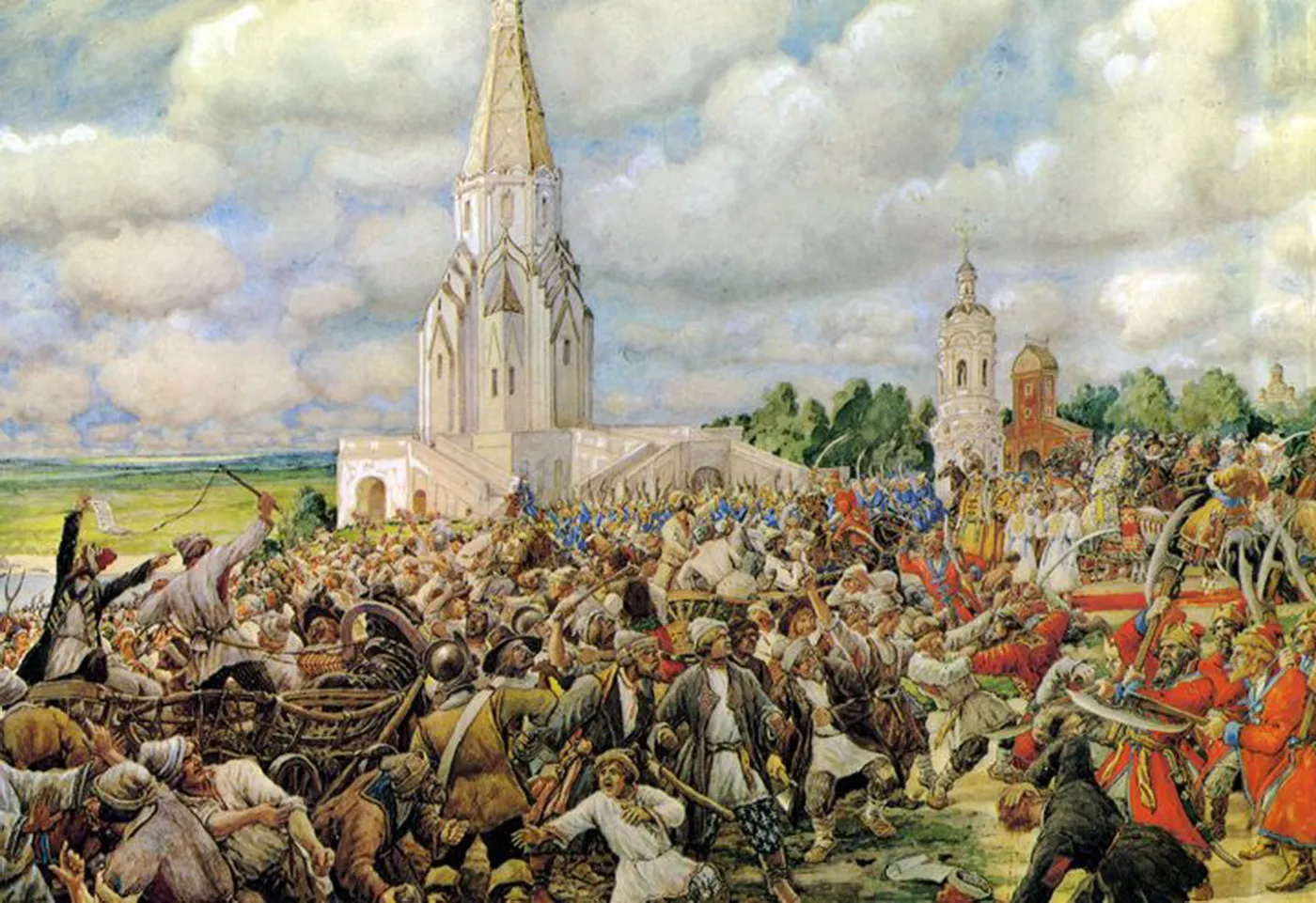
Historians disagree about what the riot was about:
- A revolt against copper money. The Brockhaus and Efron Encyclopaedia blamed the "terrible dearness" caused by copper coins, and the Soviet historian V. I. Buganov treated the "Copper Riot" as a mass uprising and a prologue to Razin's war.
- A hunt for "traitors". Lyapin (2020) points out that the investigation files never mention copper money; the crowd demanded the punishment of courtiers it believed were in secret contact with Poland. He traces the name "Copper Riot" to a popular booklet of 1908 by V. A. Nikolsky, which also coined "Salt Riot", and says contemporaries simply called it a gil', a riot.
- Between the two. Collins and the encyclopaedias show that copper inflation was ruinous; even Lyapin accepts that it formed the "background" to the protest.
How did Alexis spend his time?
Alexis's passion was falconry. Collins wrote that "His Recreations are hunting and hawking. He keeps above three hundred Falconers, and has the best Ger-Falcons in the World, which are brought from Syberia". Archive studies by M. B. Bulgakov and A. V. Barsukova count up to 3,000 hunting birds kept in the royal villages of Kolomenskoe and Vagankovo, and the falconers were later placed under the Privy Chancellery. Alexis took part in writing a rulebook for the falconers' ceremonies, the Uryadnik sokolnichya puti; the literary scholar Alexander Shunkov dates it to 1656, Bulgakov and Barsukova to 1649–1650. Its preface contains his much-quoted maxim "time for work, and an hour for pleasure".
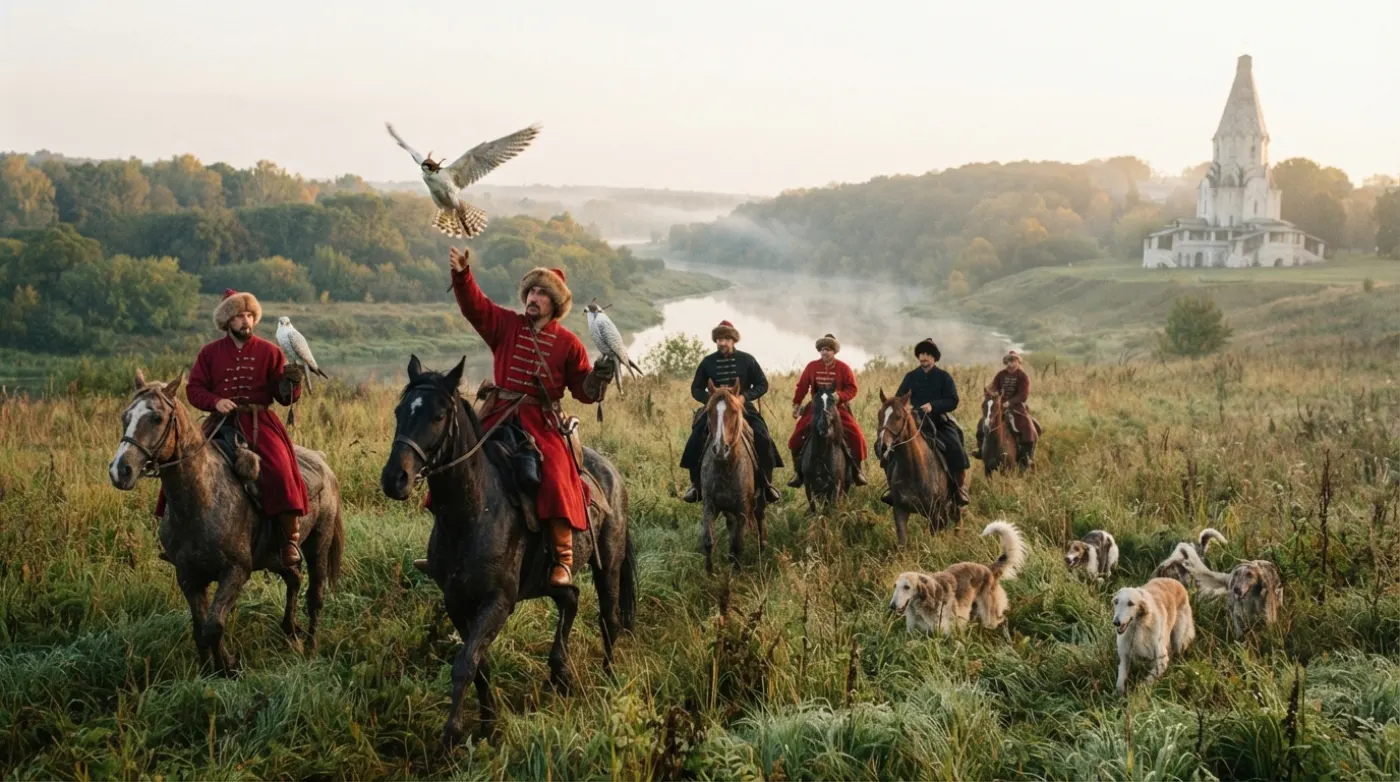
His favourite residence was the village of Kolomenskoe, which the Orthodox Encyclopaedia calls a "summer Kremlin", where he received ambassadors and reviewed troops. There a huge wooden palace of linked log halls under tent roofs and onion domes was built, according to the Orthodox Encyclopaedia mostly in the 1670s and 1680s. It decayed in the 18th century and was dismantled on Catherine the Great's orders of 1767, but measured drawings and a model were made first, and a full-size replica has since been built. The story of a "pillar for petitions" at Kolomenskoe, where anyone could post a request to the tsar, is, the Orthodox Encyclopaedia notes, one of the romantic legends of the 18th and 19th centuries.
He also wrote. Alongside his many letters he composed an account of the death of Patriarch Joseph in 1652 and unfinished notes on the Polish war, and he wrote church chants; manuscripts with his own musical settings survive. In his last years the court took up a Western novelty: in 1672 a theatre was set up at Preobrazhenskoe, where his family watched plays on biblical subjects.
Who were Alexis's wives and children?
Alexis married twice. Maria Miloslavskaya bore him thirteen children before she died on 4 March 1669. On 22 January 1671 he married Natalya Naryshkina, a relative of his new favourite, Artamon Matveev; she bore three more. The Orthodox Encyclopaedia lists them all:
| Child | Mother | Dates | Note |
|---|---|---|---|
| Dmitry | Miloslavskaya | 1649–1651 | |
| Evdokia | Miloslavskaya | 1650–1712 | |
| Marfa | Miloslavskaya | 1652–1707 | |
| Alexei | Miloslavskaya | 1654–1670 | |
| Anna | Miloslavskaya | 1655–1659 | Death year 1659 per the Brockhaus and Efron Encyclopaedia; the Orthodox Encyclopaedia gives 1707 |
| Sophia | Miloslavskaya | 1657–1704 | Regent for Ivan and Peter from 1682 |
| Ekaterina | Miloslavskaya | 1658–1718 | |
| Maria | Miloslavskaya | 1660–1723 | |
| Fyodor | Miloslavskaya | 1661–1682 | Tsar Fyodor III from 1676 |
| Feodosia | Miloslavskaya | 1662–1713 | |
| Simeon | Miloslavskaya | 1665–1669 | |
| Ivan | Miloslavskaya | 1666–1696 | Tsar Ivan V from 1682 |
| Evdokia | Miloslavskaya | 1669 | Died in infancy |
| Peter | Naryshkina | 1672–1725 | Peter the Great |
| Natalya | Naryshkina | 1673–1716 | |
| Fyodor | Naryshkina | 1674–1678 |
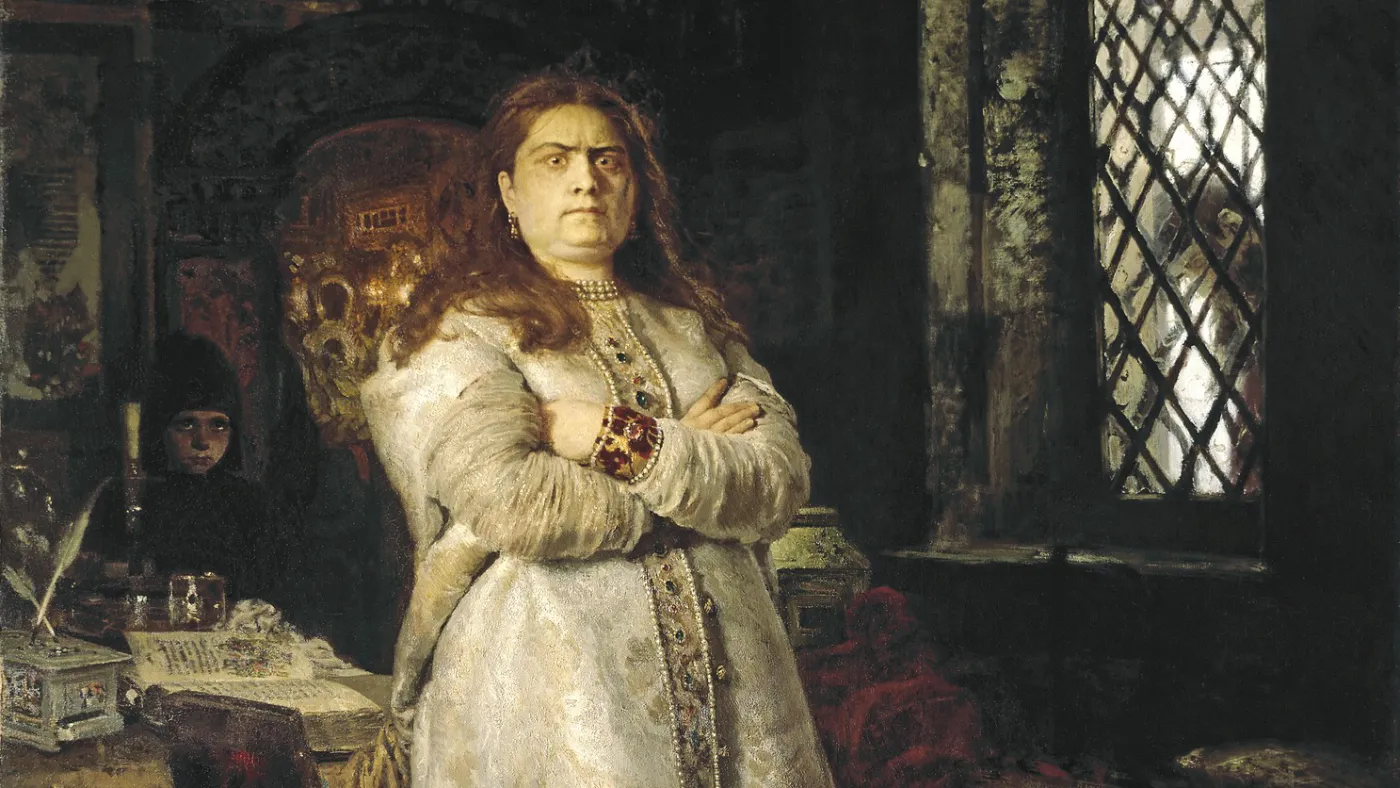
The two marriages created two rival clans at court, the Miloslavskys and the Naryshkins. After the death of Fyodor III in 1682 they fought over the throne: the Naryshkins proclaimed the ten-year-old Peter, and the Miloslavsky party around Sophia answered with the Streltsy rising of 1682, which ended with Ivan V and Peter as joint tsars and Sophia as regent; see our article on Sophia Alekseyevna.
How did Alexis's reign end, and how is it judged?
The last years were no quieter. The Solovki monastery in the White Sea refused the new church books and was besieged from 1668 to January 1676. In 1670 the Don Cossack Stepan Razin raised the Volga region; Alexis's armies crushed the rising, and Razin was executed in Moscow in June 1671 (see our article on Stenka Razin). War with the Ottomans over Ukraine followed.
On 1 September 1674 Alexis presented his son Fyodor to the people as heir. He died in Moscow on 29 January 1676, aged 46, and was buried in the Archangel Cathedral of the Kremlin.
Historians disagree about how to weigh Alexis:
- The quiet prelude to Peter. Andreev observes that Alexis is remembered as a ruler of a calm era "without great changes" largely because of "the mighty figure of Peter", who overshadows his predecessors.
- The founder of Peter's state. The Orthodox Encyclopaedia concludes that his reign "laid the foundation" for Peter's reforms: regiments on Western lines, foreign experts, a growing bureaucracy and an autocracy without assemblies.
- A ruler of two worlds. The Brockhaus and Efron Encyclopaedia saw him standing "at the crossroads between two directions, Old Russian and Westernising", reconciling them without Peter's passionate energy. Andreev calls him "a man of a transitional time" who looked to faith, not reason.
Common myths about Alexis of Russia
| Myth | What the evidence says |
|---|---|
| "Tishaishy" described his gentle character | It was a semi-official title also used for his father and sons, including Peter |
| His was a calm reign | He was at war for almost half of it, and faced the Salt Riot, the Copper Riot, the schism and Razin's rising |
| Contemporaries called the risings "Salt Riot" and "Copper Riot" | The names are modern; Lyapin traces both to a booklet of 1908 |
| The rioters of 1662 demanded the abolition of copper money | The investigation files speak of "traitors" at court, not of coins |
| Alexis was simply Morozov's or Nikon's puppet | He relied on each in turn, but saved Morozov from the crowd in 1648 and broke with Nikon himself in 1658 |
| Anyone could post a petition at a pillar in Kolomenskoe | The Orthodox Encyclopaedia lists this among the romantic legends of the 18th and 19th centuries |
| He is the same person as "Alexei Nikolaevich Romanov" | That was the son of Nicholas II, killed in 1918 |
Timeline
| Date (Old Style) | Event |
|---|---|
| March 1629 | Alexis born in Moscow |
| 1633 | Boris Morozov becomes his tutor |
| 13 July 1645 | Death of Tsar Michael; Alexis becomes tsar |
| 28 September 1645 | Coronation |
| 7 February 1646 | New duty on salt |
| 16 January 1648 | Marriage to Maria Miloslavskaya |
| 1–3 June 1648 | Salt Riot in Moscow |
| 1 September 1648 | Assembly of the Land opens |
| 1649 | Sobornoe Ulozhenie adopted and printed |
| 1652 | Nikon becomes patriarch |
| 1654 | War with Poland–Lithuania; Smolensk taken (23 September) |
| 1654/1655 | Privy Chancellery founded |
| 1655 | Vilnius taken |
| 1656 | Copper coins introduced; war with Sweden |
| 1658 | Break with Nikon |
| 25 July 1662 | Copper Riot at Kolomenskoe |
| 1666–1667 | Church council deposes Nikon |
| 20 January 1667 | Truce of Andrusovo |
| 4 March 1669 | Death of Maria Miloslavskaya |
| 1670–1671 | Razin's rising |
| 22 January 1671 | Marriage to Natalya Naryshkina |
| 30 May 1672 | Birth of Peter |
| 1 September 1674 | Fyodor proclaimed heir |
| 29 January 1676 | Alexis dies in Moscow |
What the map shows
At 1667 the Tsardom of Russia had just made peace with the Polish–Lithuanian Commonwealth at Andrusovo, keeping Smolensk and the lands east of the Dnieper. Compare the Commonwealth in the same year. For the election that brought Alexis's father to the throne, see our article on Michael Romanov's election in 1613.
Sources
Primary sources
- Grigory Kotoshikhin, O Rossii v tsarstvovanie Alekseia Mikhailovicha, 4th ed. (St Petersburg, 1906), via archive.org
- Samuel Collins, The Present State of Russia (London, 1671), Text Creation Partnership transcription and archive.org
- Adam Olearius, Opisanie puteshestviia v Moskoviiu (Russian translation of his Beschreibung der muscowitischen und persischen Reyse), via bibliotekar.ru
Studies and reference works
- V. A. Fyodorov, "Aleksei Mikhailovich", Pravoslavnaia entsiklopediia, vol. 1
- I. L. Andreev, "Aleksei Mikhailovich", Bol'shaia rossiiskaia entsiklopediia
- I. L. Andreev, "Solianoi bunt 1648", Bol'shaia rossiiskaia entsiklopediia
- A. V. Topychkanov, "Tainykh del prikaz", Bol'shaia rossiiskaia entsiklopediia
- M. A. Zinko, "Morozov, Boris Ivanovich", Bol'shaia rossiiskaia entsiklopediia
- "Andrusovskoe peremirie 1667", Bol'shaia rossiiskaia entsiklopediia
- "Kolomenskoe", Pravoslavnaia entsiklopediia, vol. 36
- "Petr I Alekseevich" and "Nikolai II Aleksandrovich", Pravoslavnaia entsiklopediia
- V. I. Buganov, "Sobornoe ulozhenie 1649", and "Russko-pol'skaia voina 1654–1667", Bol'shaia sovetskaia entsiklopediia, 3rd ed.
- "Aleksei Mikhailovich", Entsiklopedicheskii slovar' Brokgauza i Efrona, via ru.wikisource
- "Aleksei Mikhailovich", Russkii biograficheskii slovar', via ru.wikisource
- I. L. Andreev, "Aleksei Mikhailovich: shtrikhi k portretu", Istoricheskii vestnik (2013)
- D. A. Lyapin, "Prichiny 'Mednogo bunta' v Moskve 25 iiulia 1662 g.", Gumanitarnye i iuridicheskie issledovaniia (2020)
- M. B. Bulgakov and A. V. Barsukova, "Dvortsovye sokol'niki v Rossii v XVII veke", Tekhnologos (2017)
- A. V. Shunkov, "Literaturnaia priroda dokumental'nykh tekstov XVII veka ('Uriadnik sokol'nich'ia puti')", Sibirskii filologicheskii zhurnal (2013)
- A. E. Ukhnalev, "Dvorets tsaria Alekseia Mikhailovicha v Kolomenskom", Nauchnye trudy Sankt-Peterburgskoi akademii khudozhestv 68 (2024)
- I. B. Mikhailova, review of R. E. Martin, A Bride for the Tsar (2012), Vestnik SPbGU. Istoriia (2015)
- A. Cross, Peter the Great through British Eyes (Cambridge, 2000), introduction (on Collins)
Image credits
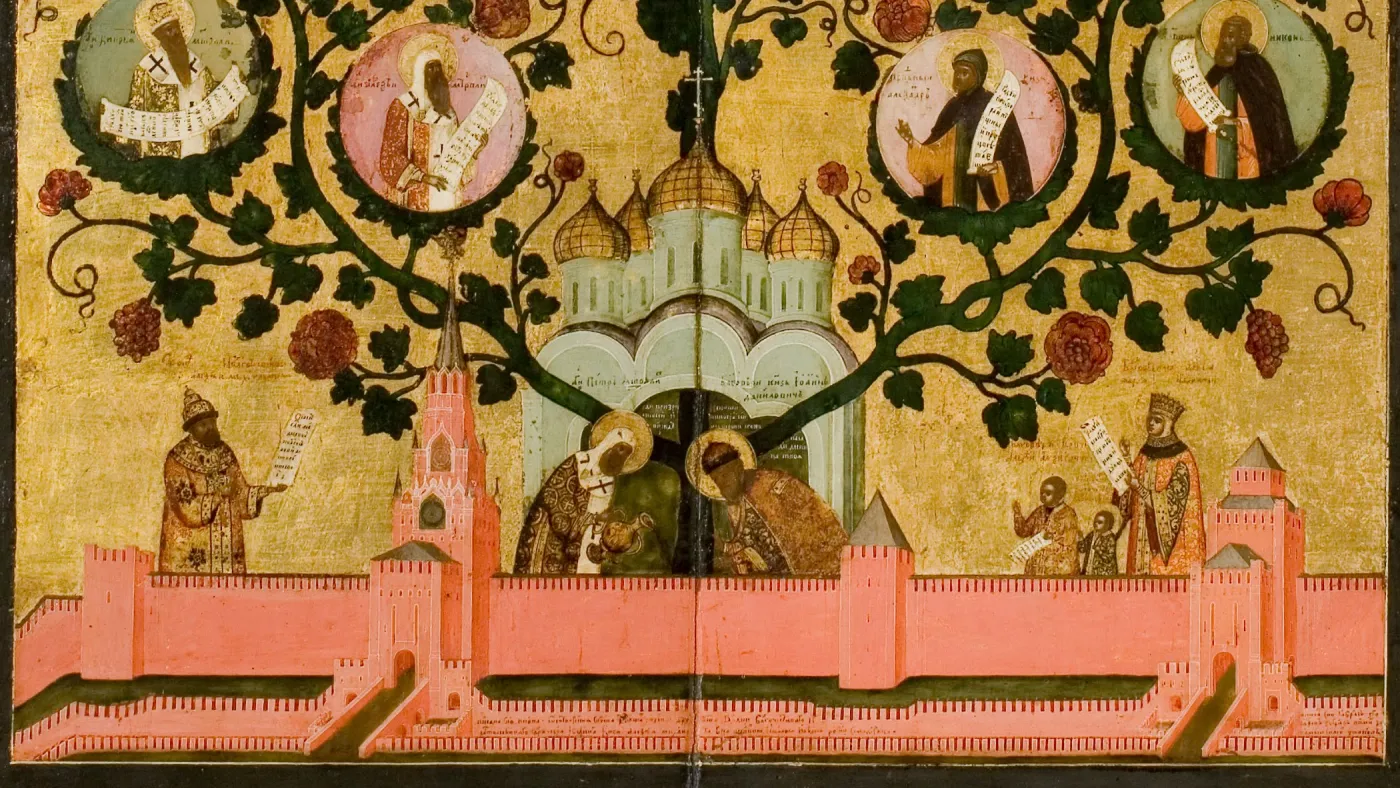
- Title image: Simon Ushakov, The Tree of the Muscovite State (Praise of Our Lady of Vladimir), 1668, State Tretyakov Gallery. Public domain, via Wikimedia Commons_-_Google_Art_Project.jpg), cropped to 16:9.
- Portrait of Alexis, Kremlin Armoury school, 1670s–1680s, State Historical Museum. Public domain, via Wikimedia Commons.
- Ernest Lissner, The Salt Riot, 1938. Public domain, via Wikimedia Commons.
- Equestrian portrait of Alexis, Kremlin Armoury school, c. 1675–1685, State Historical Museum. Public domain, via Wikimedia Commons.
- Ernest Lissner, The Copper Riot, 1938. Public domain, via Wikimedia Commons.