The oprichnina (oprichnina, from the Old Russian oprich', "apart" or "except") was the regime of terror that Ivan IV, known as Ivan the Terrible, imposed on Russia from 1565 to 1572. Ivan split the country in two. One part, the oprichnina, became his personal domain, with its own court, administration and army of oprichniki, men sworn to him alone; the rest, the zemshchina, was left to the old boyar council. From 1567 the oprichniki carried out mass killings of nobles, officials, churchmen and townspeople. Their worst crime was the sack of Novgorod in January and February 1570. In 1572 Ivan abolished the oprichnina and, very probably, forbade the word itself.
It is one of the most argued-over episodes in Russian history. Historians still disagree about what it was for, how many people it killed, and whether it had any purpose beyond the tsar's fear and rage. In 1947 Stalin praised it as a "progressive army". This article sets out what the sources say and what they do not. For Ivan's life as a whole, see Ivan the Terrible.
The oprichnina at a glance
| What | Ivan IV's personal domain, court and army, set apart from the rest of the state (the zemshchina) |
| Dates | Decree between 5 January and 15 February 1565; abolished autumn 1572 |
| Seat | Aleksandrova Sloboda (today Aleksandrov), north-east of Moscow, and a new palace in Moscow |
| Oprichniki | 1,000 at the start; several thousand by 1570 |
| Main events | Exile of princely families (1565); deposition and murder of Metropolitan Philip (1568–1569); death of Vladimir of Staritsa (1569); sack of Novgorod (1570); Moscow executions (25 July 1570) |
| Victims | Several thousand named in Ivan's own list of the dead; estimates for Novgorod alone range from about 2,000 to 15,000 |
| End | Moscow burned by the Crimean Tatars (1571); oprichnina abolished after the victory at Molodi (1572) |
What does oprichnina mean?
The word is older than Ivan's terror. It comes from oprich', an old preposition that Vladimir Dal's dictionary glosses as "except, besides; separately, apart". In medieval Rus', an oprichnina was a portion set apart, above all the share of a prince's lands left to his widow. The historian Vasily Klyuchevsky described such portions as "special separated possessions, chiefly those given in full ownership to widowed princesses"; Vladimir Kobrin notes that the widow's portion was set aside "oprich'", apart from all the other shares.
Ivan's oprichnina was a land "apart" in the same sense: a state within the state, belonging to the tsar personally. Its members were called oprichniki. Ivan's opponent Prince Andrei Kurbsky, who had fled to Lithuania, turned the word into a pun. He called them kromeshniki, from kromeshnaya t'ma, the "outer darkness" of hell; both oprich' and krome mean "except".
How did the oprichnina begin?
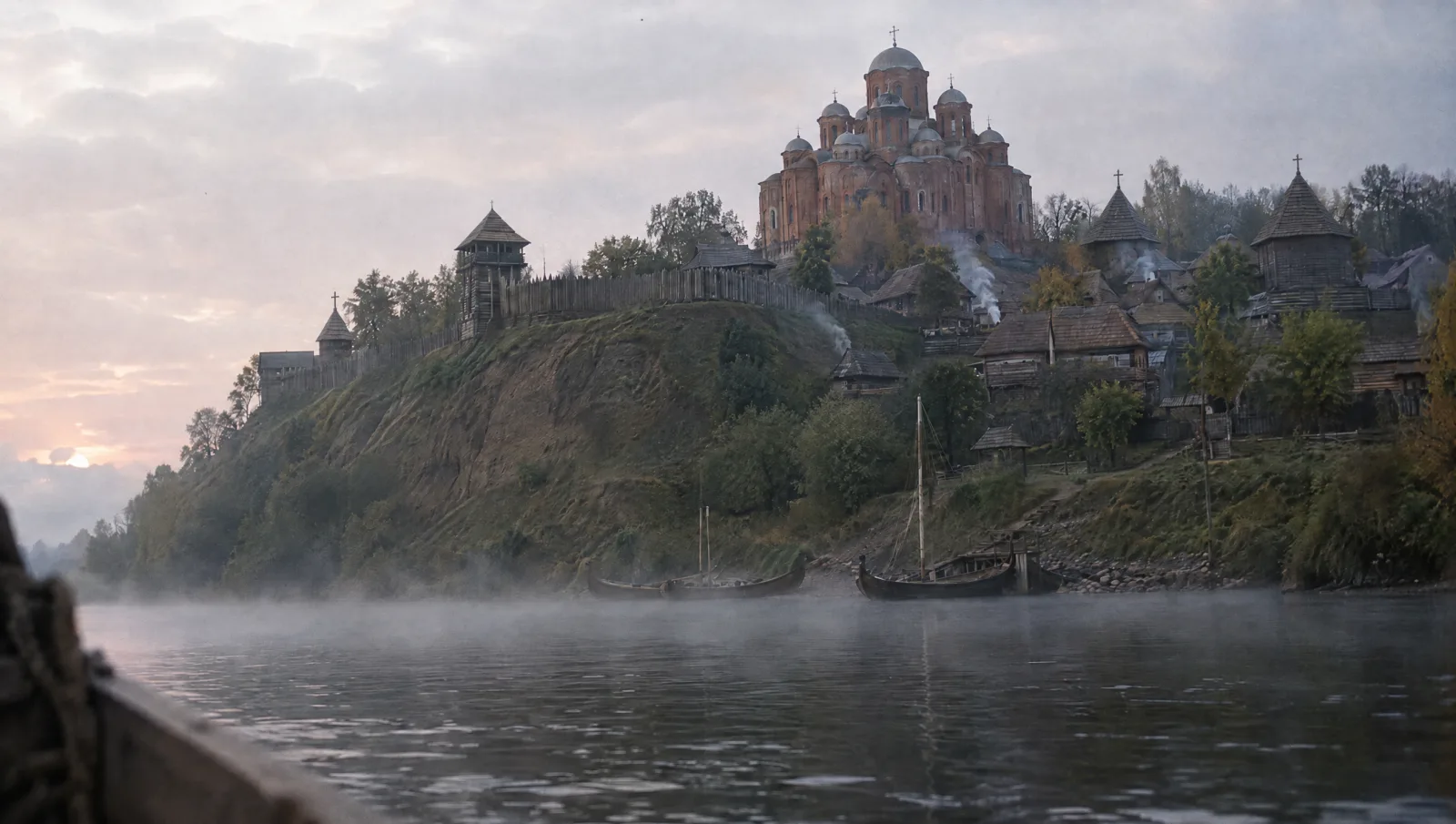
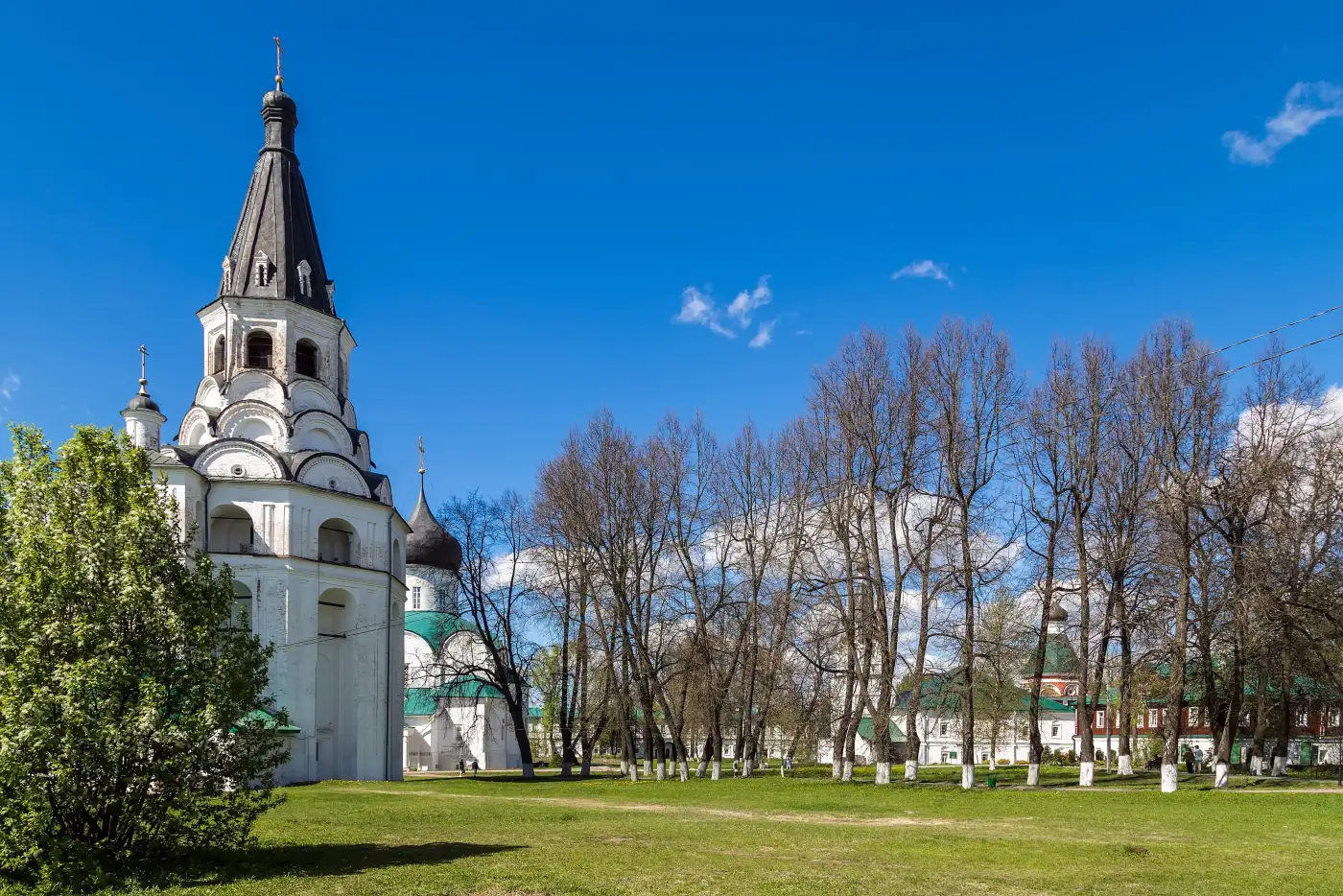
On Sunday 3 December 1564 Ivan left Moscow with his wife, his children, the icons and the treasury, and a picked escort of nobles. After weeks of wandering between his residences he settled at Aleksandrova Sloboda, a fortified residence north-east of Moscow. On 3 January 1565 two letters from him arrived in the capital. The first, addressed to the metropolitan, listed the "treasons" of the boyars, commanders and officials since his childhood and declared that, "from great sorrow of heart, not wishing to bear their many treasonous deeds", he had abandoned his realm "and gone to settle where God will direct him". The second, to the merchants and "all the Orthodox Christians" of Moscow, assured them that his anger was not directed at them. The Great Russian Encyclopedia calls this direct appeal to the townspeople the first of its kind in Russian history.
Frightened, the clergy and boyars went to Aleksandrova Sloboda and begged him to return. Ivan agreed on his own terms. The decree that followed, issued sometime between 5 January and 15 February 1565, does not survive. We know it only from a summary in the official Moscow chronicle. According to that summary, Ivan was to be free "to lay his disgrace on his traitors … and to execute others and take their property, and to make for himself in his realm an oprichnina: a court for himself and for all his household, separate". The zemshchina had to pay 100,000 roubles for the cost of setting it up.
The first executions followed in February 1565: Prince Alexander Gorbaty-Shuisky, with his son and father-in-law, and others. In May some 600–700 men from the princely families of Rostov, Yaroslavl and Starodub were exiled with their families to the newly conquered Kazan region and lost their estates. Counting families, the Great Russian Encyclopedia puts the number of people resettled and exiled in the spring and summer of 1565 at more than 6,500.
How was Russia divided?
The oprichnina took over whole districts, towns and streets, chosen for their income and strategic value. Ivan could add to it whenever he wished. Those who lived there and were not admitted to the oprichnina were expelled, and their lands went to oprichniki. The rest of the country, the zemshchina, kept its boyar council and its old offices. In Moscow, Ivan built a new oprichnina palace outside the Kremlin, on the site of today's Manezhnaya Square, with a stone wall and carved lions and eagles facing the zemshchina.
Contemporaries noticed the absurdity of a ruler at war with half his own state. When a Lithuanian envoy came to Moscow in April 1566, the officials escorting him were told what to say if he asked about it: "Our sovereign has no oprichnina at all … and if, not knowing, some call it the oprichnina, why believe the talk of peasants?" The historian Alexander Filyushkin (2025) points out that no Russian text of the time ever tried to justify or explain the oprichnina. The official chronicle, kept to 1568, mentions it only once. Filyushkin calls it "a figure of silence".
Who were the oprichniki?
The decree set their number at 1,000 men: princes, nobles and ordinary servitors chosen by a commission that included Aleksei Basmanov and Prince Afanasy Vyazemsky. The corps soon grew. The Great Russian Encyclopedia gives up to 7,000–8,000 men by the end of the 1560s, including up to 1,500 musketeers (streltsy), and an inner court of 300–350 by the end of the decade.
According to the Livonian nobles Johann Taube and Elert Kruse, who served Ivan before fleeing in 1571, each oprichnik swore an oath: "I swear to be faithful to the sovereign and grand prince … and not to keep silent about anything bad … I also swear not to eat or drink with the zemshchina and to have nothing in common with them." Oprichniki were forbidden to visit relatives in the zemshchina.
The men who led the terror were Aleksei Basmanov and his son Fyodor, Afanasy Vyazemsky, and above all Grigory Skuratov-Belsky, known as Malyuta Skuratov. Most of the first leaders were themselves destroyed in 1569–1570: Fyodor Basmanov died in prison, his father was killed, and Vyazemsky died under torture or in prison.
Did the oprichniki really carry dogs' heads and brooms?
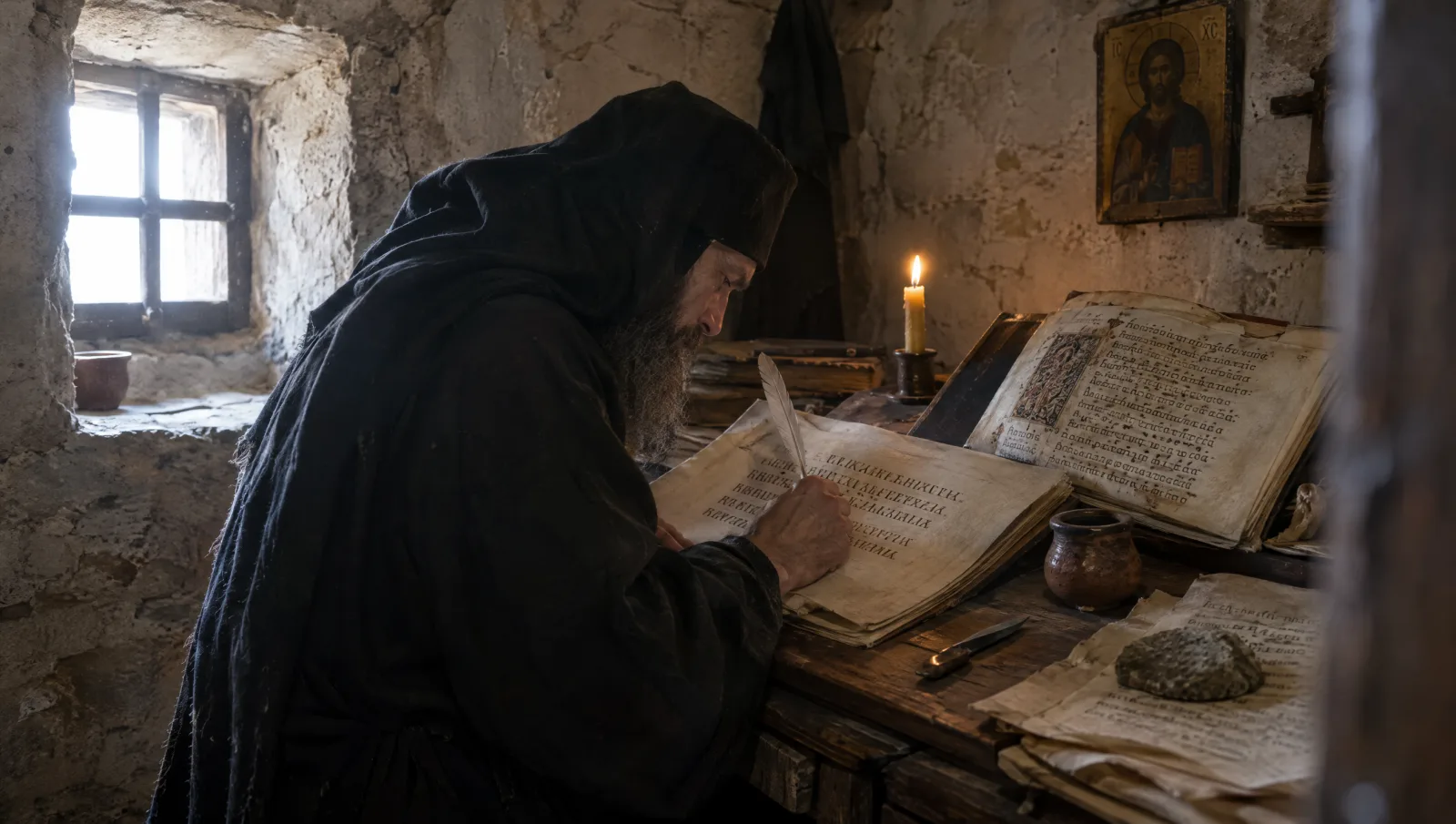
The image of the oprichnik with a dog's head and a broom comes mostly from one source. Taube and Kruse wrote in 1572 that the oprichniki had "dogs' heads on the horse's neck and a broom on the whip handle. This means that they first bite like dogs and then sweep everything superfluous out of the country." The German adventurer Heinrich von Staden, who served in the oprichnina himself, mentions only black coats and caps and "something like a tassel or a broom tied to a stick" by the quiver, "by which the oprichniki were recognised". The German interpreter Albert Schlichting describes black monastic clothing.
We have not found any sixteenth-century Russian text that describes the dogs' heads. The emblems may well be real, since two witnesses mention the broom, but the detail rests on foreign accounts written by men who had fled Ivan's service and wanted to blacken him.
Taube and Kruse also describe Aleksandrova Sloboda as a mock monastery. "He himself was the abbot, Prince Afanasy Vyazemsky the cellarer, Malyuta Skuratov the sexton … He himself rang the bells with both his sons and the sexton. Early in the morning, at 4 o'clock, all the brethren had to be in church." The historian Dmitry Volodikhin (2015) thinks this "brotherhood" may have lasted only months and doubts Taube and Kruse's reliability.
Metropolitan Philip and the protest of 1566–1568
In June 1566 about 300 servitors of the zemshchina petitioned Ivan to abolish the oprichnina. The sources disagree on what followed. The Orthodox Encyclopaedia (Pravoslavnaya entsiklopediya) says the initiators were executed and the others beaten. The Great Russian Encyclopedia says that only three were executed and the rest released after five days in prison.
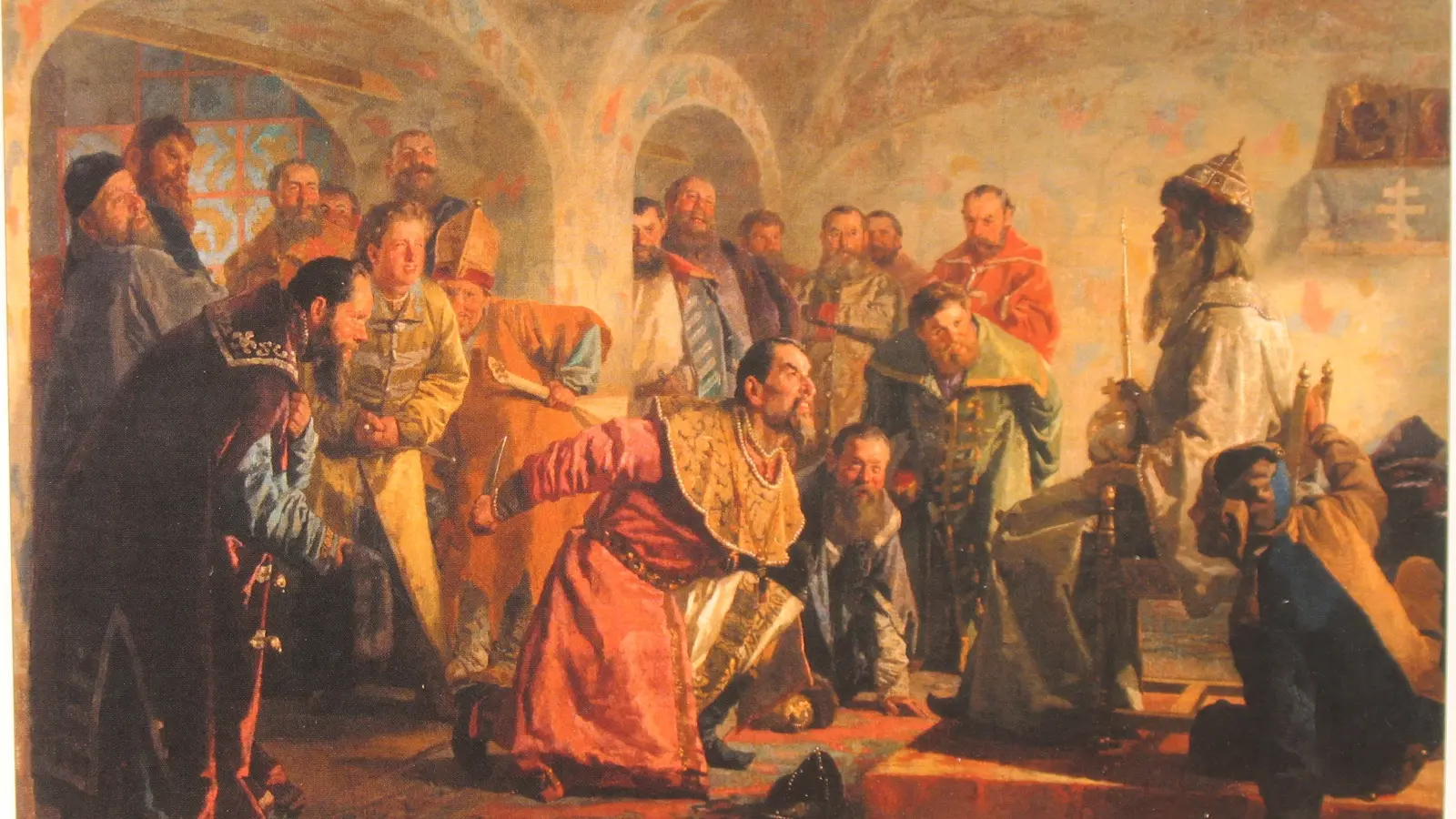
The new metropolitan, Philip (Fyodor Kolychev), former abbot of the Solovki monastery, was made to promise on 2 July 1566 "not to interfere in the oprichnina". In 1567 the terror turned to mass killing. Ivan accused the boyar Ivan Fyodorov of plotting against him. According to the Great Russian Encyclopedia, on 11 September 1568 Ivan stabbed him to death in the Kremlin palace with his own hand and had his body thrown out unburied. By the autumn of 1568, it estimates, the oprichniki had killed 650–700 people without trial.
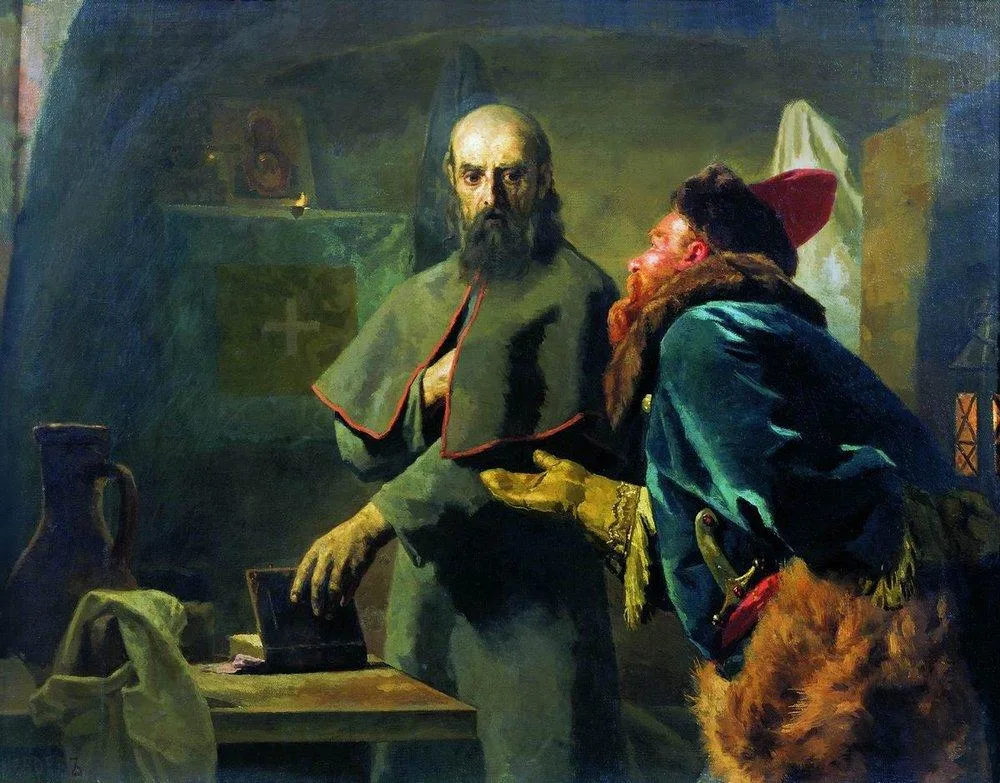
Philip spoke out. In March 1568 he publicly condemned the oprichnina in the Dormition Cathedral and refused to bless the tsar; the details come from his later Life and, the Russian Biographical Dictionary notes, "cannot be verified". In November 1568 a church council deposed him. On 8 November oprichniki under Aleksei Basmanov tore off his vestments during the liturgy and took him away on a sledge. He was imprisoned in the Otroch monastery in Tver. On 23 December 1569, as Ivan's army passed on its way to Novgorod, Malyuta Skuratov killed him in his cell. The Russian Biographical Dictionary says he was smothered with a pillow; Taube and Kruse say he was strangled with a rope and thrown into the Volga. Philip was later canonised, and in 1652 his relics were brought to Moscow.
What happened at Novgorod in 1570?
In the autumn of 1569 Ivan destroyed the last member of the dynasty who could be a rival. His cousin Prince Vladimir Andreyevich of Staritsa was summoned and, on 9 October 1569, forced to take poison with his wife and daughter. Ivan then accused Novgorod, Russia's second city, of planning to surrender to Poland-Lithuania.
In December 1569 the oprichnina army marched north, laying waste to Klin, Tver and Torzhok on the way. Its advance guard reached Novgorod on 2 January 1570 and sealed the city. Ivan arrived on 8 January. Archbishop Pimen met him on the bridge over the Volkhov; Ivan refused his blessing and accused him of treason. For the next weeks the oprichniki interrogated, tortured and killed, plundered the monasteries around the city and sacked the town itself. On 13 February Ivan summoned survivors, one man from each street, announced his pardon and blamed everything on Pimen.
The Novgorod Third Chronicle, written later in the city, describes how victims were thrown under the ice of the Volkhov:
For five weeks or more, day after day, up to 1,000 people of all ages were thrown into the water daily, and on some days up to 1,500, and it was a fortunate day when only 500 or 600 people were hurled into the river.
Heinrich von Staden, who took part, wrote: "For six whole weeks without a break, horror and misery lasted in this city!" Ivan went on to Pskov, where the abbot of the Pskov-Caves monastery was killed, but the city was spared a massacre.
How many people did the oprichnina kill?
Nobody knows. The figures depend on which source one trusts.
| Figure | What it counts | Source |
|---|---|---|
| 1,490 + 15 | killed by Malyuta Skuratov's detachment at Novgorod | Ivan's Synodikon of the disgraced, c. 1582–1583 |
| 2,170–2,180 | Novgorod victims recorded in the Synodikon; R. G. Skrynnikov allowed 3,000–4,000 | Skrynnikov, as summarised by Kobrin |
| 2,700–3,000 | killed in the whole campaign of 1569–1570, "to be considerably increased" for victims not recorded | Great Russian Encyclopedia (2014) |
| up to about 4,000 | names in Skrynnikov's reconstruction of the whole Synodikon | St Petersburg University biography of Skrynnikov |
| 10,000–15,000 | Kobrin's estimate for Novgorod alone | V. B. Kobrin (1989) |
| 2,770 | "more notable and rich" killed at Novgorod, not counting the common people | Albert Schlichting (1570/71) |
| 27,000 | killed at Novgorod | Taube and Kruse (1572) |
| 60,000 | killed at Novgorod | a Pskov chronicle, as cited by later historians |
| 700,000 | killed at Novgorod | Jerome Horsey (impossible for a city of its size) |
The Synodikon is the key source. In about 1582–1583, near the end of his life, Ivan sent monasteries lists of people he had had killed, with money for prayers for their souls. For Novgorod it records: "According to Malyuta's report, in the Novgorod expedition Malyuta finished off 1,490 people, and 15 people were finished off with arquebuses." Skrynnikov reconstructed the lists from their surviving copies and argued for the lower figures. Kobrin pointed out that the Synodikon lists only one detachment at Novgorod, and that a common grave opened there months later was said to hold 10,000 bodies.
Why did Ivan create the oprichnina?
Historians disagree.
- Tyranny and fear. Nikolai Karamzin saw it as the work of a suspicious tyrant. Vasily Klyuchevsky called it politically aimless: the oprichnina "was directed against persons, not against the order".
- A policy against the princes. Sergei Platonov argued that it was a deliberate attack on the old princely families and their hereditary estates. "The struggle against 'treason' was the aim; the oprichnina was the means."
- A weapon against the remnants of the appanage system. A. A. Zimin saw its targets as Vladimir of Staritsa, Novgorod's surviving liberties and the power of the Church.
- Terror without a programme. Vladimir Kobrin (1989) argued that the resettlements were never carried out on the scale once believed, and that the old picture of the boyars as a reactionary class opposed to centralisation does not fit recent research. He wrote that "the historian has no moral right to forgive the murder of tens of thousands of innocent people".
- A sacral mission. B. N. Floria, in the Orthodox Encyclopaedia (2023), stresses Ivan's sense of unlimited, God-given power and his aim of subordinating every estate to it.
The question of numbers and of purpose is also political. In a public debate in 2015 Dmitry Volodikhin counted "more than 4,000 documented" victims and defended the oprichnina's military record; V. D. Nazarov, author of the Great Russian Encyclopedia article, called it a terrorist despotism.
How did the oprichnina end?
The terror consumed its own makers. On 25 July 1570, in the market square of Moscow's Kitay-gorod, Ivan's men executed the keeper of the seal Ivan Viskovaty, the treasurer Nikita Funikov and other officials; the Great Russian Encyclopedia counts 220–250 executed in Moscow that summer.
The oprichnina's army failed its one real test. On 24 May 1571 Khan Devlet Giray of the Crimean Khanate broke through the Russian defences and burned Moscow; the oprichniki neither stopped him nor guarded the tsar. Heinrich von Staden dates the end of the oprichnina to that disaster.
The next year a joint army of the oprichnina and the zemshchina under the zemshchina boyar Prince Mikhail Vorotynsky defeated the Crimean Tatars at Molodi (30 July – 2 August 1572). The news reached Ivan in Novgorod on 6 August. In his will, written that summer, he left the decision to his sons: "And as to the oprichnina that I have made, that is at the will of my children, as it is more profitable to them." The Great Russian Encyclopedia concludes that Ivan decided to abolish it "most likely in mid-August" 1572, and that he "very probably" issued a decree on 1 September 1572 forbidding the word itself. Staden wrote that anyone who mentioned the oprichnina was "stripped to the waist and beaten with the knout in the market".
In 1575–1576 Ivan again split his court and realm, this time naming the baptised Tatar prince Simeon Bekbulatovich "grand prince of all Rus'". The Great Russian Encyclopedia stresses that this second division was not accompanied by mass terror.
Stalin, Eisenstein and the oprichnina
In the 1940s Stalin made Ivan IV a model of a strong, unifying ruler. Sergei Eisenstein made a film, Ivan the Terrible, in this spirit. Part II, which showed the oprichniki as a gang of masked killers, was banned. A resolution of the Communist Party's Central Committee of 4 September 1946 condemned Eisenstein for "presenting the progressive army of the oprichniki of Ivan the Terrible as a band of degenerates, like the American Ku Klux Klan".
On 26 February 1947 Stalin met Eisenstein and the actor Nikolai Cherkasov in the Kremlin. According to the record of the conversation, he told them: "The oprichnina is a royal army. Unlike the feudal army … a regular army was formed, a progressive army. You have shown the oprichniki as a Ku Klux Klan." He added: "One of Ivan the Terrible's mistakes was that he did not finish off five great feudal families." Part II was released only in 1958, after Stalin's death.
The word has stayed in Russian political language. In 2005 the philosopher Alexander Dugin founded a youth organisation that was to raise a "new oprichnina" to purge Russia of its enemies. A year later Vladimir Sorokin published Day of the Oprichnik (2006), a satirical novel set in 2028, in which a revived tsardom rules through masked oprichniki.
Common myths about the oprichnina
| Myth | What the evidence says |
|---|---|
| "Oprichnina" means secret police | The word means "apart"; it was first a territory and a court, then a corps |
| All oprichniki rode with dogs' heads and brooms | Only Taube and Kruse describe dogs' heads; Staden mentions only a broom-like tassel; no Russian source of the time describes them |
| The oprichnina was aimed only at the boyars | Victims included churchmen, officials, ordinary servitors and townspeople, and the oprichnina's own leaders |
| 60,000 or 700,000 people were killed at Novgorod | Later or foreign claims; the Synodikon records about 1,500 killed by Malyuta's detachment, and modern estimates range from about 2,000 to 15,000 |
| Simeon Bekbulatovich ruled during the oprichnina | His nominal reign was in 1575–1576, after the oprichnina was abolished |
| Soviet historians all followed Stalin's praise | Historians such as Stepan Veselovsky and Vladimir Kobrin rejected it |
Timeline of the oprichnina
| Date | Event |
|---|---|
| 3 December 1564 | Ivan leaves Moscow |
| 3 January 1565 | Ivan's two letters reach Moscow |
| January–February 1565 | Decree on the oprichnina |
| May 1565 | Princely families exiled to Kazan |
| June 1566 | Petition of some 300 servitors to abolish the oprichnina |
| 2 July 1566 | Philip promises not to interfere in the oprichnina |
| 11 September 1568 | Ivan kills the boyar Ivan Fyodorov |
| 8 November 1568 | Metropolitan Philip removed from the Dormition Cathedral |
| 9 October 1569 | Vladimir of Staritsa forced to take poison |
| 23 December 1569 | Philip killed by Malyuta Skuratov in Tver |
| 2 January – 13 February 1570 | Sack of Novgorod |
| 25 July 1570 | Mass executions in Moscow |
| 24 May 1571 | Crimean Tatars burn Moscow |
| 30 July – 2 August 1572 | Battle of Molodi |
| August–September 1572 | Oprichnina abolished; the word forbidden |
| c. 1582–1583 | Ivan's Synodikon of the disgraced |
| 4 September 1946 | Central Committee condemns Eisenstein's film |
| 26 February 1947 | Stalin calls the oprichnina a "progressive army" |
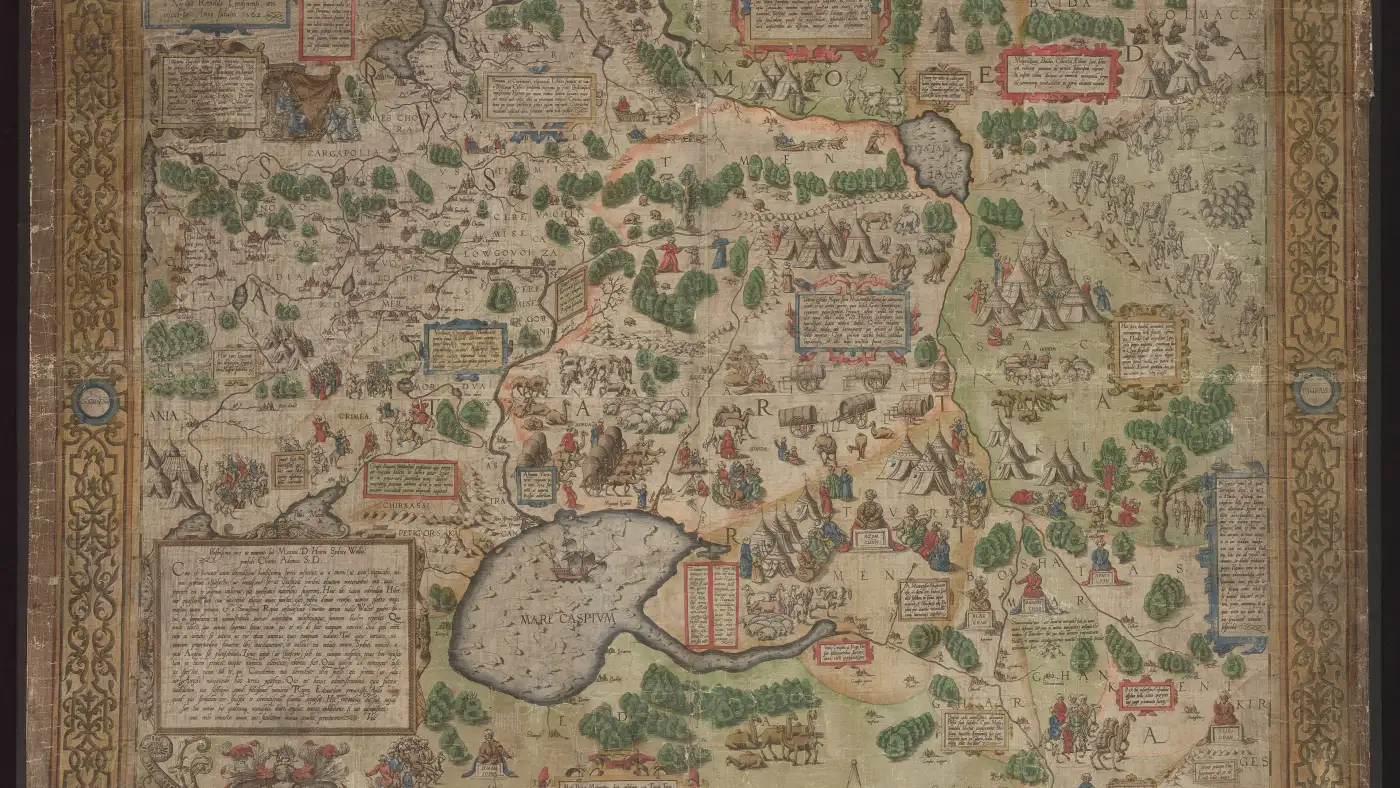
What the map shows
At 1565 the Tsardom of Russia is fighting Lithuania and Poland for Livonia; in 1569 the two will unite as the Polish–Lithuanian Commonwealth. At 1570, as the oprichniki sack Novgorod, the Crimean Khanate in the south is preparing the raid that will burn Moscow the next year. At 1572, the year the oprichnina was abolished, the Tsardom has survived both. The famine and civil war that followed a generation later are told in The Time of Troubles.
Sources
Primary sources
- Johann Taube and Elert Kruse, letter to Gotthard Kettler (1572), Russian trans. M. G. Roginskii, Russkii istoricheskii zhurnal 8 (1922): https://www.vostlit.info/Texts/rus10/Taube_Kruse/text.phtml
- Heinrich von Staden, Aufzeichnungen über den Moskauer Staat, Russian trans. I. I. Polosin, O Moskve Ivana Groznogo (Moscow, 1925): https://www.vostlit.info/Texts/rus6/Staden/text3.phtml
- Albert Schlichting, Novoe izvestie o Rossii vremeni Ivana Groznogo, trans. A. I. Malein (Leningrad, 1934): https://www.vostlit.info/Texts/rus10/Schlichting/text.phtml
- Novgorod Third Chronicle, account of 1570, in G. Vernadsky (ed.), A Source Book for Russian History from Early Times to 1917, vol. 1 (New Haven, 1972)
- Jerome Horsey, Travels, in E. A. Bond (ed.), Russia at the Close of the Sixteenth Century (London: Hakluyt Society, 1856)
- Record of the conversation of I. V. Stalin, A. A. Zhdanov and V. M. Molotov with S. M. Eisenstein and N. K. Cherkasov, 26 February 1947, in I. V. Stalin, Sochineniia, vol. 18 (Tver, 2006), pp. 433–440
- Resolution of the Orgburo of the Central Committee of the VKP(b) "O kinofil'me 'Bol'shaia zhizn''", 4 September 1946: https://www.hist.msu.ru/ER/Etext/USSR/cinema.htm
Studies and reference works
- V. D. Nazarov, "Oprichnina", Bol'shaia rossiiskaia entsiklopediia, vol. 24 (2014), p. 263
- B. N. Floria, "Oprichnina", Pravoslavnaia entsiklopediia, vol. 53 (2023): https://www.pravenc.ru/text/2581441.html
- "Ioann IV Vasil'evich", Pravoslavnaia entsiklopediia, vol. 23: https://www.pravenc.ru/text/469782.html
- A. Filyushkin, "Oprichnina without Justifications or Explanations", Quaestio Rossica 13:2 (2025), 542–558, doi:10.15826/qr.2025.2.981
- V. B. Kobrin, Ivan Groznyi (Moscow, 1989), ch. 2
- R. G. Skrynnikov, Ivan Groznyi, chapter "Novgorodskii razgrom"
- V. O. Kliuchevskii, Kurs russkoi istorii, lecture 29
- S. F. Platonov, Lektsii po russkoi istorii, "Oprichnina"
- N. M. Karamzin, Istoriia gosudarstva Rossiiskogo, vol. 9
- "Filipp (Kolychov)" and "Skuratov-Bel'skii", Russkii biograficheskii slovar'
- V. I. Dal', Tolkovyi slovar' zhivogo velikorusskogo iazyka, 2nd ed. (1881), "Oprich'"
- "Oprichnina: terror ili reforma?", Lenta.ru, 13 June 2015: https://lenta.ru/articles/2015/06/13/oprichnina/
- A. Helvert, "Antiutopicheskii roman Den' oprichnika Vladimira Sorokina i 'Novaia oprichnina' Aleksandra Dugina", Forum noveishei vostochnoevropeiskoi istorii i kul'tury 2 (2013)
- T. Shishkova, "Ivan Groznyi" (Part II), Kommersant Weekend, 3 September 2021: https://kommersant.ru/doc/4958136
Image credits
- Title image: Nikolai Nevrev, Oprichniki, late 1890s. Public domain, via Wikimedia Commons, cropped to 16:9.
- Aleksandrova Sloboda. Photo: Mike1979 Russia, 2024, CC BY-SA 4.0, via Wikimedia Commons.
- Nikolai Nevrev, Metropolitan Philip and Malyuta Skuratov, 1898. Public domain, via Wikimedia Commons.
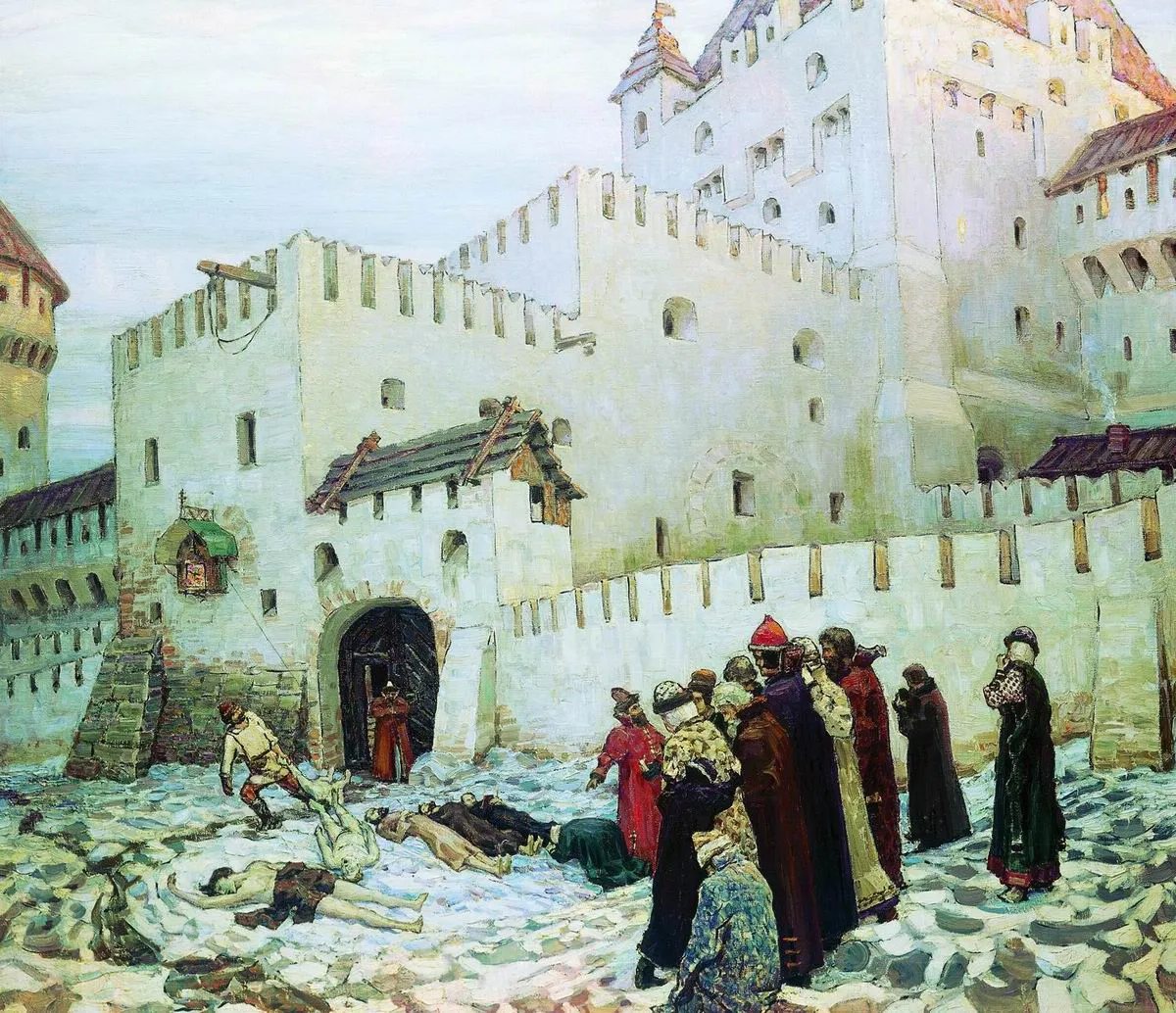
- Apollinary Vasnetsov, Moscow Torture Chamber, End of the 16th Century, 1912. Public domain, via Wikimedia Commons.