The Christianization of Kievan Rus' took about two and a half centuries, not a single summer. Some Rus' accepted Byzantine clergy in the 860s, and a Christian community had its own church in Kyiv by AD 944. Vladimir's baptism of Kyiv in AD 988 made Christianity the religion of the ruler and his towns, but pagan magicians were still leading crowds in 1071, and missionaries were still being killed in the forests in the early twelfth century.
This article follows that slow process: the Christians who came before Vladimir, the spread of the faith beyond Kyiv, the resistance, the building of a church, and what archaeology shows about ordinary people.
Were there Christians in Rus' before 988?
Yes, and the earliest evidence is Byzantine. In an encyclical letter of AD 866 or 867, Patriarch Photius of Constantinople boasted that the Rus', who had attacked his city in AD 860, "are abandoning their heathen faith and are converting to Christianity, receiving from us bishops and pastors as well as all Christian customs" (English translation, University of Oregon). This "first baptism" of a group of Rus' left no church organisation that later sources can trace.
Rus' merchants knew the advantages of the faith. The Persian geographer Ibn Khurradadhbih, writing in Arabic in the ninth century, says that those who travelled with their goods from Jurjan to Baghdad "pretend to be Christians and, like them, pay the poll tax" (Lunde and Stone translation). Christians in the caliphate paid that tax as protected non-Muslims, a status that pagans did not have.
By the 940s there were Christians at the prince's court. When Prince Igor's men swore to the treaty of AD 944 with the Byzantine Empire, the pagans swore on a hill before a statue of Perun, while "the Christian Russes took oath in the church of St. Elias", near the quarter of the Khazars. The chronicler adds: "This was, in fact, a parish church, since many of the Varangians were Christians." Igor's widow Olga was baptised soon afterwards, in the 940s or 950s. Our article on Olga covers her baptism and the debate over its date.
Being a Christian in pagan Kyiv could be dangerous. Under AD 983 the Primary Chronicle tells of a Christian Varangian who had come from Greece. When the lot for a human sacrifice fell on his son, he refused to hand him over: "These are not gods, but only idols of wood." A crowd pulled down the porch on which father and son were standing and killed them, "and no one knows where they are buried". The father and son were later venerated as the first martyrs of Rus'.
What did the baptism of 988 change?
The story of Vladimir's choice is told in detail in our article on why Vladimir the Great converted. In short, he accepted baptism as the price of a marriage alliance with the Byzantine emperor Basil II, took Anna Porphyrogenita as his bride and had the people of Kyiv baptised in the Dnieper in AD 988. Idols came down, a great stone church went up, and Greek clergy arrived from Byzantium and from Korsun in Crimea.
What changed at once was the faith of the ruler and of his capital. Everything else took generations. The chronicler, writing in the early twelfth century, saw it as a farming job shared between father and son. Vladimir "plowed and harrowed the soil when he enlightened Rus' through baptism, while this prince", his son Yaroslav the Wise, "sowed the hearts of the faithful with the written word, and we in turn reap the harvest by receiving the teaching of books."
The new Christian state also supported missions. In the winter of 1007–1008 the German missionary bishop Bruno of Querfurt stayed a month with "the lord of the Rus'" on his way to the pagan Pechenegs of the steppe. Vladimir tried to talk him out of going, then escorted him for two days to the fenced edge of his realm. After five months on the steppe, Bruno wrote to Henry II, the German king and ruler of the Holy Roman Empire, that "Christianity had been made in around thirty souls", and that "we consecrated one of our number as bishop, whom the lord of the Rus' placed with his son in the midst of the land" (Bruno's letter, trans. W. L. North).
How did Christianity reach Novgorod and the north?
Slowly, and from the top down. The Internet Encyclopedia of Ukraine sums it up: "The population of Kyivan Rus' along the main water routes was baptized gradually. The larger centers were converted first, followed by the outlying regions."
Novgorod was next in importance after Kyiv. A Novgorod chronicle (the younger redaction of the Novgorod First Chronicle, preserved in fifteenth-century copies) records under AD 989 that Ioakim of Korsun came to the city, destroyed the places of sacrifice, cut down the idol of Perun and had it dragged into the river Volkhov. Ioakim became Novgorod's first bishop and died in 1030.
Where Novgorod's Perun had stood is uncertain. In 1951–1952 the archaeologist Valentin Sedov excavated at Peryn, a low hill where the Volkhov flows out of Lake Ilmen. He found a circular platform about 21 metres across, ringed by a ditch with eight bulges in which fires had burned, and declared it "undoubtedly" Perun's shrine. Other archaeologists, among them Vladimir Konetsky and Lev Klein, have argued that it was a burial mound.
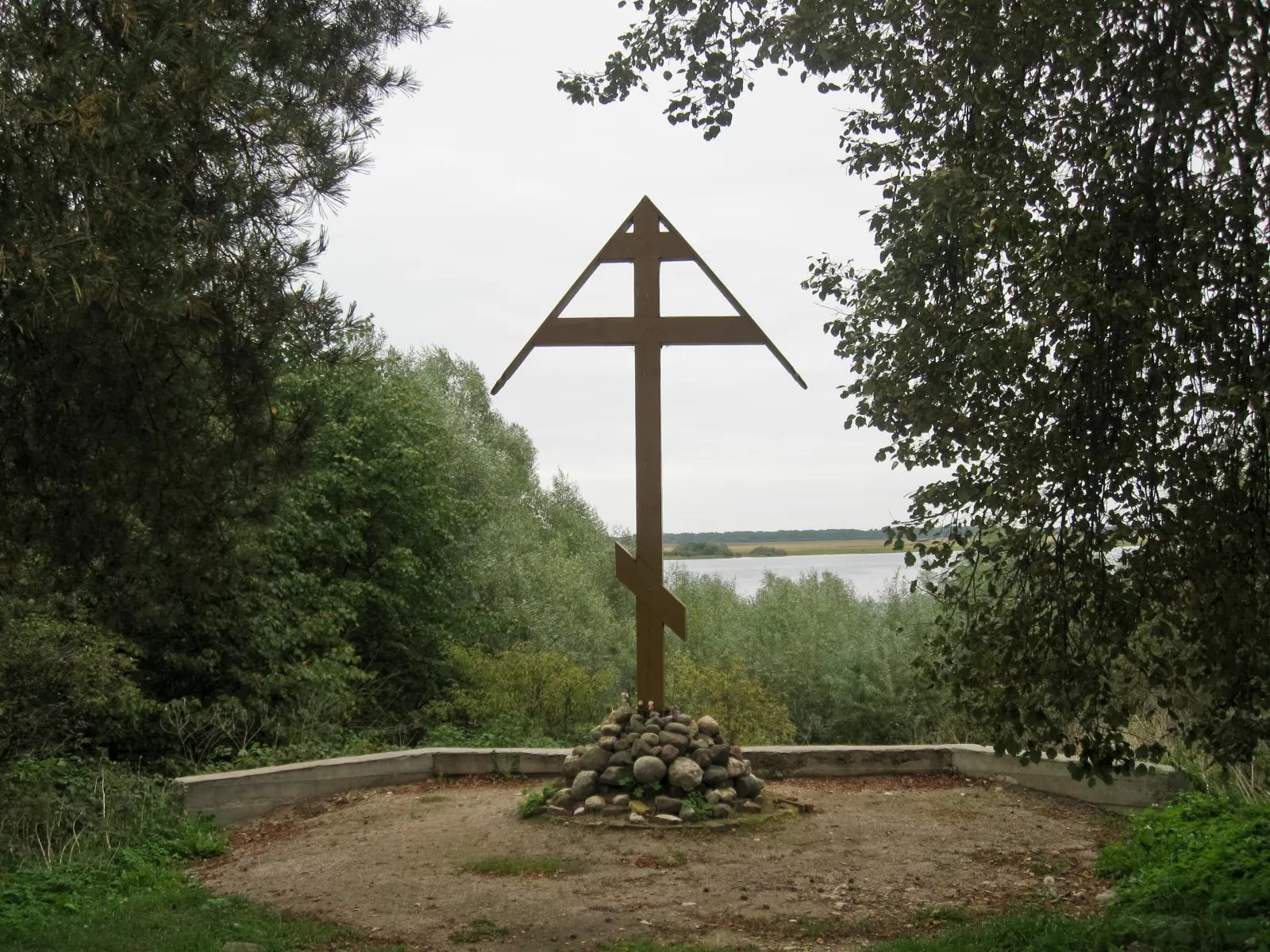
A more violent story is often repeated: that "Putyata baptised with the sword, and Dobrynya with fire", after Novgorod rose against the new faith. It comes from the so-called Joachim Chronicle, which survives only in the work of the eighteenth-century historian Vasily Tatishchev. No manuscript has ever been found, and as our article on Oleg explains, historians treat Tatishchev's unique reports as unreliable at best.
Further from the rivers, the old ways lasted much longer. The Primary Chronicle, compiled around 1113, describes how several East Slavic tribes burned their dead on a pyre, put the bones in a small urn and set it "upon a post by the roadside, even as the Vyatichians do to this day". The Vyatichi lived in the forests of the upper Oka basin, south of modern Moscow. According to the Internet Encyclopedia of Ukraine, a monk of the Kyiv Caves Monastery named Kuksha was martyred among them in 1113 while trying to convert them. In the Rostov region, the stories of Bishop Leontius and of Abraham of Rostov, who is said to have smashed an idol of Veles, come from much later saints' lives, and their dates are uncertain.
Who were the volkhvy, and why did they rise up?
The chronicle calls them volkhvy: magicians or pagan seers. Cross and Sherbowitz-Wetzor translate the word as "magicians". Most appear in the north and north-east, where other evidence suggests that Christianity was thinnest, and two of the outbreaks came in years of famine.
In 1024, "magicians appeared in Suzdal', and killed old people by satanic inspiration and devil worship, saying that they would spoil the harvest". There was famine across the region, and the people went down the Volga to Volga Bulgaria to buy grain. Yaroslav the Wise came, seized the magicians and punished some, saying that God sends "hunger, pest, drought, or some other chastisement" in proportion to a land's sins.
The chronicle's richest material comes from 1071. In Kyiv a magician predicted that within five years the Dnieper would flow backwards and the countries of the world would change places. He then disappeared "in the course of one night". During a famine in the district of Rostov, two magicians from Yaroslavl went along the Volga picking out the leading women and blaming them for the shortage of grain, honey, fish or furs. They "stabbed them in the back and drew out from their bodies grain or fish", and took the women's property. At Beloozero they met Yan, son of Vyshata, who was collecting tribute for Prince Svyatoslav.
Yan's interrogation of the two prisoners is one of the few places where a pagan cosmology survives, if only through a hostile Christian filter. According to the chronicle, the magicians explained that "God washed himself in the bath, and after perspiring, dried himself with straw and threw it out of heaven upon the earth"; then Satan and God argued over who should make man from it, "the devil made man, and God set a soul in him". Yan handed them over to men whose mothers and sisters they had killed, and they were hanged from an oak. The story probably came straight from Yan himself: under 1106 the chronicler says of him, "I heard from him many stories which I have set down in this chronicle as I heard them from his lips."
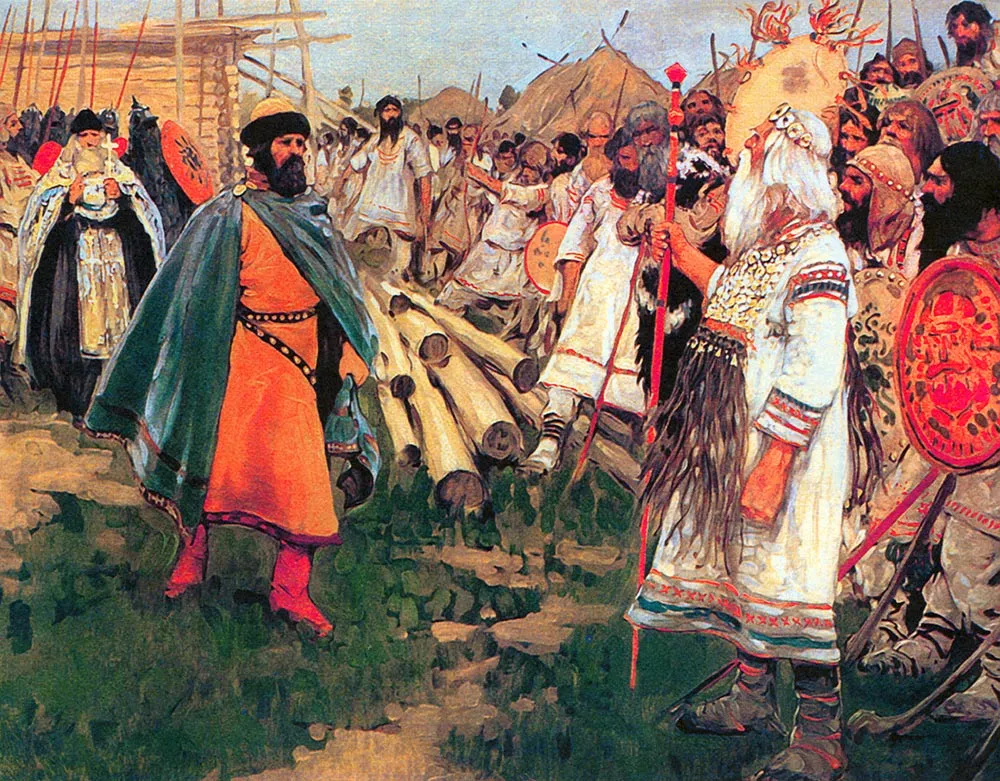
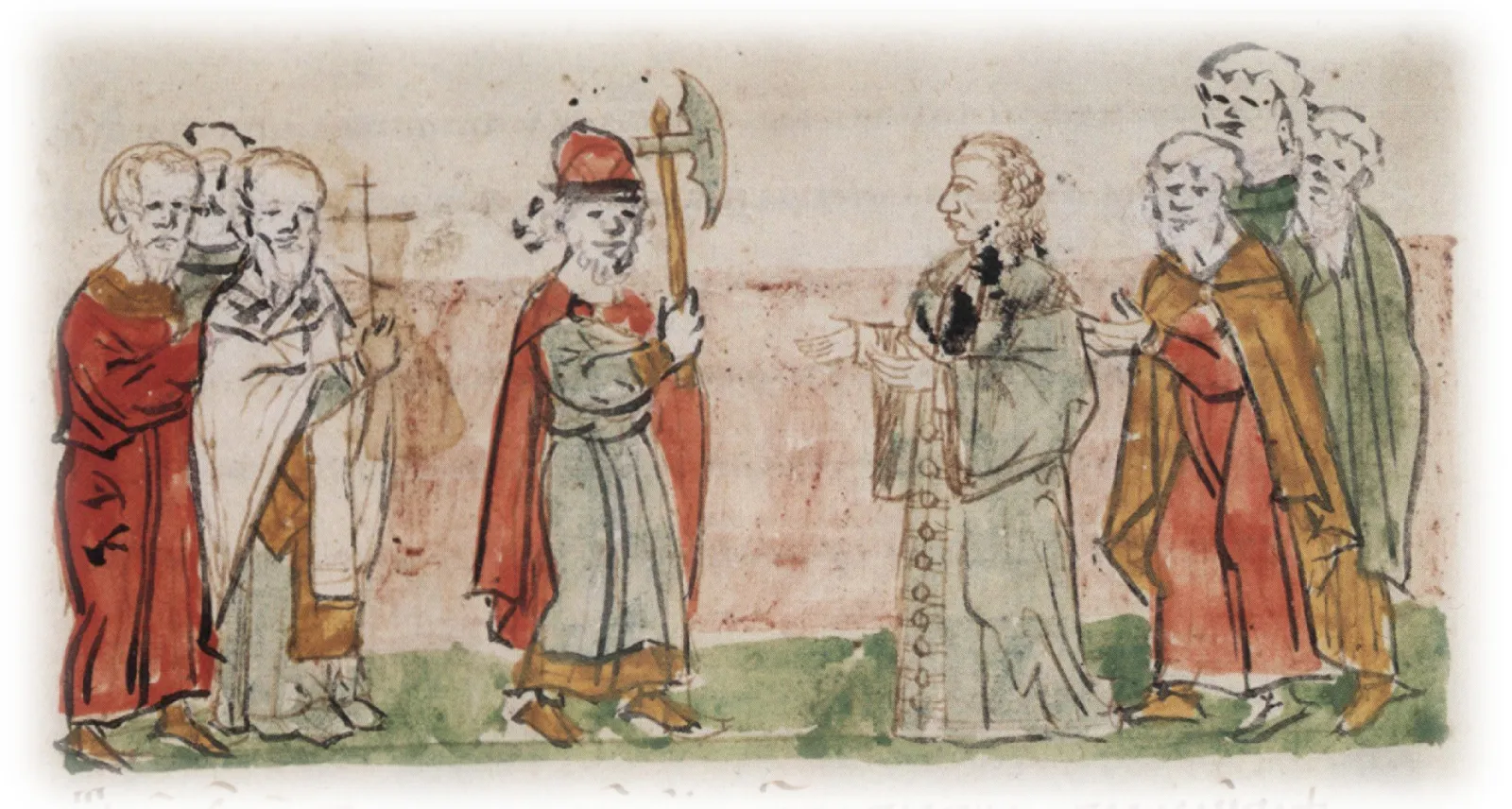
In Novgorod a magician drew almost the whole city against the faith, announcing that he would walk across the Volkhov. The people wanted to kill their bishop. The bishop put on his vestments, took up his cross and declared: "Whosoever has faith in the magician, let him follow him, but whoever is a loyal Christian, let him come to the Cross." Prince Gleb and his retinue stood by the bishop, "while the common people all followed the magician". Gleb then walked up to the magician with an axe hidden under his garments and asked whether he knew what would happen that day. When the magician answered that he would perform great miracles, Gleb killed him, "and the people dispersed".
These episodes show how the monk-chronicler saw paganism: as devil worship, defeated by firm princes. They are weaker evidence of any organised pagan church. They do show that, eighty years after the baptism of Kyiv, a town crowd in Novgorod could still choose a magician over its bishop.
How was the church of Rus' organised?
The church was built from the top down, and its first decades are poorly recorded. The first metropolitan of Kyiv (the head of the church of Rus') whom the Primary Chronicle names is Theopemptos, a Greek who consecrated Vladimir's Church of the Holy Virgin (the Church of the Tithes) in 1039. His lead seal, the oldest of the Kyiv metropolitans' seals, reads in Greek "God Help Theopemptos, the Metropolitan of Rus'". Later traditions name earlier metropolitans, Michael or Leo, but Cross and Sherbowitz-Wetzor note that none of the oldest chronicle texts names any metropolitan in Kyiv before Theopemptos. Constantinople appointed most of them. According to the Internet Encyclopedia of Ukraine, "only 2 of the first 24 metropolitans were of local origin", and the first of them was Hilarion, installed by Yaroslav in 1051.
Bishops followed the princes into the main towns. The chronicle rarely records when a bishopric was founded, but it does show when each see first has a named bishop:
| Bishopric | First bishop named in the Primary Chronicle | Year |
|---|---|---|
| Novgorod | Luka Zhidyata (after Ioakim, known from Novgorod tradition) | 1036 |
| Pereyaslavl | Peter | 1072 |
| Yuriev (on the Ros) | Michael | 1072 |
| Belgorod (near Kyiv) | Luke | 1089 |
| Rostov | Isaiah | 1089 |
| Chernihiv | John | 1089 |
| Volodymyr (in Volhynia) | Stephen | 1091 |
| Polotsk | Menas | 1105 |
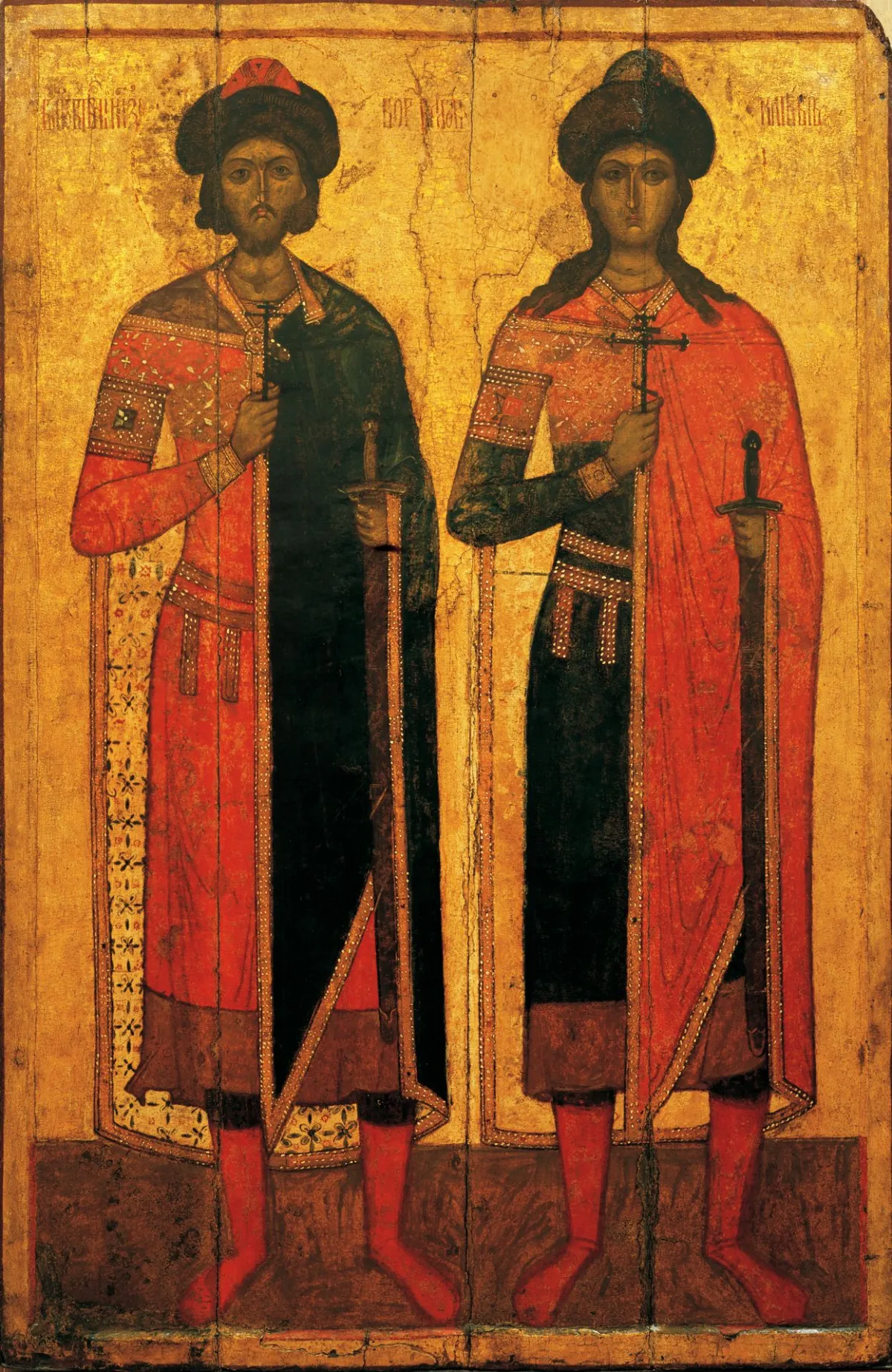
Some bishops came out of the Kyiv Caves Monastery, the realm's school for clergy. Stephen of Volodymyr, who died in 1094, "had formerly been Prior of the Crypt Monastery". In 1072 the metropolitan, the bishops and the priors of the monasteries gathered at Vyshhorod to move the relics of Boris and Gleb, Vladimir's murdered sons, into a new church (our article on Yaroslav tells their story). Rus' now had saints of its own. The chronicle even admits that the Greek metropolitan George "had been uncertain in his faith concerning the relics", until he smelled their fragrance and begged forgiveness.
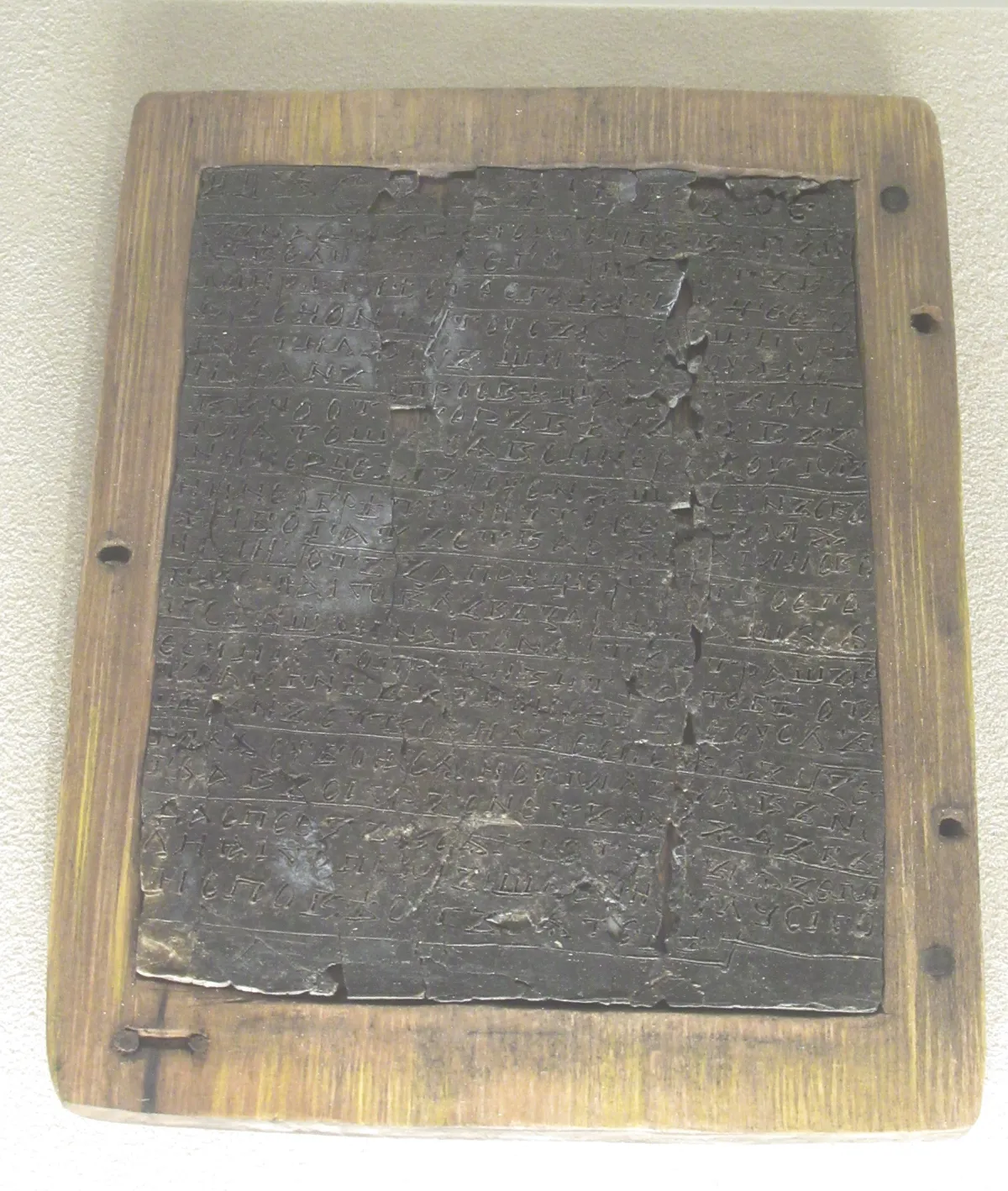
Christianity also brought books. Yaroslav "assembled many scribes, and translated from Greek into Slavic", the chronicle says under 1037. The oldest surviving book of Rus' is a set of three wax-covered wooden tablets found in Novgorod on 13 July 2000. They carry Psalms 75 and 76 and lay beneath a timber roadway tree-ring dated to 1036, which puts them in the first quarter of the eleventh century (Zaliznyak and Yanin, 2001).
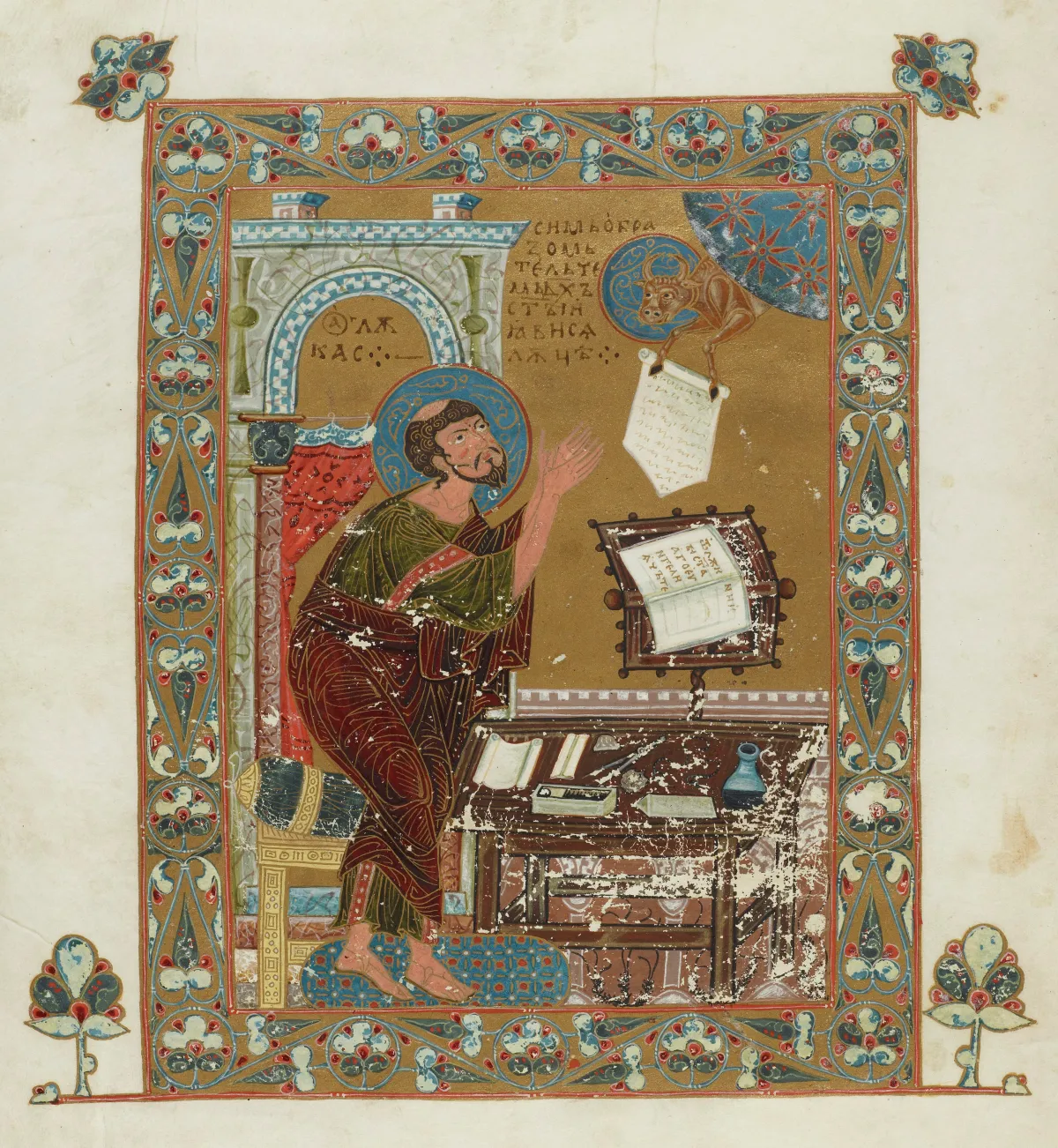
The oldest dated book of Rus', the Ostromir Gospels, was copied in 1056 or 1057 by the deacon Gregory for Ostromir, the governor of Novgorod, probably as a gift for a monastery.
What do graves reveal about conversion?
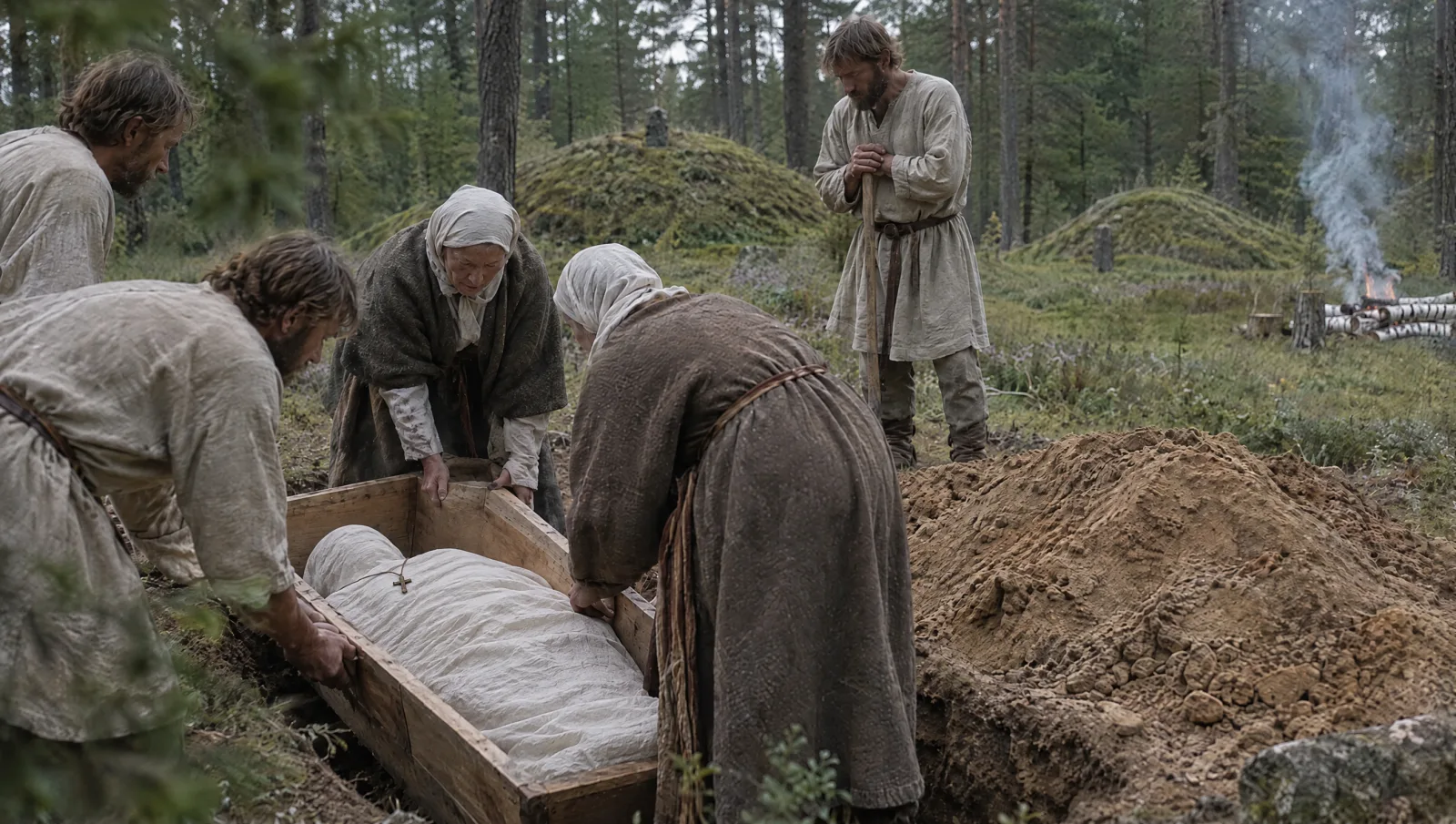
The chronicle tells the story from the top. Graves show it from below. In the countryside people went on raising burial mounds (barrows) over their dead until the Mongol invasion of 1237–1240, but what lay inside them changed. Cremation gave way to burial of the body, usually with the head to the west and often with the hands folded on the chest, a position archaeologists regard as a Christian feature.
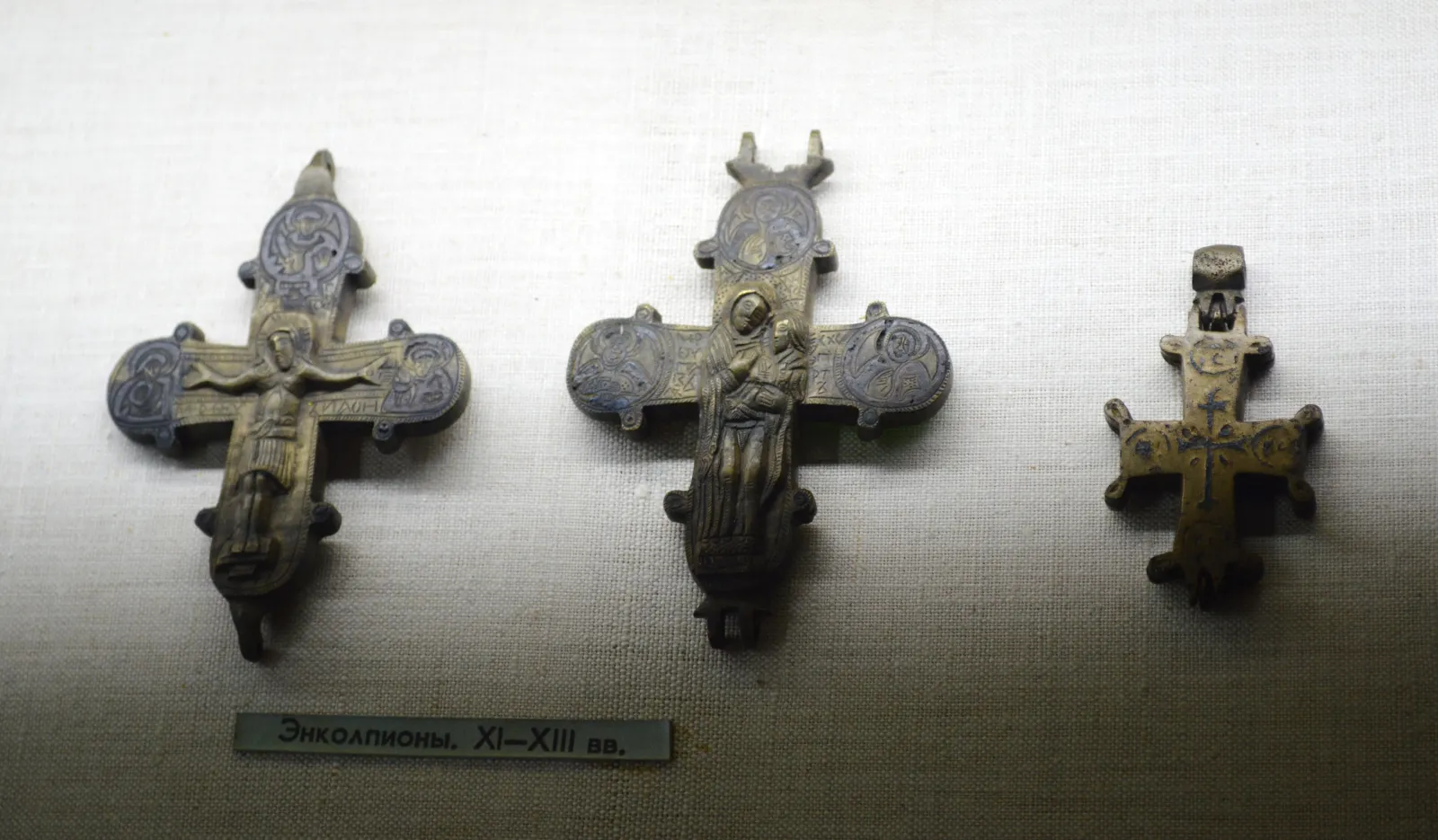
The change was neither neat nor quick. The Ukrainian archaeologist Dmytro Bibikov writes that Christian burials in Rus' "preserved an obvious pagan 'veil' as late as the Mongol invasion", in the form of mounds, special grave structures and grave goods, and that its disappearance "was quite a slow process spreading from the main administrative centres down to the periphery" (Bibikov, 2024). He studied a rare rite of "partial cremation", in which the body was only charred by the funeral pyre. More than half of the known examples lie near fortresses founded under Vladimir, and most date from the late tenth to the early eleventh century. The coffins, the position of the hands and the dates lead him to conclude that these people "were believed to be Christians". Fire kept its place: according to figures by the archaeologist O. P. Motsia, which Bibikov cites, charcoal and ash were found in the mound over more than 370 barrow burials of the eleventh to thirteenth centuries, 9% of those studied.
Did the Rus' secretly stay pagan? The "double faith" debate
Since the 1860s, historians have described Russian religion with the word dvoeverie, "double faith": Christians who kept their pagan gods under a Christian surface. The historian Stella Rock, one of the scholars who began to question the idea in the 1990s and 2000s, writes that the term has been used for the "conscious or unconscious preservation of pagan beliefs and/or rituals by Christian communities". That meaning is supported "in part" by one medieval text, the eleventh-century Sermon of the Christlover (Rock, Encyclopedia of Russian History).
Elsewhere in medieval Russian writing the word means being "in two minds", or plain hypocrisy. Its usual targets were "Lutherans and those fraternizing with Roman Catholics, rather than semiconverted heathens". The many other uses, Rock argues, "lead one to conclude that the term was not originally understood in this way". She develops the case in her book Popular Religion in Russia: 'Double Belief' and the Making of an Academic Myth (2007).
None of this means the Rus' were model Christians by 1100. It means their mixed practices, such as fire at a Christian funeral, are better explained the way Bibikov explains a burnt coffin: as "people's prejudices (and not manifestation of any deliberate paganistic response)". Nor was it a specifically Russian problem, as the old theory implied: Bibikov notes that some Christian characters in the Icelandic sagas "did not hesitate to burn" the bodies of the malicious dead.
How long did it take?
Historians put the turning point differently for town and country. The princely towns along the river routes had bishops, churches, monasteries and books by the later eleventh century. The forest villages of the north and east, among the Vyatichi and around Rostov and Beloozero, were still being converted in the early twelfth century, and their burial rites changed more slowly still.
| Date | Event | Source |
|---|---|---|
| AD 866/867 | Photius reports that the Rus' have accepted bishops | Photius, Encyclical |
| AD 944 | Christian Rus' swear the treaty in the church of St Elias in Kyiv | Primary Chronicle |
| AD 983 | A Christian Varangian and his son are killed in Kyiv | Primary Chronicle |
| AD 988 | Vladimir has Kyiv baptised in the Dnieper | Primary Chronicle |
| AD 989 | Ioakim of Korsun in Novgorod; Perun's idol thrown into the Volkhov | Novgorod First Chronicle (younger redaction) |
| 1008 | Bruno of Querfurt sets out from Kyiv to the Pechenegs | Bruno, Letter to Henry II |
| 1024 | Magicians in Suzdal during a famine | Primary Chronicle |
| 1039 | Metropolitan Theopemptos in Kyiv | Primary Chronicle |
| 1051 | Hilarion, first metropolitan from Rus' | Primary Chronicle |
| 1071 | Magicians in Kyiv, the Rostov region and Novgorod | Primary Chronicle |
| 1072 | Relics of Boris and Gleb moved to Vyshhorod | Primary Chronicle |
| c. 1113 | Kuksha killed among the Vyatichi | Kyiv Caves Paterik |
What the map shows next
At 1000 on the map, Kievan Rus' stretches from the Baltic to the steppe under a Christian prince, while its neighbours were choosing too. Bulgaria had been Christian since the ninth century and the First Bulgarian Empire was falling to Byzantium, while Poland and Hungary took the Latin faith. By 1100 on the map the realm has split into principalities, many of them with their own bishop, from Polotsk and Volhynia to Rostov-Suzdal in the north-east, where the forests were still being converted. By 1240 on the map the Mongols had taken Kyiv, and the church, still headed by a metropolitan "of Kyiv", was one of the few institutions that the old Rus' lands shared.
Sources
Primary sources (in translation)
- The Russian Primary Chronicle: Laurentian Text, trans. and ed. Samuel Hazzard Cross and Olgerd P. Sherbowitz-Wetzor (Cambridge, MA: Mediaeval Academy of America, 1953). Pages used: 56–57, 77, 95–96, 134–135, 137–138, 150–155, 169, 171, 180 and 202–203, plus the notes on pp. 257 (n. 162) and 259 (n. 171). PDF: https://www.mgh-bibliothek.de/dokumente/a/a011458.pdf
- Patriarch Photius, Encyclical to the Eastern Patriarchs (866/867), English translation (University of Oregon course text): https://pages.uoregon.edu/sshoemak/324/texts/photius_encyclical.htm
- Ibn Khurradadhbih, "On the routes of the Radhaniya and the Rus", in Paul Lunde and Caroline Stone (trans.), Ibn Fadlan and the Land of Darkness: Arab Travellers in the Far North (Penguin Classics, 2012).
- Bruno of Querfurt, Letter to Henry II (1008), trans. W. L. North from J. Karwasińska (ed.), Monumenta Poloniae Historica, s.n. IV:3 (Warsaw, 1973), pp. 97–106: https://carleton-wp-production.s3.amazonaws.com/uploads/sites/83/2019/06/Bruno_of_Querfurt_Letter_to_Henry_II_for_MARS_website.pdf
- Novgorod First Chronicle, younger redaction, s.a. 6497 (989), in A. N. Nasonov (ed.), Novgorodskaya pervaya letopis' starshego i mladshego izvodov (Moscow–Leningrad, 1950). The article paraphrases the entry; the Russian text is quoted in the Wikipedia article "Peryn".
Studies and reference works
- Dmytro Bibikov, "Between Paganism and Christianity: The Rite of Partial Cremation in the South of Old Rus'", in Rytis Jonaitis and Irma Kaplūnaitė (eds), From Paganism to Christianity: Burial Rites during the Transition Period (Vilnius: Lithuanian Institute of History, 2024), pp. 67–87, DOI 10.33918/978609831447205: https://www5015.vu.lt/data/public/uploads/2025/02/5-2024-from-paganism-dmytro-bibikov.pdf
- Stella Rock, "Dvoeverie", in Encyclopedia of Russian History (via Encyclopedia.com): https://www.encyclopedia.com/history/encyclopedias-almanacs-transcripts-and-maps/dvoeverie
- Stella Rock, Popular Religion in Russia: 'Double Belief' and the Making of an Academic Myth (London: Routledge, 2007).
- Internet Encyclopedia of Ukraine, four entries: "Christianization of Ukraine": https://www.encyclopediaofukraine.com/display.asp?linkpath=pages%5CC%5CH%5CChristianizationofUkraine.htm; "Kyiv metropoly": https://www.encyclopediaofukraine.com/display.asp?linkpath=pages%5CK%5CY%5CKyivmetropoly.htm; "Sphragistics": https://www.encyclopediaofukraine.com/display.asp?linkpath=pages%5CS%5CP%5CSphragistics.htm; "Saint Kuksha": https://www.encyclopediaofukraine.com/display.asp?linkpath=pages%5CS%5CA%5CSaintKuksha.htm
- A. A. Zaliznyak and V. L. Yanin, "Novgorodskaya psaltyr' nachala XI veka – drevneishaya kniga Rusi", Vestnik Rossiiskoi akademii nauk 71/3 (2001), 202–209.
- Wikipedia, four articles: "Peryn" (on V. V. Sedov's excavations of 1951–1952 and the critiques by V. Konetsky and L. Klein); "Theodore the Varangian and his son John"; "Ostromir Gospels"; "Novgorod Codex".
Image credits
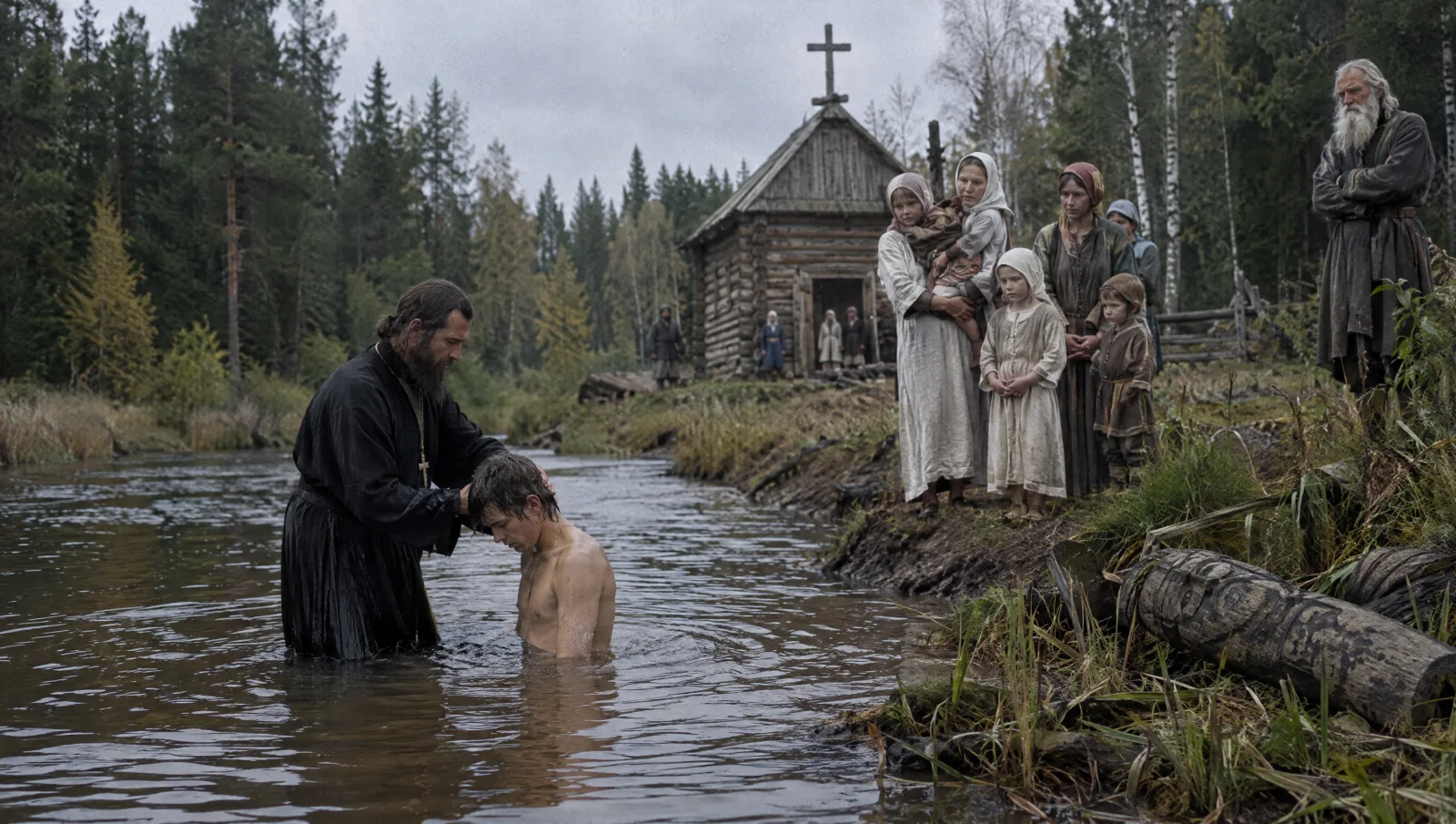
- Title image (a baptism in the north of Rus', around 1030): AI-generated illustration.
- The cross at Peryn near Novgorod. Photo: Roman Orloff, CC BY-SA 4.0, via Wikimedia Commons.
- Sergei Ivanov, Christianity and Paganism (published 1912). Public domain, via Wikimedia Commons.
- Prince Gleb and the magician, Radziwiłł Chronicle, late fifteenth century. Public domain, via Wikimedia Commons.
- Saints Boris and Gleb, Novgorod icon, about the mid-fourteenth century, State Historical Museum, Moscow. Public domain, via Wikimedia Commons.
- A wax tablet of the Novgorod Psalter, Museum of Writing, Veliky Novgorod. Photo: Lumaca, CC BY-SA 4.0, via Wikimedia Commons.
- St Luke, Ostromir Gospels, 1056–1057, National Library of Russia. Public domain, via Wikimedia Commons.
- Bronze encolpia of the eleventh to thirteenth centuries, Novgorod Museum. Photo: Lapot, CC0, via Wikimedia Commons.
- A late eleventh-century barrow burial: AI-generated illustration.