Sophia Palaiologina (born Zoe; Russian Sofia Fominichna Paleolog; died 7 April 1503) was a niece of the last Byzantine emperor, Constantine XI, and the second wife of Ivan III, grand prince of Moscow. She grew up as an exile in Rome under the protection of the pope, married Ivan in 1472 in a match arranged between Moscow and the Vatican, and was the mother of his successor, Vasily III. For thirty years she was a visible figure at the Moscow court, receiving foreign envoys and, at the end of Ivan's reign, winning a bitter succession struggle for her son.
She has also been given credit for far more than the sources show. Since the eighteenth century historians and novelists have made her the bringer of the double-headed eagle, Byzantine court ceremonial, the idea of Moscow as the "Third Rome" and even the end of the Tatar yoke. Most of this is either later than she was or rests on hearsay. This article separates what is documented from what was added afterwards. For her husband's reign, see Ivan III.
Sophia Palaiologina at a glance
| Born | Late 1440s or early 1450s, in the Morea (Peloponnese); the year is unknown |
| Parents | Thomas Palaiologos, despot of the Morea, brother of Constantine XI; Catherine Zaccaria |
| Brothers | Andreas (1453–1502) and Manuel (1455–1512) |
| Guardian | Cardinal Bessarion, in Rome, from 1465 |
| Married | Ivan III of Moscow: by proxy in Rome on 1 June 1472; in Moscow on 12 November 1472 |
| Children | Twelve, including Vasily III (born 25 March 1479) and Elena, queen of Poland |
| Died | 7 April 1503, Moscow |
| Buried | Ascension convent in the Kremlin; since 1929 in the underground chamber of the Archangel Cathedral |
Who was Sophia Palaiologina?
She was born into the last Byzantine imperial family. Her father, Thomas Palaiologos, was the youngest brother of Emperor Constantine XI, who died when the Ottomans took Constantinople in 1453. Thomas ruled part of the Morea, the Peloponnese, as despot. Her mother, Catherine, was the daughter of Centurione Zaccaria, the last Latin prince of Achaea. T. A. Matasova, whose biography (2016) is the standard modern study, places her birth "at the turn of the 1440s and 1450s" in the Peloponnese, at Patras or perhaps Leontarion.
Her exact age is a puzzle. In 1472 the chroniclers of Bologna thought she "seemed to be twenty-four", and a Roman source of 1459/60 described her as eleven or twelve, which would mean she was born about 1448. Others, including the historian Jonathan Harris, give about 1455. An anthropological study of her skeleton (S. V. Vasilyev, 2012) estimated her age at death at 45–50, which fits the later date better. The honest answer is that the year is unknown.
In 1460 the Ottomans conquered the Morea, and the family fled to Corfu. Thomas went on to Italy. Her mother died on Corfu on 28 August 1462, probably of plague, and her father in Rome on 12 May 1465. He was buried in St Peter's.
How did Zoe grow up in Rome?
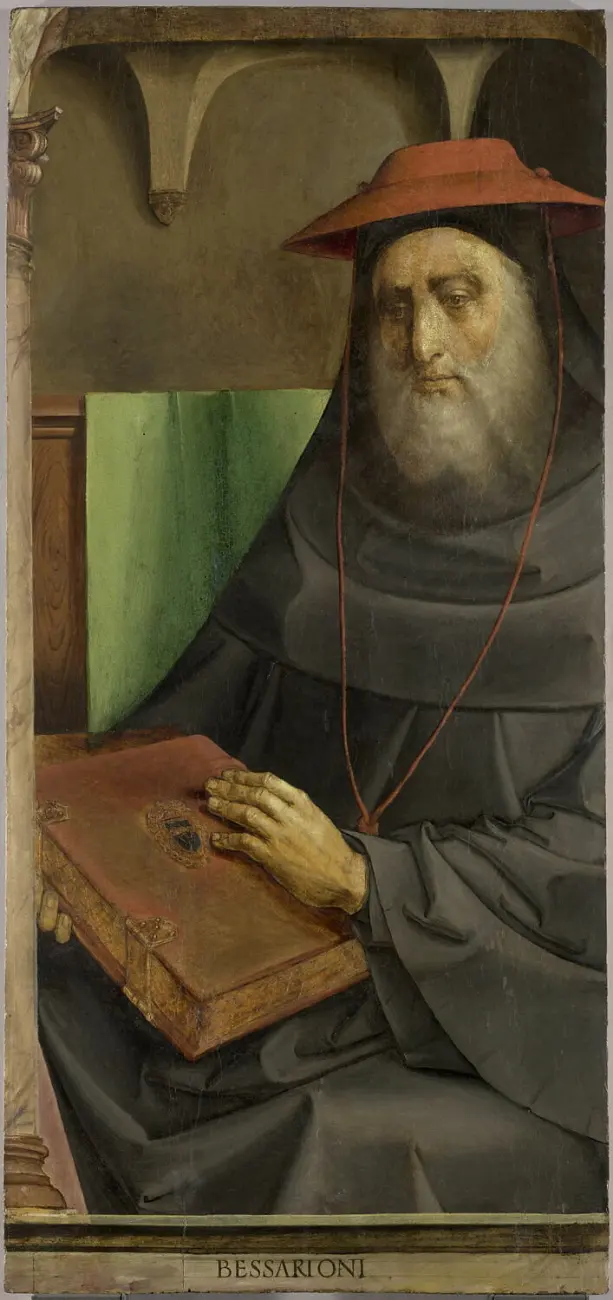
After their father's death the three children, Zoe, Andreas and Manuel, were brought to Rome and placed under the care of Cardinal Bessarion, the Greek scholar who had supported the union of the Catholic and Orthodox churches at the Council of Florence. The papacy paid them a pension of 300 écus a month. A letter from Bessarion of 9 August 1465 sets out how they were to be raised: with Greek and Latin teachers, living "as Latins", and reminded that "nobility … has no value without virtue, the more so as you are orphans, exiles and beggars".
Zoe was raised a Catholic. Several marriages were planned for her, none carried out. A match with a Gonzaga prince of Mantua was dropped for lack of a dowry. In 1466 she was betrothed to "Prince Caracciolo", according to a single witness. On 11 December 1466 the Venetian Senate suggested her as a bride for King James II of Cyprus, who married a Venetian woman instead.
How was the marriage to Ivan III arranged?
Ivan III's first wife, Maria of Tver, had died in 1467. On 11 February 1469, according to the Nikon chronicle, a Greek called Yury arrived in Moscow from Bessarion with an offer: "There is in Rome [a princess] named Sofia, daughter of the despot of Morea, Thomas, of the imperial [family] of Constantinople. She is an Orthodox Christian … she does not want to become Latin." Both parts of the message were diplomatic. The editor of the English translation of the chronicle, Serge Zenkovsky, notes that she had been raised a Catholic.
Ivan sent an Italian in his service, Gian Battista della Volpe, known in Moscow as Ivan Fryazin, to Rome. The negotiations, under Pope Paul II and then Sixtus IV, took three years. The papacy hoped for a church union and an ally against the Ottomans. Volpe arrived in Rome again on 23 May 1472. On 1 June 1472 a ceremony was held in St Peter's: the betrothal or a marriage by proxy, with Volpe standing in for Ivan. Pierling, who studied the papal documents, notes that "the documents express themselves equivocally", but that from then on the papal letters call her nobilis mulier, a married woman, instead of nobilis virgo. The pope gave her a dowry of about 6,000 ducats from the fund for the crusade against the Turks.
What happened on Sophia's journey to Moscow?
Zoe left Rome on 24 June 1472 with a large retinue, including Greeks of her household and a papal legate, Antonio Bonumbre, bishop of Accia in Corsica. She was received with festivities in Bologna, Vicenza and Nuremberg, reached Lübeck on 1 September and, after eleven days at sea, landed at Reval (Tallinn) on 21 September.
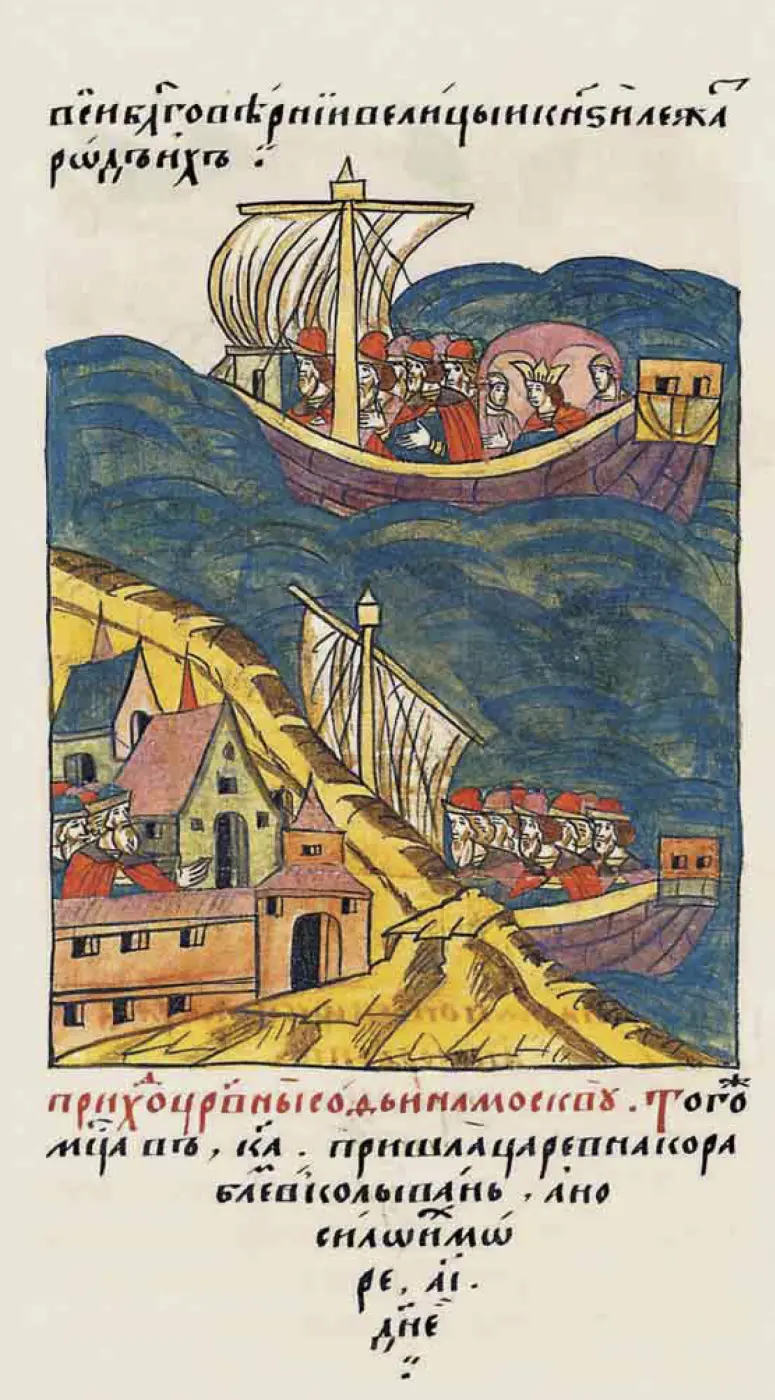
On 11 October she was met by the officials of Pskov, the first Russian city on her route. According to Pierling, she went straight to the cathedral to venerate the icons and made the legate do the same. As the procession neared Moscow, the papal legate's Latin cross, carried before him, became a problem. The Nikon chronicle records that Metropolitan Philip of Moscow warned Ivan that if the legate entered one gate of the city with his cross, "I, your Father, would leave through the other gate … because if one loves and praises a foreign faith, it means that he offends his own." Ivan had the cross put away before the procession entered Moscow.
When did Sophia marry Ivan III?
She entered Moscow on Thursday 12 November 1472. The Nikon chronicle describes the day: the metropolitan blessed her, the betrothal took place at the residence of Ivan's mother, and after the liturgy Metropolitan Philip married her to Ivan in the temporary wooden church that stood inside the unfinished Dormition Cathedral. Another chronicle, the Sofia chronicle, says that the priest who married them was the archpriest Hosea of Kolomna. She was received as an Orthodox Christian; Matasova notes that no ceremony of reception into Orthodoxy is known, only the metropolitan's blessing. The legate left after eleven weeks, on 26 January 1473, without the church union the papacy had hoped for.
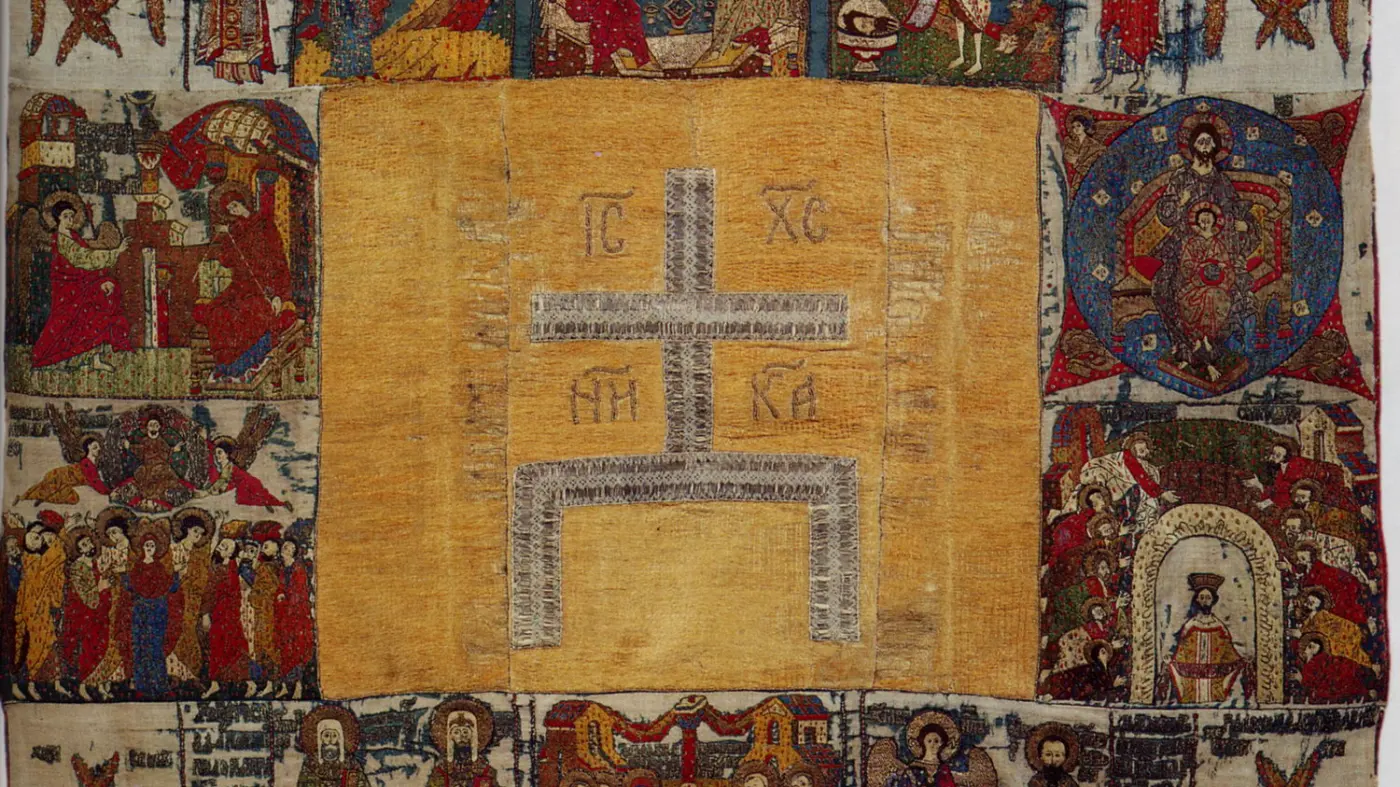
In Moscow she was called Sophia, the name she already used in the negotiations. The chronicles call her tsarevna, a princess of imperial rank. On the cloth she embroidered for the Trinity monastery in 1498/99 she calls herself "tsarevna of Constantinople, grand princess of Moscow".
What was Sophia's role at the Moscow court?
Contemporaries noticed her. The Venetian envoy Ambrogio Contarini, in Moscow in 1476–1477, visited her "at the Duke's request" and wrote that "she treated me with great kindness and courtesy, and entreated me earnestly to recommend her to my Illustrious Seignory". In 1490 she received the envoy of Emperor Maximilian. The historian Sergei Solovyov noted that she received foreign envoys, a custom not seen with the Russian-born grand princesses and tsaritsas after her.
She bore Ivan twelve children, seven sons and five daughters. Her daughter Elena married Grand Duke Alexander of Lithuania in 1495 and became queen of Poland. Her eldest son, Vasily, was born on 25 March 1479. A later legend, illustrated in the Illustrated Chronicle, held that he was born after St Sergius of Radonezh appeared to her in a vision; the historian Paul Bushkovitch (2018) argues that this story became a foundation of the court's pilgrimages to the Trinity monastery.
Her Greek relatives came too. Her brother Andreas visited Moscow in 1480 and 1490. Greeks of her household, among them Yury and Dmitry Trakhaniot, stayed in Moscow. The Russian Biographical Dictionary quotes a sixteenth-century Moscow official, Bersen Beklemishev, who blamed her for everything: "Since the grand prince's mother Sophia came here with your Greeks, our land has been in turmoil." Prince Andrei Kurbsky later called her a Greek "sorceress" and accused her of poisoning Ivan's eldest son. There is no evidence for this.
Herberstein, the Habsburg envoy who came to Moscow in 1517 and 1526, after her death, recorded what he was told: "They say that this Sophia was a very artful woman, and had considerable influence over the actions of the grand duke."
Did Sophia fight for her son's succession?
Yes, and she nearly lost. Ivan's eldest son by his first marriage, Ivan the Young, died in 1490, leaving a son, Dmitry. The court split between Dmitry and his mother, Elena of Moldavia, on one side and Sophia and Vasily on the other. In December 1497, according to the Nikon chronicle, Ivan discovered a plot among Vasily's supporters. Six of them, including Vladimir Gusev, were beheaded on the ice on 27 December. Ivan also "put his wife, Princess Sofia, out of favour, because some women who would visit her [brought her] herbs"; the women were drowned at night in the Moskva river, "and from that time he started living under greater security for his safety from her". On 4 February 1498 Ivan had Dmitry crowned as grand prince in the Dormition Cathedral.
Within four years the situation reversed. On 11 April 1502 Ivan put Dmitry and his mother under arrest, and on 14 April he made Vasily grand prince of Vladimir and Moscow. The reasons are not explained in the sources. Matasova points out that there is no direct evidence of Sophia's own role, only hints in the chronicles. The Orthodox Encyclopaedia (Pravoslavnaya entsiklopediya) links the fall of the Moscow circle of the so-called Judaisers, a heretical movement with supporters at court, to "the victory of the court party of Grand Princess Sofia and her son".
How did Sophia die?
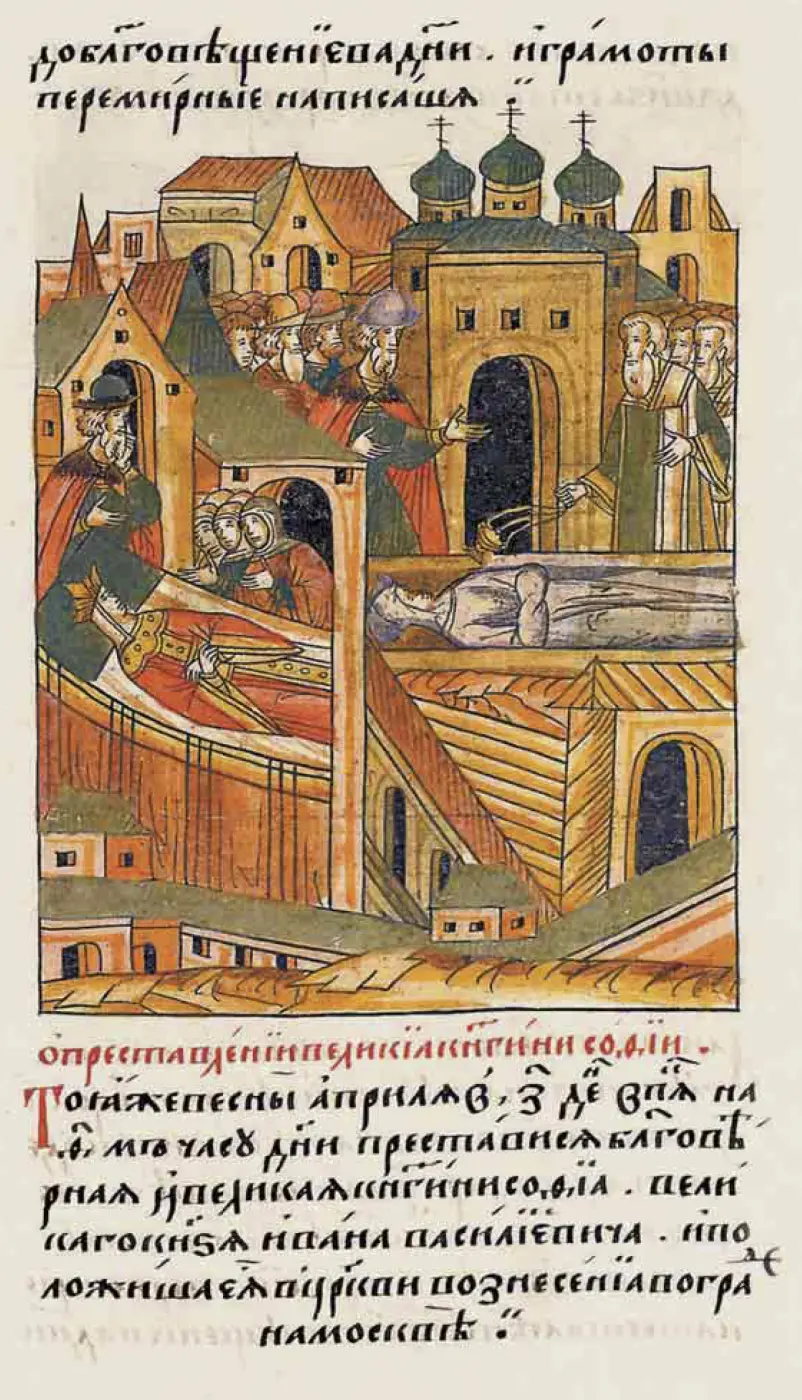
She died on Friday 7 April 1503 "at the ninth hour of the day", according to the Nikon chronicle, and was buried in the Ascension convent in the Kremlin, the burial place of Moscow's grand princesses. Some modern works give 17 April or 5 April, but the chronicle's weekday fits only the 7th. Ivan III died two and a half years later, on 27 October 1505, and Vasily III succeeded him.
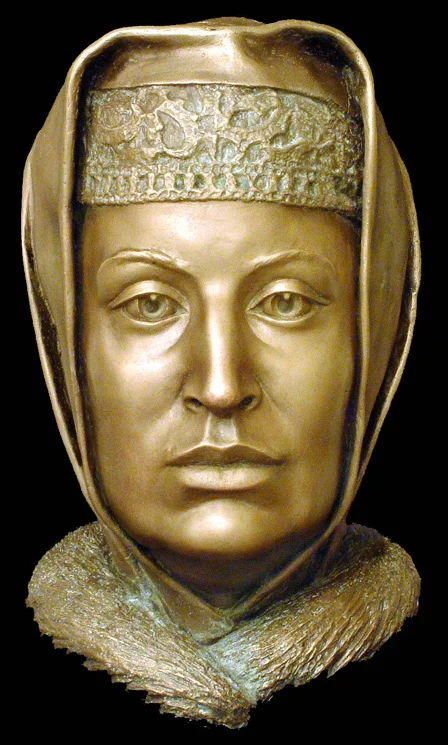
In 1929, before the Ascension convent was demolished, the white-stone sarcophagi of the grand princesses and tsaritsas were moved to an underground chamber of the Archangel Cathedral, where Sophia's remains still lie. Her skeleton has been studied by anthropologists. Vasilyev found an almost complete skull and skeleton of a woman aged 45–50 at death. The forensic sculptor Sergei Nikitin made a reconstruction of her face from the skull in 1994.
What did Sophia bring to Moscow, and what is legend?
Historians disagree on how much she mattered. Nikolai Karamzin and Sergei Solovyov saw her as the channel for Byzantine ideas of autocracy. Sceptics from the nineteenth century onwards pointed out that she had grown up in exile in Italy and never knew the Byzantine court. The theologian Georges Florovsky concluded that the marriage brought Moscow closer "to Italian modernity, rather than to a revival of Byzantine traditions". Several specific claims can be checked.
- The Italian architects. Solovyov thought Sophia "in all probability" persuaded Ivan to send for a master builder from Italy, and in 1475 Ivan's envoy Semyon Tolbuzin returned from Venice with the Bolognese engineer Aristotele Fioravanti, who rebuilt the Dormition Cathedral. No source of the time names her as the reason. Her marriage opened a channel to Italy; the decision was Ivan's.
- The double-headed eagle. It first appears on a dated seal of Ivan III in 1497, a quarter of a century after the wedding. Whether Moscow took it from Byzantium, from the Holy Roman Empire or elsewhere is, in A. V. Belyakov's words (2025), a dispute "far from final resolution".
- The Third Rome. The idea that Moscow was the third and last Rome was formulated by the monk Filofei of Pskov in letters of the 1520s, two decades after her death. The historian Marshall Poe found no Slavic text calling Moscow the Third Rome before the sixteenth century.
- The Byzantine throne. Sophia had no claim of her own. The claim passed to her brother Andreas, who styled himself emperor in Rome and in 1494 sold his titles to King Charles VIII of France.
- The end of the Tatar yoke. Herberstein heard that she would tell Ivan that "she had married a slave of the Tartars" and urge him to feign illness rather than receive the khan's envoys. In 1480, the year of the stand on the Ugra, she was not in Moscow at all: Ivan had sent her with the children and the treasury to Dmitrov and then to Beloozero in the north.
Sophia in modern memory
Her reputation has swung between extremes. Kurbsky's "sorceress" and Bersen's troublemaker became, in nineteenth-century history painting, the dignified bride; Fyodor Bronnikov painted her meeting with the officials of Pskov. The 2016 Russian television series Sofia made her a romantic heroine. Reviewing it, Argumenty i Fakty listed historical errors, among them a famous scene of Ivan trampling the khan's letter, which "is recognised as a later folkloric invention". The reviewer in turn repeated as fact the legend that Sophia brought the books that later formed the lost "library of Ivan the Terrible", for which there is no contemporary evidence.
Common myths about Sophia Palaiologina
| Myth | What the evidence says |
|---|---|
| She was heir to the Byzantine throne | The claim passed to her brother Andreas, who sold it to Charles VIII of France in 1494 |
| She brought the double-headed eagle to Moscow | It first appears on a dated seal in 1497; its origin is still debated |
| She made Moscow the "Third Rome" | The idea comes from the monk Filofei in the 1520s, after her death |
| She persuaded Ivan to throw off the Tatar yoke | A story Herberstein heard decades later; in 1480 she had been sent away to Beloozero |
| She brought Byzantine court ceremonial | She grew up in exile in Rome; most of the court changes came decades after 1472 |
| She brought the "library of Ivan the Terrible" | A legend; no contemporary source mentions such books |
| She was married in the Dormition Cathedral | The cathedral was unfinished; the wedding took place in a temporary wooden church inside it |
| She poisoned Ivan's eldest son | An accusation by Kurbsky decades later; no evidence |
Timeline of Sophia Palaiologina
| Date | Event |
|---|---|
| Late 1440s or early 1450s | Born in the Morea |
| 1460 | The Ottomans conquer the Morea; the family flees to Corfu |
| 28 August 1462 | Death of her mother on Corfu |
| 12 May 1465 | Death of her father in Rome; Bessarion becomes guardian |
| 11 February 1469 | Bessarion's envoy brings the marriage offer to Moscow |
| 1 June 1472 | Betrothal or proxy marriage in St Peter's, Rome |
| 24 June 1472 | Leaves Rome for Moscow |
| 21 September 1472 | Lands at Reval |
| 12 November 1472 | Enters Moscow and marries Ivan III |
| 1476–1477 | Receives the Venetian envoy Contarini |
| 25 March 1479 | Birth of Vasily III |
| 1480 | Sent to Beloozero during Khan Akhmat's campaign |
| 1494 | Her brother Andreas sells the Byzantine titles to Charles VIII |
| December 1497 | Falls out of favour; her son's supporters executed |
| 4 February 1498 | Dmitry the Grandson crowned |
| 1498/99 | Gives the embroidered pelena to the Trinity monastery |
| 11–14 April 1502 | Dmitry arrested; Vasily made grand prince |
| 7 April 1503 | Dies in Moscow |
| 1929 | Remains moved to the Archangel Cathedral |
| 1994 | Facial reconstruction by Sergei Nikitin |
What the map shows
At 1460, the year her family fled, the Ottoman Empire has taken Constantinople and is completing the conquest of the Morea. At 1472 she travels from the Papal States to the Grand Principality of Moscow, which still recognises the overlordship of the Golden Horde. By 1503, the year of her death, Moscow has absorbed Novgorod and Tver.
Sources
Primary sources
- The Nikonian Chronicle, vol. 5, trans. S. A. and B. J. Zenkovsky (Princeton, 1989): https://archive.org/details/nikonian-chronicle-5
- Ambrogio Contarini, in Travels to Tana and Persia (London: Hakluyt Society, 1873): https://archive.org/details/travelstotanaper00barbrich
- Sigismund von Herberstein, Notes upon Russia, trans. R. H. Major, vol. 1 (London: Hakluyt Society, 1851): https://archive.org/details/notesuponrussiab01herbuoft
- Illustrated Chronicle (Litsevoi letopisnyi svod), vol. 8 (Shumilov volume), captions via Wikimedia Commons
Studies and reference works
- T. A. Matasova, "Sof'ia (Zoia) Paleolog", in Dvor russkikh kniagin' XI–XVI vv., St Petersburg State University: https://medieval-princesses.spbu.ru/articles/sofa-paleolog/
- P. Pierling, La Russie et le Saint-Siège, vol. 1 (Paris, 1896): https://archive.org/details/larussieetlesain01pier
- "Sofiia Fominichna", Russkii biograficheskii slovar', via ru.wikisource
- S. M. Solov'ev, Istoriia Rossii s drevneishikh vremen, vol. 5, ch. 5
- J. Harris, "Zhalkii prints? Andrei Paleolog v Rime (1464–1502 gg.)", Vestnik Volgogradskogo gos. universiteta, ser. 4, 27:6 (2022), 368–383, doi:10.15688/jvolsu4.2022.6.24
- S. V. Vasil'ev, "Tri siuzheta ob identifikatsii istoricheskikh lichnostei metodami fizicheskoi antropologii", Izvestiia Irkutskogo gosudarstvennogo universiteta, ser. Geoarkheologiia, 2012, no. 1, 246–265
- P. Bushkovitch, Canadian-American Slavic Studies 52 (2018), 158–180, doi:10.1163/22102396-05202003 (abstract)
- A. V. Beliakov, Quaestio Rossica 13:2 (2025), doi:10.15826/qr.2025.2.982
- M. Poe, "Moscow, the Third Rome: The Origins and Transformations of a 'Pivotal Moment'" (NCEEER, 1997)
- "Vasilii III" and "Zhidovstvuiushchie", Pravoslavnaia entsiklopediia: https://www.pravenc.ru/text/150787.html
- Pelena "Feasts and saints", 1499, PSTGU needlework database: https://icons.pstgu.ru/needlework/937
- "Chya istoriia? Serial 'Sofiia'", Argumenty i Fakty 49 (2016)
Image credits
- Title image: pelena of Grand Princess Sophia, 1498/99, Sergiev Posad Museum-Reserve. Public domain, via Wikimedia Commons, cropped to 16:9.
- Cardinal Bessarion, Justus van Gent and Pedro Berruguete, c. 1476. Public domain, via Wikimedia Commons.
- Illustrated Chronicle miniatures (arrival at Reval; death of Sophia), 16th century. Public domain, via Wikimedia Commons.
- Facial reconstruction by Sergei Nikitin, 1994, CC BY-SA 3.0, via Wikimedia Commons.