False Dmitry I (Russian Lzhedmitry I; died 17 May 1606) was the first and most successful of the pretenders of Russia's Time of Troubles. He claimed to be Tsarevich Dmitry, the youngest son of Ivan the Terrible, who had died at Uglich in 1591. With Polish and Cossack volunteers and, above all, Russian supporters, he invaded Russia in October 1604, entered Moscow on 20 June 1605 and was crowned tsar. Eleven months later, a few days after his wedding to the Polish noblewoman Marina Mniszech, he was killed in a rising led by Prince Vasily Shuisky. His body was burned.
Who he really was is still argued over. Two Russian governments declared him to be a runaway monk, Grigory Otrepyev, and most historians accept this. But the evidence is thinner than the confident label suggests, and one of his own officers, the French captain Jacques Margeret, was convinced that he really was Ivan's son. This article follows the man himself. The wider crisis in the Tsardom of Russia is told in The Time of Troubles.
False Dmitry I at a glance
| Claimed identity | Tsarevich Dmitry Ivanovich (1582–1591), son of Ivan IV and Maria Nagaya |
| Official identity | Yury (Grigory) Bogdanovich Otrepyev, a minor nobleman from Galich who became a monk |
| Born | Around 1580 (if he was Otrepyev) |
| Appeared | Summer 1603, at Prince Adam Wiśniowiecki's estate in Poland-Lithuania |
| Invaded Russia | October 1604 |
| Tsar | Entered Moscow 20 June 1605; crowned 21 July 1605 |
| Wife | Marina Mniszech, daughter of the Polish magnate Jerzy Mniszech; married 8 May 1606 |
| Died | 17 May 1606, Moscow, killed in a rising |
| Successors | False Dmitry II ("the Thief of Tushino") and False Dmitry III |
Who was Grigory Otrepyev?
According to the government of Boris Godunov, and later that of Vasily Shuisky, the pretender was Yury Bogdanovich Otrepyev, a syn boyarsky (minor servitor) from the Galich district. B. N. Floria's account in the Orthodox Encyclopaedia (Pravoslavnaya entsiklopediya, 2020) is the fullest modern reconstruction. As a young man Otrepyev served at the courts of Mikhail Nikitich Romanov and Prince Boris Cherkassky. When Boris Godunov disgraced the Romanovs and Cherkasskys in the autumn of 1600, he became a monk under the name Grigory. With the help of his grandfather, a monk there, he entered the Chudov monastery in the Kremlin, came to the notice of Patriarch Job, worked as his copyist and was ordained deacon.
Early in 1602 he fled with two other monks, Varlaam and Misail, first to Novgorod-Seversky and then across the border into the Polish–Lithuanian Commonwealth. Varlaam's later statement to the authorities (the Izvet) is the main source for the journey. The monks spent three weeks at the Kiev Caves monastery and then went to Ostrih, the seat of Prince Konstantin Ostrozhsky. A book that Ostrozhsky gave on 10 August 1602 to "Grigory with his brethren, Varlaam and Misail" survives in the Russian state archive. It is the only dated physical trace of the monk Grigory in Lithuania. Floria writes that he then studied at the Antitrinitarian school at Hoshcha, where he learned Latin and Polish, and went to the Zaporozhian Cossacks.
How did the pretender appear in Poland?
In the summer of 1603 the young man went to Prince Adam Wiśniowiecki at Brahin, in what is now Belarus, and declared that he was Tsarevich Dmitry, saved from the assassins sent to Uglich. Wiśniowiecki, who was in a border dispute with Moscow, received him with honour. On 7 October 1603 he informed the Crown Chancellor, Jan Zamoyski. Conrad Bussow, a German in Russian service, later told a more colourful story: a servant struck by his master in the bath-house revealed himself in tears as the tsar's son. Floria's account rests on documents.
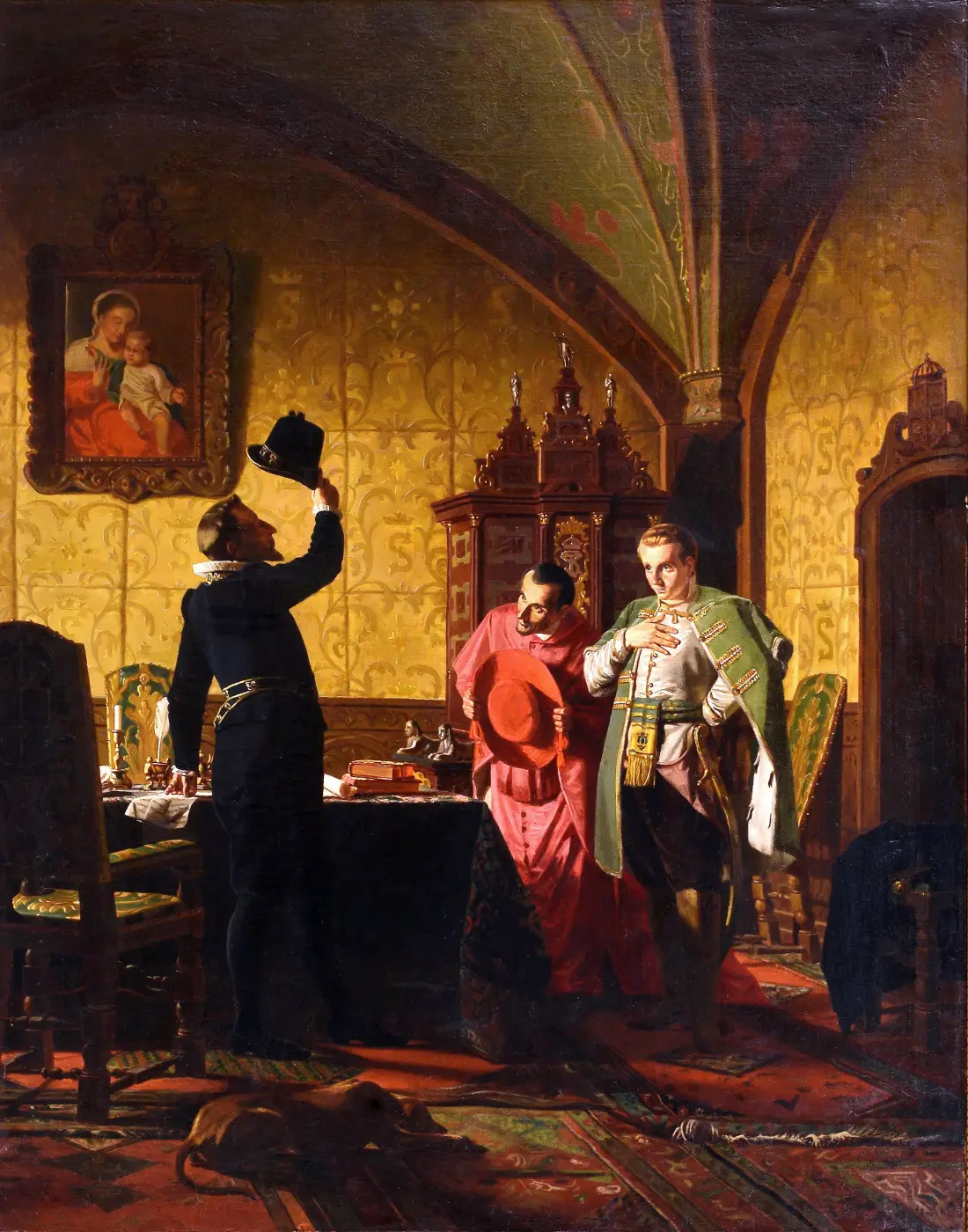
The pretender soon found a more powerful patron in Jerzy Mniszech, the palatine of Sandomierz, and fell in love with, or at least agreed to marry, his daughter Marina. In March 1604 King Sigismund III received him in Kraków. The terms drawn up there promised the Commonwealth part of the Smolensk and Seversk lands and an "eternal union", and promised to admit Jesuits to Moscow.
On 17 April 1604, according to the Orthodox Encyclopaedia, the pretender secretly renounced "the schism" and was received into the Catholic Church; Platonov gives 24 April. The next day he wrote in his own hand, in Polish, to Pope Clement VIII. Historians have drawn a striking conclusion from that letter. Sergei Platonov wrote in 1921 that it was composed in excellent Polish but copied out "not by a Pole … but by a born Muscovite, who poorly understood the text he had to copy". Floria agrees that its writer was "a Russian with a poor command of Polish".
Sigismund did not send the royal army: Zamoyski and others feared a war with Russia. Instead the king allowed a group of magnates, led by Mniszech, to help the pretender as if on their own initiative. On 25 May 1604 the pretender signed a written promise to marry Marina. She was to receive Novgorod and Pskov, keep her Catholic priests and "the worship of her Roman faith", and could divorce him if within a year he had not brought "the whole Muscovite state into the one Roman faith". Her father was promised a million Polish zlotys.
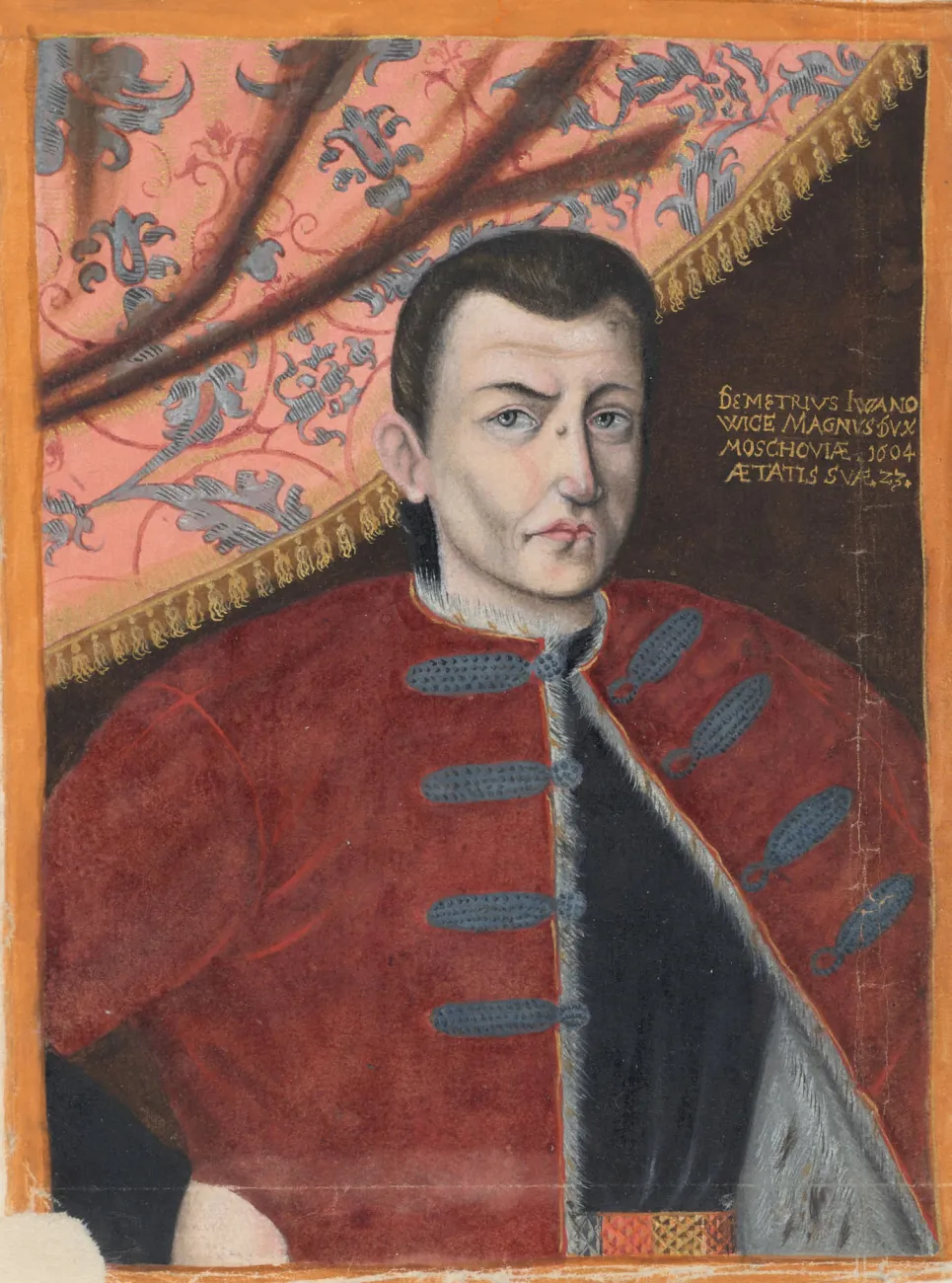
How did False Dmitry conquer Russia?
In October 1604 the pretender crossed into Russia with a small army of Polish volunteers and Cossacks. Several towns of the south-west, including Moravsk, Chernigov and Putivl, went over to him at once. Novgorod-Seversky, defended by Pyotr Basmanov, held out. Early in January 1605 most of the Polish troops went home over unpaid wages, and Mniszech went with them. On 21 January 1605 Boris Godunov's army defeated the pretender at Dobrynichi near Sevsk. Margeret writes that he escaped "with 30 or 50 riders" to Rylsk and then spent four months at Putivl.
He survived because the south was on his side. The Orthodox Encyclopaedia stresses that after Dobrynichi his Russian supporters became his main support. He took care to appear devoutly Orthodox and had the miracle-working icon of Our Lady of Kursk brought to Putivl. Don Cossacks held the small town of Kromy against the tsar's army through the spring.
Boris Godunov died suddenly on 13 April 1605. In May the army besieging Kromy mutinied, led by the Golitsyn princes and the gentry of the Seversk and Ryazan towns, and went over to the pretender, Basmanov with it. On 1 June 1605 two of his envoys, Gavrila Pushkin and Naum Pleshcheev, read his letter to the crowd on Red Square. Moscow rose, and the Godunovs were arrested. Boris's son, the young Tsar Fyodor II, and his mother were murdered on the pretender's orders on 10 June.
How did False Dmitry become tsar?
He entered Moscow on 20 June 1605. Patriarch Job was deposed, and on 30 June a Greek, Archbishop Ignatius of Ryazan, was enthroned in his place. On 18 July the pretender rode out to meet Ivan IV's widow, the nun Marfa (Maria Nagaya), the real Dmitry's mother, brought from her convent. She embraced him in public. Bussow, who was in Moscow, comments that "the old tsaritsa very skilfully played the tender mother, although in her soul she felt quite otherwise".
On 21 July 1605 he was crowned in a double ceremony. Patriarch Ignatius placed on him in the Dormition Cathedral the imperial crown that Emperor Rudolf II had sent to Boris Godunov. Then, at the tomb of Ivan IV in the Archangel Cathedral, Archbishop Arsenios of Elasson placed on him the Cap of Monomakh. Margeret, writing in the Western calendar, dates the coronation to "the last day of July", which is the same day.
One of his first acts showed both his confidence and his danger. Prince Vasily Shuisky was tried for spreading the rumour that the new tsar was an impostor and sentenced to death. Dmitry pardoned him on the scaffold. Less than a year later Shuisky led the rising that killed him.
What kind of ruler was False Dmitry?
His reign was short but not insignificant. Floria's account in the Orthodox Encyclopaedia describes an active, self-confident ruler.
- Titles. He called himself "most serene and invincible … tsesar" of Russia and of "all the Tatar tsardoms", and from late 1605 his Latin letters used the word imperator, which caused friction with Poland.
- Government. On the Polish model, a "senate" of Boyar Duma members and bishops was to become the highest body of government.
- The nobility. From the summer of 1605 a review of the gentry militia raised the land entitlements of servitors by an average of 100–200 chetverti, to win them over.
- War against the Ottomans. He planned a campaign down the Don against the Ottoman fortress of Azov. In October 1605 Crimean envoys were detained and large sums were taken from the monasteries "to pay the soldiers": 3,000 roubles from the Iosifo-Volokolamsk monastery and 5,000 from the Kirillo-Belozersky.
- The West. He sought friendship with England, and in December 1605 confirmed the privileges of the English Muscovy Company.
He did not keep his promises to Poland. He refused to give up any territory and offered money instead. He wished to build a Catholic church for the Poles in his service, arguing in the Duma that Catholics were no worse than the Protestants who already had a church and a school in Moscow, but the Jesuits who came with him did not proselytise. The Orthodox Encyclopaedia concludes that Polish help "played no significant role" in his rise: he came to power "thanks to his supporters in Russia".
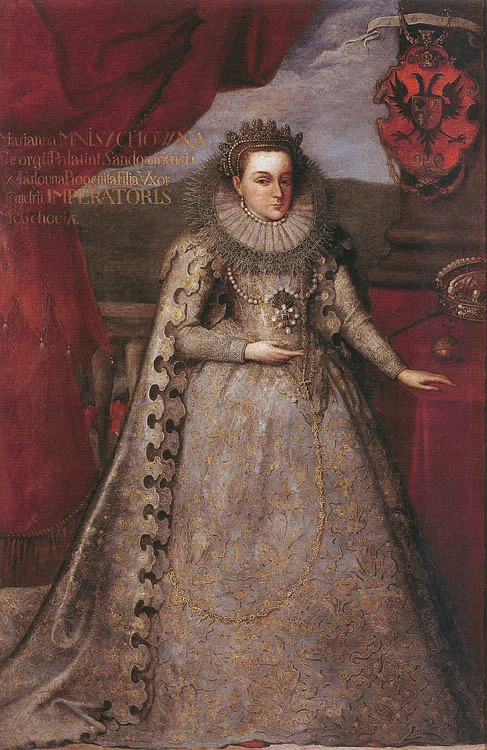
Who was Marina Mniszech?
Marina Mniszech (Polish Maryna Mniszchówna; 1588 or 1589 – 1614) was the daughter of Jerzy Mniszech, palatine of Sandomierz. In the autumn of 1605 the tsar's envoy Afanasy Vlasyev went to Poland to bring her to Moscow. On 12 (22) November 1605 a proxy wedding was held in Kraków: Cardinal Bernard Maciejowski officiated, Vlasyev stood in for the groom, and King Sigismund attended.
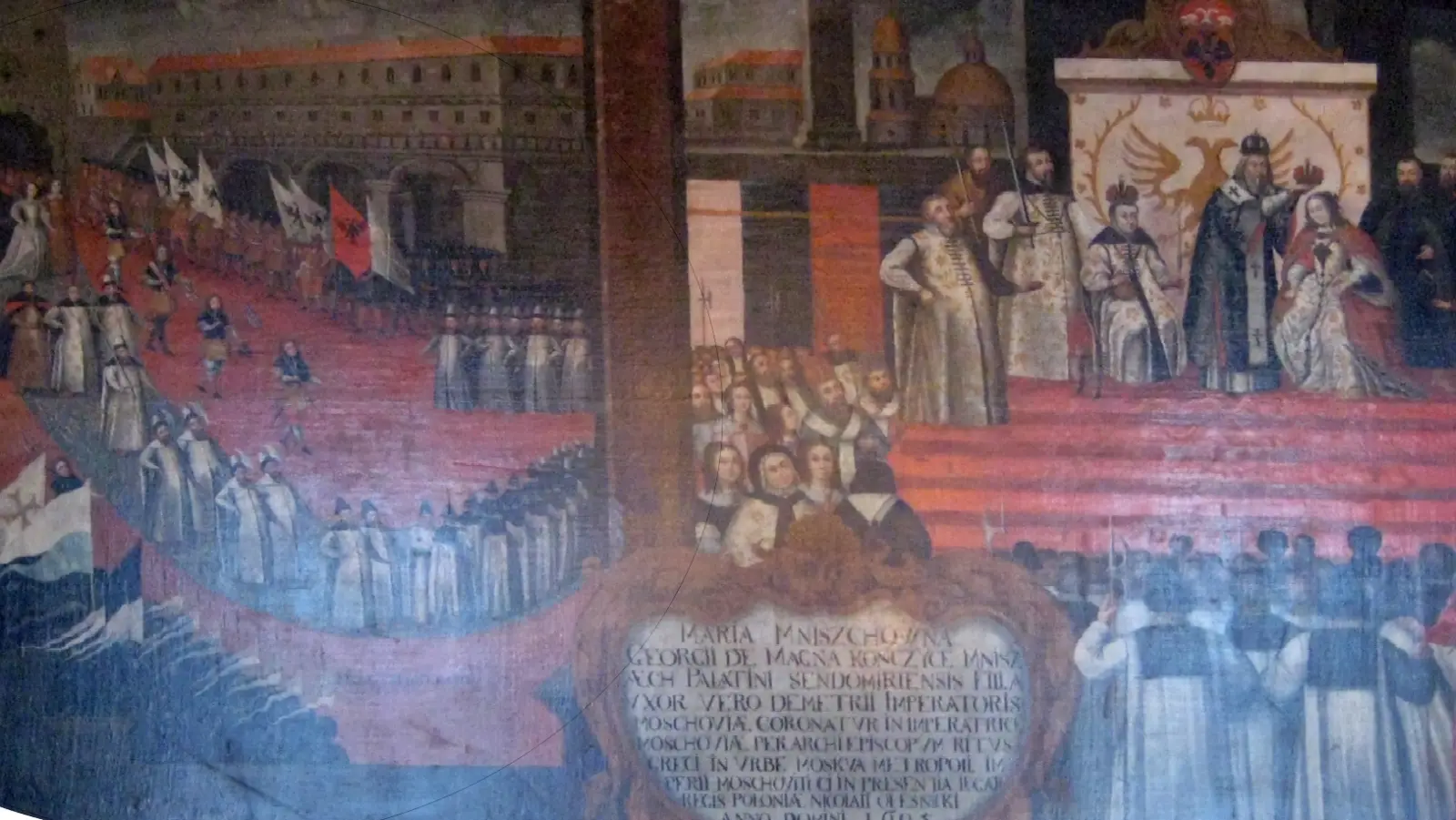
Marina made her state entry into Moscow on 2 (12) May 1606 with a large Polish retinue. Her religion was a problem. On Patriarch Ignatius's initiative she was received into Orthodoxy by anointing (chrismation) rather than baptism; Metropolitan Hermogenes of Kazan, who objected, was sent back to his diocese. On 8 May 1606 she was crowned in the Dormition Cathedral, the anointing forming part of the rite, and then married to Dmitry. The Great Russian Encyclopedia notes that she was "crowned to the tsardom" in her own right, under the Russian name Maria Yuryevna.
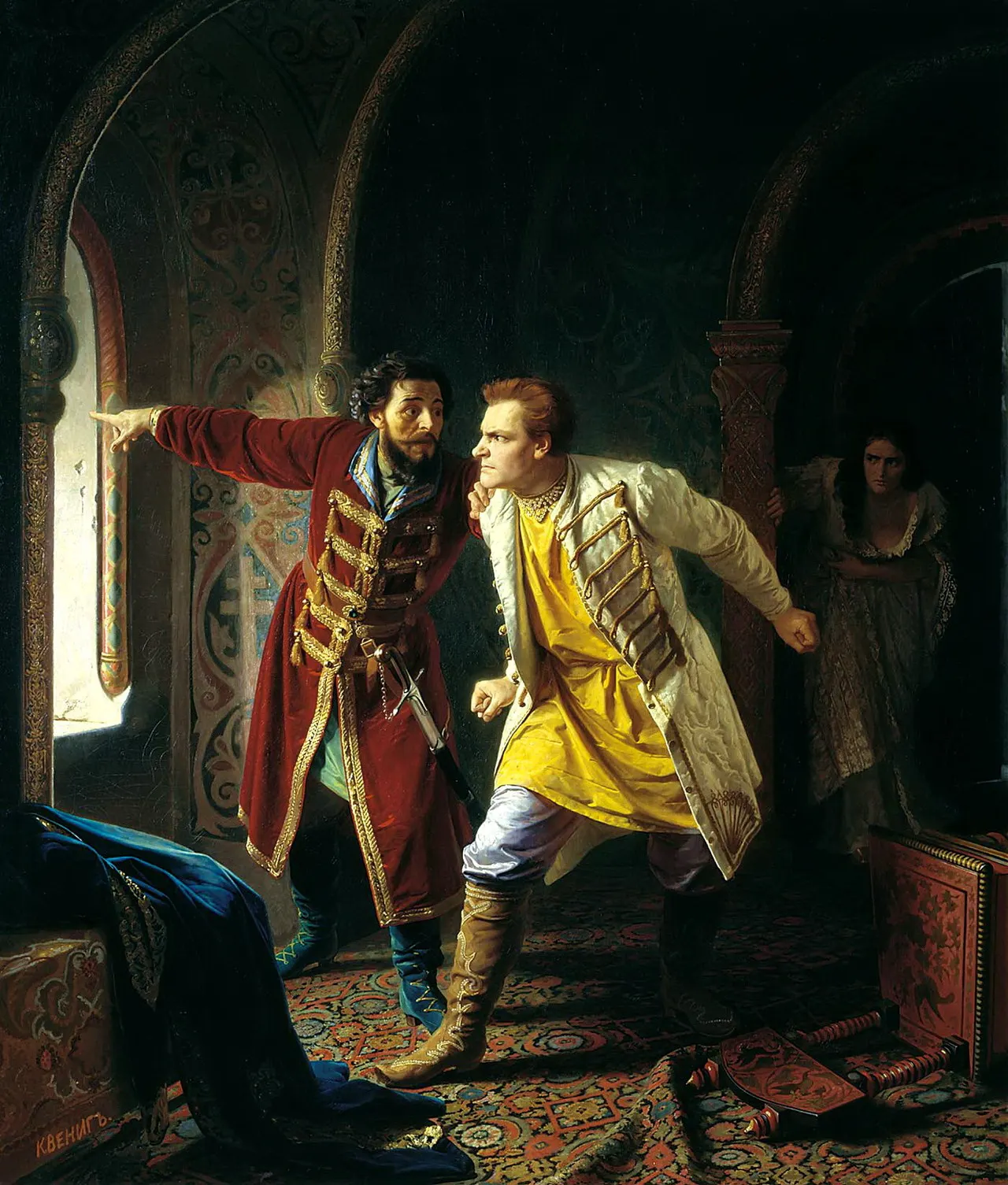
How did False Dmitry die?
The wedding brought hundreds of armed Polish nobles to Moscow. According to the Orthodox Encyclopaedia, their contempt for Russians and for Orthodox churches fed the rumours that the tsar was a false tsar and a heretic. Bussow recorded what people said in the markets: that the tsar ate unclean food, went to church without going to the bath-house first, and did not bow before the icon of St Nicholas.
On Saturday 17 May 1606 aristocratic conspirators led by Vasily Shuisky raised Moscow, joined by townspeople, musketeers and gentry troops gathered near the city. Basmanov was killed defending the palace. The tsar jumped from a window, was caught and killed. Georg Paerle, a Leipzig merchant in Moscow, put the dead at about 600 Poles and more than 1,000 Muscovites.
His body was dragged to Red Square and laid out for three days beside Basmanov's. Bussow writes that a boyar threw a mask on the dead tsar's belly and a bagpipe on his chest, put a pipe in his mouth and said: "Long have we amused you … now you amuse us!" The New Chronicle (Novyi letopisets) records that the nun Marfa, asked whether he was her son, now disowned him: "Now I know him to be accursed; I called him my son out of fear of death."
Were his ashes fired from a cannon?
The famous story is that his ashes were loaded into a cannon and fired towards Poland, the way he had come. The eyewitnesses tell it differently.
- The New Chronicle says only that after three days the body was taken to Kotly, outside Moscow, "and they burned him".
- The Dutch merchant Isaac Massa writes that it was burned with the "hell monster", a mock fortress the tsar had built for winter entertainments, and that "on the 28th the ashes were blown into the wind".
- Bussow says that on 28 May they decided to burn him, "and scattered the ashes in the air".
- Only the Leipzig merchant Georg Paerle has the cannon. He writes that after a rumour spread of lights and music at the grave, the body was dug up, burned, and the ashes loaded into "a huge cannon" and fired "at the gate through which he had entered Moscow, so that not even his dust should remain".
The cannon may be true, but it rests on one witness, and even he does not say "towards Poland". The Orthodox Encyclopaedia says simply that the body was burned and "the ashes scattered to the wind".
Was False Dmitry really Grigory Otrepyev?
Historians disagree.
- Otrepyev, as the governments said. Boris Godunov's government named him in 1604–1605 as "Grishka Otrepyev", who had "lived at the Romanovs' court". After his death the boyars' circular letter called him "the outright thief Grishka Otrepyev". Most historians since have accepted the identification, among them Platonov and Floria.
- Otrepyev, as a tool of Boris's enemies. Platonov argued that the pretender was prepared in the circle of Moscow boyars hostile to Godunov, "most likely" around the Romanovs. The Brockhaus and Efron Encyclopaedia (1896) called this the view of most historians. Floria accepts that his biography points that way but notes that "the data that would allow this view to be supported are lacking".
- Not Otrepyev. Nikolai Kostomarov, in Who was the first False Dmitry? (1864), argued that there had been no proof at the time. The witnesses who said that Grishka declared himself at Wiśniowiecki's had not seen it, and the abbot of the Chudov monastery, who allegedly recognised his former deacon, said so only after the tsar was dead, "when it was profitable to blacken him". Kostomarov suggested a West Russian origin.
- The real Dmitry. Jacques Margeret, who commanded his guard, concluded: "I am convinced that he was the true Dmitry, son of Tsar Ivan Vasilyevich the Tyrant." He argued that the real Otrepyev was a man of 35 to 38, whom the pretender brought with him into Russia for everyone to see.
- Other theories. Bussow reported, on the word of Polish nobles, that the pretender was an illegitimate son of King Stefan Batory, coached by Otrepyev.
The Brockhaus and Efron Encyclopaedia summed up in 1896: "the question of the identity of the first False Dmitry remains open". Its author added that it was "almost proven" that he believed in his own claim and was "only a tool in other hands". Most modern historians are firmer about the Otrepyev identification; none has a document that settles it.
Margeret also left the best description of him: of medium height, beardless, swarthy, very strong, "with a wart beside the nose, under the right eye", quick-witted, kind and quick-tempered "but only for a moment". He died, Margeret wrote, "in his 25th year".
What happened to Marina, and who were the other False Dmitrys?
Marina survived the rising. Her father and she were sent to Yaroslavl in August 1606. Within a year a new pretender appeared.
False Dmitry II, later called "the Thief of Tushino", was proclaimed "Tsar Dmitry" in July 1607. According to the Barkulabovo chronicle and other sources, he had been a schoolteacher in Shklov or near Mogilev, in today's Belarus. He gathered southern Russian servitors and Polish-Lithuanian soldiers and set up a rival court at Tushino outside Moscow. The siege also drew in the Kingdom of Sweden, which Shuisky called to his aid in 1609. In 1608 Marina joined him and pretended to recognise her husband. The Brockhaus and Efron Encyclopaedia dates their secret wedding to September 1608 in the camp; the Great Russian Encyclopedia says they married at Kaluga no later than April 1610. On 27 December 1609 he fled Tushino for Kaluga, where on 11 December 1610 he was killed by a Tatar prince, Pyotr Urusov, whom he had insulted. Weeks later Marina bore a son, Ivan, baptised Orthodox.
False Dmitry III, "the Pskov thief", was, according to several Russian sources, a deacon called Matyushka from the Yauza district of Moscow. He appeared at Novgorod in March 1611, was accepted at Pskov in December 1611, and the Cossacks of the First Militia besieging Moscow swore allegiance to him in March 1612 (the sources disagree on the day). He was overthrown in Pskov in May 1612, taken to Moscow and hanged on the orders of Tsar Michael Romanov.
Marina's last ally was the Cossack ataman Ivan Zarutsky. They fled south and held Astrakhan until a rising drove them out in May 1614. In June 1614 they were captured on the Yaik (Ural) river. The New Chronicle records the end briefly: "Zarutsky was impaled, and the little thief [her son, aged three] was hanged, and Marinka died in Moscow." The Great Russian Encyclopedia gives her death as no later than 24 December 1614, "according to the official version, in Moscow"; how she died is unknown.
False Dmitry in literature and music
The pretender has fascinated writers ever since.
- Friedrich Schiller was writing a tragedy, Demetrius, when he died in 1805. It remained unfinished.
- Alexander Pushkin, in Boris Godunov (1825), follows the official version: the young monk Grigory in his cell in the Chudov monastery, the escape from an inn on the Lithuanian border, and the love scene with Marina by a fountain at Sambor. Modest Mussorgsky added a Polish act with Marina to his opera; see Boris Godunov.
- Alexander Ostrovsky wrote the dramatic chronicle Dmitry the Pretender and Vasily Shuisky, published in 1866.
- Antonín Dvořák composed the opera Dimitrij in 1881–1882 to a libretto by Marie Červinková-Riegrová, based partly on Schiller's fragment. It was first performed in Prague in October 1882.
Common myths about False Dmitry
| Myth | What the evidence says |
|---|---|
| He was certainly the monk Grigory Otrepyev | Two Russian governments said so and most historians agree, but no document settles it; Margeret thought he was the real Dmitry |
| He was a creature of the Poles and the Jesuits | The king refused to send his army; the Orthodox Encyclopaedia finds that Polish help played no significant role and that his Russian supporters brought him to power |
| He tried to make Russia Catholic | He promised it in 1604 but did not do it; he refused territorial concessions, and the Jesuits in Moscow did not proselytise |
| His ashes were fired from a cannon towards Poland | Only one witness, Paerle, mentions a cannon, fired at the gate he had entered by; others say the ashes were scattered in the wind |
| His "mother" Marfa never doubted him | She recognised him publicly in July 1605 and disowned him in May 1606, saying she had acted "out of fear of death" |
| False Dmitry II was the same man | He was a different person, possibly a schoolteacher from Shklov; Marina pretended to recognise him |
Timeline of False Dmitry
| Date | Event |
|---|---|
| 15 May 1591 | Death of the real Tsarevich Dmitry at Uglich |
| Autumn 1600 | Fall of the Romanovs; Yury Otrepyev becomes the monk Grigory |
| Early 1602 | Grigory Otrepyev flees to Lithuania |
| Summer 1603 | The pretender declares himself at Adam Wiśniowiecki's |
| March 1604 | Received by Sigismund III in Kraków |
| 17 April 1604 | Secretly received into the Catholic Church (24 April in some accounts) |
| 25 May 1604 | Promise to marry Marina Mniszech |
| October 1604 | Invasion of Russia |
| 21 January 1605 | Defeat at Dobrynichi |
| 13 April 1605 | Death of Boris Godunov |
| May 1605 | The army at Kromy goes over to him |
| 20 June 1605 | Entry into Moscow |
| 18 July 1605 | Meets the nun Marfa, the real Dmitry's mother |
| 21 July 1605 | Crowned tsar |
| 12 (22) November 1605 | Proxy wedding in Kraków |
| 8 May 1606 | Marina crowned; wedding in Moscow |
| 17 May 1606 | Killed in the rising led by Vasily Shuisky |
| 28 May 1606 | Body burned, ashes scattered |
| July 1607 | False Dmitry II appears |
| 11 December 1610 | False Dmitry II killed near Kaluga |
| 1611–1612 | False Dmitry III at Pskov |
| 1614 | Marina captured; her son hanged; she dies in captivity |
What the map shows
At 1604, as the pretender crosses the border, the Tsardom of Russia under Boris Godunov faces the Polish–Lithuanian Commonwealth to the west, where his campaign was prepared. At 1605 he is tsar. By 1610 Polish troops are in Moscow, and the Crimean Khanate still threatens from the south. For the events that followed his death, see The Time of Troubles.
Sources
Primary sources
- Sobranie gosudarstvennykh gramot i dogovorov, part 2 (Moscow, 1819): https://archive.org/details/sobraniegosudarstvennyhgramotidogovorov30
- N. Ustrialov (ed.), Skazaniia sovremennikov o Dimitrii Samozvantse, 3rd ed., vol. 1 (St Petersburg, 1859), with Conrad Bussow's chronicle, Georg Paerle's notes and Jacques Margeret's Estat de l'Empire de Russie in Russian translation: https://archive.org/details/skazanijasovremennikovodimitriisamozvant62
- N. Ustrialov (ed.), Skazaniia sovremennikov o Dimitrii Samozvantse, vol. 4: Dnevnik Mariny Mnishek i poslov pol'skikh (St Petersburg, 1834): https://archive.org/details/skazanijasovremennikovodimitriisamozvant67
- Isaac Massa, Histoire des guerres de la Moscovie (1601–1610), ed. M. Obolensky and A. van der Linde (Brussels, 1866): https://archive.org/details/histoiredesguer00lindgoog
- Novyi letopisets, in Polnoe sobranie russkikh letopisei, vol. 14 (St Petersburg, 1910)
Studies and reference works
- B. N. Floria, "Lzhedmitrii I", Pravoslavnaia entsiklopediia, vol. 40 (online 2020): https://www.pravenc.ru/text/2463625.html
- B. N. Floria, "Lzhedmitrii II" and "Lzhedmitrii III", Pravoslavnaia entsiklopediia, vol. 40: https://www.pravenc.ru/text/2463627.html
- V. N. Kozliakov, "Mnishek, Marina", Bol'shaia rossiiskaia entsiklopediia, electronic version (2015)
- I. O. Tiumentsev, "Lzhedmitrii III", Bol'shaia rossiiskaia entsiklopediia, vol. 17 (2010)
- "Lzhedimitrii I", "Lzhedimitrii II" and "Mnishek, Marina", Entsiklopedicheskii slovar' Brokgauza i Efrona (1896), via ru.wikisource
- S. F. Platonov, Boris Godunov (Petrograd, 1921), via ru.wikisource
- N. I. Kostomarov, Kto byl pervyi Lzhedmitrii? (St Petersburg, 1864), via ru.wikisource
- A. V. Maul', "Telo Lzhedmitriia I v russkoi i zapadnoi kul'turnykh traditsiiakh", Studia Slavica et Balcanica Petropolitana (2012)
- V. G. Anan'ev, review of I. Ul'ianovskii, Smutnoe vremia (Moscow, 2006), Studia Slavica et Balcanica Petropolitana (2009)
- A. S. Pushkin, Boris Godunov (1831); A. N. Ostrovsky, Dmitrii Samozvanets i Vasilii Shuiskii (1866), both via ru.wikisource
- A. Dvořák, Dimitrij, Op. 64, work page: https://imslp.org/wiki/Dimitrij,Op.64(Dvo%C5%99%C3%A1k,_Anton%C3%ADn))
Image credits
- Title image: the coronation of Marina Mniszech in Moscow, attributed to Szymon Boguszowicz, c. 1613, State Historical Museum. Public domain, via Wikimedia Commons, cropped to 16:9.
- Thesaurus Picturarum watercolour, 1604, ULB Darmstadt. Public domain, via Wikimedia Commons.
- Nikolai Nevrev, The Oath of False Dmitry I to Sigismund III, 1874. Public domain, via Wikimedia Commons.
- Marina Mniszech in coronation robes, 1606, Wawel Royal Castle. Public domain, via Wikimedia Commons.
- Carl Wenig, The Last Minutes of False Dmitry, 1879. Public domain, via Wikimedia Commons.