Sigismund von Herberstein (1486–1566) was a Habsburg diplomat who travelled to Moscow twice, in 1517 and 1526, and in 1549 published the first detailed eyewitness description of Russia, Rerum Moscoviticarum Commentarii, known in English as Notes upon Russia or Notes on the Muscovites. For more than a century it was the book through which Europe saw Muscovy. It described a ruler who "surpasses all the monarchs of the whole world" in his power over his subjects, and a people who "enjoy slavery more than freedom". Historians still read it, both as a source on sixteenth-century Russia and as the origin of an enduring Western image of Russian despotism.
Herberstein's Notes at a glance
| Author | Sigismund von Herberstein, 1486–1566, diplomat in the service of Maximilian I, Charles V and Ferdinand I |
| Journeys to Moscow | 1517 (18 April – 21 November) and 1526 (26 April – 11 November) |
| Grand prince he met | Vasily III of Moscow |
| Title | Rerum Moscoviticarum Commentarii |
| First edition | Vienna, 1549; dedication dated 1 March 1549 |
| German version | Moscovia der Hauptstat in Reissen, Vienna, 1557, translated by Herberstein himself |
| Editions to 1611 | About 22 in seven languages |
| English translation | R. H. Major, Notes upon Russia, Hakluyt Society, 1851–1852 |
Who was Sigismund von Herberstein?
Herberstein was born on 23 August 1486 at Wippach castle, today Vipava in Slovenia, in what was then the duchy of Carniola. His family belonged to the Styrian nobility. As a child he learned both German and Slovene, which he called Windisch. In his German autobiography he remembered that the language had cost him much trouble in his youth, because other boys called him names, "but nobody could drive me away from the language, which was afterwards useful to me in many things". His first biographer called Slavonic his mother tongue, "although he was a German and drew his origin from Germans".
He studied at the University of Vienna and fought in the wars of Emperor Maximilian I. According to the Slovenian Biographical Lexicon, Maximilian made him a knight on 26 September 1514, after he distinguished himself in the war against Venice; some modern accounts give 1508. From 1515 he served the Habsburgs as a diplomat. The historian Marshall Poe counts "something on the order of sixty-nine" foreign missions between 1515 and 1553, to Denmark, Poland, Hungary, Spain and the Ottoman sultan, among others.
Why did Herberstein go to Moscow?
The Holy Roman Empire wanted peace in eastern Europe. Muscovy and the Grand Duchy of Lithuania were at war, and Maximilian, and later his grandson Archduke Ferdinand, hoped to reconcile them so that both could turn against the Ottomans.
The first embassy, 1517. Herberstein left Hagenau on 14 December 1516, passed through Vilnius and Novgorod and "at length reached Moscow on the 18th of April" 1517. He had his first audience with Grand Prince Vasily III on 21 April. Negotiations with Polish–Lithuanian envoys failed, and he left Moscow on 21 November. His English editor speaks of a stay of eight months; by the dates it was a little over seven.
The second embassy, 1526. He came back with Count Leonhard Nogarola, the envoy of Charles V, while Herberstein represented Ferdinand. They "reached Moscow on the 26th of April" 1526. This time a truce between Moscow and Lithuania was agreed, and Vasily "dismissed us on the 11th of November" at Mozhaisk, where he had gone to hunt hares.
How did Herberstein gather his information?
Herberstein says he relied on two things: "diligence in investigation, and my knowledge of the Sclavonic language". His Slovene allowed him to talk to Russians directly. He named the interpreters he used, such as Gregory Istoma and Dmitry Gerasimov, and recorded their stories, among them Istoma's sea voyage of 1496 around Scandinavia to Denmark.
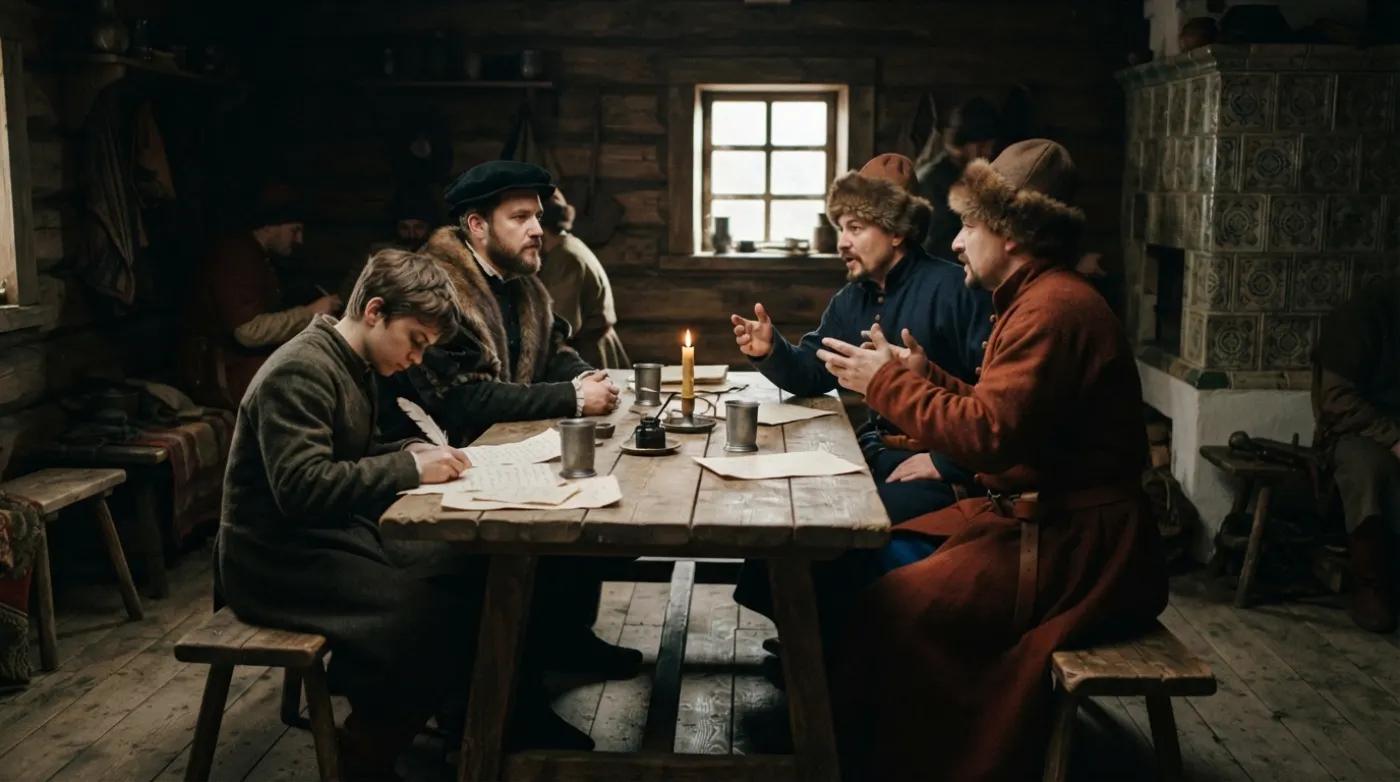
He also used written sources. According to the historian Anna Khoroshkevich, Russian texts were translated for him, including chronicles and the law code of 1497, the Sudebnik. Poe stresses that he checked what he heard: he "did not rely upon this or that man's account, but trusted only to the unvarying statements of many". Poe calls him "no plagiarist", but other scholars have shown that he borrowed without acknowledgement from an earlier writer, Johann Fabri.
What did Herberstein write about the grand prince's power?
The most influential passages describe the power of the ruler of Moscow:
"In the sway which he holds over his people, he surpasses all the monarchs of the whole world."
"He uses his authority as much over ecclesiastics as laymen, and holds unlimited control over the lives and property of all his subjects: not one of his counsellors has sufficient authority to dare to oppose him, or even differ from him, on any subject. They openly confess that the will of the prince is the will of God… on this account they call him God's key-bearer and chamberlain."
He recorded a proverb: when asked about something uncertain, the Muscovites answered, "God and the great prince know". And he asked a question that later writers would repeat for centuries:
"It is matter of doubt whether the brutality of the people has made the prince a tyrant, or whether the people themselves have become thus brutal and cruel through the tyranny of their prince."
He also explained the title of tsar. Muscovite interpreters, he said, called their ruler "emperor" to foreigners, but in their own histories and scriptures "czar is put for 'king', and kessar for 'emperor'".
What did he write about Russian society?
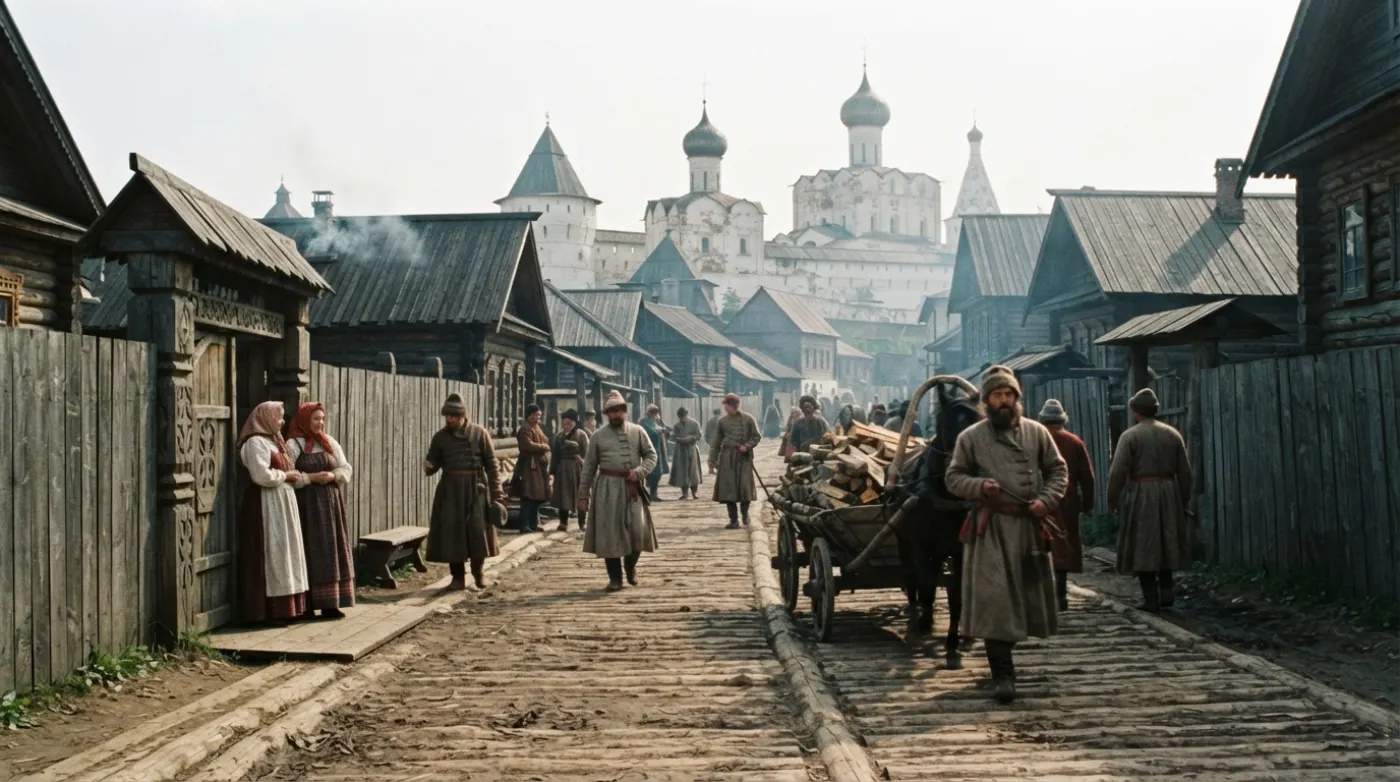
Herberstein wrote that the people "enjoy slavery more than freedom", since freed servants often sold themselves again, and that "all confess themselves to be chlopos", that is, serfs of the prince. He described Moscow as "entirely a city of wood", except for a few stone houses, churches and monasteries. He was told that the houses had been counted on the prince's order six years before his arrival and numbered more than 41,500, a figure he called "scarcely credible".
He wrote that "the condition of the women is most miserable", because a woman was considered virtuous only if she stayed shut up at home. His most quoted passage on women is a story. A German blacksmith in Moscow named Jordan, who had married a Russian woman, told him that his wife complained he did not love her, because "you have never beaten me". So he beat her, and she became more affectionate, and so he "repeated the exercise frequently". Herberstein ends: "finally, while I was still at Moscow, cut off her head and her legs." The Latin cervicem illi tandem & crura praecidit has also been translated as "finally broke her neck and legs".
This story became the basis for a famous claim that Russian wives took beatings as a sign of love. Historians treat it with caution. The Russian historian Oleg Kudryavtsev notes that it reads more like an anecdote "that could be used as the plot of a Renaissance novella" than a real history. Poe uses it as an example of contradictions among foreign accounts: the German traveller Adam Olearius, a century later, wrote that he "did not find that Russian wives regard frequent blows and beating as a sign of intense love".
What did Herberstein get wrong?
Herberstein was careful, but not infallible. His Russian translator of 1908, Alexander Malein, listed misreadings of the chronicles, such as taking the hero Dobrynya for a woman. Khoroshkevich points out that some informants were hostile to Moscow.
His most famous curiosity is the boranetz, or "vegetable lamb". A Russian informant told him of a plant on the lower Volga that grew from a seed "somewhat like a melon" into "something very like a lamb", with wool used for caps. The English translation of 1851 makes Herberstein sound credulous, but in the Latin he writes that he regarded the story of the seed and the plant as a fiction (pro commento habuerim). He reported it anyway, and later he added that the scholar Guillaume Postel had heard a similar story.
The Muscovites themselves objected to one detail. Herberstein said that Vasily kept a ewer and basin beside him at audiences, so that he could wash his hands after touching those of a foreign ambassador of another faith. During the mission of the papal envoy Antonio Possevino, Russian diplomats called the book an "old muddle-headed book" for this claim.
How did the book spread across Europe?
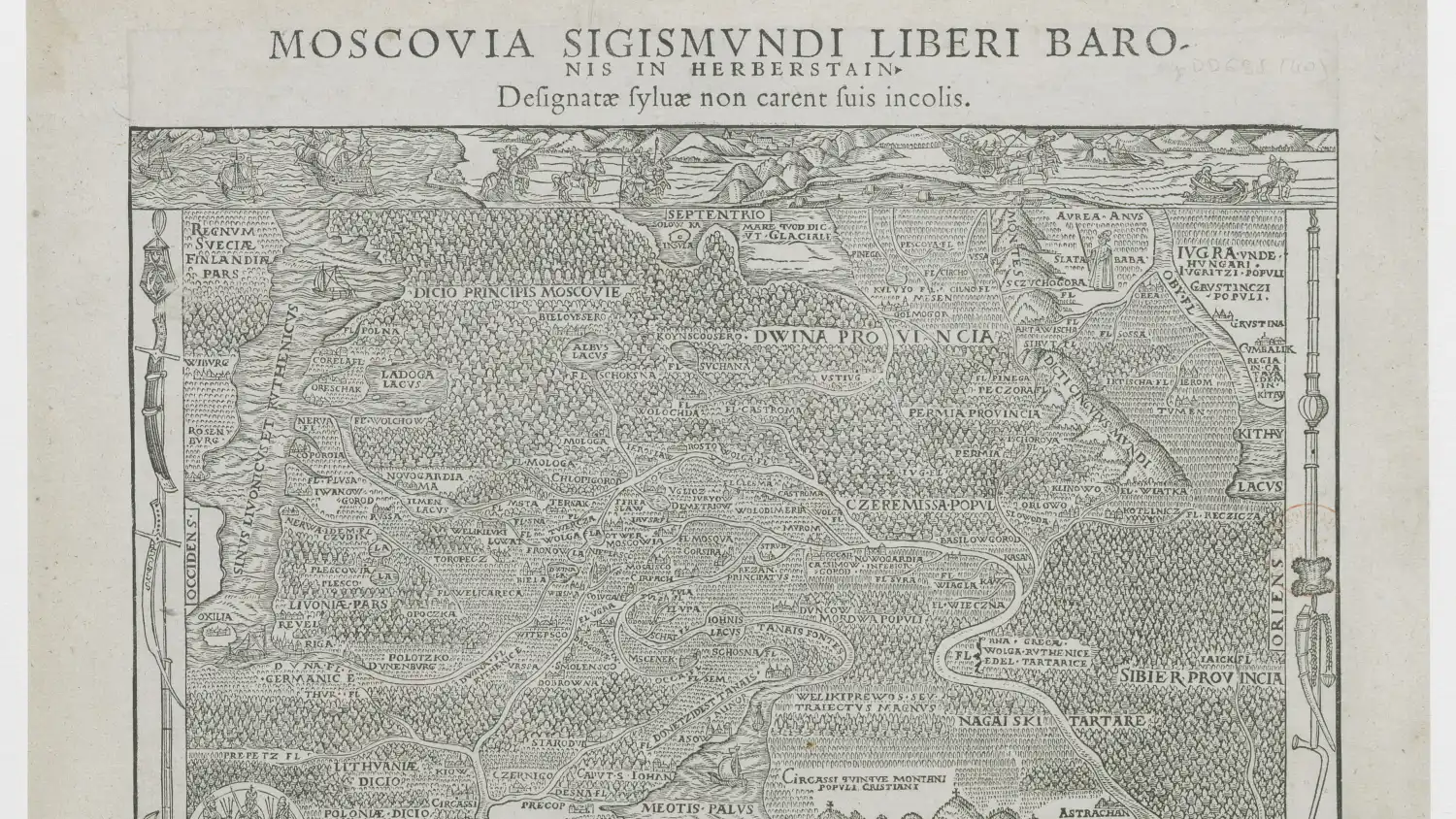
Herberstein dedicated the book to King Ferdinand on 1 March 1549 in Vienna. The first edition carries no printer's name; bibliographers attribute it to Egidius Aquila of Vienna. An Italian translation appeared in Venice in 1550, and in July 1551 the Basel printer Johannes Oporinus published a new edition. The enlarged Basel edition of 1556 added, as the editor put it, new maps "by the author himself", and woodcuts of animals and horsemen. In 1557 Herberstein published his own German translation in Vienna, Moscovia der Hauptstat in Reissen.
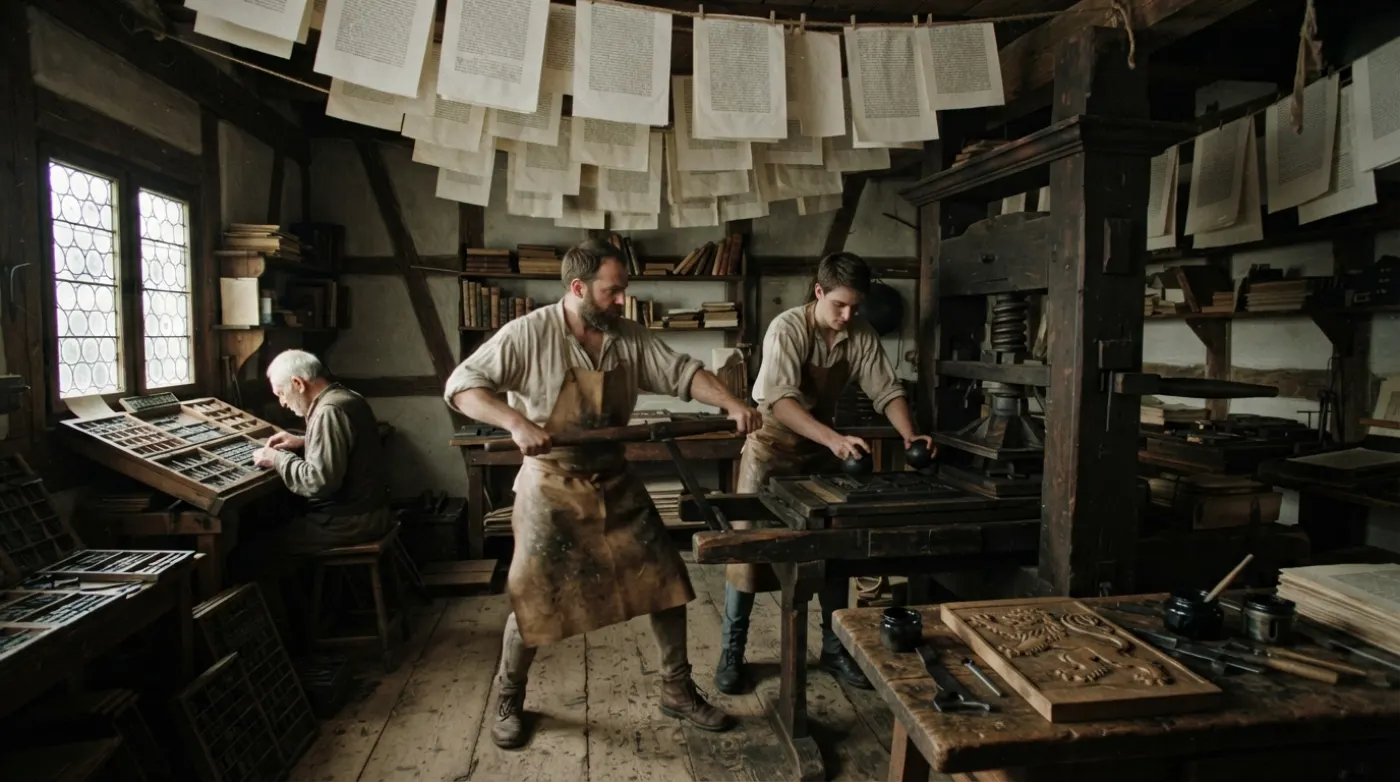
Poe counts some 22 editions and substantial extracts in seven languages up to 1611: Latin, German, Italian, Czech, Polish, English and Dutch. The book became, in his words, "the major European source of information on Muscovy". The English poet George Turberville, who went to Moscow in 1568, advised a friend: "To Sigismundus booke repayre, who all the trueth can tell."
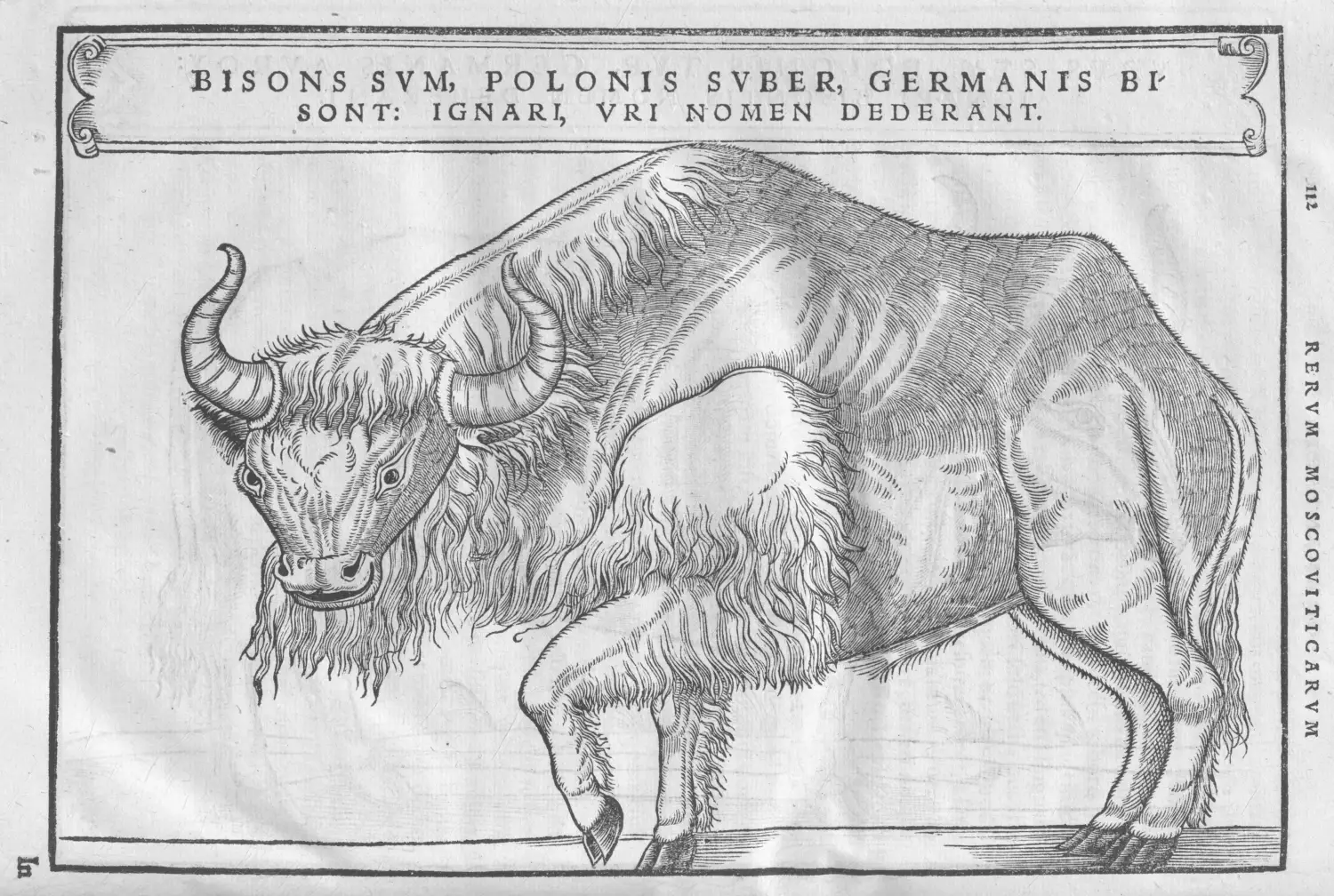
The Lithuanians, Herberstein wrote, "call the bison, in their own language, 'suber'. The Germans improperly call it 'aurox' or 'urox', which name better suits the buffalo", that is, the aurochs. The 1556 edition printed separate woodcuts of the two animals.
His geography was just as influential. Malein, citing the geographer Evgeny Zamyslovsky, gave a measure: before 1549, European geography knew only two town names in the Black Sea basin of Russia, Smolensk and Vyazma, and Herberstein gave eight; in the Volga basin, he gave 37 instead of 13.
Did Herberstein invent the image of Russian despotism?
Not entirely. Earlier writers, among them Fabri and the Italian Paolo Giovio, had described the power of the grand prince, but they had never been to Moscow and some had praised it. Poe concludes that "Herberstein did not invent the image of Russian despotism, but his depiction of it was the first to be grounded in personal experience." Later writers on Russia, from the Englishman Giles Fletcher to Olearius, built on it, and through them it reached political theory.
Kudryavtsev argues that Herberstein, as a humanist, also brought older stereotypes with him: of northern barbarians, and of tyranny as a perverted form of monarchy. He sees Herberstein as among the first to link the type of ruler to the character of a nation. At the same time, Herberstein also admired some things. Khoroshkevich notes the respect with which he wrote about peoples and customs, and Prince Andrei Kurbsky, Ivan the Terrible's critic, later called him a "distinguished imperial man and great ambassador". (On Kurbsky, see Ivan the Terrible and Prince Kurbsky.)
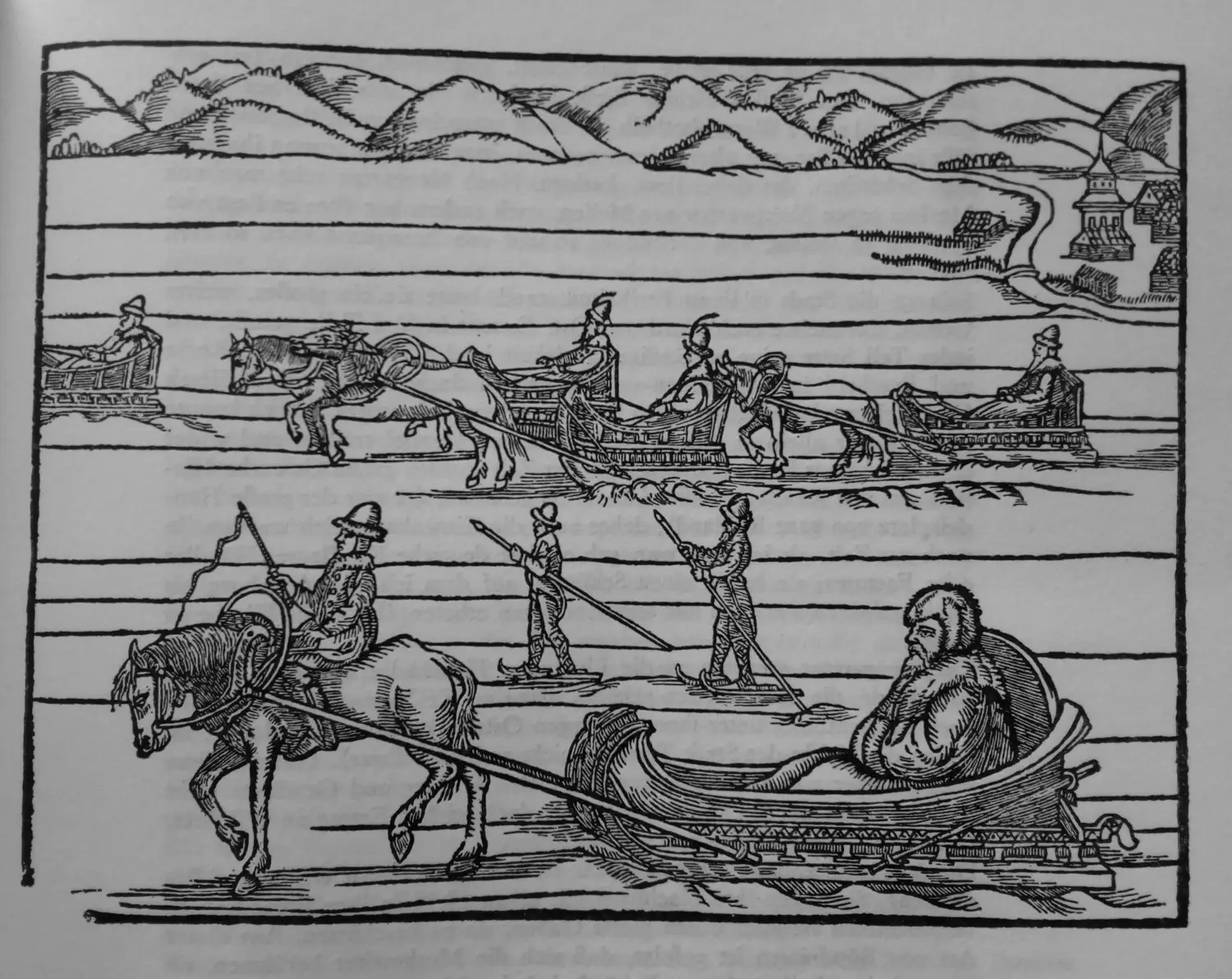
Herberstein's later life
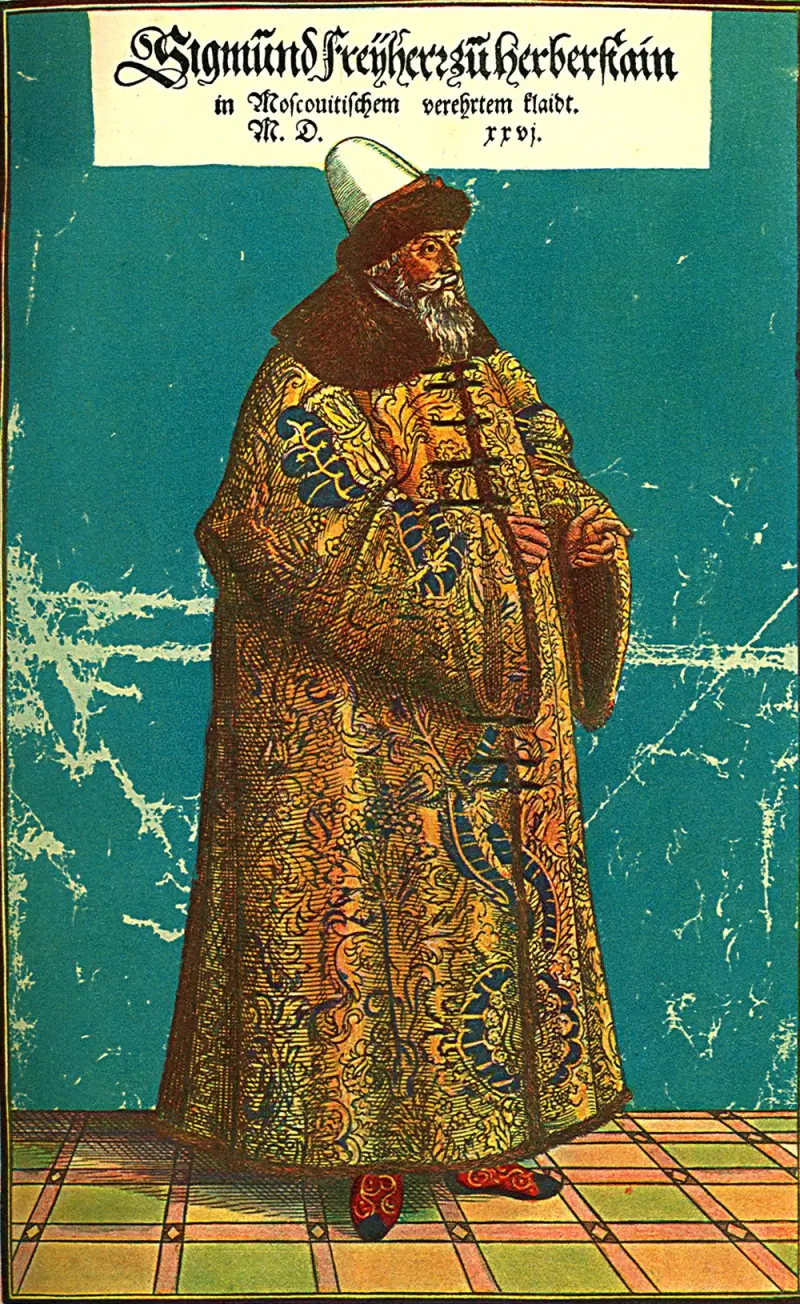
Herberstein went on serving the Habsburgs into his sixties. In 1541 he took part in an embassy to Suleiman the Magnificent's camp near Buda. In his last years he published autobiographical works, including Gratae posteritati (1558 and 1560), with woodcut portraits showing him in the robes he had received at foreign courts. He died in Vienna on 28 March 1566, "in his eightieth year", and was buried in St Michael's church; no trace of his grave remains.
In Slovenia he is remembered as Žiga Herberstein. In 2014 a facsimile of Gratae posteritati, from a copy in the library of Ptuj, was published there.
Common myths about Herberstein
| Myth | What the evidence says |
|---|---|
| Herberstein wrote the first Western account of Russia | Giovio, Fabri and others wrote earlier; his was the first detailed eyewitness account |
| Herberstein reported that all Russian wives want to be beaten | He told one story heard from a German smith, which ended in murder; historians treat it as an anecdote |
| Herberstein believed in the vegetable lamb | In the Latin he calls the story a fiction; the 1851 English translation blurs this |
| Herberstein called Moscow the "Third Rome" | The phrase does not occur in his book |
| Herberstein was born in Styria | He was born at Wippach (Vipava) in Carniola; his family's seat was in Styria |
| "Liber" was his surname | Liber baro means "free baron"; the Antwerp edition of 1557 turned it into a name, "Sigismundo Libero" |
Timeline
| Date | Event |
|---|---|
| 23 August 1486 | Herberstein born at Wippach (Vipava), Carniola |
| 26 September 1514 | Knighted by Maximilian I (per the Slovenian Biographical Lexicon) |
| 14 December 1516 | Sets out for Moscow |
| 18 April 1517 | Arrives in Moscow; first audience with Vasily III on 21 April |
| 21 November 1517 | Leaves Moscow |
| 26 April 1526 | Second arrival in Moscow |
| 11 November 1526 | Dismissed by Vasily III at Mozhaisk after a truce is agreed |
| 1541 | Embassy to Suleiman near Buda |
| 1 March 1549 | Dedication of Rerum Moscoviticarum Commentarii |
| 1550 | Italian translation, Venice |
| 1551 | First Basel edition (Oporinus) |
| 1556 | Enlarged Basel edition with maps and woodcuts |
| 1557 | German translation by Herberstein, Vienna |
| 28 March 1566 | Herberstein dies in Vienna |
| 1851–1852 | English translation by R. H. Major |
What the map shows
At 1517 the Grand Principality of Moscow under Vasily III borders the Grand Duchy of Lithuania, whose ruler was also king of Poland. By the time the book appeared, in 1549, Vasily's son had been crowned tsar and the state had become the Tsardom of Russia. For two people Herberstein wrote about, see our articles on Ivan III and Sophia Palaiologina.
Sources
Primary sources
- Sigismund von Herberstein, Notes upon Russia, trans. R. H. Major, 2 vols (London: Hakluyt Society, 1851–1852): vol. 1, vol. 2
- Sigismund von Herberstein, Rerum Moscoviticarum Commentarii (Basel: Oporinus, 1556): https://archive.org/details/herb1556
- Sigizmund Gerbershtein, Zapiski o moskovitskikh delakh, trans. A. I. Malein (St Petersburg, 1908): https://archive.org/details/her0iov
- Sigizmund Gerbershtein, Zapiski o Moskovii, trans. A. I. Malein and A. V. Nazarenko, with introduction and commentary (Moscow: MGU, 1988)
Studies and reference works
- M. Poe, "Herberstein and the Origin of the European Image of Muscovite Government", in F. Kämpfer and R. Frötschner (eds.), 450 Jahre Sigismund von Herbersteins Rerum Moscoviticarum Commentarii 1549–1999 (Wiesbaden, 2002); draft via Iowa Research Online
- M. Poe, A People Born to Slavery: Russia in Early Modern European Ethnography, 1476–1748 (Ithaca, 2000)
- M. Poe, "The Use of Foreign Descriptions of Russia as Sources for Muscovite History: A Methodological Guide", Iowa Research Online
- O. F. Kudryavtsev, "O nekotorykh stereotipakh vospriiatiia Rossii… v 'Zapiskakh o Moskovii'" (2018), doi:10.25986/iri.2018.74.4.005
- P. Vidmar, on Herberstein's portraits and woodcuts, Radovi Instituta za povijest umjetnosti 43 (2019)
- "Herberstein, Sigismund", Slovenska biografija (Slovenian Biographical Lexicon)
- L. Steindorff, on German-language historiography of Muscovy 2000–2020 (2021), doi:10.38210/rustudh.2021.3.9
- RTV Slovenija, 24 October 2014, on the facsimile of Gratae posteritati
Image credits
- Title image: Moscovia Sigismundi Liberi Baronis in Herberstain, Basel, 1556, Bibliothèque nationale de France. Public domain, via Wikimedia Commons, cropped to 16:9.
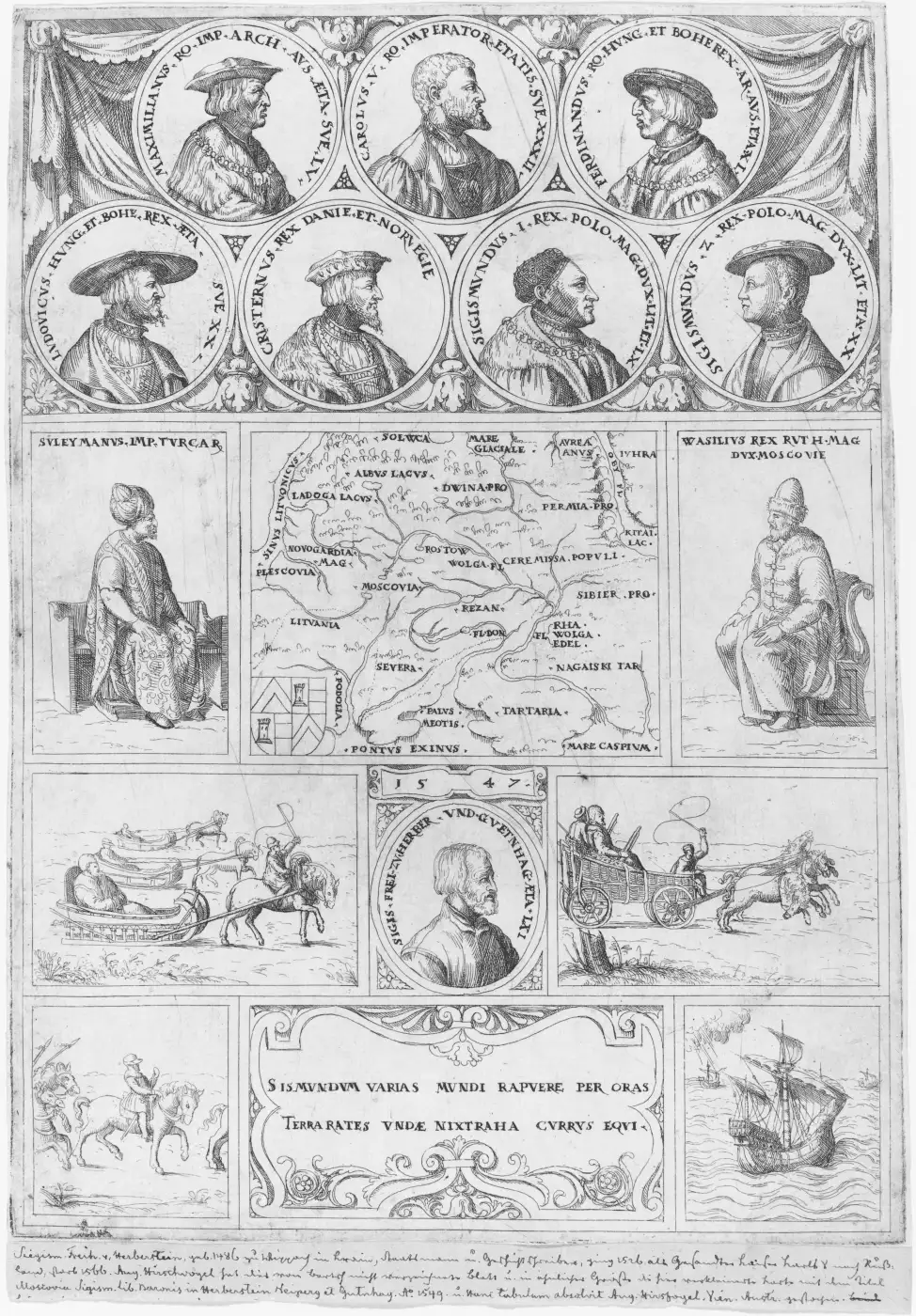
- Augustin Hirschvogel, sheet for Herberstein, 1548, National Gallery of Art, Washington. CC0, via Wikimedia Commons.
- Herberstein in Muscovite robe, woodcut, 1558–1560. Public domain, via Wikimedia Commons.
- Bison woodcut, Basel, 1556, Polona. Public domain, via Wikimedia Commons.
- Travelling by sledge, from the German edition of 1557. Public domain, via Wikimedia Commons.