Ivan Fyodorov was a Moscow deacon who, with his partner Pyotr Mstislavets, finished printing the Apostol, a book of the Acts and Epistles of the Apostles, on 1 March 1564. It is the first printed book from Moscow that carries an exact date, and for that reason Fyodorov is called Russia's "first printer". The title is not quite accurate. At least six undated books had already been printed in Moscow, and Cyrillic printing had begun in Kraków in 1491.
Fyodorov's own story is more unusual than the legend. Within two years of the Apostol he left Moscow for the Grand Duchy of Lithuania, complaining of persecution and accusations of heresy. He went on to print in Zabłudów, Lviv and Ostrog, produced the first East Slavic printed primer in 1574 and the first complete printed Church Slavonic Bible in 1580–1581, and died in debt in Lviv in December 1583. Russians, Ukrainians and Belarusians all claim him today.
Ivan Fyodorov at a glance
| Name | Ivan Fyodorov (Ivan, son of Fyodor); in Lithuania and Ukraine Ivan Fedorovych, "Ivan the Printer", "Moskvitin" (the Muscovite) |
| Born | Unknown; "about 1510" rests on a disputed university record |
| Office | Deacon of the church of St Nicholas Gostunsky in the Moscow Kremlin |
| Key book | The Moscow Apostol, printed 19 April 1563 – 1 March 1564 |
| Partner | Pyotr Timofeev Mstislavets |
| Later presses | Zabłudów (1568–1570), Lviv (1573–1574), Ostrog (1575–1581) |
| Died | 5 December 1583 (Old Style), 15 December in the modern calendar, in Lviv |
| Buried | St Onuphrius monastery, Lviv |
Was the Apostol really Russia's first printed book?
Not in the strict sense. The Great Russian Encyclopedia chooses its words carefully: the Apostol was "the first precisely dated Russian printed book". The Russian Biographical Dictionary already said in the early twentieth century that "there is now almost no doubt" that Fyodorov "cannot, strictly speaking, be called the Russian first printer".
Before the Apostol, an unknown press in Moscow had printed several books without any date, place or printer's name. Book historians call it the Anonymous Press. The bibliographer Antonina Zernova counted six of its editions in four typefaces in 1947: Gospels, Psalters and two Triodions, the service books for the weeks before and after Easter. The historian Evgeny Nemirovsky, in his biography of 1985, counted seven in five typefaces and dated them from 1553–1554 to 1564–1565.
How early they began is disputed. The oldest dated note of ownership Nemirovsky found in one of them is from 1558–1559. Zernova had found none earlier than 1561 and wrote that "there are no inscriptions that would make us assign even the earliest of these editions to the 1550s". The Orthodox Encyclopaedia dates the Anonymous Press to the mid-1550s. It links its founding to the Hundred Chapters council of 1551, which ruled that churches must use only corrected service books. Some historians think Fyodorov himself worked at this press, and the Great Russian Encyclopedia says he "possibly" did.
Printing in Cyrillic letters is older still. In Kraków, in the Kingdom of Poland, the German printer Schweipolt Fiol issued four Church Slavonic books in a Cyrillic type cut in 1491. Two of them are dated 1491. The first East Slavic printer was Francysk Skaryna of Polotsk, whose Psalter appeared in Prague on 6 August 1517.
Who was Ivan Fyodorov?
Very little is known of his early life. "Fyodorov" is not a family name but a patronymic: Ivan, son of Fyodor. Nemirovsky identified him with a "Johannes Theodori Moscus" who became a bachelor at Kraków University in 1532, and on that basis dated his birth to about 1510. The Ukrainian historian Yaroslav Isaievych rejected the identification. The student who enrolled in 1529 came, the record says, from a place in the Kraków diocese and later became a canon in Krasnystaw. The birth year is therefore unknown, and the Great Russian Encyclopedia marks it with a question mark.
By 1563 he was a deacon of the church of St Nicholas Gostunsky in the Moscow Kremlin. His printer's mark, which appears in his later books, has been compared to the Polish-Lithuanian coat of arms Szreniawa. That suggests a link to the nobility of the Grand Duchy of Lithuania, but how he came by it is unknown.
How was the Apostol made?
The best source for the Apostol is its own afterword, the earliest account of how the Moscow press was founded. It explains that Ivan IV had found that few of the church books in the land could be used: "all the rest were corrupted by copyists who were untaught and unskilled in understanding, and also by the carelessness of those who wrote them." The tsar therefore "began to think how to set out printed books, as among the Greeks, and in Venice, and in Phrygia, and among other peoples, so that from then on the holy books might be set out correctly". He told Metropolitan Makary of Moscow, who "rejoiced greatly".
The tsar paid for it: "the pious tsar ordered a house to be built at the expense of his royal treasury, where the work of printing could be set up, and generously gave from his royal treasures to the workers, to Ivan Fyodorov, deacon of St Nicholas the Wonderworker Gostunsky, and to Pyotr Timofeev Mstislavets." (All translations from the Church Slavonic in this article are our own.)
The afterword gives the dates precisely. Printing began "in the year 7071, on the 19th day of April", that is 19 April 1563 in the modern era, and the book was finished "in the year 7072, on the 1st day of March … under Archbishop Afanasy, Metropolitan of all Russia, in the first year of his office". Makary had died in 1563. As the Orthodox Encyclopaedia puts it, the metropolitan who had persuaded the tsar of the value of printing "died without waiting for the appearance of its first edition".
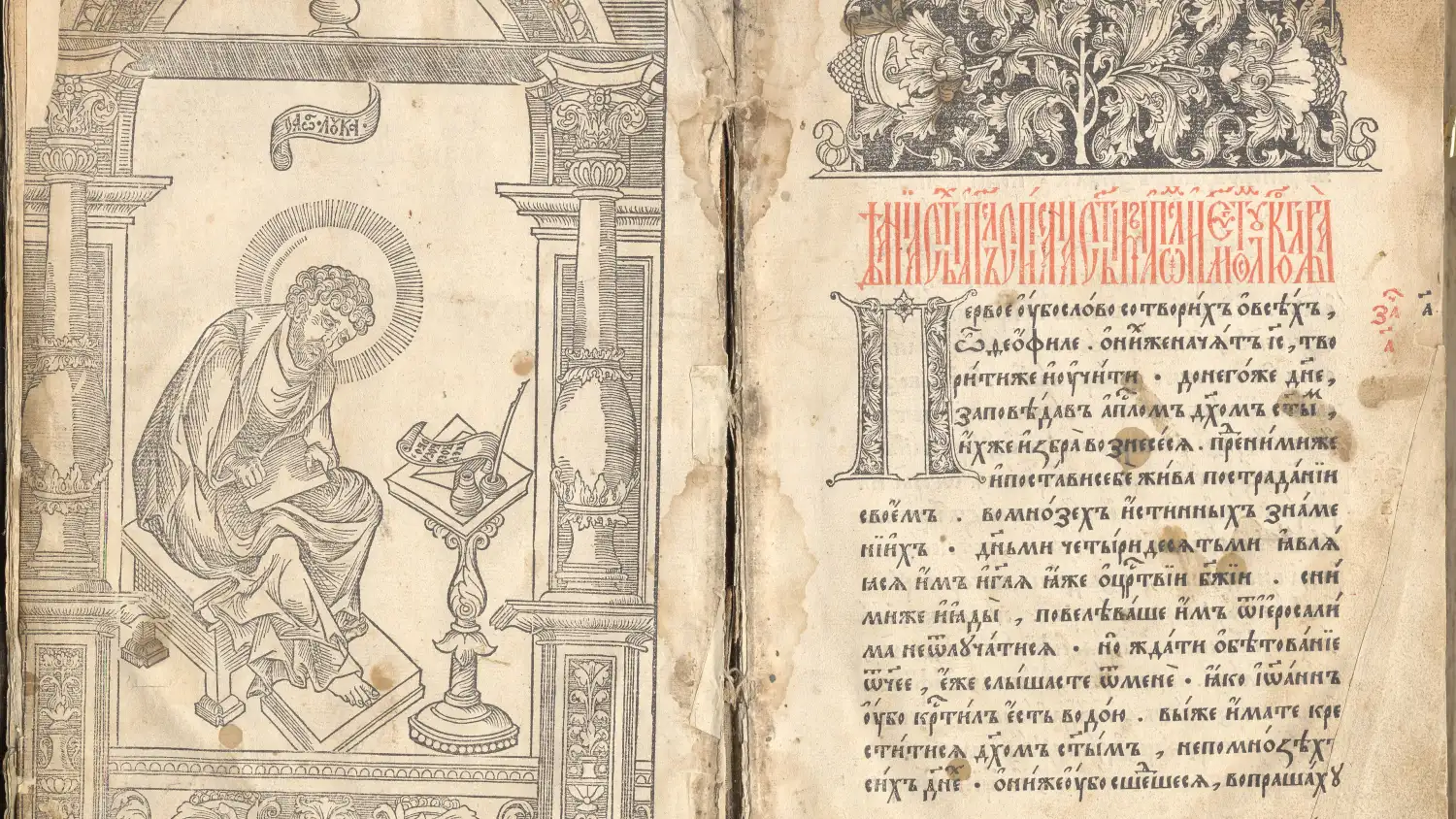
The book has 268 leaves. Its type was based on the Moscow semi-uncial handwriting of the sixteenth century, and it opens with a woodcut frontispiece of St Luke, author of the Acts. The Great Russian Encyclopedia credits Fyodorov with creating the decorative "early printed style" that later Moscow books followed.
How many copies were printed is unknown. Nemirovsky counted 61 surviving copies in 1983, six of them abroad, in London, Prague, Washington, Dublin and Cambridge in both England and Massachusetts. A later Moscow Apostol of 1597 had a stated print run of 1,050 and survives in 26 copies; from that ratio Nemirovsky estimated that more than 2,000 copies of the 1564 book were printed. Another researcher, working from the likely speed of the workers, arrived at about 600. Both figures are estimates.
In 1565 Fyodorov and Mstislavets printed two editions of a Chasovnik, the Book of Hours: the first between 7 August and 29 September, the second between 2 September and 29 October. One copy of the first and five of the second survive.
Why did Fyodorov leave Moscow?
Soon after the second Chasovnik, the two printers left for the Grand Duchy of Lithuania. The historian A. S. Usachev places their departure between 29 October 1565 and May 1566. These were the years of the oprichnina, Ivan IV's reign of terror, but Fyodorov never mentions it.
He gave his reason ten years later, in the afterword to his Lviv Apostol of 1574. He wrote that he told his story "because of the very great bitterness that often befell us, not from the sovereign himself, but from many chiefs, prelates and teachers, who out of envy devised many heresies against us, wishing to turn good into evil and to destroy God's work utterly". This, he said, "drove us from our land, our fatherland and our kin, and moved us to other, unknown lands".
Historians read this in different ways. The Soviet historian Mikhail Tikhomirov thought the printers left with the tsar's consent, perhaps even on his errand. Isaievych noted that Fyodorov may have cleared the tsar so as not to close the Russian market to his books, and doubted that the printers would have had to emigrate at all if Ivan had been well disposed to them. What the heresy charges were, and who brought them, is not known.
The legend of the burned press
A well-known story says that a mob, incited by scribes who feared for their trade, burned Fyodorov's printing house. It has a single sixteenth-century source: the English ambassador Giles Fletcher, who wrote in 1591:
"Some yeres past, in the other emperors time, there came a presse and letters out of Polonia to the citie of Mosko, where a printing house was set up with great liking and allowance of the emperour himselfe. But not long after the house was set on fire in the night time, and the presse and letters quite burnt up, as was thought by the procurement of the cleargy men."
Fletcher does not name Fyodorov or give a year, and he reports the cause only "as was thought". Fyodorov himself never mentions a fire. Zernova showed that the type and ornaments he used in Moscow reappear in his later books in Lithuania and Ukraine, so they were not "quite burnt up". The idea that the scribes were his enemies goes back to the bibliographer Vasily Sopikov in 1821 and is now rejected. Nemirovsky suggested that Fletcher's fire, if it happened, may have destroyed the earlier Anonymous Press.
What did Fyodorov print in Zabłudów and Lviv?
In Lithuania the printers were received, Fyodorov wrote, by King Sigismund II Augustus and taken under the protection of Hetman Grigory Khodkevich, who set up a press for them at his estate of Zabłudów, near Białystok in modern Poland. There Fyodorov and Mstislavets printed a Teaching Gospel, a book of sermons, between 8 July 1568 and 17 March 1569. Fyodorov alone then printed a Psalter (1569–1570). At least 51 copies of the Teaching Gospel and four of the Psalter survive. Mstislavets moved on to Vilnius.
Khodkevich, old and ill, then told Fyodorov to stop printing and live on a village he had given him. Fyodorov refused, in one of the best-known passages of his afterword: "It was not fitting for me to shorten the time of my life with the plough or with sowing seed, for instead of the plough I have the art of the tools of handwork, and instead of grain I must sow spiritual seeds throughout the world." In the autumn of 1572 he set off for Lviv, through country struck by plague.
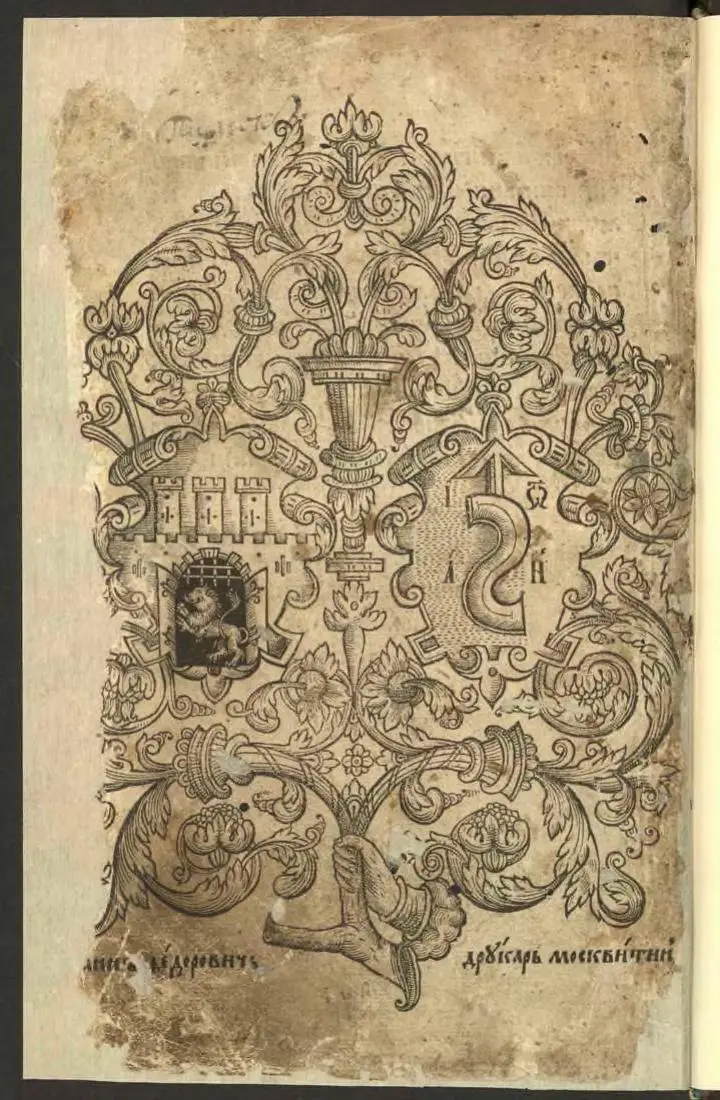
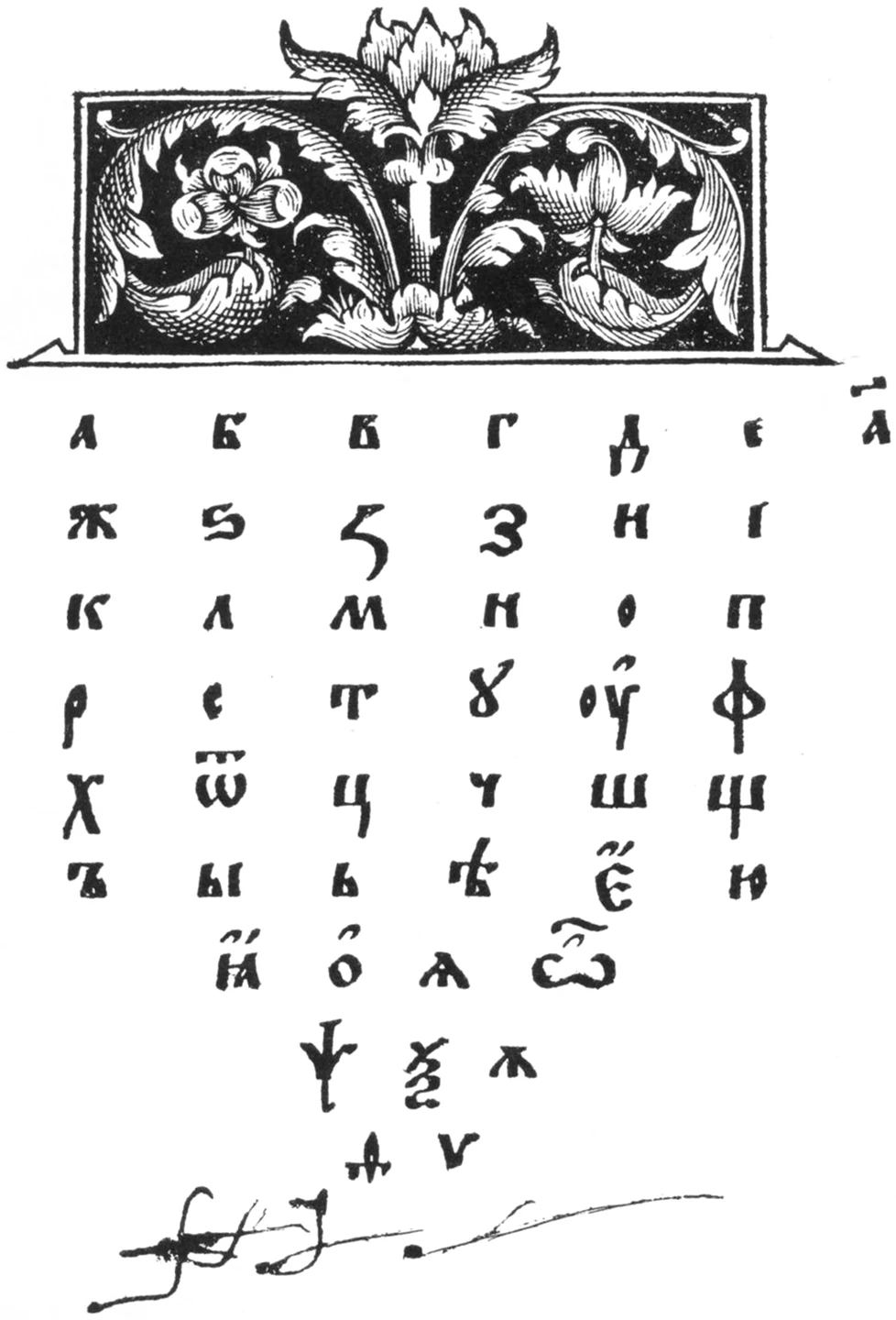
In Lviv he printed a new Apostol between 25 February 1573 and 15 February 1574. More than 120 copies survive. In 1574 he also printed an Azbuka, a small primer of 40 leaves that begins with the alphabet. It is the first known printed primer of the East Slavs. Only two copies survive: one at Harvard, published in facsimile by the linguist Roman Jakobson in 1955, and one in the British Library.
What was the Ostrog Bible?
In March 1575 Fyodorov entered the service of Prince Konstantin Ostrozhsky, one of the greatest Orthodox magnates of the Polish–Lithuanian Commonwealth. For a time he managed a monastery for the prince. Then he set up a press at Ostrog, in Volhynia, where Ostrozhsky had gathered scholars around a school. There he printed a primer on 18 June 1578, a New Testament with the Psalter in 1580, and in 1581 a one-page verse chronology by Andrei Rymsha.
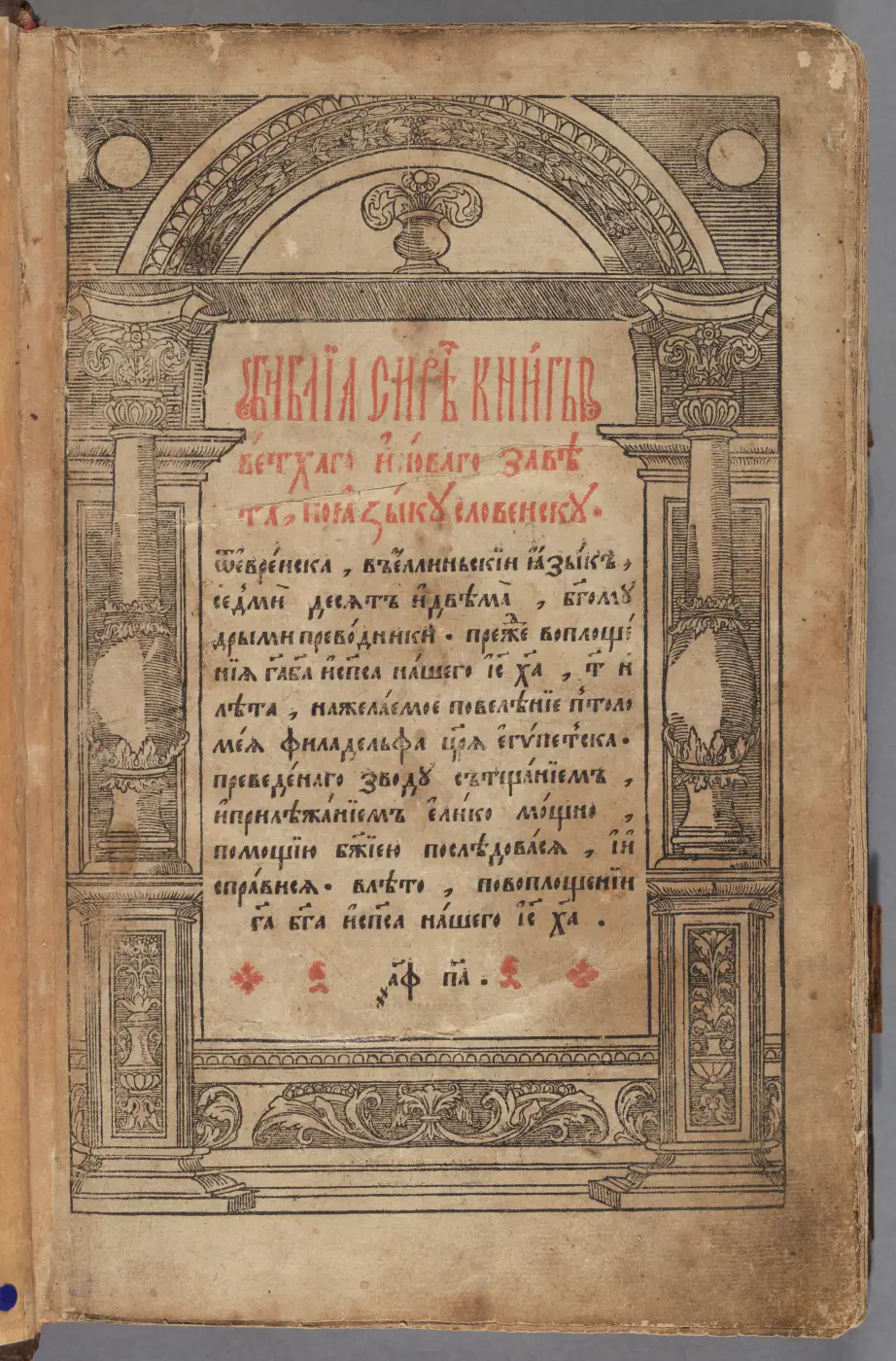
His greatest work there was the Ostrog Bible, the first complete printed Bible in Church Slavonic. Its colophons carry two dates, 12 July 1580 and 12 August 1581. The Orthodox Encyclopaedia explains that it was a single edition, whose final leaf was reprinted with the later date. Its print run is reconstructed at 1,200 to 1,500 copies. About 350 survive, which, the encyclopaedia notes, makes it "the best-preserved Cyrillic edition of its time". It spread across the East Slavic lands and among the South Slavs, and in Moldavia, Wallachia and Transylvania. One copy belonged to the English traveller Jerome Horsey, who wrote on its flyleaf: "This Bibell in the Sclavonian tonge had owt of the emperours librari. Jer. Horsey, 1581."
How did Fyodorov die?
By 1582 Fyodorov was back in Lviv. He also had other plans. In January 1583 he took an order in Kraków to cast a small field cannon. Between February and July of that year he travelled to Vienna and showed Rudolf II, ruler of the Holy Roman Empire, a many-barrelled mortar he had invented, but, the Great Russian Encyclopedia notes, "did not get an order". On 23 July 1583 he wrote from Vienna to Elector Augustus of Saxony, offering to come to Dresden. The letter survives in the Dresden city archive; there is no answer and no evidence that he went.
He died in Lviv on 5 December 1583 by the old calendar, 15 December in the modern one. Creditors had already placed liens on his property. In 1585 the bishop of Lviv, Gedeon Balaban, appealed for 1,500 złoty to redeem the pawned press. It passed to the Lviv Dormition brotherhood, whose press carried on his work.
He was buried in the St Onuphrius monastery in Lviv. His gravestone was destroyed during floor repairs in 1883, but its text is known from drawings and a plaster cast made in 1873. Around the edge it read: "Ioann Feodorovich, printer, the Muscovite, who by his diligence renewed neglected printing." Below his mark: "I await the resurrection of the dead. Printer of books never seen before." In 1971 a burial found in the church wall was cautiously identified as his. Polish experts later found that the bones were those of an old man, with raised levels of heavy metals. The remains were reburied in the church on 18 December 2014.
How is Fyodorov remembered?
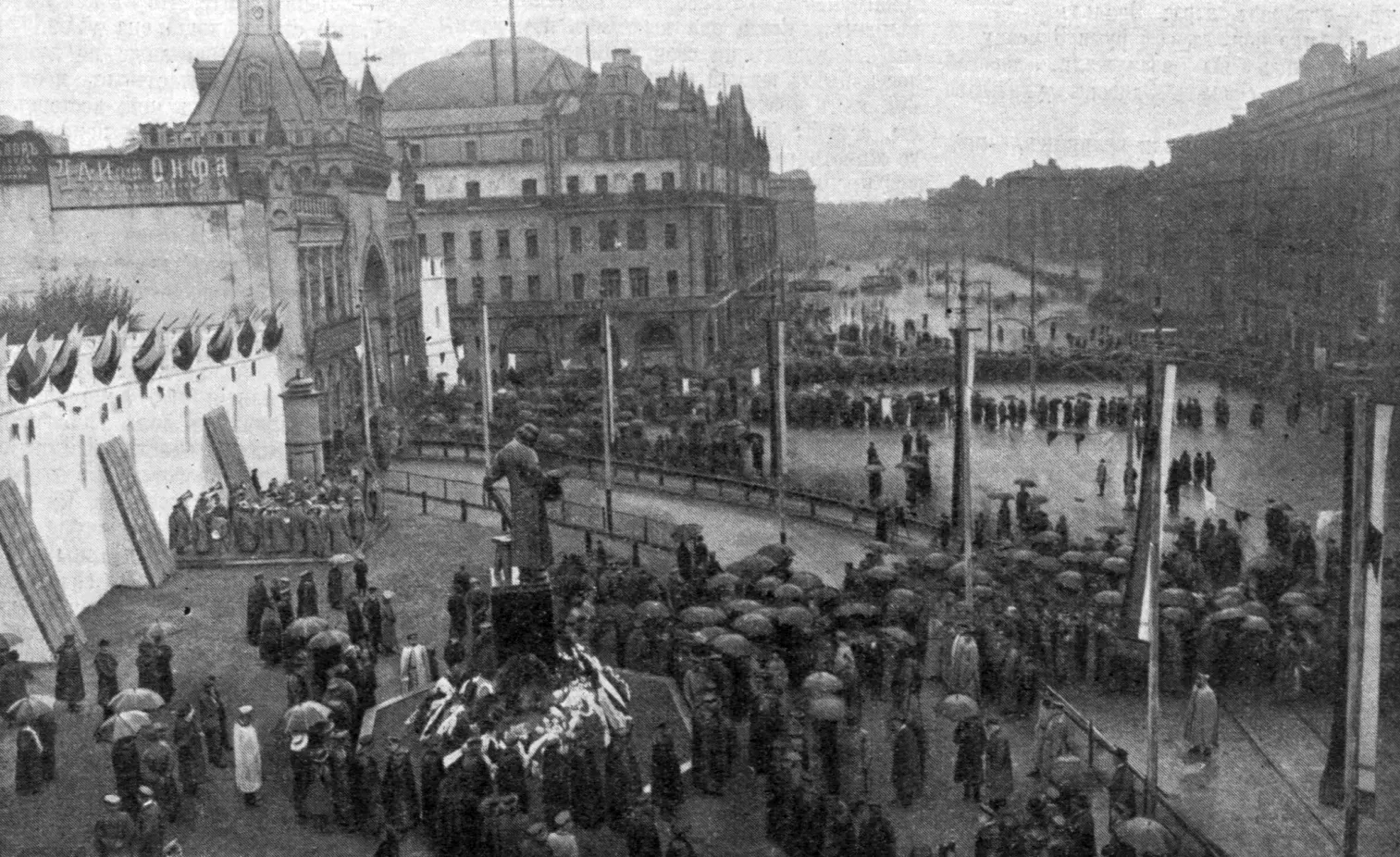
In Russia he is "the first printer". His monument by the sculptor Sergei Volnukhin was unveiled in central Moscow in 1909, near the Kremlin, and still stands there. In Ukraine he is remembered as Ivan Fedorovych, a founder of Ukrainian printing; a monument by V. N. Borisenko and V. M. Podolsky was put up in Lviv in 1977. In 2020 the Central State Historical Archives of Ukraine marked the 510th anniversary of his traditional birth year with an exhibition that called him one of the most prominent figures of Ukrainian book printing.
Readers searching for his name today will also find a modern Ukrainian politician, Ivan Fedorov, the former mayor of Melitopol and governor of Zaporizhzhia Oblast. He has no connection with the printer.
Common myths about Ivan Fyodorov
| Myth | What the evidence says |
|---|---|
| The Apostol was the first book printed in Russia | It is the first precisely dated one; six or seven undated Moscow books are older or contemporary |
| Fyodorov was the first Cyrillic printer | Schweipolt Fiol printed Cyrillic books in Kraków in 1491, and Francysk Skaryna in Prague from 1517 |
| An angry mob burned his press | Only Fletcher (1591) mentions a fire, as hearsay and without naming Fyodorov; Fyodorov took his type with him |
| He fled the tsar's anger | He wrote that his persecutors were "not the sovereign himself" but officials, clergy and teachers |
| He was born in 1510 and studied in Kraków | This rests on a university record whose identification is disputed |
| His gravestone survives in Lviv | The original slab was destroyed in 1883; its text is known from a cast of 1873 |
| There were two Ostrog Bibles, of 1580 and 1581 | It was one edition with two colophon dates |
Timeline of Ivan Fyodorov's life
| Date | Event |
|---|---|
| 1491 | Schweipolt Fiol prints Cyrillic books in Kraków |
| 6 August 1517 | Francysk Skaryna's Psalter appears in Prague |
| 1551 | The Hundred Chapters council demands corrected church books |
| c. 1553–1565 | The Anonymous Press prints undated books in Moscow |
| 19 April 1563 | Printing of the Moscow Apostol begins |
| 1 March 1564 | The Apostol is finished |
| 1565 | Two editions of the Chasovnik |
| Late 1565 or early 1566 | Fyodorov and Mstislavets leave for Lithuania |
| 8 July 1568 – 17 March 1569 | Teaching Gospel printed at Zabłudów |
| Autumn 1572 | Fyodorov moves to Lviv |
| 15 February 1574 | Lviv Apostol finished; the Azbuka follows in 1574 |
| March 1575 | Enters the service of Prince Konstantin Ostrozhsky |
| 1580–1581 | Ostrog Bible |
| 1583 | Shows a mortar to Rudolf II in Vienna |
| 5 December 1583 (15 December NS) | Dies in Lviv |
| 1883 | His gravestone is destroyed |
| 1909 | Moscow monument unveiled |
| 1977 | Lviv monument |
| 18 December 2014 | Remains reburied in the St Onuphrius church, Lviv |
What the map shows
At 1564 the Tsardom of Russia of Ivan IV stretches down the Volga to Astrakhan. Fyodorov's later work took place in the Polish–Lithuanian Commonwealth, formed by the Union of Lublin in 1569: at 1581, the year of the Ostrog Bible, both Lviv and Ostrog lie within it. For the tsar who paid for the first Moscow press, see our article on Ivan the Terrible.
Sources
Primary sources
- Afterword to the Moscow Apostol of 1564, Church Slavonic text, via ru.wikisource
- Afterword to the Lviv Apostol of 1574, Church Slavonic text, via ru.wikisource; Russian translation by M. V. Shchepkina, in U istokov russkogo knigopechataniia (Moscow, 1959)
- E. A. Bond (ed.), Russia at the Close of the Sixteenth Century (London: Hakluyt Society, 1856), with Giles Fletcher, Of the Russe Common Wealth (1591): https://archive.org/details/russiaatcloseofs20bond
- Central State Historical Archives of Ukraine, Kyiv, exhibition for the 510th anniversary of Ivan Fedorovych (2020)
Studies and reference works
- E. L. Nemirovskii, Ivan Fedorov (okolo 1510–1583) (Moscow: Nauka, 1985)
- A. S. Zernova, Nachalo knigopechataniia v Moskve i na Ukraine (Moscow, 1947): https://archive.org/details/nachalo_knigopechataniia_v_moskve_i_v_ukraine
- "Fedorov Ivan", Bol'shaia rossiiskaia entsiklopediia, vol. 33 (Moscow, 2017)
- "Pechatnyi dvor", "Apostol" and "Ostrozhskaia Bibliia", Pravoslavnaia entsiklopediia
- "Fedorov (ili Fedorovich), Ivan", Russkii biograficheskii slovar', via ru.wikisource
- Ia. Isaievych, Ukrains'ke knyhovydannia: vytoky, rozvytok, problemy (Lviv, 2002), chapter "Persha drukarnia u L'vovi"
- 5 Kanal, "U L'vovi perepokhovaly ostanky Ivana Fedorova", 18 December 2014
- LIGA.net, on the dismissal of Ivan Fedorov as head of the Zaporizhzhia regional administration (2026)
Image credits
- Title image: the Moscow Apostol of 1564, copy of the State Public Scientific and Technical Library, Novosibirsk. Public domain, via Wikimedia Commons, cropped to 16:9.
- Last page of the Lviv Apostol, 1574; alphabet page of the Azbuka, 1574; Genesis page of the Ostrog Bible, 1581. Public domain, via Wikimedia Commons.
- Unveiling of the Moscow monument, 1909, photo by S. G. Smirnov in Ogonyok. Public domain, via Wikimedia Commons.