The Russian conquest of Siberia began in 1582, when a band of Cossacks under Yermak took the capital of the Khanate of Sibir, and in its first phase ended in 1689, when the Treaty of Nerchinsk with Qing China halted the Russians on the Amur. In between, small parties of servicemen, Cossacks and fur trappers crossed northern Asia along its rivers. They built Tyumen in 1586 and Tobolsk in 1587, Mangazeya in 1601, Yeniseisk in 1619 and Yakutsk in 1632, and reached the Pacific in 1639. In 1648 Semyon Dezhnev sailed round the north-eastern tip of Asia. What drove them was fur, collected from the indigenous peoples as tribute called yasak, and secured by taking hostages. It was not, as Soviet textbooks later put it, a "voluntary entry": the sources describe burnings, hangings, famine and smallpox, as well as trade, alliances and peoples who used the newcomers for their own ends.
The conquest of Siberia at a glance
| Start | Yermak's Cossacks take Sibir (Isker), 26 October 1582 |
| First Russian towns | Tyumen (1586), Tobolsk (1587), Mangazeya (1601), Tomsk (1604) |
| Yenisei and Lena | Yeniseisk (1619), Krasnoyarsk (1628), Yakutsk (1632) |
| Pacific coast | Moskvitin reaches the Sea of Okhotsk, 1639; Okhotsk winter post, 1647 |
| Bering Strait | Dezhnev sails round Chukotka, 1648 |
| The Amur | Poyarkov (1643–1646), Khabarov (1649–1653), Albazin (from 1665) |
| What was taken | Yasak: an annual tribute, at first in furs, secured by hostages (amanaty) |
| End of the first phase | Siege of Albazin (1685–1687); Treaty of Nerchinsk, August 1689 |
(Russian documents of the period count years from the Creation and begin the year on 1 September; dates in this article are Old Style unless marked otherwise. In the 1680s add ten days for the Western calendar.)
How did the conquest of Siberia begin?
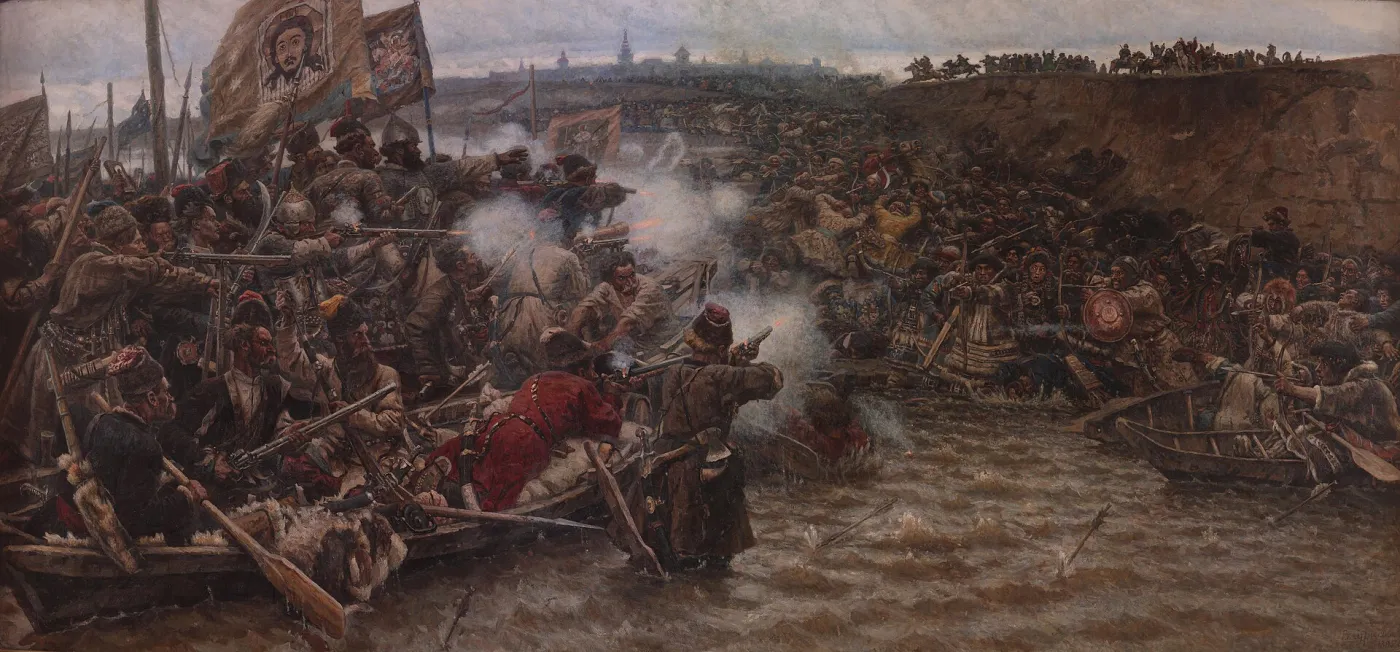
With a raid on a Tatar khanate. In the 1570s the Stroganov merchant family held large royal grants on the Chusovaya, on the edge of the Khanate of Sibir, the state beyond the Urals ruled by Khan Kuchum. From the Stroganov lands a band of Volga Cossacks under the ataman Yermak set out against the Voguls and the 'Siberians', crossed the mountains by river and, on 26 October, entered Kuchum's capital, Sibir, also called Isker or Qashliq. The year was long disputed; following Ruslan Skrynnikov, most historians now date the campaign to 1582, on the strength of an angry letter of 16 November 1582 in which Ivan IV rebuked the Stroganovs for sending the Cossacks to war beyond the Urals without his knowledge. The story of the khanate, of Kuchum and of Yermak's death in an ambush in August 1585 is told in our entry on the Khanate of Sibir.
One sentence in the old accounts sets the pattern for everything that followed. The historian Gerhard Friedrich Miller, who worked in the Siberian archives in the 1730s, paraphrases the report the Cossacks sent to Moscow: Yermak had brought "many Tatars, Ostyaks and Voguls to the shert', that they should be under the tsar's hand to the end of the age and pay yasak every year". Shert' was an oath of allegiance; Ostyaks and Voguls are the old Russian names for the Khanty and the Mansi. Conquest in Siberia meant this: an oath, a list of names and an annual payment in furs. (The translations from Russian in this article are our own.)
How did the Russians hold western Siberia?
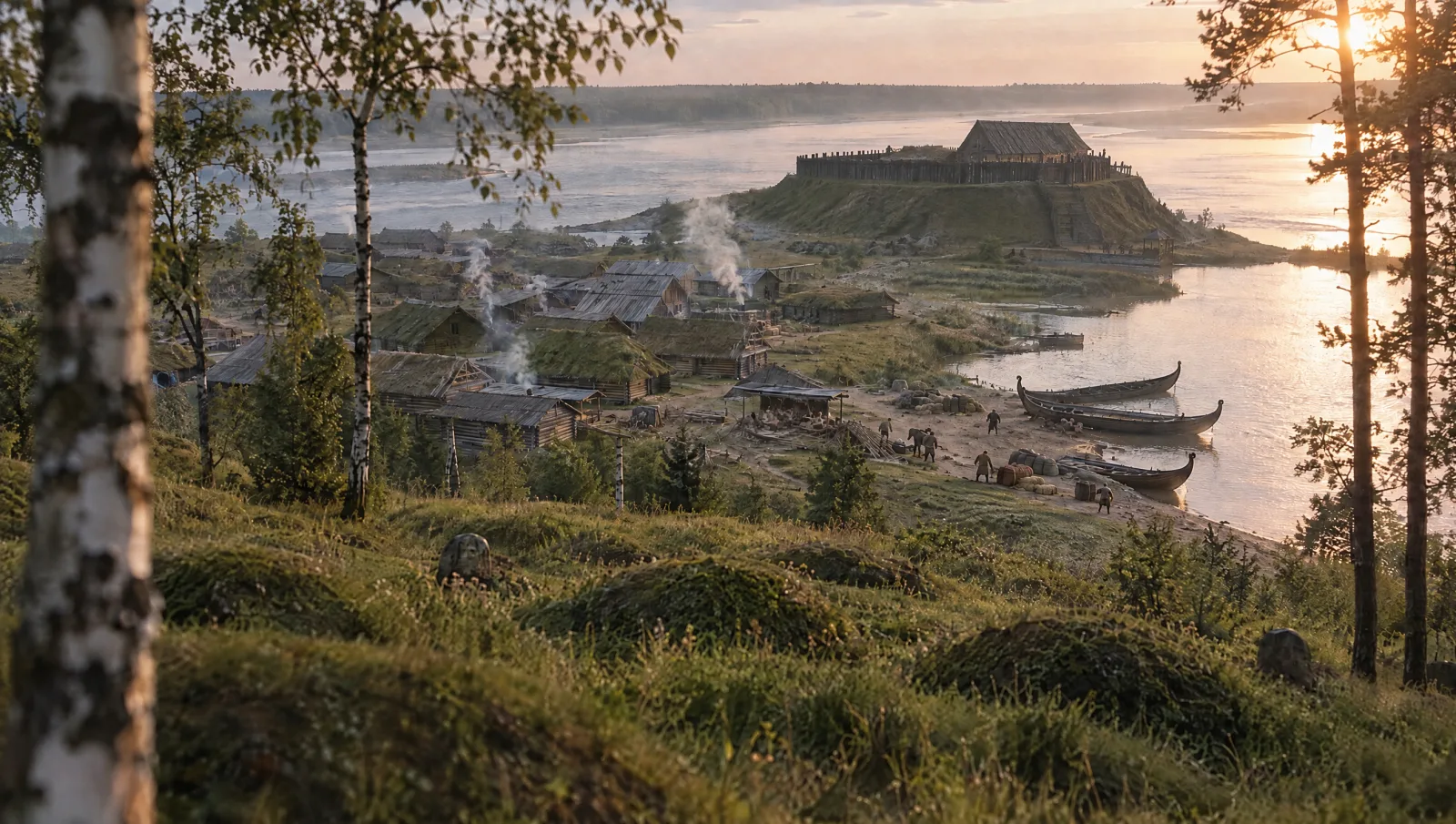
By building forts rather than by Yermak's victory. Yermak's band was almost destroyed, and fewer than a hundred survivors made their way back to Moscow in 1585. The government of the Tsardom of Russia then sent regular troops. Miller records that early in 1586 the voevodas Vasily Sukin and Ivan Myasnoy and the officer Danila Chulkov left Moscow with "a small detachment of 300 streltsy and Cossacks". Wary of the Tatars on the Irtysh, they stopped on the Tura where the old Tatar town of Chimgi had stood, and on 29 June 1586 began to build the town later called Tyumen.
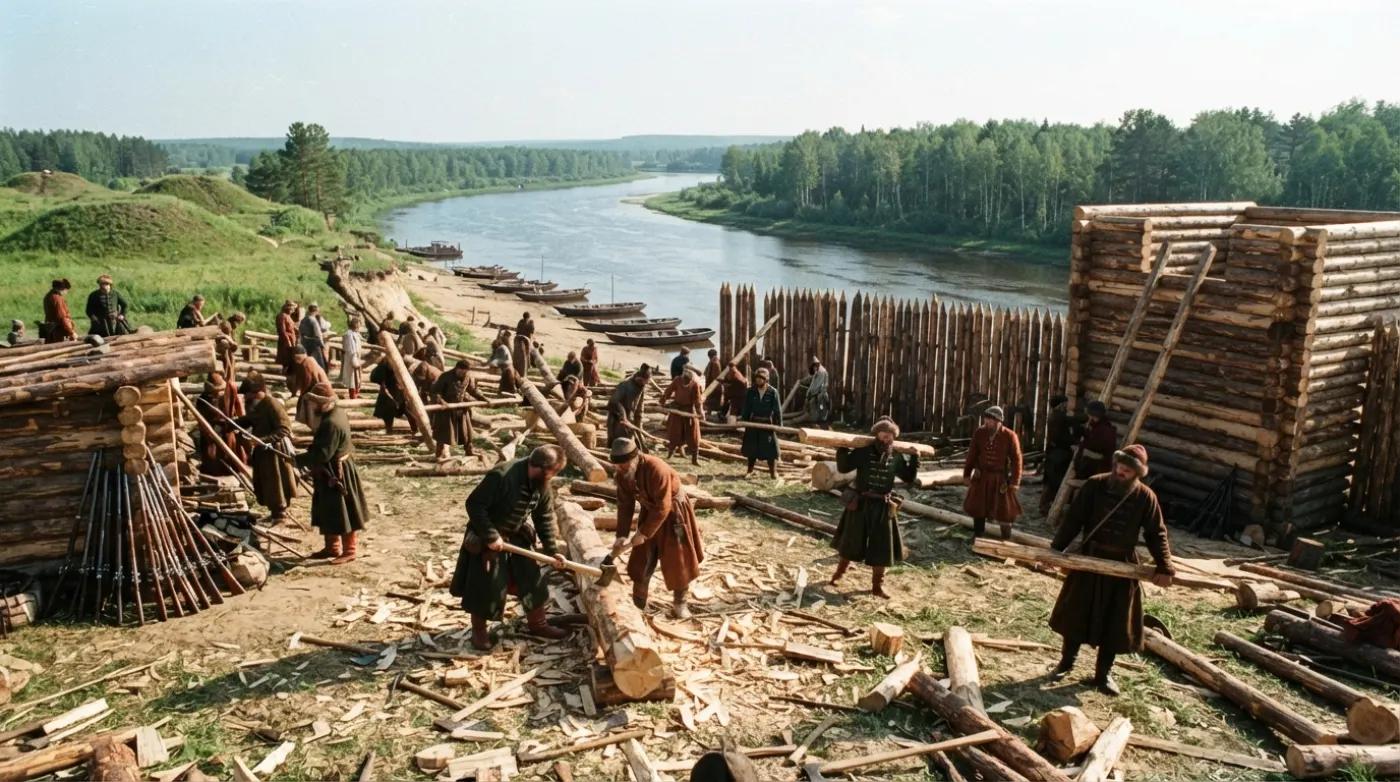
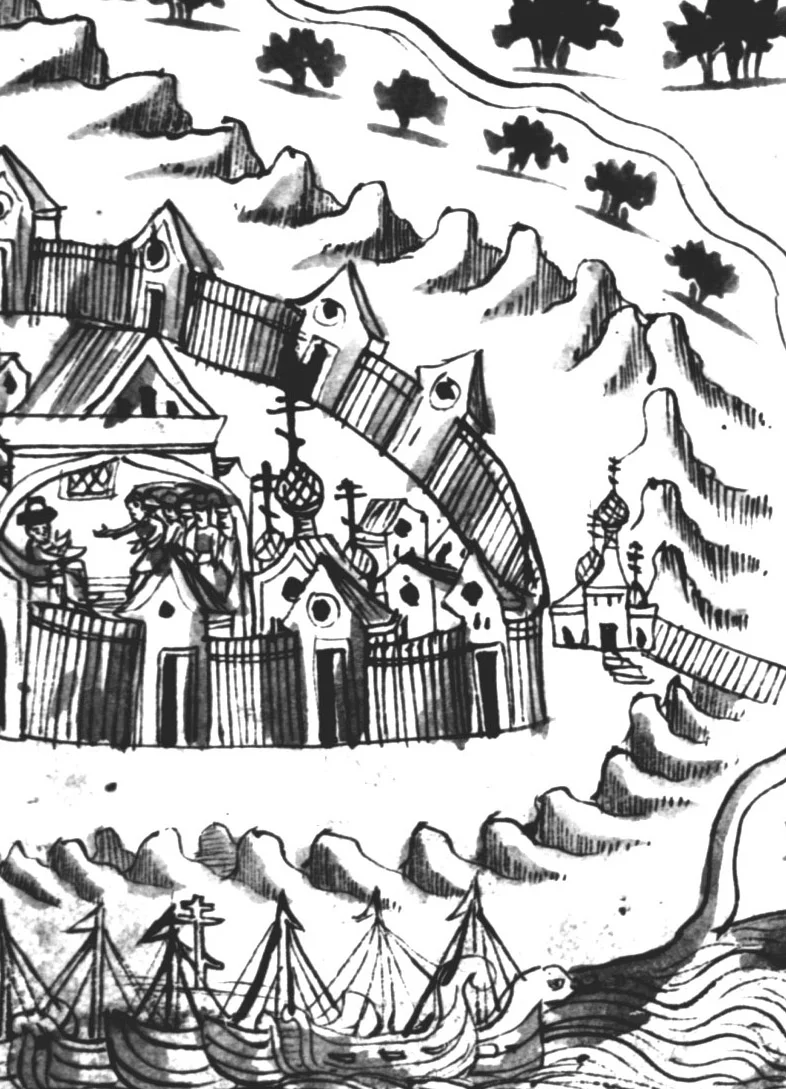
In the summer of 1587 another 500 men arrived with orders for Chulkov to found a second town "near the Tatar town of Sibir", from which it would be easier to act against the Tatars. So began Tobolsk, "at first a small wooden fort and a few buildings for the servicemen", in Miller's words, and soon the capital of Russian Siberia. Pelym followed in 1593, Surgut and Tara in 1594, Tomsk in 1604. Kuchum fought on from the steppe until his camp on the Ob was destroyed in 1598.
Why did Russia want Siberia?
For fur. The Great Russian Encyclopaedia defines yasak, from the Mongolian zasag, "power", as a tribute that became a tax, levied every year "at first in kind – in furs (the skins of sables, squirrels, foxes, beavers, martens and others), hides and cattle", and paid into the Siberian Office (Sibirsky prikaz) in Moscow. Sable was the prize. Every new fort was a collection point, and when the sable in one river basin was trapped out, the trappers and the tax collectors moved on to the next.
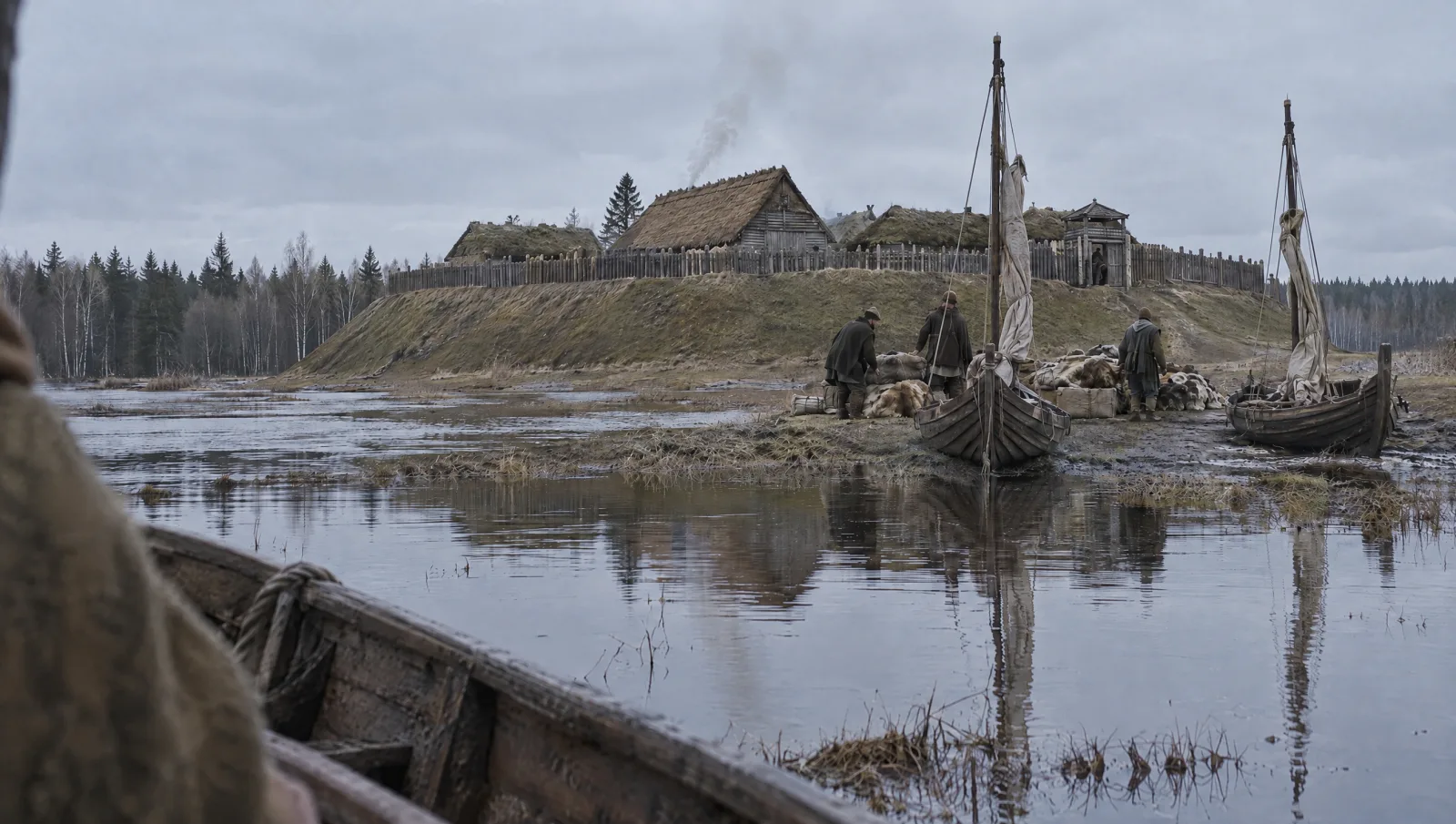
The clearest example is Mangazeya. It was built in 1601, by order of Tsar Boris Godunov, on the river Taz beyond the Arctic Circle, as a place to collect "costly export fur (sable and fox)" from Russian trappers and from the yasak payers. In its prime, in the first quarter of the seventeenth century, between one and two thousand people could be living there in the trading season, and documents called it the sovereign's "gold-seething patrimony". The archaeologist Gennady Vizgalov notes a telling decision: in 1619 the government banned the sea route to Mangazeya from the White Sea, for fear that foreigners would use it to sail into Siberia. Once the sable thinned out, from the late 1630s, the town declined, and in 1672 its people were moved to Turukhansk on the Yenisei.
How did the Russians cross Siberia so fast?
By river, and in small numbers. The great rivers of Siberia run north, but their tributaries come close to one another, and short portages lead from the Ob to the Yenisei, from the Yenisei to the Lena and from the Lena towards the Pacific. Yeniseisk was founded in 1619 and Krasnoyarsk in 1628. Trappers from Mangazeya reached Yakutia by the early 1620s; in 1632 the strelets officer Pyotr Beketov built a fort on the Lena "against the Yakut prince Mymak's ulus and between many other uluses". This counts as the founding date of Yakutsk, although the fort was moved more than once because the low bank flooded.
The Russians who did this were few. Sukin took 300 men to Tyumen, the expedition that founded Mangazeya had 150, Poyarkov about 130, the garrison of the Bratsk fort sixty. What they had were firearms, boats, iron, and a state behind them that rewarded whoever brought new peoples "under the tsar's high hand", as Dezhnev put it.
| Year | Fort or event | River system |
|---|---|---|
| 1586 | Tyumen | Tura (Tobol) |
| 1587 | Tobolsk | Irtysh |
| 1601 | Mangazeya | Taz |
| 1604 | Tomsk | Tom (Ob) |
| 1619 | Yeniseisk | Yenisei |
| 1628 | Krasnoyarsk | Yenisei |
| 1631 | Bratsk fort | Angara |
| 1632 | Yakutsk | Lena |
| 1639 | First winter hut on the Pacific | Ulya, Sea of Okhotsk |
| 1647 | Okhotsk winter post | Okhota |
| 1649 | Anadyr winter post | Anadyr |
| 1665 | Albazin resettled | Amur |
Who lived in Siberia before the Russians?
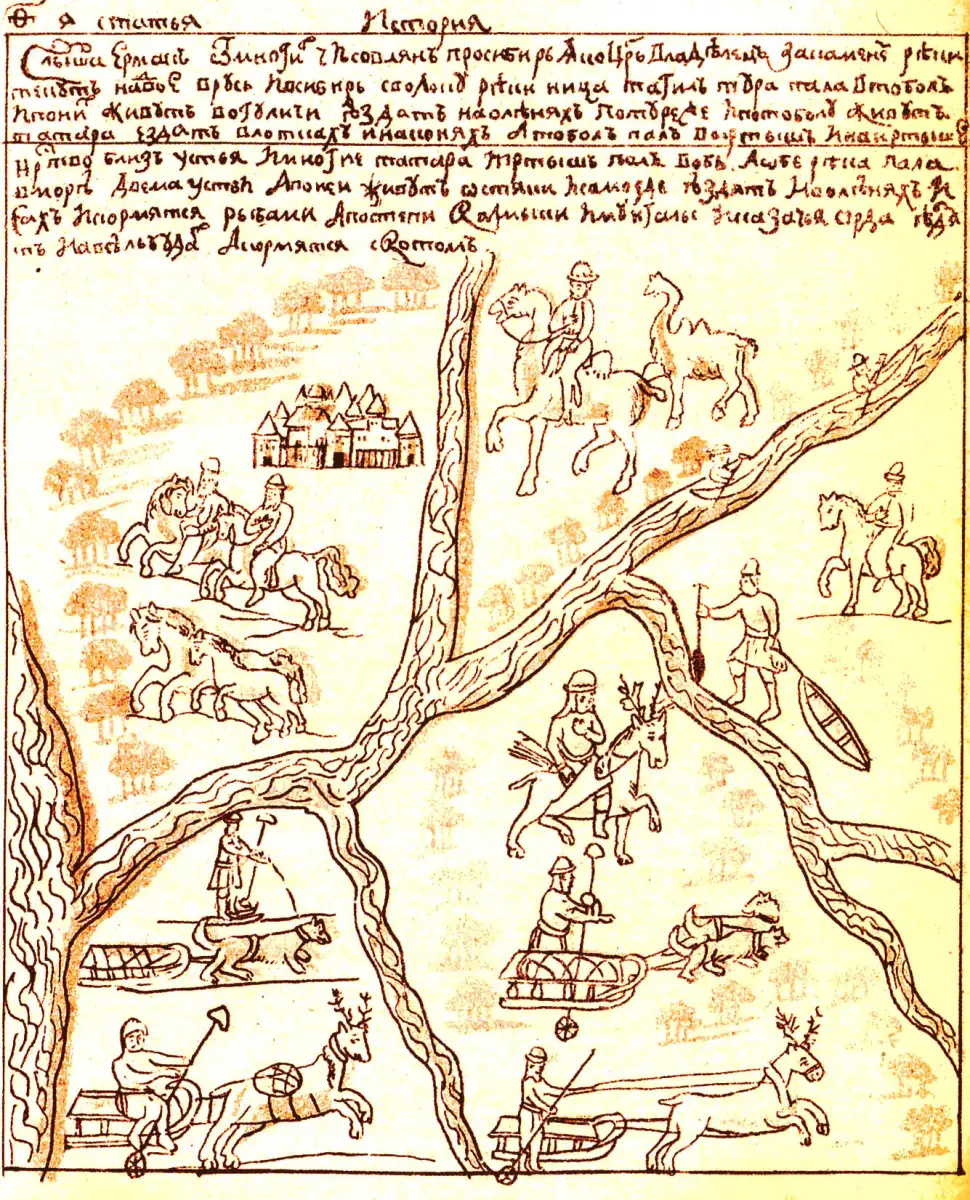
Many peoples, thinly spread. The Soviet ethnographer Boris Dolgikh, who reconstructed the clans and tribes of Siberia from the yasak books, put the indigenous population within Siberia's borders at about 160,000 in the middle of the seventeenth century. Along the Ob and the Irtysh lived the Khanty and the Mansi, some of whom had paid tribute to Kuchum. Across the forests of central and eastern Siberia, as far as the Pacific, moved small groups of Evenki and Evens, whom the Russians called Tungus. On the Lena lived the Yakuts, who call themselves Sakha. Around Lake Baikal were the Mongol-speaking Buryats, whom the Russians called bratskie lyudi. In the far north-east were the Yukagirs, the Koryaks and the Chukchi.
On the Amur the Russians met something different: settled farmers. The historian Vadim Turaev, drawing on Dolgikh, counts about 9,900 Daurs and 10,600 Dyuchers, people who grew grain and kept cattle and horses and whose name, Daur, meant "ploughman". Most of their princes had already accepted the overlordship of the Manchus, the new rulers of China.
What were yasak and amanaty?
Yasak was the price of Russian protection, and amanaty were its guarantee. When a clan agreed, or was forced, to pay, the Russians took one or more of its leading men as hostages and kept them in the fort. The historian Nikolai Berezikov, who studied the "hostage huts", finds them in Russian forts from the very beginning. A voevoda's order of 1674 told the commander of the Olyokma fort to keep the hostages "in the hostage huts, in great security, in locked rooms, behind bars and in irons, under strong guard". In 1682 sixty-four hostages sat in the small fort at Okhotsk, and Yakutsk took about sixty a year. When their relatives brought the furs, the hostages were led out into the yard to show that they were still alive.
The system invited abuse, and the archives record it. In 1645 the servicemen of Yakutsk petitioned against their own voevoda, Pyotr Golovin. According to the petition, cited by the historian Egor Bagrin, Golovin had the yasak Yakuts who came to the fort "tortured and burned with fire and beaten with the knout for more than a month, by all three executioners, without mercy", and then hanged twenty-three men of the clan nobility, many of them hostages. The Yakuts fled into the mountains and paid no yasak for more than two years. In 1677 a Cossack reported from the Penzhina that two Yukagir hostages had been starved; one was knifed in the winter hut, and the other escaped in his stocks, and in spring "his legs, in the stocks, were carried down the stream".
Resistance was constant. In January 1634 up to a thousand Yakut warriors besieged the Lena fort for about two months. In 1635 the Buryats destroyed the Bratsk fort and its garrison of sixty men. In 1641 the Buryat prince Chepchugai, rather than surrender, burned himself alive in his besieged yurt. The Chukchi were never subdued in the seventeenth century: Turaev notes that until the late 1680s they repeatedly besieged the Lower Kolyma yasak post and forced the Russians there to live "behind locked doors".
How did the Russians reach the Pacific?
Overland from the Lena, in 1639. According to the depositions of its members, the Tomsk ataman Dmitry Kopylov sent the Cossack Ivan Moskvitin "to the great sea-ocean". At the end of August or the beginning of September 1639 Moskvitin's party reached the sea later called the Sea of Okhotsk and, near the mouth of the Ulya, put up "a winter hut with a little fort", the first Russian settlement on the Pacific. In October they sailed north along the coast to the river Okhota and took hostages. Whether they later saw Sakhalin is disputed; the historian Vitaly Elizaryev (2022) thinks the chance "negligible".
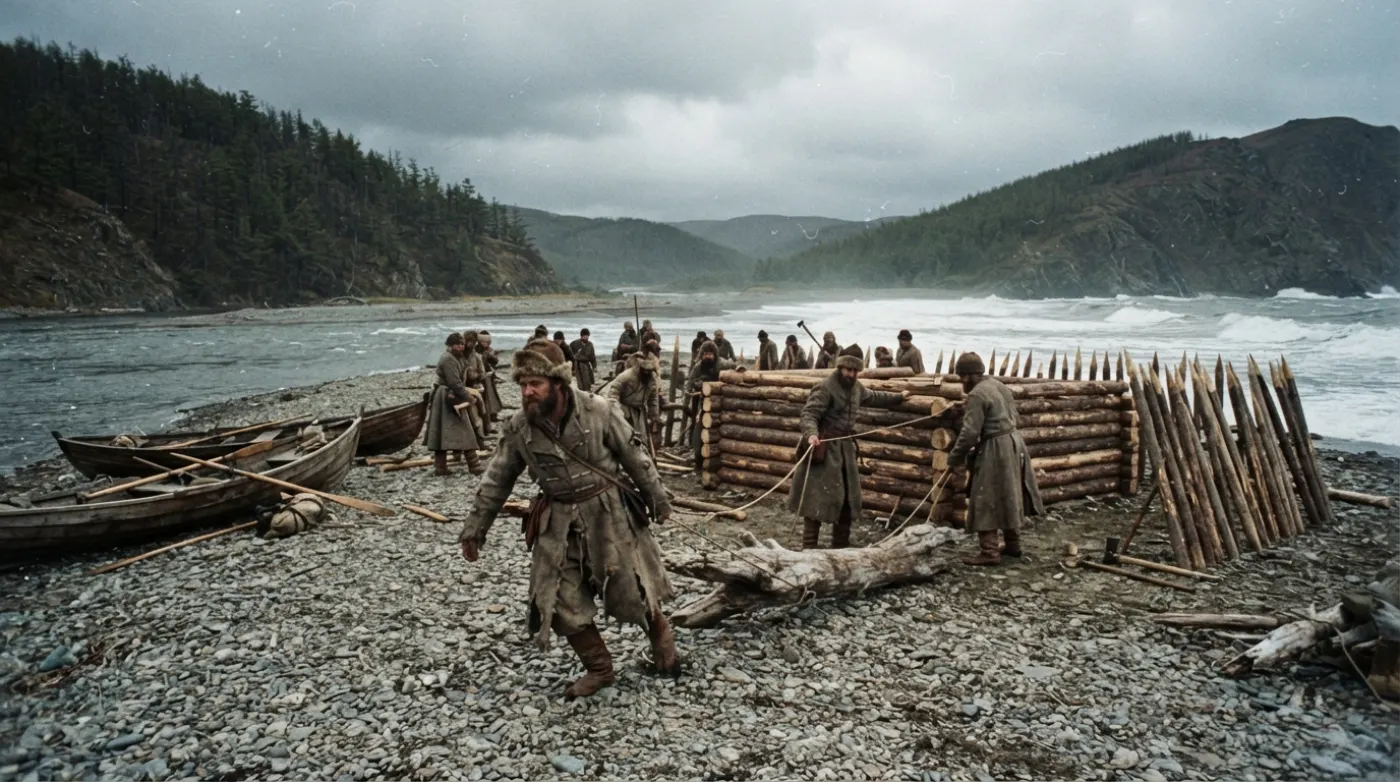
The Soviet editions of these documents left out the fighting. Turaev showed in 2013 that a collection of the early 1950s printed the deposition of the Cossack Nekhoroshko Kolobov with five cuts, made mainly where the text spoke of fighting with the Tungus. One of the missing passages says that on the Okhota the Cossacks "destroyed six yurts and killed twenty people in them". A winter post on the Okhota was founded by Yakutsk Cossacks in 1647; in 1731 Okhotsk became Russia's first Pacific seaport.
Did Semyon Dezhnev discover the Bering Strait?
He sailed through it in 1648, eighty years before Vitus Bering, though no one at the time understood what he had found. Dezhnev was a peasant from the Pinega in the Russian north who had gone to Siberia as a Cossack in the early 1630s and served at Yakutsk from 1637/38. On the Kolyma, the trader Fedot Alekseev Popov, an agent of the Usov merchants of Veliky Ustyug, organised an expedition east in search of new sable lands and walrus ivory; Dezhnev led it, "at least formally", as the government's man, in the words of the Great Russian Encyclopaedia. The first attempt in 1647 was stopped by ice. In the summer of 1648 seven kochi, small flat-bottomed sailing boats, put to sea from the mouth of the Kolyma with about ninety to a hundred men.
Storms took the boats one by one. According to most historians three reached the north-eastern tip of Asia, which Dezhnev later called the "Big Stone Nose", and one was wrecked there. Two passed through the strait into the Pacific and lost each other in a storm. Years later Dezhnev recaptured Popov's Yakut wife from the Koryaks; she told him that Popov had died of scurvy. In a report to the Yakutsk voevoda, written some six years later, Dezhnev described his own fate:
"And the sea carried me, Semeika, about everywhere against my will after the feast of the Protection of the Mother of God, and threw me ashore at the far end beyond the river Anadyr. And there were twenty-five of us on the koch in all, and we all went into the hills, not knowing the way ourselves, cold and hungry, naked and barefoot."
They walked for ten weeks to the Anadyr; thirteen of them died that winter. The survivors built a winter post on the river, the beginning of the fort of Anadyrsk, and in 1652 found a sandbank where walruses gathered. By the autumn of 1655 they had sent more than 4.7 tonnes of walrus ivory to the treasury. Dezhnev later took a cargo of ivory and furs to Moscow, where he was paid nineteen years of arrears and made an ataman. He died in Moscow early in 1673.
The same report contains his description of the Nose: it "juts far out into the sea", and "opposite that Nose there are two islands, and on those islands live Chukchi", whose lips are pierced.
Historians disagree about what exactly happened:
- Did the voyage happen at all? The American historian Frank Golder argued in 1914 that it did not. Raymond Fisher later showed, in the words of the Soviet editors, that Golder had used only Miller's summary and not the published documents; Dezhnev's original reports were found in the Moscow archives in 1951.
- What was the Big Stone Nose? Lev Berg and Alexei Efimov identified it with Cape Dezhnev and the two islands with the Diomedes. Boris Polevoy took it to be the whole Chukchi peninsula and the islands to be Arakamchechen and Itygran, which would change the route.
- Who led? As Irina Silaeva notes in her study of the nineteenth-century historian Nikolai Ogloblin, there is no exact record of whether Popov, Gerasim Ankudinov or Dezhnev was in charge at the start; Ogloblin concluded that Dezhnev led after the other two died.
What did Poyarkov and Khabarov do on the Amur?
They opened the Amur to Russia and turned its peoples against it. In 1643 the voevoda of Yakutsk sent Vasily Poyarkov with about 130 men to collect yasak and to look for silver, copper and lead in Dauria. Poyarkov crossed the mountains to the Zeya, sailed down the Amur to its mouth and came back by the Sea of Okhotsk in 1646, a journey of some 8,000 km. The Great Russian Encyclopaedia notes that in clashes with the Daurs he suffered heavy losses and "showed a harsh character and cruelty". Almost half his men died of hunger. The survivors wrote in a petition that "word has gone through all the hordes and lands that Russian men eat the dead", and that the local people would not let them land, calling them "foul cannibals".
Yerofei Khabarov was a trader and salt-boiler on the upper Lena who led two campaigns to the Amur between 1649 and 1653, financed by the voevoda Dmitry Frantsbekov on loan at interest. His instructions said to bring the Daurs under the tsar "not by battle but by kindness". His own report to Frantsbekov, printed in 1848 and cut by half in the Soviet edition of 1969, describes how it went. Sailing for seven days below the Sungari past the large villages of the Dyuchers, "of seventy and eighty yurts", he writes: "and we cut them down to the stump, and took their wives and children and cattle". Elsewhere: "I, Yarofeiko, tortured and burned those hostages, and they say only, cut off our heads." In September 1652 more than 130 of his Cossacks deserted him. In 1653 a nobleman sent from Moscow, Dmitry Zinoviev, took him back to Moscow under arrest; he was cleared in 1655.
The Amur peoples answered by turning to the Manchus. In March 1655 a Manchu army besieged the Russians at the Kumarsk fort, Turaev writes, at the request of the local people. By 1656 the Daurs had left the Amur for the Nonni river in Manchuria, many of them, Turaev notes, of their own accord and with Manchu permission. On 30 June 1658 Manchu forces destroyed the detachment of Khabarov's successor Onufry Stepanov below the Sungari, which in Turaev's words "drew a final line" under the first, failed Russian attempt on the Amur.
Why did Albazin matter?
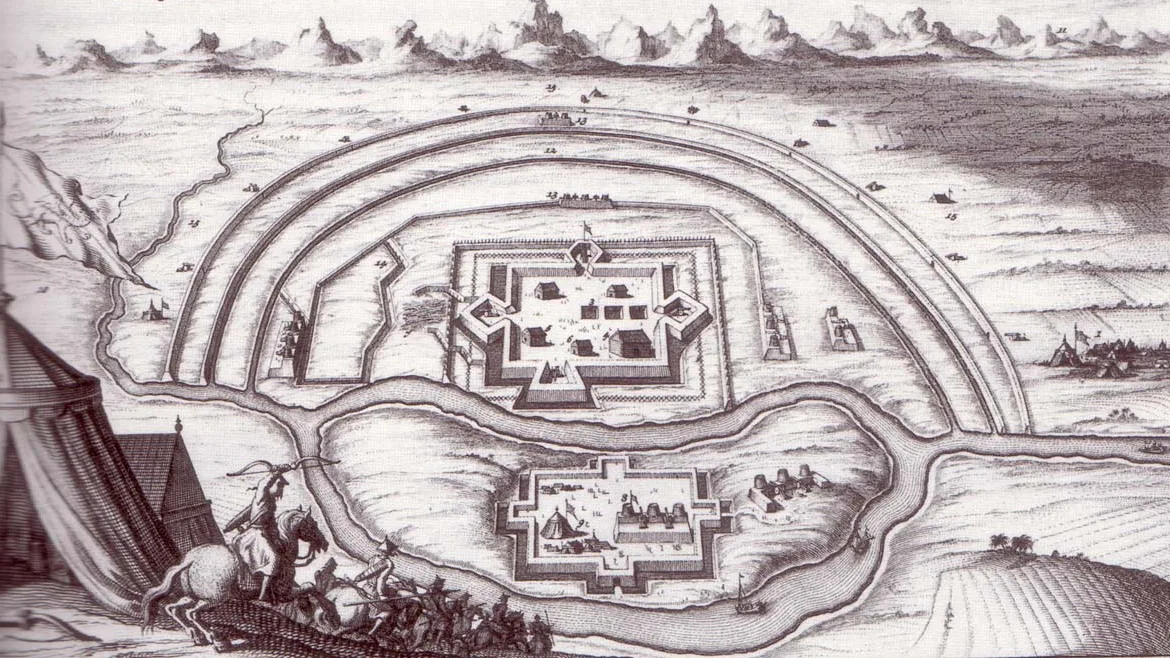
It was the fort that brought Russia and Qing China to war. In 1665 a group of 84 Cossacks under Nikifor Chernigovsky, fleeing after the murder of the Ilimsk voevoda Obukhov, who had robbed and oppressed them, settled on the site of a Daur town on the upper Amur that Khabarov had burned. They built a fort, Albazin, sowed grain and collected yasak from the local Tungus. They were sentenced to death in their absence in 1675, then pardoned; in 1682 Albazin became the centre of its own district. Around 1680 more than twenty Russian forts, villages and farms stood on the Amur between the Argun and the Zeya.
The Kangxi emperor decided to remove them. In 1682–1684 Qing troops, supported in places by local peoples, took or forced the Russians out of their outposts on the Zeya and the Amgun. On 12 June 1685 a Manchu army, about 10,000 strong with 200 guns according to the Encyclopaedia of Transbaikalia, besieged Albazin. A hundred of the 450 men inside fell in the first assault, the fort was set on fire, and the voevoda Tolbuzin surrendered; the survivors were allowed to leave for Nerchinsk. The Manchus burned the fort and withdrew, and in August the Russians came back and rebuilt it.
On 7 July 1686 the Qing army returned. Tolbuzin was mortally wounded within days, and command passed to Afanasy Beyton, whose regiment had come from western Siberia. The garrison of 826 men beat off several assaults and made five sorties. On 30 November the Manchus received the emperor's order to lift the siege, because envoys had reached Beijing with news that a Russian embassy was on its way. The blockade went on through the winter. By December only 150 of the garrison were alive, the rest dead of wounds and scurvy; by May 1687 there were sixty-six. The Manchus, who had lost more than 2,500 men, finally pulled back in May 1687.
What did the Treaty of Nerchinsk decide?
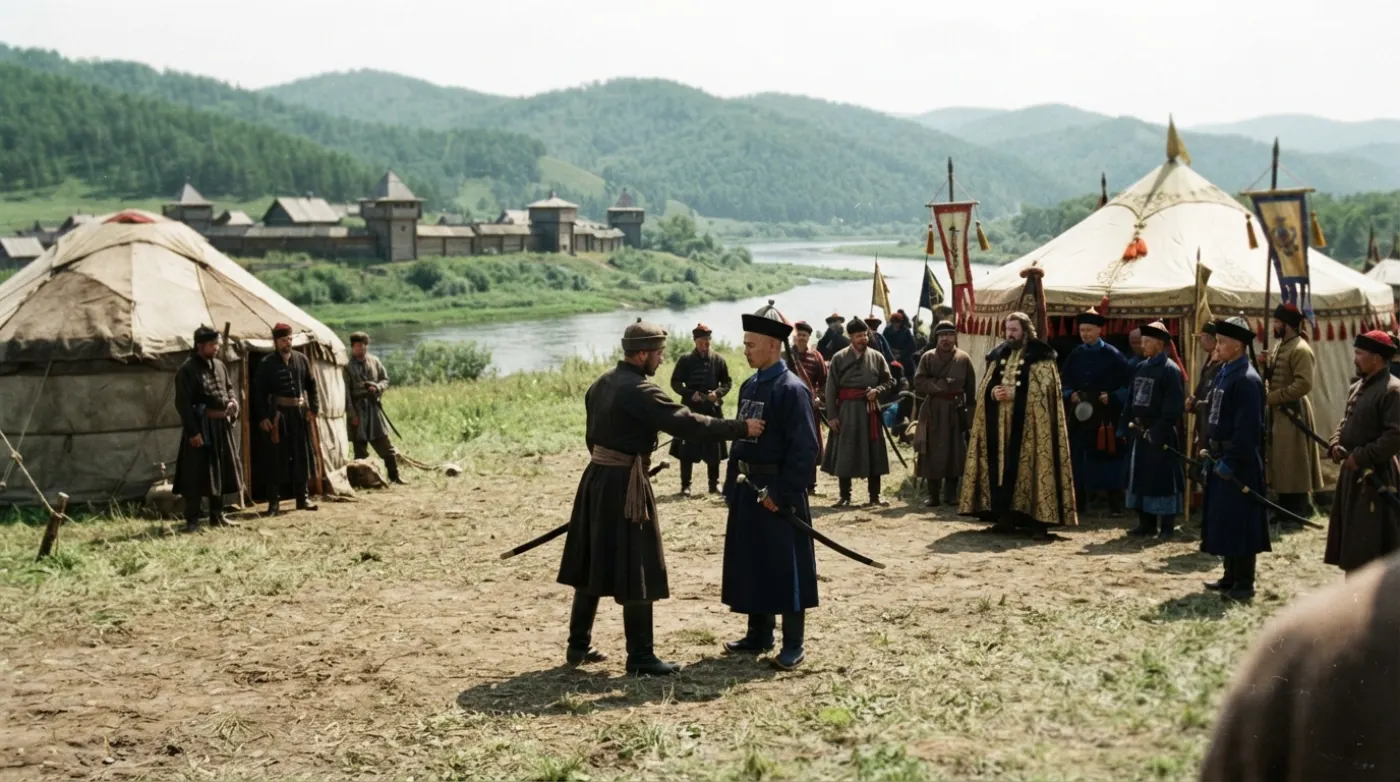
It drew the first border between Russia and China and left the Amur to the Qing for nearly 170 years. The Russian embassy was led by Fyodor Golovin, sent under the regency of Sophia Alekseyevna; the Qing delegation was led by Prince Songgotu. While Golovin negotiated, Sophia's regency was collapsing at home: on the night of 8 August 1689 her conflict with the young Peter broke into the open, and on 7 September her name was removed from the royal title. Two Jesuits in the emperor's service went with the Chinese as interpreters: the Portuguese Tomás Pereira and the Frenchman Jean-François Gerbillon. Much of the negotiation was conducted in Latin.
Gerbillon's journal, published in Jean-Baptiste Du Halde's description of China and in English in 1738, is the fullest eyewitness account. He describes the first meeting in August 1689: each side was allowed 260 guards, armed only with swords, who searched one another for hidden weapons. Golovin, he noted, wore a gold brocade cloak lined with the finest and blackest sable he had ever seen. A Pole of the Russian embassy who had studied at Cracow opened the talks in Latin. When the talks stalled over Albazin, the Qing army crossed the river and cut Nerchinsk off. Russian historians stress the pressure: according to the Presidential Library, more than 15,000 Qing troops faced about 1,500 Russians short of ammunition and food. Gerbillon stresses his own part: he went alone into the town and "brought it to an entire conclusion".
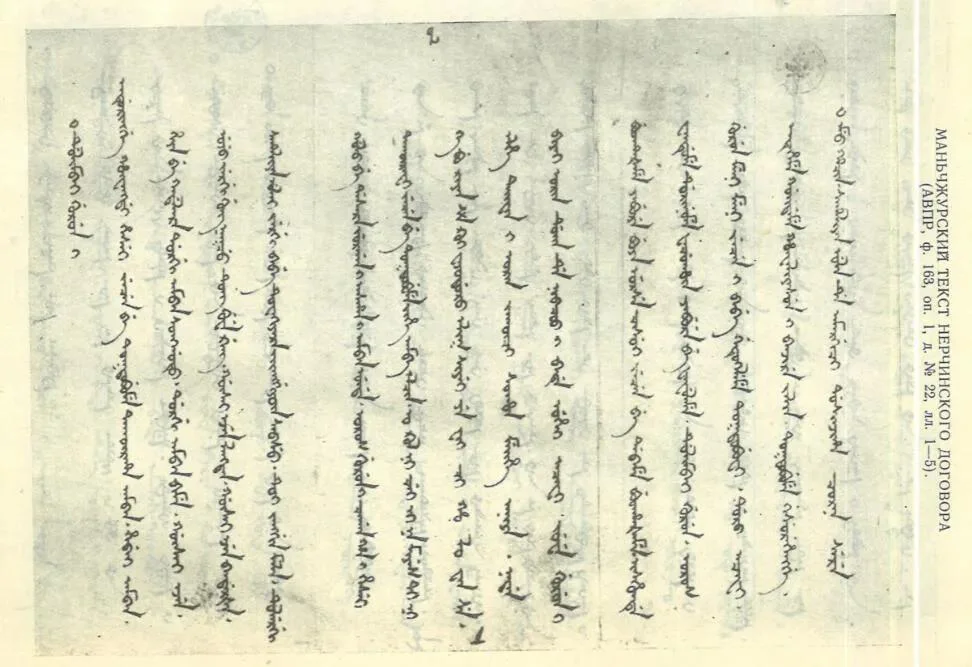
The treaty set the frontier along the little river Gorbitsa and then along the mountains to the sea, and along the Argun. Albazin was to be razed "to the foundations" and its people moved to the Russian side. The land between the river Uda and the mountains was left undecided. Fugitives were to be returned, and people with passes could trade. The texts were written in Russian, Latin and Manchu, and they differ: the Russian and Latin versions have six articles, the Manchu eight. Only the two Latin copies were sealed by both sides. The Russian text is dated 27 August; the Latin and Manchu copies were written on the 28th and the Latin ones signed on the 29th. Both sides then swore to keep the peace, taking Almighty God as witness. Gerbillon adds that the emperor had told his envoys to swear it "by the God of the Christians", believing that nothing would bind the Russians more.
Historians disagree about what Nerchinsk meant:
- A defeat under duress. Many Russian historians, and the Presidential Library's account, present the treaty as a concession wrung from an embassy under siege, with Russia giving up "almost all the lands on the upper Amur".
- A peace made by the Jesuits. Gerbillon presents himself as the man who saved the congress, and Du Halde reports that Songgotu told the emperor that without "that European" the talks would have failed.
- Russia gave up little it held. The historian Alexander Artemyev points out that after 1658 the Russians never again went down the Amur below the Bureya, and that their forts on the Zeya were lost by 1684. Turaev argues that, apart from the Argun, the treaty created not a line but a wide buffer zone up to the Stanovoy mountains, where neither side was active.
Was the conquest of Siberia peaceful?
No, though it was not only war. Before the revolution Russian historians called it a conquest; one of the earliest histories of Siberia, by Johann Eberhard Fischer, ran "from the very discovery of Siberia to the conquest of this land by Russian arms". After the mid-1930s Soviet historians replaced "conquest" with "joining", and by the 1970s "voluntary entry" had become the official view. Turaev describes how documents were trimmed to match: the collections of the early 1950s and of 1969 left out passage after passage about fighting.
The numbers we have are patchy. Turaev writes that the Yukagirs lost almost half their number in the seventeenth century alone. Smallpox was recorded in Siberia from the early seventeenth century. The first epidemic in the Far East, on the lower Yana in 1650–1653, killed all the Yakuts living there; in Yakutia, on the Okhotsk coast and in Chukotka further epidemics followed in 1659–1661, 1669–1670, 1681, 1683, 1688–1689, 1690–1692, 1695 and 1697. On the other side, Sergei Skobelev, comparing Siberia with the colonies of Asia, argues that the long-term demographic trend for the peoples of Siberia as a whole remained positive.
Not every people resisted, and not every encounter was violent. The historian Alexei Imikhelov notes that most ordinary Yakuts soon found peaceful dealings with the Russians, above all trade, to their advantage, and that part of the Buryat population wanted a peaceful settlement from the start, although he judges the joining of the lands west of Baikal to have been "predominantly violent". In 1667 Gantimur, the leader of the Nerchinsk Tungus, left the Qing for the Russian side, and in 1688 Buryats and Evenki helped the Russians drive off Mongol attacks on the Selenga forts. At Nerchinsk in 1689, Gerbillon saw the reverse: about a thousand Mongol families who had been "oppressed by their Russian masters" asked to cross over to the Qing.
What happened after 1689?
The Russians turned north-east. With the Amur closed, the next sable lands lay on Kamchatka, which Vladimir Atlasov reached in 1697–1699. In 1728 Vitus Bering sailed through the strait that now bears his name, and the Great Russian Encyclopaedia notes that the credit for its discovery went to him because Dezhnev's voyage had been forgotten. Miller found Dezhnev's reports in the Yakutsk archive in 1736. The Amur border of Nerchinsk lasted until the treaties of Aigun (1858) and Peking (1860).
Common myths about the conquest of Siberia
| Myth | What the evidence says |
|---|---|
| Yermak conquered Siberia | He took the capital of one khanate; most of Siberia was crossed by others in the next sixty years |
| Siberia was empty land | About 160,000 people lived there in the mid-seventeenth century, according to Dolgikh |
| The peoples of Siberia joined Russia voluntarily | A Soviet formula of the 1950s–1970s; the documents record wars, hostages and executions |
| Bering discovered the Bering Strait | Dezhnev sailed through it in 1648; his reports lay forgotten in Yakutsk until Miller found them in 1736 |
| Moscow planned the advance to the Pacific | Many expeditions were local ventures, financed on credit by voevodas and merchants or by the men themselves |
| At Nerchinsk Russia lost the whole Amur valley it had held | After 1658 Russia held only the upper Amur; the lower river had been out of reach for thirty years |
| The Treaty of Nerchinsk was written in Russian and Chinese | It was negotiated in Latin; the texts were in Russian, Latin and Manchu |
Timeline
| Date | Event |
|---|---|
| 26 October 1582 | Yermak's Cossacks enter Sibir |
| August 1585 (most likely) | Yermak killed |
| 29 June 1586 | Tyumen founded |
| Summer 1587 | Tobolsk founded |
| 1598 | Kuchum's camp on the Ob destroyed |
| 1601 | Mangazeya founded |
| 1604 | Tomsk founded |
| 1619 | Yeniseisk founded; sea route to Mangazeya banned |
| 1632 | Beketov founds the fort that becomes Yakutsk |
| 1634 | Yakuts besiege the Lena fort |
| 1639 | Moskvitin reaches the Sea of Okhotsk |
| 1643–1646 | Poyarkov's expedition to the Amur |
| 1647 | Okhotsk winter post |
| Summer 1648 | Popov and Dezhnev sail round Chukotka |
| 1649–1653 | Khabarov on the Amur |
| 1658 | Stepanov's force destroyed by the Manchus |
| 1665 | Chernigovsky's Cossacks settle at Albazin |
| 12 June 1685 | First Qing siege of Albazin |
| 7 July 1686 | Second siege begins |
| May 1687 | Qing forces withdraw from Albazin |
| 27–29 August 1689 | Treaty of Nerchinsk |
| 1697–1699 | Atlasov's expedition to Kamchatka |
| 1728 | Bering passes through the strait |
What the map shows
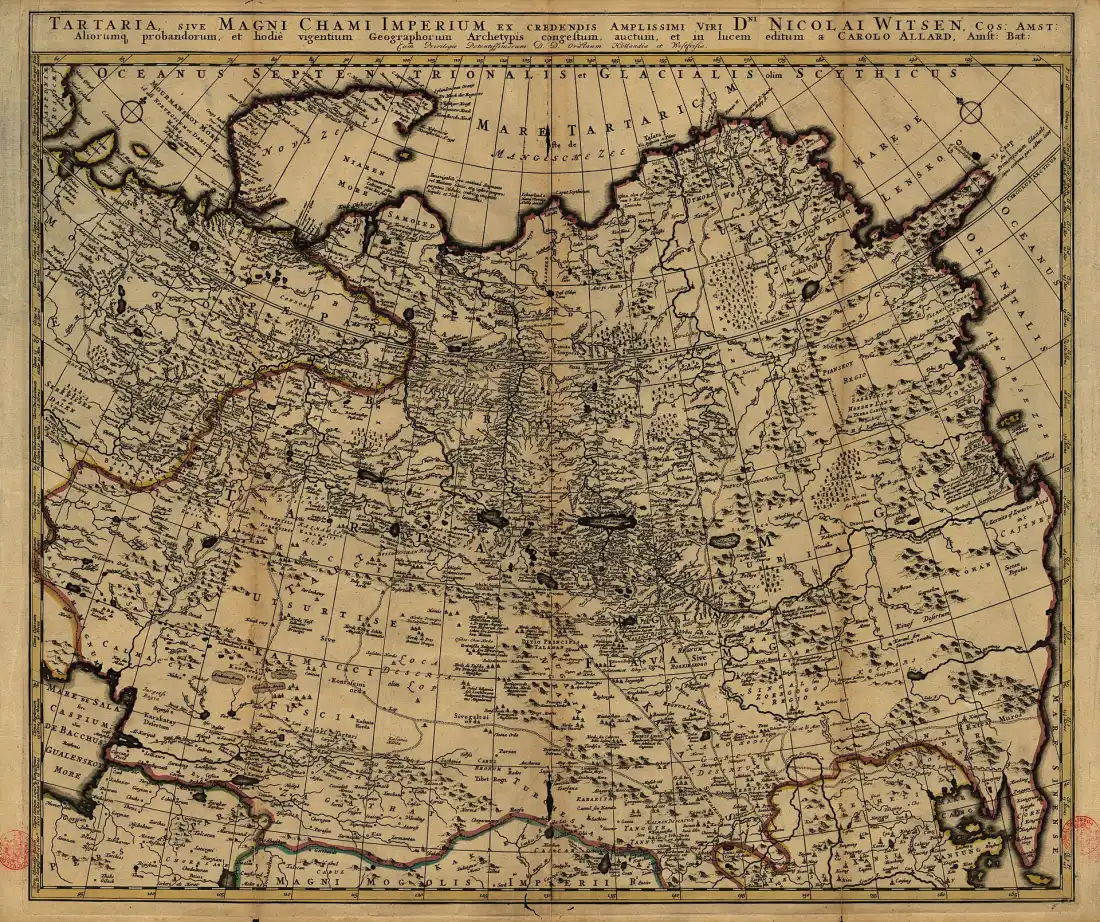
At 1689 the Tsardom of Russia reaches from the Baltic to the Pacific, while the Qing dynasty holds the Amur to the south-east and the Dzungar Khanate the steppes of the south. A century earlier, at 1582, the Khanate of Sibir still lay beyond the Urals. For the reign in which Yermak crossed them, see our article on Ivan the Terrible; for the English merchants who were looking for a north-east passage to China at the same time, see the Muscovy Company.
Sources
Primary sources
- Semyon Dezhnev, reports (otpiski) to the Yakutsk voevoda I. P. Akinfov, 1654–1655, ed. T. D. Lavrentsova, "Podlinnye dokumenty o plavanii S. I. Dezhneva", in Russkie arkticheskie ekspeditsii XVII–XX vv. (Leningrad, 1964), via vostlit.info
- Jean-François Gerbillon, "Travels into Tartary", second journey (1689), in J.-B. Du Halde, A Description of the Empire of China and Chinese-Tartary, vol. 2 (London, 1738)
- Treaty of Nerchinsk, 1689: Russian text in Russko-kitaiskie otnosheniya v XVII veke, vol. 2 (Moscow, 1972), app. 1, via vostlit.info; Latin text (Pactum Nertschiae), via la.wikisource; English translation in the "World and Japan" database (GRIPS / University of Tokyo)
- G. F. Miller, Istoriya Sibiri, vol. 1 (Moscow and Leningrad, 1937; text of 1750)
Studies and reference works
- N. I. Nikitin, "Dezhnev, Semyon Ivanovich", Bol'shaia rossiiskaia entsiklopediia (electronic version, 2020)
- "Nerchinskii dogovor 1689", Bol'shaia rossiiskaia entsiklopediia, vol. 22 (2013)
- "Albazina oborona 1680-kh gg.", Bol'shaia rossiiskaia entsiklopediia, vol. 1 (2005)
- "Khabarov", Bol'shaia rossiiskaia entsiklopediia, vol. 33 (2017)
- "Poyarkov, Vasilii Danilovich", Bol'shaia rossiiskaia entsiklopediia, vol. 27 (2015)
- G. P. Vizgalov, "Mangazeia", Bol'shaia rossiiskaia entsiklopediia
- "Iasak", Bol'shaia rossiiskaia entsiklopediia
- "Albazinskii ostrog", Entsiklopediia Zabaikal'ia (Chita)
- "Sof'ia Alekseevna", Pravoslavnaia entsiklopediia
- "Zakliuchen Nerchinskii dogovor", Presidential Library (prlib.ru)
- V. A. Turaev, "Rossiisko-kitaiskoe pogranich'e v XVII veke" (2020), doi:10.24411/2658-5960-2020-10022
- V. A. Turaev, "Khozhdenie 'vstrech' solntsu' v kontekste problem prisoedineniia Dal'nego Vostoka k Rossiiskomu gosudarstvu", Vestnik DVO RAN 2013, no. 1
- V. A. Turaev, "Istoricheskie posledstviia etnokul'turnykh kontaktov na rossiiskom Dal'nem Vostoke (XVII–XVIII vv.)", Rossiia i ATR (2012)
- E. A. Bagrin, "K voprosu o nasilii russkikh po otnosheniiu k korennomu naseleniiu Vostochnoi Sibiri i Dal'nego Vostoka v XVII v.", Oikumena (2010)
- N. A. Berezikov, "Nadzor i prinuzhdenie: amanatskie izby v Sibiri XVII v." (2015)
- A. V. Imikhelov, "Prisoedinenie Sibiri k Rossii: osnovnye faktory i dvizhushchie sily" (2012)
- S. G. Skobelev, "Demografiia korennogo naseleniia kolonii i zavoevannykh territorii Azii v XVI–XX vekakh", Vestnik NGU (2010)
- A. R. Artem'ev, "O nekotorykh spornykh voprosakh pogranichnogo razmezhevaniia mezhdu Rossiei i Kitaem po Nerchinskomu dogovoru 1689 g.", Vestnik DVO RAN 2002, no. 1
- V. N. Elizar'ev, "Novaia versiia razgadki rassprosnykh rechei uchastnikov pokhoda I. Iu. Moskvitina k ust'iu r. Amur v 1640 g.", Rossiia i ATR 2022, no. 4, doi:10.24412/1026-8804-2022-4-187-205
- I. A. Silaeva, "N. N. Ogloblin kak issledovatel' moreplavaniia i geograficheskikh otkrytii v Sibiri XVII–XVIII vv.", Izvestiia Altaiskogo universiteta (2012)
- P. L. Kazarian, "Pervyi trakt na Severo-Vostoke Rossii"
- Ia. G. Solodkin, "K istorii ekspeditsii Ermaka: neizvestnoe svidetel'stvo o vremeni 'Sibirskogo vziatiia'" (2010)
- M. F. Khartanovich and M. V. Khartanovich, "Tungusskie kniaz'ia Gantimurovy", Nauka iz pervykh ruk (2011)
Image credits
- Title image: Siege of the Russian town of Albazin by the Chinese, Dutch engraving. Public domain, via Wikimedia Commons, cropped to 16:9.
- Vasily Surikov, Conquest of Siberia by Yermak, 1895. Public domain, via Wikimedia Commons.
- Semyon Remezov, Tobolsk, from the History of Siberia, 1697–1703. Public domain, via Wikimedia Commons.
- Semyon Remezov, the peoples of Siberia, from the Remezov Chronicle. Public domain, via Wikimedia Commons.
- Nicolaes Witsen, Tartaria, Amsterdam 1705. Public domain, via Wikimedia Commons.
- Treaty of Nerchinsk, Manchu text, 1689. Public domain, via Wikimedia Commons.