Sophia Alekseyevna (1657–1704), daughter of Tsar Alexis, ruled Russia as regent for her two younger brothers, the co-tsars Ivan V and Peter I, from 1682 to 1689. She came to power after the bloody Moscow uprising of May 1682, governed with her favourite Prince Vasily Golitsyn, made a lasting peace with Poland in 1686 that kept Kiev Russian, and sent two huge and fruitless armies against the Crimea. From 1686 her decrees called her samoderzhitsa, "autocrat", alongside the two tsars. In August–September 1689 the seventeen-year-old Peter and his supporters overthrew her, and she spent the last fifteen years of her life in Moscow's Novodevichy convent, from 1698 as the nun Susanna. She is not to be confused with Sophia Palaiologina, the Byzantine princess who married Ivan III two centuries earlier.
Sophia Alekseyevna at a glance
| Born | 17 September 1657, Moscow Kremlin |
| Parents | Tsar Alexis (Aleksei Mikhailovich) and Tsaritsa Maria Miloslavskaya |
| Brothers | Tsar Fyodor III and Tsar Ivan V (full brothers); Peter I (half-brother) |
| Rule | Regent for Ivan V and Peter I, 1682–1689 |
| Titles | "Great sovereign lady" from autumn 1682; samoderzhitsa (autocrat) from spring 1686 |
| Chief minister | Prince Vasily Vasilyevich Golitsyn (1643–1714) |
| Main treaties | Eternal Peace with Poland–Lithuania (1686); Treaty of Nerchinsk with Qing China (1689) |
| Wars | Crimean campaigns of 1687 and 1689 |
| Removed | September 1689 |
| Took the veil | About 21 October 1698, as Susanna |
| Died | 3 July 1704, Novodevichy convent, Moscow |
(Dates are Old Style, the Julian calendar used in Russia; in the seventeenth century add ten days for the modern calendar.)
Who was Sophia Alekseyevna?
Sophia was born on 17 September 1657 in the Kremlin, the sixth child of Tsar Alexis and his first wife, Maria Miloslavskaya. Her mother died when she was eleven, and in 1671 her father married Natalia Naryshkina, who bore him Peter the next year. The court split along the two mothers' families, the Miloslavskys and the Naryshkins. Sophia's full brothers, Fyodor and Ivan, were both sickly; her half-brother Peter was robust.
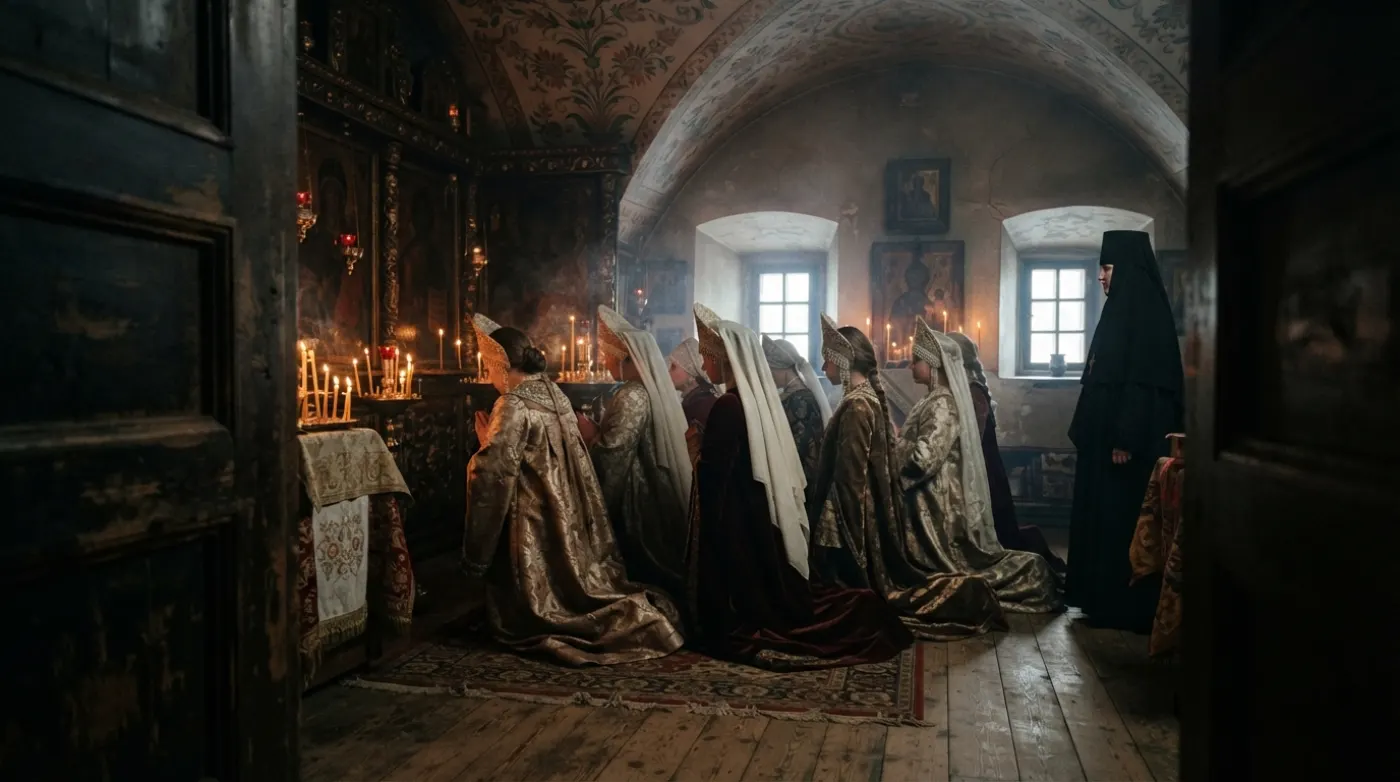
Royal daughters in Muscovy lived secluded lives in the closed women's quarters of the palace, the terem, and their public role was religious: praying for the tsar and the army, interceding for the condemned, endowing monasteries. The Orthodox Encyclopaedia notes that during Fyodor's reign (1676–1682) Sophia took on these traditional roles and was more active than her sisters in church charity, defending the economic interests of the Novodevichy, Donskoy and Valdai monasteries.
Was Sophia educated by Simeon Polotsky?
She could read and write. Beyond that, the evidence is thin. The Orthodox Encyclopaedia says that the view that she was taught by the court poet Simeon Polotsky is "widespread in historiography", but "there is no reliable evidence of this". Some historians still state it as fact: E. S. Sokolova (2017) calls her simply "a pupil of Simeon Polotsky".
What is attested is her interest in theology. According to Polotsky's pupil Silvester Medvedev, the thirteen-year-old tsarevna "diligently" read the draft of Polotsky's Crown of Faith and ordered a fair copy to be made. Medvedev later became her chief panegyrist, so his praise is not neutral. Only two pieces of her own writing survive, both letters to Golitsyn; the plays and poems once attributed to her are not hers.
(The translations from Russian in this article are our own unless a translator is named.)
How did Sophia come to power in 1682?
Tsar Fyodor died childless on 27 April 1682. His heir by seniority was his brother Ivan, then fifteen, who saw badly and had a speech impediment. The Orthodox Encyclopaedia notes that contemporaries wrote openly of his feeble-mindedness. The court and Patriarch Joachim passed him over and proclaimed the ten-year-old Peter tsar, with his mother Natalia as regent.
The Miloslavskys did not accept this. On 15 May the Moscow musketeers, the streltsy, who had their own grievances about pay and abusive colonels, marched on the Kremlin, roused by a false rumour that the Naryshkins had strangled Ivan. Over three days they killed the boyar Artamon Matveev, the Dolgoruky princes, two of Natalia's brothers and many officials. Under their pressure Ivan was declared "senior" tsar and Peter "junior" tsar on 26 May, and on 29 May, according to the Orthodox Encyclopaedia, "regency power was handed to Tsarevna Sophia". On 25 June the brothers were crowned together, Ivan with the real Cap of Monomakh and Peter with a copy.
Sophia's own part in the bloodshed is the most disputed question of her life. Contemporaries also credited her with restoring calm: the Orthodox Encyclopaedia says she tried, with other members of the royal family, to save some relatives and courtiers from the streltsy.
Historians disagree on her role in May 1682:
- Guilty. Mikhail Lomonosov, Mikhail Pogodin, Sergei Solovyov and Vasily Klyuchevsky believed she was behind the uprising, according to V. P. Naumov's survey (2015). The most hostile witness is Andrei Matveev, son of the murdered boyar, whose memoir of the 1720s accuses her of a long-hatched plan to rule.
- Not proven. Nikolai Aristov, Viktor Buganov and Andrei Bogdanov rejected that view. Lindsey Hughes (1994) pointed out that "if Sophia had wished to murder Peter in 1682 she patently failed to take the ample opportunities" offered when the Naryshkins were most vulnerable. Naumov reports that historians see Ivan Miloslavsky, his son Alexander and his nephew Pyotr Tolstoy as the main instigators.
How did Sophia defeat Khovansky and the Old Believers?
The streltsy remained masters of the capital through the summer. Their commander, Prince Ivan Khovansky, wanted a leading role of his own, and Old Believers among the streltsy demanded a return to the "old faith". On 5 July 1682 their petition was heard in the Faceted Palace before the patriarch and the royal family. Sophia defended her father's and Patriarch Nikon's church reforms and objected sharply when the dissenters called her father and brother "heretics". Medvedev's account, translated by Elizabeth Zelensky, has her ask them: "What is faith? And what is old faith or new faith?" Their leader, Nikita Pustosvyat, was handed over by the streltsy and executed on 11 July.
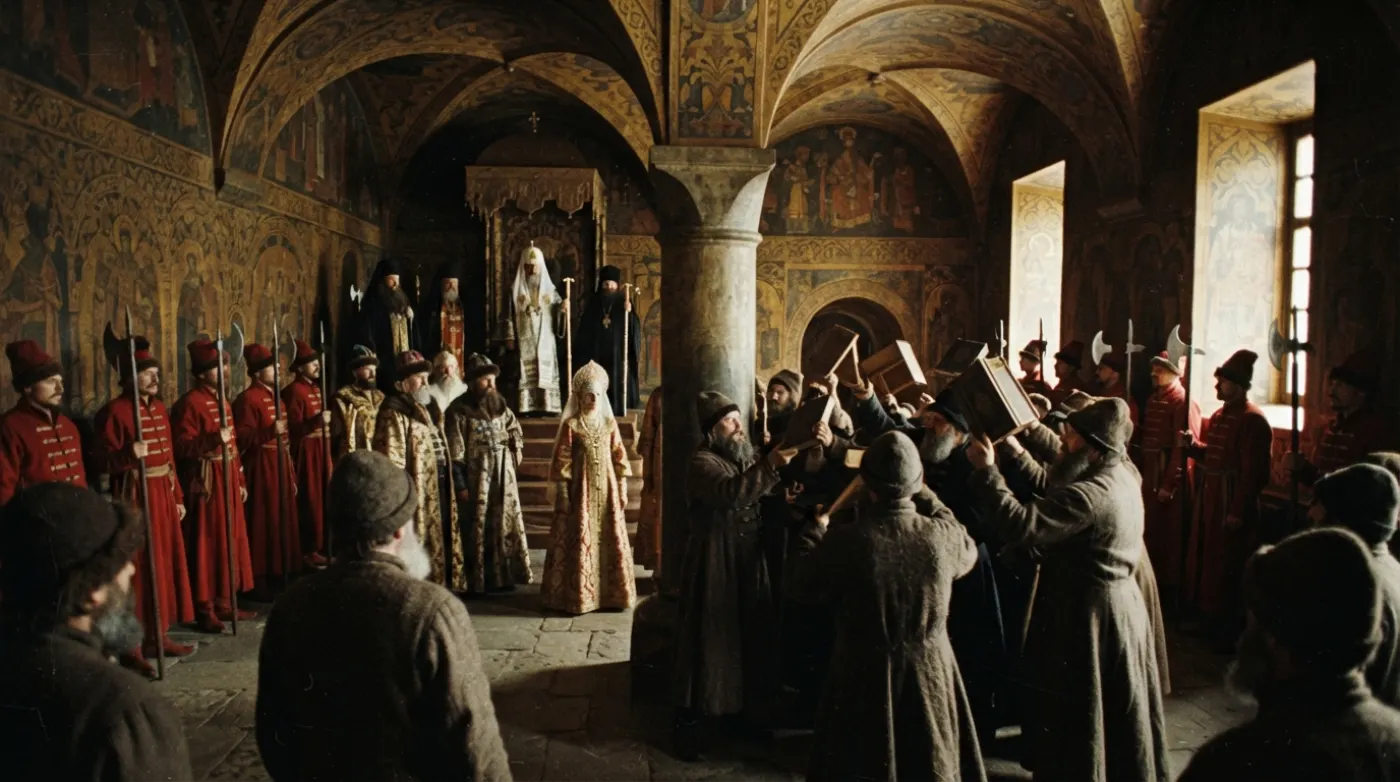
In September Sophia and the court left Moscow. At the village of Vozdvizhenskoe, near the Trinity monastery, Sophia accused Khovansky of plotting with the streltsy to destroy the royal family and called up the noble militia. Khovansky came when summoned and was executed with his son on 17 September 1682, Sophia's twenty-fifth birthday. Leaderless, the streltsy submitted. Their new chief was Fyodor Shaklovity, a secretary of humble birth who became Sophia's most trusted servant.
Was Sophia officially Russia's regent?
Not quite in the way the word suggests. The document that supposedly handed her power in May 1682 is a puzzle. Naumov (2015) reports that the published text was put together from drafts of two different documents, and he follows Andrei Bogdanov in dating the "Act" on her regency to 1687 at the earliest. In his view her power "had no legislative basis" at all; she ruled as the only member of the family able to do so. The Orthodox Encyclopaedia dates her actual takeover to after Khovansky's execution, in October 1682 (A. S. Lavrov) or between 2 and 10 November (S. M. Shamin), when she pushed aside the lawful regent, Peter's mother.
From then on she presided over the Boyar Duma, confirmed its verdicts and, from 1684, received foreign envoys. Her name appeared in decrees beside the tsars', and in church she was prayed for straight after them. The titles grew step by step, as the philologist Boris Uspensky (2021) traced in the official law collection:
| Date | Title used |
|---|---|
| Autumn 1682 | Velikaya gosudarynya, "great sovereign lady" (for example, decree of 25 October 1682) |
| Spring 1686 | Samoderzhitsa, "autocrat", in a decree of 22 April and the Eternal Peace treaty of 26 April |
| 6 January 1687 | Decree orders charters to be issued in the names of Ivan, Peter and Sophia jointly |
| 7 September 1689 | Her name struck from the royal title |
The decree of 1687 spells it out: charters were to be issued "by decree of the Great Sovereigns, Tsars and Grand Princes Ioann Alekseyevich, Peter Alekseyevich and the Great Sovereign Lady, the right-believing Tsarevna and Grand Princess Sophia Alekseyevna, Autocrats of all Great and Little and White Russia". Diplomatic letters were the exception.
Not everyone accepted this. Shaklovity testified that Peter's mother had asked: "Why has she begun to put her name together with the great sovereigns? We have people too, and they will not let this pass." He gave this evidence under interrogation in 1689, after Sophia's fall.
Did Sophia try to have herself crowned?
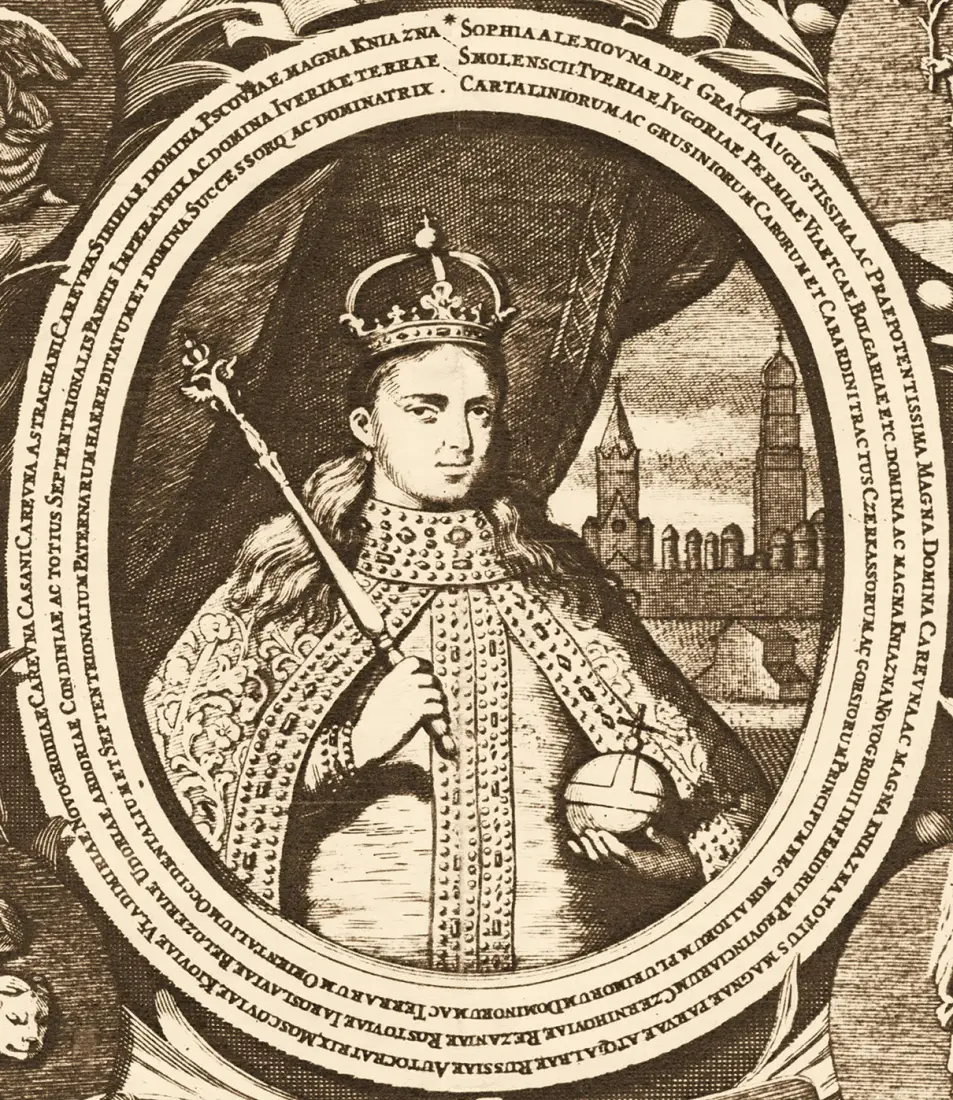
Yes, more than once, but she never went through with it. According to the Orthodox Encyclopaedia, the Danish envoy H. von Horn reported that the Boyar Duma first discussed a coronation in June 1684. In 1687 Shaklovity proposed that a petition asking the tsars to crown Sophia be presented on 1 September 1687; Sophia forbade it, because neither the Duma, the streltsy nor Patriarch Joachim, who backed Peter, were firmly on her side. A coronation rite was nevertheless drafted, and a coronation portrait was printed with verses by Medvedev.
Her court poets prepared the ground. Medvedev, Karion Istomin and the Greek Likhudes brothers compared her to Deborah, Esther, Judith, the Byzantine empress Pulcheria, Princess Olga and Elizabeth I of England, and above all to Holy Wisdom, Sophia. Zelensky (2008) calls her "an unprecedented phenomenon": a single woman wielding the highest power in a patriarchal state, for whom the traditional imagery of the tsar as Christ's image on earth did not fit.
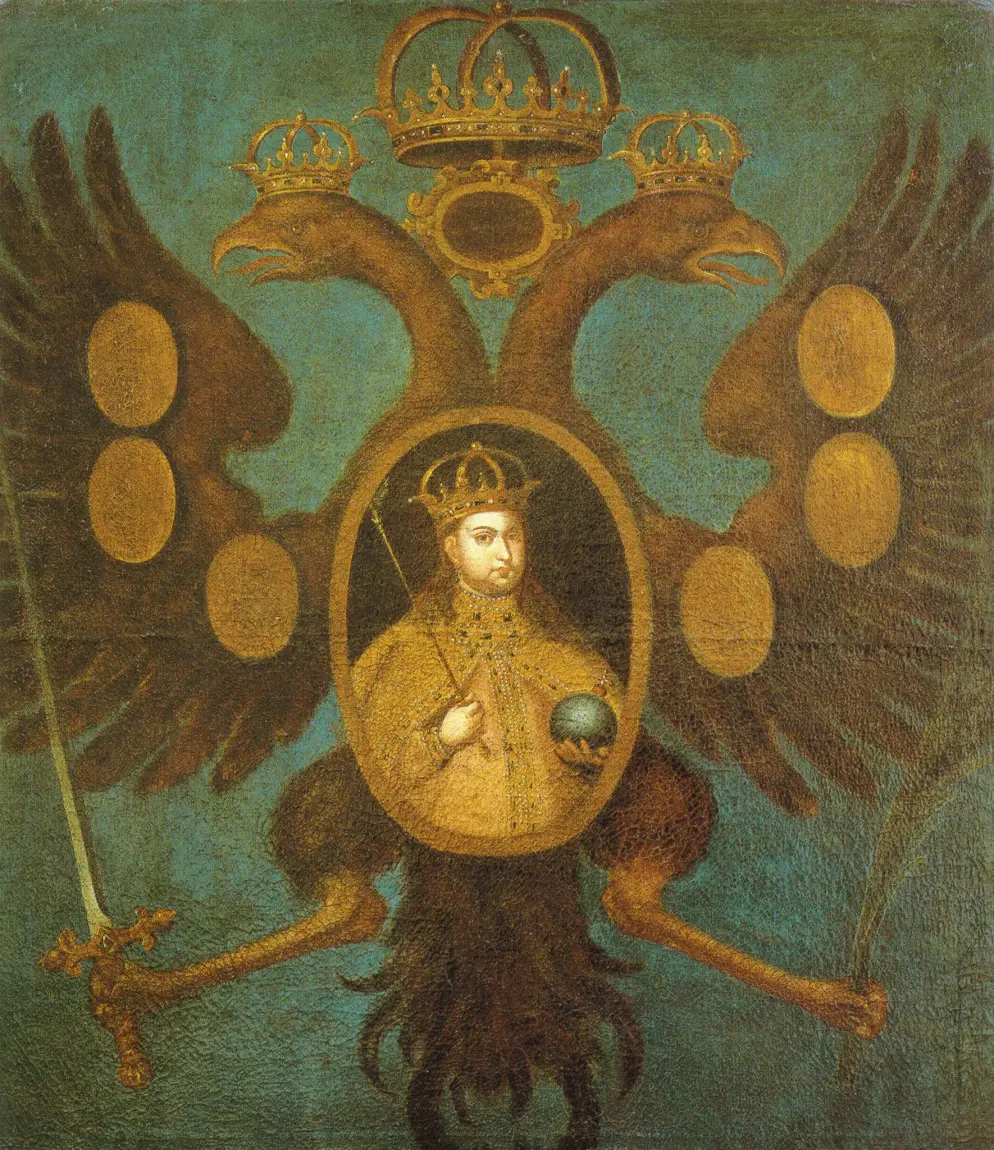
The most striking result is a group of painted portraits that show Sophia crowned, with sceptre and orb, inside the double-headed eagle of the state arms. Uspensky argues that the composition imitated a portrait of the Holy Roman Emperor Leopold I and that the images were probably meant for a coronation planned for 1 September 1689.
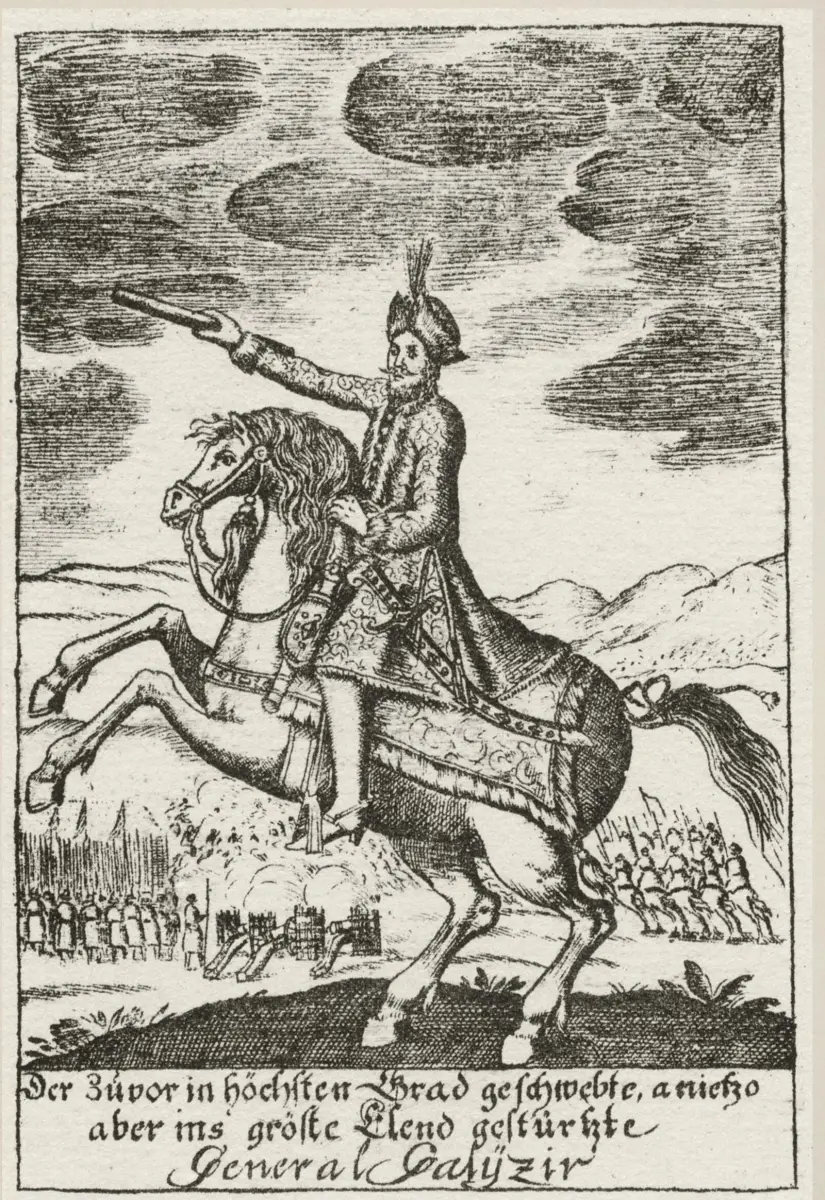
Who was Vasily Golitsyn?
Prince Vasily Vasilyevich Golitsyn (1643–1714) was a senior boyar who had already been prominent under Fyodor, when he helped abolish the old system of precedence among noble families in 1682. Under Sophia he ran the Foreign Office and was her chief minister in all but name; as Lindsey Hughes notes, "there was no official post of that name". Foreigners admired him. The French traveller Foy de la Neuville, who met him in 1689, admired his Italian-style palace and his schemes, including a plan to free peasants and give them land in return for a yearly tax.
Hughes urges caution: Neuville is the only source for that plan, and "there are no traces of abolitionist sentiment in the legislation of Sophia's regency", which continued the tightening of serfdom and the hunt for runaway peasants. Whether Golitsyn was also Sophia's lover is unprovable. The case rests on her two surviving letters to him in cipher and on what the courtier Boris Kurakin called popular rumour. Neuville's claim that they had children is not corroborated anywhere.
What did Sophia's government achieve?
The regency is best known for its foreign policy. In 1683–1684 Sophia called what turned out to be the last Assembly of the Land (Zemsky sobor) in Russian history to discuss relations with Poland, and the peace of Kardis with Sweden was renewed.
The Eternal Peace (1686). The Polish–Lithuanian Commonwealth had ceded Kiev to Moscow only for two years in the truce of Andrusovo in 1667, but Moscow had kept it. When the anti-Ottoman Holy League of Austria, Poland and Venice wanted Russia as an ally, Golitsyn answered that the tsars could not join without a permanent peace with Poland. After hard negotiations in Moscow with the Polish envoy Krzysztof Grzymułtowski, the "Eternal Peace" was signed on 26 April (6 May) 1686. Poland gave up Kiev for good in return for 146,000 roubles, and Russia joined the Holy League and entered the war against the Ottoman Empire that lasted until 1700. In the same year the patriarch of Constantinople placed the metropolitan see of Kiev under the patriarch of Moscow.
China. In the far east, the embassy of Fyodor Golovin concluded the Treaty of Nerchinsk with the Qing on 27 August 1689, giving up almost all the lands on the upper Amur (the background is in our article on the Russian conquest of Siberia).
At home the regency continued Fyodor's reforms. Sophia approved a new instruction for land surveyors in 1684 and, according to the Orthodox Encyclopaedia, chose the surveyors herself. The Slavonic-Greek-Latin Academy, Russia's first institution of higher learning, opened in 1687; two Jesuit priests were allowed to live in Moscow, and a Catholic church was consecrated in the foreign quarter. The regime rebuilt Kremlin towers and the Faceted Palace, built new apartments for the tsarevnas after a fire in 1683, began the first stone bridge across the Moskva river and filled the Novodevichy convent with new churches and buildings. The other side of the record is harsh: the "twelve articles" of 7 April 1685 made Old Believer teachers who urged self-immolation, and those who refused to give up the old faith, liable to death and, according to the Orthodox Encyclopaedia, turned persecution into a mass affair.
| Year | Measure |
|---|---|
| 1683–1684 | Last Assembly of the Land; peace of Kardis with Sweden renewed |
| 1684 | Instruction for a general land survey |
| 7 April 1685 | "Twelve articles" against Old Believers |
| 26 April 1686 | Eternal Peace with Poland–Lithuania; Russia joins the Holy League |
| 1686 | Metropolis of Kiev placed under the patriarch of Moscow |
| 1687 | Slavonic-Greek-Latin Academy opens; first stone bridge begun |
| 1687 and 1689 | Crimean campaigns |
| 27 August 1689 | Treaty of Nerchinsk |
What happened in the Crimean campaigns?
The Holy League obliged Russia to strike at the Crimean Khanate, the Ottoman vassal whose raids had carried off Russian and Ukrainian captives for generations. Golitsyn led both campaigns himself.
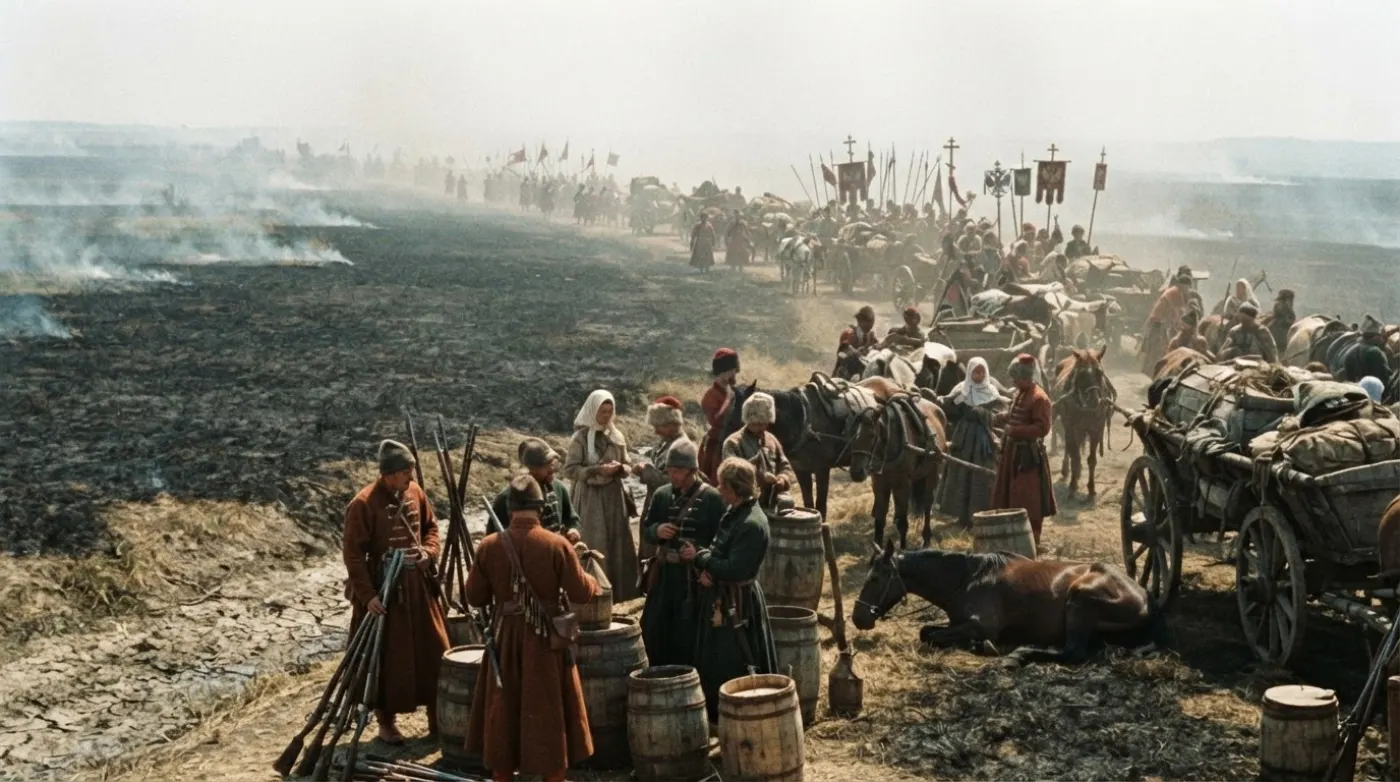
1687. The army set out from the river Merlo on 8 May. A review eight days later counted 90,160 men; about 50,000 Ukrainian Cossacks under Hetman Ivan Samoilovich were to join them. The Tatars withdrew and set the steppe on fire, leaving no grazing for the horses, and on 27 June a council of war decided to turn back without a battle. Losses from heat, thirst and disease were heavy, perhaps 15–20 per cent according to figures collected by P. I. Rudoy (2018). Samoilovich was blamed and deposed, and Ivan Mazepa was elected hetman.
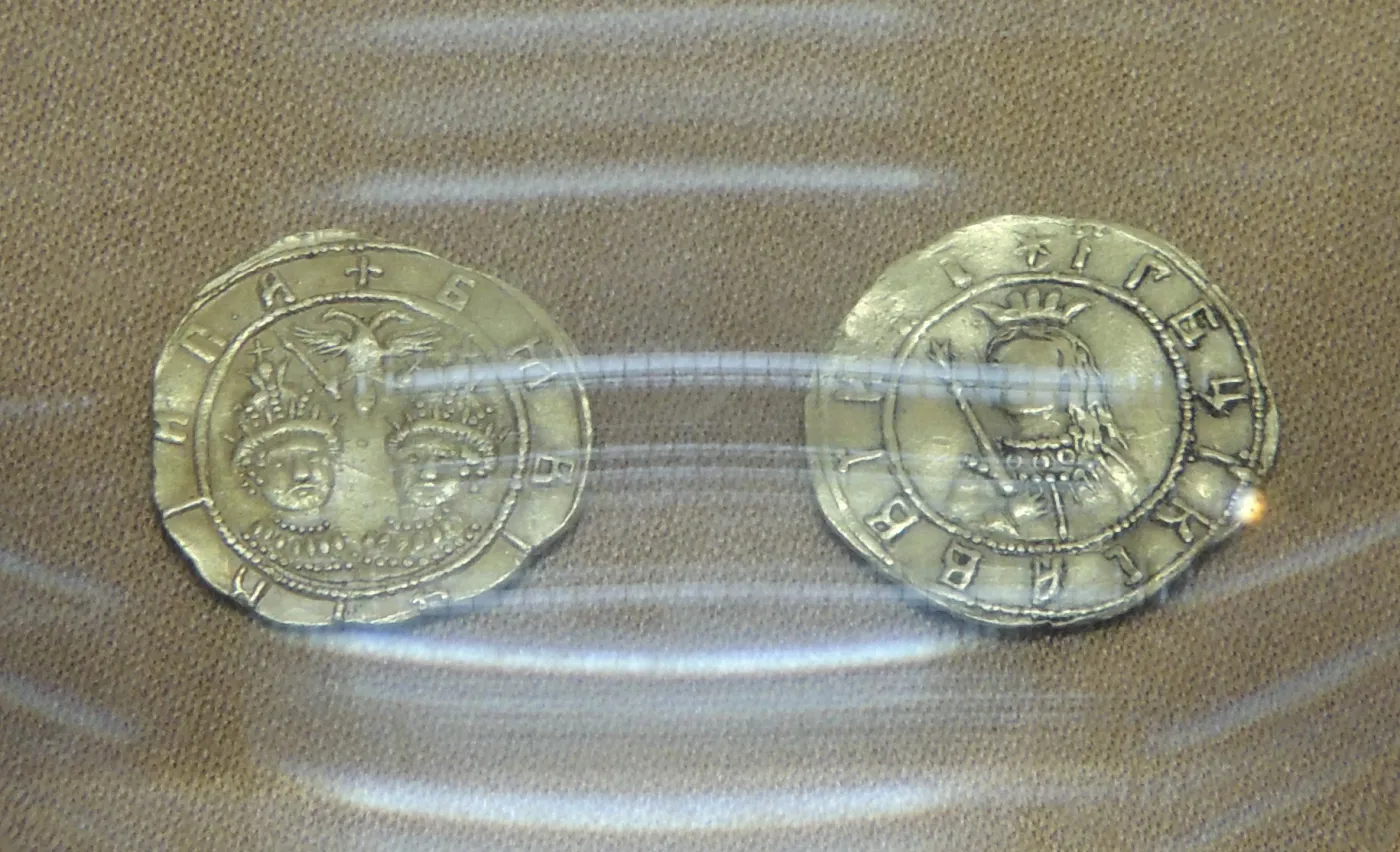
1689. This time the army left in early spring, on 17 March, to avoid the fires. It fought off Tatar attacks from 15 to 20 May and reached Perekop, the fortified line across the isthmus into the Crimea. Without siege artillery, water or fodder, the commanders advised retreat, and on 29 June the campaign was declared over. Sophia wrote to Golitsyn, in a letter quoted by Sergei Solovyov: "How can we repay you for such needed service, and above all for your labours, my light? Had you not laboured so, no one would have done it." Both campaigns were celebrated with awards, including small gold pieces with the two tsars on one side and Sophia on the other.
Historians disagree on how to judge the campaigns:
- A failure that sank the regime. Contemporaries "took a dim view of the exercise", as Hughes notes, and the rewards handed to the returning commanders became a political grievance.
- A sound strategy, badly supplied. Hughes herself argued that "far from being a foolhardy adventure, the campaigns combined long-standing Muscovite objectives with wider international commitments" and that "failure was caused more by faulty logistics than by military ineptitude". Others add that by tying down the khan, they helped Russia's allies against the Ottomans.
Why did Peter overthrow Sophia in 1689?
Time was against her. Peter married Evdokia Lopukhina on 27 January 1689, and in Muscovite eyes a married tsar of seventeen was an adult. From early 1688 he took a more active part in government. Patrick Gordon, a Scottish general in Russian service, noted that on 24 July 1689 the younger tsar refused for a while to approve what he considered excessive rewards to the officers back from the Crimea, and then would not receive them when they came to thank him.
The Orthodox Encyclopaedia sets out the final weeks. On 8 July Peter demanded that Sophia not walk with the tsars in the procession of the Kazan icon; she refused, and he left the procession. On the night of 7–8 August Sophia gathered streltsy in the Kremlin, she said for her own safety. Some of them warned Peter at Preobrazhenskoe that he was in danger, and he galloped in the night to the Trinity monastery. Sophia appealed to the streltsy: "Are we of use to you? If we are, then stand up for us. If not, we shall give up the state; it is your will."
It was not enough. Her attempt to go to the Trinity monastery herself on 29 August was stopped at Vozdvizhenskoe. On 30 August fourteen streltsy colonels went over to Peter; the patriarch and members of the Boyar Duma came to Peter at Trinity, and the foreign officers under Gordon followed. Peter declared that his sister had "begun to rule our state by her own will". On 7 September her name was removed from the royal title. Golitsyn was exiled to the north and died there in 1714; Shaklovity was executed on 12 September.
Was there a plot to kill Peter? Peter's party said so, and Neuville believed it; Voltaire later repeated the story. Hughes points out that the protagonists "left no first-hand explanation of their motives", and that Peter's flight "may have been engineered by his own followers in order to force an open confrontation". Even after the streltsy revolt of 1698, Peter "tried in vain … to find direct evidence of her initiation of a plot against his life".
What happened to Sophia in the Novodevichy convent?
Sophia was confined to the Novodevichy convent, the house she had lavishly endowed, between late September and early October 1689; the Orthodox Encyclopaedia gives 4 October. She was not yet a nun. In 1697 conspirators against Peter still assumed that if he died "the streltsy would take the tsarevna as before", and when the streltsy rebelled in 1698 they meant to proclaim her. Through her sister Marfa she showed them support and sent them one or two letters.
On 27 September 1698 Peter questioned her himself. She denied everything and explained that the streltsy named her only because they had supported her since she was "in government". About 21 October 1698 she was made to take the veil as the nun Susanna. Johann Korb, secretary of the Austrian embassy, wrote that three ringleaders "who had presented a petition inviting Sophia to take the helm of the State, were hanged over against the walls of the said monastery, close to the window of Sophia's room" (in Count MacDonnell's 1863 translation). The convent was closed to visitors and placed under Peter's security office, the Preobrazhensky Prikaz.
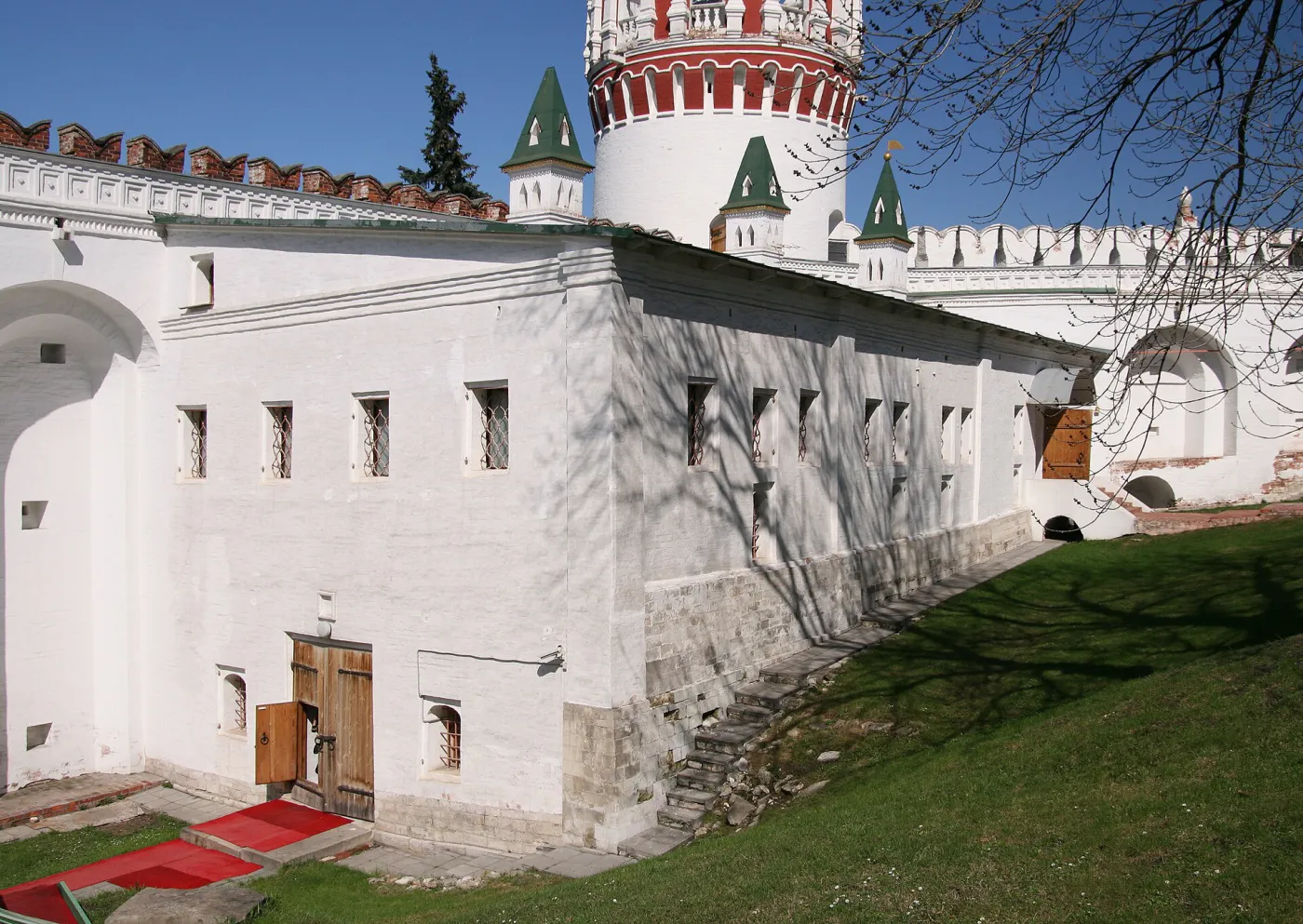
Shortly before her death she took the great schema, the strictest monastic vow, and with it her old name, Sophia; Uspensky dates this to 3 July 1703, while Naumov gives 1703 or 1704. She died on 3 July 1704 and was buried in the crypt of the convent's Smolensk cathedral.
Was Sophia the first woman to rule Russia?
No. Princess Olga of Kiev governed the Rus' as regent for her son Sviatoslav from AD 945, and in the sixteenth century Elena Glinskaya, mother of Ivan the Terrible, governed for her young son until her death in 1538; the Orthodox Encyclopaedia speaks of "the years of her regency". What set Sophia apart was the scale of her claim: an unmarried daughter, not a widowed mother, who sat in the Duma, received envoys and had herself called samoderzhitsa in law.
How has Sophia been remembered?
Under Peter her image was black. Andrei Matveev, writing in the 1720s, granted that she was "a maiden of great intelligence and the most subtle insight, filled with more than a man's mind", but only to explain her lust for power. Neuville gave posterity the cruellest portrait: she was "monstrously fat, has a head the size of a bushel, hair on her face, carbuncles on her legs", and knew Machiavelli's maxims "naturally" (in J. A. Cutshall's translation). Hughes showed that the physical description is "found only in Neuville", was added as a marginal note, perhaps came from enemies of Sophia such as Andrei Matveev, and that his story of her escaping from a convent is "completely erroneous".
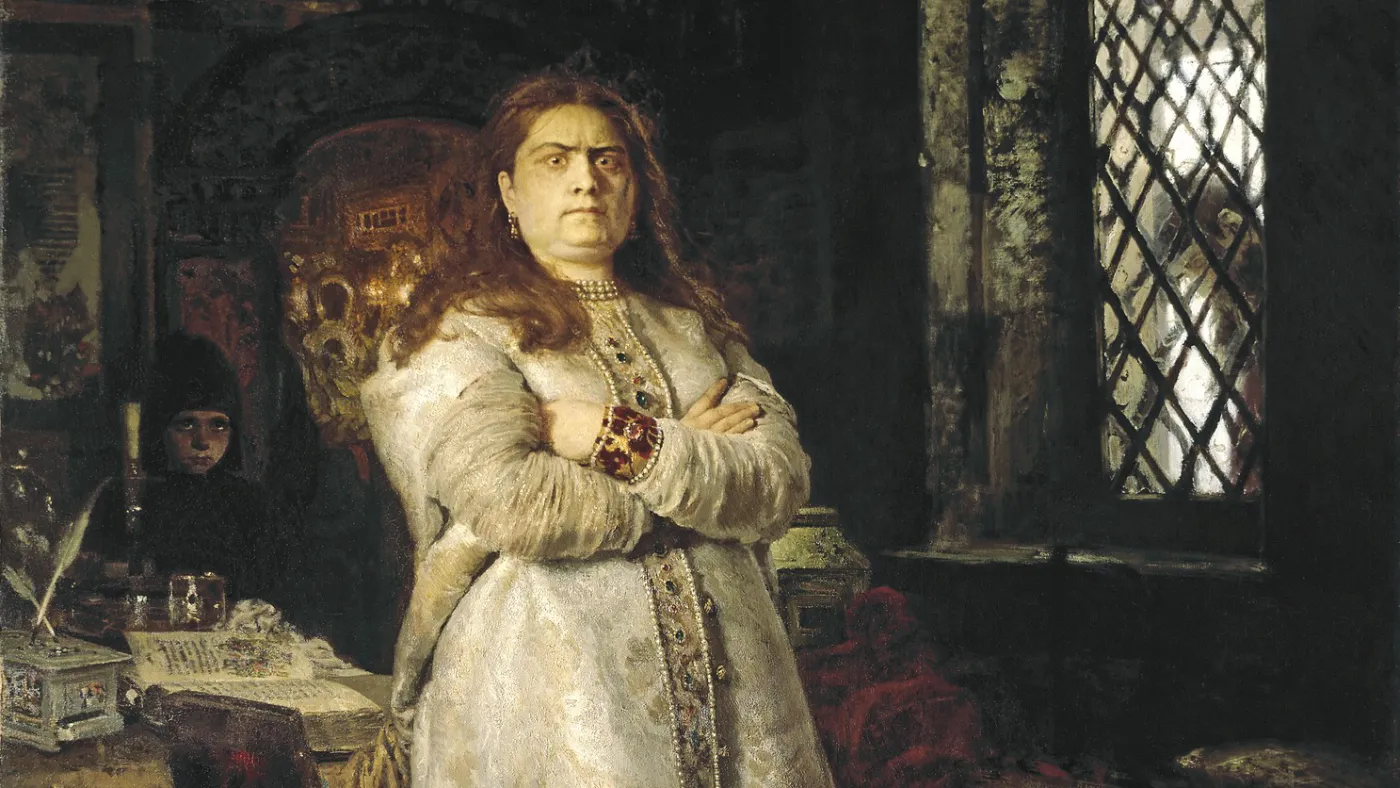
The counter-tradition began early. In 1727 Prince Boris Kurakin wrote that "Tsarevna Sophia Alekseyevna was of great intelligence and a great politician", and that "never was there such wise government in the Russian state". Nineteenth- and twentieth-century historians such as Aristov and Bogdanov developed this view, sometimes to the point of idealising her. Ilya Repin's painting of 1879 fixed another image: the caged, furious ex-ruler in her cell in 1698. Since the 2000s, the Orthodox Encyclopaedia notes, groups of admirers, mostly women, have gathered at the Naprudnaya ("Sophia's") tower of the convent, with only a vague idea of who she was.
Common myths about Sophia Alekseyevna
| Myth | What the evidence says |
|---|---|
| Sophia organised the May 1682 massacre | Historians are split; no document proves it, and her chief accusers were the victims' families |
| She was formally appointed regent in May 1682 | The "Act" on her regency survives only in a published text made from two drafts; Naumov and Bogdanov date it to 1687 or later |
| She was the first woman to rule Russia | Olga (from AD 945) and Elena Glinskaya (1530s) governed as regents before her |
| She had been shut up in a convent and escaped | Hughes calls this claim of Neuville's "completely erroneous"; she lived in the palace until 1689 |
| She planned to murder Peter in 1689 | Asserted by Peter's party, Neuville and Voltaire; Peter never found direct evidence, even in 1698 |
| She was grotesquely ugly and hairy | The description comes only from Neuville, probably from hostile informants |
| She had children with Golitsyn | Not corroborated by any source |
| She was a pupil of Simeon Polotsky | Widely repeated, but there is no reliable evidence |
| Repin's painting shows what she looked like | It was painted in 1879, 175 years after her death |
Timeline
| Date (Old Style) | Event |
|---|---|
| 17 September 1657 | Sophia born in the Kremlin |
| 1671 | Tsar Alexis marries Natalia Naryshkina |
| 27 April 1682 | Death of Tsar Fyodor; Peter proclaimed tsar |
| 15–17 May 1682 | Streltsy uprising in Moscow |
| 26 May 1682 | Ivan V senior tsar, Peter I junior tsar |
| 29 May 1682 | Regency power handed to Sophia |
| 25 June 1682 | Joint coronation of Ivan and Peter |
| 5 July 1682 | Debate with the Old Believers in the Faceted Palace |
| 17 September 1682 | Execution of Prince Ivan Khovansky |
| 1683–1684 | Last Assembly of the Land |
| 26 April 1686 | Eternal Peace with Poland–Lithuania |
| 6 January 1687 | Decree on issuing charters in the names of Ivan, Peter and Sophia |
| May–August 1687 | First Crimean campaign |
| 27 January 1689 | Peter marries Evdokia Lopukhina |
| March–June 1689 | Second Crimean campaign |
| 7–8 August 1689 | Peter flees to the Trinity monastery |
| 27 August 1689 | Treaty of Nerchinsk |
| 7 September 1689 | Sophia's name struck from the royal title |
| 4 October 1689 | Sophia moves to the Novodevichy convent |
| 27 September 1698 | Peter interrogates Sophia after the streltsy revolt |
| c. 21 October 1698 | Sophia takes the veil as Susanna |
| 3 July 1704 | Death of Sophia |
What the map shows
At 1689 the Tsardom of Russia reaches from Kiev on the Dnieper, Russian for good since the Eternal Peace, to the Amur, where the Treaty of Nerchinsk had just drawn a frontier. In the south the Crimean Khanate still holds the Black Sea steppe that Golitsyn's armies failed to cross, under the overlordship of the Ottoman Empire. Compare the Commonwealth's eastern border in 1686, and for the reign of Sophia's father, see our article on Tsar Alexis.
Sources
Primary sources
- Polnoe sobranie zakonov Rossiiskoi imperii, vol. 2 (St Petersburg, 1830), nos 920, 961, 1184, 1186, 1231, as quoted by Uspensky (2021)
- Foy de la Neuville, A Curious and New Account of Muscovy in the Year 1689, ed. Lindsey Hughes, trans. J. A. Cutshall (London: SSEES, 1994)
- Passages from the Diary of General Patrick Gordon of Auchleuchries, 1635–1699 (Aberdeen: Spalding Club, 1859)
- Johann Georg Korb, Diary of an Austrian Secretary of Legation at the Court of Czar Peter the Great, trans. Count MacDonnell, vol. 1 (London, 1863)
- A. A. Matveev, "Zapiski", in Zapiski russkikh liudei (St Petersburg, 1841), via vostlit.info
Studies and reference works
- A. V. Topychkanov, "Sofiia Alekseevna", Pravoslavnaia entsiklopediia, vol. 65 (2026)
- "Ioann V Alekseevich", Pravoslavnaia entsiklopediia, vol. 23
- "Elena Vasil'evna", Pravoslavnaia entsiklopediia, vol. 18
- Lindsey Hughes, introduction to Neuville, A Curious and New Account of Muscovy (London, 1994)
- B. A. Uspensky, "Ot gerba k parsune (portret tsarevny Sof'i Alekseevny 'v orle')", Slověne 10 (2021)
- E. K. Zelensky, "Medvedev's 'Sozertsanie kratkoe' or Eloquence as the Soul of Civitas", Kyivs'ka Akademiia 6 (2008)
- O. V. Babenko, review of V. P. Naumov, Tsarevna Sof'ia (Moscow, 2015), Sotsial'nye i gumanitarnye nauki. Otechestvennaia i zarubezhnaia literatura, ser. 5 (2016), no. 1
- E. S. Sokolova, "Samoderzhavnyi ideal v nadsoslovnykh strategiiakh Miloslavskikh i Naryshkinykh", Genesis: istoricheskie issledovaniia (2017)
- P. I. Rudoy, "Krymskie pokhody V. V. Golitsyna", Mezhdunarodnyi zhurnal gumanitarnykh i estestvennykh nauk (2018)
- Presidential Library, "Nachalsia streletskii bunt v Moskve", "Zakliuchen Nerchinskii dogovor" and "Andrusovskoe peremirie" (prlib.ru)
Image credits
- Title image: Ilya Repin, Tsarevna Sophia Alekseyevna a Year after Her Confinement in the Novodevichy Convent, 1879. Public domain, via Wikimedia Commons, cropped to 16:9.
- Engraved portrait of Sophia, attributed to Leonty Tarasevich, 1680s. Public domain, via Wikimedia Commons.
- Portrait of Sophia "in the eagle", Kremlin Armoury workshop, 1680s, State Historical Museum. Public domain, via Wikimedia Commons.
- German engraving of Vasily Golitsyn, late seventeenth century, CC BY-SA 4.0, via Wikimedia Commons, cropped.
- Award coins of Ivan V, Peter I and Sophia. Photo: shakko, 2013, CC BY-SA 3.0, via Wikimedia Commons.
- Sophia's Chambers, Novodevichy convent. Photo: Ludvig14, 2013, CC BY-SA 3.0, via Wikimedia Commons.