Serfdom in Russia was not created by a single law. It grew over about 150 years, from a rule of 1497 that let peasants leave their landlord only in the fortnight around St George's Day in late November, through emergency bans on leaving from 1581 and time limits for hunting runaways from the 1590s, to the Law Code of 1649, which made the hunt for fugitive peasants unlimited in time and their bondage hereditary. In the eighteenth century serfs could be sold without land, exiled to Siberia by their owners and forbidden to complain against them. Alexander II's Manifesto of 19 February 1861 (3 March in the modern calendar) freed about 22 million privately owned serfs in person. Their land was another matter: former serfs had to pay for it, and the last redemption payments were cancelled only from 1 January 1907.
Serfdom in Russia at a glance
| What it was | The legal binding of peasants to a landlord's estate, then to the landlord himself; the word krepostnoe pravo was coined only in the nineteenth century |
| First step | Sudebnik of 1497: peasants may leave only in the week before and after St George's Day (26 November Old Style) |
| Forbidden years | From 1581: departure banned year by year, first in some regions |
| Five-year search | Decree of 24 November 1597 |
| Indefinite search | Sobornoe Ulozhenie (Law Code), 29 January 1649, chapter XI |
| Peak | Second half of the eighteenth century, under Catherine II |
| Number of serfs | About 22 million privately owned serfs in European Russia at the tenth revision (1857–1858), roughly 36–37% of the population |
| Abolition | Manifesto and Statutes of 19 February (3 March) 1861 |
| End of redemption payments | Halved from 1 January 1906, cancelled from 1 January 1907 |
(Dates are Old Style, the Julian calendar used in Russia until 1918, unless marked otherwise. The translations from Russian in this article are our own.)
What was serfdom in Russia?
A serf (krepostnoi krest'ianin) was a peasant who could not leave the land he farmed or the lord who owned it, and whose children inherited the same status. He worked for the landlord in labour (barshchina, corvée) or paid him dues in money and kind (obrok), and in the eighteenth century the state came to rely on the landlord for its taxes and recruits.
The vocabulary is younger than the thing. According to the Soviet Historical Encyclopaedia, the adjective krepostnoi comes from krepost', a document that secured a property right, and was applied to peasants only from the middle of the seventeenth century, when selling them became normal practice. The phrase krepostnoe pravo, "serfdom", was "unknown to the laws and acts"; it was created by nineteenth-century writers from the official term krepostnoe sostoianie, "bonded condition". Nolte and Smolarz (2023) point out that Muscovite laws of the sixteenth and seventeenth centuries speak only of "peasants" and "bonded people", never of "serfs".
Not every Russian peasant was a serf. Under Peter I the "black" peasants of the north, who paid tax directly to the state, and the old petty servicemen of the south (odnodvortsy) became a separate class of "state peasants", personally free but owing the state a quit-rent on top of the poll tax. Church peasants joined them after the secularisation of church estates in 1762.
Where did serfdom in Russia begin: St George's Day
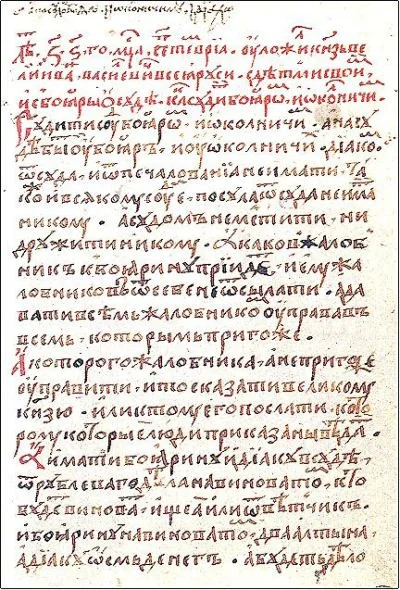
The earliest known limits on when a peasant could leave his landlord appear in charters of the mid-fifteenth century. They tied departure on some estates to the days around the autumn feast of St George, 26 November, when the year's field work was over and peasants settled their accounts with landlords and the tax collector. In September 1497 Ivan III's law code, the Sudebnik, made this the rule for the whole Grand Principality of Moscow:
"Peasants may leave a district, or move from village to village, once a year: in the week before St George's Day in autumn and the week after St George's Day in autumn."
The peasant also had to pay the landlord a fee for his dwelling, the pozhiloe: one rouble in open country and half a rouble in forest land, scaled by how long he had lived there, a quarter for one year up to the full sum after four. The Sudebnik of 1550, issued under Ivan IV, repeated the rule in its article 88, raised the fee by two altyny and added another two altyny "for carting".
How often peasants actually used the right is another question. The historian Vasily Klyuchevsky argued in the 1880s that debt tied most of them down long before any ban: the right of departure "dies out by itself, without any legislative abolition". The Brockhaus and Efron Encyclopaedia (1904) gives an example: in a Tver estate described in 1580, only two out of 60 recorded departures fell on St George's Day.
What were the forbidden years?
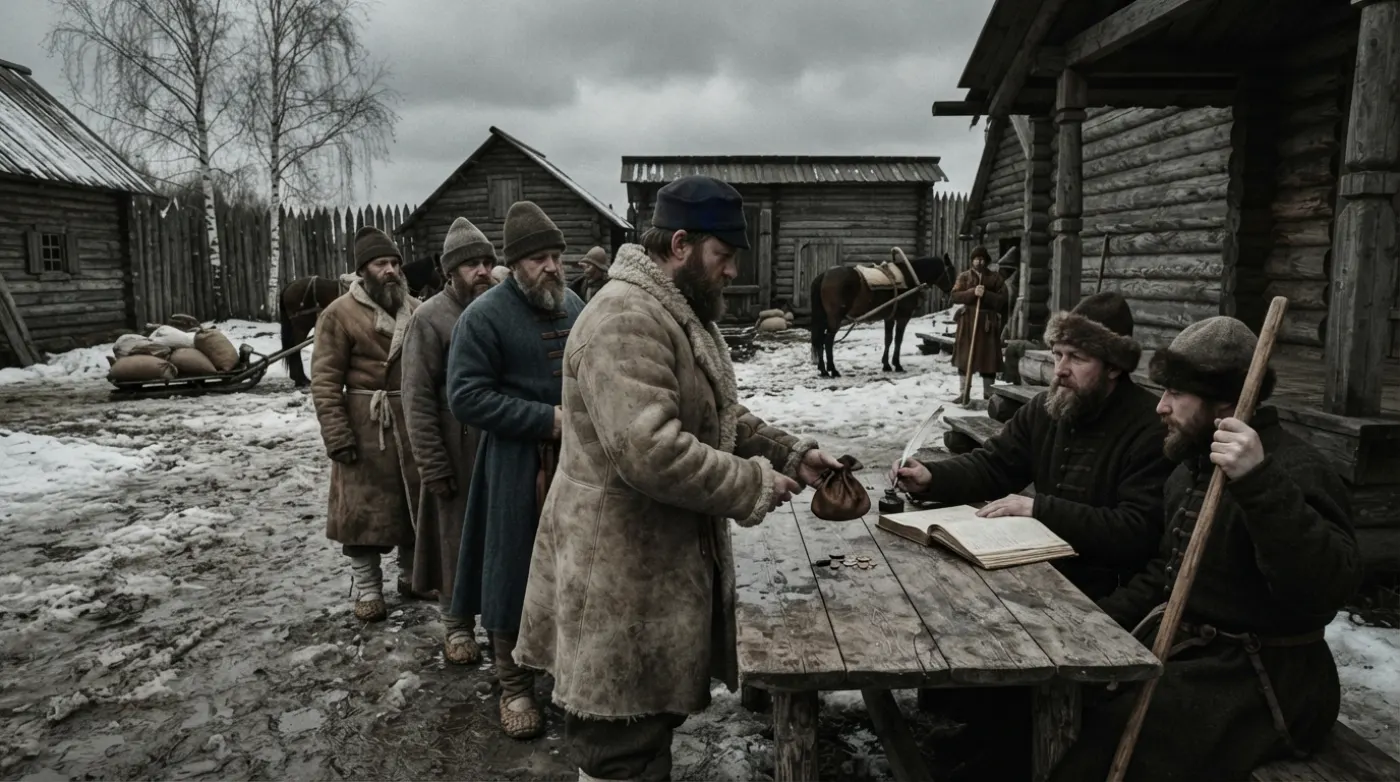
From 1581, in the last years of the Livonian War and amid what the Presidential Library calls "the extreme ruin of the country and the flight of the population", the government of Ivan IV began to declare "forbidden years" (zapovednye leta) in which peasants could not leave even at St George's Day. The term comes from zapoved', an order or prohibition. The ban went together with a general survey of the land, recorded in scribal books which recorded which household belonged to which estate.
No general decree on the forbidden years survives. As the Soviet Historical Encyclopaedia puts it, "researchers do not have a general decree" on them; they are known only from scattered charters and court records of the 1580s and early 1590s. The historian V. A. Arakcheev (2008) counts mentions in the sources only from 1581 to 1592, the last in a royal charter to the Dvina of 14 April 1592.
Did a decree of 1592 abolish St George's Day?
This is one of the oldest arguments in Russian history. In the eighteenth century Vasily Tatishchev published the text of a decree of 1597 that set a five-year limit for recovering runaways and counted back to 1592. Tatishchev, Karamzin and later Kostomarov and Sergeevich concluded that a lost decree of about 1592 had abolished the peasants' right to leave. Since Boris Godunov ran the government for Tsar Fyodor, the argument soon turned on whether he was the "founder of serfdom"; Kostomarov's essay with that question as its title appeared in 1858.
Historians disagree:
- A lost general ban existed. In the 1960s V. I. Koretsky reconstructed a decree of 1592/93 that forbade departure across the whole country and made the scribal books the legal basis of a peasant's bondage. Soviet reference works and the Presidential Library's Day in History follow this view.
- No such decree is needed. V. M. Paneiakh, G. N. Anpilogov and R. G. Skrynnikov rejected Koretsky's reconstruction; Skrynnikov saw the forbidden years turning from a temporary into a permanent measure. Arakcheev concludes that the hypothesis of a decree of 1592 "should be considered unproven".
- Serfdom came without decrees at all. Mikhail Pogodin denied that the decree of 1597 had anything to do with the right of departure, and Klyuchevsky argued that enserfment grew out of peasant debt rather than legislation. Klyuchevsky wrote in 1886 that "legislation did not establish serfdom on landlords' peasants either directly or indirectly".
Nolte and Smolarz sum up the modern menu: a "decree" interpretation, a "non-decree" interpretation based on indebtedness, the service gentry's need for resident labour, and the state's need to know where its taxpayers lived. Their summary draws on the American historian Richard Hellie, whose Enserfment and Military Change in Muscovy (1971) remains the standard study in English.
What did the decree of 1597 say?
On 24 November 1597 (4 December in the modern calendar) a decree issued in Tsar Fyodor's name ruled that peasants who had fled their landlords "within the five years before this present year" were to be searched for, tried and, as Kostomarov summarised it, returned "with their wives and children". Those who had fled six or more years earlier were left where they were. This was the first of the urochnye leta, the "fixed years" within which a landlord could reclaim a runaway.
Arakcheev reads it more narrowly: the decree did not create a rolling five-year limit for the future but simply set a cut-off date of November 1592, and the term urochnye gody was used for runaways only from the 1630s. Whatever its exact meaning, the five-year rule suited great landowners and the gentry of the southern frontier, who gained from runaways, while the ordinary servicemen of the central provinces lost them. The Presidential Library counts this quarrel over labour among the causes of the upheavals that followed.
How did the Time of Troubles change serfdom?
Famine shook the system almost at once. Decrees of November 1601 and of 1602, issued in the hunger years described in our article on the Time of Troubles, forbade moving peasants within the Moscow district but outside it allowed lesser servicemen to "carry off" peasants from one another. According to Brockhaus and Efron, they were meant to stop both flight to the frontier and the luring of peasants to great estates, and applied only to those years. In 1607, Tsar Vasily Shuisky's government extended the search period to fifteen years and, according to the Soviet Historical Encyclopaedia, for the first time set penalties for anyone who received and kept runaways. (The text of this verdict of 9 March 1607 was preserved by Tatishchev, and Karamzin already suspected its preamble "by its style and expressions, unusual in papers of that time".)
After the election of Michael Romanov the five-year limit returned. Throughout the first half of the seventeenth century, provincial gentry sent collective petitions asking for longer terms. The limit grew to nine years in the 1630s and in 1642 to ten years for runaways and fifteen for peasants carried off by other landlords. Marshall Poe, citing Hellie, notes that the gentry petitioned "throughout the seventeenth century" for "elimination of limitations on the recovery of fugitive serfs".
What did the Law Code of 1649 change?
The demand was met after the Moscow riots of 1648. The Assembly of the Land adopted the Sobornoe Ulozhenie, the Law Code of Tsar Alexis, on 29 January 1649. Its 25 chapters and 967 articles stayed the basic law of Russia until 1830.
Chapter XI, "Court concerning peasants", has 34 articles. They order runaways and their children to be returned "with their wives and children and all their peasant belongings" to whoever held them according to the scribal books compiled after the Moscow fire of 1626 or the census books of 1646–1647, and to be returned "without fixed years", bez urochnykh let. Article 3 admits that the rules had changed under people's feet: those who had taken in runaways were not to be punished for the past, "because until this present decree of the Sovereign there was no prohibition from the Sovereign that no one should take peasants in, but fixed years were set for runaway peasants". The fine for harbouring a runaway was doubled from five to ten roubles a year.
Historians disagree:
- The final step. The Presidential Library writes that the Code "finally established serfdom in the country", making the peasant's dependence hereditary and his property the landlord's.
- A step, not a foundation. Nolte and Smolarz stress that the Code "did not explicitly establish serfdom in Muscovy", although it "crucially contributed" to it. As Klyuchevsky pointed out, none of the laws up to and including the Code says in so many words that a peasant may not leave; the Code says that if he leaves, he can be brought back without limit of time.
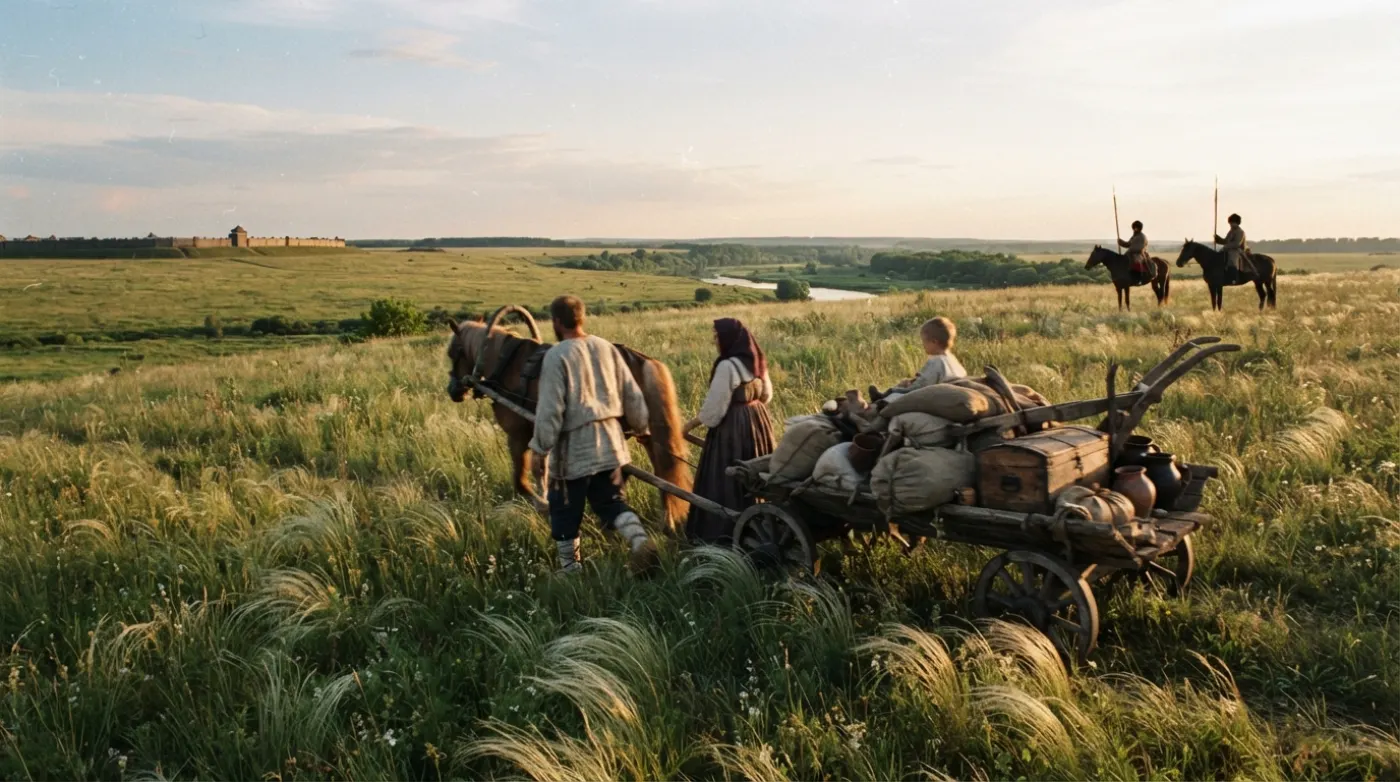
Even after 1649 the state kept setting new rules for peasants who fled to the frontier: decrees of 1653 and 1656 for the southern defence line, of 1671, 1683 and 1700 for Siberia and of 1698 for the Don. Flight to the Cossacks remained the great escape route, and the Cossack risings of the seventeenth and eighteenth centuries drew on it.
Were serfs slaves? Kholopstvo and serfdom
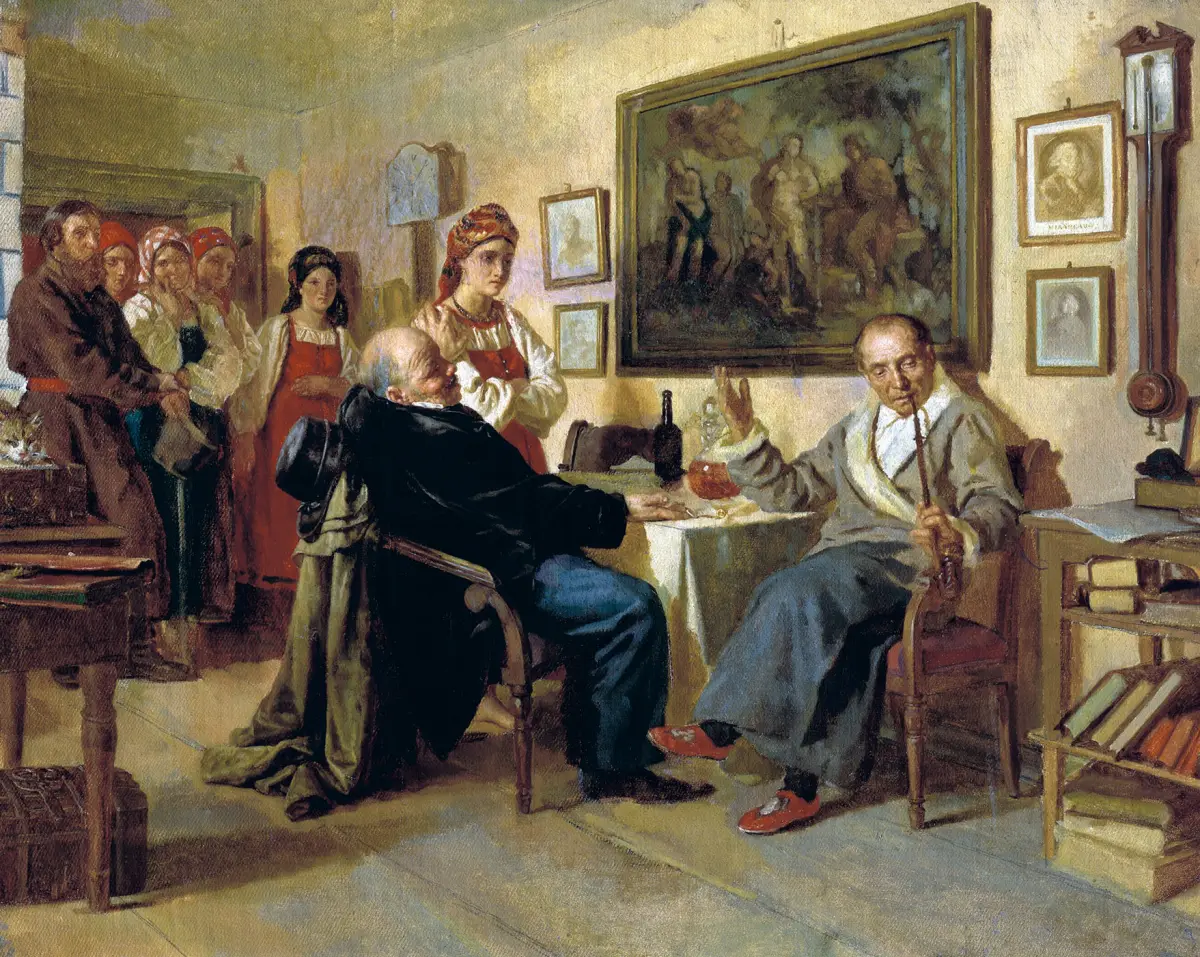
Muscovy also had people who were owned outright: the kholopy. The Sudebnik of 1497 already lists how one became a "full" kholop: by a deed of full bondage, by serving as a steward or as keeper of the keys on a village estate, or by marrying a female kholop. A kholop captured by the Tatars who escaped was free. Hellie's sample of kholopy from 1597 and 1603, as reported by Nolte and Smolarz, shows that about two-thirds had sold themselves, mostly out of poverty. The Law Code of 1649 dealt with them separately, in 119 articles of chapter XX.
A serf in 1649 was not a kholop. He farmed his own allotment, paid state taxes and, according to Brockhaus and Efron, could still appear before the ordinary courts as a plaintiff or defendant until Peter's time. The gap closed over the next century. Peter I's tax reform counted serfs and kholopy together, and a resolution of 19 January 1723 ordered that even town household servants be written down "like peasants" and taxed. Most historians date the end of kholopstvo to this point; Joukovskaia and Boiarchenkov (2025) show that it vanished only from relations between subjects and the state, while between masters and servants it "remained very much alive at least until the second half of the 1730s".
How did Peter the Great's poll tax tighten serfdom?
On 26 November 1718 Peter ordered a census of male souls to pay for his standing army, and a decree of January 1719 insisted that everyone be listed, "not omitting anyone from the old to the very last infant". From 1724 each male peasant owed a poll tax, set first at 80 kopecks and lowered to 74 and then 70 kopecks. The Brockhaus and Efron article on the peasants gives the usual verdict: Peter "worsened the position of the peasants by mixing them with the kholopy through a uniform poll tax". A regulation of 1731 tried to make landlords answerable for their serfs' taxes, and the male "revision soul" became the unit in which serfs were counted and taxed. A decree of 1721 even allowed merchants to buy villages for their factories, creating "possessional" serfs tied to works in the Urals.
How bad did serfdom get in the eighteenth century?
The Brockhaus and Efron Encyclopaedia lists the steps. A decree of 1726 took away the serfs' freedom to go away to seek work; in 1741 they were excluded from swearing the oath of allegiance to the monarch; a decree of 1747 allowed landlords to sell serfs to anyone as recruits for the army; a decree of 13 December 1760 allowed landlords to send serfs to settle in Siberia. "Under such conditions", the encyclopaedia concludes, "any difference between peasants and kholopy disappeared in the law itself". Under Catherine II, it adds, serfdom "reached the highest point of its development".
On 22 August 1767 the Senate banned serfs from petitioning against their landlords, not only to the empress in person but to any authority. Those who wrote or handed in such petitions were threatened with the knout and hard labour for life in Nerchinsk.
The trade in people was open and only lightly regulated. In 1771 the selling of serfs "under the hammer", at auction, was banned; in 1792 it was explained that auctions were permitted after all, "only without the use of the hammer". When Alexander I came to the throne in 1801 the State Council refused to ban the sale of serfs without land; the emperor could only forbid newspaper advertisements for the sale of people, after which, the encyclopaedia notes, sales were advertised as "giving into service".
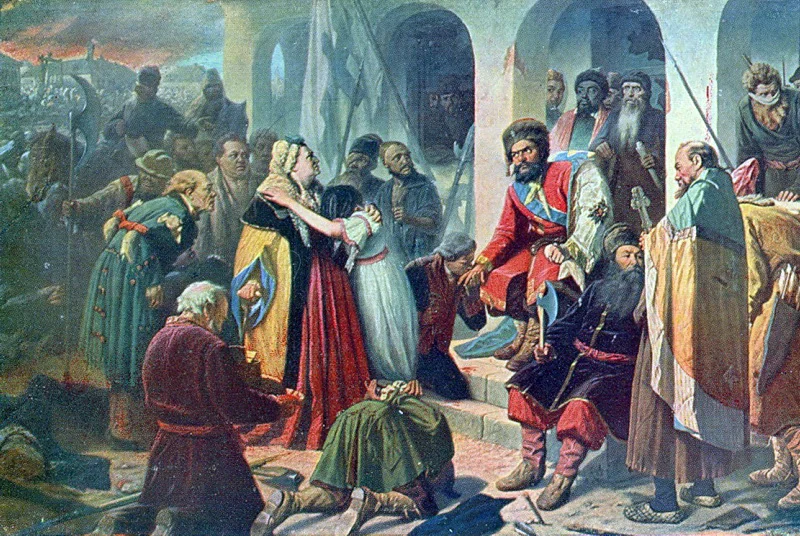
Resistance took the form of flight and, at times, war. The rising led by Emelyan Pugachev in 1773–1775 drew, according to the Brockhaus and Efron Encyclopaedia, mainly on serfs, especially peasants bound to factories and mines, together with Yaik Cossacks, Old Believers and Bashkirs. One of Pugachev's decrees "granted" his followers "freedom, without any demand for poll tax and other taxes or recruit levies". He was executed in Moscow on 10 January 1775. Nolte and Smolarz judge that such risings sought relief rather than the abolition of serfdom as a system.
How many serfs were there in Russia?
Only the tax censuses, the "revisions", give figures, and they counted male souls, sometimes both sexes, and covered changing territories. The numbers below come from those censuses as reported by the sources named.
| Census | Serfs | Share | Source |
|---|---|---|---|
| 1st revision (1723) | about 4 million male souls | – | Brockhaus and Efron |
| 2nd–8th revisions (1740s–1830s) | – | about 45% of the population | Brockhaus and Efron |
| 6th revision (1812) | almost 10.5 million male souls | – | Brockhaus and Efron |
| 10th revision (1857–1858) | about 22 million privately owned serfs, both sexes, in 50 provinces of European Russia | 36.4% | Nafziger (2013) |
| 10th revision (1857) | – | 37.5% of the whole empire | Brockhaus and Efron |
| Reform of 1861 | 22.5 million peasants of both sexes freed | – | Great Soviet Encyclopaedia |
The serf population stopped growing after 1812. By 1859, according to Brockhaus and Efron, two-thirds of all serfs, some 7 million people, lived on estates that their owners had mortgaged to state banks. The number of household serfs without land rose to 1,467,378 male souls at the tenth revision, as landlords hurried to take peasants off the land before an expected reform.
How did the emancipation of 1861 work?
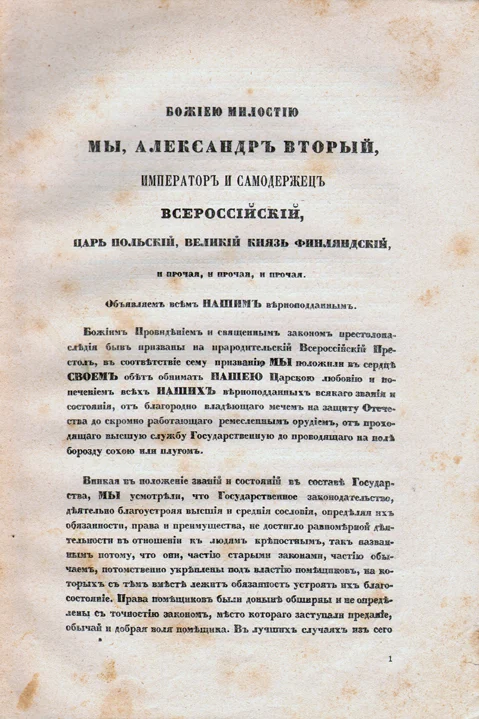
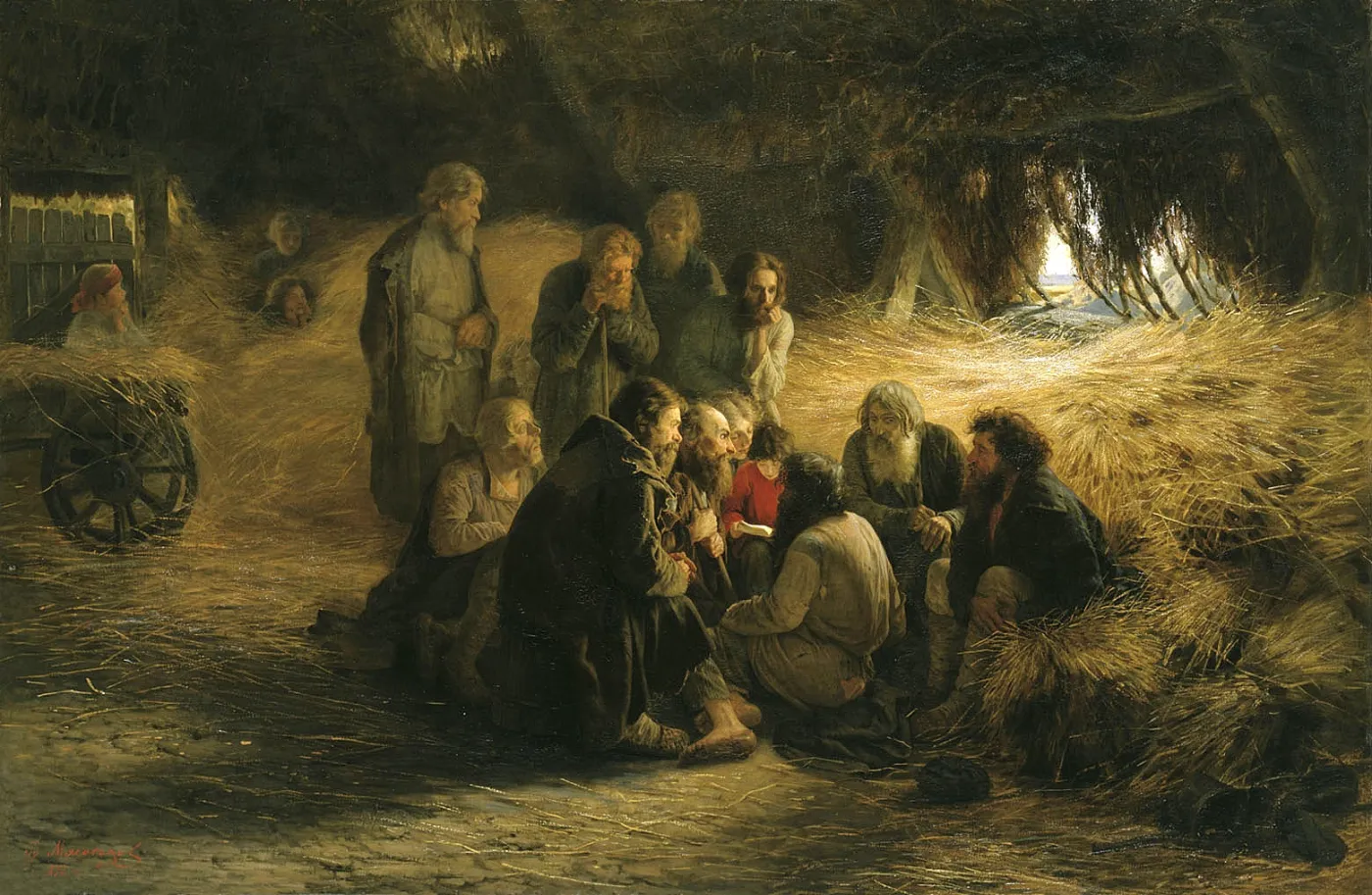
Reform came in small steps first. A law of 1803 allowed landlords to free whole villages with land as "free cultivators"; by 1855 only about 114,000 male serfs had been freed this way. Serfs in the Baltic provinces were freed without land in 1816–1819. Alexander II had the nobility of each province draw up proposals in provincial committees, and on 19 February 1861 he signed the Manifesto, edited by Metropolitan Filaret of Moscow, together with the Statutes, 17 legislative acts by the Great Soviet Encyclopaedia's count. It was made public in St Petersburg and Moscow on 5 March and elsewhere between 7 March and 2 April.
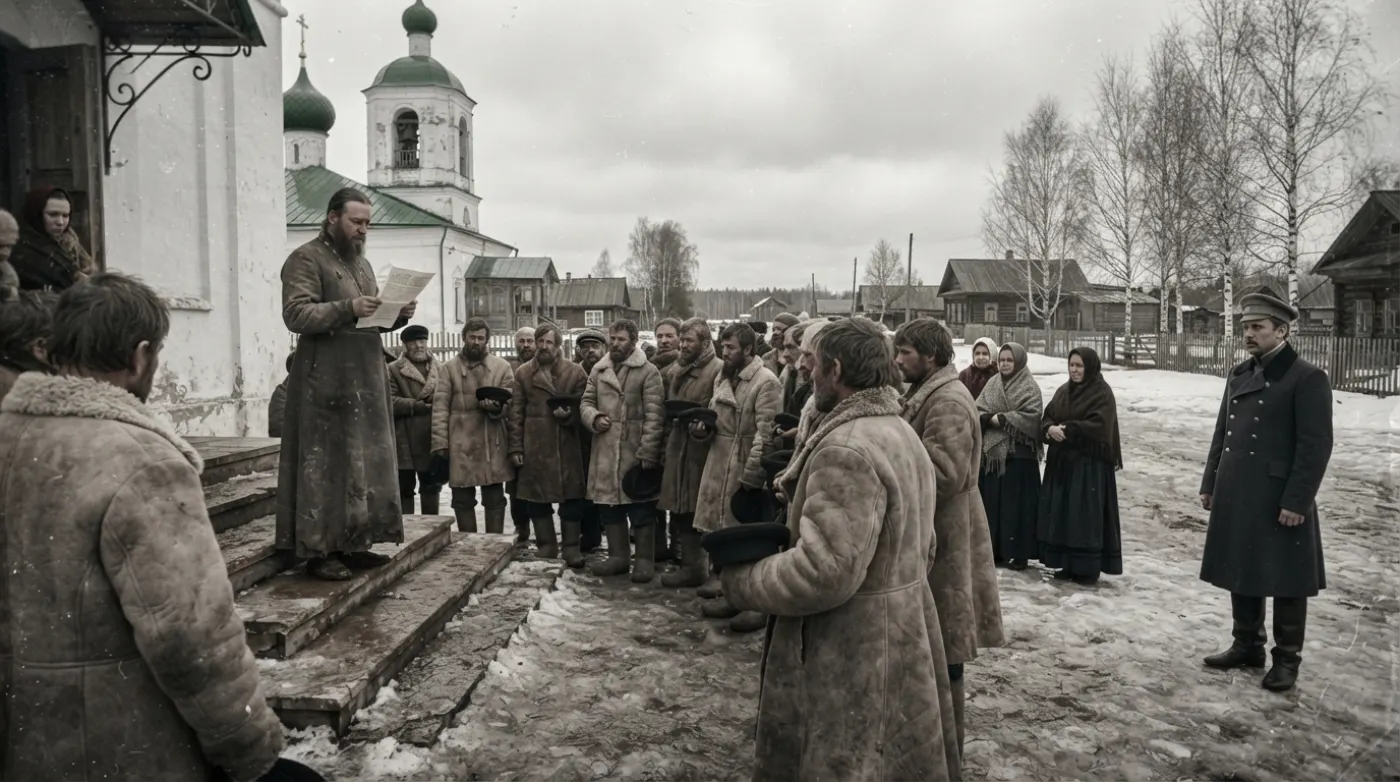
The General Statute begins bluntly: "Serfdom over the peasants settled on landlords' estates, and over household people, is abolished for ever." The Manifesto was more cautious. The serfs "will receive in due course the full rights of free rural inhabitants". The landlords kept ownership of all their land and had to grant the peasants the permanent use of their homesteads and a field allotment, for which the peasants owed labour or dues. "In this condition, which is transitional, the peasants are called temporarily obligated." For two years, until the charters for each estate were drawn up, peasants and household serfs were "to remain in their former obedience to the landlords". Household serfs were to receive full freedom after two years.
Who paid for the land? Redemption payments
The land had to be bought. The state paid the landlord 80% of the price of a full allotment (75% of a reduced one) in interest-bearing bonds, and the peasants repaid this loan to the treasury at 6% a year for 49 years. The price was not the market value of the land but the peasants' old dues, capitalised at 6%. According to the economist Losiitsky, cited in the Granat Encyclopaedia (1911), allotments in the non-black-earth provinces were valued for redemption at 342 million roubles, against a sale value of 180 million. Through "cut-offs" of land by landlords, small free "gift" allotments and outright refusals, the land farmed by peasants shrank sharply in some provinces: by 42.4% in Saratov province and by 41.3% in Samara.
Redemption was at first voluntary, and many peasants stayed "temporarily obligated", still paying dues or working for the landlord. On 1 January 1881, 1,552,403 male souls, 15.3% of the former private serfs, were still in that condition. A law of 28 December 1881 made redemption compulsory from 1 January 1883.
Arrears piled up for decades. During the revolution of 1905 the government gave way: a manifesto of 3 November 1905 halved the redemption payments from 1 January 1906 and cancelled them from 1 January 1907. Prince D. I. Shakhovskoi concluded, as the Granat Encyclopaedia reports, that the former serfs had paid for their land "with interest to spare". The poll tax, introduced by Peter I, had already been abolished for them from 1 January 1886.
Was Russian serfdom like American slavery?
The American historian Peter Kolchin built a whole book, Unfree Labor (1987), on the comparison. The differences are as striking as the likenesses. Nolte and Smolarz stress that Russian serfs "belonged to the same ethnic and religious group as their owners", lived in village communes (mir) that shared out land and answered collectively for taxes, and could, with permission, work away from home as traders or craftsmen. Alessandro Stanziani (2009) argues that the legal status of Russian peasants "allowed it to be distinguished from slavery in the strict sense", likening it to long-term indenture. Against that stands the eighteenth-century law, in which, as Brockhaus and Efron put it, the difference between serf and kholop had disappeared, and the open sale of people without land.
The timing is often reversed in popular memory. Russia's Manifesto of 1861 came before Lincoln's Emancipation Proclamation of 1 January 1863, which applied to the states in rebellion against the United States, and before the Thirteenth Amendment, ratified on 6 December 1865, which abolished slavery across the country. In the German lands serfdom was abolished earlier, in the Kingdom of Prussia by the October Edict of 1807.
Common myths about serfdom in Russia
| Myth | What the evidence says |
|---|---|
| Serfdom in Russia was ancient | The first general limit on leaving dates from 1497; full bondage was reached only in 1649 and its harshest form in the eighteenth century |
| Boris Godunov abolished St George's Day by decree in 1592 | No such decree survives; its existence has been disputed since the nineteenth century, and Arakcheev calls it unproven |
| The Law Code of 1649 forbade peasants to leave | It abolished the time limit for recovering runaways; the ban itself was never put into words |
| Serfs were simply slaves | They had allotments, communes and their own taxes, and were Orthodox Russians like their owners, but by the eighteenth century they could be sold without land, exiled and denied petitions |
| All Russian peasants were serfs | About half of the population at most; millions of state peasants were not privately owned |
| Russian serfs were freed after American slaves | The Manifesto of 1861 came before the Emancipation Proclamation (1863) and the Thirteenth Amendment (1865) |
| In 1861 the serfs got their land free | They had to buy it with redemption payments that ran until 1906 |
Timeline
| Date | Event |
|---|---|
| Mid-15th century | Some estates limit peasant departure to the days around St George's Day |
| September 1497 | Sudebnik of Ivan III: one departure term a year, around 26 November |
| June 1550 | Sudebnik of Ivan IV, article 88: same term, higher fee |
| 1581 | First "forbidden years" |
| 14 April 1592 | Last known mention of the forbidden years |
| 24 November 1597 | Five-year limit for recovering runaways |
| 1601–1602 | Famine; limited departure allowed again |
| 1607 | Fifteen-year search period; penalties for harbouring runaways |
| 1642 | Ten years for runaways, fifteen for peasants carried off |
| 29 January 1649 | Sobornoe Ulozhenie: search without time limit |
| 1675, 1682, 1688 | Decrees recognise the sale of peasants without land |
| 1718–1724 | Census and poll tax; kholopy taxed like peasants (1723) |
| 1760 | Landlords may exile serfs to Siberia |
| 22 August 1767 | Serfs forbidden to petition against landlords |
| 1773–1775 | Pugachev's rising |
| 5 April 1797 | Paul I's manifesto on three-day barshchina |
| 1803 | Law on free cultivators |
| 1816–1819 | Serfs in the Baltic provinces freed without land |
| 1857–1858 | Tenth revision |
| 19 February (3 March) 1861 | Manifesto and Statutes abolishing serfdom |
| 28 December 1881 | Redemption made compulsory from 1883 |
| 3 November 1905 | Manifesto ends redemption payments |
| 1 January 1907 | Last redemption payments cancelled |
What the map shows
In 1649 the Tsardom of Russia bordered the Polish–Lithuanian Commonwealth in the west, while runaway peasants headed for its open frontiers in the south and in Siberia. By 1861, when serfdom was abolished, the Tsardom had become the Russian Empire, whose ruler signed the Manifesto as "Emperor and Autocrat of All the Russias, Tsar of Poland, Grand Duke of Finland". In the same year the Civil War between the Union and the Confederate States of America began, the war that ended American slavery. For the household world that serfs and kholopy served in, see our article on the Domostroy.
Sources
Primary sources
- Sudebnik of 1497, text after Rossiiskoe zakonodatel'stvo X–XX vekov, vol. 2 (Moscow, 1985), via ru.wikisource
- Sudebnik of 1550, text after Sudebniki XV–XVI vekov (Moscow and Leningrad, 1952), via the law library of HSE University, Nizhny Novgorod
- Sobornoe Ulozhenie of 1649, chapter XI, in Polnoe sobranie zakonov Rossiiskoi imperii, 1st series, vol. 1 (St Petersburg, 1830), via ru.wikisource
- Manifesto of 19 February 1861, after Rossiiskoe zakonodatel'stvo X–XX vekov, vol. 7 (Moscow, 1989), via ru.wikisource
- General Statute on Peasants Released from Serf Dependence, 19 February 1861, PSZ, 2nd series, vol. 36, no. 36657, via ru.wikisource
- Emancipation Proclamation (1863) and Thirteenth Amendment (1865), US National Archives
Studies and reference works
- Presidential Library, "Ukaz tsaria Fedora Ioannovicha ob 'urochnykh letakh'" (24 November 1597) and "Priniato Ulozhenie tsaria Alekseia Mikhailovicha" (29 January 1649), Den' v istorii
- V. A. Arakcheev, "Zakrepostitel'nye meropriiatiia v Russkom gosudarstve v nachale 1590-kh gg.", Izvestiia RGPU im. A. I. Gertsena (2008)
- V. A. Arakcheev, "Problema 'urochnykh let' v Russkom gosudarstve v kontse XVI – nachale XVII veka", Izvestiia RGPU im. A. I. Gertsena (2008)
- N. I. Kostomarov, "Dolzhno li schitat' Borisa Godunova osnovatelem krepostnogo prava?" (1858)
- "Iur'ev den'", "Krest'iane", "Kholopstvo", "Podushnaia podat' v Rossii", "Pugachevshchina" and "Operatsiia vykupnaia", Entsiklopedicheskii slovar' Brokgauza i Efrona (1895–1906)
- A. Svirshchevsky, "Vykupnye platezhi", Entsiklopedicheskii slovar' Granat, vol. 12 (1911)
- S. M. Kashtanov, "Krepostnoe pravo", and "Zapovednye leta", Sovetskaia istoricheskaia entsiklopediia
- "Krepostnoe pravo", "Zapovednye leta", "Iur'ev den'", "Krest'ianskaia reforma 1861" and "Vremennoobiazannye krest'iane", Bol'shaia sovetskaia entsiklopediia, 3rd ed.
- H.-H. Nolte and E. Smolarz, "Slavery and Serfdom in Muscovy and the Russian Empire", in D. A. Pargas and J. Schiel (eds), The Palgrave Handbook of Global Slavery (Palgrave Macmillan, 2023)
- A. Stanziani, "The Legal Status of Labour from the Seventeenth to the Nineteenth Century: Russia in a Comparative European Perspective", International Review of Social History 54 (2009)
- A. Joukovskaia and V. Boiarchenkov, "The Abolition of Kholopstvo in 1723? A Study in Legal History", Russian History 52 (2025)
- S. Nafziger, "Russian Serfdom, Emancipation, and Land Inequality: New Evidence" (working paper, 2013)
- M. Poe, "The Consequences of the Military Revolution in Muscovy in Comparative Perspective" (1996)
Image credits
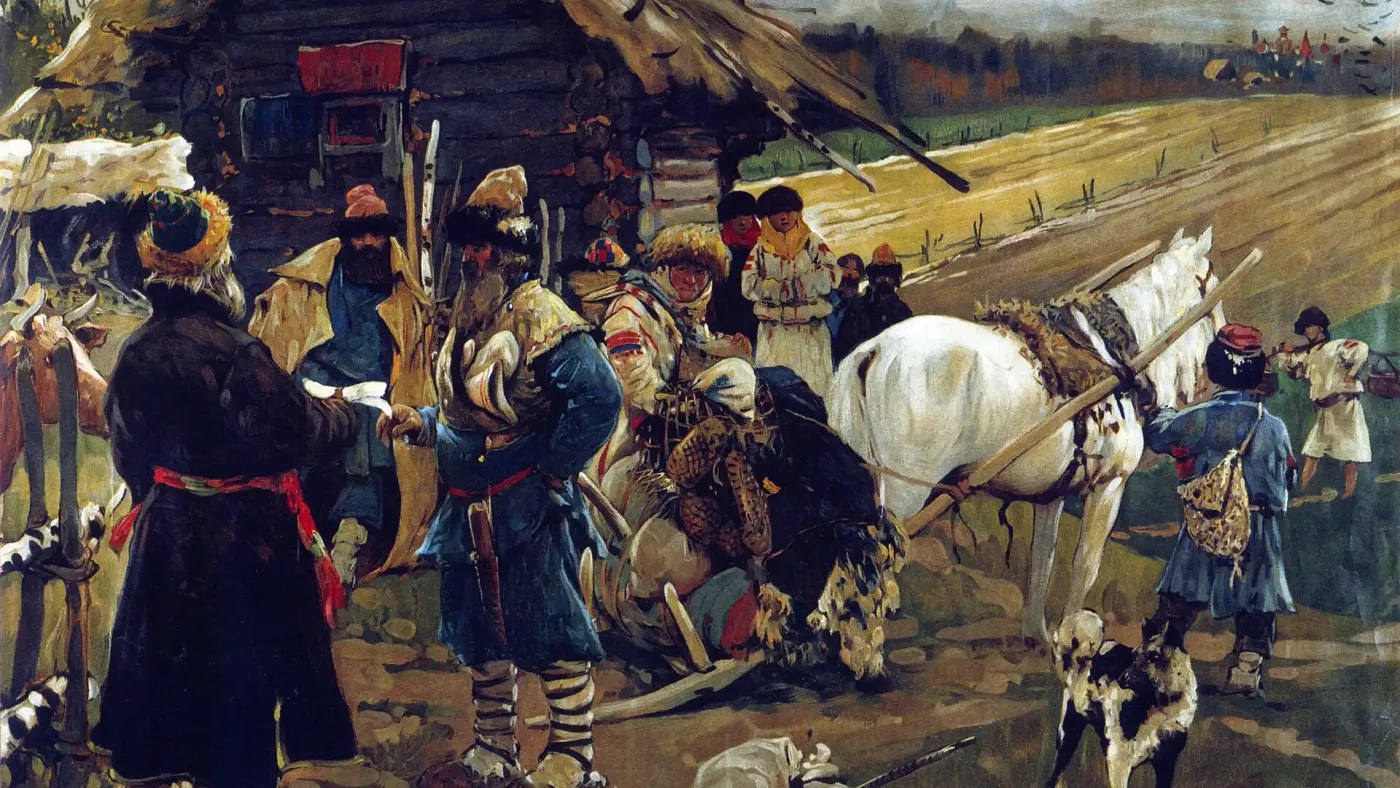
- Title image: Sergei Ivanov, Yuri's Day, 1908. Public domain, via Wikimedia Commons.jpg), cropped to 16:9.
- Sudebnik of 1497, manuscript page. Public domain, via Wikimedia Commons.
- Nikolai Nevrev, The Bargain, 1866. Public domain, via Wikimedia Commons.
- Vasily Perov, Pugachev's Judgement, 1879. Public domain, via Wikimedia Commons.
- First page of the Manifesto of 19 February 1861, reproduction published by Ivan Sytin, 1911. Public domain, via Wikimedia Commons.
- Grigoriy Myasoyedov, Reading of the Statutes of 19 February 1861, 1873. Public domain, via Wikimedia Commons.