Yaroslav the Wise (c. AD 978–1054) was the grand prince of Kyiv who, after a four-year fratricidal war, ruled Kievan Rus' from 1019 until his death and made it one of the most connected powers in Europe. He is remembered for three things: the first written Rus' law, the Russkaya Pravda; the Saint Sophia Cathedral and Golden Gate of Kyiv; and a web of marriages that tied his family to the crowns of Norway, Hungary and France. His bones, oddly, are missing.
Who was Yaroslav the Wise?
Yaroslav Vladimirovich – Ukrainian Yaroslav Mudryi, Old Norse Jarizleifr, baptised George (Yuri) – was a son of Vladimir the Great, the prince who converted Rus' to Christianity. The Primary Chronicle names his mother as Rogneda of Polotsk, and the Internet Encyclopedia of Ukraine follows it.
His birth year is uncertain. The Encyclopedia of Ukraine gives AD 978, which fits the Chronicle's statement that he died aged 76; Britannica gives AD 980. When Soviet anthropologists examined the skeleton believed to be his in 1939, they judged it a man of over sixty – consistent with either date, but no proof of the Chronicle's arithmetic.
The same study found a dislocated hip and a knee fracture from later life, matching the chronicle tradition that Yaroslav limped. Vladimir set him up first in Rostov (from c. AD 988, per the Encyclopedia of Ukraine), then from 1010 in Novgorod, the northern trading city that became his power base.
How did Yaroslav win the war of succession (1015–1019)?
In 1014 Yaroslav refused to send Novgorod's yearly tribute of 2,000 silver grivnas to Kyiv – a grivna being a silver ingot used as the Rus' unit of account. Vladimir died in July 1015 while preparing to punish him, and his eldest surviving son, Sviatopolk, later nicknamed "the Accursed", seized Kyiv.
Yaroslav's army of Novgorodians and Varangians – Scandinavian warriors hired as mercenaries – nearly came apart before it marched: a brawl in Novgorod ended with his Varangians massacred, a story told in our article on who the Varangians were. He still defeated Sviatopolk at Liubech on the Dnieper and took Kyiv. The Chronicle dates the battle to 1016; the Encyclopedia of Ukraine puts it in 1015.
Sviatopolk had a powerful father-in-law: Bolesław I the Brave of Poland. In 1018 Bolesław beat Yaroslav on the Bug River and escorted Sviatopolk into Kyiv. Thietmar of Merseburg, a German bishop writing that very year from informants' reports, says the city received them on 14 August and describes it as holding "more than four hundred churches, eight markets, and an unknown number of inhabitants" (David Warner's translation). Thietmar adds that Yaroslav's stepmother, wife and nine sisters were found there; one sister, Predslava, was carried off to Poland by Bolesław.
Polish tradition later claimed that Bolesław notched his sword, Szczerbiec, on Kyiv's Golden Gate. Treat that as legend: the Primary Chronicle places the Golden Gate among Yaroslav's building works of 1037, years after Bolesław left. Kyiv soon turned against its Polish garrison, and in 1019 Yaroslav routed Sviatopolk on the Alta River. Sviatopolk fled west and died in exile.
Did Yaroslav murder Boris and Gleb?
During the war three of Yaroslav's half-brothers were killed: Boris, Gleb and Sviatoslav. The Primary Chronicle and the eleventh-century Lives of Boris and Gleb blame Sviatopolk. They present Boris and Gleb as passion-bearers – Christians who accepted an unjust death without resisting – and the pair became the first saints of Rus'. Their relics were moved to a new church at Vyshhorod under Yaroslav's son Iziaslav, but the exact date and process of their canonisation are still debated.
The other side of the story comes from Iceland. The Eymundar þáttr, a saga episode written down centuries later, has the Varangian chief Eymund kill "Burizlaf" on the orders of his employer Jarizleifr – Yaroslav. When Osip Senkovsky translated the tale into Russian in 1834, historians began to ask whether "Burizlaf" was Boris. In 1957 Nikolai Ilyin argued that the chronicle account is a later, hagiographic construction and that Yaroslav was the likelier culprit.
Andrzej Poppe, author of the most comprehensive study of the Boris and Gleb cult, rejected that reading and defended the Chronicle's version. The counter-argument is simple: "Burizlaf" is also the name Scandinavian sources give Bolesław of Poland, so the saga may be garbling the war against Sviatopolk and his Polish ally. Yaroslav clearly did profit from the cult, since saintly brothers murdered by a usurper made his own rule look like divine justice.
Verdict: the evidence against Yaroslav is circumstantial and comes from a late saga; the evidence against Sviatopolk comes from sources written for Yaroslav's family. Neither can be proven.
How did Yaroslav become sole ruler of Rus'?
Victory in 1019 did not settle everything. In 1021 Yaroslav fought his nephew Briachislav of Polotsk, and his half-brother Mstislav of Tmutarakan and Chernihiv proved a tougher rival. At Listven in 1024 Mstislav won, and by an accord of 1026 the brothers split Rus' along the Dnieper: Mstislav took the east bank, Yaroslav kept Kyiv and the west.
The partnership worked. In 1030 Yaroslav campaigned against the Chud (Estonians) and founded Yuriev – named after his baptismal name – which is today Tartu in Estonia. In 1030–1031, helped by Mstislav, he retook the Cherven towns on the Polish border and founded the town of Jarosław. When Mstislav died without heirs in 1036, Yaroslav annexed his lands and ruled all Rus' except Polotsk.
The same period brought his best-known victory. The Pechenegs, Turkic nomads of the steppe who had menaced Kyiv for generations, attacked the city. The Primary Chronicle dates this to 1036; the Encyclopedia of Ukraine gives 1037. Yaroslav crushed them, and Saint Sophia rose on or near the battlefield. After this the Pechenegs cease to be a serious threat in the chronicles; the southern frontier was held with new forts along the Ros and Sula rivers.
The last war with Byzantium
In 1043 Yaroslav sent his eldest son Vladimir, with the commander Vyshata, on a naval raid against Constantinople, the capital of the Byzantine Empire. Michael Psellos, a Byzantine courtier who watched it, credits the imperial fleet and Greek fire with the victory; the Rus' chronicles blame a storm. It was the last Rus'–Byzantine war. Peace followed, sealed by the marriage of Yaroslav's son Vsevolod to a princess of Emperor Constantine IX Monomachos's family – whose son is remembered as Vladimir Monomakh.
What was the Russkaya Pravda?
The Russkaya Pravda ("Rus' Justice") is the oldest written law code of Rus', and its oldest layer is the Pravda of Yaroslav. Scholars divide the Short Pravda into two parts: Yaroslav's articles, traditionally linked to the reward he gave Novgorod for its support in the war, and the Pravda of the Yaroslavichi, issued by his sons. The Extensive Pravda of the twelfth century, as Daniel Waugh of the University of Washington summarises, "takes as its basis the Short Pravda and adds another 80 articles", some reflecting legislation by Vladimir Monomakh in or soon after 1113.
Its first article is its most famous. Kin of a murdered man may take revenge – a brother for a brother, a son for a father and other named relatives – but if there is no avenger, the killer pays a vira, a wergild or blood-price, of 40 grivnas. The fine rose for members of the prince's retinue, the druzhina. According to the Extensive version, Yaroslav's sons abolished blood revenge altogether when they revised the law in the 1070s.
| Provision | What it says |
|---|---|
| Homicide | Blood revenge by close kin; otherwise 40 grivnas' compensation |
| Status | Higher payments for the prince's men than for ordinary free people |
| Honour | Fines for insults such as damaging a man's beard (12 grivnas) |
| Procedure | Oaths, witnesses and the local community settle most disputes |
| Sons' revision | Blood feud replaced by fines paid to kin and to the prince (1070s) |
Two myths need correcting. First, Yaroslav did not "write" the law alone: the Short Pravda records customary law and princely rulings, and, as Darrell P. Hammer put it in Slavic Review (1972), "There is no statement in the Russkaia Pravda that Iaroslav had decreed—that is, legislated—anything." Second, no copy survives from his lifetime: Yale Law Library counts "only three texts prior to the fifteenth century and ninety-two texts dating from the sixteenth to the eighteenth centuries." The Short Pravda comes down in the Novgorod First Chronicle, in two fifteenth-century copies, and the oldest surviving Extensive text is in the Novgorod Synodal Kormchaya of 1282. Read it in English in George Vernadsky's Medieval Russian Laws (1947) or Daniel Kaiser's The Laws of Rus' (1992); the University of Washington hosts a helpful introduction to the Russkaia Pravda and the Church Statutes. A separate Church Statute of Yaroslav, on church courts and family law, survives only in much later versions and its authenticity is debated.
Whom did Yaroslav's children marry? The father-in-law of Europe
Around 1019 Yaroslav married Ingegerd, daughter of King Olof Skötkonung of Sweden, known in Rus' as Irina and later venerated as St Anna of Novgorod. The sagas say he gave her Ladoga (Norse Aldeigjuborg) as a bride-gift; that detail rests on saga tradition alone.
"Father-in-law of Europe" is a modern popular nickname, not a medieval title, but the record behind it is real. Historian Christian Raffensperger, in Reimagining Europe (2012) and Ties of Kinship (2016), uses these marriages to argue that Rus' belonged fully to the European dynastic world rather than standing apart from it.
| Child | Spouse | Realm | Source | Certainty |
|---|---|---|---|---|
| Elisiv (Elizabeth) | Harald Hardrada | Norway | Sagas; Britannica; Encyclopedia of Ukraine | Certain |
| Anastasia | Andrew I | Hungary | Britannica; Encyclopedia of Ukraine | Certain |
| Anne (Anna) | Henry I, married 1051 | France | French charters; Britannica | Certain |
| Agatha | Edward the Exile | England | Anglo-Norman writers | Contested |
| Iziaslav | Gertrude, daughter of Mieszko II | Poland | Encyclopedia of Ukraine | Certain |
| Vsevolod | Princess of the Monomachos family | Byzantium | Encyclopedia of Ukraine | Probable; name uncertain |
| Sviatoslav | First wife unknown; second, Oda of Stade (c. 1065) | Holy Roman Empire (Saxony) | Saxon annals; modern genealogies | Probable (Oda) |
| Vladimir | Unknown (the Encyclopedia of Ukraine links him to Oda of Stade, but Saxon sources marry her to Sviatoslav) | – | – | Unknown |
| Igor, Vyacheslav | Unknown | – | – | Unknown |
The best-known daughter, Anne, crossed Europe to marry Henry I of France. After his death in 1060 her name appears on royal charters beside that of her young son Philip I, even though Count Baldwin V of Flanders was formally his guardian. On a 1063 charter for the abbey of Saint-Crépin-le-Grand at Soissons her name is written in Cyrillic as "АНА РЪИНА" – Ana reina, "Anne the queen". Linguist George Shevelov cautioned that it may have been inscribed for her rather than by her.

Yaroslav's sister Maria Dobroniega married Casimir I of Poland, and Iziaslav married Casimir's sister, a double alliance usually dated to the early 1040s. His court also sheltered exiles: Olaf II of Norway and his son Magnus, the young Harald – later Yaroslav's son-in-law and the subject of our article on the Varangian Guard – and Andrew of Hungary. So did, according to later English writers, the sons of Edmund Ironside. That is also why Agatha is contested: sources say Edward the Exile married in Rus', but none names her father.
What did Yaroslav build? Saint Sophia and the Golden Gate
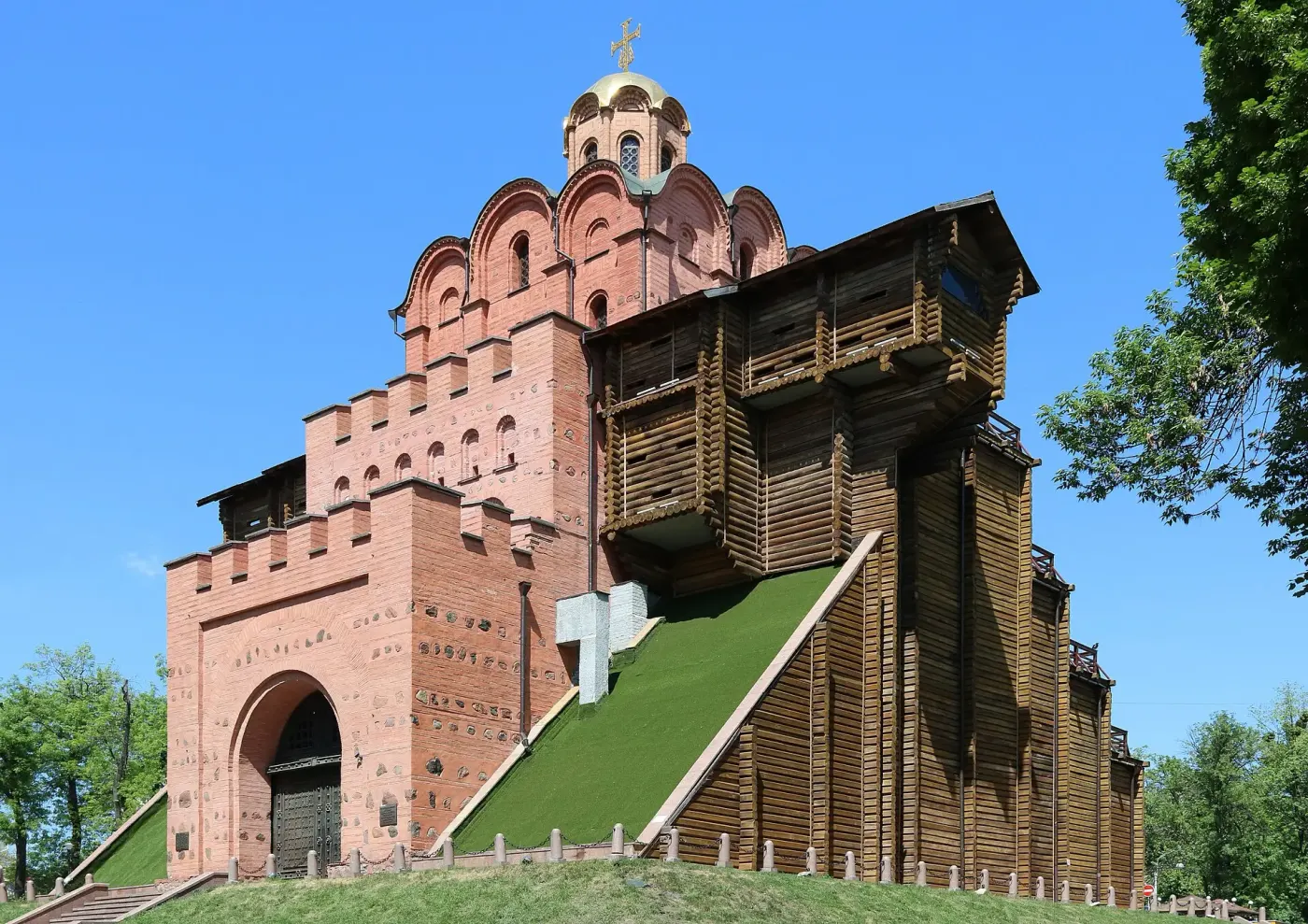
The Primary Chronicle's entry for 1037 is the heart of his reputation. In Samuel Cross's translation: "Yaroslav built the great citadel at Kiev, near which stand the Golden Gates." It adds that "He applied himself to books, and read them continually day and night. He assembled many scribes, and translated from Greek into Slavic," and that he "deposited them in the Church of St Sophia, which he himself had founded."
His new walled city covered nearly 60 hectares, entered through the Golden, Polish and Jewish gates, with Saint Sophia at the centre.
When it was founded is one of the great dating debates: the Novgorod First Chronicle gives 1017, the Primary Chronicle 1037, and Ukraine officially marked the cathedral's millennium in 2011, following the date 1011. The Encyclopedia of Ukraine gives 1037–1044 while noting "some suggest 1017–37".
UNESCO inscribed the cathedral, with the Kyiv-Pechersk Lavra, as a World Heritage Site in 1990, calling it "designed to rival Hagia Sophia in Constantinople".
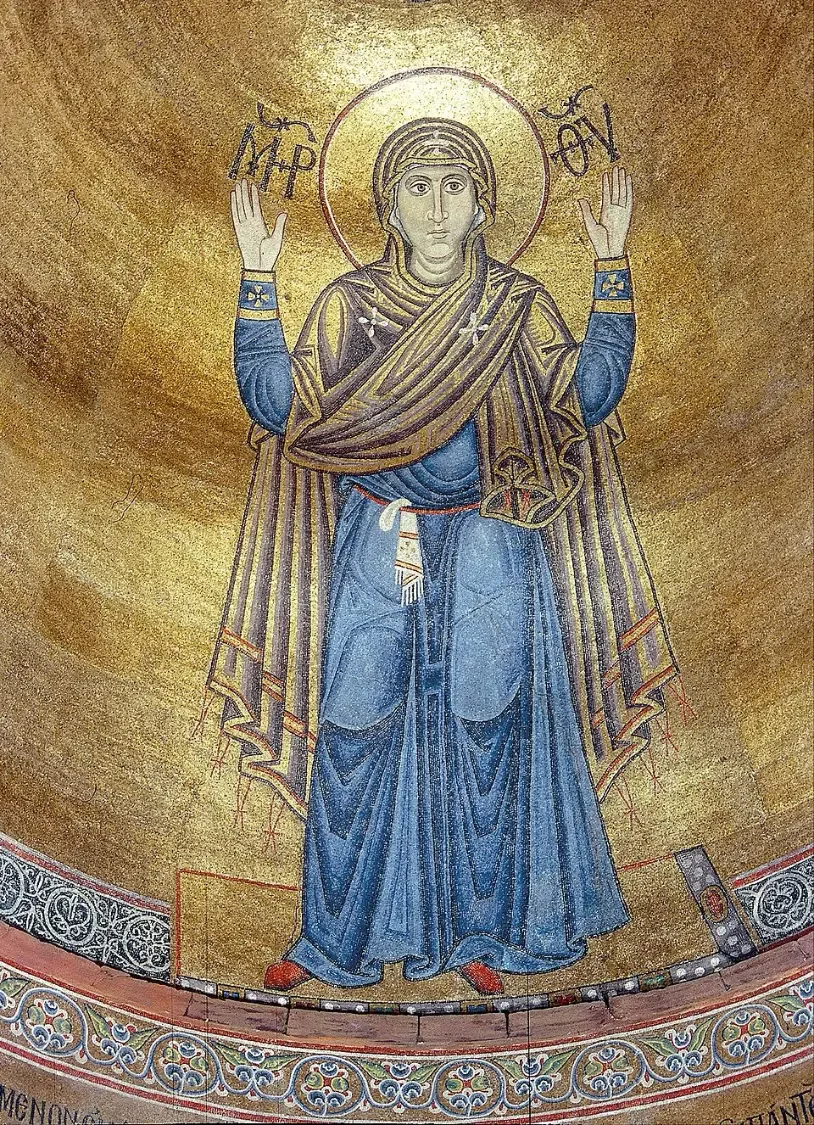
Inside are mosaics including the towering Virgin Orans and frescoes of Yaroslav's family.
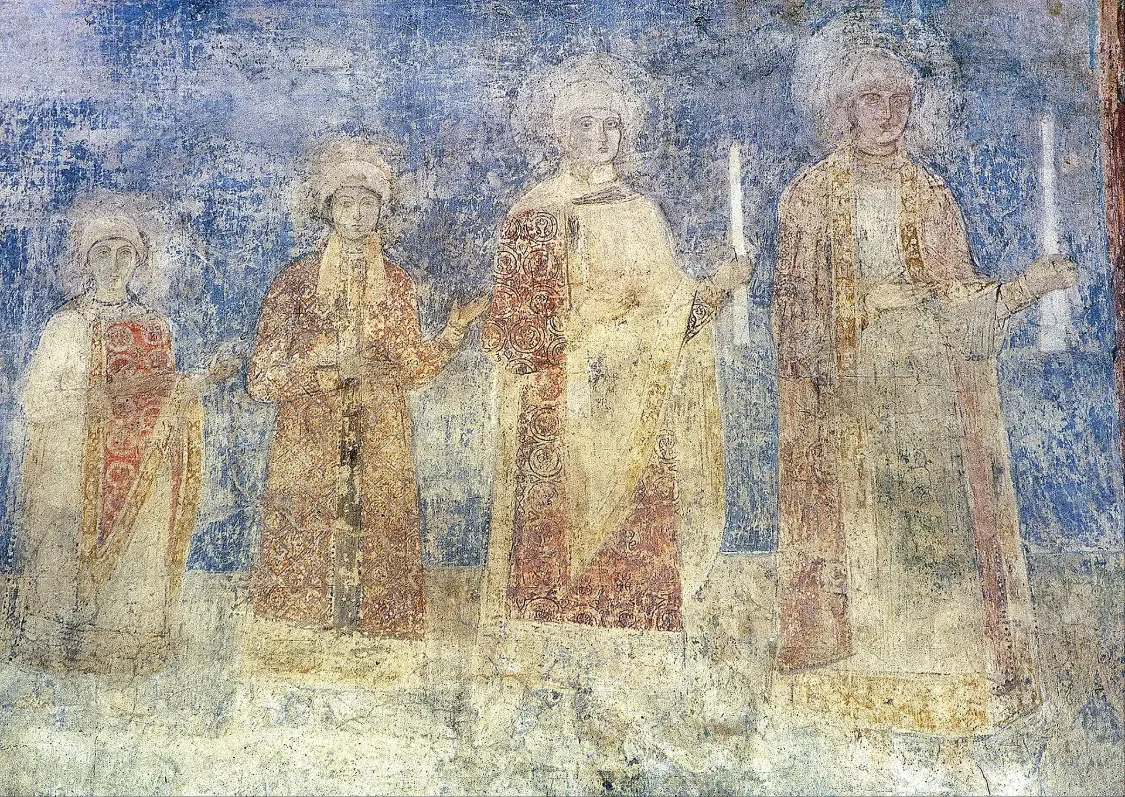
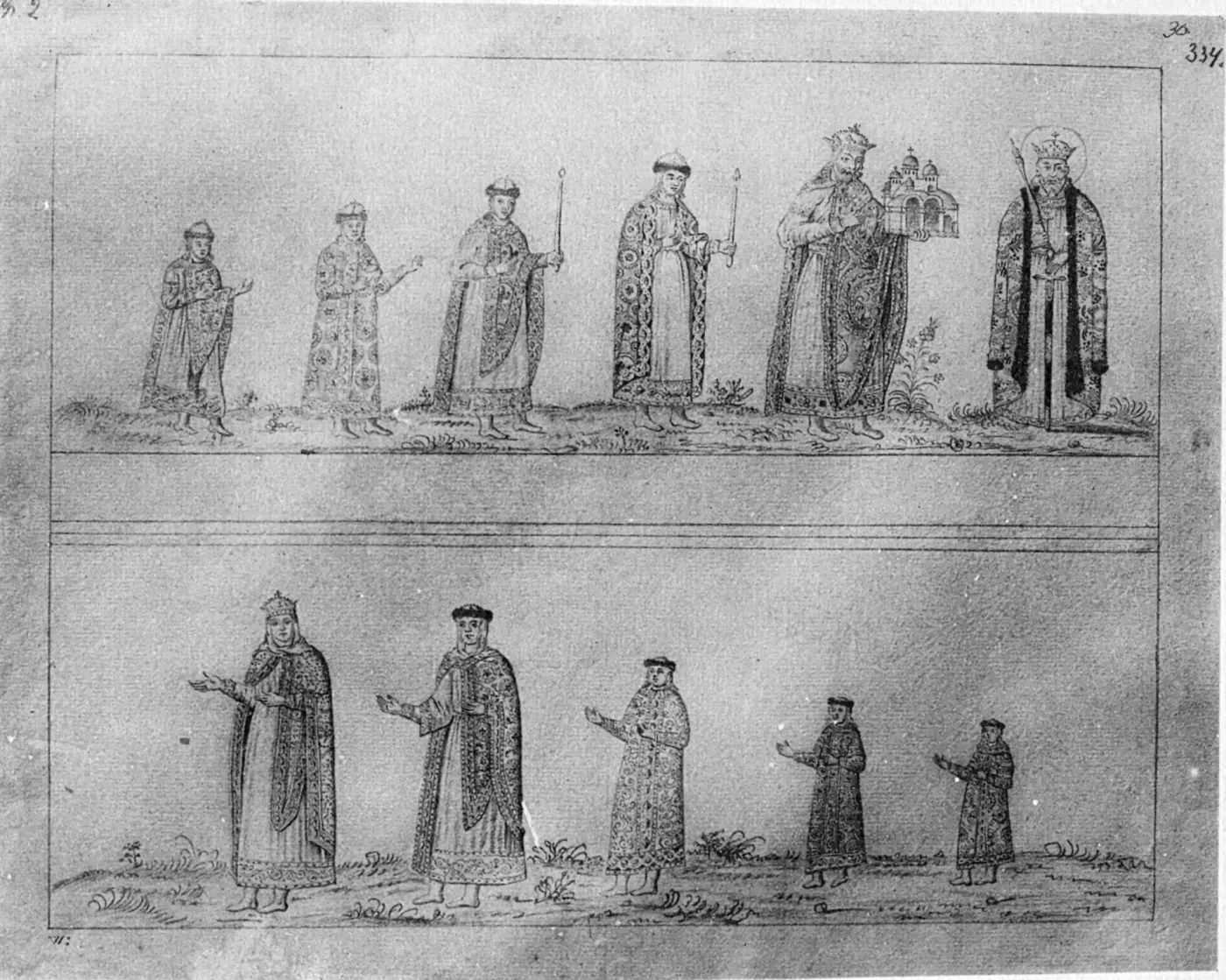
That family group was a ktitor (founder's) fresco; most of it is lost, and we know its layout from a drawing by Abraham van Westerveld made in 1651.
The walls also carry more than seven and a half thousand graffiti from the eleventh to the early eighteenth centuries, according to the National Reserve "Sophia of Kyiv", most of them found by Serhiy Vysotsky and Vyacheslav Kornienko. One records: "In the year 6562 [1054], month of February, on the 20th, the dormition of our tsar, on Sunday, in the week of the martyr Theodore" – a startling title for a Rus' prince. The German chronicler Adam of Bremen, writing in the 1070s, called Kyiv "aemula sceptri Constantinopolitani, clarissimum decus Graeciae": rival of the sceptre of Constantinople and brightest ornament of Greece.
Church politics followed the buildings. A Greek metropolitan – the senior bishop of the Rus' church – was confirmed in Kyiv by 1039. In 1051 Yaroslav had a council of Rus' bishops install Hilarion, author of the Sermon on Law and Grace, as the first native metropolitan without waiting for Constantinople. In Novgorod his son Vladimir built another Saint Sophia and was buried there in 1052.
Why is Yaroslav called "the Wise"?
The epithet is not medieval. Scholars trace Mudryi ("the Wise") to nineteenth-century historians, who read the Chronicle's portrait of a bookish, law-giving, church-building prince and made it a label. The Chronicle itself, compiled in the early twelfth century by monks who owed much to his dynasty, supplied the raw material.
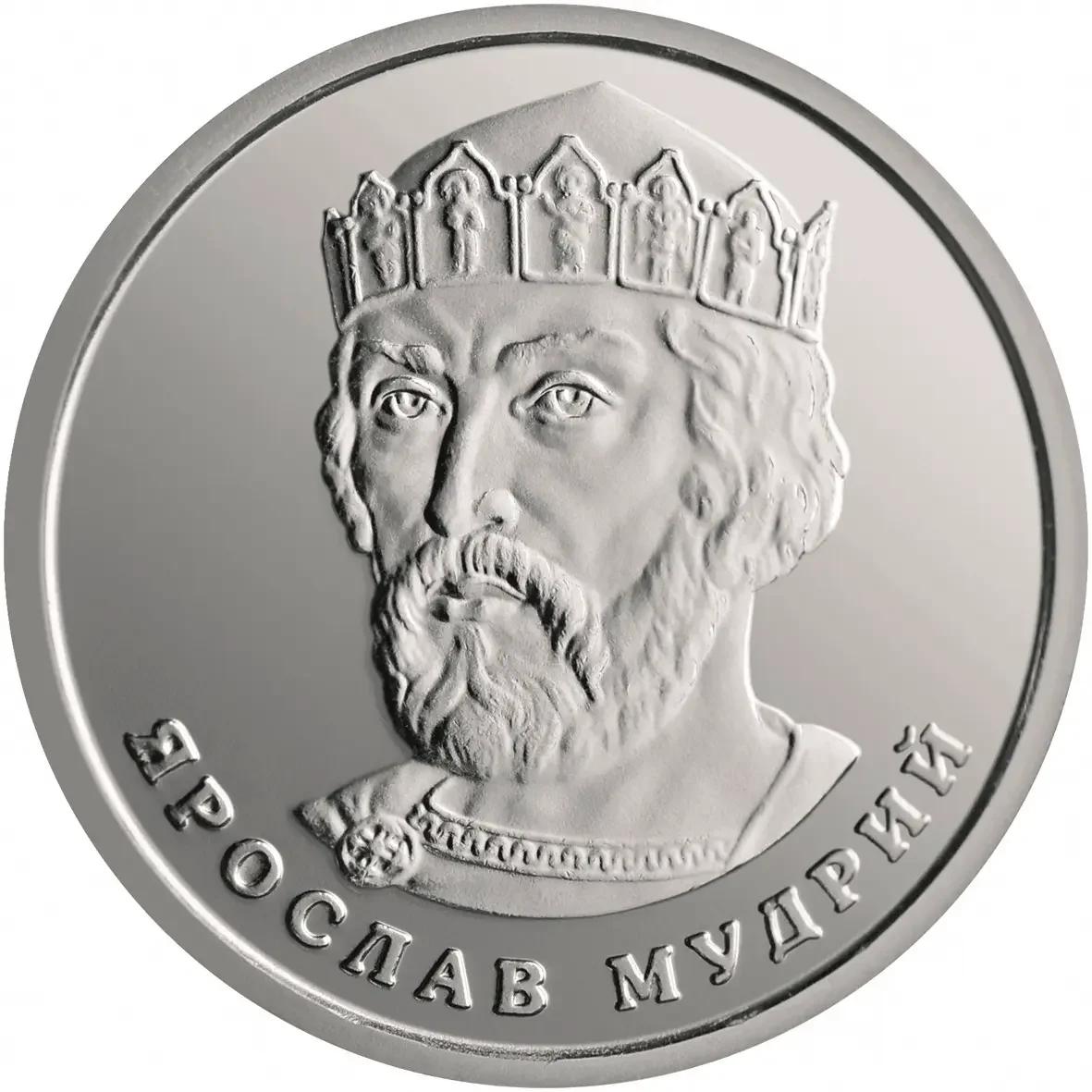
Today the name is everywhere. Ukraine's Order of Prince Yaroslav the Wise was founded by presidential decree No. 766/95 on 23 August 1995. His portrait appears on Ukraine's 2-hryvnia coin; the 2-hryvnia banknote that also carried it stopped being legal tender on 2 March 2026, though banks still exchange it.
Russia's 1,000-rouble note shows Oleg Komov's statue of him in Yaroslavl, unveiled in 1993. The Russian Orthodox Church added him to its calendar in 2005 and extended his veneration church-wide in 2016; his feast is 20 February (Julian), which falls on 5 March in the modern calendar.
Where are Yaroslav the Wise's remains?
The Primary Chronicle says that when he died in 1054 "they laid him in a marble tomb in the Church of St Sophia". The Chronicle dates the death to 19 February at Vyshhorod; the graffito and most modern references give 20 February, which some Ukrainian scholars read as the burial date. The carved marble sarcophagus still stands in the cathedral.
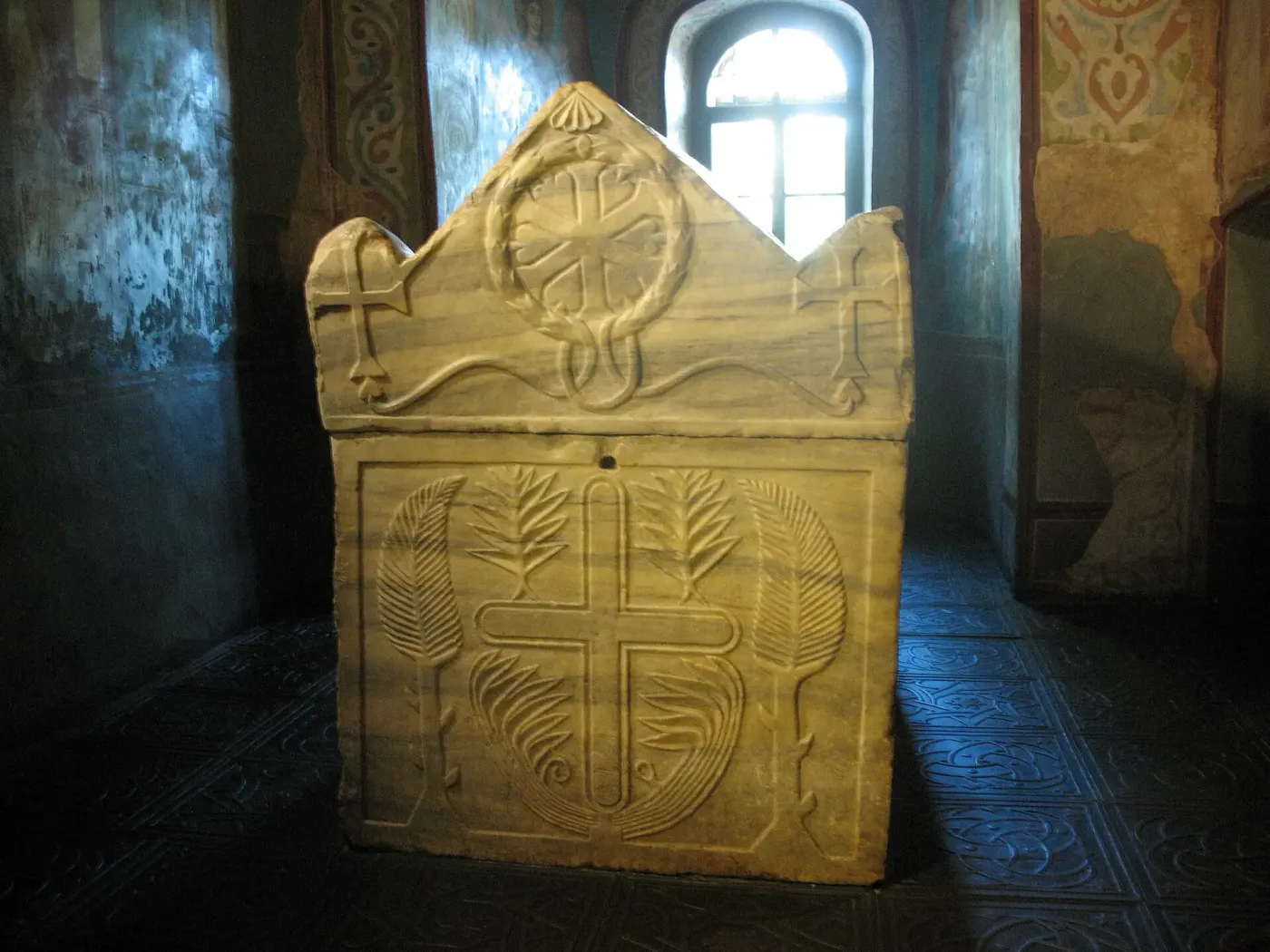
When it was opened in 1939, the Soviet team found mixed bones of a man aged sixty to seventy, a woman of fifty to fifty-five and a small child, as Olexa Powstenko recorded in The Cathedral of St Sophia in Kiev (1954). Mikhail Gerasimov modelled Yaroslav's face from the skull. In 2009 researchers of the Sophia of Kyiv reserve opened the tomb again to take DNA samples – according to The Day, the fourth examination since 1936, after openings in 1936, 1939 and 1964. Inside, as Nikitenko later reported, they found a box of bones and three Soviet newspapers left in 1964; reassembled, the skeleton proved to be female.
Where did the man go? Reserve researcher Nadezhda Nikitenko has argued that the bones were removed during the German occupation, around 1943, and taken abroad by emigrant clergy. She has said: "We believe that the remains are in New York – in Brooklyn, in Holy Trinity Church." That is a hypothesis, not a finding: no remains have been produced or tested. Meanwhile, according to RISU (2010), tomography and anthropological studies found that the female remains "have anthropological characteristics of the Scandinavian type", feeding speculation that they are Ingegerd's; Polish and Russian laboratories offered to do the research, but Ukraine's Ministry of Culture did not permit the relics to leave the country.
What happened after Yaroslav died?
Yaroslav's "testament" in the Chronicle urges his sons to love one another and divides the land. Iziaslav got Kyiv and Novgorod, Sviatoslav Chernihiv, Vsevolod Pereiaslav, Igor Volodymyr in Volhynia and Vyacheslav Smolensk; the younger brothers were to obey the eldest "in place of your father". Historians read this as the root of the seniority, or rota, system of the Rurikid dynasty: the throne of Kyiv passing along the line of brothers, each prince holding an appanage – a territory granted to a junior member of the family.
It did not keep the peace. Britannica's verdict is blunt: "This advice had no lasting effect, and civil war ensued." The Encyclopedia of Ukraine concludes that Rus' "would never again be united." Yaroslav's reign was the high point of a single Kyivan state; after it came a family federation of rival principalities, the political world into which the modern states of Ukraine, Russia and Belarus all reach back for origins.
What the map shows next
Open Kievan Rus' in 1036 to see the realm at its height, then jump to 1060 on the map. By then Yaroslav's inheritance has broken into separate principalities – the Principality of Kiev, Chernigov, Pereyaslavl, Smolensk and Volhynia – each ruled by one of his sons.